PSEG said that its two nuclear plants account for between 40 and 50 percent of electricity production in New Jersey, but are in danger of becoming financially unviable within two years. They said that would cost the state 1,600 jobs.
Cyber security at nuclear facilities: US-Russian joint support needed
 https://thebulletin.org/cyber-security-nuclear-facilities-us-russian-joint-support-needed11354 15 DECEMBER 2017, Anna Wagner. In April 2016, operators at the Gundremmingen nuclear power plant in Germany discovered two computer viruses, W32.Ramnit and Conficker. The viruses had attacked office computers, removable drives, and visualization software used to move nuclear fuel rods. Fortunately, all critical systems at the plant were isolated from the Internet, and the viruses only caused “some disruption,” according to International Atomic Energy Agency (IAEA) Director Yukiya Amano. He said, however, that the issue of cyber attacks on nuclear facilities “should be taken very seriously.”
The 2016 incident is not an isolated case. The nuclear industry encounters cyber threats on a daily basis, and it is only a matter of time until control systems are compromised.
Cyber security is obviously a controversial topic in US-Russian relations. The political climate, including Edward Snowden’s revelations in 2013 and Russian interference in the 2016 US presidential election, has made the cyber domain a no-go zone for discussion. Cooperative efforts and confidence-building measures that were discussed in 2013 are long forgotten. Nevertheless, both states face an ongoing need to address this emerging threat and to work against third parties—such as terrorist groups—before a large-scale incident occurs. A scientific partnership focused on the civilian nuclear industry is a potential way to restart a cyber security dialogue in the future.
The United States and Russia have worked extensively, both bilaterally and multilaterally, on the enhancement of nuclear security domestically and globally. It has always been one of a few topics on which both states could find common ground. Assisting other countries, especially nuclear newcomers, by building capacity in the nuclear cyber security field can be the first step toward bilateral talks on this issue.
Cyber security at nuclear facilities. Cyber attacks are never entirely virtual, because they can have direct impacts on physical and human infrastructure. A malicious intrusion into control systems at a nuclear power plant, for instance, could cause a radiological accident or an intentional release of radioactive material. In a worst-case scenario, interference with the command and control of nuclear weapons could lead to unprecedented consequences, such as an unauthorized missile launch.
Civilian nuclear facilities require thousands of digital systems to support their operation. Software patches and updates are even more challenging than routine maintenance, and tech support usually comes from a single vendor. Contrary to popular belief, a computer system that is isolated from unsecured networks (or “air-gapped”) is not immune to cyber attacks, which can come from a compromised supply chain or from insiders. The Stuxnet computer worm, for example, destroyed about 1,000 Iranian centrifuges between 2009 and 2010, despite the fact that critical systems were air-gapped. The worm spread to these systems from infected USB thumb drives.
A number of states lack stringent requirements or national policies to protect nuclear facilities from cyber attacks. This is a dangerous situation, considering the growing number of incidents: for instance, the SQL Slammer worm that infected the Davis-Besse nuclear power plant in Ohio in 2003, the 2014 attack at the Korea Hydro and Nuclear Power plant that resulted in the leak of 10,000 workers’ personal details, and the 2015 intrusion into Supervisory Control And Data Acquisition (SCADA) systems of the Ukrainian power grid that caused outages for several hours. These cases not only show that security practices are in need of further improvements, but also reinforce a negative image of the nuclear industry.
Building a cyber framework by supporting other states. As leading powers in the nuclear domain, the United States and Russia play a special role in preventing an act of nuclear terrorism. Their long history of relations in this field has contributed to protecting and securing nuclear material around the world. Examples include a number of agreements on nuclear weapons control, lab-to-lab cooperation, the Megatons to Megawatts program, the Warhead Safety and Security Exchange agreement, and the Plutonium Production Reactor Agreement. The nuclear partnership continued to evolve until the recent deadlock over issues ranging from Ukraine to Syria.
Because of the renewed tensions, many agreements are collapsing or being revoked. Abandoning bilateral relations in the nuclear field sends worrying signals to other states. Fortunately, the United States and Russia still agree on curtailing Kim Jong-un’s nuclear ambitions, and there is still a glimpse of hope that the Iran nuclear deal will not be dismantled.
Building on previous nuclear cooperation, the US and Russia can enhance cyber nuclear security in other states where possible. By doing so, they can improve international security and facilitate the use of clean energy. Examples of potential activities and projects include:
- Establishing a set of minimum standards or recommendations to help assess cyber personnel qualifications at newly built plants. Russia, for example, provides a national educational program for nuclear cyber security, while the United States has various training and certification programs for cyber security specialists working in the critical infrastructure sector. Protecting computer systems at a nuclear facility is a complicated task, and a country with no experience in the field can lack trained human capital.
- Joint research on new developments in the field of computer security. For example, blockchain technology, originally developed to secure transactions made with the Bitcoin currency, is being introduced into the energy sector. Guardtime, a cyber security firm, is currently providing blockchain solutions to protect nuclear power plants in Great Britain and recently became one of the contractors chosento protect the energy sector in the United States.
- Creating a communication link between Russian and US Computer Emergency Response Teams. This can provide coordination during large-scale incidents.
- Technical exercises during scientific workshops. Such activities, led by the United States and Russia, can complement IAEA training and enhance the agency’s manuals. For instance, workshops can target topics such as patch management, detection of supply chain vulnerabilities, and the development of “human firewalls” to reduce the risk of human error. Working together on educational and training projects can help address pressing nuclear security challenges around the world and facilitate collaboration between Russian and US scientists.
A small step forward. The current political environment that surrounds cyber issues leaves slim prospects for a US-Russian dialogue. New developments in offensive cyber capabilities exacerbate the situation. Cyber weapons are perfect tools for an aggressor: They can damage critical infrastructure remotely and untraceably, with no casualties for the aggressor, at any given time. Bearing in mind the potential for a nuclear disaster triggered by a cyber attack, it would be beneficial for the United States and Russia to establish some sort of connection through support of other countries.
It is easy to overlook small cases, such as the malicious software discovered at the Gundremmingen plant last year, but they are evidence of the greater dangers that cyber attacks pose to nuclear facilities. A future incident could turn out to be a large-scale event, perhaps even one with irreversible consequences.
The United States and Russia have the best techniques for addressing these unique challenges. A cooperative exchange of expertise with other nations would be a small step toward stronger international security and a better-trained workforce in nuclear energy. Cyber defense is evolving, but so is the offense. The risks of nuclear terrorism are real. That is why the international community needs stronger policies to prevent terrorist groups from using cyber weapons.
Does Georgia even need two additional nuclear reactors?
 Critics Of Plant Vogtle Say Georgia Doesn’t Need New Nuclear, WABE, • Next week, Georgia regulators will decide on the future of the country’s only nuclear power construction project.
One big issue is how much completing the expansion at Plant Vogtle will cost, after years of delays, rising prices and the bankruptcy of the lead contractor – and how much of that cost Georgia Power ratepayers are likely to bear.
But another question is, does Georgia even need two additional nuclear reactors?………
the demand for energy didn’t grow as much as Georgia Power projected when it began the Vogtle expansion. The Great Recession took a bite out of business growth and the ensuing expected energy need. Increasing use of energy-efficient appliances has made a difference, too, according to energy consultant Matt Cox, CEO of the Greenlink Group.
“Georgia’s GDP has been growing pretty healthily for the past several years while our electricity consumption has not been doing the same,” Cox said.
According to Cox’s calculations, Georgia Power could get by without the Vogtle expansion. He said the company could boost energy efficiency, add more renewables and buy power from other companies.
Cox testified this week at the Georgia Public Service Commission’s hearings on Plant Vogtle on behalf of critics of the project…….
Georgia is the only state in the nation with active nuclear power construction. Earlier this year, South Carolina utilities canceled a similar expansion project. That leaves Vogtle as the only project left of what was supposed to be a “nuclear renaissance.”
“No one in their right mind would start a new nuclear plant from scratch today. It’s twice as expensive as other ways of providing the same energy needs,” said Peter Bradford, a professor at Vermont Law School who served on the U.S. Nuclear Regulatory Commission. He also testified on behalf of Vogtle critics at the hearings this week.
“Even half-finished, it’s not at all clear that it isn’t cheaper to cancel and meet the needs some other way,” he said.
The Georgia Public Service Commission will vote Thursday on whether to allow construction on the two nuclear reactors to continue. https://www.wabe.org/critics-plant-vogtle-say-georgia-doesnt-need-new-nuclear/
Bill to Help Rescue New Jersey Nuclear Plants Is Unveiled
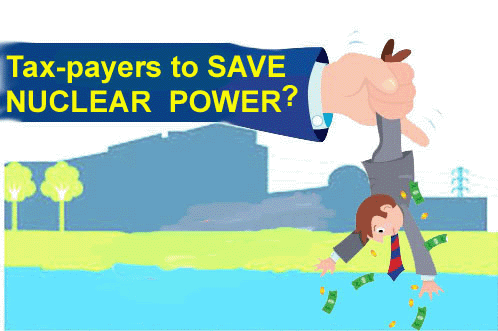 New Jersey’s electric utilities would be required to purchase credits from nuclear power plants to help rescue the industry under new legislation. U.S. News, By MICHAEL CATALINI, Associated Press, 15 Dec 17 TRENTON, N.J. (AP) — New Jersey‘s electric utilities would be required to pay for credits from nuclear power plants under legislation lawmakers unveiled Friday as part of an effort the state’s largest energy company says is needed to rescue a major source of power in the state’s energy grid.
Wikileaks ruled by UK tribunal to be a media organisation
 Julian Assange welcomes UK ruling that WikiLeaks is a media organisation, WikiLeaks founder welcomes ruling by UK tribunal. IBT ,By Jason Murdock, December 14, 2017 WikiLeaks has been recognised as a “media organisation” by a UK tribunal in a ruling that flies in the face of claims by US officials who have branded it a “hostile intelligence agency”.
The anti-secrecy website – helmed by Julian Assange – has faced the ire of CIA director Mike Pompeo, who has compared its work to Hezbollah, Isis and al-Qaeda. Over the years, WikiLeaks has disclosed countless documents pilfered from the US government……….
The tribunal, in a section detailing the public interest for disclosing any withheld information, described Assange as “the only media publisher and free speech advocate in the Western world who is in a situation that a UN body has characterised as arbitrary detention”.
It added: “The circumstances of his case arguably raise issues about human rights and press freedom, which are the subject of legitimate public debate.”….http://www.ibtimes.co.uk/julian-assange-welcomes-uk-ruling-that-wikileaks-media-organisation-1651567
Government and utilities shaken by high court challenge to public trust in Japan’s nuclear authority

Residents who filed an injunction to suspend the restart of a reactor at the Ikata nuclear power plant speak at a news conference Wednesday in Hiroshima.
Wednesday’s ruling by the Hiroshima High Court halting the planned restart of a nuclear reactor in Ehime Prefecture has cast doubt on the judgment of Japan’s Nuclear Regulation Authority — which had approved the restart under stricter post-Fukushima guidelines — shocking the government and utilities across the nation.
The ruling deals a heavy blow to a plan by Prime Minister Shinzo Abe’s administration to bring more reactors back online, and is sure to prompt the government and utilities to keep a closer eye on similar cases continuing across the country.
Yuichi Kaido, a lawyer representing local residents, called the ruling the “most important” since the Fukushima nuclear disaster, spurred by the Great East Japan Earthquake and tsunami on March 11, 2011.
About 40 court cases — including those seeking injunctions — were filed in the wake of the Fukushima meltdown disaster. But while district courts have ordered some reactors stopped, each shutdown decision has been overturned by a high court.
“This is the first time (plaintiffs) have won at the high court level,” Kaido said at a news conference in Tokyo. He said the ruling may signal a turn of the tide.
Wednesday’s ruling was also noteworthy for touching on the risk of volcanic eruption.
“The possibility of heated rock and volcanic ash reaching the reactor cannot be evaluated as small. The location is not suitable” for a nuclear reactor, said presiding Judge Tomoyuki Nonoue in handing down the ruling. The reactor affected is the No. 3 unit at Shikoku Electric Power Co.’s Ikata plant, which is located about 130 kilometers from the caldera of the volcanically active Mount Aso in Kumamoto Prefecture.
“The effect that volcanic ash may have on reactors nationwide is underrated,” Kaido said.
Government officials were quick to attempt to play down the risk. “It’s just a court ruling. The government’s position to seek the restart for reactors approved by the (Nuclear Regulation Authority) remains unchanged,” said a senior trade ministry official.
The central government’s target for power generations calls for 20 percent to 22 percent of the nation’s supply to be contributed by nuclear reactors by 2030.
Nuclear Regulation Authority Chairman Toyoshi Fuketa told a news conference that the high court decision would not influence its ongoing and future safety screenings of other reactors.
“We will just fulfill the role of a regulator,” Fuketa said.
But the reality is that utilities have been seeking to convince municipalities that reactors cleared by the watchdog under the tougher guidelines are safe.
“I’m worried that it could create negative momentum,” said an industry official.
For Shikoku Electric, the blocked restart will mean a spike in fuel costs as it will be forced to rely mainly on non-nuclear power generation.
“While the nuclear reactors are suspended, we will need to rely on thermal power, which means we will need to shoulder a ¥3.5 billion loss per month for fuel,” an executive of the utility said at a news conference on Wednesday.
Other utilities are facing similar constraints. Kyushu Electric Power Co. aims to restart two reactors at its Genkai plant in Saga Prefecture, but local residents have filed an injunction seeking to halt the move. A Kyushu Electric executive said he was “surprised at the unexpected ruling” on the Ikata plant.
Meanwhile, the response of residents in Ehime Prefecture was mixed.
One man voiced concern over the ruling’s potential to damage the local economy. The man, who runs a lodging business, said the town accommodated several hundred nuclear power plant workers a year before the Fukushima disaster.
“Ikata is a town of nuclear power,” he said. “I feel that (the ruling) has left locals behind.”
Another resident, however, welcomed the move as a judicial “breakthrough.”
Japanese Embassy Promoting Fukushima Sake in London, UK
Did they inform those people that this sake is made from Fukushima contaminated rice, that no matter how delicious it tastes there is no safe level of radiation, that internal radiation is much more harmful than external radiation?
Of course they didn’t.

Three Days of a London Ecstatic for Fukushima Saké: The London Fukushima Saké Fair Event Report
In the plot full of excitement at sake of Fukushima
A PR Event in London to Highlight Fukushima’s Fifth Year Running With The Most Gold Medals From the All-Japan New Saké Awards
The Fukushima Saké Fair, a public relations event to create buzz for Japanese sakés from Fukushima Prefecture, was held during the three days from October 17th through the 19th, 2017, at venues throughout London, including the Halls of Parliament, famous for Big Ben, and the Embassy of Japan.
More than 480 persons attended the event over the course of the three days. Faces red with delighted intoxication were seen here and there, tasting Fukushima saké, which had, for the fifth year running, acquired the most gold medals at the All-Japan New Saké Awards.
In addition, a Fukushima Night was also held at two Japanese restaurants within London: Tokimeite and Yashin Ocean House. Among the participants were those who remarked that the Fukushima sakés were the best Japanese sakés they had ever imbibed, happily drawing a close on the great success of the Fukushima Saké Fair event.
Negotiations Among Importers and Six Saké Brewers Within Fukushima
Lively discussions were had at the Fukushima Saké Negotiations, held on October 18th, among the participating saké brewers and the local restaurants and alcohol wholesalers.
Interest in Japanese saké is on the rise in London. Many persons are taking note of quality Fukushima sakés, and among the sommeliers and alcohol wholesalers present at the event were comments such as how the Fukushima sakés were full-bodied and crisp, how well they would accompany meat dishes, and how they should be carried by those restaurants and wholesalers. More than 100 negotiations took place. The expectation is that, moving forward, there will be many more Fukushima saké transactions in the market.
Japanese Foreign Minister’s Gimmick to Promote Fukushima Contaminated Produce
Japanese Government won’t stop at anything to promote Fukushima’s contaminated produce to its people so as to calm their fears and to the foreign markets so as to make them lift their imports restrictions on Eastern Japan produce.

Boris Johnson downs a can of peach juice from Fukushima given to him by Japanese minister to prove goods from the nuclear meltdown zone are safe
Boris Johnson was handed Fukushima fruit drink by Japanese minister Tarō Kōno
He downed can in three gulps as an act of solidarity, saying: ‘Very good. Mmmh’
Many countries – including the US and China – still ban imports from the area
Nuclear plant in the prefecture suffered huge meltdown after earthquake in 2011
Boris Johnson has downed a can of peach juice from an area of Japan that suffered a triple nuclear meltdown in a bid to show its produce is safe.
The foreign secretary was handed the Fukushima fruit drink by Japanese foreign affairs minister Tarō Kōno, who brought it with him on his visit to London.
A nuclear plant in the prefecture suffered a huge meltdown after an earthquake in 2011, causing a release of radioactive material that led to over 50 countries banning imports of food from the area.

The foreign secretary was handed the Fukushima fruit drink by Japanese foreign affair minister Tarō Kōno, who brought it with him on his visit to London. Pictured: He downs the can

A nuclear plant in the prefecture suffered a huge meltdown after an earthquake in 2011, causing a release of radioactive material that led to over 50 countries banning imports of food from the area. Pictured: Boris with Kono at the Foreign Office in London yesterday
But Boris didn’t seem to mind as he delightedly gulped down a small can of peach juice, captured on video and published to Twitter by Kōno yesterday.
Smirking after swigging the drink, Boris mutters: ‘Very good… Mmmh.’
He then takes a good look at the can before going for gulp number two.
Again the juice meets his approval, with the foreign secretary declaring: ‘Yum! I need it.’
He then takes a final swig and utters yet another ‘Mmmmh’ before putting the can down, presumably empty.
Kōno explained in his tweet: ‘British FM Boris Johnson drinking peach juice from Fukushima, showing the products from Fukushima are safe.’

Pictured: Boris finishing off the juice
Many countries – including the US and China – still have restrictions on Fukushima produce in place following the disaster
But as part of efforts to persuade the world that the area’s goods are perfectly safe, many Japanese politicians have munched on its food and gulped down its drinks.
In 2011, however, MP Yasuhiro Sonoda rather fluffed the PR exercise by visibly shaking as he drank water collected from the Daiichi nuclear plant in Fukushima.
Boris Johnson swigs can of peach juice from Fukushima

Foreign secretary drinks down gift from Japan’s foreign minister in attempt to show food and drink from region is safe after triple nuclear meltdown
“Yum.” That was foreign secretary Boris Johnson’s verdict on a can of peach juice from Fukushima – a ‘gift’ from his Japanese counterpart, Taro Kono – during their meeting in London this week.
The moment, captured by Kono on his smartphone, was intended to prove that food and drink from Fukushima is safe, almost seven years after the triple nuclear meltdown.
While some countries have maintained restrictions on food from the region – a major producer of peaches – the EU said this month it would ease import restrictions on agricultural items and seafood that were introduced after the March 2011 disaster.
More than 50 countries and regions imposed import curbs on Japanese produce after the disaster, and about half – including China and the US – still have them in place.
“Very good … Mmm,” Johnson pronounced, studying the label on the can for good measure.
He polished off the sweet drink without incident, no doubt to the relief of his Japanese guests. But attempts by other politicians to use food and drink to prove a point, or simply ingratiate themselves with voters, have left a bitter taste.
During a BSE scare in Britain in 1990, the then agriculture secretary, John Gummer, unsuccessfully tried to feed his four-year-old daughter, Cordelia, a burger made with British beef.
In recent years, Ed Miliband and Theresa May proved that encounters with the food of the masses – in his case a bacon sandwich, in hers a cone of chips – are best kept out of the public eye.
May’s predecessor, David Cameron, had set a poor example by choosing to tackle a simple hot dog with a knife and fork.
Japanese politicians of all stripes have taken up the cause of Fukushima produce.
In 2011 Yasuhiro Sonoda, then a ruling party MP, visibly shook as he gulped down a glass of decontaminated – and perfectly safe – water collected from inside two reactor buildings at Fukushima Daiichi.
NRA has nuke plant volcano checklist, but experts point to eruptions’ unpredictability

When it comes to volcanic threats to nuclear power stations, the Nuclear Regulation Authority (NRA) requires utilities to do a lot of digging.
The NRA demands that utilities evaluate the potential risks presented by any volcanoes within 160 kilometers of a given plant. That evaluation begins with a look through the written record for any mentions of eruptions plus examining the geological features of the area to determine if there is any chance the volcano will be active again in the future. If a future eruption can’t be ruled out, then the utility must determine whether pyroclastic flows — fast moving clouds of hot gas and volcanic matter — or lava flows could reach the plant. If there is such a risk, then the plant site is labeled unsuitable and the reactors banned from going on line.
In the case of the Sendai nuclear plant’s No. 1 and 2 reactors, it was found that there were five volcanoes with histories of cataclysmic eruptions within the 160-kilometer zone. A “cataclysmic eruption” is one that spews vast amounts of magma, causing large-scale ground subsidence and creating a caldera.
NRA inspectors found that there was “sufficiently little chance” of a cataclysmic eruption that could cause a pyroclastic flow to hit the Sendai plant grounds while the station was in operation. Furthermore, the regulatory body determined that measures to deal with up to 15 centimeters of volcanic ash from the Sakurajima volcano — about 50 kilometers distant — would be enough to maintain plant safety.
The NRA also called on utilities to make preparations to shut down reactors and move the nuclear fuel out of their nuclear plants if there was any sign of an impending cataclysmic eruption detected. Sendai plant operator Kyushu Electric Power Co. assured the NRA that the utility would spot signs of such an eruption by keeping a close watch out for changes in the Earth’s crust caused by magma accumulation, and the regulator accepted this explanation.
However, some volcanologists have pointed out that it is very difficult to predict the timing or scale of a cataclysmic eruption. Furthermore, there is neither a predetermined spot to move the nuclear fuel to nor a set standard for the NRA to order reactor shutdowns.
Across Japan, the Genkai nuclear station’s No. 3 and 4 reactors (which have passed NRA safety inspections ahead of a planned restart), the No. 1 to 3 reactors at Hokkaido Electric Power Co.’s Tomari nuclear plant (where the volcanic risk inspection has nearly been completed), and the No. 2 unit at the Shimane nuclear power station run by Chugoku Electric Power Co. are all close to volcanoes with calderas. However, the NRA has never declared a plant site unfit due to the threat of volcanic activity.
Regarding the Hiroshima High Court’s Dec. 13 decision to order Shikoku Electric Power Co. to shut the No. 3 reactor at its Ikata power plant in Ehime Prefecture, NRA chief Toyoshi Fuketa told reporters, “I am not directly concerned (with the case) so I am not in a position to comment.” He added that the ruling would have “no effect” on NRA inspections.
Hokkaido University specially appointed professor of nuclear reactor engineering Tadashi Narabayashi, meanwhile, said the court decision was the product of “logical leaps.”
“Stopping (reactor) operation based on personal rights requires an imminent danger,” Narabayashi wrote in a comment to the Mainichi Shimbun. “It’s difficult to say that the chance of a cataclysmic eruption, which is thought to happen only about once in 10,000 years, meets that definition. The Ikata plant’s No. 3 unit is protected from falling volcanic material and has an enhanced reactor core cooling system, so there is simply no probability of an incident that would endanger the lives of the people in the city of Matsuyama or Hiroshima.”
Meanwhile, Kobe University magma specialist Yoshiyuki Tatsumi praised the court ruling as “based on scientific knowledge grounded in current volcanology.”
“There is about a 1 percent chance of a cataclysmic eruption in Japan in the next 100 years, so mathematically speaking, one could happen at any time,” he continued. “At present, we do not know what kinds of signs would portend such an eruption. It is also unknown how much magma has built up under Mount Aso (in Kumamoto Prefecture), so the government needs to strengthen its observations there among other measures.”
One Fukushima Tepco employee’s Leukemia certified, how many of the subcontracted employees ignored?

In the background, from left, the No. 1, 2, 3, and 4 reactor buildings of the Fukushima No. 1 Nuclear Power Plant are seen, in Okuma, Fukushima Prefecture, on Oct. 31, 2016. In front are tanks used to store contaminated water.
Gov’t certifies Fukushima TEPCO employee’s leukemia as work-related illness
The leukemia that developed in a Tokyo Electric Power Co. (TEPCO) employee in his 40s working on the aftermath of the damaged Fukushima No. 1 Nuclear Power Plant was certified as a work-related illness by the Ministry of Health, Labor and Welfare on Dec. 13, it has been learned.
According to the ministry, the man was in charge of ensuring the safety of the reactors at the Fukushima plant since April 1994. After the reactor meltdowns in March 2011, he donned protective clothing and a mask and also led the effort to cool the overheating reactors with water. He developed leukemia in February last year and is currently receiving treatment.
Over the roughly 19 years that he worked at the nuclear facility, he was exposed to some 99 millisieverts of radiation. Of that, approximately 96 millisieverts occurred after the accident. As the radiation exposure levels exceeded the ministry’s baseline of 5 millisieverts per year multiplied by years of employment, his cancer was certified as being linked to his work at the nuclear power station.
This marks the third case of receiving work-related illness certification for developing leukemia in the aftermath of the nuclear disaster.
Ex-Fukushima plant worker granted compensation
Japan’s labor ministry has certified that a former worker at the crippled Fukushima Daiichi nuclear plant is eligible for work-related compensation after developing leukemia from radiation exposure.
The worker in his 40s is employed by Tokyo Electric Power Company, which operates the plant in the northeastern prefecture of Fukushima. He worked at the plant for more than 19 years until last year. He maintained equipment among other jobs.
That period includes the 9 months following the nuclear accident at the plant, which started on March 11th, 2011.
The ministry says during those months, he checked out damage from the quake-generated tsunami and injected water into the containment vessels of the No.1 and No.3 reactors.
The reactor cores melted down during the accident.
The ministry says he developed leukemia in February of last year and applied for work-related compensation.
The man was exposed to an accumulated 99.3 millisieverts of radiation. The ministry says that amount can cause the disease.
He is the 4th person to be recognized as eligible for work-related compensation after developing leukemia or thyroid cancer in relation to containment work at the plant.
Since the nuclear accident, a total of about 56,000 workers have been engaged in containment and decommissioning work at the plant through May of this year.
For 1st time, a high court rules against nuclear plant operations

Lawyers hold up signs outside the Hiroshima High Court on Dec. 13 proclaiming an injunction had been ordered on operations at the Ikata nuclear power plant.
For 1st time, a high court rules against nuclear plant operations
HIROSHIMA–A high court for the first time has banned operations at a nuclear power plant.
The Hiroshima High Court issued the injunction in a verdict Dec. 13 that applies to the No. 3 reactor at the Ikata nuclear power plant in Ikata, Ehime Prefecture, operated by Shikoku Electric Power Co.
In the ruling, the high court concluded there was a chance the Ikata plant could be affected by a pyroclastic flow from Mount Aso if an eruption occurred similar in scale to a massive one 90,000 years ago on the southern island of Kyushu.
A computer simulation by Shikoku Electric of the possible effects from an eruption like the one in ancient times showed there was a possibility of a pyroclastic flow reaching the grounds of the Ikata plant.
The high court concluded that the Ikata plant was located in an inappropriate location and that the Nuclear Regulation Authority’s decision that new safety standards had been met was not rational.
The company suspended operations in October to carry out a periodic inspection. If a judicial decision overturning the Dec. 13 high court ruling is not issued, the Ikata reactor will not be able to resume operations–even if the inspection is completed without problems.
For that reason, the latest ruling could affect the government’s plans to resume operations at other nuclear plants more than six years after the triple meltdown at the Fukushima No. 1 nuclear power plant.
An official with Shikoku Electric Power labeled the court injunction as “extremely regrettable” and lamented the fact that it did not accept the company’s assertion that the plant is safe.
“The verdict is unacceptable,” the official said.
The utility plans to initiate procedures immediately to have the injunction suspended.
The injunction request was made by four residents of Hiroshima and Matsuyama cities. Among the main points of contention before the high court were the rationality of new safety standards approved by the Nuclear Regulation Authority (NRA) in the aftermath of the 2011 Fukushima nuclear disaster; the rationality behind the expected maximum strength of an earthquake for the area; and an evaluation of the effect of volcanic ash on the reactor’s operations.
While district courts have issued injunctions on operations at other plants, higher courts have overturned all those verdicts until now.
For example, the Fukui District Court in April 2015 and the Otsu District Court in March 2016 ordered operations stopped at the No. 3 and No. 4 reactors of the Takahama nuclear power plant in Fukui Prefecture operated by Kansai Electric Power Co., but those verdicts were later overturned.

Lawyers hold up banners with messages such as, “Injunction issued,” following a Hiroshima High Court order to suspend operation of the No. 3 reactor at Shikoku Electric Power Co.’s Ikata Nuclear Power Plant, in Hiroshima’s Naka Ward, on Dec. 13, 2017.
High court orders Shikoku Electric to halt Ehime nuclear reactor
HIROSHIMA (Kyodo) — The Hiroshima High Court on Wednesday revoked a lower court decision and ordered the suspension of a nuclear reactor in western Japan, dealing a blow to the government and utilities aiming to bring more reactors back online.
The first high court suspension order in a series of similar injunction requests demanded that plant operator Shikoku Electric Power Co. shut the No. 3 unit of the Ikata power plant in Ehime Prefecture until the end of September next year.
The ruling blocks the planned resumption in January of the unit, which is currently offline for a regular checkup after it was restarted in August 2016.
Shikoku Electric said the decision is “unacceptable” and plans to file an appeal against it.
The court found it was irrational that the Nuclear Regulation Authority judged that the potential risks associated with a volcanic eruption would not breach the stricter regulations introduced following the 2011 Fukushima nuclear crisis.
“Specific threats to the lives and health of residents are anticipated,” the court said.
The latest decision follows the ruling by the Otsu District Court in March 2016 that ordered Kansai Electric Power Co. to suspend two reactivated nuclear reactors at the Takahama plant. The district court decision was later overturned by the Osaka High Court.
The government is looking to produce 20 to 22 percent of the country’s electricity supply with nuclear power by 2030 after the Fukushima nuclear crisis led to a nationwide halt of nuclear plants.
The focal points of the latest decision included whether the estimate by the plant operator of the potential size of an earthquake, a key factor in a reactor’s quake-resistance design, was reasonable, and whether safety screening conducted under the new regulations was credible.
The plaintiffs claimed that in calculating the size of a potential earthquake, the utility underestimated the fact that the reactor lies above the epicenter of an anticipated Nankai Trough mega-quake and that it is located near a geological fault.
They added that the post-Fukushima regulations cannot ensure safety and major damage could occur at the time of an accident or disaster because they were compiled without thoroughly determining the cause of the 2011 disaster.
But Shikoku Electric said that it has ensured safety and there is no danger.
Hiroyuki Kawai, the lawyer representing the plaintiffs said, “Our plea was understood. We could protect the Seto Inland Sea. It is our victory.”
The plaintiffs had said that if the Ikata plant, which faces the Seto Inland Sea, was to be severely damaged, nuclear substances could spread and contaminate the sea.
In March, the Hiroshima District Court had found that the new regulations and Shikoku Electric’s estimates of a possible earthquake and tsunami were reasonable.
The district court had turned down the request to halt the reactor, saying, “There is no specific risk that residents will suffer severe damage due to radioactive exposure associated with an accident.”
Following the checkup, Shikoku Electric was expected to bring the reactor back online on Jan. 22.
The plaintiffs were four residents from Matsuyama in Ehime and Hiroshima on the other side of the Seto Inland Sea. Similar injunction demands have been contested at the Takamatsu High Court, the Oita District Court and the Iwakuni branch of the Yamaguchi District Court.

Ikata power plant’s No.2 reactor, right, and No. 3 reactor in Ehime prefecture
Japan’s high court orders suspension of Ehime nuclear reactor
HIROSHIMA (Kyodo) — The Hiroshima High Court on Wednesday revoked a lower court decision and ordered the suspension of a nuclear reactor at the Ikata power plant in Ehime Prefecture, western Japan.
It is the first high court decision on a series of injunction demands filed with four district courts seeking to halt the No. 3 reactor at the plant, which was restarted in August 2016 but is now offline for a regular checkup.
The focal points of the decision included whether the estimate by the plant operator Shikoku Electric Power Co. of the potential size of a quake, a key factor in a reactor’s quake-resistance design, was reasonable, and whether safety screening conducted under stricter regulations set after the 2011 Fukushima nuclear disaster was credible.
Risks predicted in the event of nuclear accidents and natural disasters such as a volcanic eruption were also contested.
The plaintiffs claimed that in calculating the size of a potential earthquake, the utility underestimated the fact that the reactor lies above the epicenter of an anticipated Nankai Trough mega-quake and that it is located near a geologic fault.
They added that the post-Fukushima regulations cannot ensure safety and major damage could occur at the time of an accident or disaster because they were compiled without thoroughly determining the cause of the 2011 disaster.
But Shikoku Electric said that it has ensured safety and there is no danger.
In March, the Hiroshima District Court had found that the new regulations set by the Nuclear Regulation Authority and Shikoku Electric’s estimates of a possible earthquake and tsunami were reasonable.
The district court had turned down the request to halt the reactor, saying, “There is no specific risk that residents will suffer severe damage due to radioactive exposure associated with an accident.”
Following the checkup, Shikoku Electric was expected to bring the reactor back online on Jan. 22 and resume operations on Feb. 20.
No. 3 reactor will stay offline as key safety issues remain contested
The plaintiffs were four residents from Matsuyama in Ehime and Hiroshima on the other side of the Seto Inland Sea. Similar injunction demands have been contested at the Takamatsu High Court, the Oita District Court and the Iwakuni branch of the Yamaguchi District Court.

A lawyer representing residents who filed an injunction to suspend reactor operations at Ikata nuclear power plant speaks in front of Hiroshima High Court on Wednesday, after the court revoked a lower court decision and ordered suspension of the No. 3 reactor
Hiroshima High Court orders suspension of Ikata nuclear reactor in Ehime Prefecture, revoking district court ruling
HIROSHIMA – The Hiroshima High Court on Wednesday revoked a lower court decision and ordered the suspension of a nuclear reactor at Shikoku Electric Power Co.’s Ikata power plant in Ehime Prefecture, dealing a blow to the government and utilities that are aiming to bring more reactors back online.
The high court suspension order — the first in a series of similar injunctions — mandates that the plant operator shutter the No. 3 unit at the Ikata power plant until the end of September next year.
The ruling blocks the planned resumption in January of the unit, which is currently offline for regular checks after it was restarted in August 2016.
Shikoku Electric said the court’s decision is “unacceptable” and plans to file an appeal.
The court questioned a decision by the Nuclear Regulation Authority that potential risks associated with volcanic eruptions would not breach the stricter regulations introduced following the 2011 Fukushima nuclear crisis.
“Specific threats to the lives and health of residents are anticipated,” the court said.
The latest decision follows a ruling by Otsu District Court in March 2016 that ordered Kansai Electric Power Co. to suspend two reactivated nuclear reactors at its Takahama plant. The district court decision was later overturned by the Osaka High Court.
The Fukushima nuclear crisis led to a nationwide halt of nuclear plants, but the government is looking to produce 20 to 22 percent of the country’s electricity supply using nuclear power by 2030.
The focal points of Hiroshima High Court’s decision Wednesday included whether estimates by the plant operator, Shikoku Electric Power Co., of the potential size of possible earthquakes, were reasonable, and whether safety screening conducted under stricter regulations set after the 2011 Fukushima nuclear disaster was credible.
Risks predicted in the event of a nuclear accident or natural disasters such as a volcanic eruptions were also contested.
The plaintiffs claimed that in calculating the size of a potential earthquake, the utility had underestimated the fact that the reactor lies above the epicenter of an anticipated Nankai Trough mega-quake, and that it is located near a geologic fault.
They added that the post-Fukushima regulations cannot ensure safety, and that major damage could occur at the time of an accident or disaster because the regulations were compiled without thoroughly determining the cause of the 2011 disaster.
But Shikoku Electric maintains that it has ensured safety and that there is no danger.
Hiroyuki Kawai, the lawyer representing the plaintiffs said, “Our plea was understood. We could protect the Seto Inland Sea. It is our victory.”
The plaintiffs had said that if the Ikata plant, which faces the Seto Inland Sea, was to be severely damaged, nuclear substances could spread and contaminate waters in the area.
In March, the Hiroshima District Court found that the new regulations set by the Nuclear Regulation Authority and Shikoku Electric’s estimates of a possible earthquake and tsunami were reasonable.
The district court had turned down the request to halt the reactor, saying, “There is no specific risk that residents will suffer severe damage due to radioactive exposure associated with an accident.”
Following the checks, Shikoku Electric had been expected to bring the reactor back online on Jan. 22 and resume operations on Feb. 20.
The plaintiffs were four residents from Matsuyama in Ehime and Hiroshima, located on the opposite side of the Seto Inland Sea to the nuclear plant. Similar injunctions have been contested at the Takamatsu High Court, Oita District Court and the Iwakuni branch of Yamaguchi District Court.
Russian nuclear plant says it finally emits nuclear isotope #Ruthenium106

By The Associated Press
A senior executive at the Russian nuclear processing plant suspected of being behind a spike of radioactivity over Europe this fall admitted Wednesday that the isotope recorded does emerge as part of the plant’s production cycle but said its levels are negligible.
Russian officials last month reported high levels of ruthenium-106 in areas close to the Mayak nuclear plant in the Ural Mountains.
The environmental group Greenpeace alleged that Mayak could have been the source of a ruthenium-106 leak, but the plant said it has not extracted the isotope or conducted any other operations that may lead to its release “for many years.”
But Yuri Mokrov, adviser to Mayak’s director general, said in a webcast press conference Wednesday that ruthenium-106 routinely emerges during the processing of spent nuclear fuel. Mokrov insisted, however, the plant was not the source of any major leak, saying it does not produce the isotope on purpose and that the emissions that the plant makes are so insignificant “we can only see it in the chimney.”
A Russian panel of experts dispatched to investigate the leak has failed to identify where the isotope came from, but alleged that it could have come from a satellite that came down from its orbit and disintegrated in the atmosphere. The commission said last week that a thorough inspection of the Mayak plant and its personnel had found no safety breaches.
“There is ruthenium in spent nuclear fuel, and Mayak during its activities routinely comes across this isotope,” Mokrov said, adding that “actual emissions are hundreds times lower the permitted levels.”
Mayak, in Russia’s Chelyabinsk region, saw one of the world’s worst nuclear accidents on Sept. 29, 1957, when a waste tank exploded. That contaminated 23,000 square kilometers (9,200 square miles) of territory and prompted authorities to evacuate 10,000 residents from neighboring regions.
http://abcnews.go.com/Technology/wireStory/russian-plant-admits-emits-nuclear-isotope-leak-51762608
100 times above normal radiation in Fukushima in the snow #Safecast #CRIIRAD #UNSCEAR #Tokyo2020

Measurement date December 13, 2017 Measurement of high doses
9 mcSv/h at 1 m above ground
15 mcSv/h at 0.5 m above ground
46 mcSv/h at 5cm above the ground
Conditions Snow, low winds, cold and radioactive!
Source; kienaiyoru To support this brave soul who is documenting the risk of radioactive hot sports that seem to be being ignored by the main stream media and in even in some academic circles, please subscribe to his you tube channel and click like; https://www.youtube.com/user/kienaiyoru/videos?disable_polymer=1

Russia disburses El Dabaa nuclear power plant loan/bribe to Egypt

Image source; DEVELOPMENT AND CLIMATE CHANGE IN EGYPT: FOCUS ON COASTAL RESOURCES AND THE NILE 2002 https://search.oecd.org/env/cc/33330510.pdf
Egypt is to receive the first tranche of Russia’s $25 billion loan for El Dabaa nuclear power plant in January 2018, the electricity ministry reported on Wednesday.
The loan will cover 85% of the total construction cost of the nuclear plant plant valued at $21 billion, as well as designs, safety and environmental studies, Daily News Egypt stated.
On Monday, Egypt and Russia signed the agreement of El Dabaa nuclear power project during the meeting of Egyptian President Abdel Fattah El Sisi and his Russian counterpart Vladimir Putin in Cairo.
The Russian state nuclear company Rosatom will implement the nuclear power project within 12 years.
The project comprises of four units with 1,200 megawatts each.
-Mubasher
http://noozz.com/russia-disburses-1st-tranche-of-el-dabaa-nuclear-power-plant-loan-next-january/
Nigeria: Nuclear Agency Spent N367 Million Illegally – Senate Panel

By Ismail Mudashir
The Nigerian Nuclear Regulatory Authority (NNRA) generated N490million as Internally Generated Revenue (IGR) in 11 months and spent N367million without approval of the National Assembly.
This was revealed by members of the Senate Committee on Petroleum (Upstream) when top management of the agency led by the Director General, Lawrence Dim appeared for budget defence.
The IGR, according to the committee chaired by Senator Tayo Alasoadura (APC, Ondo) was generated between January and November this year.
The senators said out of the N490m, the agency remitted only N122.6m to the Federation Account and spent the rest without budgetary provision.
A member of the committee, Senator Baba Kaka Garbai (APC, Borno) said the agency violated the country’s law by spending the money without approval of the National Assembly.
“You must have the approval of the National Assembly before spending the IGR. What you have done is an infraction of the law that provides that no money is spent without being appropriated for,” he said.
Committee chairman, Alasoadura demanded for the details of how the IGR was spent. “In preparing this, there is no key to show why 25 per cent is remitted and you did not show the balance. What did you do with the balance because it is not captured in the budget?
“I know what the law says but in preparing your budget, you should be explicit about why you remit only 25 per cent of your IGR. Where is the balance? Did we appropriate that money? We didn’t appropriate the money,” he said.
Responding, the DG said the law provides for the agency to spend 75 percent of the revenue for running of it day to day activities. He pledged to produce the details of how the IGR was spent.
1 This Month
Chernobyl: The Lost Tapes – A good documentary on Chernobyl on SBS available On Demand for the next 3 weeks– https://www.sbs.com.au/ondemand/tv-program/chernobyl-the-lost-tapes/2352741955560

of the week–London Campaign for Nuclear Disarmament

Tell the Ukrainian Government to Drop Prosecution of Peace Activist Yurii Sheliazhenko
To see nuclear-related stories in greater depth and intensity – go to https://nuclearinformation.wordpress.com
-
Archives
- April 2026 (152)
- March 2026 (251)
- February 2026 (268)
- January 2026 (308)
- December 2025 (358)
- November 2025 (359)
- October 2025 (376)
- September 2025 (257)
- August 2025 (319)
- July 2025 (230)
- June 2025 (348)
- May 2025 (261)
-
Categories
- 1
- 1 NUCLEAR ISSUES
- business and costs
- climate change
- culture and arts
- ENERGY
- environment
- health
- history
- indigenous issues
- Legal
- marketing of nuclear
- media
- opposition to nuclear
- PERSONAL STORIES
- politics
- politics international
- Religion and ethics
- safety
- secrets,lies and civil liberties
- spinbuster
- technology
- Uranium
- wastes
- weapons and war
- Women
- 2 WORLD
- ACTION
- AFRICA
- Atrocities
- AUSTRALIA
- Christina's notes
- Christina's themes
- culture and arts
- Events
- Fuk 2022
- Fuk 2023
- Fukushima 2017
- Fukushima 2018
- fukushima 2019
- Fukushima 2020
- Fukushima 2021
- general
- global warming
- Humour (God we need it)
- Nuclear
- RARE EARTHS
- Reference
- resources – print
- Resources -audiovicual
- Weekly Newsletter
- World
- World Nuclear
- YouTube
-
RSS
Entries RSS
Comments RSS
 nuclear-news