BBC 12th Sept 2017, Work has begun on the “challenging” task of removing radioactive fuel
elements stuck inside the most famous of Dounreay’s reactors. Closed since
1977, the Dounreay Fast Reactor is known for its dome-shaped exterior.
Almost 1,000 fuel elements have been in the reactor for years after the work to remove them was halted because they were swollen and jammed in.
New technology has now been developed to make it possible to remove them. It
could take three years to complete the job at the nuclear power site near
Thurso in Caithness. Once all the elements have been removed work can begin
on dismantling the reactor. http://www.bbc.co.uk/news/uk-scotland-highlands-islands-41245375
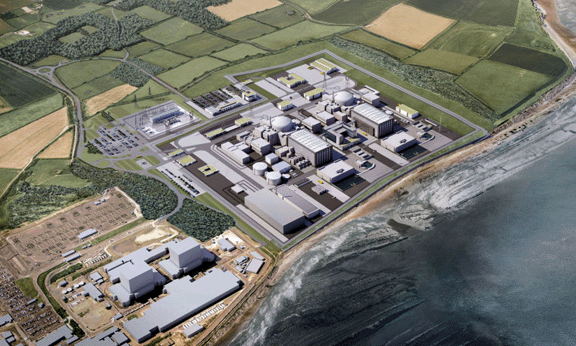
Reuters 12th Sept 2017, Taxpayers will not be on the hook for any additional costs incurred in the building of the new $24 billion Hinkley Point nuclear plant, British
finance minister Philip Hammond said. A British parliamentary watchdog said
in June that the deal to construct the nuclear power station, which is
being built by French state-owned utility EDF, was risky.
Fox News 14 Sept 17One of the United States’ most advanced nuclear submarines returned to port in Washington state this week flying a Jolly Roger, a move steeped in maritime lore and mystery.
The images of the USS Jimmy Carter, a Seawolf-class nuclear-powered submarine passing through the Hood Canal, were posted to a Pentagon media site and Twitter page. They show the skull and bones flying beside the American flag, the Washington Post reported.
The current industry “solution” is to store it unsafely where it was generated (near major metropolitan areas like Los Angeles and San Diego) or to get political revenge and force it on Nevada (a state that produces no nuclear waste and continues to suffer from 928 atom bomb tests).
Did anyone notice that two of Florida’s nuclear power plants quickly shut down before the hurricane? Or that South Carolina has abandoned construction of two new plants after wasting $8 billion on them? How about the San Onofre Nuclear Generating Stationbeing closed following a generator failure and radiation accident?
Japan commission supports nuclear power despite Fukushima, Kedger Enquirer
BY MARI YAMAGUCHI, Associated Press, SEPTEMBER 14, 2017 TOKYO
Japan’s nuclear policy-setting Atomic Energy Commission called Thursday for nuclear power to remain a key component of the country’s energy supply despite broad public support for a less nuclear-reliant society.
The commission recommended in a report that nuclear power account for at least 20 percent of Japan’s energy supply in 2030, citing a previous government energy plan. It said rising utility costs caused by expensive fossil fuel imports and slow reactor restarts have affected Japan’s economy……..
Thursday’s report comes as regulators are making final preparations to certify the safety of two reactors at the Kashiwazaki-Kariwa nuclear plant in northern Japan, also operated by TEPCO. The utility says restarting the Kashiwazaki plant, one of its three nuclear plants, is vital to finance the massive cost of the Fukushima cleanup and compensation for disaster-hit residents.
The Nuclear Regulation Authority on Wednesday deemed TEPCO “competent” to run the plant safely and its final greenlight is expected within weeks, though its actual restart could be months away, after an on-site inspection and local consent. Many Japanese oppose the Kashiwazaki plant’s restart, saying TEPCO should not be allowed to operate a nuclear plant until it fully investigates the cause of the Fukushima accident and completes the cleanup.
The report also endorsed Japan’s ambitious pursuit of a nuclear fuel cycle program using plutonium, despite a decision last year to scrap the Monju reactor, a centerpiece of the plutonium fuel program, following decades of poor safety records and technical problems. Japan faces growing international scrutiny over its plutonium stockpile because the element can be used to make atomic weapons.
Japan currently has a stockpile of 47 tons of plutonium — 10 tons at home and the rest in Britain and France, which reprocess and store spent fuel for Japan. Japan plans to start up its controversial Rokkasho reprocessing plant next year, but critics say that would only add to the problem.
Without the prospect of achieving a plutonium-burning fast reactor, Japan has resorted to burning a mixture of plutonium and uranium fuel called MOX in conventional reactors as a last ditch measure to consume plutonium. The report calls it “the only realistic method of making use of plutonium.”
The need to reduce its plutonium stockpile adds to Japan’s push for reactor restarts. It would require 16 to 18 reactors to burn enough MOX to keep its plutonium stockpile from growing, according to a pre-Fukushima accident target set by the Federation of Electric Power Companies of Japan, an umbrella group for Japanese utilities. The target is unchanged, though widely seen as too optimistic.
Geological processes send more meltwater from glaciers and ice sheets to Earth’s mid-latitudes. Rachael Lallensack, As an ice sheet melts, it leaves a unique signature behind. Complex geological processes distribute the meltwater in a distinct pattern, or ‘fingerprint’, that causes seas to rise unevenly around the world. Now, for the first time, researchers have observed what these sea-level fingerprints look like on a global scale.
“No one has put it together for a complete global picture like this before,” says James Davis, a geophysicist at Columbia University in Palisades, New York. The work was published in Geophysical Research Letters on 9 September1.
The concept of sea-level fingerprints has been been factored into models used to predict sea-level rise for several years, says lead researcher Isabella Velicogna, a geophysicist at the University of California, Irvine. And researchers have used tide gauges for just as long to observe the fingerprints in coastal regions. But the global view provided by the latest study adds confidence to projections of future sea-level rise.
As an ice sheet melts, it leaves a unique signature behind. Complex geological processes distribute the meltwater in a distinct pattern, or ‘fingerprint’, that causes seas to rise unevenly around the world. Now, for the first time, researchers have observed what these sea-level fingerprints look like on a global scale.
“No one has put it together for a complete global picture like this before,” says James Davis, a geophysicist at Columbia University in Palisades, New York. The work was published in Geophysical Research Letters on 9 September1.
The concept of sea-level fingerprints has been been factored into models used to predict sea-level rise for several years, says lead researcher Isabella Velicogna, a geophysicist at the University of California, Irvine. And researchers have used tide gauges for just as long to observe the fingerprints in coastal regions. But the global view provided by the latest study adds confidence to projections of future sea-level rise.
Velicogna and co-author Chia-Wei Hsu, also at the University of California, Irvine, used gravity data from NASA’s two Gravity Recovery and Climate Experiment (GRACE) satellites, which measure changes in mass on Earth’s surface. The scientists looked at satellite data from April 2002 to October 2014, and matched it with measurements from pressure stations on the ocean floor. These instruments measure the total mass above them.
Velicogna says that the findings should be used to create a roadmap for better placement of ocean-bottom pressure stations, which in turn can be used to improve calculations of sea-level fingerprints in the future.
“We know sea-level change throughout the world won’t be uniform, and it’s useful for people to know how those changes might show up,” says Mark Tamisiea, a geophysicist at the University of Texas at Austin.
Solar grid keeps harvests high, hospitals lit in parched rural Zimbabwe, by Tonderayi Mukeredzi | Thomson Reuters Foundation, 11 September 2017, With worsening droughts drying fields and hydropower, solar energy is providing a way forward in rural areas MASHABA, – Until recently, farmers in this town in southern Zimbabwe struggled to water their crops, frustrated by poor rainfall and the regular breakdown of the diesel engines that powered their irrigation systems.
As in most areas of rural Zimbabwe, rain-fed agriculture provides most of the jobs in this part of Gwanda district, some 130km (80 miles) southeast of Bulawayo.
But sparse rains over the last decade, a worsening problem associated with climate change, have caused many harvests to fail, and cut into the country’s generation of hydropower, which provides much of its electricity.
In Mashaba, however, the community’s luck is turning. In 2015, the town installed a solar mini-grid power station that has helped green the hot, arid area transform into a hive of entrepreneurial activity. The off-grid power system, with 400 solar panels that provide nearly 100 kilowatts of reliable power, has made it possible to effectively irrigate crops, boosting farming yields and fuelling economic growth. Local leaders say schools have become more productive and medical facilities safer.
The $3.2 million mini-grid was funded by the European Union, the OPEC Fund for International Development and the Global Environment Facility as part of a drive to promote universal access to modern energy in rural areas. Its construction was overseen by Practical Action Southern Africa, a development charity.
The plant powers the Mankonkoni and Rustlers Gorge irrigation schemes, which cover 32 hectares (79 acres) and 42 hectares (104 acres) respectively; the Mashaba Primary School; a business centre with three shops; the Mashaba Clinic; and the Masendani Business Centre, which has four shops and an energy kiosk.
A board of trustees selected by the community is responsible for the day-to-day operation of the mini-grid, and community members have been trained to maintain and operate it.
¶ “Harrowing Storms May Move Climate Debate, if Not GOP Leaders” • For years, climate change activists have faced a dilemma: how to persuade people to care about a grave but seemingly far-off problem and win their support for policies that might cost them in utility bills and at the pump. Now, people can see the problem for themselves. [New York Times]
Sailboat in Georgia (Credit: Luke Sharrett | The New York Times)
¶ “Nuclear industry jeopardized” • Nuclear power financing is embroiled in a global bankruptcy with two top reactor makers in financial debacles. After Toshiba-Westinghouse went bankrupt, its French equivalent, the state-owned AREVA went technically bankrupt after losing $12.3 billion over six years. The whole industry is facing repercussions. [Millennium Post]
¶ “Will Hurricane Harvey Launch a New Kind of Climate Lawsuit?” • Scientists can now link “acts of God” to climate change…
Russia and China have started doing joint military exercises. North Korea is and has been a client state of them both.
Rosoboronexport is part of Rostec – directly owned by the Russian State. It “is a legal successor of the state arms exporters existed in the ex-USSR and present-day Russia…. On August 4, 2006, the Bush administration imposed sanctions on Rosoboronexport accusing it of supplying Iran in violation of the United States Iran Nonproliferation Act of 2000…” [1]
US Nuclear Power Stations reactor status for Tuesday Sept. 12, 2017, showing Turkey Pt. Reactors and St. Lucie 1 at 0% output to grid.
In the blog they state that the second Turkey Pt. Nuclear reactor shut down automatically, whereas in the reactor events notice they state that it was manually shutdown: “MANUAL REACTOR TRIP ON LOWERING STEAM GENERATOR WATER LEVEL: On 09/10/17 at 1855 [EDT], [Turkey Point] Unit 4 reactor was manually tripped from 88% RTP [Rated Thermal Power] due to a failure of 4C Steam Generator main feed regulating valve causing lowering S/G [Steam Generator] level…. The licensee is investigating the failure of the feed regulating valve. Offsite power is available. Decay heat is being removed via main feedwater with steam discharged to atmosphere using the ADVs [Atmospheric Dump Valves]. There is no known primary-secondary steam generator tube leakage“. https://www.nrc.gov/reading-rm/doc-collections/event-status/event/2017/20170911en.html
¶ A paper published in the journal Climatic Change builds on earlier research finding that nearly two-thirds of historical greenhouse gas emissions can be traced to just 90 companies. Researchers from the Union of Concerned Scientists and two universities calculated how much of the actual change in the climate can be tied to those emissions. [InsideClimate News]
Source of climate change (Credit: Christopher Furlong)
World:
¶ The Climate Group announced that Kellogg Company, DBS Bank Ltd, and Clif Bar & Company joined its RE100 campaign and committed to sourcing 100% renewable electricity across their global operations. The total demand of the 105 campaign members is now around 150 TWh annually, more than enough to power New York State. [The Climate Group]
¶ BYD announced that the first commercial application of its SkyRail monorail mass transit solution opened for operation in Yinchuan, China, on September…









 nuclear-news