Call for South Carolina Electric and Gas and Santee Cooper to Refund Ratepayers for Nuclear Project
Should SCE&G Refund Ratepayers for Nuclear Project? ft Free Times, By David Travis Bland, 23 June 17,
It’s official – Three Mile Island nuclear power station to shut down in September 2019
TMI another step toward shutdown, as Exelon notifies Nuclear Regulatory Commission, June 23, 2017 Press & Journal Exelon Generation Co. officially notified the U.S. Nuclear Regulatory Commission this week of its intent to shut down Three Mile Island Nuclear Station in September 2019.
J. Bradley Fewell, senior vice president for regulatory affairs and general counsel, Exelon Generation, signed the letter sent to the NRC, which was dated June 20. Exelon is based in Warrenville, Illinois, in Chicago’s western suburbs.
The letter is part of the official process to shut down the plant “due to severe economic challenges,” it states. A nuclear plant cannot be reopened once permanently shut down…….
TMI has failed to clear the past three auctions held by PJM, which basically means that TMI is not able to produce electricity at the price that the market is willing to pay.
“Three Mile Island Unit 1 is unprofitable and has lost more than $300 million over the past five years despite being one of Exelon’s best-performing plants,” states the letter to PJM, signed by Bryan C. Hanson, senior vice president of Exelon Generation, and president and chief nuclear officer of Exelon Nuclear……
Should British tax-payers cough up for both Hinkley and Wylfa nuclear power boondoggles?
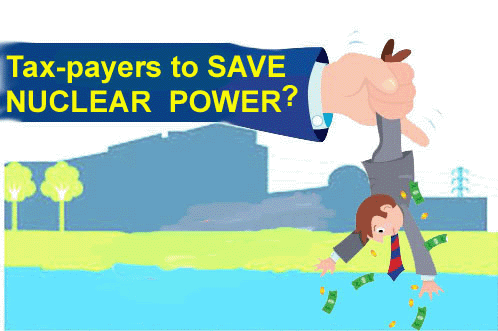 FT 23rd June 2017, NAO said the government should have at least considered sharing the construction risk at Hinkley to lower the cost for consumers. This conclusion will add to debate in Whitehall over whether the government should contribute to financing other planned nuclear plants, including one planned by Hitachi of Japan at Wylfa in Anglesey.
Talks have been held between the UK and Japanese governments about making Wylfa a public-private partnership, according to people briefed on the matter. This would reduce costs for consumers compared with Hinkley but expose taxpayers to more risk. https://www.ft.com/content/8a6a7f5a-574b-11e7-80b6-9bfa4c1f83d2
Wylfa nuclear power project threatens the biodiversity of North Wales nature reserve

Daily Post 21st June 2017, Nature lovers have drawn up battle lines over Anglesey’s planned nuclear
power station amid fears that rare species will be put at risk. North Wales
Wildlife Trust (NWWT) said current proposals for Wylfa Newydd are
“damaging” and could jeopardise Wales’ sole breeding colony of
Sandwich terns.
It said construction work will take place just 110 metres
from an internationally designated nature reserve at Cemlyn, while the
development will drain directly into Tre’r Gof fen, a Site of Special
Scientific Interest.
The Trust has issued a long list of species it
believes are at risk from the power plant, from water voles to otters,
great crested newts and European eels. Local populations of chough, adders,
brown hares, red squirrels and hedgehogs could also be vulnerable, it said.
http://www.dailypost.co.uk/news/local-news/wildlife-groups-fear-rare-species-13217542
Defects in pressure vessel of Flamanville nuclear reactor could stall EPR’s global nuclear industry
 France Info 22nd June 2017 [Machine Translation] Defects on the pressure vessel of the EPR of Flamanville: “EDF and Areva were not transparent,” denounces Greenpeace. Greenpeace believes that EDF and Areva have not sufficiently communicated on the defects of the pressure vessel of the EPR of Flamanville.
“The origin of the anomalies and the history of the design” have not been made\ public, denounces the association in particular. The NGO is based on a report to which it has had access and which is due to be published onThursday by the High Committee for Transparency and Information on Nuclear Safety (HCTISN) on anomalies in the Flamanville EPR tank ( Handle). The HCTISN is an expert committee on nuclear safety. It decided in June 2015 totake the matter of the anomalies on the tank of the EPR of Flamanville.
According to Greenpeace, the report states that EDF and Areva “did not explain to the public the origin of the anomalies and the history of the design and manufacture of the EPR reactor vessel.” The report also notes that “no alternative technical scenario has been made public, in the event of the rejection of the tank and its lid by the Nuclear Safety Agency
(ASN)”.
“Since the beginning of the case, EDF and Areva have put the ASN before the fait accompli: they refuse to communicate a plan B to force it to accept that the EPR starts with pieces veined,” explains Yannick Rousselet, in charge of Campaign for Greenpeace France. “The rejection of the tank by the ASN would trigger a ‘domino effect’ by questioning the
feasibility of all EPR projects sold by EDF and AREVA in the UK, China and inland, says Yannick Rousselet. Industrialists put an intolerable pressure on the ASN, making the future of the nuclear sector on its shoulders.” http://www.francetvinfo.fr/sante/environnement-et-sante/defauts-sur-la-cuve-de-lepr-de-flamanville-edf-et-areva-nont-pas-ete-transparents-denonce-greenpeace_2248675.html
June 2017 Britain sets a new renewable energy record

 Content Coms 22nd June 2017, It’s official; this month – June 2017 – the UK set a new renewable
energy record as wind and solar power surged. The Telegraph broke the news,
saying the blustery start to summer has helped the renewable energy
industry to its highest ever output, as wind turbines and solar panels
helped to meet more than half of the UK’s electricity demand.
It’s a telling reminder you don’t necessarily need the blinding sun of recent
days for panels to do their work. Revolutions take place quietly most of
the time.
Either way, the news is a truly astonishing result, and coupled
with last year’s confirmations that the world as a whole has decoupled
growth from carbon emissions, looks set to truly confound sceptics of
renewable and low carbon technologies.
And of course, it makes yet more of a mockery of President Trump’s fossil-based repudiation of Paris. His
idiocy now stands proven by the truth of what renewables can do, powering
over half of one of the world’s important economies; the UK. In fact,
soon we will be calling oil the energy alternative, and renewables the
mainstream. https://www.contentcoms.co.uk/content-coms-view-wind-solar-combine-build-uk-renewables-revolution/
Contrary to his boast, President Trump was NOT the first to suggest a solar wall
Times 23rd June 2017, President Trump laid claim to an idea that could help his promised wall
along the Mexico border to turn a profit: solar panels. “I will give you an
idea that nobody has heard about yet. The southern border: lots of sun,
lots of heat. We are thinking about building a wall as a solar wall. So it
creates energy. And pays for itself,” he told a campaign-style rally in
Cedar Rapids, Iowa.
The scheme would lower the cost to Mexico too, he said,
adding: “Pretty good imagination, right? My idea!” Mr Trump has discussed
the scheme in private meetings with legislators but floated it publicly for
the first time on Wednesday.
Contrary to his claim, however, others had
already raised the idea. Designs for the wall submitted to the US
government in April by Thomas Gleason, a Las Vegas businessman, had solar
panels powering lig hting, sensors and border patrol stations. The
Department of Homeland Security has been inviting companies to submit
plans, although Congress still has not allocated the funds needed to build
the wall. https://www.thetimes.co.uk/edition/world/president-trump-claims-solar-panels-will-pay-for-his-mexican-wall-bt62xbkfl
Vulnerable to Climate Change – Murcia, Spain
 From heatwaves to hurricanes, floods to famine: seven climate change hotspots Global warming will not affect everyone equally. Here we look at seven key regions to see how each is tackling the consequences of climate change, Guardian, John Vidal, 23 June 17
“………Murcia, Spain
He and his colleague Joel Guiot, a paleoclimatologist, last year studied pollen locked in layers of sediment over the past 10,000 years and compared them with projections about climate and vegetation from the Intergovernmental Panel on Climate Change.
If warming is allowed to rise to 2C, the scientists concluded, much of southern Spain and the Mediterranean basin could become desert. Their paper, published in Science, was shocking because it showed that even a small temperature increase could be enough to create ecological havoc in a very heavily populated region with relatively wealthy countries.
They warned that North African countries would see increased temperatures and drought that would drive the southern deserts further north; that deserts would expand in the Middle East, pushing temperate forests higher into the mountains; and that ecosystems not seen in the Mediterranean basin in more than 10,000 years could develop.
“We are more certain of the drying trend in the region than almost anywhere else on the planet. Temperatures have risen 1C globally but 1.4C in the Mediterranean region. The trend is for it to become ever warmer,” says Cramer.
Increasing temperature, he says, drives droughts. “More carbon dioxide in the atmosphere means rising temperatures, less precipitation and then more drying that leads to desertification.”
Meanwhile, water stress, heat waves and an extended drought linked to climate change in the eastern Mediterranean has been widely implicated in the long Syrian war and an underlying driver of conflict in Middle East and North African countries.
The World Resources Institute concurred in 2015 that the Mediterranean basin was a climate hotspot when it placed 14 of the world’s 33 most water-stressed countries in 2040 in the Middle East and North Africa region. “Drought and water shortages in Syria likely contributed to the unrest that stoked the country’s 2011 civil war. Dwindling water resources and chronic mismanagement forced 1.5 million people, primarily farmers and herders, to lose their livelihoods and leave their land, move to urban areas, and magnify Syria’s general destabilisation,” it said.
The fast-growing, heavily populated region is climatically vulnerable, it concluded. The food supplies and the social balance of places like Palestine, Israel, Algeria, Lebanon and Jordan are all highly sensitive to even a small change in water supplies. As climate change intensifies, communities face grave threats from both droughts and floods.
The combined impact of many more people, higher temperatures and changing weather patterns on the region’s already scarce freshwater resources poses further potential for conflict. But optimists hope it could force compromise between competing states and water users. Rural areas already have no option but to switch to more efficient irrigation systems and drought tolerant crops, and urban areas are learning to conserve water…..
Vulnerable to Climate Change – Bangladesh

“….Dhaka, Bangladesh
I met Honufa soon after she arrived in Dhaka 10 years ago. Erosion and saltwater intrusion on her family’s land on one of the low-lying islands in the mouth of the Ganges River had forced the young Bangladeshi woman to leave her village for the capital. She had taken a boat and then an overnight bus and ended up in a slum called Beribadh.
Honufa is a climate refugee, one of thousands who have struggled to grow their crops. Millions are likely to follow her if current trends continue.
“In the next 20 years we would expect five to 10 million people to have to move from the coastal areas,” says Saleemul Huq, director of the Bangladesh-based International Centre for Climate Change and Development. “The whole country is a climate hotspot, but the most vulnerable area is the coast. Dhaka is the place where people head to,” he says.
Huq, who has advised the Bangladesh government at successive UN climate summits, says there is strong evidence that climate change is now impacting Dhaka. “Temperatures have already gone up by 1C. We can see that the weather patterns have changed. Ask anyone in the street, and they will say the frequency of floods has changed. Bangladesh has a long history of floods, but what used to be a one-in-20-year event now happens one year in five. It is what we would expect with climate change models.”
Huq and other Bangladeshi climate scientists expect to see more extremes. “Changing rain patterns suggest we will not get more rain over the coming years but it will be distributed differently, with less in the dry season and more during the monsoons. Paradoxically, this will lead to more floods and droughts, and heavier monsoons,” he says.
“We are beginning to see sea levels rising and increased salinity in coastal areas. It is a slow onset, which will get worse. It is a climate change phenomenon and not something we had before.”
Huq leads research into how Bangladesh can adapt to climate change. “We’ve done a lot of research looking at the most vulnerable hotspots. We are learning by doing,” he says. “Government has now invested in a major climate change action plan. To counter coastal salinity there is a big program of rainwater harvesting and coastal protection. Scientists are developing saline-tolerant rice. People and government are proactive.
“The trouble is that we are always catching up with the problem. There is a limit to what we can grow. At some point we will run out of options, then people will have to move. We know that if we don’t take action people will all end up in Dhaka, so [we] need to invest in other towns and cities.”….https://www.theguardian.com/environment/2017/jun/23/from-heatwaves-to-hurricanes-floods-to-famine-seven-climate-change-hotspots?CMP=share_btn_tw
Vulnerable to Climate Change – Mphampha, Malawi
 From heatwaves to hurricanes, floods to famine: seven climate change hotspots Global warming will not affect everyone equally. Here we look at seven key regions to see how each is tackling the consequences of climate change, Guardian, John Vidal, 23 June 17
Mphampha, Malawi
Late last year, the temperature in southern Malawi in southern Africa rose to more than 46C. A long regional drought crossing Zimbabwe, Zambia, Madagascar and Tanzania had scorched and killed the staple maize crop and millions of people who had not seen rain for more than a year depended on food aid. Long-term climate data in southern Africa is sparse, but studies backed by oral evidence from villagers confirm the region is a climate hotspot where droughts are becoming more frequent, rains less regular, food supplies less certain, and the dry spells and floods are lasting longer.
With more than 90% of Malawi and the region depending on rain-fed agriculture, it does not need scientists to tell people that the climate is changing. I sat down with villagers near Nsanje in the south of Malawi.
“I know what it is to go hungry,” says Elvas Munthali, a Malawian aid worker. “My family depended on farming. The climate is changing. Now we plant maize at the end of December or even January; we used to do that in November.”
Patrick Kamzitu, a health worker in Nambuma, says: “It is much warmer now. The rains come and we plant but then there is a dry spell. The dry spells and the rains are heavier but shorter.”
One of best studies comes from the Chiwawa district near Nsanje, close to the Mozambique border. Detailed research by the University of Malawi, backed by 50 years of rainfall and temperature data, established that rains, floods, strong winds, high temperatures and droughts were all becoming more common.
The story is more or less repeated across southern Africa and backed by governments and scientific modeling. USAid, the African Development Bank, the World Bank and IPCC assessments suggest average annual temperatures rose nearly 1C between 1960 and 2006.
Looking ahead, scientists expect average annual temperatures across southern Africa to soar, possibly as much as 3C by the 2060s, to 5C by the 2090s – a temperature that would render most human life nearly impossible. But estimates vary greatly. Rainfall, says USAid, could decrease in some places by 13% and increase in others by 32%.
All African countries know that they must adapt their farming, restore their forests, improve their water supplies and grow their economies quickly to have any chance of surviving climate change. But the adaptation money pledged to these, the world’s poorest countries, by the rich at successive UN climate summits has barely started to trickle through.
Changes could be catastrophic. In North Africa, Egypt could lose 15% of its wheat crop if temperatures increase 2C – 36% if they rise 4C. Morocco expects crop yields to remain stable up to about 2030, but then to drop quickly afterward.
Conversely, a study of 11 west African countries from the International Food Policy Research Institute expects some farmers to be able to grow more food as temperatures rise and rainfall increases. Climate change may mean Nigeria, Ghana and Togo can grow and export more sorghum, raised for grain.
But most African countries are extremely vulnerable to climate change and have no reason to expect it will improve their lot. Instead of waiting for western money, they are pressing ahead where they can with water conservation, tree planting and small-scale irrigation schemes. Drought and flood resistant crops are being adopted by the few, but the odds of more severe droughts and floods are high and the resources to resist them are slim…..https://www.theguardian.com/environment/2017/jun/23/from-heatwaves-to-hurricanes-floods-to-famine-seven-climate-change-hotspots?CMP=share_btn_tw
Vulnerable to Climate Change – Longyearbyen, Norway
 From heatwaves to hurricanes, floods to famine: seven climate change hotspots
Global warming will not affect everyone equally. Here we look at seven key regions to see how each is tackling the consequences of climate change, Guardian, John Vidal, 23 June 17 “….
Longyearbyen, Norway
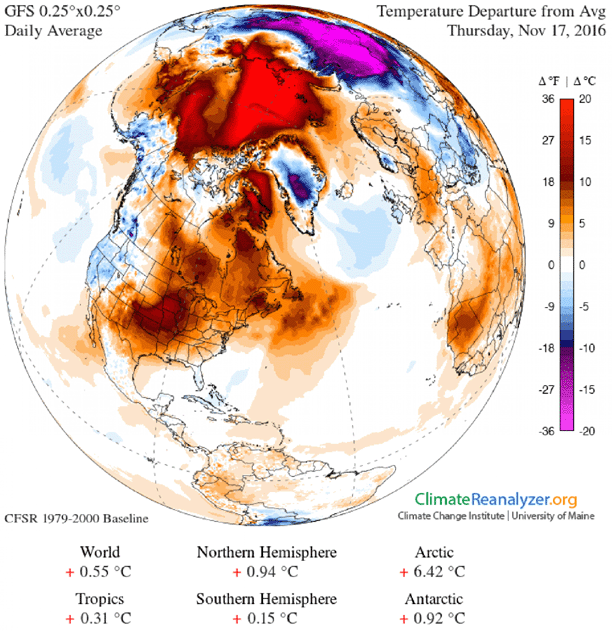
The temperature in Longyearbyen on the Svalbard archipelago about 650 miles from the North Pole, averaged about –4C in April. If that sounds cold, consider that it was nearly 8C warmer than the 30-year average for the time of year, and that April was no outlier. The average temperature for the whole of 2016 in Longyearbyen was near freezing. Usually it is –10C.
Thawing Arctic is turning oceans into graveyards
“No region on the planet is experiencing more dramatic climate change than the Arctic,” says Kim Holmén, international director of the Norwegian Polar Institute, who has lived on and off in Svalbard for 30 years. Although he is unsure precisely why temperatures are rising so fast there, he says, “make no mistake, there has never been a run of temperatures like this ever recorded.”
Holmén works at the Zeppelin research station at Ny-Ålesund, where 11 countries study climate change, air quality and ice. “Water temperatures on Svalbard have increased 10C or more in my time here,” he says. The fjord, which used to be covered with ice one-metre thick in winter, no longer freezes over. “We see temperatures changing, snow melting earlier, new species of fish. We are seeing big unexpected changes.”
Longyearbyen, home to some 2,100 people, is on borrowed time, Holmén says. “There have been two avalanches there in the last year, both defined as 1,000-year events. These are the types of events we expect to see increasing. A whole part of Longyearbyen may have to be abandoned.
The remote Norwegian archipelago of Svalbard brings a relatively warm stream of water from the south into the fjords and inlets which moderates the climate enough that coastal areas witness an explosion of green in the summer. In contrast, a cool ocean current keeps the eastern coasts cold and snowy even during the summer.“The changes taking place now will influence [many other places]. The global climate is clearly influenced by the Arctic. There will be ramifications everywhere. We already see more precipitation in northern Scandinavia and low pressure weather systems taking a more northerly route.”
Holmén is backed by Julienne Stroeve, professor of polar observation at University College London. I first met her in 2012 on a Greenpeace ship which steamed north from Longyearbyen to within 300 miles of the pole across a sea that would normally be iced over. She spoke from Cambridge Bay in the Canadian high Arctic.
“2017 is already setting records,” she says. “There was a record low [ice cover] for March this year, so that makes six months in a row with record [or near record] low ice conditions. There are many ways the Arctic is changing. You see it in melt season starting earlier than it used to and taking longer to freeze up, in the melting of the Greenland ice sheet and the Arctic glaciers, the warming of permafrost temperatures, in increased coastal erosion, the northward migration of the tree line and species, and in how local communities can no longer keep their food in the ground because the thaw increased.”
Could a £400bn plan to refreeze the Arctic before the ice melts really work?
Both Stroeve and Holmén are by nature cautious scientists, not given to dramatic statements. But both say they are astonished, even scared, by the speed at which the Arctic changes are happening.
“Given our current emission rates of 35 to 40 gigatons [of carbon dioxide] per year we should see ice-free conditions in September in about 20 years,” says Stroeve.
Longyearbyen residents are getting used to more extreme weather and coming to terms with what it means for them. The town has created a new risk assessment map and an avalanche warning system. Some parts of the town may be deemed unsafe and will have to be moved. Others may be protected by snow fences or walls.
“What is happening here is a very obvious case of climate change with consequences for animals, plants and humans,” says Holmén. It is happening across the Arctic much faster than we thought possible, and I expect now to see an ice-free Arctic in 20 or so years.”….https://www.theguardian.com/environment/2017/jun/23/from-heatwaves-to-hurricanes-floods-to-famine-seven-climate-change-hotspots?CMP=share_btn_tw
Vulnerable to Climate Change – Manaus, Brazil
 From heatwaves to hurricanes, floods to famine: seven climate change hotspots Global warming will not affect everyone equally. Here we look at seven key regions to see how each is tackling the consequences of climate change, Guardian, John Vidal, 23 June 17
“…. Manaus, Brazil
When Carlos Nobre, one of Brazil’s leading climatologists, lived in Manaus in the 1970s, the population was a few hundred thousand and the highest temperature ever recorded in the city had been 33.5C. The city was surrounded by cool, dense forest and the greatest river on Earth. Heat waves were rare and floods regular but manageable.
Today Manaus has more than 2 million people, and it and the wider Amazon region are changing fast. In 2015, Nobre says, the temperature in Manaus soared to 38.8C. “The Amazon is tropical and very hot, but when I lived there the hot spells were rare,” he says. “Now we see many more of them.” Not only that, he says, but dry seasons are longer by a week than they were a decade ago and weather is more erratic.
Nobre notes that tree loss is exacerbating the effects of climate change. “In many parts of continental South America one sees about 1C warming in the Amazon, which can [be] mostly attributed to global warming. In areas like Rondônia, where there has been widespread deforestation, we see an additional 1C warming due to replacement of forest – which is a high-evaporating vegetation – to pasture, which is less evaporating.”
Hot spells in such a humid climate are a real hazard to health. Yet adaptation to climate change in a teeming, poor city like Manaus is non-existent for the many people who must struggle just to survive. For the middle classes, air conditioning is now essential. The most city authorities can do is plant trees to cool the streets and protect the river banks from flooding.
The great uncertainty is how far the drying of the Amazon could affect the rest of the world. “If you change the rainfall in the Amazon, you could transport the impacts very far away,” Nobre says. “According to my calculations, there will be a lot of impacts in southeastern Brazil and also over equatorial Africa and the US. But we cannot pinpoint what will happen.”
Perhaps most ominous is the fact that a positive feedback loop appears to be in play. As the Amazon dries, Nobre says, tropical forest will gradually shift to savanna, releasing carbon dioxide into the atmosphere and further adding to global warming.
“When we see a dry season of over four months, or deforestation of more than 40%, then there is no way back. Trees will slowly decay, and in 50 years we would see a degraded savanna. It would take 100–200 years to see a fully fledged savanna.”
The Amazon then would be unrecognizable, along with much of Earth. …https://www.theguardian.com/environment/2017/jun/23/from-heatwaves-to-hurricanes-floods-to-famine-seven-climate-change-hotspots?CMP=share_btn_tw
Vulnerable to Climate Change – Philippines
From heatwaves to hurricanes, floods to famine: seven climate change hotspots Global warming will not affect everyone equally. Here we look at seven key regions to see how each is tackling the consequences of climate change, Guardian, John Vidal, 23 June 17
an emotional powerful speech on climate change
……Manila, Philippines
When Typhoon Haiyan struck the city of Tacloban in November 2013, Yeb Sano was the Philippines’ climate commissioner. He was distraught when I met him. He believed that his brother who lived there had been killed along with many thousands of others.
One hour later Sano broke down as he addressed the world’s diplomats. It was the third super typhoon to hit the Philippines in three years, and five of the 10 strongest typhoons had come in the previous eight years. “Climate change is real and now,” he told them in tears.
The Philippines is regularly ranked in lists of the top few countries most affected by climate change. “We are already experiencing climate change impacts, including sea-level rise, hotter temperatures, extreme weather events and changes in precipitation,” says Sano, who has now left government to direct Greenpeace SE Asia.
“These in turn, result in human rights impacts, such as loss of homes and livelihoods, water contamination, food scarcity, displacement of whole communities, disease outbreaks, and even the loss of life.”
Scientists widely agree that the country, along with nearby Indonesia, Vietnam and Cambodia, is a hotspot. Analysis of 70 years’ of government data, published in the International Journal of Climatology last year, shows a small decrease in the number of smaller typhoons that hit the Philippines each year, but more intense ones. It is not conclusive evidence, but previous studies have suggested the increase may be due to rising sea-surface temperatures since the 1970s.
There is no doubt temperatures are rising on land. In Manila and the surrounding metropolitan area, which has a population of more than 12m, the tropical storms are more intense, the floods are more frequent, the nights are hotter and there are fewer cool days, says the state meteorological office, Pagasa.
“There has been a significant increase [in the last 30 years] in the number of hot days and warm nights and a decreasing trend in the number of cold days and cold nights,” Alicia Ilaga, head of climate change in the government’s agriculture department, told me in 2015. “Both maximum and minimum temperatures are getting warmer. Extreme rainfall events are becoming more frequent. In most parts … the intensity of rainfall is increasing.”
It’s not just Manila feeling the heat. In its latest 2014 report, the Intergovernmental Panel on Climate Change says it expects life in major Asian and African coastal cities like Manila, Guangzhou, Lagos, Ho Chi Minh City, Kolkata and Shanghai to worsen as temperatures rise.
“Urban climate change–related risks are increasing (including rising sea levels and storm surges, heat stress, extreme precipitation, inland and coastal flooding, landslides, drought, increased aridity, water scarcity, and air pollution) with widespread negative impacts on people (and their health, livelihoods, and assets) and on local and national economies and ecosystems,” it says. “These risks are amplified for those who live in informal settlements and in hazardous areas and either lack essential infrastructure and services or where there is inadequate provision for adaptation.”
Food supplies are also threatened. I visited the International Rice Research Institute (IRRI) outside Manila. This research centre, funded by the world’s richest nations to develop better strains of the crop that feeds nearly half the world, has seen temperatures soar.
A few years ago, IRRI’s deputy director general, Bruce Tolentino, called climate change the greatest global challenge in 50 years. “The challenge now is to rapidly adapt farming to climate change with modern varieties and feed a fast-growing global population, half of which depends on rice as a staple food. One billion people go hungry every day. In the 1990s, rice yields were growing 2% a year; now they are just 1%. Temperatures here have risen 2–4C. Climate change will reduce productivity. Rainfall is unpredictable and rice is grown in areas like deltas that are prone to sea level rises. We have to gear up for more challenging agro-ecological conditions, we need to be able to use swampy areas and develop varieties that can be grown in salty or flooded areas.”
RRI has been working to develop rice varieties that can withstand extreme climatic conditions such as droughts, floods, heat and cold, and soil problems such as high salt and iron content. New drought-tolerant varieties that can produce up to 1.2 metric tons more per hectare [0.54 tons per acre] than varieties that perform poorly under drought conditions have been introduced to India, Nepal and elsewhere.
“Every city and every sector of society in the region is at risk,” says Sano. “The IPCC tells us it will probably get 4C warmer. That means everything will be compromised, from food and energy to settlements. We are not ready. The challenge is too huge. We are very vulnerable.”…..
Vulnerable to Climate Change – New York State
 From heatwaves to hurricanes, floods to famine: seven climate change hotspots Global warming will not affect everyone equally. Here we look at seven key regions to see how each is tackling the consequences of climate change, Guardian, John Vidal, 23 June 17 “….
New York, US
New York state may seem an unlikely climate hotspot, but research confirms its status in the top league of potential change. Drawing on the US national climate assessment and research by leading federal agencies and academics, it calculates that temperatures statewide have risen about 1.3C since 1970, spring begins a week sooner than it did just a few decades ago, there is less winter snow and more intense downpours. Meanwhile, sea levels are rising at nearly twice the global rate and birds and fish populations are all moving north.
Even more dramatically, the latest scientific projections suggest trouble ahead. By the 2050s, says the New York Department of Environmental Conservation, sea levels could rise nearly 76cm (30 inches), storm surges and flooding will be more common in coastal areas, and West Nile virus and many other diseases could be prevalent.
But, says Carl Pope, climate advisor to the former New York mayor Michael Bloomberg, if climate change is to be addressed, it must be led by big cities like New York, which release nearly 70% of the global emissions but also have the capacity to create solutions.
“Cities will always trump countries when it comes to climate change,” he says. “Cities are where emissions are. They are mostly consumers of fossil fuels, so they would like to use them as little as possible; they have a natural instinct to save on fossil fuels. Also, they are not very ideological. Improving quality of life is seen as a good.”
Mayors, Pope says, are now well ahead of most governments, leading attempts to reduce air pollution which contributes heavily to climate change, and eager to introduce electric cars and renewable energy. “There is a great public will to improve the quality of life in cities,” he says.
Pope identifies three groups of cities which he thinks will lead others on climate: “Cities in Nordic countries that will be meticulous about everything. Then there are a few in Latin America and Africa, which will be unbelievably creative. A third group is in east Asia and China, which will do things on a massive scale.” https://www.theguardian.com/environment/2017/jun/23/from-heatwaves-to-hurricanes-floods-to-famine-seven-climate-change-hotspots?CMP=share_btn_tw
1 This Month

of the week – Shut Down Drone Warfare!


Tell the Ukrainian Government to Drop Prosecution of Peace Activist Yurii Sheliazhenko

Petition to revoke the licensing of the Near Surface Nuclear Disposal Facility (NSDF) at Chalk River. https://www.ourcommons.ca/petitions/en/Petition/Details?Petition=e-7247
To see nuclear-related stories in greater depth and intensity – go to https://nuclearinformation.wordpress.com
-
Archives
- March 2026 (251)
- February 2026 (268)
- January 2026 (308)
- December 2025 (358)
- November 2025 (359)
- October 2025 (376)
- September 2025 (257)
- August 2025 (319)
- July 2025 (230)
- June 2025 (348)
- May 2025 (261)
- April 2025 (305)
-
Categories
- 1
- 1 NUCLEAR ISSUES
- business and costs
- climate change
- culture and arts
- ENERGY
- environment
- health
- history
- indigenous issues
- Legal
- marketing of nuclear
- media
- opposition to nuclear
- PERSONAL STORIES
- politics
- politics international
- Religion and ethics
- safety
- secrets,lies and civil liberties
- spinbuster
- technology
- Uranium
- wastes
- weapons and war
- Women
- 2 WORLD
- ACTION
- AFRICA
- Atrocities
- AUSTRALIA
- Christina's notes
- Christina's themes
- culture and arts
- Events
- Fuk 2022
- Fuk 2023
- Fukushima 2017
- Fukushima 2018
- fukushima 2019
- Fukushima 2020
- Fukushima 2021
- general
- global warming
- Humour (God we need it)
- Nuclear
- RARE EARTHS
- Reference
- resources – print
- Resources -audiovicual
- Weekly Newsletter
- World
- World Nuclear
- YouTube
-
RSS
Entries RSS
Comments RSS
 nuclear-news