Six years after Japan’s Fukushima nuclear disaster, Westinghouse and Toshiba join Tokyo Electric Power in a fight for survival.
Six years after Japan’s Fukushima nuclear accident three global nuclear corporations are fighting for their very survival.
The bankruptcy filing by Westinghouse Electric Co. and its parent company Toshiba Corp. preparing to post losses of ¥1 trillion (US$9 billion), is a defining moment in the global decline of the nuclear power industry.
However, whereas the final financial meltdown of Westinghouse and Toshiba will likely be measured in a few tens of billions of dollars, those losses are but a fraction of what Tokyo Electric Power Co. (Tepco) is looking at as a result of the Fukushima nuclear disaster.
If the latest estimates for the cost of cleaning up the Fukushima plant prove accurate, Tepco faces the equivalent of a Toshiba meltdown every year until 2087.
In November 2016, the Japanese Government announced a revised estimate for the Fukushima nuclear accident (decommissioning, decontamination, waste management and compensation) of ¥21.5 trillion (US$193 billion) – a doubling of their estimate in 2013.
But the credibility of the government’s numbers have been questioned all along, given that the actual ‘decommissioning’ of the Fukushima plant and its three melted reactors is entering into an engineering unkown.
This questioning was borne out by the November doubling of cost estimates after only several years into the accident, when there is every prospect Tepco will be cleaning up Fukushima well into next century.
And sure enough, a new assessment published in early March from the Japan Institute for Economic Research, estimates that total costs for decommissioning, decontamination and compensation as a result of the Fukushima atomic disaster could range between ¥50-70 trillion (US$449-628 billion).
Rather than admit that the Fukushima accident is effectively the end of Tepco as a nuclear generating company, the outline of a restructuring plan was announced last week.
Tepco Holdings, the entity established to manage the destroyed nuclear site, and the Nuclear Damage Compensation and Decommissioning Facilitation Corporation (NDF) are seeking ways to sustain the utility in the years ahead, confronted as they are with escalating Fukushima costs and electricity market reform.
The NDF, originally established by the Government in 2011 to oversee compensation payments and to secure electricity supply, had its scope broadened in 2014 to oversee decommissioning of the Fukushima Daiichi plant on the Pacific Ocean coast north of Tokyo.
The latest restructuring plan is intended to find a way forward for Tepco by securing a future for its nuclear, transmission and distribution businesses. If possible in combination with other energy companies in Japan.
But the plan, already received less than warmly by other utilities rightly concerned at being burdened with Tepco’s liabilities, is premised on Fukushima cost estimates of ¥21.5 trillion — not ¥50-70 trillion.
To date Tepco’s Fukushima costs have been covered by interest-free government loans, with ¥6 trillion (US$57 billion) already paid out. Since 2012 Tepco’s electricity ratepayers have paid ¥2.4 trillion to cover nuclear-related costs, including the Fukushima accident site.
That is nothing compared to the costs looming over future decades and beyond and it comes at a time when Tepco and other electric utilities are under commercial pressure as never before.
The commercial pressure comes from electricity market reform that since April 2016 allowed consumers to switch from the monopoly utilities to independent power providers.
Prior to the deregulation of the retail electricity market, Tepco had 22 million customers. As the Tepco president observed late last year “The number (of customers leaving Tepco) is changing every day as the liberalization continues … We will of course need to think of ways to counter that competition.”
Countering that competition shouldn’t mean rigging the market, yet Tepco and the other utilities intend to try and retain their decades long dominance of electricity by retaining control over access to the grid. This is a concerted push back against the growth of renewable energy.
Current plans to open the grid to competition in 2020, so called legal unbundling, are essential to wrest control from the big utilities.
The message of unbundling and independence, however, doesn’t seem to have reached the Ministry of Economy, Trade and Industry (METI) that oversees the electricity industry.
Current plans would allow Tepco to establish separate legal entities: Tepco Fuel & Power (thermal power generation), Tepco Energy Partner (power distribution) and Tepco Power Grid (power transmission).
Tepco Holdings will retain their stock and control their management, meaning the same monopoly will retain control of the grid. Where Tepco leads, the other nine electric utilities are aiming to follow.
Leaving the grid effectively still under the control of the traditional utilities will throw up a major obstacle to large scale expansion of renewable energy sources from new companies.
Such businesses will be ‘curtailed’ or stopped from supplying electricity to the grid when the large utilities decide it’s necessary, justified for example to maintain the stability of the grid.
The fact that ‘curtailment’ will be permitted in many regions without financial compensation piles further pain onto new entrants to the electricity market, and by extension consumers.
Further, METI plans to spread the escalating costs of Fukushima so that other utilities and new power companies pay a proportion of compensation costs. METI’s justification for charging customers of new energy companies is that they benefited from nuclear power before the market opened up.
The need to find someone else to pay for Tepco’s mess is underscored by the breakdown of the Fukushima disaster cost estimate in November.
When put at ¥22 trillion estimate, ¥16 trillion is supposed to be covered by Tepco. The Ministry of Finance is to offer ¥2 trillion for decontamination, and the remaining ¥4 trillion is to be provided by other power companies and new electricity providers.
The question is how does Tepco cover its share of the costs when it’s losing customers and its only remaining nuclear plant in Japan, Kashiwazaki Kariwa (the worlds largest), has no prospect of restarting operation due to local opposition?
What happens when Fukushima costs rise to the levels projected of ¥50-70 trillion?
The policy measures being put in place by Tepco, other utilities and the government suggests that they know what is coming and their solution for paying for the world’s most costly industrial accident will be sticking both hands into the public purse,
WHAT’S DRIVING WORLD BACK TO MAD OLD DAYS OF NUCLEAR WEAPONS? http://www.scmp.com/week-asia/opinion/article/2083538/opinion-whats-driving-world-back-mad-old-days-nuclear-weapons World leaders led by US president Donald Trump seem willing to put social issues on the back burner while they – irrationally – prepare for Armageddon, BY CHOW CHUNG-YAN 2 APR 2017 It can be hard not to lose heart these days after going through daily news headlines. Sometimes history seems to be moving backwards. The absurdity often makes one wonder if the world is going mad.
Among the crazy things that took place this week, here is one that is not getting much attention: the United Nations called for a meeting on Tuesday to continue negotiations for a legally binding ban on nuclear weapons, but nearly 40 countries – including the US, China, Russia, Britain and France – decided to skip it. None of the participants from the 100 countries attending the meeting belong to the group of states in possession of nuclear weapons.
US envoy Nikki Haley explained afterwards that national security concerns required Washington to keep its nuclear weapons because of “bad actors” who could not be trusted…
China, Russia, Britain and other nuclear powers did not even talk to the media.
If Kim Jong-un were watching the news, he would probably have a big smirk on his face. Yes, Kim is a cold-blooded power-hungry maniac. But judging from what happened on Tuesday, leaders of the world’s major capitals are probably just as callous.
While North Korea is aspiring to build a few nuclear bombs, the big five – US, China, Russia, France and Britain – are sitting on arsenals that between them could destroy this planet many times over. Still, none of them feel they have enough.
For those born in the 1980s or later, the threat of a nuclear war seems remote. But for older generations, such a threat was once very real. But for older generations, such a threat was once very real. From the end of the second world war until the collapse of the Soviet Union in 1989, fears of a nuclear Armageddon were widespread.
At the peak of the cold war, all major powers devoted precious national resources to building their nuclear capacities, with the US and the USSR leading the race. The atomic bombs the US dropped on the Japanese cities of Hiroshima and Nagasaki during the second world war were powerful, but they were mere popguns compared to the thermonuclear weapons of the cold war era.
The cold war stand-off established the Mutual Assured Destruction (MAD) doctrine. According to MAD, major nuclear powers would refrain from direct conflict because a nuclear exchange would result in the complete annihilation of both sides. Some historians credited this balance of nuclear deterrence as an important factor behind the longest period of peace in modern history, with no war breaking out between major powers for almost 70 years.
Dread of a nuclear holocaust forced world leaders to cool the hysteria. The end of the cold war brought brief hopes of optimism. But today, the situation is getting more dangerous. Globally, annual expenditure on nuclear weapons is estimated at US$105 billion. In comparison, the Office for Disarmament Affairs, the principal UN body responsible for advancing a nuclear-weapon-free world, has an annual budget of US$10 million.
Two studies, one by the Brookings Institution and another by the Carnegie Endowment for International Peace, recently drew the same conclusion: governments around the world are going to spend a crazy amount of money on nuclear weapons in the next decade.
Together, nine major nuclear countries will spend a staggering US$1 trillion on new research, production and maintenance of nuclear arms over the next 10 years. At a time of economic crises and imposed austerity measures, world leaders led by US president Donald Trump have decided to cut investment on education, health care and climate change so that we can have more powerful weapons of mass destruction.
Last year, Washington gave the green light to a new generation of “smart” nuclear bombs – the B61-12s – which will be the most expensive ever produced. Moscow and Beijing both expressed concerns and hinted they would respond in kind. This year, Chinese scientists announced a theoretical breakthrough in developing the so-called “N2 bomb” – a new type of weapon of mass destruction that is as strong as a nuclear bomb but produces no radioactive fallout.
The chance of a hot nuclear war among major powers remains astronomically small. The only real reason for them to continue pouring precious resources into the arms race is because they cannot break out of their cold war mentalities.
Today, terrorism, climate change and contagious diseases are much bigger and more realistic threats to the world than invasion by Moscow or a nuclear war between Beijing and Washington.
The only real nightmare is for such weapons to fall into the hands of terrorists.
No matter how much major powers improve their nuclear arsenals, it will not deter terrorists – there is no such thing as nuclear retaliation against people who want to see the world blow up.
A World Bank study estimated that if governments cut their spending on nuclear weapons by half and used the money on poverty alleviation, it would have been possible to achieve the UN Millennium Development Goal of eradicating extreme poverty and hunger.
It would be naïve to ask the major powers to give up their nuclear weapons, but if they could divert more resources to fighting poverty, terrorism and global warming, we would have a much safer, better world. Chow Chung-yan is the executive editor of the South China Morning Post, overseeing daily print and digital operations
Intelligence agencies fear ISIS and other terrorist groups could have developed ways to plant explosives in laptops and mobile phones which can bypass airport security screening methods, the Telegraph reports. Last month, Britain and the US banned travellers from a number of countries carrying laptops and large electronic devices on board.
They also fear terrorists, foreign spies and hackers could try to break into nuclear power station security systems.
Jesse Norman, the energy minister, said nuclear plants must ensure they ‘remain resilient to evolving cyber threats’.
Mr Norman told the paper: ‘The Government is fully committed to defending the UK against cyber threats, with a £1.9 billion investment designed to transform this country’s cyber security.’
Terrorists are feared to have developed the technology after getting hold of airport screening equipment allowing them to experiment.
FBI experts have tested how explosives can be hidden inside laptop battery compartments so that it can still be turned on.They are said to have concluded that the technique would be achievable using everyday equipment.
In a statement, the US Department of Homeland Security said: ‘Evaluated intelligence indicates that terrorist groups continue to target commercial aviation, to include smuggling explosive devices in electronics.
‘The US government continually reassesses existing intelligence and collects new intelligence. ‘This allows us to constantly evaluate our aviation security processes and policies and make enhancements when they are deemed necessary to keep passengers safe.’
Last year al-Shabaab, an al-Qaeda affiliate group in Somalia, detonated a bomb on a flight from Mogadishu to Djibouti by hiding it in a part of a laptop where bomb-makers had removed a DVD drive.
Survivors Speak Out As UN Negotiates Nuke Ban, Huffington Post, By Ariel Conn,31 Mar 17 “…….A Nuclear Rallying Cry
Not surprisingly, the horror of the effect nuclear bombs have on children provides some of the most compelling arguments for a ban treaty.
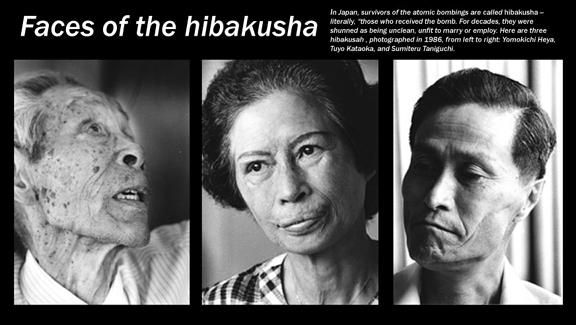
Fujimori Toshiki, a Hibakusha (survivor of the bombs dropped on Japan), described his personal experience to the General Assembly at the very start of the negotiations. He was a baby at the time, and he and his mother were just far enough away from the blast that a two-story home protected them somewhat.
“I had my entire body covered with bandages,” said Toshiki, “with only eyes, nose, and mouth uncovered. Everybody thought I would die over time. Yet, I survived. It is a miracle. I am here at the U.N., asking for an abolition of nuclear weapons. I am convinced that this is a mission I am given as a survivor of the atomic bomb.”
His 13-year-old sister was not so lucky. She was one of 6,300 teenagers to die near the blast site because their schools had sent them there to help “create firesafe [sic] areas against air raids.”
Toshiki added, “Every year, on Aug. 6, my mother would gather all of us children and would talk to us about her experience in tears. I once asked my mother why she would speak about it if recalling the experience makes her suffer. ‘I can’t make you go through the same experience.’ That was her answer. Her tears were her heartfelt appeal. She called, as a mother, for a world with no more hell on earth.”
Setsuko Thurlow, another Hibakusha, was also 13 when the bombs fell. She described witnessing the slow death of her 4-year-old nephew Eiji. He was “transformed into a charred, blackened and swollen child who kept asking in a faint voice for water until he died in agony.”
Thurlow continued, “Regardless of the passage of time, he remains in my memory as a 4-year-old child who came to represent all the innocent children of the world. And it is this death of innocents that has been the driving force for me to continue my struggle against the ultimate evil of nuclear weapons.”
However, unlike the stories of landmines and cluster munitions, which told of present-day children suffering and dying, these stories are over 70 years old. It can be difficult to relate to events that happened so long ago and that most people believe has not ― and cannot ― be repeated.
But Sue Coleman-Haseldine told the assembly of stories and concerns that were more recent. Coleman-Haseldine is an Aboriginal who lived near the atomic weapons testing sites in Australia. She was two when the testing first began in the 1950s.
“Our district is full of cancer now,” she said.
She continued, “I grew up hearing about the bombs, but I didn’t know about how the sickness went through the generations. When mining companies started eyeing off areas of my country I started to look more into it and I went to an Australian Nuclear Free Alliance meeting to learn more about fighting mining companies but also radiation fallout. What I learnt devastated me. To find out that our bush foods were possibly contaminated was a real blow to me.”
02/04/2017 WASHINGTON — Famed anthropologist and conservationist Jane Goodall wants everyone to stand up to those working to undermine scientific research by joining this month’s “March for Science.”
“Many scientists have spent years collecting information about the effect of human actions on the climate,” said Goodall, who turns 83 on Monday. “There’s no question that the climate is changing, I’ve seen it all over the world. And the fact that people can deny that humans have influenced this change in climate is quite frankly absurd.”
Asked by The Huffington Post about Trump’s climate actions, Goodall called them “immensely disturbing.” However, she believes the Trump administration has woken people up, citing the numerous marches and demonstrations.
The “March for Science” is supported by a nonpartisan coalition of scientific groups and is scheduled for Earth Day — April 22. While the main rally will occur in Washington, D.C., satellite marches have been organized in more than 400 locations around the globe. The D.C. event is “a call for politicians to implement science-based policies, as well as a public celebration of science and the enormous public service it provides in our democracy, our economy, and in all our daily lives,” according to the official website of the march.
“I really hope that everybody who can will take part in this march,” Goodall said. “I so wish I could be marching with you. I can’t, I will be far away. But there will be a cardboard, life-size Jane marching, showing everybody that I want to be there and that I shall be there with you all in spirit.”
Since Trump came to power, the American supreme court has now ruled that a government employee does NOT have protection of the first amendment (freedom of speech). Jeff Ruch executive director for Public Employees for Environmental Responsibility (PEER) who describes PEER as a “shelter for battered staff” said government workers have fewer rights with freedom of speech than a incarcerated person in a penitentiary.
If you are wondering what the big picture is in this story, it stifles a whistle blower’s resolve to engender the hidden facts in the safety of nuclear, medicine, air travel or any other industry where the government has their foot in the door. Some people may not give a damn what happens in America but this impacts on every man, woman and child on this planet. https://www.facebook.com/groups/344452605899556/
How to fix the future: saving the planet from climate change requires action – now, write David Suzuki and Ian Hannington , SMH, 1 Apr 17
With rapidly accelerating climate change threatening the very future of humanity, it will take nothing short of a revolution to turn things around. The degree of hardship and sacrifice that will entail depends on the determination, speed, and comprehensiveness of our actions. Employing a broad range of available solutions as quickly and as widely as possible could ensure that we build a healthier, cleaner world with greater equity.
The main solutions are those that will shift us away from fossil fuels as quickly as possible. Conserving energy is key, as is continuing to develop clean energy sources. The fastest-growing and most promising technologies are wind and solar, but geothermal, tidal, and some types of hydro are all important as well. Biofuels show some promise, as long as valuable land for food production isn’t taken over to produce them.
As well as shifting away from fossil fuels, it’s important to protect, restore, and, in some cases, build carbon sinks — forests, wetlands, and other green spaces that absorb and store carbon. Agricultural practices also play a big role, as agriculture is a main contributor to global warming. Reducing livestock production, enhancing soils, and focusing on local production are just some ways to reduce the impacts of growing and producing food. Personal solutions are also crucial. Reducing reliance on private automobiles, conserving energy, and reducing or eliminating animal products from our diets can all help. Stabilising human population growth is also crucial. Giving women more rights over their own bodies, providing equal opportunity for them to participate in society, and making education and birth control widely available will help slow population growth and create numerous other benefits.
April 2, 2017 Britain: Britain raised its terrorism alert in the past 24 hours saying that the Islamic State (IS, formerly ISIS) group operating in Syria and Iraq may have developed ways of bypassing nuclear power station security measures.
According to Intelligence agencies, the terrorist groups have developed ways to plant explosives in laptops and mobile phones that can evade airport security screening methods.
Energy minister Jesse Norman said that the government was “fully committed to defending the UK against cyber threats, with a £1.9 billion investment designed to transform this country’s cyber security.”
The growing threat of attack on Britain’s 15 operational reactors, which account for nearly a fifth of the country’s electricity from terrorists, foreign spies and “hacktivists” remains high.
Norman said the civil nuclear strategy published in February sets out ways to ensure that the civil nuclear sector “can defend against, recover from, and remain resilient in evolving cyber threats.”
Deputy director-general Professor Malcolm Chalmers of the Royal United Services Institute, an independent think tank for defence and security, said that it was crucial for the Government to “respond rapidly”.
ZUMA’S CABINET RESHUFFLE OPENS DOOR FOR SA NUCLEAR DEAL, EyeWitness News, 1 April 17 Hartmut Winkler is professor of physics, University of Johannesburg.This article first appeared on The Conversation.
South Africa has just witnessed a game-changing Cabinet reshuffle with the firing of five ministers and several deputy ministers. This included the Finance Minister Pravin Gordhan and his second-in-charge Mcebisi Jonas.
The three ministries with the most critical impact on the energy sector have all been affected, significantly increasing the chances of the country opting for a highly controversial nuclear energy programme. Continue reading →
A little-known ANC member and part-time lecturer at the University of KwaZulu-Natal put Facebook users into a tailspin on Sunday evening when she took to the platform to declare that she had knowledge that the new finance minister, Malusi Gigaba, has already signed off on a new nuclear deal.
Sibusisiwe Mngadi, who lists as among her occupations being a part-time lecturer at the University of KwaZulu-Natal Pietermaritzburg and an area manager at the Msunduzi Municipality, wrote: “The Nuclear Deal deadline was last night. Guess whose signature is on the paper? The new Finance Minister Malusi Gigaba.” She alleges the deal will benefit President Jacob Zuma’s controversial nephew Khulubuse Zuma to the tune of R50 billion by his company being given the contract to build nuclear plants.
“Mission Nuclear done and dusted. Guess whose company is in charge of building the nuclear plants?
“Khulubuse Zuma is the SA holding company for the Nuclear plants. The next 20 yrs Khulubuse Zuma will be making more than 50billion. Congratulations, mission accomplished.”
She did not reveal what her source for this allegation was and many of her followers questioned whether she was properly informed or telling the truth.
Many pointed out that it was highly unlikely the new finance minister would have been able to sign off on such an important deal (the most expensive in South African history) after being in the job for just one day. Update: Treasury in an official statement later said that the new finance minister had signed no such documents and there were no documents ready to sign. Gigaba is yet to even occupy his office at Treasury.
Mngadi explained that she had not joined the struggle against apartheid and been jailed only for this to happen to her “beloved ANC”.
It is understood that President Jacob Zuma and the Gupta family have been pushing hard for government to sign off on a trillion-rand deal with Russia’s state-owned nuclear company Rosatom.
The former finance minister, Pravin Gordhan, and his predecessor, Nhlanhla Nene, were in no hurry to sign off on any nuclear agreements with Russia, or anyone else. Many analysts have concluded that both were axed due primarily to their opposition to any hasty conclusion of such a deal with Russia.
When Nene was axed in favour of Des van Rooyen in 2015, there were similar allegations that Van Rooyen had hurriedly signed off on the nuclear deal (he was in office for just four days), but these rumours turned out to be baseless.
Former ANC MP and party whistleblower Vytjie Mentor repeated the allegation about the deal being signed, though it’s not clear if she sourced her allegations from Mngadi or verified them independently.
She wrote: “Gigaba signed the nuclear deal last night. It will be R6 trillion with over-runs. All South Africans are now officially slaves of the Russians, and thus will be the case for the next 100 years.”
Mngadi’s post has already been shared nearly 700 times, with it also going viral on WhatsApp and Twitter.
Mentor has thrown her weight behind a group of South Africans calling for the observance of #BlackMonday by wearing black tomorrow in support of the call for Zuma to step down.
ANC member Sibusisiwe Mngadi had alleged on Facebook earlier on Sunday that “the nuclear deal deadline was last night” and that Gigaba had signed it.
She also alleged that President Jacob Zuma’s nephew Khulubuse Zuma would benefit from nuclear plants being built.
“Khulubuse Zuma is the SA holding company for the Nuclear plants. The next 20yrs Khulubuse Zuma will be making more than 50billion. Congratulations, mission accomplished,” she alleged on the post.
Mngadi listed her occupations as a researcher and part-time lecturer at University of KZN in Pietermaritzburg, and an area manager at Msunduzi Municipality.
Some of her followers asked her for proof to support her claims. She replied that people should do their own digging, alluding only to a “parliament document that was signed yesterday”.
Former ANC MP Vytjie Mentor also entered the fray on her personal Facebook profile page, seeming to support the allegations.
“Gigaba signed the Nuclear Deal Last night. It will be R6 trillion with over-runs. All South Africans are now Officially slaves of the Russians, and thus will be the case for the next 100 years,” Mentor alleged.
National Treasury issued a series of tweets on the matter on Sunday night. “The Minister arrived (on) Friday and has not yet gone beyond boardrooms where he met management and later had a telecon with rating agencies,” the treasury account stated.
“He is formally occupying his office tomorrow and will have a briefing meeting with the outgoing Minister Pravin Gordhan in the morning. There are no documents of deals ready for signature on nuclear. Therefore the reports are misleading and mischievous.”
Gigaba’s spokesperson Mayihlome Tshwete also took to Twitter to say he had signed “not a single thing”, not even to sign off for the printing of his business cards. He said Gigaba had not even received any documents from the Director-General.“Sadly, we must now release a statement to deny fake news, then the story will be about the denial,” he lamented.
In government’s updated Integrated Resource Plan (IRP) 2016, which is still under discussion, it intends to add 20 385MW units of nuclear power to the national grid, Fin24 reported.
This will make up approximately one-third of South Africa’s total generation mix.
On December 20, 2016, Eskom, which has taken over from the Department of Energy as owner and operator of the proposed nuclear build programme, issued a Request for Information (RFI) for the procurement of nuclear energy. Comment is currently open for the Request for Proposal (RFP) until April 28.
The RFP is expected to be issued to the market place by the middle of the year and in 2018 Eskom and the Nuclear Energy Corporation SA (Necsa) will choose their preferred bidders and negotiate and finalise contracts.
2 April 2017 Staff ReporterJohannesburg – Former finance minister Pravin Gordhan said the masses should be worried when top ANC officials admitted that they didn’t know where a decision was made.
Professor Njabulo Ndebele said the country was in a “deep political and moral crisis” characterised by power and greed.
Zuma’s spokesperson Dr Bongani Ngqulunga said the president was not involved “in the planning of the memorial service and in the cancellation thereof. Any impression created that the president cancelled or ordered the cancellation is erroneous and unfortunate.”
Meanwhile, while Gordhan was doing the presentations in London there was a gentleman called Chenkov who kept on asking many questions about South Africa. He wanted to know if the South African government was looking at developing nuclear energy. Gordhan quickly quashed the idea of nuclear and repeatedly confirmed that the South African government would never develop this energy.
Chenkov had no further questions. After the presentation Chenkov called someone and spoke in Russian but whoever he was speaking to was not impressed and angrily dropped the phone.
It is believed that this person immediately called President Jacob Zuma and threatened him that if he did not immediately trigger the process of changing the finance minister and sign the nuclear deal, as commission had already been paid, he would be taught a lesson.
A shaken Zuma immediately called the minister back home. “You obviously know what happened!”
Survivors Speak Out As UN Negotiates Nuke Ban, Huffington Post, By Ariel Conn,31 Mar 17
“[My nephew was] transformed into a charred, blackened and swollen child who kept asking in a faint voice for water until he died in agony.”
To imagine innocence is to picture children playing. As such, most people and governments are horrified by the idea of children and other helpless civilians suffering and dying, even during war. Finding a way to prevent the unnecessary slaughter of innocents has brought over 115 countries to the United Nations in New York this week to begin negotiations of a historic treaty that would, once and for all, ban nuclear weapons.
The countries are united by concerns that tens or even hundreds of thousands of innocent men, women and children – mothers, sons, fathers, daughters, aunts, uncles, cousins, friends and neighbors – could be killed, quite literally, in a flash.
In a statement to the opening of negotiations, Peter Maurer, president of the International Committee of the Red Cross, or ICRC, said, “The prohibition and elimination of nuclear weapons is a humanitarian imperative.”
Responding to a Humanitarian Imperative
A ban on nuclear weapons is certainly historic, but it’s not without precedence. Prohibiting and eliminating other weapons because of their horrific humanitarian consequences has happened before. In fact, most of the world’s deadliest weapons are currently banned.
At a press conference, Beatrice Fihn, executive director of the International Campaign to Abolish Nuclear Weapons, ICAN, said, “The treaty will finally ban weapons designed to indiscriminately kill civilians, completing the prohibitions on weapons of mass destruction.”
For example, when adults around the world learned of the tens of thousands of children killed by landmines while simply pursuing childhood activities, such as playing in open fields, a global cry arose to bring an end to the indiscriminate weapons. In 1997, 133 countries signed the Mine Ban Treaty, and as of today 162 have signed. According to the International Campaign to Ban Landmines, “only 35 states remain outside the treaty, but most of them do not actually use or produce antipersonnel mines.”
A similar rallying cry heralded the Convention on Cluster Munitions. Cluster munitions often landed without exploding and remained unstable. Their toy-like appearance attracted thousands of children, who were killed and maimed by the weapons. The treaty was adopted in 2008 and is described by clusterconvention.org as an “international treaty of more than 100 States that addresses the humanitarian consequences and unacceptable harm caused to civilians by cluster munitions.”
Today, most countries abide by these treaties, and even countries like the United States, which has not signed either treaty, is either mostly in compliance or is showing signs of improvement………
Relegating Nukes to History A common concern about these negotiations is the notable absence of the nuclear states. However, history, as seen with the landmine and cluster munitions treaties, gives those supporting the negotiations reason to hope.
In his statement for the ICRC, Maurer added, “Of course, adopting a treaty to prohibit nuclear weapons will not make them immediately disappear. But it will reinforce the stigma against their use, support commitments to nuclear risk reduction, and be a disincentive for proliferation. … As with chemical and biological weapons, a clear and unambiguous prohibition is the cornerstone of their elimination.”
Susi Snyder, the nuclear disarmament program manager for PAX in the Netherlands, explained, “This is the start of a negotiation. The impact of the negotiation cannot be guessed or measured until the treaty is done. Even then, as with all treaties and growing norms, the impact will grow over time.”
By THE TIMES EDITORIAL BOARDAPRIL 2, 2017 It was no secret during the campaign that Donald Trump was a narcissist and a demagogue who used fear and dishonesty to appeal to the worst in American voters. The Times called him unprepared and unsuited for the job he was seeking, and said his election would be a “catastrophe.”
Still, nothing prepared us for the magnitude of this train wreck. Like millions of other Americans, we clung to a slim hope that the new president would turn out to be all noise and bluster, or that the people around him in the White House would act as a check on his worst instincts, or that he would be sobered and transformed by the awesome responsibilities of office.
Instead, seventy-some days in — and with about 1,400 to go before his term is completed — it is increasingly clear that those hopes were misplaced.
In a matter of weeks, President Trump has taken dozens of real-life steps that, if they are not reversed, will rip families apart, foul rivers and pollute the air, intensify the calamitous effects of climate change and profoundly weaken the system of American public education for all.
His attempt to de-insure millions of people who had finally received healthcare coverage and, along the way, enact a massive transfer of wealth from the poor to the rich has been put on hold for the moment. But he is proceeding with his efforts to defang the government’s regulatory agencies and bloat the Pentagon’s budget even as he supposedly retreats from the global stage.
These are immensely dangerous developments which threaten to weaken this country’s moral standing in the world, imperil the planet and reverse years of slow but steady gains by marginalized or impoverished Americans. But, chilling as they are, these radically wrongheaded policy choices are not, in fact, the most frightening aspect of the Trump presidency.
What is most worrisome about Trump is Trump himself. He is a man so unpredictable, so reckless, so petulant, so full of blind self-regard, so untethered to reality that it is impossible to know where his presidency will lead or how much damage he will do to our nation. …….
In the days ahead, The Times editorial board will look more closely at the new president, with a special attention to three troubling traits:
1 Trump’s shocking lack of respect for those fundamental rules and institutions on which our government is based……
This is China’s strongest statement yet on climate action, Climate Home, 30/03/2017,
As President Trump rolls back climate policies and finance, China’s UN representative makes a detailed pitch for global leadership. By Karl Mathiesen
In the week before Donald Trump began to roll back Obama-era climate regulations, China’s government made its clearest statement yet that it sees climate action as central to its best interests.
Speaking at a New York event on 23 March, China’s permanent representative at the UN Liu Jieyi said China remained committed to openness and collaboration on climate change, “whatever the vicissitudes of the international situation”.
Under Barack Obama, the US state department expended huge effort and political capital cajoling the Chinese into a bilateral deal that laid the foundations for the Paris accord on climate change.
One of the pillars of that deal was the Clean Power Plan – which mandated emissions reductions in the US energy sector. On Tuesday, Trump signed an order that began rolling back that policy declaring he was “putting an end to the war on coal”.
But Liu’s comments make clear that China now sees climate action as a matter of national interest, independent of US policy.1 That applies not only at home, but across a range of diplomatic forums.






 Gordhan said to have spooked Russian connection on nuclear deal http://www.iol.co.za/news/politics/gordhan-said-to-have-spooked-russian-connection-on-nuclear-deal-8459357









 nuclear-news