Take part in April 22nd Earth Day and global March for Science
The Bulletin supports the March for Science April 22nd is not just Earth Day, it’s the global March for Science. Find out everything you need to know about attending in your area, or about attending digitally through an online stream. The Bulletin will be present at the March for Science Chicago, and we’ll have a booth at the Science Expo at the end of the march route. Stop by and visit. And be sure to catch theBulletin‘s Rachel Bronson, Sonny Garg, and Daniel Holz in a “Fireside Chat,” hosted by the March for Science Chicago, onTuesday, April 18th.
Scientists can be advocates and maintain scientific credibility
https://skepticalscience.com/scientists-can-march-maintain-credibility.html13 April 2017 by dana1981
Scientists are often hesitant to engage in what might be considered “advocacy,” for fear of losing credibility with the public. But a recent study led by John Kotcher at George Mason’s Center for Climate Change Communication found that “climate scientists who wish to engage in certain forms of advocacy have considerable latitude to do so without risking harm to their credibility, or the credibility of the scientific community.”
The study found that the perceived credibility of a hypothetical scientist did not decline when that scientist advocated for generalities such as a “strong effort” to curb the impacts of climate change—nor did credibility decline if the scientist called for more specific and concrete actions such as “strict limits on carbon emissions from coal power plants.” But perceived credibility did decline when the hypothetical scientist advocated building more nuclear power plants, which are relatively unpopular amongst the American public.
These results suggest that as long as scientists don’t advocate for specific unpopular policies, a range of advocacy positions are available that won’t harm their credibility. For example, polling has shown that most Americans—including Trump voters—support policies to combat climate change. They also think it’s a bad idea to cut scientific research funding, they support clean energy, and they want the government to do more to mitigate climate change risks.
Additionally, there’s been no more important time in recent history for scientists to engage in advocacy on behalf of our science, which is under attack from the current administration. According to the March 16 issue of the journal Science, President Trump proposed a federal budget that would cut funding to the Environmental Protection Agency’s science programs by 40 percent, the Energy Department’s Office of Science programs by 20 percent, grants to the main research arm of the National Oceanic and Atmospheric Administration (NOAA) by 26 percent, NOAA satellites by 13 percent, the National Institutes of Health by 20 percent, and so on. Trump’s EPA administrator rejects the expert consensus and overwhelming scientific evidence that human carbon pollution is the dominant cause of recent global warming, and has been filling EPA positions with like-minded individuals. President Trump has still only moved to fill one out of 46 key government science and technology positions, and reports indicate that the candidates he’s considering for the position of his science advisor all deny human-caused climate change.
The House of Representatives recently passed two bills that would severely limit the EPA’s ability to issue scientifically-justified regulations. And of course President Trump signed an executive order to roll back a slew of science-based government climate policies.
This month, we have two opportunities to engage in activism to push back against these anti-science policies, in the form of marches.
Delay in Ontario Power Generation’s (OPG’s) planned underground storage facility for nuclear waste
 OPG nuclear waste site remains on hold, pending more studies http://www.ecolog.com/issues/ISArticle.asp?aid=1003960830&PC=EN&issue=04132017&utm_content=bufferc4714&utm_medium=social&utm_source=twitter.com&utm_campaign=buffer by Mark Sabourin EcoLog, 4/13/2017
Progress remains stalled on Ontario Power Generation’s (OPG’s) planned underground storage facility for nuclear waste following review of its latest submission to the Canadian Environmental Assessment Agency (CEAA). The CEAA has told OPG that the additional information it supplied at the CEAA’s request is not good enough and has asked for more about alternatives to OPG’s preferred site 680 metres below the surface and 1.2 km from the shore of Lake Huron.
The report and recommendation of the Joint Review Panel on the project have been on the desk of the federal Minister of Environment and Climate Change since May 2015. Though the report found that, with certain mitigation measures, the project was not likely to cause significant adverse environmental effects, it remains widely unpopular on both sides of the Canada-US border. The minister has so far avoided making a decision by requesting studies on technically and economically feasible alternative sites and an updated analysis of cumulative environmental effects of OPG’s recommended site.
OPG is proposing a deep geologic repository for low- and intermediate-level nuclear waste in a geologically stable rock formation 680 metres below the site of its Bruce nuclear power plant. According to OPG, the bulk of the waste, which is currently stored aboveground, will decay within 300 years, though a portion will remain radioactive for another 100,000 years. It argues that entombment deep below ground in geologically stable rock is the safest long-term option.
However, opponents argue that a site near the shore of one of the Great Lakes, the source of water for more than 40 million people, is the wrong choice.
Almaraz nuclear incident sparks calls for probe, halt to storage plan
Portugal news Online, BY TPN/ LUSA 12-04-2017 Environmental campaigners have called for an investigation into an unplanned stoppage at the nuclear plant at Almaraz, near the border with Portugal, while a member of the European parliament for Portugal’s governing Socialist Party said such incidents should prompt an “immediate halt” in the construction of a waste storage facility on the site.
“These incidents should prompt the Spanish authorities to immediately halt construction of the waste storage and to plan, in consultation with Portugal and the European Union, for the plant’s closure”, said EU MP Carlos Zorrinho, in a statement sent to Lusa News Agency.
While the incidents “are apparently without systemic risk (…) in the case of nuclear energy the precautionary principle and that of zero tolerance should apply”, he concluded.
Zorrinho’s comments came following an incident at the plant earlier this week, on Monday, when an unplanned stoppage occurred in one of the main pumps…….
In February, Spain and Portugal agreed to settle a dispute involving plans to build a nuclear waste storage facility at Almaraz with the help of European Union mediators.
That was after Portugal lodged a formal complaint because of Spain’s failure to carry out a full environmental impact study before advancing with the plan. http://www.theportugalnews.com/news/almaraz-nuclear-incident-sparks-calls-for-probe-halt-to-storage-plan/41642?utm_content=buffer6ac89&utm_medium=social&utm_source=twitter.com&utm_campaign=buffer
The Fukushima Evacuees Future
End of March 2017 the Japanese government pretends that the Fukushima disaster is over, ending the compensation and housing programs, forcing the evacuees to return to the contaminated towns close to the Fukushima Daiichi nuclear disaster site.
Masahiro Imamura, the reconstruction minister, while asked multiple questions about the plight of those classified as voluntary evacuees did expose the government opinion about the disaster’s victims, shocking all the journalists by his insensitivity. During that interview the reconstruction minister got angry with a reporter, ordering him to get out and to never come there again.
The government is encountered wide criticism for its handling of evacuees issue. To raise the radiation exposure limits for all people included children to that of nuclear plant workers has been condemned worldwide.
Those classified as voluntary evacuees are the people who evacuated from the regions of Fukushima that were not under official evacuation orders. Plus as more towns are now reopened, their evacuation orders lifted, those people who do not return are now becoming considered voluntary evacuees as well. The government provided housing assistance for voluntary evacuees ended in March. Asked about the government position on evacuees choosing to not return home Imamura sais that if they chose to not return to their home town they should take full responsibility for their own actions.
Japan’s government has done everything possible to remove all possible other options for evacuees, to force the evacuees to return to live in their contaminated towns. Compensation was ended for many. Housing programs have also ended, and temporary housing units are scheduled for closure, while at the same time many of the reopened towns lack sufficient services and many homes are heavily damaged, abandoned as they were since 2011.
Decontamination efforts to reduce radiation levels have not been very successful. With maybe a low radiation level only in the town center, with a radiation monitor set on concrete, but around town still many locations with unsafe levels. Many of those towns close to Fukushima Daiichi nuclear plant still have no evacuation plan in case of further events.
The nuclear plant site remains a considerable risk. Work to dismantle sections of the damaged reactor buildings can release radioactive dust to the wind. Risks of hydrogen explosions, radiation releases or criticalities will remain as long as the site exists in its current state or has highly radioactive materials on site. To force the people back to live in close proximity to the site just puts them at further risk.
Imamura faced with a petition calling for his resignation tried to apologized in a more nuanced tone but the government policy remains. Prime Minister Abe dismissed calls for Imamura to resign.
https://www3.nhk.or.jp/nhkworld/nhknewsline/quotesoftheday/20170405/
Under the Arctic Dome — Brutish High Pressure System is Wrecking the Already Thinned Sea Ice | robertscribbler

GR: Arctic warming and polar ice cap melting are proceeding as predicted. The predictions should have alarmed our governments. The reality is going to be painful. Our governments and elected leaders chose to ignore the warnings in return for handouts from the fossil-fuel industry. The voters are beginning to catch on, but our politicians probably think their bag of loot guarantees them a happy future. However, they are not going to like the unavoidable extreme weather events they’ve helped lock in to our future.
“There’s a real atmospheric brute towering over the Arctic’s Beaufort Sea at this time. A high pressure system that would put shame to most other anti-cyclonic phenomena that bear the name. It is sending out a broad, clockwise pattern of winds. It is pulling up warm air from the Pacific to invade the Bering, Chukchi, East Siberian and Laptev Seas. And its torquing motion is shattering…
View original post 182 more words
Our Health and Safety and the Doubling of Sellafield

Letter to Tim Farron MP sent today….
Dear Tim,
Following correspondence with you regarding questions about the Moorside Health Impact Assessment we have been sent a message from Dr Ian Fairlie. Dr Fairlie has generously offered a briefing to your team on the health impacts of Moorside. His letter is below..
“Hello Tim
I write as a scientist on the causation of the raised incidences of childhood leukemias observed near Sellafield, but also at many nuclear facilities world-wide. Some people take the view that these may be due to a theoretical virus and population-mixing as proposed by a Professor Kinlen many years ago.
However this hypothesis has many problems. Perhaps the most relevant is that it moots an incoming population which carries some kind of virus or agent which “infects” the existing population and results in increased rates of childhood leukemia among them. However almost all the increased leukemias observed…
View original post 366 more words
April 14 Energy News

Opinion:
¶ “Nuclear plant shutdown divides Great Lakes community” • There are nine nuclear plants on the US side of the Great Lakes, but cheaper energy sources are forcing some to shut down. About half of the funding for Covert Public Schools, in Covert, Michigan, comes from taxes on Palisades Nuclear Plant, but many residents want to see it close. [WBFO]
 Palisades Nuclear Plant (NRC image)
¶ “EPA Administrator Scott Pruitt’s claim that China and India have ‘no obligations’ until 2030 under the Paris Accord” • The EPA administrator denounced the Paris Climate Accord as a “bad deal for America,” claiming China and India had no obligations until 2030. We have good news for him. That problem is solved! [Washington Post]
Science and Technology:
¶ A research paper examines a previously unknown influence of humans on extreme weather. Carbon emissions lead to warming of the atmosphere…
View original post 779 more words
Have U.S. President Donald Trump’s missile strikes brought us closer to nuclear war?
 Could Syria Spark a Nuclear War Between Russia and America?, National Interest, Geoff Wilson Will Saetren, 12 Apr 17, On April 6, 2017, the 100th anniversary of the United States entering World War I, American warships launched 59 Tomahawk cruise missiles at regime targets in Syria. The base that absorbed the attack, Al Shayrat air base in Homs province, houses both Russian and Syrian troops, who are allies in Syria’s bloody civil war.
It was a flawless military operation, popular with American politicians, media and the public. And it is a serious problem.
Syria’s war: Who is fighting and why
Much like the geopolitical environment in Europe preceding World War I, Syria is home to a complex web of alliances and support structures. More than a century ago, the assassination of an archduke in Bosnia ignited a chain reaction that saw two blocks of alliances explode into a devastating global world war. The realities in Syria are even more complex and the stakes have never been higher.
Among the myriad of opposing factions in Syria, there are two goliaths. Russia, allied with the Assad regime and provider of troops, warplanes and sophisticated equipment to the pro-Syrian effort — and the United States, which has sided firmly with rebel and Kurdish factions committed to Syrian president Bashar Al Assad’s ouster. Between them, they possess 94 percent of the world’s nuclear weapons.
It is in this environment that U.S. president Donald Trump’s missile strikes have brought us one step closer to a scenario in which two nuclear superpowers could engage in direct combat operations against each other.
U.S. commandos have been carrying out missions in Syria since at least 2014, and over the past year, the United States has been steadily ratcheting up its involvement in the Syrian civil war……..
Keeping news of U.S. troop deployments in Syria from the Russians might sound good to Trump’s chest-thumping style of military planning, but it is vital that the Russians have at least a somewhat clear picture of where U.S. forces are operating.
If they don’t, the prospect of U.S.-Russian violence becomes very real.
Without proper channels of communication in place, it is entirely possible that U.S. and Russian forces could find themselves in a firefight. With both sides rapidly increasing their presence and commitment to the Syrian conflict, the situation could quickly escalate beyond either party’s control.
This is already happening. Hours after the strike, Russia announced that it is withdrawing from a 2015 memorandum that has significantly decreased the risk of in-flight incidents between U.S. and Russian aircraft operating in Syrian airspace. The Russian withdrawal comes as a direct result of the U.S. missile strikes on its ally, which Russia sees as a “grave violation of the memorandum.” The only reason that Russian troops weren’t killed in the attack on Al Shayrat is that the United States notified Russia in advance, using a hotline that was part of the now-defunct memorandum.
The danger should be readily apparent. With U.S. and Russian forces operating on opposing sides of a very contentious and complicated struggle, the risk of a catastrophic mishap is alarmingly high.
Sleepwalking toward nuclear war………
….with a combined active military stockpile of some 8,300 thermonuclear weapons, this is not a guessing game that anyone should want to play.
Official Russian military doctrine calls for the use of tactical nuclear weapons to control the escalation of a conventional conflict. In other words, if Russia finds itself in a fight that it can’t win, a real nuclear option is on the table. Some in the U.S. have mirrored this first-use strategy.
Frank Kendall, the Pentagon’s top acquisition chief told Congress in 2014, that low-yield nuclear weapons provide the President with “uniquely flexible options in an extreme crisis, particularly the ability to signal intent and control escalation.”
This is becoming a trend. Just this year, the Pentagon’s defense science board issued a report urging, “the president to consider altering existing and planned U.S. armaments to achieve a greater number of lower-yield weapons that could provide a ‘tailored nuclear option for limited use.’” But those weapons already exist, and some are already deployed in theater.
Some 50 B61 gravity bombs are based at the Incirlik air force base in Turkey, just 68 miles north of the Syrian border. Each one is fitted with a “dial-a-yield” nuclear warhead that can be set to explode with a force anywhere between 300 and 50,000 tons of TNT. It could be set to be 3 times more powerful than the bomb that was dropped on Hiroshima, or 98 percent less powerful than the bomb that was dropped on Hiroshima.
These weapons go beyond deterrence. These are weapons that are tailored for use on a battlefield. And they are right next-door.
In 1914 Europe’s monarchs thought they understood battlefield strategy. They quickly lost control of the situation, resulting in a war that lasted 4 years and killed close to 20 million people.
Miscalculating in Syria could have far greater consequences.
Geoff Wilson is a policy associate at The Ploughshares Fund, where he focuses on U.S. nuclear and military strategy, and is a co-editor of the report “Ten Big Nuclear Ideas for the Next President.” Will Saetren is the author of Ghosts of the Cold War: Rethinking the Need for a New Cruise Missile, and is an alumnus of the Roger L. Hale Fellowship at The Ploughshares Fund.
This first appeared in WarIsBoring here. http://nationalinterest.org/blog/the-buzz/could-syria-spark-nuclear-war-between-russia-america-20137
U.S. Won’t Strike North Korea Pre-emptively: South Korea Tries to Reassure Citizens
 South Korea Seeks to Assure Citizens U.S. Won’t Strike North Pre-emptively APRIL 11, 2017 SEOUL, South Korea — Reacting to worries and conjecture spreading in South Korea of a possible pre-emptive American military strike on nuclear-armed North Korea, the government sought to reassure citizens on Tuesday that there would be no such attack without its consent.
American nuclear power industry prospects down the drain, after Westinghouse bankruptcy
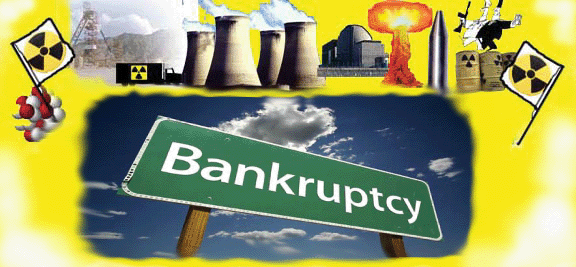 A Bankruptcy That Wrecked Global Prospects Of American Nuclear Energy, Forbes, Kenneth Rapoza The bankruptcy of Westinghouse Electric Company (WEC) has ruined its global ambitions. While the Pennsylvania-based company asserts that its March 29 filing for creditor protection doesn’t impact its businesses globally, very few seem to believe it as its Japanese parent company Toshiba Corp. warned on Tuesday that WEC may have nuked its future…….
“I see enormous difficulties ahead for Westinghouse,” says Simon Taylor, director of the Judge Business School at the University of Cambridge. Westinghouse was working on an over $20-billion Toshiba-controlled project in the north of England called Moorside, intending to build three of its pressurized water reactors known as the AP1000. Following the bankruptcy announcement, Engie, a French utility, exercised its option to sell its 40% interest to Toshiba, and quit the project. Now Toshiba is desperate to sell the fully-owned site to competitors as it doesn’t stand a single chance to raise money needed to build the plant.
Taylor thinks Westinghouse, one of the oldest names in U.S. electric power, will now have a harder time. China was their biggest hope.
“The Chinese, so far as I can tell, will never buy another AP1000 again,” Taylor says…….
[In India] . Experts doubt that any commercial contract could be signed until there is a clarity about Toshiba’s exit and Westinghouse’s own future while the calls to scrap the project altogether are gaining momentum…..
In Eastern Europe, Westinghouse prospects look even bleaker. Westinghouse has always relied in the U.S. geopolitical clout to get business there. In order to weaken Russia’s influence in the region Washington would all but force former communist countries into choosing WEC’s often untested offering or even scrapping competitors’ projects. But with all that political support the problem has always been in Westinghouse’s inability to finance its projects.
Westinghouse signed a contract in Bulgaria in 2014 for the construction of an AP1000 power plant at the Kozloduy site. There has been little progress since then as neither the client nor the vendor are capable of finding money for the project.
Back home, both of the two nuclear power plants being built in the U.S are AP1000s. Both are a combined $17 billion over budget.
Over the next 12 years, the U.S. has around 15 nuclear power plants on paper. Of those 12, five have been suspended, including Westinghouse’s planned 2029 project with Duke Energy in Florida to build two reactors. Their other Duke project, in South Carolina, is now delayed by at least three years and with this bankruptcy, will probably never get built. WEC’s two new AP1000 projects are licensed by Duke. “We’ve been monitoring Westinghouse and their other projects here and across the world…but we are not making any decisions to build and not going to speculate on that right now,” says Rita Sipe, a spokesperson for Duke Energy.
The Economist magazine speculated on April 1 that there would be ugly lawsuits in South Carolina and Georgia, adding that the future of the AP1000 “looks bleak”. Sadly, it was not an April Fool’s joke.
While it is certainly common in nuclear power plant construction to witness delays and cost over-runs, WEC seems to have carved out a niche of notoriety here. It’s finally bankrupted them.
“It’s hard to see who would be able, willing and permitted to buy WEC,” says Taylor. The Trump Administration says it is seeking a non-Chinese owner of Westinghouse. WEC is not yet talking about selling assets……https://www.forbes.com/sites/kenrapoza/2017/04/13/a-bankruptcy-that-wrecked-global-prospects-of-american-nuclear-energy/#608e8b7e17a1
Cautious and problematic negotiations at at U.N. nuclear weapons ban treaty meeting
 Big debates at U.N. nuclear weapons ban treaty negotiations Alicia Sanders-Zakre and Steven Pifer Brookings, April 12, 2017
The negotiation at the United Nations on a treaty to ban nuclear weapons began on March 27 with a bit of drama: U.S. Ambassador Nikki Haley gave a press conference explaining the U.S. decision to boycott the proceedings……
Some states advocated for the prohibition of the threat of use of nuclear weapons, claiming that it would serve to delegitimize nuclear deterrence doctrine. Others thought this prohibition was unnecessary, as the U.N. Charter already outlaws the threat of use of force. Moreover, a ban on the use of nuclear weapons would also ban the threat of their use.
Prohibiting the testing of nuclear weapons was also a contested question. Several states, including Kazakhstan, which continues to suffer the effects of having hosted the major Soviet nuclear test site, argued that testing should be explicitly prohibited. Others expressed concern that such a prohibition could come into conflict with the Comprehensive Test Ban Treaty or undermine its entry into force.
The participating states came down differently on the issue of the transit of nuclear weapons. While some stressed that transiting nuclear weapons through the territory of signatory states should be illegal, others pointed out that verifying this provision would be very challenging.
As to institutional arrangements, the participating states were in general agreement that the treaty should include a provision for regular meetings of states parties and use existing international organizations such as the International Atomic Energy Agency and perhaps the Comprehensive Test Ban Treaty Organization to help implement verification measures.
While states generally agreed that the treaty should be universal, they disagreed on the process for accession of nuclear weapons states. Gaukhar Mukhatzhanova of the James Martin Center for Nonproliferation Studies presented three options for accession: Nuclear weapons states could eliminate their arsenals before signing the treaty, sign the treaty with a clear plan for elimination, or negotiate a plan for elimination upon signing. Many states supported the second option while others advocated for the first.
All of these questions will require further discussion when the participating states gather for the second round of the negotiation in June.
LOOKING AHEAD
It is not clear that any of the issues where differences have arisen will prove deal-breakers for some participating states. How they resolve those differences—and whether in the end they can come to consensus on a ban treaty—will shape their ability to mobilize pressure on the nuclear weapons states.
And that is what this negotiation is all about. The non-nuclear weapons states have already committed in the NPT not to acquire nuclear arms. The question is whether they can push the nuclear weapons states to accelerate their disarmament efforts.
None of the specific resolutions will change the views of the nuclear weapons states on whether or not to take part in the ban treaty negotiation. They continue to regard the enterprise as disconnected from reality. But a successful negotiation that results in a treaty could up the pressure. The nuclear weapons states should pay attention. https://www.brookings.edu/blog/order-from-chaos/2017/04/12/big-debates-at-u-n-nuclear-weapons-ban-treaty-negotiations/
Nuclear history, and the false promises of Generation IV reactors
Generation IV reactors to the rescue?
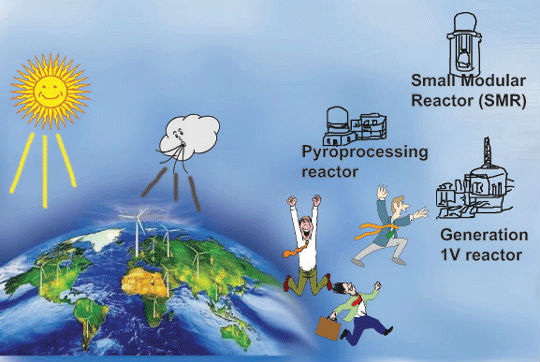
Given these problems, some look to new ‘Generation IV’ designs. They are basically new versions of the old designs looked at in the 1950s, 60s and 70s in the USA and elsewhere – and abandoned as unviable, or after accidents.
They include fast neutron plutonium breeders, High Temperature Reactors (HTRs) and Molten Salt Reactors (MSR) possibly using thorium as a fuel and possibly also in scaled down Small Modular Reactor (SMR) format.
The message from the past is not promising……
False promise: nuclear power: past, present and (no) future http://www.theecologist.org/News/news_analysis/2988856/false_promise_nuclear_power_past_present_and_no_future.html David Elliott 12th April 2017
Nuclear power was originally sold on a lie, writes Dave Elliott. While we were being told it would make electricity ‘too cheap to meter’, insiders knew it cost at least 50% more than conventional generation. Since then nuclear costs have only risen, while renewable energy prices are on a steep decline. And now the nuclear behemoths are crumbling … not a moment too soon.
In a December 1953 speech to the United Nations, President Dwight D. Eisenhower launched the ‘Atoms for Peace’programme, saying:
“The miraculous inventiveness of man shall not be dedicated to his death but consecrated to his life.”
He claimed that “peaceful power from atomic energy is not a dream of the future. That capability, already proved, is here – now – today.” And the USA would help to ensure it could be used worldwide.
However, his advisors soon told him that it wasn’t viable. A classified internal State Department Intelligence Report, circulated in January 1954, ‘Economic Implications of Nuclear Power in Foreign Countries‘, warned that the introduction of nuclear power would
” … not usher in a new era of plenty and rapid economic development as is commonly believed. Nuclear power plants may cost twice as much to operate and as much as 50 percent more to build and equip than conventional thermal plants.” [Quoted by Mara Drogan in ‘The Nuclear Imperative: Atoms for Peace and the Development of U.S. Policy on Exporting Nuclear Power, 1953-1955 Diplomatic History 40 Issue 5 948-974.]
Nonetheless, the nuclear juggernaut rolled on, with, US Atomic Energy Commission Chairman Lewis Strauss, in a 1954 address to science writers, claiming: “It is not too much to expect that our children will enjoy in their homes electrical energy too cheap to meter.”
The USA, followed by the UK, France, Russia and Japan, poured vast resources into nuclear power – new plants and new research projects.
Murphy’s law of nuclear power?
But things didn’t always go to plan. For example, there took place a series of accidents at US experimental reactor test sites, including an explosion at the SL1 project in Idaho in 1961, which killed three operators – one of whom was impaled to the roof by a fuel rod.
Then in 1966, the Fermi fast reactor, near Detroit, suffered a fuel melt down, and in 1979, the Pressurised Water Reactor (PWR) at Three Mile island narrowly avoided a major hydrogen explosion by venting radioactive gas to the air. That signalled the end of nuclear growth in the the USA. The multi-billion dollar plant had to be written off. Opposition mounted. New plants, orders collapsed.
Then came the Chernobyl disaster in the Ukraine in 1986, with the cloud spreading across most of Europe. There was a global meltdown in orders for new plants.
However, it wasn’t just the accidents that were the problem. The poor economics of nuclear gradually became more apparent- as cheaper alternatives began to emerge. It turned out to be too expensive – e.g. it could not compete with cheap gas plants in the UK. As Lord (Walter) Marshall, one- time head of the UK Atomic Energy Authority, when chair of the CEGB in 1987, commented:
“The British Public have never had the cheap electricity that we have always promised from nuclear power. It has been, and continues to be, a case of ‘jam tomorrow, but never today’.”
But for our politicians, the nuclear dream never died
But that didn’t stop Marget Thatcher from pushing ahead with a new nuclear plant (a PWR) at Sizewell, work on it starting in 1987. Or Tony Blair later trying to relaunch a new programme “with a vengence”. That has still yet to happen. But it’s pending, with the £24 billion Hinkley Point C European Pressurised-water Reactor (EPR), if it goes ahead, being the first new UK plant in 30 years.
Fukushima, in 2011, had intervened, slowing the nuclear programme worldwide, and creating liabilities of hundreds of billions of dollars. But the UK has pressed ahead with plans for maybe 18GW of new plant – delivering around 30% of UK electricity in the 2030s.
This expansion is based on so-called ‘Generation III’ reactors, basically upgrades of the Generation II PWRs and similar designs that have been the mainstay of nuclear so far. The new versions are unlikely to be any more competitive against cheap gas and increasingly cheap renewables.
The nuclear industry still has hopes for the French EPR, the Toshiba / Westinghouse AP1000 and the Hitachi ABWR – an upgrade of the Fukushima boiling water reactor design.
But the EPRs being built in France and Finland, Flamanville and Olkiluoto, are both around eight years late and three times over budget. Flamanville’s gigantic stainless steel reactor vessel and dome is also suffering from serious metallurgical flaws which may yet prevent its completion.
The two AP1000s being built in the USA have also been delayed, creating losses of over $10 billion that have pushed Westinghouse into bankruptcy, and its Japanese parent company, Toshiba, into what may prove to be a terminal financial meltdown. The two ABWRs under construction in the US are also seriously behind schedule.
Generation IV reactors to the rescue?
Given these problems, some look to new ‘Generation IV’ designs. They are basically new versions of the old designs looked at in the 1950s, 60s and 70s in the USA and elsewhere – and abandoned as unviable, or after accidents.
They include fast neutron plutonium breeders, High Temperature Reactors (HTRs) and Molten Salt Reactors (MSR) possibly using thorium as a fuel and possibly also in scaled down Small Modular Reactor (SMR) format.
The message from the past is not promising. Most countries (US, UK, France) gave up on fast breeders in the 1980s and 1990s. Japan has now too. The UK tested an HTR in the 1960s with its Dragon project at Winfrith. Germany and the USA had a go too. The US also tested some MSR technology in the 1960s, and also the use of thorium as fuel. SMRs were also tested.
None of these ideas went forward owing to massively escalating costs and successive technical dificulties. But the industry claims that new variants on these old designs will be upgraded, cheaper and safer.
However, in a review of Generation IV options, the French nuclear agency IRSN said that, at the present stage of development, it did not see any evidence that “the systems under review are likely to offer a significantly improved level of safety compared with Generation III reactors, except perhaps for the High Temperature Reactor” – and even that would require “significantly limiting unit power”.
Allison MacFarlane, former chair of the US Nuclear Regulatory Commission, talking about the HTR, said “I do not see past experience pointing at a positive direction.”
She also noted that Fast Breeder Reactors “turn out to be very expensive technologies to build. Many countries have tried over and over. What is truly impressive is that … many governments continue to fund a demonstrably failed technology.”
As nuclear power grows more costly, renewables prices plunge
Cost reduction is clearly vital if any of these ideas is to prosper. That’s one of the arguments used for small modular reactors (SMRs): they would be faster to build and so possibly easier to finance. It might also be possible to use the waste heat from them to supply heat to urban areas – if residents would accept them in or near cities.
But is that likely? SMRs are very unlikely ever to be cheap. The reason why civil nuclear power stations ever got so big as the EPR (1.6GW), ABWR (1.6GW) and AP1000 (1.25GW) is to reap ‘economies of scale’ which would be lost by going small.
And of course there is nothing remotely ‘new’ about SMRs, indeed they are a distinctly mature technology: hundreds of them have been deployed in military submarines and ships, for decades. The reason why they were never used for civil power generation is simple – they cost too much! So what exactly is about to change?
In any case all these Generation IV ideas are a decade or two, or maybe more, away from anything approaching commercial reality. It’s like the situation renewables faced in the 1980s. Renewables did break through and are now viable – wind and PV solar especially. Will Generation IV nuclear be able to do the same? Or do we need to wait until Generation V – fusion? If that ever works. Or do we actually need any of these nuclear ideas?
Renewables have outperformed nuclear across the board – undercutting its cost and delivering over twice its total annual output globally: renewables now supply 24% of global electricity, and are growing rapidly, as against the fairly static 11.5% from nuclear.
Renewables are on the way to 50% of power production in many countries by 2030, and maybe close to 100% by 2050. The resource is huge, and, unlike uranium or thorium, it won’t ever run out, or leave long-term hazardous wastes. That looks like our best future.
Pentagon’s new killing systems for space
Why is America Sending an Aircraft Carrier Near North Korea?, National Interest, Kris Osborn, 12 Apr 17 “……….The Pentagon is also substantially increasing its arsenal of Ground Based Interceptors, or GBIs, currently stationed at Vandenberg AFB, Calif., and Ft. Greeley, Ala. The plan, first announced by former Defense Secretary Chuck Hagel several years ago, aims to increase the number of GBIs to 44 by 2017. GBIs are interceptor missiles designed to shoot up into space and destroy approaching enemy ICBMs.
Mann praised the Army soldiers who work on GBI preparation, maintenance and operation at Ft. Greely, explaining how they endure difficult weather conditions to serve America better protect the U.S. homeland.
Multi-Object Kill Vehicle:
The Pentagon’s Missile Defense Agency is in the early phases of engineering a next-generation “Star Wars”-type technology able to knock multiple incoming enemy targets out of space with a single interceptor, officials said.
“We will develop and test, by 2017, MOKV command and control strategies in both digital and hardware-in-the-Loop venues that will prove we can manage the engagements of many kill vehicles on many targets from a single interceptor. We will also invest in the communication architectures and guidance technology that support this game changing approach,” a Missile Defense Agency spokesman, told Scout Warrior last year.
Decoys or countermeasures are missile-like structures, objects or technologies designed to throw off or confuse the targeting and guidance systems of an approaching interceptor in order to increase the probability that the actual missile can travel through to its target.
If the seeker or guidance systems of a “kill vehicle” technology on a GBI cannot discern an actual nuclear-armed ICBM from a decoy – the dangerous missile is more likely to pass through and avoid being destroyed. MOKV is being developed to address this threat scenario.
The Missile Defense Agency has awarded MOKV development deals to Boeing, Lockheed and Raytheon as part of a risk-reduction phase able to move the technology forward, MDA officials said.
Steve Nicholls, Director of Advanced Air & Missile Defense Systems for Raytheon, told Scout Warrior last year that the MOKV is being developed to provide the MDA with “a key capability for its Ballistic Missile Defense System. The idea is to discriminate lethal objects from countermeasures and debris. The kill vehicle, launched from the ground-based interceptor extends the ground-based discrimination capability with onboard sensors and processing to ensure the real threat is eliminated.”
MOKV could well be described as a new technological step in the ongoing maturation of what was originally conceived of in the Reagan era as “Star Wars” – the idea of using an interceptor missile to knock out or destroy an incoming enemy nuclear missile in space. This concept was originally greeted with skepticism and hesitation as something that was not technologically feasible.
Not only has this technology come to fruition in many respects, but the capability continues to evolve with systems like MOKV. MOKV, to begin formal product development by 2022, is being engineered with a host of innovations to include new sensors, signal processors, communications technologies and robotic manufacturing automation for high-rate tactical weapons systems, Nicholls explained.
The trajectory of an enemy ICBM includes an initial “boost” phase where it launches from the surface up into space, a “midcourse” phase where it travels in space above the earth’s atmosphere and a “terminal” phase wherein it re-enters the earth’s atmosphere and descends to its target. MOKV is engineered to destroy threats in the “midcourse” phase while the missile is traveling through space.
An ability to destroy decoys as well as actual ICBMs is increasingly vital in today’s fast-changing technological landscape because potential adversaries continue to develop more sophisticated missiles, countermeasures and decoy systems designed to make it much harder for interceptor missile to distinguish a decoy from an actual missile.
As a result, a single intercept able to destroy multiple targets massively increases the likelihood that the incoming ICBM threat will actually be destroyed more quickly without needing to fire another Ground Based Interceptor.
Raytheon describes is developmental approach as one that hinges upon what’s called “open-architecture,” a strategy designed to engineer systems with the ability to easily embrace and integrate new technologies as they emerge. This strategy will allow the MOKV platform to better adjust to fast-changing threats, Nicholls said.
The MDA development plan includes the current concept definition phase, followed by risk reduction and proof of concept phases leading to a full development program, notionally beginning in fiscal year 2022, Raytheon officials explained.
MDA officials have told Scout Warrior that the MOKV program shows great promise for the future of missile defense technology.
While the initial development of MOKV is aimed at configuring the “kill vehicle” for a GBI, there is early thinking about integrating the technology onto a Standard Missile-3, or SM-3, an interceptor missile also able to knock incoming ICBMs out of space. The SM-3 is also an exo-atmopheric “kill vehicle,” meaning it can destroy short and intermediate range incoming targets; its “kill vehilce” has no explosives but rather uses kinetic energy to collide with and obliterate its target. The resulting impact is the equivalent to a 10-ton truck traveling at 600 mph, Raytheon statements said. http://nationalinterest.org/blog/the-buzz/why-america-sending-aircraft-carrier-near-north-korea-20136?page=2
Hans M. Kristensen on New START 2017: Russia Decreasing, US Increasing Deployed Warheads
New START 2017: Russia Decreasing, US Increasing Deployed Warheads https://fas.org/blogs/security/2017/04/newstart2017/ Apr.03, 2017 By Hans M. Kristensen
The latest set of New START aggregate data released by the US State Department shows that Russia is decreasing its number of deployed strategic warheads while the United States is increasing the number of warheads it deploys on its strategic forces.

The Russian reduction, which was counted as of March 1, 2017, is a welcoming development following its near-continuous increase of deployed strategic warheads compared with 2013. Bus as I previously concluded, the increase was a fluctuation caused by introduction of new launchers, particularly the Borei-class SSBN.
The US increase, similarly, does not represent a buildup – a mischaracterization used by some to describe the earlier Russian increase – but a fluctuation caused by the force loading on the Ohio-class SSBNs.
Strategic Warheads
The data shows that Russia as of March 1, 2017 deployed 1,765 strategic warheads, down by 31 warheads compared with October 2016. That means Russia is counted as deploying 228 strategic warheads more than when New START went into force in February 2011. It will have to offload an additional 215 warheads before February 2018 to meet the treaty limit. That will not be a problem.
The number of Russian warheads counted by the New START treaty is only a small portion of its total inventory of warheads. We estimate that Russia has a military stockpile of 4,300 warheads with more retired warheads in reserve for a total inventory of 7,000 warheads.
The United States was counted as deploying 1,411 strategic warheads as of March 1, 2017, an increase of 44 warheads compared with the 1,367 strategic deployed warheads counted in October 2016. The United States is currently below the treaty limit and can add another 139 warheads before the treaty enters into effect in February 2018.
The number of US warheads counted by the New START treaty is only a small portion of its total inventory of warheads. We estimate that the United States has a military stockpile of 4,000 warheads with more retired warheads in reserve for a total inventory of 6,800 warheads.
Strategic Launchers
The New START data shows that Russia as of March 1, 2017 deployed 523 strategic launchers, an increase of 15 launchers compared with October 2016. That means Russia has two (2) more launched deployed today than when New START entered into force in February 2011.
Russia could hypothetically increase its force structure by another 177 launchers over the next ten months and still be in compliance with New START. But its current nuclear modernization program is not capable of doing so.
Under the treaty, Russia is allowed to have a total of 800 deployed and non-deployed strategic launchers. The data shows that it currently has 816, only 16 above the treaty limit. That means Russia overall has scrapped 49 total launchers (deployed and non-deployed) since New START was signed in February 2011.
The United States is counted as deploying 673 strategic launchers as of March 1, 2017, a decrease of eight (8) launchers compared with October 2016. That means the United States has reduced its force structure by 209 deployed strategic launchers since February 2011.
The US reduction has been achieved by stripping essentially all excess bombers of nuclear equipment, reducing the ICBM force to roughly 400, and making significant progress on reducing the number of launch tubes on each SSBN from 24 to 20.
The United States is below the limit for strategic launchers and could hypothetically add another 27 launchers, a capability it currently has. Overall, the United States has scrapped 304 total launchers (deployed and non-deployed) since the treaty entered into force in February 2011, most of which were so-called phantom launchers that were retired but still contained equipment that made them accountable under the treaty.
The United States currently is counted as having 820 deployed and non-deployed strategic launchers. It will need to destroy another 20 to be in compliance with New START by February 2018.
Conclusions and Outlook
Both Russia and the United States are on track to meet the limits of the New START treaty by February 2018. The latest aggregate data shows that Russia is again reducing its deployed strategic warheads and both countries are already below the treaty’s limit for deployed strategic launchers.
In a notorious phone call between Russian President Vladimir Putin and US President Donald Trump, the Russian president reportedly raised the possibility of extending the New START treaty by another five years beyond 2021. But Trump apparently brushed aside the offer saying New START was a bad deal. After the call, Trump said the United States had “fallen behind on nuclear weapons capacity.”
In reality, the United States has not fallen behind but has 150 strategic launchers more than Russia. The New START treaty is not a “bad deal” but an essential tool to provide transparency of strategic nuclear forces and keeping a lid on the size of the arsenals. Russia and the United States should move forward without hesitation to extend the treaty by another five years.
Additional resources:
- New START Aggregate Data (as of March 1, 2017)
- Status of World Nuclear Forces
1 This Month


Tell the Ukrainian Government to Drop Prosecution of Peace Activist Yurii Sheliazhenko

Petition to revoke the licensing of the Near Surface Nuclear Disposal Facility (NSDF) at Chalk River. https://www.ourcommons.ca/petitions/en/Petition/Details?Petition=e-7247


of the week – STOP SMALL MODULAR REACTORS IN CANADA
To see nuclear-related stories in greater depth and intensity – go to https://nuclearinformation.wordpress.com
-
Archives
- March 2026 (204)
- February 2026 (268)
- January 2026 (308)
- December 2025 (358)
- November 2025 (359)
- October 2025 (376)
- September 2025 (258)
- August 2025 (319)
- July 2025 (230)
- June 2025 (348)
- May 2025 (261)
- April 2025 (305)
-
Categories
- 1
- 1 NUCLEAR ISSUES
- business and costs
- climate change
- culture and arts
- ENERGY
- environment
- health
- history
- indigenous issues
- Legal
- marketing of nuclear
- media
- opposition to nuclear
- PERSONAL STORIES
- politics
- politics international
- Religion and ethics
- safety
- secrets,lies and civil liberties
- spinbuster
- technology
- Uranium
- wastes
- weapons and war
- Women
- 2 WORLD
- ACTION
- AFRICA
- Atrocities
- AUSTRALIA
- Christina's notes
- Christina's themes
- culture and arts
- Events
- Fuk 2022
- Fuk 2023
- Fukushima 2017
- Fukushima 2018
- fukushima 2019
- Fukushima 2020
- Fukushima 2021
- general
- global warming
- Humour (God we need it)
- Nuclear
- RARE EARTHS
- Reference
- resources – print
- Resources -audiovicual
- Weekly Newsletter
- World
- World Nuclear
- YouTube
-
RSS
Entries RSS
Comments RSS
 nuclear-news