How is climate change affecting us now?
https://wordpress.com/read/feeds/17124327/posts/1420777969 QUORA QUESTION: HOW IS CLIMATE CHANGE AFFECTING US NOW? Quora Questions are part of a partnership between Newsweek and Quora, through which we’ll be posting relevant and interesting answers from Quora contributors throughout the week. Answer from Michael Barnard, low-carbon innovation analyst:
Climate change is already being felt in innumerable ways today.
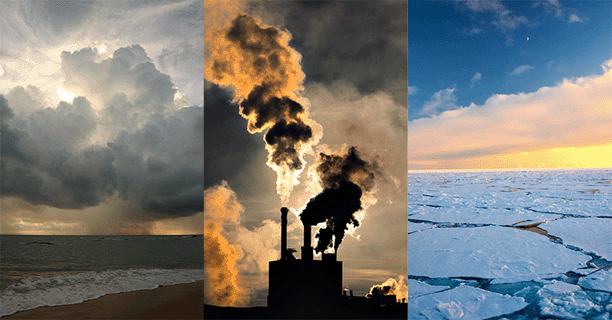
Climate change is one of the underlying contributors to some of the most major stories of the past decade and is being felt broadly and mostly negatively.
Coral Reef Bleaching Event Climate Change Coral reefs are about to enter a record third year of bleaching due to warmer seas, a federal agency announced.
Regional conflicts: Climate change has increased drought in the middle east, and has contributed to the rise of ISIS and the destabilization of the middle east playing out now. This in turn has led to the millions of Syrian and other refugees in temporary refugee camps in countries outside of the worst impacted areas and the hundreds of thousands of refugees attempting to get to Europe and often drowning. Researchers Link Syrian Conflict to a Drought Made Worse by Climate Change.
Miami is sinking: Many parts of Miami are already experiencing sea water welling up from under foot at king tides and some are experiencing regular flooding at merely high tides. This is with the relatively small amount of sea level rise already experienced. This is an indicator of what is to come. Miami Is Sinking Into the Sea—But Not Without a Fight.
Farmers are under stress: Farmers are already adapting to changes in climate, but not without impacts. There is already an increase in frequency and severity of drought and heavy rains, extremes which make getting crops difficult. Already crops are shifting north in the northern hemisphere. Climate Impacts in the Midwest: Becoming More Resilient.
Pine Beetle devastating forests: The Pine Beetle has shifted its range further north with increasingly warm climates in North America, moving into Canada and devastating extremely large areas of pine forest. This has caused significant economic and environmental fallout. The Bug That’s Eating the Woods
Wildfires are increasing: Wildfires are becoming more frequent, more severe and covering more ground due to climate change. This is killing people, burning communities out, reducing air quality substantially over major areas of continents and costing quite a lot to deal with. Is Global Warming Fueling Increased Wildfire Risks?
Insurance premiums are up: Insurance companies have been paying out a lot more in claims due to climate change, and in return have been changing their premium structures and rates. They have seen a statistically clear indication of climate change in terms of extreme weather events which cause significant economic damage. Extreme weather forces insurers to adapt and lobby for change.
Hundreds of thousands are already dying annually: A UN organization tasked with monitoring the impacts of climate change calculates that climate change is already causing 400,000 premature deaths a year. CLIMATE VULNERABILITY MONITOR.
Permafrost is melting: Northern communities and physical infrastructure is built on permanently frozen ground, which if melted is a quagmire. Melting of this permafrost is already occurring, destroying buildings and infrastructure such as roads. Permafrost warming in parts of Alaska ‘is accelerating’ – BBC News.
Jellyfish blooms are causing damage: Jellyfish are enjoying the warmer oceans, and increasing substantially in range and numbers. They are clogging thermal power plant intakes causing the plants to shut down and destroying fish farms. Massive Swarms of Jellyfish Are Wreaking Havoc on Fish Farms and Power Plants.
Tornadoes are increasing and shifting range: Tornadoes are clustering, increasing in destructive power and being seen further north and in different times of the year. This is one of the predictions of climate change models and appears to be playing out. Communities with no tornado warnings or experience in dealing with them are being hit. New U.S. tornado trend is worrisome.
Press link for more: Newsweek
North Korea’s nukes evil? America’s nukes peaceful?
 America’s Peace Making Nukes vs. North Korea’s WMD: Simultaneous Nuclear Weapons Tests by U.S. and North Korea By Prof Michel Chossudovsky Global Research, April 15, 2017 “………North Korea versus the United States
US public opinion is routinely led to believe that US nukes are harmless (safe for civilians). The devastating consequences (amply documented) of the use of nuclear weapons is carefully obfuscated. In contrast to the nukes developed by North Korea, the US Department of Defense considers both the B61-11 and the new B61-12 as”harmless to the surrounding civilian population because the explosion is underground“, according to “scientific opinion” on contract to the Pentagon.http://www.globalresearch.ca/americas-peace-making-nukes-vs-north-koreas-wmd-simultaneous-nuclear-weapons-tests-by-u-s-and-north-korea/5585140
While the DPRK’s nukes are considered as bona fide Weapons of Mass Destruction (WMD) and a Threat to Global Security, America’s tactical mini-nukes are categorized as “peace-making bombs”. They’re harmless to civilians according to the military manuals; let’s go head and use them as part of a pre- emptive “humanitarian” war under an R2P mandate (“Responsibility to Protect”).
Lest we forget, the DPRK has been threatened by the US with nuclear war for more than half a century. Barely a few years after the end of the Korean War (1950-53), the US initiated its deployment of nuclear warheads in South Korea. This deployment in Uijongbu and Anyang-Ni had been envisaged as early as 1956.
Trump-Style Political Insanity
All the safeguards of the Cold War era, which categorized the nuclear bomb as “a weapon of last resort”, have been scrapped. “Offensive” military actions using nuclear warheads are now described as acts of “self-defense”.
In the post Cold war era, US nuclear doctrine was redefined. There is no sanity under the Trump administration as to what is euphemistically called US foreign policy. Trump hasn’t the foggiest idea as to the consequences of nuclear war. Nor does he have an understanding of the workings of US foreign policy.
At no point since the first atomic bomb was dropped on Hiroshima on August 6th, 1945, has humanity been closer to the unthinkable… (Image of Hiroshima in the wake of the bombing)
Stay informed, spread the word far and wide. To reverse the tide of war, the broader public must be informed. Post on Facebook/Twitter.
Confront the war criminals in high office.http://www.globalresearch.ca/americas-peace-making-nukes-vs-north-koreas-wmd-simultaneous-nuclear-weapons-tests-by-u-s-and-north-korea/5585140
North Korea’s steady march towards a missile that can hit America
Month-by-month North Korea edges closer to a missile that can hit America http://www.news.com.au/world/asia/monthbymonth-north-korea-edges-closer-to-a-missile-that-can-hit-america/news-story/d524ea3d65ef15906bb1b1439923fb5d\ APRIL 16, 2017 ANALYSIS
THE strategic temperature on the Korean peninsula continues to rise and North Korea’s failed missile launch has done nothing to dial down tensions.
The launch clearly designed to coincide with the visit of US Vice President Mike Pence to South Korea, as well as sending an unequivocal that Pyongyang is not deterred by the US military build-up in the region.
The missile launch proved to be a dud, but it’s wrong to assume this reveals major flaws in North Korea’s capacity to strike targets far and wide.
The regime in Pyongyang has already proven it possesses the ability to acquire an intercontinental ballistic missile (ICBM) by successfully placing satellites into orbit twice. The regime has also rapidly accelerated the country’s nuclear weapons program, which has been central to North Korea’s strategy of military self-reliance since the 1960s.
Month-by-month, Pyongyang is edging closer to weaponising a nuclear-armed missile that can hit the United States (and by definition Australia). This is a sobering prospect, one that deeply concerns policymakers. It explains why the Trump administration has deployed a carrier battle group to waters surrounding the Korean peninsula, and why Washington will move to reinforce this presence if North Korea tests another missile in coming days, or worse still, a nuclear device.
Pyongyang will probably carry out either a nuclear test or another missile launch before the end of the month. The regime will be keen to validate its credentials in standing up to President Trump, not least to demonstrate to the North Korean people that Kim Jong-un is in firm command of the country but also to prove to the world that North Korea will not be pushed around by any other country, no matter how powerful or who’s in charge.
Andrew O’Neil is Professor of Political Science and Dean of Research in the Business School at Griffith University
New and worrying studies on Greenland ice
New study shows worrisome signs for Greenland ice https://www.skepticalscience.com/worrisome-signs-for-greenland-ice.html 14 April 2017 by John Abraham
As humans put more heat-trapping gases into the atmosphere, like carbon dioxide, ice around the planet melts. This melting can be a problem, particularly if the melting ice starts its life on land. That’s because the melt water flows into the oceans, contributing to rising sea levels. Right now there are three main reasons that sea levels are rising. First, as ocean waters heat, they expand. Second, melting of ice in Antarctica flows into the ocean. Third, melting of ice on Greenland flows into the ocean. There is other melting, like mountain glaciers, but they are minor factors.
Okay, so how much is melting of Greenland contributing to sea level rise? Estimates are that about 270 gigatons of water per year are melting. The melting of an ice sheet like that atop Greenland can occur from the surface as air temperatures and sunlight warm the upper layer of ice. It can also occur from the edges as ice shelves collapse and fall into the oceans in large chunks.
For ice-shelf collapse, there’s a complex process that occurs at the bottom of the ice. Part of the ice is floating out over water and part of it is grounded on land. Warm water can get underneath the ice, lift it up, and melt the ice from below.
The bedrock underneath the ice sheet is not flat or gradually changing. There are undulations that rise and fall and change the water-ice-ground connection. Topology called “retrograde” can make it easier for ice to melt and can increase the rate of ice shelfcollapse. So, scientists have a real interest in learning about the topology of the land underneath ice sheets so they can better predict ice collapse and sea level rise.
This brings us to a new study published by the American Geophysical Union in a journal called Geophysical Letters Review. The scientists use gravitometry to obtain a high-quality picture of the land underneath a very fast moving part of Greenland ice called the Jacobshavn Isbrae. Basically, the scientists flew gravity sensors across the ice at low altitudes and low velocity. These sensors are called accelerometers and they can be used to determine the x, y, and z gravity components. The measurements of the gravity allowed them to attain the local height of the subsurface with greater accuracy than previously known.
As stated in the paper, the motivation for this work was clear:
the fjord bathymetry and glacier bed topography of the lower portion of Jacobshavn Isbrae have remained poorly known. At least not sufficiently to provide reliable information for ice sheet numerical models.
They found that the trough underneath the ice was not symmetrically shaped; the northern part of the trough was deeper than the southern part.
Stop focusing on celebrities and shares – inform people on climate change – David Suzuki
“As long as we’re focused on celebrity and economics, we’re not going to see the world in a way that 
allows us to live and thrive,” he said.
“Why don’t you at least give us an indicator of what we’re doing to the planet?” he asked. “We don’t do that. Our priorities are indicated by things like the Dow Jones average and all that crap.
 Suzuki wants journalists to forget the Dow Jones, report on climate every day, National Observer April 13th 2017 David Suzuki cuts straight to the chase. The state of Canada’s climate action is “disgusting,” he says, and the federal government should be ashamed.
Trump administration plans to eliminate climate data collection
Scientists Fear Climate Data Gap as Trump Aims at Satellites, NYT APRIL 10, 2017 Among the sweeping cuts in the Trump administration’s 53-page budget blueprint released last month, one paragraph stood out to climate researchers. It proposed eliminating four of NASA’s climate science missions, including instruments to study clouds, small airborne particles, the flow of carbon dioxide and other elements of the atmosphere and oceans.
Irresponsible of Court rulings to permit restart of restart of Japan’s NPPs
Court rulings permitting restart of NPPs are irresponsible http://www.japan-press.co.jp/modules/news/index.php?id=10497 April 5, 2017 Akahata editorial
‘Safety myth’ may again run rampant
If deeming that as long as the NRA gives a green light to resuming operations of nuclear reactors, courts do not need to judge whether or not such operations are appropriate, they would no longer be judicial apparatuses independent from the government. The Abe Shinzo Cabinet in principle reactivates NPPs which meet the NRA regulatory standards. It is tantamount to reinforcing the “safety myth” about the NRA screening itself.
Both of the court rulings state that people have the right to seek to protect their lives and livelihoods from NPP-related risks as the Constitution guarantees “personal rights”. The two judgements point out that the investigation into the cause of the 2011 Fukushima nuclear meltdown is totally insufficient. Concerning the NRA quakeproofing and tsunami-proofing criteria that the state used in approving the restart of NPPs, the court decisions criticized the criteria as “too lax”, which is of grave significance. The Fukui and Otsu district courts refused to blindly follow the government’s pro-nuclear policy and made independent decisions, clearly highlighting the collapse of the “safety myth”.
However, the recent decisions by the Osaka High Court and the Hiroshima District Court were completely unlike the previous two courts’ decisions. Regarding the nuclear safety standards that the NRA employed in allowing the reactivation of the reactors, the rulings by the two courts acknowledged the safety standards as “not unreasonable”, claiming that they reflect lessons learned from past accidents as well as the latest scientific and technical knowledge”. The Hiroshima ruling not just followed the state policy but abandoned the principle of judicial independence. It asserted that inconsistencies among court judgements will lead to confusion and that the Hiroshima court made the decision in line with the April 2016 decision by the Fukuoka High Court Miyazaki Branch which allowed the operation of Nos 1 and 2 reactors at the Kyushu Electric Power Company Sendai NPP (Kagoshima Pref.). If the judiciary keeps taking such a stance, it will be unable to protect people’s lives and their human rights.
Safeguard people’s rights
In the first place, the Constitution guarantees people’s right to go to court. It is a matter of course that judges should make their own decisions without being influenced by the state.
Experimental deep bore project under consideration
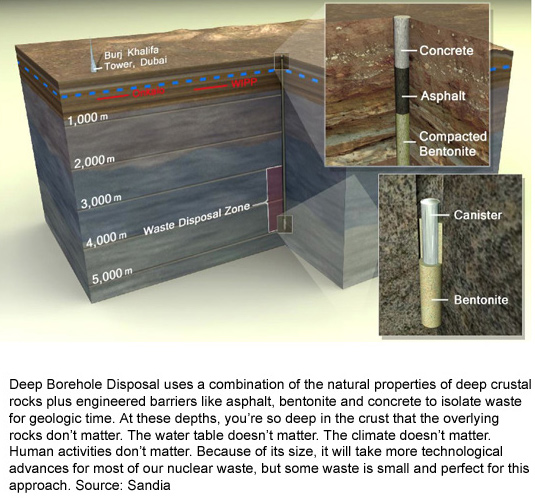 County commissioners weigh nuclear waste storage project http://www.wral.com/county-commissioners-weigh-nuclear-waste-storage-project/16647314/ ALAMOGORDO, N.M. — County commissioners in southern New Mexico are in debate over a federal project that aims to determine whether nuclear waste can be stored far underground.
The Otero County Commission discussed a proposed resolution in opposition of the project Thursday, but the panel decided to hold off on taking any action, The Alamogordo Daily News reported (http://bit.ly/2oaS2oL).
Commissioners say they have received comments from residents both for and against the project, which involves the drilling of narrow, vertical holes deep into the ground to test whether they can hold disposed nuclear material.
The U.S. Department of Energy is paying for the testing by New Mexico-based TerranearPMC and has said no nuclear waste will be involved.
Fred Stong, director of FIRST Robotics New Mexico, voiced his support for the project during Thursday’s meeting, saying he would like to see it continue because there are many residents who support science and technology.
“There is no waste in this program. This is a wonderful geographical opportunity,” Stong said. “Our job is to bring technology in, not drive away technology from this community.” But resident Bobby Jones said the federal government’s plan was too risky and he doesn’t “support the project because of what might happen afterwards.”
TerranearPMC CEO Kenneth Fillman said he shares residents’ concerns and an environmental assessment will be conducted before the company moves forward with the project.
The Otero County Commission meeting came the same day Harding County passed a resolution opposing a similar borehole project in neighboring Quay County.
Beatrix Potter’s Beloved Lake District Still Endangered by Proposed New Nuclear Reactors and Nuclear Waste

Beatrix Potter, best known as the author-illustrator of “The Tale of Peter Rabbit“, “supported the efforts of the National Trust to preserve not just the places of extraordinary beauty but also those heads of valleys and low grazing lands that would be irreparably ruined by development… She left nearly all her property to the National Trust, including over 4,000 acres (16 km2) of land, sixteen farms, cottages and herds of cattle and Herdwick sheep. Hers was the largest gift at that time to the National Trust, and it enabled the preservation of the land now included in the Lake District National Park and the continuation of fell farming.” https://en.wikipedia.org/wiki/Beatrix_Potter
A friend of Beatrix Potter who arrived in Cumbria in the 1930s remarked: “When I first came to the Lake District whenever John or I walked there were birds but since the atomic station came there have…
View original post 1,126 more words
April 16 Energy News

Opinion:
¶ “The Nuclear Industry Is Heading Into a Financial Black Hole That Threatens Any Future Expansion” • Any lingering hope that a nuclear power renaissance would help combat climate change appears to have been dashed by the Westinghouse bankruptcy. “There is no one left to invest anymore because renewables are just cheaper.” [Truthdig]
 Sunset at the Sellafield nuclear plant (Dom Crayford | Flickr)
¶ “Why scientists are fighting back. We’ve had enough of Trump’s war on facts” • Next Saturday, in Washington, DC, and in rallies around the world, scientists and their supporters will stage what is likely to be the largest gathering of its kind in history. The March for Science has mobilised scientists and their supporters as never before. [The Guardian]
¶ “The de-electrification of the US economy” • The initial drop in electricity use in 2008 and 2009 could be attributed partly to…
View original post 531 more words
Tepco’s latest plan for Kawashiwazaki-Kariwa plant envisions restart in 2019

Tokyo Electric is now aiming to restart the Kawashiwazaki-Kariwa nuclear plant in Niigata Prefecture in April 2019, sources say.
The company plans to include the goal in its financial outlook under a reconstruction program, the sources said Friday.
Restarting the giant plant is considered important to Tokyo Electric Power Company Holdings Inc.’s ability to recover from the triple meltdown at the Fukushima No. 1 nuclear plant in March 2011.
But the prospects for rebooting the plant are dim because it is opposed by Niigata Gov. Ryuichi Yoneyama.
The reconstruction plan is also expected to include Tepco’s commitment to pursuing integration with other companies in some areas.
Tepco is expected to draw up the new plan and file for government approval as early as this month.
Six years after Fukushima – women and children still suffer most
The Japanese government is trying to get back to normality after the Fukushima nuclear disaster, but the crisis is far from over for women and children, says Greenpeace. Thousands of mothers have sued the authorities.

Six years ago, the triple disaster – earthquake, tsunami and meltdown at the Fukushima Daiichi power plant – took the lives of almost 20,000 people and displaced more than 160,000 people from their homes. More than 80,000 people are still living in temporary accommodation.
The disaster had an enormous impact on all members of the affected communities, but to this day it is women and children who “have borne the brunt of human rights violations resulting from it,” according to a report by Greenpeace.
While some injustices faced by women and children were caused by policy failures in the immediate aftermath of the disaster, other women’s and children’s rights violations are a direct result of the current government’s plans to resettle residents to “heavily contaminated ares in Fukushima,” says Greenpeace.
In an effort to get back to normality as quickly as possible, the Japanese government is set to lift evacuation orders at the end of March and allow evacuated residents to return to areas close to the Fukushima power plant.
 Employees clean an elementary school in Fukushima. It’s scheduled to re-open in April.
Greenpeace warned, however, that radiation levels are still dangerously high and called on the government not to “pressure” residents to return to their contaminated homes, under threat of losing financial support. A year after an area is declared safe, the government will stop paying compensation to evacuees.
In March, Japan will also cut housing support for people who decided to move out although they were not under a government evacuation order.
“Cutting off housing support for self-evacuees threatens more than 10,000 households, potentially forcing many people back to contaminated areas against their will,” says Kendra Ulrich, Global Energy Campaigner with Greenpeace Japan. Ending compensation payments “even though radiation levels far exceed the long-term targets in many areas […] amounts to economic coercion and is a deliberate violation of the law and survivors’ human rights.”
“Atomic divorce”
The resettlement plans create a dilemma for those who refuse to go back to their former homes but are dependent on financial support, especially single mums. After the disaster, a lot of women separated from or even divorced their husbands, who chose to stay in contaminated regions because of their work, and evacuated with their children.
There are no official numbers on how many families split as a result of the disaster. But the phenomenon is common enough to have a name, “genpatsu rikon” – literally meaning “atomic divorce”.
 These mothers evacuated with their children from Fukushima prefecture.
Mothers are now faced with the choice between losing housing support or moving back to unsafe areas. In order to speed up the return of evacuees, the government decontaminated corridors and islands instead of entire areas, effectivley creating “an invisible, open-air prison for citizens to return to,” says Greenpeace.
Decontaminated zones often consist of 20 meter strips along roads, around houses and agricultural fields. This poses a health threat as the returnees would be surrounded by contamination.
Mothers are worried about their health and the development of their children. Noriko Kubota, a professor of clinical psychology at Iwaki Meisei University, believes that living in “safe zones” could have a long-lasting negative impact on kids.
“If children need to stay inside and cannot run around outside freely, that would impact their psychological development, more specifically their skills of interacting with each other and controlling their emotions among others,” Kubota told DW.
Mothers sue government
Women are, however, not only silent victims in this disaster. Thousands of mothers have together filed lawsuits against the Japanese government to fight for the continuation of housing support and fair compensation. They also demand accountability for the disaster from the government and Tokyo Electric Power Co. (TEPCO), the company running the Fukushima Daiichi plant.
 Ms Horie is sueing the government for fair compensation.
“I never imagined becoming a plaintiff myself. I’m going to court now for my children and for the next generation,” Ms Horie told Greenpeace. She moved with her children from Fukushima to Kyoto, where she filed a class action suit together with other mums. “Back then, they said on TV that the accident wouldn’t affect our health immediately, but it might affect my kids in the future. That’s why I decided to evacuate.”
Women who left contaminated areas have been “labeled as neurotic or irrational,” says Greenpeace. Their concerns were dismissed both by their partners and the government. The lawsuit is not only about financial compensation but also for moral satisfaction.
“I want to stand in court, knowing that I am right to evacuate my child,” says Ms Sonoda, who moved with her child from Fukushima to England. “We are right.”
http://www.dw.com/en/six-years-after-fukushima-women-and-children-still-suffer-most/a-37871135
As I See It: Support for ‘voluntary evacuees’ insufficient but not too late to start
Kurumi Sugita: “I do not agree with the following part of the article.
“Radiation levels in Fukushima Prefecture dropped significantly shortly after the outbreak of the disaster, and in some areas, radiation levels are not much different from those in the Kansai region, where I live. “
There exists at least three problems which are related to each other:
1) you shouldn’t base your judgement only on airborne radiation measurements. We should look at the soil radio contamination density which is more reliable.
2) the official figures of airborne radiation measurements are average figures, which annihilates the problem of hotspots.
3) the governments do not acknowledge the risk of internal radiation and its health hazards.
All in all, the so-called “voluntary” evacuees have good reasons to keep evacuated and it is their basic human right.”

Friends help an evacuee (foreground) move in Osaka’s Suminoe Ward, ahead of the cutoff date for free housing, on March 18, 2017.
As I See It: Support for ‘voluntary evacuees’ insufficient but not too late to start
So-called “voluntary evacuees” who fled Fukushima Prefecture due to the ongoing nuclear crisis were cut off from free housing services at the end of March.
Since last fall, I have been reporting on the issue of termination of free housing for “voluntary evacuees” — those who evacuated from Fukushima Prefecture out of radiation concerns, even though their places of residence did not come under the government’s evacuation orders — and have met many evacuees who faced termination amid straitened circumstances and with no prospects of living independently.
Six years have passed since the outbreak of the nuclear disaster, and I believe that insufficient assistance provided by the central government, the Fukushima Prefectural Government, and the municipalities to which Fukushima Prefecture residents evacuated led to the current state of affairs.
Following the onset of the nuclear crisis at Fukushima No. 1 Nuclear Power Plant in March 2011, some Fukushima Prefecture residents who did not live in areas designated by the central government as no-go zones “voluntarily” evacuated to other areas of Fukushima Prefecture and beyond. The Fukushima Prefectural Government regarded the homes such evacuees chose to live in as “temporary housing” provided to victims of disasters, and covered their rent. Unlike evacuees from areas designated as no-go zones, most “voluntary evacuees” have not been eligible for compensation from Tokyo Electric Power Co. (TEPCO), the operator of the stricken Fukushima nuclear plant, leaving payment for housing from the Fukushima Prefectural Government as the only assistance such evacuees received. In June of 2015, however, the prefectural government announced that it would be terminating such assistance at the end of March 2017, saying that “an environment for leading everyday life in Fukushima is in the process of coming together.”
Radiation levels in Fukushima Prefecture dropped significantly shortly after the outbreak of the disaster, and in some areas, radiation levels are not much different from those in the Kansai region, where I live. However, many former Fukushima prefectural residents are still concerned with radiation, and among some families, children do not want to move back to Fukushima because they’ve made friends where they live now. As of October 2016, there were approximately 10,000 households of “voluntary evacuees” from Fukushima Prefecture. This spring, many of those households were faced with the difficult question of whether to move back to their hometowns, or pay out of pocket in order to continue life where they are.
What I took from reporting on the issue is the polarization of “voluntary evacuees.” Those who have been able to adapt to life where they’ve evacuated to and rebuild their lives said they wanted to leave behind their status as “evacuees.” Some even said they’d become leaders of neighborhood community associations.
Meanwhile, others said they couldn’t sleep at night because they were unable to find affordable housing, or that they didn’t have the funds to move. Among the latter were those with family members who have disabilities, or members who are from other countries and do not speak Japanese well — in other words, families who were vulnerable even before the outbreak of the nuclear disaster. I learned of cases in which people’s lives turned for the worse after they evacuated. For example, there have been cases of divorce that resulted after mothers evacuated with their children, leaving the father behind. Meanwhile, other evacuees developed mental illness or suffered strokes. Such evacuees needed assistance that was finely tuned to their individual needs in the areas of employment, medical care and education. However, there were many instances in which I felt they were not receiving sufficient care.
A 57-year-old man who “voluntarily” evacuated from the city of Fukushima to an Osaka municipal residence, remained isolated in a corner of the massive city for 4 1/2 years after the outbreak of the disaster. The man has a visual impairment that has qualified him for level-1 physical disability certification. He is not completely blind, but to read documents, he must step out onto the veranda for natural light and use a magnifying glass. With his disability, it is nerve-racking for him to go out alone in an unfamiliar city. His South Korean-born wife, 62, who helps him with his everyday life, does not read or write Japanese well. Because of this, he rarely obtained information from documents that were delivered to him from administrative offices or support organizations.
He thus remained unable to receive assistance, and was bogged down by debt that he incurred from moving and purchasing household furnishings. He didn’t even learn about the termination of free housing until six months after the Fukushima Prefectural Government made the announcement. Subsequently, based on the advice of a supporter who visited him at his home, he transferred his residency registration to the city of Osaka, and began receiving the city’s support services. However, he still has mixed feelings toward administrative agencies. “They had to have known about my visual disability. Whether it be the Fukushima Municipal Government or the Osaka Municipal Government, if someone had made the effort to inform me, I wouldn’t have had to suffer as much as I did,” he said.
In fiscal 2016, the Fukushima Prefectural Government and the municipalities to which Fukushima prefectural residents evacuated made individual visits to “voluntary evacuees.” They should have made the visits an opportunity not only to listen to residents’ concerns about housing after they were cut off, but also to help map out plans for households under straitened circumstances to become independent. But that was not necessarily the case.
A woman in her 50s who, with her child, evacuated from the Fukushima Prefecture city of Koriyama to a Tokyo public housing complex, was emotionally beaten down after constantly being reminded by housing management that she and her child were to leave by the end of the 2016 fiscal year. The woman said that she was even told that she could be hit with a lawsuit if she did not move out of the building.
The dedication with which local governments took the effort to visit evacuees differed from municipality to municipality, and at least one municipal government did not send staff to visit evacuees until three months before the free housing service was brought to an end. To make matters worse, many municipal governments were sending staff not from their welfare departments, but from their public housing departments to make the visits. Under such circumstances, criticism against municipal governments for lacking a commitment to provide comprehensive support to evacuees is hard to refute.
Another thing that caught my attention as I covered this issue is that a large number of evacuees are apprehensive about going on public assistance. A mother and child who evacuated to the city of Osaka declined advice to apply for welfare. They said they did not want to become a burden to the state, and eked out a living on an 80,000-yen monthly income. However, public assistance exists precisely for people like this family. Municipalities that have dispatched staff to make individual visits to evacuee households, and are abreast of which households are in dire straits, should actively try to dispel misperceptions and prejudice about welfare, and help those people receive the assistance they need.
I believe that the evacuees’ original municipalities of residence and the municipalities to which they evacuated are both responsible for the fact that they were unable to receive sufficient support before free housing was shut down. The Fukushima Prefectural Government assumed that the provision of housing assistance would suffice, while municipalities to which the residents evacuated had a latent notion that the evacuees weren’t “real” residents of the municipality.
It’s not too late, though. Both parties should collaborate and commit to closely assisting those facing grave hardships achieve self-reliance.
http://mainichi.jp/english/articles/20170413/p2a/00m/0na/012000c
To 15 April – nuclear and climate news
 Once again – weapons, and with the Syria conflict, the threat of nuclear war are in the news this week. South Korea tries to reassure citizens that U.S. won’t strike North Korea pre-emptively. Meanwhile cautious and problematic negotiations at at U.N. nuclear weapons ban treaty meeting.
The other big nuclear story is the dismal nuclear power industry prospects, after Westinghouse bankruptcy. Toshiba corporation might not survive its nuclear financial crisis.
Pre-emptive strike by USA on North Korea is on the cards, if North Korea conducts nuclear weapons test. North Korea has threatened “nuclear thunderbolts” at the first sign of a US preemptive strike.
Hans M. Kristensen on New START 2017: Russia Decreasing, US Increasing Deployed Warheads. Nuclear history, and the false promises of Generation IV reactors
In a radical change of pattern, Arctic warm water is being pushed to the surface. Global warming hitting Sub-Arctic wastelands, permafrost, more severely than expected.
March For Science 22 April . People’s Climate March 29 April.
CHINA. China warning North Korea against escalating tensions to an ‘irreversible’ stage.
IRAN. Foreign Ministers at G7 declare support for Iran nuclear agreement. US reaffirms Iran nuclear agreement. Overall analysis of the Iran Nuclear Agreement.
USA.
- For the first time, USA drops largest Non-Nuclear Bomb, in Afghanistan.
- Trump’s attack on Syria very good for his shares in missile-maker Raytheon.
- Pentagon’s new killing systems for space.
- American nuclear power industry prospects down the drain, after Westinghouse bankruptcy. Nuclear contractors not turning up for work amid Westinghouse woes. America’s nuclear power operators getting desperate for tax-payer subsidies. Ohio Lawmakers consider bailout for FirstEnergy nuclear plants.
- New radiation detection system begins operations at Port of Los Angeles.
- Geewhiz “new nuclear” lobby will try to hijack the March for Science.
- CLIMATE: California could get catastrophic sea level rise. Florida Emergency Declared as More Than 100 Wildfires Burn Across the State
SOUTH KOREA. South Korea’s nuclear power programme under threat, as Presidential candidates against nuclear or coal expansion.
UK. Toshiba’s financial woes – a bad omen for UK nuclear programme: is Moorside dead? UK’s Ministry of Defence brings in nuclear bigwig to run the £41bn programme for Dreadnought nuclear missile submarines.
JAPAN. IAEA chief urges global support for decommissioning Fukushima plant. Fukushima-linked bullying survey reveals hundreds more cases. Toshiba warns that it might not survive its nuclear financial crisis. Japan’s nuclear technology faces extinction.
RUSSIA. Russia’s plans for nuclear waste ships: but where will they dump the radioactive trash?
SOUTH AFRICA. South Africa’s new Finance Minister all set to rubber stamp nuclear build programme. Eskom says that South Africa has NOT signed any nuclear deal. South Africa’s ‘R1 trillion nuclear deal will guarantee SA ‘junk status’
EUROPE. Problems in Europe with Westinghouse nuclear fuel assemblies
Pre-emptive strike by USA on North Korea is on the cards, if North Korea conducts nuclear weapons test,
 US prepared to launch pre-emptive strike if North Korea conducts nuclear weapons test, reports say, news.com.au, 14 Apr 17 Senior US intelligence officials have reportedly told NBC News the US is prepared to launch a pre-emptive strike with conventional weapons against North Korea if the country appears set to follow through with a nuclear weapons test.
Speculation has been building that the rogue state could be planning to conduct its sixth nuclear test, with reports of activity at the Punggye-ri nuclear test site ahead of Saturday’s 105th anniversary of the birth of the country’s founder Kim Il-Sung.
Citing intelligence officials, NBC News reported that the US had positioned two destroyers in the region, one around 480km from the nuclear test site. The destroyers are capable of shooting Tomahawk cruise missiles.
“US officials, mindful of such concerns here, repeatedly reaffirmed that (the US) will closely discuss with South Korea its North Korea-related measures,” foreign minister Yun Byung told a special parliamentary meeting.
US President Donald Trump today vowed that the “problem” of North Korea “will be taken care of”.”North Korea is a problem, the problem will be taken care of,” Mr Trump said.
Separately on Twitter he expressed confidence China, Pyongyang’s sole ally, would “properly deal with North Korea.”But, “if they are unable to do so, the U.S., with its allies, will! U.S.A.”
Asked on Thursday whether the bomb dropped in Afghanistan – a GBU-43/B Massive Ordnance Air Blast bomb better known by its nickname, the “Mother Of All Bombs” – was a warning to Pyongyang, Mr Trump demurred. “I don’t know if this sends a message to North Korea,” he said. “It doesn’t make any difference if it does or not.”
The Voice of America, quoting US government and other sources, said North Korea “has apparently placed a nuclear device in a tunnel and it could be detonated Saturday AM Korea time.”
A US monitoring group, 38North, has described the Punggye-ri test site as “primed and ready.”
The North is under multiple sets of United Nations sanctions over its nuclear and ballistic missile programs…….http://www.9news.com.au/world/2017/04/14/09/06/us-prepared-to-launch-pre-emptive-strike-if-north-korea-conducts-nuclear-weapons-test-reports-say
1 This Month


Tell the Ukrainian Government to Drop Prosecution of Peace Activist Yurii Sheliazhenko

Petition to revoke the licensing of the Near Surface Nuclear Disposal Facility (NSDF) at Chalk River. https://www.ourcommons.ca/petitions/en/Petition/Details?Petition=e-7247


of the week – STOP SMALL MODULAR REACTORS IN CANADA
To see nuclear-related stories in greater depth and intensity – go to https://nuclearinformation.wordpress.com
-
Archives
- March 2026 (204)
- February 2026 (268)
- January 2026 (308)
- December 2025 (358)
- November 2025 (359)
- October 2025 (376)
- September 2025 (258)
- August 2025 (319)
- July 2025 (230)
- June 2025 (348)
- May 2025 (261)
- April 2025 (305)
-
Categories
- 1
- 1 NUCLEAR ISSUES
- business and costs
- climate change
- culture and arts
- ENERGY
- environment
- health
- history
- indigenous issues
- Legal
- marketing of nuclear
- media
- opposition to nuclear
- PERSONAL STORIES
- politics
- politics international
- Religion and ethics
- safety
- secrets,lies and civil liberties
- spinbuster
- technology
- Uranium
- wastes
- weapons and war
- Women
- 2 WORLD
- ACTION
- AFRICA
- Atrocities
- AUSTRALIA
- Christina's notes
- Christina's themes
- culture and arts
- Events
- Fuk 2022
- Fuk 2023
- Fukushima 2017
- Fukushima 2018
- fukushima 2019
- Fukushima 2020
- Fukushima 2021
- general
- global warming
- Humour (God we need it)
- Nuclear
- RARE EARTHS
- Reference
- resources – print
- Resources -audiovicual
- Weekly Newsletter
- World
- World Nuclear
- YouTube
-
RSS
Entries RSS
Comments RSS
 nuclear-news