Niigata governor dashes TEPCO’s hopes for reactor restarts in 2019
 Tokyo Electric Power Co. President Naomi Hirose, left, hands a report to Niigata Governor Ryuichi Yoneyama at the prefectural government office in Niigata on April 19.
NIIGATA–Niigata Governor Ryuichi Yoneyama said a longer period may be needed to verify safety at the Kashiwazaki-Kariwa nuclear power plant, destroying Tokyo Electric Power Co.’s schedule to restart reactors there.
Yoneyama announced the possible extension of the safety-confirmation period, which he had earlier put at three or four years, at a news conference on April 19 after his meeting with TEPCO President Naomi Hirose here.
The governor said it will take time to confirm that the nuclear plant can withstand major earthquakes, especially a building that is expected to serve as the headquarters in the event of a severe accident at the site.
Only after safety is confirmed can discussions begin on restarting the nuclear plant in the prefecture, Yoneyama said.
Under TEPCO’s reconstruction plan currently being worked out, operations at the Kashiwazaki-Kariwa nuclear plant, one of the largest in the world, will resume in April 2019 at the earliest.
However, TEPCO needs the prefectural government’s consent to restart reactors, and Yoneyama’s words show that the utility’s plan will be impossible to achieve.
TEPCO in 2014 became aware that the headquarters building at the plant was insufficient in terms of earthquake resistance. But the company failed to disclose the shortcomings and maintained its policy of using the building as a disaster headquarters.
The deficiencies of the building came to light in February this year.
Hirose visited the Niigata prefectural government office on April 19 to explain to Yoneyama the issue of the insufficient anti-quake capabilities at the plant’s building.
He acknowledged problems in the mindset of his employees.
“They had a tendency to put priority on the benefits of their own company,” Hirose told the governor.
As for the time needed to confirm safety at the nuclear plant, Yoneyama told Hirose, “The period could become longer depending on the circumstances.”
The prefectural government plans to set up a committee in June at the earliest to verify safety at the Kashiwazaki-Kariwa plant.
“I don’t think nuclear power plants are indispensable for the economies of Japan and Niigata Prefecture,” Yoneyama said at the news conference after his meeting with Hirose.
The reactor restarts, however, may be crucial for TEPCO’s finances.
The company needs to secure 500 billion yen (about $4.6 billion) every year for 30 years to decommission the reactors at its crippled Fukushima No. 1 nuclear power plant and pay compensation to those who evacuated after the disaster unfolded in March 2011.
Resumed operations of two reactors at the Kashiwazaki-Kariwa nuclear plant could provide 100 billion yen a year for TEPCO.
NIRS Telebriefing: Arnie discusses Nuclear Disasters
Spring: The Season of Nuclear Disaster – Three Mile Island, Chernobyl, Fukushima Daiichi was the title of the April 4, 2017 tele-briefing hosted by the Nuclear Information and Resource Service (NIRS) and guest speaker Fairewinds’ Chief Engineer Arnie Gundersen. Hosted by Tim Judson, NIRS executive director, Arnie discusses the myths of atomic energy, the ins and outs of each disaster, and his own personal experiences with assessing the industry failures and magnitude of each disaster. At the end of his presentation, Arnie and Tim also answered questions from listeners in this enlightening segment.
Japan to scrap 5 more nuclear reactors
String of facilities approaching maximum life span
 Workers take apart a pump at Chubu Electric Power’s Hamaoka nuclear plant.
TOKYO — Five nuclear reactors in Japan were approved for decommissioning on Wednesday, pushing utilities and other companies to join hands to tackle both the great business opportunities and daunting technical problems involved with the process.
Two reactors at Kansai Electric Power‘s Mihama plant, as well as one each at Japan Atomic Power’s Tsuruga plant, Chugoku Electric Power‘s Shimane plant and Kyushu Electric Power‘s Genkai facility received the green light from Japan’s Nuclear Regulation Authority. The safety updates needed to keep them running beyond their mandated 40-year life span were deemed too costly.
Japan had 54 nuclear reactors before the 2011 meltdown at the Fukushima Daiichi nuclear plant. A total of 15, including the six at Fukushima Daiichi, are now set to be taken out of service. Another one or two will be brushing up against the 40-year limit every year, unless one-time, 20-year extensions are sought and granted.
Companies now face a pressing need to acquire expertise on dismantling reactors and disposing of radioactive materials. No commercial nuclear reactor has ever been decommissioned in Japan before, and utilities are looking for partners with the necessary capabilities.
Kansai Electric is seeking help from France’s Areva and Japan’s Mitsubishi Heavy Industries in decommissioning the Nos. 1 and 2 reactors at Mihama, particularly in decontaminating pipes and equipment. Japan Atomic Power and U.S.-based EnergySolutions signed an agreement last spring to cooperate on the former’s Tsuruga plant.
Japanese utilities are also beginning to work with each other. Kansai Electric entered a partnership last year with Kyushu Electric, Chugoku Electric and Shikoku Electric Power. The four plan to cut decommissioning costs by jointly procuring materials and sharing technology and staffers.
Other players are also angling for a piece of the pie. Two years ago, Mitsubishi Heavy set up a department specializing in dismantling nuclear reactors. The company was a key player in building the Mihama and Genkai reactors, and wants a lead role in taking them apart. Japanese general contractor Shimizu also signed a technical cooperation agreement with U.K.-based Cavendish Nuclear.
Utilities have increased their rates in order to raise the necessary funds to decommission the five newly approved reactors. They have already come up with about 160 billion yen ($1.47 billion) of the estimated 180 billion yen total. But the process will likely take two or three decades, and costs could easily grow.
The utilities may also face significant challenges to disposing of the roughly 27,000 tons of contaminated waste the five reactors are expected to generate. For example, Japan Atomic Power wants to bury less radioactive materials at the site of the Tokai nuclear plant, one of the earlier plants approved for decommissioning, but faces strong local opposition.
Relevant legislation has not been finalized either. Highly contaminated materials are supposed to be buried more than 70 meters below ground. But the Nuclear Regulation Authority has only just begun debating exactly how they should be buried.
http://asia.nikkei.com/Politics-Economy/Policy-Politics/Japan-to-scrap-5-more-nuclear-reactors
5 Reactors Decommissioning Approved

Decommissioning plans for 5 reactors approved
Japan’s nuclear regulator has approved plans submitted by operators of 4 power plants to decommission 5 aging nuclear reactors. The reactors are to be scrapped in a process lasting up to nearly 30 years.
The Nuclear Regulation Authority approved the plans at a meeting on Wednesday.
Under a government policy introduced after the 2011 nuclear accident at the Fukushima Daiichi plant, reactor lifespan was limited to 40 years in principle.
In 2015, utility companies decided to dismantle the 5 reactors. The 5 include 2 reactors at the Mihama plant and one at the Tsuruga plant, both in Fukui Prefecture, one at the Shimane plant in Shimane Prefecture and one at the Genkai plant in Saga Prefecture.
The plans call for first decontaminating pipes and dismantling facilities that are free of radioactive contamination.
The operators assume that the reactors and their buildings will be taken down and removed by fiscal 2045 at the latest.
At issue is where to put control rods, reactor parts and other radioactive waste. No site for a final disposal facility has been designated.
The regulator is checking another decommissioning plan for a reactor at the Ikata plant in Ehime Prefecture. The facility’s operator decided last year to dismantle it.
https://www3.nhk.or.jp/nhkworld/en/news/20170419_18/
Nuclear authority approves decommissioning plans for 5 aging reactors
TOKYO (Kyodo) — Japan’s nuclear authority approved decommissioning plans for five aging reactors at four power plants on Wednesday, the first such approvals since a government regulation was implemented after the 2011 Fukushima disaster to stop the operation of reactors beyond 40 years.
The five reactors are the Nos. 1 and 2 units at Kansai Electric Power Co.’s Mihama plant in Fukui Prefecture, the No. 1 unit at Japan Atomic Power Co.’s Tsuruga plant in Fukui Prefecture, the No. 1 unit at Chugoku Electric Power Co.’s Shimane plant in Shimane Prefecture and the No. 1 unit at Kyushu Electric Power Co.’s Genkai plant in Saga Prefecture.
While the utilities indicated it will take about 30 years to complete the decommissioning of each reactor, the disposal sites for the radioactive waste from the facilities have yet to be determined.
The decommissioning work will involve removing spent fuel from pools, dismantling reactors and demolishing surrounding facilities.
The regulation brought in following the 2011 disaster at Tokyo Electric Power Co.’s Fukushima Daiichi plant prohibits nuclear reactors from operating for over 40 years in principle, but the Nuclear Regulation Authority can approve the operation of a unit for up to 20 more years if the operator makes safety upgrades and the unit passes screening.
It was decided in March 2015 to scrap the five reactors, mainly due to profitability, as huge amounts of additional investment would be needed to meet the new safety requirements to keep the reactors operating beyond 40 years.
Meanwhile, the authority has given approval for the extended operation of the No. 3 unit at Kansai Electric’s Mihama plant as well as the Nos. 1 and 2 units at its Takahama plant in Fukui Prefecture, which are also around 40 years old.
The authority is currently examining Shikoku Electric Power Co.’s decommissioning plan for the No. 1 unit at the Ikata plant in Ehime Prefecture, after the utility decided in March 2016 to scrap the reactor.
In Wednesday’s meeting, the authority also decided that Japan Nuclear Fuel Ltd.’s uranium enrichment facility in the village of Rokkasho, Aomori Prefecture, satisfies regulatory requirements, virtually giving a green light for its operation. The decision will become official after consultation with the industry minister.
It will become the second fuel plant to clear new regulatory requirements after Global Nuclear Fuel-Japan Co.’s plant in Kanagawa Prefecture.
http://mainichi.jp/english/articles/20170419/p2g/00m/0dm/079000c
TEPCO Restaurant Opened to Public in Nuclear No-Go Zone

Okuma, Fukushima Pref., April 17 (Jiji Press)–A restaurant of a Tokyo Electric Power Company Holdings Inc. employee dormitory in an Fukushima Prefecture exclusion zone designated after the March 2011 nuclear accident was opened Monday to local residents who make temporary visits to their homes.
It is the first restaurant that can be used by residents of the town of Okuma, one of the host municipalities of TEPCO’s disaster-stricken Fukushima No. 1 nuclear plant, since the accident at the plant forced a blanket evacuation.
The staff restaurant, Okuma Shokudo, has about 240 seats and is open to the general public from 11:30 a.m. to 2 p.m., except on weekends and national holidays. It offers 21 menu items at the prices for TEPCO employees.
The restaurant operator, Torifuji Honten, is now based in the Fukushima city of Iwaki after evacuating from its head office in the town of Tomioka, also in the northeastern prefecture.
“We hope to contribute to disaster reconstruction if only a little bit,” said Takanobu Mori, 49-year-old manager of the TEPCO staff restaurant.
http://jen.jiji.com/jc/eng?g=eco&k=2017041700795
Russia’s Secretive, Floating, Old Style Nuclear Reactor: Fueling and Testing in St. Petersburg, on the Baltic?


Russian President Putin trying to nuke his hometown? As Trump would say: “Sad”!
Rosatom, the Russian State owned company which answers to President Putin, and which poisoned most of Europe with radioactive materials from Chernobyl, wants to load fuel and possibly do tests in St. Petersburg on an old Soviet style nuclear reactor floating on a barge. St. Petersburg has only been Russian since it was captured in 1703. Putin was born, grew up, studied, and later worked in it. Does he hate it so much? Or is Putin only sly, and not as intelligent as we think?
“Authorities have ignored requests to find out why they insist on conducting the refueling — and possibly other testing — in St. Petersburg, a UNESCO-protected World Heritage Site with a population of just under 5 million…
Oleg Bodrov, chairman of the Public Ecological Council of the Southern Shore of the…
View original post 1,366 more words
April 20 Energy News

Opinion:
¶ “Unsubsidized wind and solar now the cheapest source for new electric power” • Last year, the average “levelized cost” of electricity from solar worldwide dropped 17% percent, onshore wind costs dropped 18% and offshore costs fell 28%. Unsubsidized wind and solar can provide the lowest cost new electrical power. [Computerworld]
 Italian village in a wind farm (NASA photo)
¶ “Rick Perry’s Memo Is A Minefield” • Rick Perry directed the Department of Energy to do a 60-day study of the US electric grid. The memo clearly tries to look innocuous. Nevertheless, it is a minefield full of hidden traps for those who do not parse it carefully and a groundwork for an attack on low-cost solar and wind power. [CleanTechnica]
¶ “Trump Admin. Outlines Global Solar Plan: 10 Terawatts By 2030” • President Trump talks a great game when it comes to coal jobs…
View original post 763 more words
Renewable Energy Technology is Now Powerful Enough to Significantly Soften the Climate Crisis

In order for the world to begin to solve the climate crisis, one critical thing has to happen. Global carbon emissions need to start falling. And they need to start falling soon before the serious impacts that we are already seeing considerably worsen and begin to overwhelm us.
Carbon Emissions Plateau For Last Three Years
Over the past three years, countries around the world have been engaged in a major switch away from the biggest carbon emitter — coal. China is shutting down hundreds of its worst polluting coal plants, India is following suit, the U.S. is shuttering many of its own facilities, and in Europe the trend is much the same. Around the world, investment in new coal fired plants continues to fall even as the old plants are pressured more and more to halt operations.

(It’s starting to look like cheap renewable energy and…
View original post 929 more words
How a Warming Planet Drives Human Migration

GR: Thoughts on Climate Change
The climate news today (and really every day now) is not good. The Times article below focuses on just one of the bad bits. Global warming and consequent shifts in weather patterns are stressing everyone, but especially those people living in equatorial regions. Droughts, fires, and floods are becoming intolerable. The emerging climate-change-driven diaspora will carry the stress north and south into temperate latitudes. Projections made by many scientists in the U. S., European Union, and Asia portray a dismal future for Earth and humanity.
A Glimpse of Future Earth
Climate-change emigrants and their descendents moving north will not escape the ravages of a warming planet for very long. Stresses in northern latitudes have already begun. As the human population squeezes north to find food and water, resources will dwindle and conflicts will intensify. Nature in even the diminished form that we see…
View original post 407 more words
April 19 Energy News
Opinion:
¶ “The State & Promise of the Electric Airplane” • The electric airplane industry truly is the final frontier. Hauling a battery pack in a car for propulsion is fairly easy compared to dragging one around in the air. This article provides a glimpse of the state and promise of the electric airplane – the new wild frontier. [CleanTechnica]
 Hamilton aEro
¶ “What America’s workers know about climate change” • Unions and environmental advocates have had our differences over the years, but increasingly we are finding common ground based on our shared concerns. And more than ever, union members are experiencing firsthand the threat the climate crisis poses to those core values. [CNN]
¶ “To Build A More Resilient Electric Grid, Many Believe The Answer Is Going Small” • Nearly half a million miles of high-voltage transmission lines cross the country, but the people planning…
View original post 775 more words
USA considers show of strength, shooting down North Korea missile tests,
US military considers shooting down North Korea missile tests, sources say As Pentagon looks for strategies to pressure into denuclearization, officials worry that intercepting missiles could escalate tensions and risk war, Guardian, Spencer Ackerman in New York and Justin McCurry in Tokyo, 18 Apr 17, The US military is considering shooting down North Korean missile tests as a show of strength to Pyongyang, two sources briefed on the planning have told the Guardian.
Amid heightened tensions over North Korea’s nuclear weapons and ballistic missile programs, the Pentagon is looking for ways short of war to pressure the country into denuclearization, particularly if Pyongyang goes forward with a sixth nuclear test.
The defense secretary, James Mattis, has briefed Congress on the option, but the military has not yet decided to intercept a test missile.
One US official said the prospective shoot-down strategy would be aimed at occurring after a nuclear test, with the objective being to signal Pyongyang that the US can impose military consequences for a step Donald Trump has described as “unacceptable”.
On a visit to South Korea this week, the US vice-president, Mike Pence, warned Pyongyang against testing Trump’s “resolve”, and declared an end to Obama’s “strategic patience” policy.
Experts and former officials said shooting down a North Korean missile during a test would risk an escalation that Washington might not be able to control, which would risk potentially devastating consequences to US allies South Korea and Japan……..https://www.theguardian.com/world/2017/apr/18/us-military-shoot-down-north-korea-missile-tests
Men in charge of nuclear warheads are ready to use them! This is criminal
 Nuclear war has become thinkable again – we need a reminder of what it means https://www.theguardian.com/commentisfree/2017/apr/17/nuclear-war-has-become-thinkable-again-we-need-a-reminder-of-what-it-means Paul Mason As Trump faces down North Korea, it’s alarming to
 think that most of the world’s nuclear warheads are now in the hands of men who are prepared to use them
The one dropped on Hiroshima measured 15 kilotons; it destroyed everything within 200 yards and burned everybody within 2km. The warhead carried by a Trident missile delivers a reported 455 kilotons of explosive power. Drop one on Bristol and the fireball is 1km wide; third-degree burns affect everybody from Portishead to Keynsham, and everything in a line from the Bristol Channel to the Wash is contaminated with radiation. In this scenario, 169,000 people die immediately and 180,000 need emergency treatment. Given that there are only 101,000 beds in the entire English NHS, you can begin to imagine the apocalyptic scenes for those who survive. (You can model your own scenario here.)
But a Trident missile carries up to eight of these warheads, and military planners might drop them in a pattern around one target, creating a firestorm along the lines that conventional Allied bombing created in Hamburg and Tokyo during the second world war.
I don’t wish to alarm you, but right now the majority of the world’s nuclear warheads are in the hands of men for whom the idea of using them is becoming thinkable.
For Kim Jong-un, it’s thinkable; for Vladimir Putin, it’s so thinkable that every major Russian wargame ends with a “nuclear de-escalation” phase: that is, drop one and offer peace. On 22 December last year, Trump and Putin announced, almost simultaneously, that they were going to expand their nuclear arsenals and update the technology.
Right now, a US aircraft carrier strike force is steaming towards North Korea(the DPRK) to menace Kim’s rogue regime. We don’t know what secret diplomacy went on between Xi Jinping and Trump at Mar-a-Lago, but the US is sounding confident that China will rein the North Koreans in.
What we do know is that Trump has been obsessed since the 80s with nuclear weapons, that he refuses to take advice from military professionals and that he seems not to understand the core Nato concept of nukes as a political deterrent, as opposed to a military superweapon.
This sudden mania for speaking of nuclear warfare, among men with untrammeled power, should be the No 1 item on the news, and the No 1 concern of democratic and peace-loving politicians.
The video fireworks on US cable news channels have progressed in the space of 10 days from cruise missile launches to bunker-busting airburst porn. One US news host referred to the former as “beautiful”.
I will always remember the Botoxed faces of the US news anchors when they arrived in New Orleans after Hurricane Katrina. It was as if they had been woken up from a dream, and the best of them realised how they had been sleepwalking towards the disaster.
Katrina shows what happens when a disaster hits a fragile, poverty-stricken and socially fragmented city. In New Orleans, for a few days, civilisation fell apart. Policemen, suddenly called on to haul their overweight frames into self-sacrificing and arduous work, quit on the spot. The modern equivalent of lynchings happened. Central government and unified military command of the situation broke down. My experience there convinced me that, in the event of mass fatalities being inflicted on a developed world city, the real problem would be social chaos, not mass radiation sickness.
Trump is ramping up the military rhetoric for a horribly simple reason: two weeks ago, the isolationist wing of his team got outflanked by generals; they tried some war to see how it went down and it went down well.
We may get lucky. It may be that the Chinese leadership is prepared to put serious pressure on North Korea to prevent Kim’s regime staging some kind of provocation against the US navy. Or we may get unlucky: the DPRK has a nuclear weapon, even if the missiles needed to deliver it are unstable.
It has been human nature, given the scale of devastation a nuclear war would bring, to blank the possibility from our minds, to worry about small risks because the big one is incalculable. But from the 50s to the 00s, we had – in all nuclear powers – military/industrial complex politicians who understood the value of multilateralism. All around us high politics is becoming emotion driven, unilateral, crowd-pleasing and falling under the control of erratic family groups and mafias, rather than technocrats representing ruling elites.
For the warmongers, true multilateralism is a serious annoyance; that’s why so many of the world’s autocrats are busy forcing NGOs to register, cutting off foreign funds to them and decrying the presence of international observers or sabotaging their work.
If Theresa May wanted to send a useful message at Easter it could have been: in compliance with the non-proliferation treaties, we will never use our nuclear weapons first; we will stick to diplomatic and economic pressure to get the DPRK to comply; and we will use our own, independent diplomatic clout to strengthen disarmament and non-proliferation.
That is what a responsible nuclear-armed power would do. The UK’s silence as Trump toys with military escalation and nuclear rearmament is criminal.
$billions of Americans’ tax money squandered on weapons
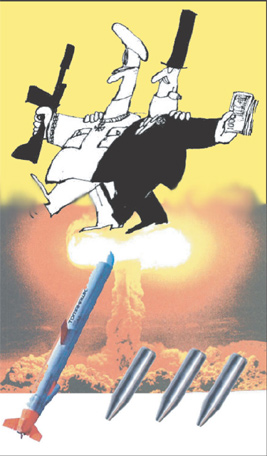 Where Your Taxes Go: The Militarized Budget On the other hand, there is another side of the US government: the government of tax breaks and tax cuts for the rich, the one that squanders as much on the military as the next seven countries combined.
Only 22 percent of military taxes go to US troops for pay and benefits. Meanwhile, nearly half of the military budget goes to a powerful group of multinational corporations that make billions in profits from US warmongering.
Take Lockheed Martin. As the federal government’s biggest military contractor, it received $36 billion in taxpayer dollars in 2015, amounting to 80 percent of its revenues from all sources.
And that’s just one contractor. In all, the Department of Defense handed out more than $297 billion in contracts in 2016….Events like the Syria bombing, and Trump’s election, tend to send stock prices for these companies soaring.

Where Your Dollars Are Going: Why Some Antiwar Activists Are Withholding Taxes, April 18, 2017, By Lindsay Koshgarian, Truthout | News Analysis Among the marches, petitions and call-in campaigns that comprise much of the Trump resistance movement, one resistance tactic gets little attention: withholding taxes. As the US seems ready to slide into yet another Middle East war in Syria while preparing for massive cuts to government programs at home, what role does tax resistance play in opposing regressive and violent policies?
While being anti-tax is typically associated with conservatism, there is a small but longstanding tradition within the progressive movement of withholding taxes — specifically, war taxes.
How does tax resistance work, and does it result in a lack of support for government programs that most progressives support and would like to see grow? How much of our taxes go to war, the military and militarism anyway, and how much to worthy programs like education, aid for struggling families, the environment and more?
Paying income taxes may not usually spur introspection, but it might if Americans realized that, for example, they are working 27 days out of every year to pay taxes that support war profiteers. Most progressives and many on the right of the political spectrum would never willingly write a check to weapons contractors, or speak in support of weapons systems that will fuel tomorrow’s air strikes and drone attacks. If Lockheed Martin, the nation’s most prolific military contractor, were a store or coffee shop, many would boycott it. So why willingly give Lockheed $170 a year through taxes — which the average taxpayer now does?
Pride and Prejudice: How the Government Helps (and How Americans Pay for It) The extent to which government helps those who need it most and strengthens every community is certainly underappreciated in a country obsessed with “small government,” a nation that reveres former President Ronald Reagan, who once said, “The nine most terrifying words in the English language are: I’m from the government, and I’m here to help.”
Of course, the government does help. More than half of almost every group of Americans — from every region of the country, white, Black, Latino, rural, urban, conservative, liberal — have benefited at some point in their lives from government programs like Social Security, Medicare, Medicaid, food stamps, unemployment and welfare. Government programs are often targeted to help those most in need of aid or those historically oppressed. Half of the students who receive Pell grants for college tuition come from families with incomes below $15,223, and 77 percent of them would be the first generation of their families to earn a bachelor’s degree. Nearly one in four Pell recipients is Black. Meanwhile, programs like Meals on Wheels for seniors are almost universally beloved and respected for taking care of some of the most vulnerable members of our society. The federal government serves as a crucial source of support for many………
Where Your Taxes Go: The Militarized Budget
On the other hand, there is another side of the US government: the government of tax breaks and tax cuts for the rich, the one that squanders as much on the military as the next seven countries combined; the one that has increased its spending on federal prisons by 10 times over the last 40 years — the government that seeks to consolidate power and exert control over the world’s most vulnerable people.
The US government promotes an extreme overreliance on military might and a disturbing parallel of policing, incarceration, surveillance and immigration raids and deportations here at home. A recent National Priorities Project analysis of the US discretionary budget showed that 64 percent of the federal discretionary budget — the budget decided by Congress each year, which is covered almost entirely by income taxes — is devoted to the military and militarism: to making and preparing for war, dealing with the consequences of war, and to programs that amount to intimidation and oppression here at home.
At least 23 percent of income taxes go to the military — and if you count spending on veterans’ benefits, national debt due to past wars, or other militarized spending like that for the FBI, federal prisons or immigration enforcement, the estimates only go higher. In addition to paying an average of $3,290 in yearly income taxes for the traditional military, Americans each pay $88 for border control and immigration and customs enforcement, $33 for the federal prison system, and more for programs ranging from the FBI to the CIA and beyond.
Only 22 percent of military taxes go to US troops for pay and benefits. Meanwhile, nearly half of the military budget goes to a powerful group of multinational corporations that make billions in profits from US warmongering.
Take Lockheed Martin. As the federal government’s biggest military contractor, it received $36 billion in taxpayer dollars in 2015, amounting to 80 percent of its revenues from all sources. Lockheed used those taxpayer dollars to pay its CEO more than $19 million in 2015. Taxpayers contributed six times as much to this one weapons maker as they did to all foreign aid in 2016. This should give us pause when we consider how often the US turns to military intervention versus prevention, diplomacy or other means during international crises.
And that’s just one contractor. In all, the Department of Defense handed out more than $297 billion in contracts in 2016 — more than half of the department’s budget.
Events like the Syria bombing, and Trump’s election, tend to send stock prices for these companies soaring.
An Act of Resistance
So, how does it all balance out? Does the government help more than it harms? Is there a way to support the good while resisting the bad?
This is what some war tax resisters attempt to do. In practice, resisting war tax runs the gamut from not paying any taxes at all to withholding a token amount of tax — as low as a few dollars — as a way of registering resistance. For those who want to support the government in its helping capacities, or who want to see those capacities grow, the second may be the better option.
Clearly, resisting taxes is not for everyone — it can come with legal penalties, headaches and a good deal of uncertainty. And of course, war tax resisting is not the only way to influence how your tax dollars are used: calling, visiting or writing your representatives in government; voting; and engaging in street protests play key roles in resisting war and militarism. Still, we are in the midst of a big resistance, and for some, resisting tax may be just what the doctor ordered. http://www.truth-out.org/news/item/40248-where-your-dollars-are-going-why-some-anti-war-activists-are-withholding-taxes
Will USA provoke a nuclear war ?
Washington pushes world to brink of nuclear war, WSWS, 18 April 2017 The repeated statements by US Vice President Mike Pence and other Trump administration officials Monday that the “era of strategic patience” with North Korea is over and “all options are on the table” have laid bare the mounting threat that Washington will provoke a war on the Korean peninsula involving the use of nuclear weapons and the deaths of millions.
“Just in the past two weeks, the world witnessed the strength and resolve of our new president in actions taken in Syria and Afghanistan,” Pence declared during a provocative visit to South Korea that brought him to the demilitarized zone (DMZ) on the North Korean border. “North Korea would do well not to test his resolve or the strength of the armed forces of the United States in this region,” Pence said.
This boasting about the reckless acts of military aggression—first, the cruise missile attack on Syria on April 7 and then, a week later, the use in Afghanistan of the Massive Ordnance Air Blast (MOAB) bomb, the most destructive weapon unleashed anywhere since the US incineration of Hiroshima and Nagasaki—cannot be read by the government of North Korea as anything other than an ultimatum to accept US demands or expect to be on the receiving end of far greater violence.
With the naval strike group led by the nuclear-powered aircraft carrier USS Carl Vinson set to take up a position off the Korean peninsula, the means of inflicting such violence are being put into place. The global implications of this buildup were underscored Monday with the report that both Russia and China have dispatched spy ships to trail the Vinson battle group. For these two nuclear-armed countries, Washington’s launching of a war against North Korea poses an existential threat.
The drive toward a military confrontation in Asia that could lead to a nuclear third world war has unfolded largely behind the backs of the people of the United States and the entire world. Neither the politicians of the two big business parties in the US nor the corporate-controlled media have so much as hinted to the public the horrific consequences of even a “limited” nuclear exchange on the Korean peninsula, nor the likelihood that such a catastrophe would draw all of the major nuclear powers into a global conflagration.
The recklessness of the path being pursued by Washington is staggering. Why the “era of strategic patience” has ended is not explained, nor are the conclusions drawn from this declaration even challenged. There are a whole number of states that now have nuclear weapons. North Korea’s pursuit of such arms does not represent a credible threat to the US.
“All options are on the table” can only mean that Washington is prepared to launch an unprovoked first strike against North Korea. Yet, within the media, there is barely a mention that such a course involves the threat of nuclear war. Nor is there the slightest suggestion that the US Congress should convene to vote on whether to authorize an attack that could produce casualties in the millions. The accepted wisdom is that Donald Trump doesn’t have to tell anyone what military action he will take until after the attack is executed. The only hint Trump gave of his intentions was at a Monday Easter egg-rolling event on the White House lawn, where he declared that North Korea has “gotta behave.”
The real character of the policy being pursued by Washington was indicated by John Bolton, the Bush administration’s ambassador to the United Nations, who told Fox News that the “way to end North Korea’s nuclear weapons program is to end North Korea,” i.e., topple the government and militarily smash the country.
The real and growing danger posed by Washington’s reckless policy is beginning to be registered, if only in the mildest form.
The New York Times, which had previously celebrated the Trump administration’s turn toward stepped-up militarism against Syria and Russia, proclaiming its feeling of “emotional satisfaction and justice done” over the cruise missile strike of April 7, has become somewhat nervous that things are spinning out of control………..
The assumption that China can be pressured into imposing Washington’s diktat in relation to North Korea is without foundation….. If Beijing were to accede to these demands, it would have immense strategic implications for China as well as major internal political consequences.
There are already indications that tensions between Beijing and Washington are escalating on the Korean peninsula after Seoul’s announcement that it intends to move ahead rapidly with the installation of the US Terminal High Altitude Area Defense system, or THAAD, which the US claims is designed to defend against North Korean missiles, but which China recognizes as a means of assuring the US a nuclear first-strike capability……
Everything that is being done by the US government involves astonishing levels of risk, including that of a nuclear war. Whether it happens in the immediate confrontation with North Korea cannot be predicted, but that this is the course Washington is prepared to pursue all over the world is undeniable……..https://www.wsws.org/en/articles/2017/04/18/pers-a18.html
USA scientists ready for 22 April’s mass march against Trump’s war on science
 Science strikes back: anti-Trump march set to draw thousands to Washington Scientists are ditching their labs for the streets in a mass protest against the Trump administration’s war on facts, but will the effort resonate with skeptics? Guardian, Oliver Milman 18 Apr 17, On Saturday, thousands of scientists are set to abandon the cloistered neutrality of their laboratories to plunge into the the political fray against Donald Trump in what will likely be the largest-ever protest by science advocates.
The March for Science, a demonstration modeled in part on January’s huge Women’s March, will inundate Washington DC’s national mall with a jumble of marine biologists, birdwatchers, climate researchers and others enraged by what they see as an assault by Trump’s administration upon evidence-based thinking and scientists themselves.
Many scientists at federal agencies, concerned their work may be sidelined or censored for political purposes, will take the unusual step of publicly damning the administration.
“It’s important for scientists to get out of the lab and talk about what’s important,” said Andrew Rosenberg, who spent a decade at the National Oceanic and Atmospheric Administration and is now at the Union of Concerned Scientists. “You don’t check your citizenship at the door when you get a PhD. No one would tell an architect they can’t have a view on HUD [the Department of Housing and Urban Development]. That would be nonsense.”
The march now has dozens of people grappling with the logistics of the DC march and more than 500 companion events around the world. More than 100 organizations have lent their support, including the institutional heft of the American Association for the Advancement of Science, the world’s largest general scientific organization, and the American Geophysical Union.
1 This Month


Tell the Ukrainian Government to Drop Prosecution of Peace Activist Yurii Sheliazhenko

Petition to revoke the licensing of the Near Surface Nuclear Disposal Facility (NSDF) at Chalk River. https://www.ourcommons.ca/petitions/en/Petition/Details?Petition=e-7247


of the week – STOP SMALL MODULAR REACTORS IN CANADA
To see nuclear-related stories in greater depth and intensity – go to https://nuclearinformation.wordpress.com
-
Archives
- March 2026 (204)
- February 2026 (268)
- January 2026 (308)
- December 2025 (358)
- November 2025 (359)
- October 2025 (376)
- September 2025 (258)
- August 2025 (319)
- July 2025 (230)
- June 2025 (348)
- May 2025 (261)
- April 2025 (305)
-
Categories
- 1
- 1 NUCLEAR ISSUES
- business and costs
- climate change
- culture and arts
- ENERGY
- environment
- health
- history
- indigenous issues
- Legal
- marketing of nuclear
- media
- opposition to nuclear
- PERSONAL STORIES
- politics
- politics international
- Religion and ethics
- safety
- secrets,lies and civil liberties
- spinbuster
- technology
- Uranium
- wastes
- weapons and war
- Women
- 2 WORLD
- ACTION
- AFRICA
- Atrocities
- AUSTRALIA
- Christina's notes
- Christina's themes
- culture and arts
- Events
- Fuk 2022
- Fuk 2023
- Fukushima 2017
- Fukushima 2018
- fukushima 2019
- Fukushima 2020
- Fukushima 2021
- general
- global warming
- Humour (God we need it)
- Nuclear
- RARE EARTHS
- Reference
- resources – print
- Resources -audiovicual
- Weekly Newsletter
- World
- World Nuclear
- YouTube
-
RSS
Entries RSS
Comments RSS
 nuclear-news