 White House Shouldn’t Try To Reverse Iran Nuclear Deal, Parsi Says, NPR, April 20, 20175 , Heard on Morning Edition Steve Inskeep talks to Trita Parsi, an Iran scholar, who warns of dire consequences if Trump officials renege on the nuclear accord and reverse a pledge to ease sanctions against Tehran.
STEVE INSKEEP, HOST:
Let’s make sense of two moves that President Trump’s administration made this week. The administration affirms that Iran is following a nuclear deal. The administration also says Iran is misbehaving around the Middle East. Put another way, Secretary of State Rex Tillerson says Iran is following a deal that the Trump administration really doesn’t like.
INSKEEP: One observer of the administration moves is Trita Parsi, president of the National Iranian American Council. He supported the nuclear deal made by the Obama administration, although he is not on good terms with Iran’s government. Welcome to the program.
INSKEEP: So what does it mean that President Trump, who said he would rip up this nuclear deal on day one, instead says Iran is following it?…..
PARSI: Well, I think the first thing to say is that it doesn’t seem as if the Trump administration really knows what it’s doing. It’s a significant contradiction to first come out and say that the Iranians – contrary to all of their claims that Iran would be cheating – actually is living up to the deal only to come out the day after and saying, well, we hate the deal anyways and signaling that the U.S. might actually be walking away from the deal, unless of course the aim is to get rid of the deal without the U.S. having to pay the cost for it, meaning instead of the U.S. violating the deal directly by not renewing these sanctions waivers, killing the deal by escalating tensions in Yemen and elsewhere in the region and hoping that that will force the Iranians out of the deal…….
INSKEEP: Wouldn’t you like some pressure on this government, though, even though you are a supporter of the nuclear deal?
PARSI: Certainly. There’s many areas in which there needs to be pressure on Iran, particularly, I would say, on the human rights front. But an approach that is centered on pressure and that is completely void of diplomacy most likely will lead to a military confrontation…….
INSKEEP: Can you just remind us what the basics of this nuclear deal are? Iran still has a nuclear program – right? – but it’s restricted.
PARSI: Iran has a restricted nuclear program. There are inspections in every aspect of Iran’s program. And all of the various pathways that Iran had towards building a nuclear bomb as a result of this deal has been closed. Some of these restrictions will be lifted in about 15 or so years. But the most important restriction is the inspections regime, the additional product called a Non-Proliferation Treaty, will be permanent, granted, of course, that all sides live up to their end of the bargain. And as the Trump administration certified two days ago, so far, the Iranians are living up to the bargain. And now, the United States also has to continue to waive sanctions in order for the United States to be in compliance with the deal.
INSKEEP: OK. You just mentioned waiving sanctions. Does President Trump have to actively do something to keep the sanctions off Iran for the moment?
PARSI: Yes. Before May 18, the United States is obliged to continue to waive sanctions in order for the U.S. to be in compliance. If it doesn’t, then the U.S. pulls out of the deal, and that will likely cause the Iranians to do the same.
INSKEEP: So that would be the next big moment to watch, potentially, is whether President Trump is willing to affirmatively keep sanctions eased on Iran.
PARSI: Exactly. And the day after the deadline is the Iranian presidential elections.
INSKEEP: And in which the president who did the deal, President Hassan Rouhani, is up for re-election.PARSI: He is up for re-election. And if he loses, then we will have a president in the United States and a president in Iran that most likely will be opposed to this deal. And that would be very negative for the continuation of this nuclear accord.
INSKEEP: Trita Parsi has a book coming out called “Losing An Enemy: Obama, Iran, And The Triumph Of Diplomacy.” He’s with the National Iranian American Council……http://www.npr.org/2017/04/20/524833644/white-house-shouldnt-try-to-reverse-iran-nuclear-deal-parsi-says
April 21, 2017
Posted by Christina Macpherson |
Iran, politics international, USA |
Leave a comment
 Russia’s Secretive Floating Nuclear Power Plant Making Waves In St. Petersburg, Radio Free Europe, 20 Apr 17, ST. PETERSBURG, Russia — Ecologists in Russia’s northern capital are raising the alarm over government plans to fuel a floating nuclear power plant just 2 kilometers from the heart of the city.
Officials have been saying since December that they are nearly ready to begin fueling the Akademik Lomonosov, the country’s first-ever ship-borne nuclear-power station, which is scheduled to be deployed at Vilyuchinsk on the Far Eastern Kamchatka Peninsula in 2019. Because the process is shrouded in secrecy and the government has ignored requests for information, it is unclear what the status of the fueling process currently is.
“From this floating nuclear power plant to the city’s mining institute [for example] is probably only about 500 meters,” Rashid Alimov, director of energy programs for Greenpeace Russia, told RFE/RL. “The historical center is densely populated. We have to exclude even the thought of an accident. That is why we have written to the governor. … According to the law, carrying out such operations at the Baltic Shipyard must be approved by the city, evacuation plans have to be drawn up. We have asked the municipal authorities about this.”……..
Independent nuclear-energy analyst Aleksei Shchukin, who spent more than 30 years working on nuclear-powered icebreakers, told RFE/RL that the fueling operation presents risks. Although the reactors are based on designs developed in the 1960s, the configuration on the Akademik Lomonosov is unique and untested.
“That is why I think there is no point in taking a risk and fueling the reactors in the center of a huge city,” Shchukin said. “This is very dangerous. They could take the vessel to Murmansk or Arkhangelsk, where there are bases for repairing and refueling nuclear vessels. That would be much safer.”
Authorities have ignored requests to find out why they insist on conducting the refueling — and possibly other testing — in St. Petersburg, a UNESCO-protected World Heritage Site with a population of just under 5 million.
Previous Incidents……..
April 21, 2017
Posted by Christina Macpherson |
Russia, safety |
Leave a comment
These impediments—together with colossal capital outlay and several additional disadvantages shared with fission reactors—will make fusion reactors more demanding to construct and operate, or reach economic practicality, than any other type of electrical energy generator.
The harsh realities of fusion belie the claims of its proponents of “unlimited, clean, safe and cheap energy.” Terrestrial fusion energy is not the ideal energy source extolled by its boosters, but to the contrary: It’s something to be shunned.

 Fusion reactors: Not what they’re cracked up to be http://thebulletin.org/fusion-reactors-not-what-they%E2%80%99re-cracked-be10699 Daniel Jassby, 19 Apr 17 Daniel Jassby was a principal research physicist at the Princeton Plasma Physics Lab until 1999. For 25 years he worked in areas of plasma physics and neutron production related to fusion energy research and development. He holds a PhD in astrophysical sciences from Princeton University.
Fusion reactors have long been touted as the “perfect”energy source. Proponents claim that when useful commercial fusion reactors are developed, they would produce vast amounts of energy with little radioactive waste, forming little or no plutonium byproducts that could be used for nuclear weapons. These pro-fusion advocates also say that fusion reactors would be incapable of generating the dangerous runaway chain reactions that lead to a meltdown—all drawbacks to the current fission schemes in nuclear power plants.
And, a fusion-powered nuclear reactor would have the enormous benefit of producing energy without emitting any carbon to warm up our planet’s atmosphere.
But there is a hitch: While it is, relatively speaking, rather straightforward to split an atom to produce energy (which is what happens in fission), it is a “grand scientific challenge” to fuse two hydrogen nuclei together to create helium isotopes (as occurs in fusion). Our sun constantly does fusion reactions all the time, burning ordinary hydrogen at enormous densities and temperatures. But to replicate that process of fusion here on Earth—where we don’t have the intense pressure created by the gravity of the sun’s core—we would need a temperature of at least 100 million degrees Celsius, or about six times hotter than the sun. In experiments to date the energy input required to produce the temperatures and pressures that enable significant fusion reactions in hydrogen isotopes has far exceeded the fusion energy generated.
But through the use of promising fusion technologies such as magnetic confinement and laser-based inertial confinement, humanity is moving much closer to getting around that problem and achieving that breakthrough moment when the amount of energy coming out of a fusion reactor will sustainably exceed the amount going in, producing net energy. Collaborative, multinational physics project in this area include the International Thermonuclear Experimental Reactor (ITER) joint fusion experiment in France which broke ground for its first support structures in 2010, with the first experiments on its fusion machine, or tokamak, expected to begin in 2025.
As we move closer to our goal, however, it is time to ask: Is fusion really a “perfect”energy source? After having worked on nuclear fusion experiments for 25 years at thePrinceton Plasma Physics Lab, I began to look at the fusion enterprise more dispassionately in my retirement. I concluded that a fusion reactor would be far from perfect, and in some ways close to the opposite.
Scaling down the sun. Continue reading →
April 21, 2017
Posted by Christina Macpherson |
2 WORLD, France, Reference, technology |
Leave a comment

 The Trump Administration Is Apparently Terrified of Actually Making a Decision About Paris Sad!, Mother Jones, OLIVER MILMAN, APR. 19, 2017 This story was originally published by the Guardian and is reproduced here as part of theClimate Desk collaboration.
Donald Trump’s aides have abruptly postponed a meeting to determine whether the US should remain in the Paris climate agreement, with an unlikely coalition of fossil fuel firms, environmental groups and some Republicans calling on the president to stick with the deal.
Trump’s top advisers were set to meet on Tuesday to provide the president with a recommendation ahead of a G7 meeting in May. However, a White House official said the meeting had been postponed due to conflicting schedules. It is unclear when it will now take place.
Trump has already signed executive orders to start the demolition of the clean power plan, throw open federal land to coal mining, and halt new vehicle emissions standards but has so far not acted on his campaign pledge to “cancel” the Paris compromise.
His aides are understood to be split on whether the US should stay in the voluntary agreement, which was fully ratified last year. Barack Obama pledged that the US would cut greenhouse gas emissions by 26-28 percent by 2025, based on 2005 levels, as part of a landmark global effort that for the first time required emissions reduction goals from all nations, including the large developing emitters China and India.
Trump’s adviser Steve Bannon and the Environmental Protection Agency head, Scott Pruitt, are both in favor of ditching the Paris agreement. Last week, Pruitt called the agreement a “bad deal” for the US that imposes a burden that other countries do not have to bear.
However, the weight of opinion may be in favor of those who support the agreement. Trump’s daughter, Ivanka, and son-in-law, Jared Kushner, both advisers to the president, have positioned themselves as defenders of the agreement, while Rex Tillerson, the secretary of state, has supported the idea of “keeping a seat at the table.” Other advisers at the meeting were expected to include Rick Perry, the energy secretary; Gary Cohen, an economic adviser; and HR McMaster, the national security adviser.
Support for the Paris deal has come from seemingly unlikely quarters—the oil giant ExxonMobil wrote to the White House to advocate it as an “effective framework for addressing the risks of climate change.” BP and Shell have also previously endorsed the Paris deal, along with dozens of other businesses including Gap, General Mills and the Kellogg Company.
A group of Republicans in Congress also warned against withdrawing from the agreement. The Florida congressman Carlos Curbelo, in his role as co-chair of the Climate Solutions Caucus, said it was “imperative that we maintain our seat at the table.”
“The world’s leading nations must work together to not only reduce the impact carbon emissions have on climate change, but also mitigate and prepare for the effects, which communities like ours are dealing with every day,” Curbelo said in a joint statement with Ted Deutch, a Democrat who is his fellow co-chair……..
If Trump decides to exit the deal, it will require a three-year notice period before the process begins. In order to speed up the process, he could remove the US from the overall UN climate change framework or submit the deal to the Senate to be ratified as a treaty, where it will probably fail.
A third, and perhaps most likely, option is to remain in the agreement in name only, retaining a modicum of US prestige abroad while dismantling Obama-era rules designed to reduce emissions. The US will face no penalty for not meeting its emissions targets, although some other countries have raised the possibility of imposing a “carbon tariff” on American goods.
Regardless of whether the US stays within the Paris deal, its chances of making deep cuts in its emissions have receded since Trump took office. Without the clean power plan, more stringent emissions standards on vehicles and gas and oil drilling operations or any sort of tax on greenhouse gases—a plan recently floated by some Republicans—the US will pull back from the effort to help avoid more severe heatwaves, droughts, the disappearance of coral reefs and coastal inundation.
“Regardless of what Trump does on Paris, he has abrogated our position,” said Tom Steyer, a leading hedge fund manager and climate campaigner. “This is an administration trying as hard as possible to bring back coal mining; they have given up American leadership on energy and climate. They have already walked away.” http://www.motherjones.com/environment/2017/04/trump-aides-postpone-meeting-paris-climate-deal
April 21, 2017
Posted by Christina Macpherson |
climate change, politics international, USA |
Leave a comment
 On April 29, We March for the Future We’ll either save or doom the planet during the Trump administration. Don’t sit the Peoples Climate Mobilization out., The Nation, 20 Apr 17 By Bill McKibben,
It is hard to avoid hyperbole when you talk about global warming. It is, after all, the biggest
thing humans have ever done, and by a very large margin. In the past year, we’ve decimated the Great Barrier Reef, which is the largest living structure on Earth. In the drought-stricken territories around the Sahara, we’ve helped kick off what The New York Times called “one of the biggest humanitarian disasters since World War II.” We’ve melted ice at the poles at a record pace, because our emissions trap extra heat from the sun that’s equivalent to 400,000 Hiroshima-size explosions a day. Which is why, just maybe, you should come to Washington, DC, on April 29 for a series of big climate protests that will mark the 100th day of Trumptime. Maybe the biggest thing ever is worth a day……
This week of rallying is the logical extension of the climate-justice movement that emerged in the last decade, led by frontline communities and climate scientists, by indigenous people and farmers and ranchers. All the battles currently under way will be on full display as we march: against the Dakota Access and Keystone pipelines and now a dozen others; against fracking wells and mountaintop-removal coal mines; for solar panels, solar panels, and more solar panels. (Not to mention bikes, buses, and electric cars.) This march embraces, finally, large segments of the labor movement. Workers and citizens dying in the heat and floods will march next to scientists pale from too many hours in front of the computer. It is a march for the future.
But reaching the future depends on dealing
with the present, and the present is uniquely bleak. Governments have been oblivious before, but it’s hard to remember one as actively, determinedly stupid. It was revelatory to watch, earlier this month, as even Fox’s Chris Wallace filleted Scott Pruitt, the head of Trump’s EPA. “What if you’re wrong?” he finally asked the flustered Pruitt, who couldn’t quite recall even climate denialism’s standard talking points. Pruitt, of course, is wrong, since his entire job is to represent the industry that has spent a quarter-century lying through its teeth about climate change. But he’s aggressively wrong—he hadn’t even started his new job before the transition team was leaking news that the administration was ready to defund the satellites we use to keep track of the climate. Think about that for a moment. We’re not just going to ignore the mounting evidence; we’re going to stop collecting it.
Which helps explain, I think, the mounting anger of the scientific community. They’ll march first, on April 22, to the National Mall, and in hundreds of satellite marches around the world. Expect lines of people in lab coats, pushing equation-laden blackboards down the streets of Washington. Scientists have been, for the most part, resolutely apolitical: Their job has been to provide the data, offer the analysis, and then stand back and let “policy-makers” take over. In a rational world, that would make sense. There’s no particular reason why someone who knows the best way to compute the melt rate of Greenland’s glaciers (no easy task, by the way) would also know the best way to move us off fossil fuel.
But as scientists have finally begun to realize, there’s nothing rational about the world we currently inhabit. We’re not having an argument about climate change, to be swayed by more studies and journal articles and symposia. That argument is long since won, but the fight is mostly lost—the fight about the money and power that’s kept us from taking action and that is now being used to shut down large parts of the scientific enterprise. As Trump budget chief Mick Mulvaney said in March, “We’re not spending money on that anymore. We consider that to be a waste of your money to go out and do that.” In a case this extreme, scientists have little choice but to be citizens as well. And given their credibility, it will matter: 76 percent of Americans trust scientists to act in the public interest, compared with 27 percent who think the same thing about elected officials………
the news isn’t all grim. In fact, what makes the current Trumpish backsliding so absurd is that it comes just as we’ve figured out at least some of what we need to do about climate change. The price of a solar panel has dropped 80 percent in the last decade and continues to plummet. In much of the world, wind power is now the cheapest way to generate electricity. That means that if we wanted to, we could take giant steps—fast. A few nations have shown the way: Denmark produced nearly half its power from wind in 2015, and Costa Rica ran its electricity system almost exclusively off renewables. The price of batteries is dropping just as fast now, and their capacity grows with each new iteration. It’s not just Elon Musk; the Chinese are starting to drive this revolution as they install vast quantities of renewable power.
Which is a good reminder that markets alone are not going to make this transition happen—at least, they’re not going to make it happen fast enough to catch up with the physics of global warming. For that we’ll need concerted government action, like the Senate bill that Bernie Sanders and Jeff Merkley will introduce in late April calling for 100 percent renewable energy by 2050. It won’t pass, obviously—but it will serve as the new standard for sensible people to rally around.
And it will be popular—every poll shows that Americans of every ideology love solar power (close to 90 percent in some surveys). Not only that, but they’d love the jobs that come with the transition to solar: by first estimate, about 4 million. That job growth should put Trump’s endless posturing about coal miners in stark relief—thanks mostly to automation, there are barely 76,000 of them left; twice as many Americans work in car washes.
All these streams will converge on the National Mall on April 29, chosen because that weekend marks Trump’s first 100 days in office. This Peoples Climate Mobilization(#ClimateMarch) will be the big one, the sequel to the massive protest that filled the streets of New York in September of 2014. Expect—well, expect lots of people determined to show that they’re fed up with Trump’s nonsense and aware that there’s another future available. We’ll be marching from the Capitol, up Pennsylvania Avenue, and we’ll completely surround the White House—a kind of citizens’ arrest of the nincompoop inside. There will be a moment of silence and then tremendous noise, loud enough to shake the occupants of 1600 Pennsylvania Avenue to their senses if they had them. We’ll end with a closing event at the Washington Monument, where people will be able to gather in “circles of resistance” and talk about the road ahead. (There will also be candidate training the next day for climate activists who want to run for office.)…..https://www. thenation.com/article/on- april-29-we-march-for-the- future/
April 21, 2017
Posted by Christina Macpherson |
ACTION |
Leave a comment
 Brain specialist doctor believes Donald Trump’s frontal lobe is failing http://www.palmerreport.com/politics/brain-specialist-doctor-believes-donald-trumps-frontal-lobe-is-failing/2354/ By Bill Palmer Apr 19, 2017
 Over the past week Donald Trump has begun making so many basic confused errors that it’s become a matter of serious concern to a number of Americans. He’s forgetting names. He’s forgetting people. He’s forgetting what to do during the National Anthem. He’s forgetting that a kid just handed him a hat. He’s forgetting which country he just bombed. And now a brain specialist doctor says she believes it’s evidence that Trump’s frontal lobe is failing.
Brenda J. Iannucci, M.D., is a Cognitive Function Specialist based in upstate New York. She’s been attempting to diagnose Donald Trump’s health from afar, which seems warranted in light of Trump’s refusal to release his medical records during and since the election. Dr. Iannucci summed up Trump’s worsening lack of recall in the following fashion: “Cognitive failure in Trump: naming functions located frontotemporal regions of brain. Recall and reasoning fail concurrently” (
link). The circumstantial evidence to support her assertion is growing by the day.
Over the weekend Donald Trump humiliated himself by not remembering to put his hand over his heart during the Easter Egg Roll, and then taking a kid’s hat from him and autographing it before randomly flinging it into the crowd – seemingly forgetting that the kid had just handed it to him. Then he went on Fox News and unwittingly revealed he didn’t remember that Kim Jong-Il gave way to Kim Jong-Un in North Korea six years ago. Then he began repeatedly referring to his close ally Paul Ryan as “Ron” during a Tuesday rally in Ryan’s home state. And this came after Trump bombed Syria and then immediately announced that he had bombed Iraq instead.
So when Dr. Brenda Iannucci states her professional assessment that Donald Trump’s frontal lobe appears to be failing, even someone who’s not a medical professional can see where she’s coming from.
April 21, 2017
Posted by Christina Macpherson |
politics, USA |
Leave a comment
 House Democrat introduces bill to amend presidential removal procedures http://thehill.com/homenews/house/329206-house-democrat-introduces-bill-to-amend-presidential-removal-procedures BY CRISTINA MARCOS – 04/17/17 A House Democrat has introduced legislation to enhance the Constitution’s presidential removal procedures in response to concerns about President Trump’s behavior.
Rep. Earl Blumenauer (D-Ore.) filed the bill during the House’s two-week April recess to empower former presidents and vice presidents of both parties, in coordination with the sitting vice president, to determine if a president is fit for office.
“It is hard to imagine a better group to work with the vice president to examine whether the president is able to discharge the duties of the office. When there are questions about the president’s ability to fulfill his or her constitutional responsibilities, it is in the country’s best interest to have a mechanism in place that works effectively,” Blumenauer said in a statement.
Blumenau’s proposal stems from concern that the Constitution’s 25th Amendment, which was adopted five decades ago, would fall short in cases of emotional or mental incapacity.
The amendment states that the vice president assumes the Oval Office in the event that a president is removed from office, dies or resigns. Alternatively, the vice president and a majority of Cabinet officers can also jointly declare that a president is unfit to serve. The vice president would then take over as president in such a case.In the event that a president refused to step down, two-thirds of both the House and Senate would have to vote to force the resignation.
But Blumenauer posited that the mechanism wouldn’t be effective if a mentally unstable president simply fired all the Cabinet members. He argued it’s also possible that Cabinet members might feel pressured to stand by the president in the polarized political environment despite their own personal misgivings.
“Because the cabinet can be fired by the president, there is a natural bias that would make them reluctant to acknowledge the president’s inability to serve. It’s time to revisit and strengthen the Amendment and make sure there is a reliable mechanism in place if the president becomes unable to discharge the powers and duties of office,” Blumenauer said.
Blumenauer first raised concerns about the 25th Amendment in a House floor speech in February during which he expressed worry about what he viewed as “erratic” behavior from Trump. At the time, he pointed to Trump’s baseless claims about voter fraud in the election and stating that it was sunny during his inaugural address when it was, in fact, raining.
A handful of Democratic lawmakers have openly raised questions about Trump’s psychological state since he took office in January, including Blumenauer, Sen. Al Franken (Minn.) and Reps. Ted Lieu (Calif.) and John Yarmuth (Ky.).
April 21, 2017
Posted by Christina Macpherson |
politics, USA |
Leave a comment

 Russia claims it can wipe out US Navy with single ‘electronic bomb’, Fox news 19 Apr 17 Russia has claimed it can disable the entire US Navy in one fell swoop using powerful electronic signal jamming.
A news report from the country – where the media is essentially controlled by the state – said the technology could render planes, ships and missiles useless.
The newsreader says: “Today, our Russian Electronic Warfare (REW) troops can detect and neutralise any target from a ship’s system and a radar, to a satellite.”
The news report claims a single Russian war plane flew several times around American destroyer the USS Donald Cook in the Black Sea several years ago, disabling its systems and leaving it helpless.
The report also claims they are capable to creating electronic jamming domes over their bases that make them invisible on radar screens.
The propaganda piece even quotes top US General Frank Gorenc as saying: “Russian electronic weapons completely paralyse the functioning of American electronic equipment installed on missiles, aircraft and ships.”
The reporter adds: “You don’t need to have expensive weapons to win – powerful radio-electronic jamming is enough.”……..http://www.foxnews.com/world/2017/04/19/russia-claims-it-can-wipe-out-us-navy-with-single-electronic-bomb.html
April 21, 2017
Posted by Christina Macpherson |
Russia, weapons and war |
Leave a comment
 Championing Nuclear Non-Proliferation Rules: The EU and Iran , Lobelog, by Peter Jenkins, 20 Apr 17 In a newly published book, Tarja Cronberg contrasts EU and US conceptions of multilateralism in the nuclear field. Her work is titled Nuclear Multilateralism and Iran.
A former member of the European Parliament (EP) and chair of the EP delegation for EU relations with Iran, Cronberg writes: “For the US multilateralism is a means to an end, but for Europeans it is an end in itself.” Both the EU and the US are committed, she continues, to upholding international law, well-functioning international institutions, and a rules-based international order. But the EU’s commitment is more heartfelt and goes deeper than the US commitment. After all, the EU itself is a multilateral institution, and, lacking military resources, is more dependent on global rules. The US approach is “utilitarian,” writes Cronberg, quoting Robert Kagan, whereas the EU approach could be characterized as both idealistic and needy (my words, not hers).
These distinctions are the starting-point for an analysis of the EU contribution to resolving the concern aroused by International Atomic Energy Agency (IAEA) reports in 2003 that Iran had “pursued a policy of concealment” for 18 years and had failed to declare the possession and use of nuclear material to develop a uranium enrichment capability. Cronberg finds that the EU contribution was important, even essential to the eventual outcome of that process. The EU showed itself to be a “unified” and effective “actor.”
Good Cop/Bad Cop
This finding leads her to offer several recommendations to EU policymakers. Her chief recommendation relates to the role the EU should aspire to play in the event of similar nuclear proliferation cases in the future. She would like the EU role to be “autonomous.” In effect she is advocating that the EU put itself forward as a purer champion of a multilateral rules-based order than the United States, to lead the international search for peaceful solutions.
In support of that recommendation she makes a telling point. On moral and political grounds the five Nuclear Non-Proliferation Treaty (NPT) Nuclear Weapon States (NWS) ought to have disbarred themselves from preaching nuclear non-proliferation years ago. Most NPT parties resent the continuing reluctance of the NWS to act on their NPT pledge to negotiate “in good faith” on nuclear disarmament. Indeed most parties find NWS hypocrisy nauseating. In contrast, although two NWS are members of the EU (only one, in all probability, from April 2019), the EU as a whole is entitled to characterize itself as a non-nuclear weapon entity………
This is a thought-provoking book that draws on “front-line” experience of the issues and historical events that the author addresses. It appears at a time when the commitment of the United States to the multilateral rules-based order that it fathered over 70 years ago seems weaker than ever. http://lobelog.com/championing-nuclear-non-proliferation-rules-the-eu-and-iran/
April 21, 2017
Posted by Christina Macpherson |
Iran, politics international, resources - print |
Leave a comment
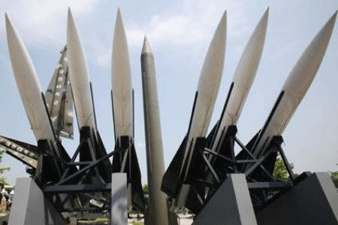 THE PLAN TO MAKE AMERICA’S NUKES GREAT AGAIN COULD GO HORRIBLY WRONG, VICE News, By Keegan Hamilton on Apr 20, 2017. It was nearly 2 o’clock in the morning on Oct. 23, 2010, when an Air Force lieutenant called from his base in Wyoming to report the nightmare scenario unfolding before him. Fifty intercontinental ballistic missiles — each tipped with a nuclear warhead 20 times more powerful than the bomb the U.S. dropped on Hiroshima — had suddenly lost contact with the computers at the base’s launch center.
“I… we… have no idea what’s happening right now,” the officer sputtered as he tried to explain the situation to support staff at a remote command center. Another officer barked orders behind him, interrupting the call. “Holy shit!” the lieutenant exclaimed. “I will have to call you back!”
The Air Force could tell that the weapons were still in their underground silos, but there was no way to know whether the missiles had been hijacked. A renegade missile crew, someone splicing into underground cables, or hackers exploiting radio signal receivers attached to the ICBMs could have set them on a countdown to launch. Even worse, without contact with the missiles, it was impossible to halt an unauthorized launch attempt.
Fortunately, the missiles were undisturbed. Altogether, they were knocked offline for a total of about 45 minutes, and the entire situation was resolved in a matter of hours. But for a chaotic stretch during the blackout, nobody knew what was wrong or how to fix it. As one colonel put it in an email, “the weapon system was kicking our butt.”
The culprit turned out to be a simple computer glitch: A circuit card had popped loose in the brains of the base’s Weapons System Processor.
The Air Force maintains that the situation was always under control. Still, it’s a stark reminder that even a minor mishap involving our nation’s aging nukes could have catastrophic consequences.
The U.S. keeps 416 “Minuteman” missiles ready to blast off at a moment’s notice. It’s unlikely — but not impossible — that a false alarm could make it seem like an attack is underway. In such a scenario, President Donald Trump, who has the sole, unchecked authority to launch U.S. nuclear weapons, would have only a few minutes to react. The codes used to fire the missiles are about the length of a tweet. And once one is launched, there’s no taking it back.
The technology that currently powers these nukes is notoriously antiquated. Most of the systems were designed and built during the height of the Cold War in the 1960s and ’70s, with the last major overhaul completed during the Reagan administration. Some computers in the missile base command centers still use eight-inch floppy disks.
In a May 2016 report, the Government Accountability Office determined that a key component of the Defense Department’s “command and control system,” which would be used to either start or prevent World War III, is “made up of technologies and equipment that are at the end of their useful lives.” The Pentagon is now in the midst of a $60 million overhaul of the system, which is expected to be complete by 2020.
The U.S. is on track to spend about $1 trillion over the next three decadesupgrading all facets of the nuclear arsenal, with $3.2 billion already budgeted for the 2017 fiscal year. A large chunk of that money will go toward upgraded missiles, new infrastructure, and overhauled command-and-control systems, such as digital phone lines and modern computers. Obama initiated the modernization plan, but it has found a new champion in Trump, who wants to boost the nuclear weapons program budget by an extra billion dollars……
Cyberwarfare has already moved into the nuclear realm. The U.S. has reportedly attempted to digitally sabotage North Korea’s nuclear and missile programs, perhaps as recently as last week, and it’s widely believed that malware created by the National Security Agency infected computers at an Iranian uranium-enrichment facility in 2010.
In February, the Pentagon issued a report on “cyber deterrence” that addressed the threat posed to nuclear weapons at home. It warned that “the cyberthreat to U.S. critical infrastructure is outpacing efforts to reduce pervasive vulnerabilities.” In other words, the bad guys are coming with new ways to attack digital weak spots faster than we can fix them.
As the mishap in Wyoming shows, the aging computers that control America’s nukes are by no means perfect. But with the modernization process already underway and multiple experts raising concerns about the plan to bring the most dangerous weapons known to man into the 21st century, the question is whether the solution to repair the creaky old machines is more dangerous than the existing problem…..https://news.vice.com/story/the-plan-to-make-americas-nukes-great-again-could-go-horribly-wrong
April 21, 2017
Posted by Christina Macpherson |
USA, weapons and war |
Leave a comment
 The most common tricks politicians use to muddle inconvenient science “I think my primary message would be learn to appreciate evidence.” VOX, by Sean Illing@seanillingsean.illing@vox.com Apr 20, 2017 On Saturday, thousands of people will march on Washington in support of science. And they’ll do so for very good reasons: Science, under the Trump administration, is under assault. As Vox’s Brian Resnick noted recently, the Trump administration has proposed cutting around $7 billion from science programs, including stifling research funding for the EPA and the National Institutes of Health.
In this interview, I talk to Dave Levitan, author of the new book Not a Scientist: How Politicians Mistake, Misrepresent, and Utterly Mangle Science. A how-to guide for spotting nonsense, Levitan’s book highlights the rhetorical tricks and logical errors politicians use when they distort science for political purposes. Here, we discuss the ideological roots of science denialism and why it’s so important for citizens to demand evidence in support of policy claims.
Dave Levitan The whole idea for the book came about when I started seeing patterns. Cherry-picking data is probably the most familiar. The tendency to draw on a single data point in support of some broader argument, like Sen. James Inhofe did with the famous snowball on the Senate floor. Or taking a very specific subset of data, like Ted Cruz did when he claimed there hasn’t been any global warming for 17 years. That might be the most commonly seen one where you really just pick and choose exactly which study and data point, which subset or source to use, and then conveniently draw on that when it aligns with your political narrative.
Another really common one is where they claim that because there is still some degree of uncertainty around whatever the subject happens to be, then that means we shouldn’t do anything about it. Climate change is a great one for that, but it dates back much farther. Conservatives used the same tactics for delaying action on acid rain in the ’80s, for example. President Reagan would say, “Well, we still have to study this and figure out what’s going on. There’s not enough data to do anything.”
First of all, they were wrong. There was plenty of data. We knew exactly how to deal with acid rain and ended up fixing it pretty well. So that one comes up a lot, the idea that because there’s any degree of uncertainty that we shouldn’t do anything, which is of course ridiculous because every scientific measure ever taken has a degree of uncertainty and always will……..
I think my primary message would be learn to appreciate evidence. I really wish that your average reader of news would keep in mind that evidence is important and just because someone said something doesn’t make it true. That’s true for people on the right or left, for scientists themselves, and for everyone. People have to back up their claims with evidence.
If individual citizens have this in mind at all times, I think they’d do a better job of spotting bullshit and lies. Make sure that people show their work, that their policy pronouncements are backed up with reliable data. http://www.vox.com/conversations/2017/4/20/15339844/science-climate-change-republican-party-march-for-science
April 21, 2017
Posted by Christina Macpherson |
climate change, resources - print, spinbuster, USA |
Leave a comment
Three Mile Island, like much of nuclear industry, is on the brink Wallace McKelvey | WMckelvey@pennlive.com on April 19, 2017 Nuclear power, which generates more than a third of Pennsylvania’s electricity, could soon disappear from the state amid a glut of cheap natural gas from the Marcellus Shale play.
And the first of the state’s five plants to fall could be Three Mile Island, which could close as soon as 2019.
That’s the argument, at least, that TMI owner Exelon is making as it seeks the Legislature’s help to keep struggling reactors like TMI open. The same argument is being made in other states — Illinois and New York both moved to shore up nuclear plants in the last year.
In turn, the gas lobby and other advocacy groups have ramped up efforts to thwart a bailout of the nuclear industry that they say would lead to electric rate hikes.
Pennsylvania lawmakers from both chambers and both parties formed a “nuclear caucus” with the goal of crafting a proposal to rescue the industry this fall. For their part, caucus leaders say they’re not interested in bailouts or subsidies……
Exelon’s most recent SEC filing described TMI as the facility “at the greatest risk of early retirement due to current economic valuations and other factors….
“We’ve operated for the past six years at a loss,” said Joseph Dominguez, Exelon’s executive vice president of governmental and regulatory affairs and public policy. “We have effectively tried everything we can to weather the storm. I think the question in front of us now is how much longer we’re willing to go.”
For two years in a row, TMI failed to clear PJM’s capacity auction, meaning that it was not able to sell guaranteed power in 2019 and 2020…..
In Illinois, Exelon announced the closure of two of its nuclear power plants but reversed the decision when the governor signed off on a $235 million subsidy … Competitors have since filed lawsuits to block the measure.
Exelon isn’t the only nuclear energy company to consider closing plants in Pennsylvania. FirstEnergy Corp. announced that it would close or sell the Beaver Valley nuclear power station near Pittsburgh within the next year. PSEG, which owns half of Peach Bottom station in York County alongside Exelon, also said it wouldn’t operate nuclear plants that are unprofitable. It has pressed New Jersey for similar subsidies to continue operating its nuclear plants there…..
“Here’s what the U.S. government must do to bring about a gradual phase-out of almost all U.S. nuclear power plants: absolutely nothing,” former Nuclear Regulatory Commission member Peter Bradford wrote in 2013. He cited the “abundance of natural gas, lower energy demand induced by the 2008 recession, increased energy-efficiency measures, nuclear’s rising cost estimates and the accident at the Fukushima Daiichi Nuclear Power Station” in Japan……… http://www.pennlive.com/politics/index.ssf/2017/04/nuclear_power_three_mile_islan_1.html
April 21, 2017
Posted by Christina Macpherson |
business and costs, USA |
Leave a comment
Donald Trump is betting that the genuine threat of nuclear war will get Kim Jong-un to back down. That is an incredibly dangerous bet to make. Michael Bradley Managing partner at Marque Lawyers…….(Subscribers only) https://www.crikey.com.au/2017/04/19/betting-that-north-korea-wont-launch-nuclear-war-is-a-dangerous-game-of-chicken/
April 21, 2017
Posted by Christina Macpherson |
general |
Leave a comment
Hong Kong-based watchdog reports six minor incidents at Guangdong power suppliers last year, including accumulation of 3mm shrimps around water pipe at Ling Ao station, South China Morning Post, Ernest Kaoernest.kao@scmp.com Wednesday, 19 April, 2017 Operators of a nuclear power plant in Shenzhen have surrounded water intake pipes with gill nets to prevent the accumulation of shrimp that caused a minor safety incident last year.
April 21, 2017
Posted by Christina Macpherson |
China, incidents |
Leave a comment

The call might have been made to decommission five over-the-hill nuclear reactors, but the problem remains of where to dispose of their total 26,820 tons of radioactive waste.
The plant operators have yet to find disposal sites, and few local governments are expected to volunteer to store the waste on their properties.
The decommissioning plans for the five reactors that first went into service more than 40 years ago was green-lighted by the Nuclear Regulation Authority on April 19.
It is the first NRA approval for decommissioning since the 2011 Fukushima nuclear disaster triggered by the Great East Japan earthquake and tsunami.
That disaster led to a new regulation putting a 40-year cap, in principle, on the operating life span of reactors.
The reactors to be decommissioned are the No. 1 reactor at Japan Atomic Power Co.’s Tsuruga plant in Fukui Prefecture; the No. 1 reactor at Kyushu Electric Power Co.’s Genkai plant in Saga Prefecture; the No. 1 and No. 2 reactors at Kansai Electric Power Co.’s Mihama plant in Fukui Prefecture; and the No. 1 reactor at Chugoku Electric Power Co.’s Shimane plant in Shimane Prefecture.
The decommissioning will be completed between fiscal 2039 and fiscal 2045 at a total cost of 178.9 billion yen ($1.64 billion), according to the utilities.
In the process, the projects are expected to produce 26,820 tons of radioactive waste–reactors and pipes included.
An additional 40,300 tons of waste, such as scrap construction material, will be handled as nonradioactive waste due to radiation doses deemed lower than the government safety limit.
Securing disposal sites for radioactive waste has proved a big headache for utilities.
About 110 tons of relatively high-level in potency radioactive waste, including control rods, are projected to pile up from the decommissioning of the No. 1 reactor at the Mihama plant.
Such waste needs to be buried underground deeper than 70 meters from the surface and managed for 100,000 years, according to the NRA’s guidelines.
In addition, the decommissioning of the same reactor will generate 2,230 tons of less toxic waste as well, including pipes and steam generators.
Under the current setup, utilities must secure disposal sites on their own.
Kansai Electric, the operator of the Mihama plant, has pledged to find a disposal site “by the time the decommissioning is completed.”
But Fukui Prefecture, which hosts that plant and others, is demanding the waste from the Mihama facility be disposed of outside its borders.
The project to dismantle the reactor and other facilities has been postponed at Japan Atomic Power’s Tokai plant in Ibaraki Prefecture because the company could not find a disposal site for the relatively high-level waste.
The decommissioning of the reactor had been under way there since before the Fukushima disaster.
The expected difficulty of securing disposal sites could jeopardize the decommissioning timetable, experts say.
Even finding a disposal site for waste that will be handled as nonradioactive has made little headway.
What is more daunting is the hunt for a place to store high-level radioactive waste that will be generated during the reprocessing of spent fuel, they said.
http://www.asahi.com/ajw/articles/AJ201704200039.html
April 20, 2017
Posted by dunrenard |
Japan | decommissioning, Radioactive waste, reactors |
Leave a comment










 nuclear-news