Climate change: historic drought led to civil war in Syria, and later to UK’s Brexit – Al Gore
 Climate change played key role in Syrian civil war and helped Brexit, Al Gore says, http://www.sanluisobispo.com/news/nation-world/national/article140523093.htmlAn 24 Mar 17, historic drought in Syria led to that nation’s civil war, which, in turn, helped Brexit pass in England, according to former United States Vice President Al Gore who explained his theory at a conference in London this week.
Gore, who has long argued that humans are causing climate change, won an Oscar for his climate-change documentary “An Inconvenient Truth.”
“From 2006 to 2010, 60 percent of the farms in Syria were destroyed and had to be abandoned. Eighty percent of the livestock were killed. The drought in the eastern Mediterranean is the worst ever recorded,” Gore said according to several press reports.
The drought, Gore says, forced more than a million Syrians into cities where they “collided” with refugees from the Iraq War, setting the stage for the Syrian Civil War. Gore said that WikiLeaks documents revealed internal conversations among the Syrian government.
Gore is not the first to tie the severe drought to climate change or the civil war that followed.
“They were saying to one another, ‘We can’t handle this. There’s going to be a social explosion.’ There are other causes of the Syrian civil war,” Gore said, “but this was the principle one.”
That conflict, which began in July 2011, has killed more than 450,000 Syrians and displaced more than 12 million Syrians, according to Al-Jazeera. CNN reports more than 4.8 million Syrians have left the country due to the conflict, which started as a government crackdown in response to protests.
Many of those fleeing the country have migrated to Europe, creating crises in several European nations. That, Gore says, helped lead to Brexit. In June of 2016, citizens of the United Kingdom voted to leave the European Union. Many linked the ongoing refugee crisis to the vote to leave.
“It has unleashed with other factors this incredible flow of refugees into Europe, which is creating political instability in Europe,” Gore said, “and which contributed in some ways to the desire of some in the U.K., to say, ‘Wow, we’re not sure we want to be a part of that anymore.’ ”
The Trump administration does not share Gore’s views on human-caused climate change and has already rolled back numerous Obama-era environmental protections.
Environmental Protection Agency chief Scott Pruitt told CNBC that carbon dioxide is not a primary contributor to global warming. Mick Mulvaney, Trump’s budget director, said climate change research programs are “a waste of your money” while unveiling Trump’s first budget proposal.
“Regarding the questions as to climate change, I think the President was fairly straightforward. We’re not spending money on that anymore. We consider that to be a waste of your money to go out and do that,” Mulvaney said.
A declassified report describes strange UFO incident near a nuclear station
DECLASSIFIED: TR-3B UFO staked out nuclear power plant, claims shock government report http://www.express.co.uk/news/weird/783479/TR-3B-UFO-Cooper-Nuclear-Station-Nebraska-Black-Vault A TRIANGLE-shaped UFO hovered above a nuclear power plant for two consecutive nights newly declassified government files have revealed. By JON AUSTIN, Mar 24, 2017 Papers released under freedom of information laws describe reports by a former security officer at the power plant describing the strange incident.
The unnamed officer worked at the Cooper Nuclear Station near Brownville, Nebraska, according to the files released by the Nuclear Regulatory Commission (NRC).
The incident was described as an “unidentified flying object violating the protected area at the station”.
According to the documents, the report was only received by the former employee in June 2010.
The report said: “An unidentified flying (UFO) object violated the protected area at Cooper Nuclear Station between 1986 and 1989, but the event was not reported to the NRC as required.
“The CI [confidential informant] described an event that occurred during his employment as a security officer.
“He was employed there from 1986 through 1989 and did not remember specifically when during that time the event occurred.
“While posted at the intake structure one night, he observed an ‘unidentified flying object’ fly down the Missouri River about 150 feet in the air and hover in front of the intake. He observed it for a few moments and then contacted a fellow security officer who also observed it.”
It said that after they watched it together, the object went back up the river.
Colleagues did not believe the pair, it was reported.
It said the following evening, the officer saw the UFO return.
He did not tell anyone until it came into the protected area and hovered just north of the reactor building.
The man described it as triangular in shape with a rotating circle of lights on the bottom. This matches the description of the alleged TR-3B triangular UFO, which some conspiracy theorists claim is a secret US spy craft developed using reverse engineered alien technology taken from crashed flying saucers.
It was also reportedly silent and a third of the size of the reactor building.
He the called the security room and most officers on shift reportedly saw it.
The report addedL “These individuals included (names reacted), all of whom still work at the plant today.
“After hovering there for a few minutes, the UFO exited the protected area and returned back up the river to the north as it had the previous night.
“The CI said that he never saw the UFO at the plant again after that evening.”The whistleblower said the incident should have been reported as a violation of the protected area space but was not reported.
The documents show that Nick Taylor, the NRC senior resident inspector, searched for corroborating documents from the time, but found nothing.
However, he said: “I’d be careful about concluding that if an event wasn’t recorded in CAP [Corrective Action Program] that it did not occur.”
The files were published on UFO website TheBlackVault.com, whose founder John Greenewald requested they be released.
The website includes millions of declassified documents, many obtained by Mr Greenewald.
Research programme launched on controversial solar geoengineering

 US scientists launch world’s biggest solar geoengineering study Research programme will send aerosol injections into the earth’s upper atmosphere to study the risks and benefits of a future solar tech-fix for climate change, Guardian, Arthur Neslen, 24 Mar 17, US scientists are set to send aerosol injections 20km up into the earth’s stratosphere in the world’s biggest solar geoengineering programme to date, to study the potential of a future tech-fix for global warming.
The $20m (£16m) Harvard University project will launch within weeks and aims to establish whether the technology can safely simulate the atmospheric cooling effects of a volcanic eruption, if a last ditch bid to halt climate change is one day needed.
Scientists hope to complete two small-scale dispersals of first water and then calcium carbonate particles by 2022. Future tests could involve seeding the sky with aluminium oxide – or even diamonds.
“This is not the first or the only university study,” said Gernot Wagner, the project’s co-founder, “but it is most certainly the largest, and the most comprehensive.”
“The real issue here is something much more challenging,” he said “What does moving experimentation from the lab into the atmosphere mean for the overall path towards eventual deployment?”
Geoengineering advocates stress that any attempt at a solar tech fix is years away and should be viewed as a compliment to – not a substitute for – aggressive emissions reductions action.
But the Harvard team, in a promotional video for the project, suggest a redirection of one percent of current climate mitigation funds to geoengineering research, and argue that the planet could be covered with a solar shield for as little as $10bn a year.
Some senior UN climate scientists view such developments with alarm, fearing a cash drain from proven mitigation technologies such as wind and solar energy, to ones carrying the potential for unintended disasters.
Kevin Trenberth, a lead author for the UN’s intergovernmental panel on climate change, said that despair at sluggish climate action, and the rise of Donald Trump were feeding the current tech trend.
“But solar geoengineering is not the answer,” he said. “Cutting incoming solar radiation affects the weather and hydrological cycle. It promotes drought. It destabilizes things and could cause wars. The side effects are many and our models are just not good enough to predict the outcomes”…….
critics of solar radiation management approach this as a call to redouble mitigation efforts and guard against the elevation of a questionable Plan B.
“It is appropriate that we spend money on solar geoengineering research,” said Kevin Anderson, the deputy director of the Tyndall Centre for Climate Change Research. “But we also have to aim for 2C with climate mitigation and act as though geoengineering doesn’t work, because it probably won’t.”https://www.theguardian.com/environment/2017/mar/24/us-scientists-launch-worlds-biggest-solar-geoengineering-study
Hawaii’s first utility-scale solar farm that stores solar energy in giant battery packs, now open on the island of Kauai.
Tesla Powers Kauai With Solar Energy After Sunset, ENS, LIHUE, Kauai, Hawaii, March 23, 2017 Hawaii’s first utility-scale solar farm that stores solar energy in giant battery packs and delivers it to homes after sunset has opened on the island of Kauai.
The solar power array enables a Kauai utility to increase its renewable energy generation to more than 40 percent due to high-capacity Tesla storage batteries.
“Storage is a challenge for us here in Hawaii,” said Governor David Ige at the blessing ceremony earlier this month. “I want to congratulate the residents of Kauai. Renewable energy sources are the future and we’re committed to making that happen.” Dignitaries from throughout the state were on hand for the blessing ceremony.
The project, commissioned by Kauaʻi Island Utility Cooperative and owned by Tesla, Inc., is located on 50 acres of land north of Lihue in Kapaia owned by Grove Farm.
The Kauai Island Utility Cooperative increased its solar capacity by connecting Tesla lithium-ion battery storage systems called Powerpacks to the solar farm. Each Powerpack can store 52 megawatts of power.
The solar storage system will feed up to 13 megawatts of electricity into Kauai’s grid to meet peak demand in the evening hours.
The Powerpacks store enough energy to service 4,500 homes during peak night demand. Before this system was built, Kauai’s grid had reached the maximum amount of solar power it could handle……..
Tesla is diving into solar energy following its acquisition of SolarCity last November. The company also is powering nearly the entire island of Ta’u in American Samoa with solar power and its Powerpacks.http://ens-newswire.com/2017/03/23/tesla-powers-kauai-with-solar-energy-after-sunset/
Arctic Entering Its Hottest Period in 2.5 Million Years as Last Remnants of Laurentide Melt Away

“This is the disappearance of a feature from the last glacial age, which would have probably survived without anthropogenic greenhouse gas emissions.” — Adrien Gilbert
*****
There are many ways to tell the Earth’s temperature. One is by measuring how warm the atmosphere is near the surface. Another is to track the heat content of the world’s oceans. Still another is by taking account of melting glaciers and comparing thaw lines with times in the geological past.
And according to new research, the present state of the Barnes Ice Cap — which is the last tiny remnant of the once vast Laurentide Ice Sheet — tells a tale of heat not seen in 2.5 million years.

(NASA satellite shot of the last melting remnant of the Laurentide Ice sheet on August 30 of 2016. Want to see a time lapse of Barnes Ice Cap melt from 1984…
View original post 483 more words
March 24 Energy News

World:
¶ According to 2017 Key Trends in Hydropower, published this week by the International Hydropower Association, a total of 31.5 GW of hydropower capacity was commissioned worldwide in 2016, including 6.4 GW of pumped storage, nearly twice the amount installed in 2015. Hydropower capacity is now 1,246 GW. [CleanTechnica]
 Please click on the image to enlarge it
¶ One of the largest solar panel manufacturers in India has doubled its production capacity to 400 MW. The company may be looking to expand its capacity with an eye on the rapidly expanding Indian solar power market. The company has also increased its solar cell production capacity from 180 MW to 300 MW. [CleanTechnica]
¶ Global PV manufacturer Hanwha Q Cells said it has been awarded a tender to construct a 1-GW solar power plant in Turkey, in partnership with Kalyon. The Karapinar YEKA project will be…
View original post 768 more words
The Robot Probe Cannot Confirm Where is the Melted Fuel of Unit 1

Tokyo Electric Power Company announced on February 23 that it had completed a robot probe survey lasting five days in the reactor containment vessel of Fukushima Daiichi nuclear power plant Unit 1.
Its goal was to confirm the whereabout of the melted nuclear fuel, but it was blocked by piping and could not put the camera in athe place where nuclear fuel could be seen.
Information necessary for taking out the nuclear fuel to decommission the reactor remains inadequate, and some voices began to question the robot conducted investigation method.
During the 5-day survey, there was also a point where the measuring instrument with an camera and a radiation dosimeter integrated together was hung up in a range from 0 to 3 meters from the bottom of the containment vessel, pipes and debris blocking its path in many points. The radiation dose in the water is from 3.0 to 11 Sv. Per hour. It was not possible to directly check the melted nuclear fuel.
TEPCO and the country are facing the decommissioning of a furnace …
Tepco robot failed to capture images of melted fuel in reactor 1

A photo taken by a robot on Wednesday shows an underwater image of water pool on the bottom of the containment vessel of the reactor 1 at the Fukushima No. 1 plant
Tokyo Electric said Thursday that it failed to get any photos of potential fuel debris during a five-day probe of the primary containment vessel at reactor 1 of the Fukushima No. 1 power plant.
Tokyo Electric Power Company Holdings Inc., however, stressed that the investigation was worthwhile because its robot was able to take underwater images in the pool of water at its bottom and gauge its radiation level, which will help it estimate where the melted fuel lies.
The monstrous tsunami of March 11, 2011, tipped reactors 1, 2 and 3 into core meltdowns. The molten fuel rods then penetrated their pressure vessels before apparently dropping to the bottom of the giant containment vessels.
There is about a 2.5-meter deep water pool at the bottom of the primary containment vessel of reactor 1, and Tepco believes most of its melted fuel rods fell into it. Thus the main mission of the robot investigation this time was to capture underwater images.
The robot traversed gratings set up several meters above the vessel’s bottom and lowered a wire with a camera and dosimeter on its tip at 10 locations in the water.
Yet none of the images disclosed by Tepco showed anything resembling fuel debris, while parts of machinery, such as a valve, were captured.
When the robot dangled the camera on spots where Tepco thought there was a higher probability of locating the fuel, it instead found a 90-cm pile of sediment.
Tepco spokesman Yuichi Okamura said the sediment is probably not fuel debris, given the relatively low radiation readings, which ranged from 5.9 to 9.4 sieverts per hour.
Although the readings indicate extreme danger to people, Okamura said the readings would have been much higher had they been melted fuel rods. He said Tepco had no idea what the sediment is but added that there was a possibility it was covering the fuel.
According to Okamura, radiation readings get weaker by a hundredth if blocked by a meter of water. Since the robot detected readings from 5.9 to 9.4 sieverts per hour about 90 cm above the pool’s bottom, there might be something down there emitting strong radiation.
Tepco plans another investigation this month to pick up samples of the sediment.
While no fuel debris was recognized, Okamura said Tepco would review the data and analyze it further. By comparing radiation readings from various locations, the utility might be able to roughly pinpoint where the melted rods lay, he said.
He added that it was an achievement that the robot lasted for five days in the deadly radiation and that Tepco was able to retrieve it.
The week in nuclear and climate news
 CLIMATE. The worrying thing about climate change is not only that it’s happening so fast, but that it could now be seen as “normal”. The World Meteorological Organisation is telling us that the world climate is now in ‘uncharted territory’.
This month, my websites have focused on MEDIA. And that scene is worrying, too, as mainstream media has trivialised or ignored climate change. . However, that might now be changing.
NUCLEAR. As climate change risks becoming “normalised”, so, too, does the Fukushima situation. As if the 6th anniversary is over – now we can all ‘move on’? Deadly nuclear radiation levels detected in Fukushima. 80% of families not going back to Fukushima after housing aid ends. Fukushima fishermen fight release of tainted water as tritium standoff continues. Yakuza gangsters thriving. And lots more…
New Study: Rapid Transition to Renewable Energy Helps Global Economy, Prevents Worst Climate Impacts
USA.
- March Climate Madness — Wildfires, Scorching Summer Heat Strike Central and Southwestern U.S. By Winter’s End
- North Korea nuclear program is ‘imminent’ threat says Rex Tillerson. Trump govt to review decades-old US aim of world without nuclear weapons. Restricting First Use of Nuclear Weapons Act of 2017 introduced into US Congress. Sound reasons for USA not to replace Land-Based Nuclear Missiles.
- New York State lawmakers push for details on nuclear plant subsidies. Nearly 70 locally elected officials in New York call to stop pro nuclear subsidies. American electricity consumers in Eastern States stand to lose $3.9 Billion because of aid to nuclear industry.
- Some US Republicans are worried about President Trump’s mental state.
JAPAN. Japan stages mass evacuation drills, following North Korean missile launches. Toshiba’s financial meltdown set off by nuclear power plans. Govt plans A Campaign to Tackle “Misinformation” about Radioactive Contamination. Japanese companies exploit refugees for Fukushima radioactive clean-up work.
NORTH KOREA. North Korea’s Capability Has Entered A ‘New Phase’ – warns U.N. Nuclear Inspector Yukiya Amano.
INDIA. India could launch ‘preemptive’ nuclear strike against Pakistan, says expert.India Already Facing Water Shortages Ahead of Dry Season
UK. Request by UN to Britain: Pause Hinkley Nuclear Plant Work for Environmental Assessment. As Toshiba’s $500m nuclear bankruptcy looms, Britain’s Moorside project could be doubtful. Campaign groups mobilise against UK’s Bradwell nuclear power project.
NORWAY. At Svanhovd another tiny measurement of radioactive iodine – ongoing release?
RUSSIA. Russia developing Major Naval Base for Nuclear Warships in Syria.
PERU. Signals of Climate Change Visible as Record Fires Give Way to Massive Floods in Peru
SOUTH AFRICA. South Durban Community Environmental Alliance (SDCEA) organising anti nuclear petition
At Svanhovd, Norway, another tiny measurement of radioactive iodine – ongoing release?
 Another tiny measurement of radioactive iodine at Svanhovd https://thebarentsobserver.com/en/ecology/2017/03/another-tiny-measurement-radioactive-iodine-svanhovd
Norwegian Radiation Protection Authorities (NRPA) without any suspected source. Thomas Nilsen March 23, 2017
The very small amount of radioactive iodine was measured in week 10, between March 6 to 13, by the authorities’ instruments at Svanhovd, a few hundred meters from Norway’s border to the Kola Peninsula in the north.
«We measured 0,35 microbecquerels of iodine-131. We didn’t detected any other radioactive isotopes,» says Head of section for emergency preparedness with NRPA, Astrid Liland, in an e-mail to the Barents Observer.
The radiation authorities says no other measurements of iodine are found anywhere else in Norway for the period.
NRPA underlines that no radiation is measured at Svalbard where the measurement filters are connected to the CTBTO network with the purpose of monitoring the nuclear test ban treaty.
This is the second time this winter that radioactive iodine is measured at Svanhovd. Following the traces measured in January, a series of tweets started to spread claiming the source to be a possible Russian nuclear weapon test at Novaya Zemlya. No other evidence supported such weapon test.
Ongoing release?
Nuclear physicist with the Bellona Foundation, Nils Bøhmer, says this second period of measurement indicates that there are some kind of ongoing releases.
«If it is iodine-131, it is serious because that likely means a continuing release still going on. Iodine-131 has a half-life of only 8 days, so what was measured in January are long gone,» Bøhmer says to the Barents Observer.
A possible ongoing release is supported by measurements in Finland a week before the trace was detected in Norway’s northeasternmost corner.
In late February, the Radiation and Nuclear Safety Authority of Finland detected radioactive Iodine-131 in Rovaniemi. Levels were at 0,3 microbecquerels per cubic meter of air. Norwegians have not reported any traces of the isotope for that period. The January trace of radioactive Iodine-131, still of unknown origin, was first detected at Svanhovd near Kirkenes in northern Norway. Shortly afterwards, the isotope was detected over large areas in Europe, first in Rovaniemi in Finnish Lapland. Within the next two weeks, traces of radioactivity, although in tiny amounts, were measured in Poland, Czech Republic, Germany, France and Spain, the Barents Observer reported.
Toshiba’s financial meltdown set off by nuclear power plans
 Nuclear power plants help ignite Toshiba’s meltdown, http://www.houstonchronicle.com/business/
 columnists/tomlinson/article/Toshiba-reveals-real-problem-with-nuclear-power-11019881.php , By Chris Tomlinson March 23, 2017 Toshiba Corp., one of Japan’s oldest and largest multinational conglomerates, is on the verge of bankruptcy, revealing the real problem with nuclear power plants: They cost too much.
Toshiba revealed last month that it will likely post a $4.4 billion loss because its U.S. subsidiary, Westinghouse Electric, has written off $6.3 billion from work on four new nuclear reactors in Waynesboro, Georgia and Fairfield County, South Carolina.
Toshiba’s stock price has fallen from 475.20 yen a share in December to a recent low of 178 yen. Ratings agencies have slashed Toshiba’s credit ratings and warn of an imminent default on the company’s bonds because there are likely more budget over-runs ahead at both facilities.
“The current financial strain on Westinghouse and Toshiba could lead to higher completion costs and further delays,” Fitch Rating Service reported.
And the Japanese government is in no mood to bail Toshiba out.
“Fiscal pressure rose last week as the Japanese government said it was not considering supporting Toshiba and the company missed, for the second time, a reporting deadline for its audited third quarter results,” the Fitch note added. “Its application to delay its results until April 11 was approved, but it remains at risk of being de-listed for failure to meet the requirements of the Tokyo Stock Exchange.”
Analysts at Standard & Poor’s were no less pessimistic.
“Absent unanticipated, significantly favorable changes in the issuer’s circumstances, we see a rising likelihood Toshiba will become unable to fulfill its financial obligations in a timely manner or will undertake a debt restructuring we classify as distressed in the next six months,” S&P wrote.
The Georgia and South Carolina plants were supposed to prove that nuclear power is viable in the United States. Westinghouse touts the AP1000 PWR reactor as the most advanced available based on licensed technology.
The nuclear energy industry is lobbying governments around the world to build more plants because they release no greenhouse gases and supply a steady supply of energy no matter the weather conditions. When it comes to operating costs, nuclear power is cheap.
The capital expenses, though, are huge. And if it weren’t for a regulated electricity market, there is no way these two nuclear power plants could compete with natural gas, wind and coal in a competitive electricity market like we have in Texas.
Reports emerged Tuesday that Toshiba is considering a prepackaged bankruptcy with Westinghouse’s creditors. The $500 million deal would keep Westinghouse operating until the debt is restructured.
This follows on the heels of reports that Toshiba wants out of the nuclear business altogether.
There are over 60 nuclear reactors under construction around the world. In many places they will make economic sense, while in others, they are government vanity projects.
As attractive as it might seem, though, new nuclear power plants still haven’t shown that they’re economic in the United States, and the dire status of Toshiba and Westinghouse is proof.
North Korea’s Capability Has Entered A ‘New Phase’ – warns U.N. Nuclear Inspector Yukiya Amano
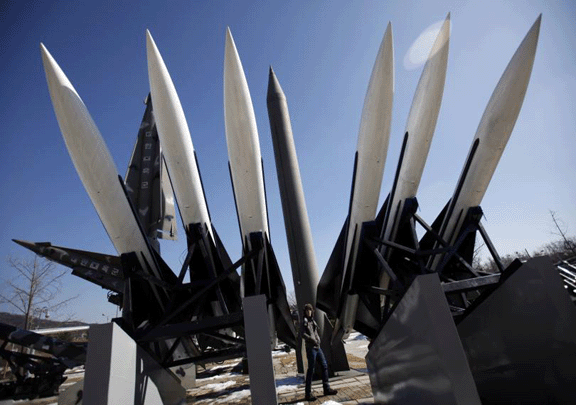
 U.N. Nuclear Inspector: North Korea’s Capability Has Entered A ‘New Phase’ And while a diplomatic solution is necessary, one is unlikely to be reached, warns Yukiya Amano. WASHINGTON — North Korea’s nuclear weapons program has entered a “new phase,” with the country having doubled the size of its uranium-enrichment facility in recent years, Yukiya Amano, director general of the International Atomic Energy Agency, told The Wall Street Journal.
As Toshiba’s $500m nuclear bankruptcy looms, Brtitain’s Moorside project looks doubtful
 Fears for Moorside as Toshiba ‘lining up’ $500m bankruptcy backstop for Westinghouse nuclear arm,Telegraph UK 21 MARCH 2017 Fears that Toshiba’s struggling nuclear business Westinghouse could be on the brink of going under have been reignited following reports that it is lining up a US bankruptcy protection finance package.
The company is reportedly reviewing proposals from financial institutions and investment firms for a so-called debtor-in-possession loan to keep the company afloat while it undertakes a bankruptcy process.
According to Reuters, people familiar with the matter have said the loan is likely to be over $500m to enable the heavily indebted company to pay employees and complete the work on four nuclear power plants in the US. The projects are the first nuclear reactors to be built in the US for thirty years, but heavy delays have saddled Toshiba with writedowns of 712.5bn yen (£5bn).
The sources warned that the talks are at an early stage and that no final decision has been made to wind down the company. A UK spokesman for the company was not immediately able to comment.
A potential bankruptcy procedure raises serious questions over the future of a key £10bn nuclear project which plans to use the AP1000 nuclear reactor designed by Westinghouse.
Toshiba is a 60pc shareholder in the NuGeneration consortium, which plans to develop the Moorside project alongside France’s Engie, formerly known as GDF Suez.An early exit from Toshiba could heavily delay the start up of the 3.2GW Moorside project while NuGen scrambles to find new investment and approve a new nuclear reactor design to use in the project……
The company said it will deliver its full year results on April 11, its third scheduled date after failing to disclose the full impact of its Westinghouse woes twice before. http://www.telegraph.co.uk/business/2017/03/21/toshiba-lining-500m-bankruptcy-backstop-say-reports/
Trump govt to review decades-old US aim of world without nuclear weapons
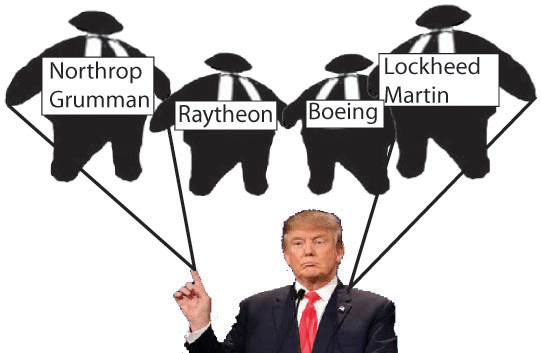 Donald Trump’s administration to review decades-old US aim of world without nuclear weapons, The Independent, Policy review under way as US opposes proposed UN treaty on a global nuclear weapons ban Lizzie Dearden @lizziedearden, 21 Mar 17
Donald Trump’s administration is to review whether the US will keep its policy of nuclear disarmament.
Christopher Ford, the National Security Council’s senior director for weapons of mass destruction and counter-proliferation, said an assessment of US policy will examine whether the aim was “realistic”.
“Like all administrations we’re reviewing policy across the board, and that necessarily includes whether or not the goal of a world without nuclear weapons is in fact a realistic objective, especially in the near to medium term, in the light of current trends in the international security environment,” he told the Carnegie International Nuclear Policy Conference.
“It’s too early to say what the answers will be – looking at things with fresh eyes is not saying we will necessarily end up with different positions.”
Mr Ford said there was a “tension” between the goal of nuclear disarmament and the security requirements of the US and its allies.
He argued that the “headspace” for reducing nuclear arsenals had diminished in the years since the Cold War and cuts by the US and Russia seemed unlikely while other nuclear states continue development.
Mr Trump “will not accept a second place position in the nuclear weapons arena” but is open to broader engagement with Russia on the issue, Mr Ford said. He added that the current “threat environment” had changed substantially from when the review that established America’s current aims took place under Barack Obama in 2010.
The nuclear adviser said the Trump administration would continue American opposition to a “dangerous and misbegotten” proposed treaty to ban nuclear weapons.
UN member states voted overwhelmingly to start negotiations on a “legally binding instrument to prohibit nuclear weapons, leading towards their total elimination” last year.
A conference on the issue will be held in New York starting on 27 March but the treaty was opposed by nuclear powers including the US, Britain, Russia, France and Israel.
Mr Trump has not made any official policy statement on nuclear weapons but has touched on the issue repeatedly in his speeches and tweets.
Questioned about his warm statements towards Vladimir Putin at a press conference in February, the President warned that war between the US and Russia would be a “nuclear holocaust like no other”…….. http://www.independent.co.uk/news/world/americas/us-politics/donald-trump-nuclear-weapons-goal-world-without-reconsider-deproliferation-treaties-white-house-a7641706.html
Unsafety at France’s La Hague nuclear recycling plant ? AREVA unions warn

 Areva unions warn about safety at France’s La Hague nuclear recycling plant Unions says cost cuts, redundancies jeopardise safety * Regulator ASN inspects plant following union warning * ASN: plant is safe but will be vigilant, adapt procedures * ASN confirms some radioactive waste containers flawed (Adds ASN comments) Nasdaq, By Geert De ClercqPARIS, March 23 (Reuters) –
1 This Month
Chernobyl: The Lost Tapes – A good documentary on Chernobyl on SBS available On Demand for the next 3 weeks– https://www.sbs.com.au/ondemand/tv-program/chernobyl-the-lost-tapes/2352741955560

of the week–London Campaign for Nuclear Disarmament

Tell the Ukrainian Government to Drop Prosecution of Peace Activist Yurii Sheliazhenko
To see nuclear-related stories in greater depth and intensity – go to https://nuclearinformation.wordpress.com
-
Archives
- April 2026 (126)
- March 2026 (251)
- February 2026 (268)
- January 2026 (308)
- December 2025 (358)
- November 2025 (359)
- October 2025 (376)
- September 2025 (257)
- August 2025 (319)
- July 2025 (230)
- June 2025 (348)
- May 2025 (261)
-
Categories
- 1
- 1 NUCLEAR ISSUES
- business and costs
- climate change
- culture and arts
- ENERGY
- environment
- health
- history
- indigenous issues
- Legal
- marketing of nuclear
- media
- opposition to nuclear
- PERSONAL STORIES
- politics
- politics international
- Religion and ethics
- safety
- secrets,lies and civil liberties
- spinbuster
- technology
- Uranium
- wastes
- weapons and war
- Women
- 2 WORLD
- ACTION
- AFRICA
- Atrocities
- AUSTRALIA
- Christina's notes
- Christina's themes
- culture and arts
- Events
- Fuk 2022
- Fuk 2023
- Fukushima 2017
- Fukushima 2018
- fukushima 2019
- Fukushima 2020
- Fukushima 2021
- general
- global warming
- Humour (God we need it)
- Nuclear
- RARE EARTHS
- Reference
- resources – print
- Resources -audiovicual
- Weekly Newsletter
- World
- World Nuclear
- YouTube
-
RSS
Entries RSS
Comments RSS
 nuclear-news