Worldwide, utilities that rely on nuclear energy are in crisis
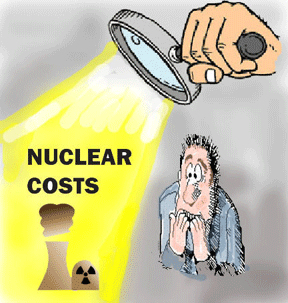 Nuclear Power Is In Crisis As Cost Overruns Cripple Industry Giants, New Matilda., By Jim Green on February 26, 2017 “……….Utilities in crisis everywhere
Toshiba’s demise would not greatly concern the nuclear industry if it was an isolated case, but it is symptomatic of industry-wide problems. Nick Butler from Kings College London wrote in a Financial Times online post: “Toshiba is just one company in the global nuclear industry, but its current problems are symptomatic of the difficulties facing all the private enterprises in the sector. Civil nuclear power involves huge up-front capital costs, very long pay-back periods and high risks that are compounded by a lack of experience, especially in managing nuclear construction projects after a long period with few new plants. For all those reasons, private investors avoid the sector and prefer to put their money where they see faster and safer returns.”
Nuclear utilities around the world are in deep trouble ‒ their problems were summarised in the July 2016 World Nuclear Industry Status Report:
“Many of the traditional nuclear and fossil fuel based utilities are struggling with a dramatic plunge in wholesale power prices, a shrinking client base, declining power consumption, high debt loads, increasing production costs at ageing facilities, and stiff competition, especially from renewables.
- In Europe, energy giants EDF, Engie (France), E.ON, RWE (Germany) and Vattenfall (Sweden), as well as utilities TVO (Finland) and CEZ (Czech Republic), have all been downgraded by credit rating agencies over the past year. All of the utilities registered severe losses on the stock market.
- French utility AREVA has accumulated €10 billion (US$10.9 billion) in losses over the past five years. Share value 95% below 2007 peak value. Standard & Poor’s downgraded AREVA shares to BB+ (‘junk’) in November 2014 and again to BB- in March 2015. …
- The AREVA rescue scheme could turn out to be highly problematic for EDF as its risk profile expands. EDF struggles with US$41.5 billion debt, downgraded by S&P, shares lost over half of their value in less than a year and 87% compared to their peak value in 2007.
- RWE shares went down by 54% in 2015.
- In Asia, the share value of the largest Japanese utilities TEPCO and Kansai was wiped out in the aftermath of the Fukushima disaster and never recovered. Chinese utility CGN (EDF partner for Hinkley Point C), listed on the Hong Kong stock exchange since December 2014, has lost 60% of its share value since June 2015. The only exception to this trend is the Korean utility KEPCO that operates as a virtual monopoly in a regulated market.
- In the US, the largest nuclear operator Exelon has lost about 60% of its share value compared to its peak value in 2008.”…….. https://newmatilda.com/2017/02/26/nuclear-power-is-in-crisis-as-cost-overruns-cripple-industry-giants/
Russians alarmed by Donald Trump’s posture on nuclear weapons

 Trump’s US nuclear stance alarms Russia http://www.skynews.com.au/news/politics/nthamerica/2017/02/25/trump-s-us-nuclear-stance-alarms-russia.html
Published: 10:16 am, Saturday, 25 February 2017 Russian politicians close to the Kremlin say US President Donald Trump’s declared aim of putting the US nuclear arsenal ‘at the top of the pack’ risked triggering a new Cold War-style arms race between Washington and Moscow.
In an interview with Reuters, Trump said the US had fallen behind in its nuclear weapons capacity, a situation he said he would reverse, and he said a treaty limiting Russian and US nuclear arsenals was a bad deal for Washington.
Russian officials issued no reaction, with Friday a public holiday, but pro- Kremlin politicians expressed consternation about the comments from Trump, who Moscow had hoped would usher in new, friendlier relations between the two countries.
‘Trump’s campaign slogan ‘Make America great again’, if that means nuclear supremacy, will return the world to the worst times of the arms race in the ’50s and ’60s,’ said Konstantin Kosachev, chairman of the international affairs committee in the upper house of the Russian parliament.
The president’s remarks in the interview with Reuters were, Kosachev said in a post on his Facebook page, ‘arguably Trump’s most alarming statement on the subject of relations with Russia’.
Over the course of the Cold War, the Soviet Union and the US realised that achieving supremacy was dangerous, and accepted the doctrine of parity as the best way to ensure peace, Kosachev wrote on his Facebook page.
‘Are we entering a new era? In my view we need an answer to that question as soon as possible.’
During the US presidential race, Trump said he would try to end the enmity that broke out between the Kremlin and Washington during Barack Obama’s presidency.
But just over a month into the Trump presidency, that prospect has receded, especially with the sacking of Michael Flynn, a leading proponent of warmer ties with Moscow, from his job as national security adviser.
Another pro-Kremlin lawmaker, Alexei Pushkov, wrote on Twitter that Trump’s comments on increasing US nuclear capacity ‘put in doubt the agreement on limiting strategic arms, returning the world to the 20th century’.
He said a Cold War arms treaty laid the foundation for nuclear stability between Moscow and Washington. ‘That needs to be preserved. And the United States cannot achieve decisive superiority.’
‘Instead of trying to achieve an illusory nuclear supremacy over Russia, the US administration should find a solution to the exceptionally complicated nuclear problem of North Korea,’ wrote Pushkov, a member of the defence and security committee in Russia’s upper house of parliament. – See more at: http://www.skynews.com.au/news/politics/nthamerica/2017/02/25/trump-s-us-nuclear-stance-alarms-russia.html#sthash.fwqZWCfw.dpuf
– See more at: http://www.skynews.com.au/news/politics/nthamerica/2017/02/25/trump-s-us-nuclear-stance-alarms-russia.html#sthash.fwqZWCfw.dpuf
– See more at: http://www.skynews.com.au/news/politics/nthamerica/2017/02/25/trump-s-us-nuclear-stance-alarms-russia.html#sthash.fwqZWCfw.dpuf– See more at: http://www.skynews.com.au/news/politics/nthamerica/2017/02/25/trump-s-us-nuclear-stance-alarms-russia.html#sthash.fwqZWCfw.dpuf
It’s now time to work for climate adaptation and social justice
The pressing priority is always to pull down emissions. Climate change is portrayed a future threat and our responsibility to act is framed in reference to our children and grandchildren. If environmental ruin is already here, it is deemed marginal compared to the tempests amassing on the horizon.
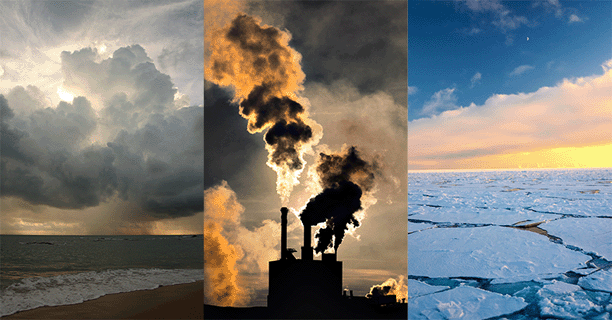
But this uneven focus on the future understates the gravity of present impacts. Today, climate change accounts for 87 per cent of disasters worldwide. Some of the worst droughts in decades are continuing to unravel across southeastern Africa and Latin America. Cyclonic storms, floods, wildfires, and landslides are bearing on the world’s most vulnerable populations.
The sudden violence of disasters is paralleled by the brutality of gradual change. Coastlines are being shaved and eroded by rising tides. The encroachment of sea water is increasing the salinity of littoral lands, leaving them withered and infertile. Rain patterns are shifting, shattering the millions who rely on the sky for sustenance. Every second, one person is forced to flee their home due to extreme climactic conditions.
This context of daily displacement and desolation means that the fight to tackle climate change today is fundamentally a fight to determine the fatality of the future. Yet adaptation, the crucial tool in that fight, has been side-lined and neglected.
So what is adaptation?
Adaptation means preparing our society for the climatic threats it faces and will face, insofar as we can. It means weaving safety nets for the world’s most vulnerable populations. It means bolstering river embankments, introducing measures to prevent diseases, building water-resistant infrastructure, expanding storm sewers and water storage, extending insurance, implementing disaster early-warning systems, and introducing a range of measures to palliate damage.
Some adaptation initiatives are already underway. From the Cook Islands to Morocco, farmers are adjusting practices and diversifying crops, to create a more climate-resilient agriculture. Current agricultural models, where monocultures breed vulnerability, are being transformed into biodiverse agrosystems.
In flood-prone areas, like Delaware, urban planners and citizens are reengineering and redesigning neighbourhoods to reduce the risk of inundation and future sea level rise. In urban areas prone to intense heat, like the Indian city of Ahmedabad (which lost 1,300 citizens to a 2010 extreme heat wave), municipal officials are implementing heat action plans which train health workers, distribute cooling supplies, open public areas for shade, and raise public awareness.
In some areas, the only plausible form of adaptation is abandon. In Fiji, villages such as Vunidogola are already being relocated after Cyclone Winston and other disasters devastated a number of settlements – while rising sea levels provide an additional layer of risk. The Fijian state has listed relocation as a top priority for the government.
A decade ago, the Maldivian government also organized a ‘staged retreat’, concentrating populations away from secluded islands threatened by rising sea levels. In Alaska, the citizens of Newtok have applied for federal disaster relief to finance their own relocation, as thawing permafrost erodes the land under their feet, pulling the village towards the Ninglick River. In China, the government has relocated over a million people away from areas governed by environmental hazards.
But adaptation is not just a technical exercise; it is also a struggle to shape what kind of world will greet the intensifying weather patterns of tomorrow. Whose lives will matter when the storms arrive? Will the seawalls we build to hold back the swelling tides be accompanied by walls to hold out those fleeing?
The challenge of adaptation directly exposes the climate crisis as a crisis of social justice. All disasters break open the wounds of unequal societies. Storms do not discriminate, but they do make landfall on landscapes riven by disparities of wealth, power and safety.
The labels of ‘natural disaster’ and ‘extreme weather’ can mislead us into thinking that the principal dangers we face stem from the atmosphere’s furies. But as geographer Jesse Ribot writes, ‘vulnerability does not fall from the sky.’ The wreckage of climate change is the product of collision: between environmental conditions and human realities.
This collision explains why women are far more likely than men to die in natural disasters and endure the slow violence of environmental degradation. It lies at the root of why ethnic minorities, the disabled, the silenced, and the neglected, are all disproportionately susceptible to the rigours of a changing climate.
Deep adaptation means challenging these inequities……….. https://newint.org/features/web-exclusive/2017/02/22/brace-for-impact-time-to-build-fight-for-climate-adaptation/
Tory grandee wants Britain to pour billions of taxpayer money into nuclear power projects
 Yeo: Treasury needs to pour billions into nuclear projects , Telegraph UK 25 FEBRUARY 2017 The Treasury is facing calls to pour billions of pounds into a string of troubled new nuclear projects which threaten the UK’s energy supplies.
Tim Yeo, a former environment minister and energy committee chairman, is warning that the only way the Government can avert a crisis for the country’s nuclear programme is to take a direct financial stake in the projects.
Ministers should also actively encourage investment from nuclear companies in China, South Korea and Russia where the the industry is relatively insulated from the challenges faced by European companies thanks to strong state backing, he said.
Ministers are wary of involving the foreign powers in its energy security plans and have steadfastly resisted taking on the financial risk involved in nuclear construction.
In a letter to Business Secretary Greg Clark, the Tory grandee says there is a real danger that the pipeline of nuclear projects will fail to come on stream before 2030 unless Government agrees to intervene. Mr Yeo said the existing support regime, which guarantees a fixed price for each megawatt of power produced, does not go far enough to help investors who face billions in construction costs before the nuclear plant begins producing power……
The health and economic costs if USA’s Clean Power Plan is repealed
 Clean Power Plan Repeal Would Cost America $600 Billion, Cause 120,000 Premature Deaths, https://www.forbes.com/sites/energyinnovation/2017/02/23/clean-power-plan-repeal-would-cost-america-600-billion-cause-120000-premature-deaths/#3536fd713b78 Jeffrey Rissman, The Trump administration has prioritized repealing the Clean Power Plan (CPP), a set of rules by the U.S. EPA aimed at limiting pollution from power plants. New analysis shows that repealing the rule would cost the U.S. economy hundreds of billions of dollars, add more than a billion tons of greenhouse gases to the atmosphere and cause more than 100,000 premature deaths due to inhaled particulate pollution.
- First, the EPS works at national scale, so policies are represented as nationwide averages; that is, without individually modeling U.S. states.
- Second, a variety of different policies might be used to achieve the CPP targets. We analyzed a mixed package representative of how the EPA expects states to achieve their targets.
- Third, the EPS calculates results through 2050, but the CPP targets only extend through 2030. The policy package we use to represent the CPP includes continued policy improvement through 2050 at the same rate as in earlier years (that is, policies strengthen by the same amount each year from 2017 to 2050), rather than CPP policies becoming frozen at their 2030 levels.
Nearly $600 Billion in Economy-Wide Costs
Cumulative net costs to the U.S. economy (in increased capital, fuel, and operations and maintenance (O&M) expenditures) would exceed $100 billion by 2030 and would reach nearly $600 billion by 2050.
It may seem ironic that removing regulations can result in increased costs to the economy, but regulations can help to overcome market barriers and similar problems that prevent certain economically-ideal outcomes from being achieved in a free market (for instance, under-investment in energy efficiency technologies).
120,000 New Premature Deaths
Although the CPP’s focus is on reducing carbon emissions, the same policies also reduce particulate pollution, which is responsible for thousands of heart attacks and respiratory diseases each year. Repealing the CPP would increase particulate emissions, causing more than 40,000 premature deaths in 2030 and more than 120,000 premature deaths in 2050.
Far More New Coal Capacity, Far Less New Renewables Capacity
Without the CPP, the U.S. electric grid would feature a larger capacity of coal power plants, while the capacity of wind and solar on the system would be smaller, as shown in the following table. [on original]
This finding is echoed by a new forecast from the U.S. Energy Information Administration, which predicts that without CPP implementation, coal will become America’s leading source of electricity generation by 2019.
This slow-down in the transition to clean energy would cost the U.S. technological leadership in the rapidly-growing solar and wind industries and would cost the U.S. many jobs. Even today, when wind makes up 6.6 percent and solar 1.8 percent of total U.S. installed capacity, the solar industry employs 374,000 people and wind industry 101,000 workers, roughly two and a half times the 187,000 combined workers in the coal, natural gas and oil industries.
Clean Power Plan Repeal A Terrible Mistake For America
Repealing the Clean Power Plan would be a terrible mistake. A repeal would increase costs to the U.S. economy by hundreds of billions of dollars, cut years off the lives of tens of thousands of Americans and sacrifice U.S. technological leadership and job creation. For the future prosperity and strength of the country, the CPP should be preserved, and its targets should continue to strengthen through 2050 and beyond.
Climatologists explain threat of drastic cooling in North Atlantic
Drastic cooling in North Atlantic beyond worst fears, scientists warn https://www.theguardian.com/environment/2017/feb/24/drastic-cooling-north-atlantic-beyond-worst-fears-scientists-warn
Climatologists say Labrador Sea could cool within a decade before end of this century, leading to unprecedented disruption, reports Climate News Network, Guardian, Alex Kirby , 25 Feb 17, For thousands of years, parts of northwest Europe have enjoyed a climate about 5C warmer than many other regions on the same latitude. But new scientific analysis suggests that that could change much sooner and much faster than thought possible.
Climatologists who have looked again at the possibility of major climate change in and around the Atlantic Ocean, a persistent puzzle to researchers, now say there is an almost 50% chance that a key area of the North Atlantic could cool suddenly and rapidly, within the space of a decade, before the end of this century.
That is a much starker prospect than even the worst-case scientific scenario proposed so far, which does not see the Atlantic ocean current shutdown happening for several hundred years at least.
A scenario even more drastic (but fortunately fictional) was the subject of the 2004 US movie The Day After Tomorrow, which portrayed the disruption of the North Atlantic’s circulation leading to global cooling and a new Ice Age.
To evaluate the risk of extreme climate change, researchers from the Environnements et Paléoenvironnements Océaniques et Continentaux laboratory (CNRS/University of Bordeaux, France), and the University of Southamptondeveloped an algorithm to analyse the 40 climate models considered by the Fifth Assessment Report.
The findings by the British and French team, published in the Nature Communications journal, in sharp contrast to the IPCC, put the probability of rapid North Atlantic cooling during this century at almost an even chance – nearly 50%.
Current climate models foresee a slowing of the meridional overturning circulation (MOC), sometimes known also as the thermohaline circulation, which is the phenomenon behind the more familiar Gulf Stream that carries warmth from Florida to European shores. If it did slow, that could lead to a dramatic, unprecedented disruption of the climate system.
In 2013, drawing on 40 climate change projections, the IPCC judged that this slowdown would occur gradually, over a long period. Its findings suggested that fast cooling of the North Atlantic during this century was unlikely.
But oceanographers from EU emBRACE had also re-examined the 40 projections by focusing on a critical spot in the northwest of the North Atlantic: the Labrador Sea.
The Labrador Sea is host to a convection system ultimately feeding into the ocean-wide MOC. The temperatures of its surface waters plummet in the winter, increasing their density and causing them to sink. This displaces deep waters, which bring their heat with them as they rise to the surface, preventing the formation of ice caps.
The algorithm developed by the Anglo-French researchers was able to detect quick sea surface temperature variations. With it they found that seven of the 40 climate models they were studying predicted a total shutdown of convection, leading to abrupt cooling of the Labrador Sea by 2C to 3C over less than 10 years. This in turn would drastically lower North Atlantic coastal temperatures.
But because only a handful of the models supported this projection, the researchers focused on the critical parameter triggering winter convection: ocean stratification. Five of the models that included stratification predicted a rapid drop in North Atlantic temperatures.
The researchers say these projections can one day be tested against real data from the international OSnap project, whose teams will be anchoring scientific instruments within the sub-polar gyre (a gyre is any large system of circulating ocean currents).
If the predictions are borne out and the North Atlantic waters do cool rapidly over the coming years, the team says, with considerable understatement, climate change adaptation policies for regions bordering the North Atlantic will have to take account of this phenomenon.
Future sea level rise studies by NASA project – Oceans Melting Greenland (OMG)
 OMG measurements of Greenland give us a glimpse of future sea rise https://www.skepticalscience.com/omg-greenland-sea-level-rise.html 24 February 2017 by John Abraham If you meet a group of climate scientists, and ask them how much sea levels will rise by say the year 2100, you will get a wide range of answers. But, those with most expertise in sea level rise will tell you perhaps 1 meter (a little over three feet). Then, they will immediately say, “but there is a lot of uncertainty on this estimate.” It doesn’t mean they aren’t certain there will be sea level rise – that is guaranteed as we add more heat in the oceans. Here, uncertainty means it could be a lot more or a little less.
Why are scientists not certain about how much the sea level will rise? Because there are processes that are occurring that have the potential for causing huge sea level rise, but we’re uncertain about how fast they will occur. Specifically, two very large sheets of ice sit atop Greenland and Antarctica. If those sheets melt, sea levels will rise hundreds of feet.
Parts of the ice sheets are melting, but how much will melt and how fast will the melting occur? Are we talking decades? Centuries? Millennia? Scientists really want to know the answer to this question. Not only is it interesting scientifically, but it has huge impacts on coastal planning.
One reason the answer to this question is illusive is that melting of ice sheets can occur from above (warm air and sunlight) or from below (warm ocean waters). In many instances, it’s the melting from below that is most significant – but this melting from below is really hard to measure.
With hope we will have a much clearer sense of ice sheet melting and sea level rise because of a new scientific endeavor that is part of a NASA project – Oceans Melting Greenland (OMG). This project has brought together some of the best oceanographers and ice experts in the world. The preliminary results are encouraging and are discussed in two recent publications here and here.
In the papers, the authors note that Greenland ice loss has increased substantially in recent decades. It now contributes approximately 1/3 to total sea level rise. The authors want to know whether this contribution will change over time and they recognize that underwater processes may be the most important to study. In fact, they note in their paper:
Specifically, our goal is improved understanding of how ocean hydrographic variability around the ice sheet impacts glacial melt rates, thinning and retreat.
In plain English, they want to know how water flow around Greenland affects the ice melt.
Their experiments are measuring a number of key attributes. First, yearly changes in the temperature of ocean water near Greenland. Second, the yearly changes to the glaciers on Greenland that extend into the ocean waters. Third, they are observing marine topography (the shape of the land underneath the ocean surface).
The sea floor shape is quite complicated, particularly near Greenland. Past glaciers carved deep troughs in the sea floor in some areas, allowing warm salty water to reach huge glaciers that are draining the ice sheet. As lead OMG investigator Josh Willis said:
What’s interesting about the waters around Greenland is that they are upside down. Warm, salty water, which is heavy, sits below a layer of cold, fresh water from the Arctic Ocean. That means the warm water is down deep, and glaciers sitting in deep water could be in trouble.
As the warm water attacks marine glaciers (glaciers that extend into the ocean), the ice tends to break and calve, retreating toward land. In some cases, the glaciers retreat until their grounding line coincides with the shore. But in other cases the undulating surface allows warm water to wear the glacier underside for long distances and thereby increase the risk of large calving events.
Oftentimes, when glaciers near the coast break off they uncork other ice that can then more easily flow into the oceans.
Pulling down nuclear reactors now looks like the only viable area for the nuclear industry
Nuclear Power Is In Crisis As Cost Overruns Cripple Industry Giants, New Matilda., By Jim Green on February 26, 2017 “………‘Rapidly accelerating crisis’
Shellenberger has recently written cataclysmic assessments of nuclear power’s “rapidly accelerating crisis” and a “crisis that threatens the death of nuclear energy in the West“.
Likewise, Dan Yurman says that a “sense of panic is emerging globally” as Toshiba exits the reactor construction industry. He adds: “After nine years of writing about the global nuclear industry, these developments make for an unusually grim outlook. It’s a very big rock hitting the pond. Toshiba’s self-inflicted wounds will result in long lasting challenges to the future of the global nuclear energy industry. Worse, it comes on top of the French government having to restructure and recapitalize Areva, its state-owned nuclear power corporation, so that it can complete two 1650 MW EPR reactors that are under construction in Europe and to begin work on the Hinkley project the UK.”
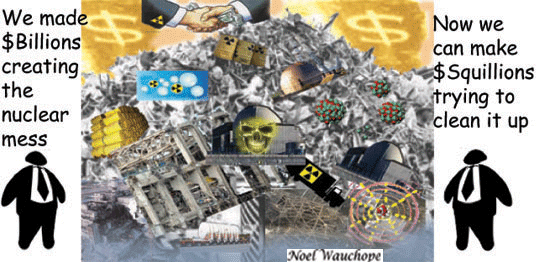
Ironically, Westinghouse, the villain in Toshiba’s demise, may have made the best strategic decision of all the nuclear utilities. In 2014, Westinghouse announced plans to expand and hopefully triple its nuclear decommissioning business. Decommissioning is undoubtedly a growth area.
The average age of the global reactor fleet now stands at 30 years. The World Nuclear Association anticipates 132 reactor shut-downs by 2035. The International Energy Agency anticipates a “wave of retirements of ageing nuclear reactors” and an “unprecedented rate of decommissioning” ‒ almost 200 shut-downs between 2014 and 2040. Up to 200 reactors are set to go offline in the next two decades according to a recent Nuclear Energy Insider article……… https://newmatilda.com/2017/02/26/nuclear-power-is-in-crisis-as-cost-overruns-cripple-industry-giants/
Nigeria in debt to International Atomic Energy Agency, and can’t afford to run nuclear power safely
Indebtedness, a stumbling block to Nigeria’s nuclear sector progress- NNRA DG http://tribuneonlineng.com/indebtedness-stumbling-block-nigerias-nuclear-sector-progress-nnra-dg/ THE Nigerian Nuclear Regulatory Authority (NNRA) has appealed to the Federal Government to ensure the payment of its indebtedness to the International Atomic Energy Agency (IAEA), lamenting that the debt has been a stumbling block to the progress of nuclear sector in Nigeria.
The Director-General/Chief Executive Officer (DG/CEO) of the authority, Professor Lawrence Dim, who made this appeal in a signed statement made available to the Nigerian Tribune in Abuja, on Sunday, further urged the government to ensure that Nigeria paid up all her access contribution fees to the IAEA to enable the NNRA made meaningful contributions in the society.
He also implored the government to improve the funding of the NNRA, as nuclear power programme required long term commitment, pointing out that the authority has lived up to its mandate by continuously ensuring the protection of life, health, as well as property and the environment.
Professor Dim observed that there was the need for the institutionalisation of the Nuclear Safety Security and Safeguards Bill through an act of the National Assembly in order to domesticate the nation’s international obligations.
The DG, who admitted that there was inadequate information on the beneficial uses of ionizing radiation, said these were parts of recommendations after the 4th National Workshop organised by the NNRA in Abuja for Editors and Correspondents.
According to him, government at all levels should ensure that all facilities that ought to be under regulatory control of the NNRA are indeed regulated by the NNRA. Not all the facilities that should be under regulatory control of the NNRA are indeed regulated by the Authority.
“There is generally a low level of awareness with respect to the nuclear sector. The Nuclear Safety, Security and Safeguards Document (Bill) is yet to be passed into law by the National Assembly. There should be more information dissemination on the nuclear sector in order to enlighten the public.
“Government should embark on an intensive manpower development to achieve the critical mass of professionals for the development of the nuclear sector. The NNRA should collaborate with the relevant agencies on grassroots sensitization”, he added.
Other Management Staff present at the workshop included Director, Radiological Safety, Professor T. C. Akpa; Director, Authorization and Enforcement, Dr. Yau Idris; as well as Deputy Director, Nuclear Safety, Physical Security and Safeguards , Dr. Nasiru Bello and the Head of Information and Protocol Unit, Mrs. Ekaette Ebong Bassey.
South Adricans: Say no to nuclear plants!
 So no to nuclear plants http://highwaymail.co.za/252113/so-no-to-nuclear-plants/ Liz Purdham, Pinetown
South African citizens have till the end of March to object to the nuclear plant. UNDERSTAND President Zuma and team have made a deal with the Russians to build a nuclear plant here in South Africa.
Many hundreds of South Africans are totally against this deal – why aren’t we marching with banners, “No Nuclear”? You know the dangers of the nuclear plant from radiation to storing the radioactive waste, which has to be kept secure for years.
We all remember the Cheronbyl accident which led more countries to abandon the nuclear option and go for renewables.
We need to stand up against this deal – someone said, “it will show the Arms Deal as a picnic” so, no doubt, many stand to gain bribes and illegal pay-outs.
Through the Highway Mail, we can stand up against this programme. Apparently we only have till the end of March to object. It is so important – please make it a priority.
February 26 Energy News

Opinion:
¶ “How to Support Renewable Energy (and Why You Really Should)” • Even with the divided US political climate, most people agree on public support for increasing our use of renewable energy sources. Some are concerned about pollution, others about the national security. But many are attracted to benefits of renewable energy. [Scientific American]
 Geothermal power plant (Stepheng3, Wikimedia Commons)
¶ “Conservative group’s carbon plan gives us hope for climate change action” • The Climate Leadership Council, a conservative panel including former Secretaries of State George Schultz and James Baker and former Treasury Secretary Henry Paulson, is challenging climate skeptics in their party with a market-based approach. [Hawaii Tribune Herald]
¶ “Wind Energy Boom Hits The US” • It’s free, plentiful, carbon neutral and in the right hands could have a radical impact on the future. Installed wind capacity was greater than hydroelectric, according to…
View original post 656 more words
Weaken safety standards, to save the industry – that’s the advice from pro nuclear lobbyists
 Nuclear Power Is In Crisis As Cost Overruns Cripple Industry Giants, New Matilda., By Jim Green on February 26, 2017A future for nuclear power?
“……A fundamental difficulty for the nuclear industry is that the imperatives for greater safety and reduced costs push in opposite directions. Mark Cooper, from the Institute for Energy and the Environment at Vermont Law School, recently told the New York Times: “Nuclear safety always undermines nuclear economics. Inherently, it’s a technology whose time never comes.”
Retreating from post-Fukushima efforts to strengthen safety standards inevitably increases the risk of another Chernobyl- or Fukushima-scale catastrophe. Leaving aside the disputed health effects from those disasters, the economic costs associated with both disasters was in the ball-park of US$500 billion, and both had devastating impacts on public acceptance of nuclear power.
Yet a retreat from post-Fukushima efforts to strengthen safety standards seems to be where the industry and its enthusiasts are heading in their efforts to curb nuclear power’s astonishing cost increases and overruns.
Proposals include weakening safety regulations; abandoning Generation 3/3+ reactors in favour of Generation 2 reactor types (or redefining Generation 2 reactor types as Generation 3/3+); and overturning the established scientific orthodoxy that even the smallest doses of ionizing radiation can cause morbidity and mortality.
How to convince the public to accept reduced nuclear safety standards even as 80,000 people remain displaced because of the Fukushima disaster and clean-up and compensation cost estimates double then double again? In a word: spin.
Shellenberger, for example, wants “higher social acceptance” but he also wants weakened safety regulations such as the repeal of a US Nuclear Regulatory Commission rule designed to strengthen reactors against aircraft strikes. He squares the circle with spin and sophistry, claiming (without evidence) that the NRC’s Aircraft Impact Rule “would not improve safety” and claiming (without evidence) that the NRC “caved in to demands” from anti-nuclear groups to establish the rule………. https://newmatilda.com/2017/02/26/nuclear-power-is-in-crisis-as-cost-overruns-cripple-industry-giants/
Trump Allows Oil, Gas, and Coal Companies to Cheat Americans out of Royalties – At Least Pending Litigation (Gold, Uranium and Other Hardrock Miner’s Don’t Pay Royalties for their Thefts from Public Lands)

News release from the Sierra Club:
“TRUMP ENDS RULE BLOCKING CORPORATE POLLUTERS FROM PAYING THEMSELVES
Interior Rule Prevented Fossil Fuel Companies From Selling Resources to Themselves
Friday, February 24, 2017
Contact:
Jonathon Berman, (202) 297-7533, jonathon.berman@sierraclub.org
Washington, DC — Today, Donald Trump rescinded a Office of Natural Resource Revenue rule that prevented companies from selling fossil fuels extracted on public lands to a subsidiary at a low price, paying royalties on that initial sale, and then reselling the fuel at a far higher price without paying royalties on the second sale.
In response, Sierra Club Lands Protection program Director Athan Manuel released the following statement:
“It’s no surprise that someone with Donald Trump’s checkered business history would rescind a rule preventing fossil fuel companies from ripping off the American people. Donald Trump should represent the people, and as such, should conduct business that puts their interests first — not…
View original post 196 more words
February 25 Energy News
Opinion:
¶ “Trump’s draconian budget proposals will destroy US clean energy innovation” • Voters who expected Trump to prioritize revitalized manufacturing may be disappointed, as his opening budget proposals will stymie progress toward the critical jobs of the 21st century: developing, manufacturing, and installing renewable energy. [Quartz]
 Hey Trump: Europe is beating you on clean
energy – bigly. (Reuters / Denis Balibouse)
¶ “Here’s Why the US Nuclear Industry Is in Jeopardy” • The Spiraling construction costs at new facilities and planned closures of decades-old plants highlight why the nuclear industry in the United States remains in trouble, even as the quest for zero-carbon energy sources grows. Nuclear plants are facing financial meltdowns. [Seeker]
¶ “The Economist embraces renewables” • In this week’s cover story, The Economist thoughtfully argues for expanded use of renewable energy, noting, “It is no longer far-fetched to think that the world…
View original post 777 more words
BILLIONS from the Public Purse to Poison Us All With New Cancer Factories
The UK is banking on the 3.2GW nuclear power plant to provide as much as 7pc of the country’s energy by the middle of next decade. However, the Hinkley Point, Moorside and Sizewell B projects have all been dogged by delays and concerns over whether the multi-billion pound investments can be shouldered by the companies.

From the Telegraph ….
http://www.telegraph.co.uk/business/2017/02/25/yeo-treasury-needs-pour-billions-nuclear-projects/
Yeo: Treasury needs to pour billions into nuclear projects
hinkley
The Treasury is facing calls to pour billions of pounds into a string of troubled new nuclear projects which threaten the UK’s energy supplies.
Tim Yeo, a former environment minister and energy committee chairman, is warning that the only way the Government can avert a crisis for the country’s nuclear programme is to take a direct financial stake in the projects.
Ministers should also actively encourage investment from nuclear companies in China, South Korea and Russia where the the industry is relatively insulated from the challenges faced by European companies thanks to strong state backing, he said.
Tim Yeo
Tim Yeo Credit: Geoff Pugh
Ministers are wary of involving the foreign powers in its energy security plans and have steadfastly resisted taking on the financial risk involved in nuclear construction.
In a letter to Business…
View original post 215 more words
1 This Month
Chernobyl: The Lost Tapes – A good documentary on Chernobyl on SBS available On Demand for the next 3 weeks– https://www.sbs.com.au/ondemand/tv-program/chernobyl-the-lost-tapes/2352741955560

of the week–London Campaign for Nuclear Disarmament

Tell the Ukrainian Government to Drop Prosecution of Peace Activist Yurii Sheliazhenko
To see nuclear-related stories in greater depth and intensity – go to https://nuclearinformation.wordpress.com
-
Archives
- April 2026 (114)
- March 2026 (251)
- February 2026 (268)
- January 2026 (308)
- December 2025 (358)
- November 2025 (359)
- October 2025 (376)
- September 2025 (257)
- August 2025 (319)
- July 2025 (230)
- June 2025 (348)
- May 2025 (261)
-
Categories
- 1
- 1 NUCLEAR ISSUES
- business and costs
- climate change
- culture and arts
- ENERGY
- environment
- health
- history
- indigenous issues
- Legal
- marketing of nuclear
- media
- opposition to nuclear
- PERSONAL STORIES
- politics
- politics international
- Religion and ethics
- safety
- secrets,lies and civil liberties
- spinbuster
- technology
- Uranium
- wastes
- weapons and war
- Women
- 2 WORLD
- ACTION
- AFRICA
- Atrocities
- AUSTRALIA
- Christina's notes
- Christina's themes
- culture and arts
- Events
- Fuk 2022
- Fuk 2023
- Fukushima 2017
- Fukushima 2018
- fukushima 2019
- Fukushima 2020
- Fukushima 2021
- general
- global warming
- Humour (God we need it)
- Nuclear
- RARE EARTHS
- Reference
- resources – print
- Resources -audiovicual
- Weekly Newsletter
- World
- World Nuclear
- YouTube
-
RSS
Entries RSS
Comments RSS
 nuclear-news
