This may be the most dangerous time in human history.
In a dramatic recent decision, the Bulletin of the Atomic Scientists has moved its iconic Doomsday Clock ahead from three minutes to only two-and-a-half minutes to midnight.
Humankind faces two existential challenges of global and potentially apocalyptic scope: nuclear weapons and climate change. Our focus here is on nuclear dangers, but we strongly encourage you, Presidents Trump and Putin, to undertake in a spirit of urgency all necessary steps to avert further global warming.
As the leaders of the United States and Russia, the two countries with the largest nuclear arsenals, you have the grave responsibility of assuring that nuclear weapons are not used — or their use overtly threatened — during your period of leadership.
The most certain and reliable way to fulfill this responsibility is to negotiate with each other, and the other governments of nuclear-armed states, for their total elimination.
The U.S. and Russia are both obligated under Article VI of the Nuclear Non-Proliferation Treaty to engage in such negotiations in good faith for an end to the nuclear arms race and for complete nuclear disarmament. Your success in this endeavor would make you heroes of the Nuclear Age.
Initiating a nuclear war, any nuclear war, would be an act of insanity. Between nuclear weapons states, it would lead to the destruction of the attacking nation as well as the nation attacked. Between the U.S. and Russia, it would also destroy civilization and threaten the survival of humanity.
There are still nearly 15,000 nuclear weapons in the world, of which the United States and Russia each possess some 7,000. Approximately 1,000 of these weapons in each country remain on hair-trigger alert — a catastrophe waiting to happen that could be prevented with the stroke of a pen.
If nuclear weapons are not used intentionally, they could be used inadvertently by accident or miscalculation. Nuclear weapons and human fallibility are an explosive combination, which could at any moment bring dire consequences to the U.S., Russia and the rest of humanity. The world would be far safer by negotiating an end to policies of nuclear first-use, hair-trigger alert and launch-on-warning. Further, negotiations need to be commenced on the phased, verifiable and irreversible elimination of nuclear weapons.
Nuclear deterrence presupposes an unrealistic view of human behavior if projected over time. It depends on the willingness and ability of political leaders to act with total rationality in the most extreme circumstances of stress and provocation. It provides no guarantees of sustained security or physical protection. It could fail, spectacularly and tragically, at any moment.
The further development and modernization of nuclear weapons by the U.S., Russia and others, and the proliferation of nuclear weapons to other countries, would make for an even more dangerous world. It is important for the sake of regional peace and the avoidance of future nuclear confrontations to uphold the international agreement that places appropriate limitations on Iran’s nuclear program, an agreement that has the support of the five permanent members of the United Nations Security Council plus Germany.
Your nuclear arsenals give each of you the power to end civilization. You also have the historic opportunity, should you choose, to become the leaders of the most momentous international collaboration of all time, dedicated to ending the nuclear weapons era over the course of a decade or so. This great goal of Nuclear Zero can be achieved by negotiating, as a matter of priority, a treaty to ban and eliminate nuclear weapons.
We, the undersigned, implore you to commence negotiations to reduce the dangers of a nuclear war, by mistake or malice, and immediately commit your respective governments to the realizable objective of a nuclear weapons-free world. It would be the greatest possible gift to the whole of humanity and to all future generations, as well as of enduring benefit to the national and human security of Russia and the United States.
Image source; “July 20, 2016 = The first indication that something was amiss came at 9 a.m. on Saturday, January 25, 2003. Workers at the Davis-Besse nuclear power plant, in Ohio, noticed a slowdown in applications on the corporate WAN. Little did they know a worm called SQL Slammer was hammering the network. And things were about to get worse. By 4 p.m. the malware had gotten into the systems used to control the reactor. The Safety Parameter Display System, which tells operators about the state of the plant, blinked off at 4:50 p.m. Twenty-three minutes later the Davis-Besse Plant Process Computer crashed. Fortunately, the reactor itself was offline for repairs. It took several hours to restore the systems. An isolated case? Sadly not. Davis-Besse was one of the first cyber-related events suffered by a nuclear power plant, but is not the only one.” https://newsroom.cisco.com/feature-content?articleId=1774597&type=webcontent
Opinions Differ On Whether Nuclear Industry Is Ready For Cyber-Challenges
16 Feb 2017
The nuclear industry says “extensive regulations” against potential cyber-attacks are in place that are closely monitored and regularly inspected. But not all experts agree, with some arguing that the “static” cybersecurity architecture at today’s nuclear facilities is not effective enough on its own to prevent a breach by a determined adversary. In this special report, NucNet editor-in-chief David Dalton takes a look at the case for both sides and at the conclusions of a major report which argued there is a “culture of denial” in the industry when it comes to the risks posed by hackers. The full report is online for subscribers: http://bit.ly/2jCi012
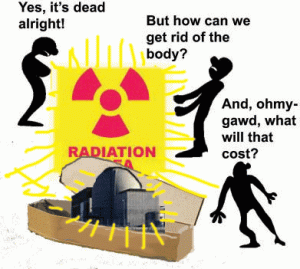
Shutting down Germany’s nuclear power plants is going to be atrociously expensive. Experts also doubt the funds set aside will be enough to cover the costs of scrapping the plants and their radioactive waste.
Dismantling Germany’s nuclear power plants will devour billions – quite possibly many more than previously estimated. And the question remains: Who will ultimately foot the bill?
The decision to move away from nuclear energy is a done deal in Germany, where all nuclear power plants are intended to be offline by 2022. It’s a political decision that will cost billions of euros, while the expansion of renewable energy is already pushing up electricity rates.
It also remains unclear exactly how much it will cost to dismantle the power plants after they’ve been mothballed. Experts are certain that the 34 billion euros set aside by plant operators for this purpose will not be enough to do the job.
The government officially lists nine nuclear plants as providing electricity for Germany’s power grid. Eight additional reactors were already switched off in the wake of the Fukushima disaster in Japan. There are also 16 power stations currently undergoing the long shut-down process.
In total, there are at least 33 facilities that will need to be dismantled and whose contaminated scrap will have to be disposed of.
Aside from the costs involved, there is also the question of where to store the spent nuclear fuel. The federal government calculated in April 2013 that the selection of a site for this purpose over the next 15 years would cost two billion euros.
Irretrievable reserves
Even before Fukushima, Germany’s nuclear operators were building reserves to finance the dismantling of their reactors. However, they were planning for the reactors to remain in operation for longer, leaving more time for the entire process.
The German Atomic Forum (DAtF) estimates that the reserves total around 34 billion euros. Reports indicate that 18 billion lie with the provider Eon, 10 billion with RWE and 3.6 billion with Vattenfall.
Since the dismantling process is now set to begin earlier and be carried out faster, it’s questionable whether these reserves will be sufficient.
Energy experts say the true figure needs to be much higher. RWE calculates that closing a single nuclear plant in Mülheim-Kärlich in the state of Rhineland-Palatinate will cost 750 million euros. Even the anti-nuclear Green party in Germany’s parliament has acknowledged that a much higher sum will be needed to decommission the plants.
Problems also emerge when it comes to the availability of the 34 billion euros that have accumulated. This capital is not sitting in a bank, ready to be accessed. The plant operators have mostly invested it. In RWE’s case, for example, the money has largely been put toward plants in the Netherlands and in Great Britain.
Who will pay?
Furthermore, RWE is understandably not willing to lose any money in the nuclear energy sector, as the energy company’s lawsuit in the case of a temporary decommissioning of its Biblis nuclear power plant showed. In a final appeal, RWE won the case, opening the possibility for the company to file for compensation. Industry insiders say damages could total 187 million euros.
Thanks to Germany’s shift on energy policy, the country’s nuclear providers, who were counting on longer life spans for their reactors, suddenly find themselves with thinner financial reserves. Some politicians suspect that if a provider were to go bankrupt, it might be able to use the money it has set aside for purposes other than disposing of its facilities.
Setting up a public fund is seen as one option for ensuring that money is available to decommission the remaining plants, but it’s a move that could bring further difficulties for the companies involved. As things stand now, RWE would have to take on additional debt in order to afford the payments into a fund of this sort.
Dismantling Germany’s nuclear power plants will devour billions – quite possibly many more than previously estimated. And the question remains: Who will ultimately foot the bill?
Companies vying to build UK nuclear power stations told to cut electricity prices but not how!
This interview covers a range of Spinned points.
Firstly Dr Jenifer Baxter skirts around the issue of renewables stating that nuclear is needed for a stable supply. Then the conversation quickly moves on to the extra cost in planning and specifically mentions the cost of checking the site of a reactor building that does not need to be done for renewables at the start of the building process.
Nigel Cassidy then mentions that the UK government has asked operators to give a 15 to 20 percent discount for future new builds. He then mentions the dreaded word”viability” and then Dr Jenifer Baxter quickly mentions the size of future projects and moves on to Small modular reactors [None are in the production stage btw – Shaun] or smaller standard reactors [That would also need site planing costs added? – Shaun].
The question is then posed that these new reactors might be built and meet the price criteria compared to Hinkley Point and the response was that because of Hinkley Points long running time (for planning) that;
“probably increased the cost of it”
and that new builds could take into account some of the Governments requirements in advance (post Fukushima?).
The conversation then moves onto the EURATOM treaty and Brexit. She states that one impact would be that increased cost of nuclear energy to the nuclear industry would be a result of Brexit.
She also goes onto explain that EURATOM has 4 components and that the Nuclear Cooperation Agreement is the most crucial one to consider. This section of the Euratom agreement allowing countries to share goods, services, skills and research and she states that this needs to be agreed with other countries before Brexit;
“for the UK nuclear industry to be able to continue normally”.
On the issue of Brexit giving the UK nuclear industry some benefits in trading with other countries that Britain does not normally trade with in the nuclear sector. She then goes onto say that first the UK has to develop new Nuclear Cooperation Agreements. She then goes onto say the ” The people who are best placed to support the government in developing a new framework, that allows us to continue working as normal, are those that are working in the UK nuclear industry. Then the conversation goes on to say that if such a framework is not in place before Brexit that this might impact the supply of nuclear fuel from suppliers around the world that might;
“jeopardise the security of supply”
with the countries who are enriching the uranium and those that are making the fuel rods, so stopping the free movement from country to country.
Lastly on the issues of poor investor confidence she states that the UK has;
“a very good research framework for new nuclear programs and decommissioning, in the UK and internationally and it`s supported by the EURATOM treaty, we need to make sure that the innovation that happens within that sector will help to continue to help to reduce the cost of nuclear power stations”
LOL (Hopeful LOL) Transcription by Shaun McGee aka arclight
16 February 2017 Companies vying to build nuclear power stations in the UK have been told they must offer lower electricity prices than that approved for the Hinkley Point plant last year. Government officials have indicated that future projects will be expected to deliver a discount of at least 15-20% on the price of electricity from the £18bn Hinkley plant in Somerset – a settlement widely criticised for its high cost. To discuss this further, Dr Jenifer Baxter, Head of Energy and Environment at the Institution of Mechanical Engineers, joined Nigel Cassidy on Share Radio Breakfast.
“It is clear that OPG misrepresented the findings to the government, to the media and the public,” said McLeod, a retired lawyer and former deputy minister of the environment. “They excel at alternative facts.”
McLeod called it astounding how far OPG appeared willing to go to misrepresent data to the federal government, which has yet to decide if the project should proceed over the objections of hundreds of communities on both sides of the Canada-U.S. border.
Colin Perkel, The Canadian Press Published Wednesday, February 15, 2017 6:45AM EST
TORONTO — A public opinion survey used to bolster claims of widespread support for a proposed nuclear waste bunker near Lake Huron was misleading and actually found little backing for the project, critics say.
While Ontario Power Generation stands by the poll of 805 people, critics insist an analysis shows the utility distorted its findings in submissions to the federal government.
Among other things, poll questions provided false or misleading assumptions designed to skew the response in favour of the deep geologic repository, they said.
Far from showing that a majority of people in Ontario support the repository, the poll actually shows most people oppose it, said Rod McLeod, with the group SOS Great Lakes.
“It is clear that OPG misrepresented the findings to the government, to the media and the public,” said McLeod, a retired lawyer and former deputy minister of the environment. “They excel at alternative facts.”
McLeod called it astounding how far OPG appeared willing to go to misrepresent data to the federal government, which has yet to decide if the project should proceed over the objections of hundreds of communities on both sides of the Canada-U.S. border.
Kevin Powers, a spokesman for OPG, stood by a survey he said was done by one of the top polling firms in the country. Its methodology was scientifically sound and the questions were ordered to prevent bias, he said.
Powers also said reference to its results amounted to just a “single paragraph” in a 700-page report to the government which was among 15,000 pages of evidence showing the project has been proven scientifically safe.
“The survey was intended to give us a clear understanding of what people thought about the (repository) not give us results that we wanted to hear,” Powers said.
“We feel that geology, physics, geoscience and engineering — not opinion research — should guide decision making on this project.”
In a recent submission to the federal minister of the environment, OPG cites the Gandalf Group survey as showing barely more than half of people in Ontario were even aware of the project. The utility then states that 60 per cent of those who had heard about it — based on “their initial understanding” of the project — were supportive.
Robin Palin, a public-relations consultant in Montreal who analyzed the survey, said the upshot of the poll is that it found 33 per cent support among respondents for a repository somewhere in the province.
“There are no other numbers in the entire poll that can be considered statistically-valid representations of Ontario public opinion,” Palin said.
In addition, he said, survey participants were fed unsupportable statements favouring the project. One example was a statement that “experts from around the world, including the U.S. Environmental Protection Agency, agree that this deep geologic repository will protect the environment from nuclear waste.”
At best, the critics say, some international experts support the project but others believe such it would be unsafe, and that the American environmental agency has not actually expressed an opinion.
The Canadian Environmental Assessment Agency is currently examining the latest OPG submissions on whether there are better alternatives to digging the bunker in bedrock about 1.2 kilometres from Lake Huron.
The project, currently estimated to cost $2.4 billion, would see a bunker built at the Bruce nuclear power plant near Kincardine, Ont. Hundreds of thousands of cubic metres of low and intermediate radioactive waste — now stored at the site above ground — would be buried 680 metres deep.
The process for a possible high level nuclear storage facility in Andrews continued with a public hearing for the community on Wednesday. Many voiced their opinion against the facility including Silvia Ramos a resident of Andrews who is worried about the health and safety of the children if the waste is stored in her city.
“It’s not good for them. It’s a high level radiation that they want to put here. I just don’t want it for my kids,” said Ramos.
Waste Control Specialists, the organization who recently applied for the high-level storage facility, believed the facility would help employment and help the economy, but residents aren’t buying it.
Chuck McDonald, WCS Spokesperson, said “If we expand our operations, we’ll see an expansion in our workforce naturally. These are good paying jobs, full benefits. We are an important part of the local economy.”
“I don’t want the jobs. It’s a job that’s going to kill someone. Maybe not this year, maybe not next year. What about in five years? Or ten years later?” said Ramos.
During the three-hour meeting, the residents spoke their minds and with WCS’s time line of a possible approval of the license happening in 2019 you can expect the disapproval from Ramos and others to get louder.
Actually, there have been more than 10 accidents linked to Astravyets and they have been hidden from the public. This project is being built in disregard of all international standards and principles of international law. Belarus has invited international experts at different stages of the construction, but this has largely been a public relation exercise. Belarus doesn’t perform any stress tests, it doesn’t invite experts at all the stages. It doesn’t [run] this project in accordance with international norms.
EXCLUSIVE / On his first visit to Brussels, newly-elected Prime Minister of Lithuania Saulius Skvernelis shared his fears with Euractiv.com about the building of a nuclear plant in Belarus, 40 km from Vilnius and of the hybrid war waged by Russia against the former Soviet republic.
Before becoming prime minister of Lithuania on 13 December 2016, Saulius Skvernelis served as a Lithuanian Peasant and Green Union MP, as interior minister from 2014 to 2016 and as a police commissioner.
He spoke to Euractiv.com Senior Editor Georgi Gotev on Wednesday (14 February).
After your recent election, this is your first visit to Brussels in your new capacity. What’s your message?
Indeed, this is one of my first foreign visits following my election [after visits to Latvia and Estonia] and it demonstrates how much importance Lithuania attaches to the EU. Our government is very much pro-European and we reflect the position of our voters towards the EU. More than 70% of our population in Lithuania believes in the European Union, supports its actions and believes in what it does.
The events taking place currently around the world, in Europe, like Brexit, show that the EU must be united as never before. We don’t have another alternative. We must support a united Europe, we must support the focus on human rights, on the most important freedoms, on the market economy, the free movement of capital and goods. We don’t have any other alternative. My presence in Brussels just demonstrates our focus on these values.
But your country has a specific concern: the Astravyets nuclear power plant being built by your neighbour Belarus.Yes, this is one of the biggest problems and threats, the nuclear plant that is being built in Astravyets. Our government has a very clear position against nuclear energy.
I’m surprised to hear that because Lithuania had until recently planned to build Visaginas, the nuclear power plant that was supposed to replace the Soviet-built facility at Ignalina, which has been decommissioned. Even the EU pressed you to build it. Can you explain?Visaginas was a project designed to strengthen our energy independence. However, now we identified other alternatives for our energy supply. We no longer consider this project as economically viable. It would not be safe, and therefore it is no longer on our agenda. Our government is not going to discuss this project further, and the issue is settled.
Probably you know that Lithuania is currently part of the electricity network of Russia and we have a strategic priority to disconnect from the Russian energy system and to achieve synchronisation with the European system.
The project in Astravyets is not safe. It is being implemented disregarding all international standards and principles of international law, and it is a threat to our security. It is been built at a distance of 40 km from our country.
Is there a risk that such a project could keep you in Russia’s energy orbit?
Yes, partially, this is true, because the nuclear power plant (NPP) of Astravyets could not function without our infrastructure. That is, the hydro accumulative power plant of Kruonis. It is related with the balancing in the electricity generation process.
You can also oppose this project by saying that your country will not buy power from Astravyets?
Yes, and we are going to anchor this position in a law, which our parliament will adopt in the near future. The law will state that Lithuania will not be allowed to buy energy from third countries generated in unsafe power plants. Here we are not speaking only about Astravyets, we are speaking about all the unsafe NPPs. As you probably know another NPP started to be built in Kaliningrad [Baltiiskaya NPP, which was initially designed as the counter-project of Visaginas].
But can you convince the EU countries that they should do the same?
This is not a problem only between Lithuania and Belarus. It’s a problem to be tackled between the EU and Belarus. It is very important to have the trust of our citizens and the EU should be able to show it is capable of such solidarity. Sometimes we see how economic interests prevail over solidarity principles. This will be an indicator that the EU can be in solidarity with our people and our problems as well.
But in the case of Nord Stream 2, which Poland strongly opposes, Sweden is not only giving its territorial waters, but is providing a port for the construction of the pipeline.It shows that all of us have our own interests. The Nord Stream 2 project is an attempt to divide the EU member states.
Let’s talk about your security concerns. There have been reports that when one of the two reactor’s pressure vessels for Astravyets, weighing more than 300 tonnes, was transported by train last December, it hit a railway power supply line and fell from a height of 4 metres. Is it safe to use such a reactor? Is there anything the EU can do to make sure that there will be no risks related to such an incident?
Actually, there have been more than 10 accidents linked to Astravyets and they have been hidden from the public. This project is being built in disregard of all international standards and principles of international law. Belarus has invited international experts at different stages of the construction, but this has largely been a public relation exercise. Belarus doesn’t perform any stress tests, it doesn’t invite experts at all the stages. It doesn’t [run] this project in accordance with international norms.
There is a local agency which monitors the construction process in Belarus. However it feels certain political pressure not to identify these problems. Because we know that this project is not a Belarusian project, it’s a Russian project by Rosatom. I will never be convinced that a project that is [done] in this way will be recognised as a safe project. It is impossible.
My main question remains. What can the EU do? Nothing?
If we accept that we cannot do anything, that would mean a sign of helplessness and that would bring in even more scepticism towards the EU. First of all, it is very important to recognise very clearly that this is a problem between the EU and Belarus. And that the relations between the EU and Belarus can continue only by recognising that we have to give the Astravyets the same importance as to issues of human rights and democracy. And that the relations between the EU and Belarus, be it in the economic, the financial domain and all the other domains will be discussed only bringing in the aspect of Astravyets. We must have a strategic problem leading to concrete results, developed by the European Commission, very concretely. The Baltic electricity system has to be synchronised with the European continental network. We must disconnect from the Russian system. We cannot buy electricity generated by unsafe nuclear plants. This is our strategic goal.
How serious is the issue of Russian propaganda, of cyber-attacks, of alleged hybrid war? Russia always denies being involved, and always maintains the so-called “plausible denial”. Which means that those who believe those things exist can believe, and those who don’t want to believe don’t believe. What is the reality?
We have a 50-year old relationship with Russia, or the former Soviet Union, but this is the same. We can see it as a fact: there have been several [cyber] attacks against our official institutions. We can see there is huge propaganda from the Russian side, coming to the TV screens of our audience in Lithuania, there are so-called “public organisations” from Russia functioning in Lithuania. Russia says that it is not engaged in eastern Ukraine, but we can see it is otherwise. Russia says it has nothing to do with the bringing down of the Malaysian airliner [MH17]. We can say this is not true. We can make conclusions ourselves and we can see that the words differ very much from the deeds.
We must understand that there are threats from the hybrid war, that these threats are very real, but this is cooperation in another format, namely in the NATO alliance. We have already started the deployment of the enhanced forward presence to the Baltic States and Poland. We are making big efforts to increase our spending on national defence, to increase our defence capabilities. This is very important.
So EU leaders, NATO leaders, understand the situation in the same way you do, or not?
I believe that sufficiently has been done already and the best message was expressed by NATO Secretary General Jens Stoltenberg yesterday (14 February) when he said that a threat against one member of the alliance means a threat for the entire alliance, and that the alliance is committed to defend all its members. This is the best message. Tomorrow (today, 16 February) Lithuania is going to celebrate its Independence Day. The Secretary General said he could never put it in a better way, that Lithuania will never again have to restore its independence. This message is of particular importance, especially to those of us who think it may be otherwise.
Feb. 15–SHIPPINGPORT — An advocacy group opposed to nuclear energy is calling for the shutdown of the Beaver Valley Nuclear Power Station amid fears of potentially defective parts from a French company.
Beyond Nuclear, a suburban Washington, D.C., group “working for a world free from nuclear power and nuclear weapons,” has called for the closing after concerns surfaced regarding a French company that supplied parts to 17 domestic nuclear power plants.
The company, called Areva, is under fire for “potentially defective safety-related components and potentially falsified … documentation” coming from its Le Creusot Forge facility, Beyond Nuclear said in a report.
In the report, Beyond Nuclear said it is “impossible to guarantee the reliability and quality of reactor components if the content of quality control and quality assurance documents cannot be verified and trusted.”
Areva is under investigation from France’s nuclear watchdog agency called the Autorité de Sûreté Nucléaire, according to the domestic Nuclear Regulatory Commission. The NRC also said it is reviewing a petition submitted by Beyond Nuclear that calls for the shutdown of the affected plants.
FirstEnergy spokeswoman Jennifer Young confirmed Wednesday that Beaver Valley Unit 1 does have parts that were manufactured at the Areva facility in France. Those parts are located in the replacement reactor head and steam generators at Beaver Valley.
In addition, Nuclear Regulatory Commission spokesman Neil Sheehan confirmed that Unit 2 at Beaver Valley “has components made at the forge, but (FirstEnergy) has decided to delay their installation for at least a few years.”
Sheehan said the NRC is investigating the matter but, at the moment, sufficient evidence does not exist to warrant further action.
“Because there are no immediate safety concerns, there is no justification for the NRC to order plants to shut down and inspect components, as some groups have suggested,” Sheehan said. “Should new information raise a specific safety concern, the agency will take appropriate action.”
For FirstEnergy’s part, Young said Beaver Valley Unit 1 has been using parts from the France forge for more than a decade, and the company has not been notified of any potential concerns from the Nuclear Regulatory Commission.
“We have not been notified that any components at Beaver Valley associated with the Creusot Forge are affected by safety, technical or quality challenges,” Young said. “We will take appropriate actions if they are recommended in the future.”
In addition, Young said the plant’s rigorous and thorough testing and inspection protocols “are designed to identify any material issues well before safety is challenged.”
Sheehan said the NRC is in frequent contact with Areva officials, and the agency is “prepared to take action should ongoing reviews identify any issues warranting immediate attention.”
What appears to be a lump of melted nuclear fuel is discernible in a photo, released late last month, of the interior of the crippled No. 2 reactor at the Fukushima No. 1 nuclear power plant.
The high radiation level inside the reactor would be lethal to humans so a small robot was expected to start inspecting the interior on Feb. 16. (The robot started inspection around 7:50 a.m.)
The robot is marked with the name TOSHIBA.
While leading the nation in the dismantling of nuclear reactors, Toshiba Corp. has aggressively pursued nuclear power plant construction overseas through its U.S. affiliate.
But on Feb. 14, the company announced a projected loss of 712.5 billion yen ($6.3 billion) in its nuclear business. To survive, Toshiba will have to sell off its profitable businesses piecemeal. To be sure, the company is in for massive restructuring.
The 2011 nuclear accident at the Fukushima plant was one of the indirect causes of Toshiba’s losses. Around the world, tighter regulations have been applied to nuclear power plants because of safety concerns, and Toshiba’s four nuclear plant construction projects in the United States became far more costly than anticipated.
The company has only itself to blame for underestimating the consequences of the Fukushima disaster.
I dropped in at the Toshiba Science Museum in Kawasaki, Kanagawa Prefecture, the other day. Its impressive array of exhibits included Japan’s first electric refrigerator, washing machine and vacuum cleaner. There was even a portable personal computer, said to be the first of its kind in the world.
Once a prestigious corporation that boasted cutting-edge technology, I wonder how long Toshiba’s decline will continue.
Overseas, Siemens AG of Germany withdrew from the nuclear business after the Fukushima accident, and France’s Areva SA is said to be struggling.
Toshiba’s massive losses remind us anew that the end is drawing near on the era of lucrative nuclear businesses.
A long, tough road lies ahead for the decommissioning of Fukushima’s nuclear reactors. I feel for Toshiba workers who are engaged in this task while their company languishes.
It will soon be six years since the Fukushima disaster. The days of having to confront the gravity of that accident are far from over.
Australia will snub negotiations for a treaty to ban nuclear weapons at the United Nations.
The global summit will take place on March 27.
“The Australian government’s longstanding position is that the proposed treaty to ban nuclear weapons does not offer a practical path to effective disarmament or enhanced security,” a Department of Foreign Affairs and Trade spokeswoman told AAP.
Australia, the United States, Russia, Israel, France and the UK were among the countries last year who voted against a resolution to hold a conference.
A total of 123 nations voted in favour of the resolution while 38 opposed it and 16 abstained.
The conference aims to negotiate a “legally binding instrument to prohibit nuclear weapons, leading towards their total elimination”.
Australia relies on the deterrent protection from the US’s nuclear weapons arsenal.
Anti-nuclear weapons campaign group ICAN Australia spokeswoman Gem Romuld said the government’s decision was bitterly disappointing and out of step with the stance of neighbouring countries in the region.
“This is an unprecedented move for Australia to not participate in multilateral nuclear disarmament negotiations,” she told AAP.
A large research synthesis, published in one of the world’s most influential scientific journals, has detected a decline in the amount of dissolved oxygen in oceans around the world — a long-predicted result of climate change that could have severe consequences for marine organisms if it continues.
The paper, published Wednesday in the journal Nature by oceanographer Sunke Schmidtko and two colleagues from the GEOMAR Helmholtz Centre for Ocean Research in Kiel, Germany, found a decline of more than 2 percent in ocean oxygen content worldwide between 1960 and 2010. The loss, however, showed up in some ocean basins more than others. The largest overall volume of oxygen was lost in the largest ocean — the Pacific — but as a percentage, the decline was sharpest in the Arctic Ocean, a region facing Earth’s most stark climate change.
The loss of ocean oxygen “has been assumed from models, and there have been lots of regional analysis that have shown local decline, but it has never been shown on the global scale, and never for the deep ocean,” said Schmidtko, who conducted the research with Lothar Stramma and Martin Visbeck, also of GEOMAR.
Ocean oxygen is vital to marine organisms, but also very delicate — unlike in the atmosphere, where gases mix together thoroughly, in the ocean that is far harder to accomplish, Schmidtko explained. Moreover, he added, just 1 percent of all the Earth’s available oxygen mixes into the ocean; the vast majority remains in the air.
Climate change models predict the oceans will lose oxygen because of several factors. Most obvious is simply that warmer water holds less dissolved gases, including oxygen. “It’s the same reason we keep our sparkling drinks pretty cold,” Schmidtko said.
But another factor is the growing stratification of ocean waters. Oxygen enters the ocean at its surface, from the atmosphere and from the photosynthetic activity of marine microorganisms. But as that upper layer warms up, the oxygen-rich waters are less likely to mix down into cooler layers of the ocean because the warm waters are less dense and do not sink as readily.
“When the upper ocean warms, less water gets down deep, and so therefore, the oxygen supply to the deep ocean is shut down or significantly reduced,” Schmidtko said.
The new study represents a synthesis of literally “millions” of separate ocean measurements over time, according to GEOMAR. The authors then used interpolation techniques for areas of the ocean where they lacked measurements.
The resulting study attributes less than 15 percent of the total oxygen loss to sheer warmer temperatures, which create less solubility. The rest was attributed to other factors, such as a lack of mixing.
Matthew Long, an oceanographer from the National Center for Atmospheric Research who has published on ocean oxygen loss, said he considers the new results “robust” and a “major advance in synthesizing observations to examine oxygen trends on a global scale.”
Long was not involved in the current work, but his research had previously demonstrated that ocean oxygen loss was expected to occur and that it should soon be possible to demonstrate that in the real world through measurements, despite the complexities involved in studying the global ocean and deducing trends about it.
That’s just what the new study has done.
“Natural variations have obscured our ability to definitively detect this signal in observations,” Long said in an email. “In this study, however, Schmidtko et al. synthesize all available observations to show a global-scale decline in oxygen that conforms to the patterns we expect from human-driven climate warming. They do not make a definitive attribution statement, but the data are consistent with and strongly suggestive of human-driven warming as a root cause of the oxygen decline.
“It is alarming to see this signal begin to emerge clearly in the observational data,” he added.
“Schmidtko and colleagues’ findings should ring yet more alarm bells about the consequences of global warming,” added Denis Gilbert, a researcher with the Maurice Lamontagne Institute at Fisheries and Oceans Canada in Quebec, in an accompanying commentary on the study also published in Nature.
Because oxygen in the global ocean is not evenly distributed, the 2 percent overall decline means there is a much larger decline in some areas of the ocean than others.
Moreover, the ocean already contains so-called oxygen minimum zones, generally found in the middle depths. The great fear is that their expansion upward, into habitats where fish and other organism thrive, will reduce the available habitat for marine organisms.
In shallower waters, meanwhile, the development of ocean “hypoxic” areas, or so-called “dead zones,” may also be influenced in part by declining oxygen content overall.
On top of all of that, declining ocean oxygen can also worsen global warming in a feedback loop. In or near low oxygen areas of the oceans, microorganisms tend to produce nitrous oxide, a greenhouse gas, Gilbert writes. Thus the new study “implies that production rates and efflux to the atmosphere of nitrous oxide … will probably have increased.”
The new study underscores once again that some of the most profound consequences of climate change are occurring in the oceans, rather than on land. In recent years, incursions of warm ocean water have caused large die-offs of coral reefs, and in some cases, kelp forests as well. Meanwhile, warmer oceans have also begun to destabilize glaciers in Greenland and Antarctica, and as they melt, these glaciers freshen the ocean waters and potentially change the nature of their circulation.
When it comes to ocean deoxygenation, as climate change continues, this trend should also increase — studies suggest a loss of up to 7 percent of the ocean’s oxygen by 2100. At the end of the current paper, the researchers are blunt about the consequences of a continuing loss of oceanic oxygen.
“Far-reaching implications for marine ecosystems and fisheries can be expected,” they write.
Any introduction of nuclear energy for electricity generation will involve a commitment of at least a century from the “government” and all stakeholders, says the Malaysia Nuclear Power Corporation (MNPC).
Director Datuk Dr Dominic Lau Hoe Chai said this included the commitment to maintain a sustainable national infrastructure, right from planning, selection of suitable sites, construction, commissioning and operation of the nuclear power plants to decommissioning, as well as, waste disposal and management.
“This requires a sound basis of national decision making founded on objective studies and assessment of national capabilities and state preparedness, supported by public awareness, understanding and acceptance,” he told a seminar on “Public Understanding of Nuclear Energy” here today.
“There are substantial concerns about writing blank cheques so policy is more to work extremely hard to make sure that this happens if all possible.” Mr Lenox said a £6bn gap in funding would be left if Toshiba did not come on board and it would be “crazy” to put that amount of money in.
16 February 2017
The Labour and Tory by-election candidates for Copeland locked horns over whether the Government should underwrite investment into the planned Moorside nuclear power station. Prime Minister Theresa May had earlier been accused by the GMB union, which represents nuclear workers, of “ducking” concerns about the future of the development after huge losses reported by Toshiba, one of its backers while on a visit to Copeland.
The question arose again at a hustings, staged by GMB, in Whitehaven on Wednesday night when candidates Trudy Harrison (Conservative), Gillian Troughton (Labour), Rebecca Hanson (Liberal Democrats), Fiona Mills (Ukip) and Jack Lenox (Green Party) were asked whether they thought the Government should guarantee they would step in financially if Toshiba pulled out of the deal. Mrs Troughton called for clarity on Moorside and urged the Government to provide certainty for the community and the UK as a whole and cautioned: “We cannot allow this to slip through our fingers.” But Mrs Harrison hit back and accused Labour of “hypocrisy” in its pledge to back nuclear when its leader Jeremy Corbyn had “a political history of decades of campaigning against nuclear”. Mrs Troughton told a small audience at Whitehaven Golf Club: “Moorside is absolutely vital as part of the energy mix to keep the lights on in this country and it is vital for this community for the jobs it will bring. “What we need is clarity over Moorside going ahead. We need some commitment from the Government to underwrite part of this so that we have certainty. “Labour have committed to underwriting this and making sure that there is certainty for this project to go ahead and the Government must do that, but Theresa May has failed to guarantee that that will happen today. “We need to see who is really interested in making Moorside go ahead. “Who is really interested in making sure we have jobs in the nuclear industry because I don’t see it from this Government and because I don’t see the infrastructure investment there that’s needed to make that happen.” Mrs Harrison replied she had had assurances from Mrs May and Business Secretary Greg Clark that there was a “strong commitment” to Moorside. She said: “This is the only Government to be investing in new nuclear and quite frankly for the Labour Party to say there are totally committed to nuclear when their leader has a political history of decades of campaigning against nuclear is hypocrisy. “To secure investment, more than anything investors need confidence. “Confidence in the Government all the way to the top. “That’s what this Government can provide and as your MP I will be able to work closely and directly with Government to make sure that happens.” Ms Mills argued the Government should underwrite the development and said: “It’s a huge amount of money but I do believe if we leave the European Union a bit more quickly and crystallise the benefits of doing so we might have more money for development. “So that again is why we need a strong voice in Parliament for a complete Brexit.” Ms Hanson said concerns over Moorside not happening were “not logical” with huge investment in the project which had large commercial value. She added guaranteeing an investment underwriting was not Liberal Democrat policy although the party was committed to nuclear so international carbon targets could be met. She said: “I think you will find, realistically, it’s not any party policy. “There are substantial concerns about writing blank cheques so policy is more to work extremely hard to make sure that this happens if all possible.” Mr Lenox said a £6bn gap in funding would be left if Toshiba did not come on board and it would be “crazy” to put that amount of money in. Planned downgrading of services at West Cumberland Hospital in Whitehaven – including consultant-led maternity services transferred 40 miles to Carlisle’s Cumberland Infirmary – also featured at the hustings.
In one day, a group of 200 hackers, coders, and students saved 8,404 NASA and DOE webpages onto the Internet Archive and downloaded 25 gigabytes from 101 public datasets.
Access to this valuable information is essential if we want to continue to make scientific progress, especially in the field of climate research.
Baggers and Taggers
With pages of climate-related documents and other environmental issues quickly disappearing from government websites, hackers, students, and scientists have decided to take it upon themselves to salvage the information that still remains. Groups in more than 20 cities have embarked upon the task of collecting this valuable data and saving it outside of government servers. This weekend, a group of 200 hackers, coders, and students from the University of California, Berkeley decided to go even further.
Photo by Jamie Lyons
Organized by groups like DataRefuge and the Environmental Data and Governance Initiative, the UC Berkeley hackathon on Saturday didn’t just collect data from NASA’s Earth sciences programs and the Department of Energy. They also started building robust systems to monitor whatever changes might occur in these sites in the future and keep track of what’s already been removed.
Their task was two-fold. Half of the group, the “taggers,” placed web crawlers on easily copied government webpages and sent their text to the Internet Archive as digital copies. Another group, the “baggers,” worked on the more data-intensive websites. Using custom scripts, they scraped complicated data sets from these federal websites, and as with most worthwhile tasks, collecting data from these pages wasn’t easy. “All these systems were written piecemeal over the course of 30 years. There’s no coherent philosophy to providing data on these websites,” Daniel Roesler, CTO at UtilityAPI and a volunteer guide for the UC Berkeley baggers, explained to Wired.
By the end of Saturday, the effort collectively loaded 8,404 NASA and DOE webpages onto the Internet Archive and downloaded 25 gigabytes from 101 public datasets. But more work needs to be done, and the organizers know this, so they plan to work on building tools to continually track and monitor similar websites. “Climate change data is just the tip of the iceberg,” said Eric Kansa from the non-profit group Open Context. “There are a huge number of other datasets being threatened with cultural, historical, sociological information.”
Right now, scientists are working hard to achieve breakthroughs in numerous fields that will completely transform our world. They’re trying to figure out how to put people on Mars, build supercomputers, produce clean energy, and so much more. Key to making progress on any of these fronts is access to information and the ability to communicate with their fellow researchers. By archiving this important data, individuals like those at the UC Berkeley hackathon are helping the scientific community stay on course at a time when the obstacles faced may seem insurmountable.







 nuclear-news