Plans for Fuel Supplies during Disasters in Expectation of Nankai Megathrust Earthquakes Report
The oil companies are planning how they might best deal with supplying energy supplies after a megathrust earthquake in Japan. Within the document is a very basic diagram and summary of the location of power plants and the estimated seismic damage that different areas will be subjected to. Also withing the report are locations of oil refineries.
The full 53 page report can be found here; http://aperc.ieej.or.jp/file/2017/1/13/Plans_for_Fuel_Supplies_during_Disasters_in_Expextation_of_Nanka+i_Megathrust_Earthquakes.pdf
Nuclear power plants
– Figure 6 shows locations of expected earthquake zones and nuclear power plants.
– Hamaoka Nuclear Power Station of Chubu Electric Power Company is located in the
area where earthquakes with the seismic intensity scale of 7 or greater are expected
(not in commercial operation today).
– Sendai Nuclear Power Station of Kyushu Electric Power Company is the only
commercially operating nuclear power plant at this point. Siesmic intensity scale 5+ are expected there.

Japan 2016 thermal coal imports fall from record, LNG purchases down for 2nd year
Japan’s coal imports for power generation fell in 2016 from four years of successive record highs and liquefied natural gas (LNG) purchases dropped for a second year as an energy crisis brought on by the 2011 Fukushima disaster eased, official data showed.
Rising supplies of homegrown renewable energy and the return of some nuclear power, amid falling demand as Japan’s population declines, mean the world’s third-largest economy has more diversity in its sources of energy.

Source for chart ; http://eneken.ieej.or.jp/data/7126.pdf (2017 January) Added by Arclight2011 aka Shaun
Thermal coal imports declined to just below 110 million tonnes in 2016, down from a record-high 113.84 million tonnes in 2015, the Ministry of Finance said on Wednesday. Import costs fell 20 percent from a year earlier.
Shipments of liquefied natural gas (LNG) dropped for a second year last year, down 2 percent to 83.34 million tons , while their value fell 40 percent.
Japan is the world’s biggest importer of LNG, gas chilled to liquid form for transportation on ships, and demand had surged to successive records after the March 2011 meltdowns at the Fukushima Daiichi nuclear plant led to the eventual shutdown of all reactors in the country.
But two reactors are now operating under new safety standards and more may be restarted this year. (Note The output from last year was minimal compared to renewables output because of outages and a late start on reactors Arclight2011 aka Shaun)
Crude oil imports slipped to 3.35 million barrels per day, o 194.828 million kilolitres for the year, the lowest since 1988, with their value falling by nearly a third.
The following tables lay out Japan’s fossil fuels imports for last month and for all of 2016, with volumes of crude, oil products and gasoline/naphtha in million kilolitres; LNG, LPG and coal in million tonnes; values in millions of yen.
Numbers are preliminary.
       December
             Fuel    Volume   Yr/yr %       Value   Yr/yr %
    Mineral fuels         -         -   1,304,492      -4.8
        Crude oil    18.061       3.0     599,350       1.8
 All oil products         -         -     127,216     -11.3
 Gasoline/naphtha     2.374     -11.9      84,264     -20.9
              LNG     7.549      -6.5     323,361     -25.5
              LPG     0.963       1.0      46,251     -13.6
       Total coal    16.314       3.9     203,451      39.4
     Thermal coal     9.454      -5.5      96,880       9.8

        Full year
             Fuel    Volume   Yr/yr %       Value   Yr/yr %
    Mineral fuels         -         -  12,044,238     -33.9
        Crude oil   194.828      -0.3   5,534,054     -32.4
 All oil products         -         -   1,073,286     -41.1
 Gasoline/Naphtha    26.295     -13.0     824,332     -38.8
              LNG    83.340      -2.0   3,283,913     -40.4
              LPG    10.900      -0.8     446,943     -31.3
       Total coal   189.732      -0.5   1,654,450     -16.2
     Thermal coal   109.931      -3.4     876,746     -20.0
Fonte : Reuters (Reporting by Aaron Sheldrick and Osamu Tsukimori; Writing by Aaron Sheldrick)
Poland rejects renewables in favour of coal and will eventually use nuclear because of “investor confidence”
Dr Birol also highlighted recent changes in siting regulations and reductions in the support mechanisms for renewable energy which have created uncertainty, and have had negative implications for investor confidence. “The future of renewable energy in Poland looks uncertain”

Source for Image; http://eneken.ieej.or.jp/data/7126.pdf
IEA Urges Poland to Clean Up its Energy Sector
Poland’s new energy strategy should put the country on a pathway towards a cleaner energy system while strengthening energy security, the International Energy Agency said in its latest review of the country’s energy policies. The forthcoming energy strategy is likely to prioritise long-term energy security, placing a strong emphasis on reducing greenhouse gas (GHG) emissions and air pollution, increasing energy efficiency and decarbonising the transport system.
The new energy strategy will require significant investments to reduce the share of carbon-intensive power plants and increase the share of low-carbon energy, including nuclear energy and renewables, said Dr Fatih Birol, the IEA’s Executive Director, at the launch in Warsaw of Energy Policies of IEA Countries: Poland 2016 Review.
Dr Birol also noted that Poland is investing in nuclear energy capacity in order to strengthen its energy independence, security of supply and reduce GHG emissions. The IEA review highlights the need to develop a skilled workforce and the mechanisms for financing the construction and operation of the new nuclear power plants as soon as possible.
The review notes that according to the government coal will remain the cornerstone of the energy system of Poland for the long term. The mining sector is a major source of employment and policies affecting the sector have a large social and regional impact. Dr Birol said that the new energy strategy must determine the long-term role of coal in the economy.
Coal combustion remains the largest source of greenhouse gas emissions and local air pollution in Poland. Many of its coal-fired power plants are old and inefficient: the replacement of these plants by plants with the newest technology represents an economic challenge for the sector, but at the same time offers an opportunity to reduce GHG emissions, air pollution and the carbon footprint from power generation. Coal use in household heating, together with waste burning, is a major source of local air pollution and “the government must ensure that less-well-off households are provided with the means to switch to cleaner solutions, such as natural gas or district heating where available,” said Dr Birol.
Poland’s energy efficiency policies have been strengthened by the adoption of measures such as the white certificate scheme, and have incentivised industry to increase energy savings. These measures represent a solid starting point, but the government needs to broaden the scheme while at the same time developing and implementing new measures targeted at the buildings sector. In the electricity sector, Poland must step up investment in new generation and strengthen interconnections with neighbouring countries if the country is to satisfy future demand for electricity.
Dr Birol also highlighted recent changes in siting regulations and reductions in the support mechanisms for renewable energy which have created uncertainty, and have had negative implications for investor confidence. “The future of renewable energy in Poland looks uncertain” Dr Birol added. On the other hand, Dr Birol welcomed the country’s decision to pursue nuclear energy as a means to reduce emissions and strengthen energy security while highlighting the importance of making the correct technology and partner choice in a timely manner.
Plans to remove nuclear fuel at Fukushima delayed again
Reuters
Jan. 25, 2017, 07:00 PM
(Reuters) – A plan to remove spent nuclear fuel from Tokyo Electric Power Co Holdings Inc’s Fukushima Daiichi nuclear plant hit by the March 2011 tsunami has been postponed again due to delays in preparation, the Nikkei business daily reported on Thursday.
Work is now set to begin in fiscal 2018 at the earliest, the Nikkei said. (http://s.nikkei.com/2jqT5B1)
Removal of the spent fuel from the No. 3 reactor was originally scheduled in the first half of fiscal 2015, and later revised to fiscal 2017 due to high levels of radioactivity around the facilities, the Japanese business daily reported.
The timeline has been changed again as it was taking longer than expected to decontaminate buildings and clean up debris, the news agency reported.
The report comes a few months after the Japanese government said in October the cost of cleaning up the Fukushima plant may rise to several billion dollars a year, adding that it would look into a possible separation of the nuclear business from the utility.
(Reporting by Krishna V Kurup in Bengaluru; Editing by Shounak Dasgupta)
After years of setbacks, Japanese unfit for nuclear energy projects
No one is fit for nuclear.
Not those who believed that they were nor those who still believe that they are.
Let’s all ban this deadly industry from our planet earth!

According to a well-known joke about the national traits of Europeans, it is heaven if the chefs are French, the engineers are German and the bankers are Swiss and it is hell if the chefs are British, the engineers are French and the bankers are Italian.”
As for the Japanese? They appear not suited to a particular field — nuclear energy. And that is no joke. The development of nuclear technology as part of national policy and by private nuclear businesses has repeatedly experienced failure, causing problems to numerous people and wasting a massive amount of money.
Mutsu, Japan’s first and only nuclear-powered ship which was launched in the early 1970s, suffered a radiation leakage and was decommissioned in 1992 after having only four experimental runs.
The government decided late last year to decommission the prototype fast-breeder reactor Monju in Fukui Prefecture, which has hardly been in operation for more than 20 years following a fire triggered by a sodium leak broke out at the facility in 1995.
Construction work on a spent nuclear fuel reprocessing plant in Rokkasho, Aomori Prefecture, got underway in 1993, but its completion was postponed 23 times and there are no prospects that it will be put in operation in the foreseeable future.
Roughly 5 trillion yen has so far been spent on nuclear projects in Japan.
In March 2011, a serious accident occurred at Tokyo Electric Power Co.’s Fukushima No. 1 Nuclear Power Plant after the complex was hit by a massive tsunami triggered by the Great East Japan Earthquake. Over 80,000 residents from areas near the atomic power station are still living outside the affected areas as evacuees. The costs of dealing with the nuclear crisis have already surpassed 20 trillion yen.
Meanwhile, Toshiba Corp. has added a new page to the negative history of Japan’s nuclear development.
In 2006, Toshiba acquired Westinghouse Electric Co., a U.S. nuclear plant company, for over 600 billion yen. The deal was criticized as too costly, but Toshiba wanted to control the world nuclear power market. Toshiba’s president at the time was upbeat about the takeover saying, “We’ll conduct business aggressively.”
Nevertheless, Toshiba will likely suffer nearly 1 trillion yen in losses from the deal because the electronics giant failed to find hidden problems involving its U.S. nuclear power unit. The world nuclear power market has shrunk since the outbreak of the Fukushima nuclear crisis. Following revelations that it had padded its profits through accounting irregularities, Toshiba downsized its workforce by more than 10,000 people, but its rehabilitation efforts are still insufficient. Its financial difficulties have even put the company’s survival in jeopardy.
Physicist and technology commentator Kiyoshi Sakurai, who is well versed in technical problems and accidents involving nuclear plants, warned in a past Mainichi Shimbun interview, “Only a handful of those concerned with a certain project loudly underscore the significance of the project. These people could self-righteously go too far without understanding the project’s objectivity or necessity.”
His remarks remind the public of a past silly war (World War II).
More sadly, it is feared that Japanese people traumatized by the atomic bombing tend to stick to the peaceful use of atomic energy and have lost the capacity for calm and rational judgment.
After reviewing the above, one can see that Japanese people are unfit for nuclear energy development projects. (By Hideaki Nakamura, Editorial Writer)
http://mainichi.jp/english/articles/20170125/p2a/00m/0na/006000c
Donald Trump cracks down on scientists and science agencies
 Trump Just Ordered Government Scientists to Hide Facts From the Public He also immediately suspended all EPA contracts and grants.Mother Jones, JAN. 24, 2017 Throughout Donald Trump’s campaign, he and his proxies consistently expressed hostility to government regulation, particularly of the fossil fuel and agriculture industries. Within days of taking over, the Trump administration has already put a squeeze on the two agencies that most directly regulate Big Energy and Big Ag, the Environmental Protection Agency and the US Department of Agriculture.
At the EPA, the administration has ordered that “all contract and grant awards be temporarily suspended, effective immediately,” ProPublica writers Andrew Revkin and Jesse Eisinger report, quoting an internal EPA email they obtained. Myron Ebell, the climate change denier who led the Trump team’s EPA transition and directs the Center for Energy and Environment at the Competitive Enterprise Institute, confirmed the suspension, Revkin and Eisenger report.
That’s potentially a massive blow to the agency’s core functions, says Patty Lovera, assistant director of the environmental watchdog group Food & Water Watch. “The EPA’s not necessarily out there running a bulldozer to clean up a toxic site,” she says. Superfund, an EPA program responsible for cleaning up the nation’s most contaminated land, is executed through contracts, she said. The EPA turns to contractors for “tons of water stuff, too”—from monitoring water quality downstream from polluters to helping municipalities update water infrastructure to avoid toxins.
“It’s one thing to put a pause on new contracts so they can be reviewed, but to reach back and stop existing ones is a whole other can of worms,” Lovera said.
in Flint, Michigan, where lead contamination has led to the nation’s most notorious drinking-water catastrophe in years, the announcement brought uncertainty and confusion. “State officials are seeking more information on a U.S. Environmental Protection Agency freeze on grants and contracts and what it could mean to $100 million in federal funds already appropriated for the Flint water crisis,” the news site MLive.com reported Tuesday. In statement quoted by MLive.com, the press secretary for Michigan Gov. Rick Snyder noted that “we haven’t received any guidance from the federal government” about the EPA’s funding to address the Flint crisis.
Andrew Rosenberg, who directs the Center for Science and Democracy for the Union of Concerned Scientists, adds research to the list. The agency funds crucial environmental science through contracts with outside scientists, and interruptions to their funding can be devastating, he said. He likened the situation to the government shutdown of 2013, which temporarily blacked research funding throughout the federal government, including the EPA. In a blog post at the time, Rosenberg quoted an EPA scientist he interviewed on the effects of such interruptions:
A toxicologist who works for the Environmental Protection Agency expressed great frustration that the crucial work of testing chemicals on the market for toxicity has been interrupted. This work had been slow and complex, and short of manpower. Now, things are worse, the scientist writes. “The next time you reach under the sink to pull out a cleaning product, ask yourself if you’d really like to know if it was causing cancer, or if it was safe.” The shutdown, the toxicologist concludes, will keep toxic chemicals on the shelves “longer than they otherwise should have.”
Of course, it remains unclear exactly how far-ranging the contract suspension is—and that brings us to another move from the White House: a media blackout. . TheHuffington Post‘s Kate Sheppard got hold of an internal EPA email sent to staff Monday blocking all press releases, social-media messages, and blog posts. As for answering queries from journalists, “Incoming media requests will be carefully screened,” the email stated. My own calls and emails to EPA spokespeople on Tuesday went unanswered.
Meanwhile, over at the USDA, a similar media blackout is afoot, reports BuzzFeed‘s Dino Grandoni:………
f the funding interruptions and media blackouts continue, she said, much of what the USDA and EPA do to study and protect the public from polluting industries will be negated. And that might be the point, she said: If you can prevent public agencies from conducting vital functions, “you can say they don’t do anything and justify cutting their funding.”
On a positive note, all the information that emerged Tuesday on the EPA and the USDA came from internal leaks. Trump may be determined to keep these crucial watchdog and research agencies tightly muzzled, but at least some career bureaucrats and scientists appear unwilling to keep the public in the dark http://www.motherjones.com/environment/2017/01/trump-has-already-cracked-down-epa-and-usda
Victoria, Australia, shows how to develop energy efficiency

 VICTORIA ENGAGING WITH SMES ON RESOURCE EFFICIENCY
 https://www.theclimategroup.org/news/victoria-engaging-smes-resource-efficiency
New case study shows how the Australian state is supporting businesses on energy and materials efficiency by Virginia Bagnoli 24 January 2017 LONDON: The Climate Group has published a new case study, showing how the Australian state of Victoria is engaging small and medium sized enterprises (SMEs) to support them in improving energy and materials efficiency.
The new study demonstrates how SMEs can significantly reduce greenhouse gas (GHG) emissions while substantially improving energy efficiency by applying sustainable resource management and energy efficient production processes.
The state of Victoria identified these gaps and designed a new program tailored to SMEs to help them change inefficient practices, save money and increase productivity through energy and materials efficiency measures.
VICTORIA’S APPROACH
SMEs have historically been difficult to reach and engage with on environmental programs due to company priorities and a traditional focus on shorter-term business requirements. Victoria understood that the program needed to align with fundamental business needs and provide multiple points of entry to make participation accessible.
Victoria’s program is also being viewed as particularly innovative due to its multi-faceted approach to addressing the challenges of information, understanding the business case and accessing capital. This approach was delivered by assessing and understanding the barriers for SMEs, communicating effectively to channel the multiple benefits associated with energy and materials savings, and leveraging existing policies and programs.
The program components targeted businesses at different stages of ‘readiness’ – ranging from businesses at an exploratory stage wanting to determine how they could benefit from energy and/or materials efficiency, through to businesses ready to implement specific projects.
Eligible businesses could apply for a grant to partly cover the cost of a materials efficiency or energy efficiency assessment. A competitive, merit‑based application process provided three rounds of grants of up to A$50,000 to support businesses in managing the costs of implementing materials efficiency projects. Grants of up to A$25,000 were available for energy efficiency projects (with businesses contributing at least half the cost of the project).
MAKING THE BUSINESS CASE FOR ENERGY EFFICIENCY
The program ran from 2012 to 2016 and since its launch it has achieved tangible results: three rounds of grants over the past two years have provided A$3.8 million in funding to over 140 projects and these businesses are expected to save a combined A$4.74 million a year.
Recruiting businesses to the program was the greatest challenge encountered. According to the Victorian government, SMEs typically have little time to devote to what is not seen as a strategic priority for them. The key solution to this has been to convince businesses that energy and materials efficiency will help with business-critical issues and to provide financial support in order to create efficiency change and transform business performance.
Through the program, Victoria has implemented an effective method of approaching businesses and making the program attractive to them; a considerable challenge giving that materials efficiency in particular is a new concept to most businesses and service providers.
Using what was learned from the program, Victoria also recently embarked on a new initiative for SMEs, SV Business – Boosting Productivity, which will work with an additional 1,000 SMEs.
Download the Victoria case study here and find all the Policy Innovation program case studies here.
The Climate Group supports state and regional governments in developing effective climate change and clean energy policies through its Policy Innovation program. State and regional governments around the world are developing a new generation of innovative climate and energy policies and our Policy Innovation program showcases and explores these emerging models, working closely with governments for them to scale globally.
Nuclear lobby dumping its climate change argument, in order to suit Donald Trump
Under Trump, INL pivots its nuclear message Post Register January 24, 2017 By LUKE RAMSETH lramseth@postregister.com Idaho National Laboratory officials are considering how to shift their message under a Trump administration that has sent mixed signals on energy research and the existence of climate change.
China challenges Donald Trump, in deploying nuclear missiles close to Russia

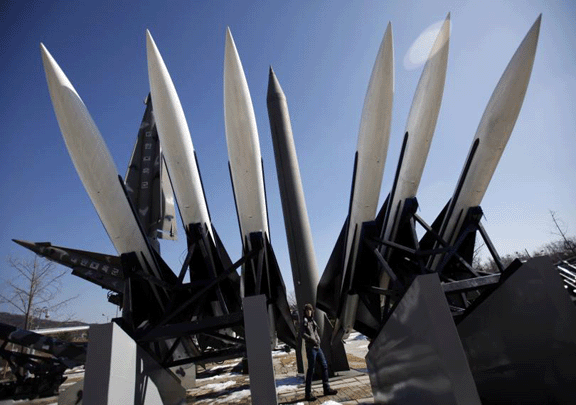 China Announces Deployment of New Long Range Nuclear Missile, Popular Mechanics. 24 Jan 17
The target—at least of the announcement—is Trump. In a rare move, China has publicly announced the deployment of a new intercontinental ballistic missile (ICBM). The Dong Feng (“East Wind”) -41 missile, or DF-41, can carry up to a dozen nuclear warheads and China claims it has the longest range of any nuclear missile in the world. The announcement of the missiles is likely a warning to U.S. President Donald Trump, who is known for sharply worded anti-Chinese rhetoric and has announced plans for a new ballistic missile system.
The DF-41 is described by Global Times as the most advanced ICBM in the world. It reportedly has a range of 8,699 miles, enough to hit any target on Earth with the exception of South America and parts of Antarctica. It can carry up to 12 nuclear warheads, and travels on China’s nationwide network of roads to make it difficult to track down and destroy.
The location of the missiles and the timing of the release are notable. Heilongjiang Province is in Northern China, near the country’s long border with Russia. The DF-41’s long range, if accurate, means it could be based anywhere and still hit any useful target on Earth, but the implication is that China considers Russia a friendly country.
Nuclear energy corporation EDF lobbies UK govt to weaken safety rules

 What could go wrong? Nuclear energy giant wants safety rules relaxed https://www.rt.com/uk/374788-nuclear-plant-edf-safety/ 24 Jan, 2017 A nuclear energy company is trying to keep Scotland’s aging power stations open years longer than is allowed under current government regulations.
EDF Energy is asking the UK government’s nuclear watchdog to allow its power station in Hunterston, North Ayrshire, to continue running until it is 47 years old, and its facility in Torness, East Lothian, to remain open until it is 42 years old.
The power plants were designed to last only 30 years, according to investigative news site the Ferret.
The revelation has caused concern among experts and politicians, who fear continued use of the nuclear reactors could put the public at risk.
EDF Energy, which is majority-owned by the French government, has requested the Office for Nuclear Regulation (ONR) to permit an increase in the proportion of cracked graphite bricks in the two power plants from 10 to 20 percent.
In order to generate nuclear energy, thousands of graphite bricks used to make up reactor cores are bombarded with radiation. When these bricks begin to crack, it threatens the plant’s ability to make a safe shutdown.
The Hunterston and Torness power plants have both already seen their lifespans extended by seven years, until 2023 and 2030 respectively.
A report for the Scottish Green Party by Pete Roche, of the Edinburgh Energy and Environment Consultancy, quotes a senior EDF figure as saying the lifespans of the plants could be extended even further.
EDF Scottish Business Director Paul Winkle told a fringe meeting at the Scottish National Party (SNP)’s 2016 conference this will depend on the company’s assessments, according to the report.
“The current life for Hunterston is 2023 and Torness is 2030, and that is based on our assessment of aging mechanisms in those plants and being absolutely sure that when they are shut down they are still safe to operate.
“But to go beyond that we will do assessments and it may be possible to make some small further extensions, but we will not operate them beyond when we are confident they are safe to operate.
“Our current estimate is, with Hunterston, we get to a point where, if we go beyond 2023 there will be uncertainty. We will do more analysis in due course. Those dates are based on our best judgement.”
Scottish Green MSP Ross Greer warned local communities would be concerned by the proposals.
“The lack of public consultation is just unacceptable,” he said.
“If we did this properly, the public would reject an aging, cracking, safety hazard. The Scottish government’s relaxed position on nuclear needs [to be] challenged. We simply don’t need to sweat these plants and add to our toxic legacy.”
Radiation Free Lakeland (RFL) urges UK Labor leader to oppose nuclear power station planned for Moorside
Jeremy Corbyn urged to oppose nuclear power station planned for Moorside A campaign group is calling on  Labour leader Jeremy Corbyn to publicly oppose nuclear new-build plans in west Cumbria. News and Star, 24 Jan 17
Radiation Free Lakeland (RFL) has written to Mr Corbyn to urge him to lodge his “firm and outspoken” opposition to plans for a three-reactor station at Moorside, on land next to Sellafield.
By doing so, adds RFL, Mr Corbyn would “galvanise and inspire nuclear opponents, and give them a compelling reason to vote Labour”.
RFL’s letter comes in the week that Mr Corbyn – who has been described as “anti-nuclear” by opponents – has twice visited Copeland ahead of a hotly-anticipated Parliamentary by-election to replace Jamie Reed. In her letter to Mr  Corbyn, RFL’s Marianne Birkby points to safety concerns about the design of the AP1000 reactors proposed for Moorside, and the “intolerable nuclear burden” already faced locally…..
She also draws his attention to a petition – Stop Moorside: the biggest nuclear development in Europe – that has attracted over 11,000 signatures.
She said: “We oppose Moorside and feel that you may be underestimating the strength of feeling against the plans. “When you appeared on The Andrew Marr Show last weekend, you missed the chance to condemn the project.
“Please set aside the siren voices that are working hard to convince you that outright opposition to Moorside would be a vote-loser.
“Instead, listen to the voices of resistance, which include many Labour voters previously encouraged by your rational, well-informed spepticism of the nuclear industry and its taxpayer-funded spin doctors.”
NuGen, the firm behind plans for Moorside, is currently analysing feedback from last summer’s public consultation into the plant.
The firm hopes to get the final go ahead in 2018. http://www.newsandstar.co.uk/news/Jeremy-Corbyn-urged-to-oppose-nuclear-power-station-planned-for-Moorside-30bf74c4-e216-4b83-92d3-439aacffc817-ds
Pakistan test-fires nuclear missile capable of hitting multiple targets,
http://zeenews.india.com/asia/pakistan-test-fires-nuclear-missile-capable-of-hitting-multiple-targets_1970284.html
January 24, 2017 Islamabad: Pakistan on Tuesday “successfully” test-fired its second indigenously-developed nuclear-capable missile, Ababeel, with a range of 2,200 km and capable of “engaging multiple targets with high precision”. The test firing comes two weeks after the launch of submarine-fired Babar III, that Indian analysts dubbed as fake.
In an apparent reference to India, Pakistan Military spokesperson Maj Gen Asif Ghafoor said: “The development of the Ababeel weapon system was aimed at ensuring survivability of Pakistan’s ballistic missiles in the growing regional Ballistic Missile Defence (BMD) environment.”
The missile is capable of delivering multiple warheads, using Multiple Independent Re-entry Vehicle (MIRV) technology. “The test flight was aimed at validating various design and technical parameters of the weapon system,” Maj Gen Ghafoor said in a statement.
“Ababeel is capable of carrying nuclear warheads and has the capability to engage multiple targets with high precision, defeating the enemy’s hostile radars,” it added.
On January 8, Pakistan conducted its first successful test fire of submarine launched cruise missile Babur III having a range of 450 km. The missile was fired from an underwater, mobile platform and hit its target with precise accuracy.
The Babur weapons system incorporates advanced aerodynamics and avionics that can strike targets both at land and sea with high accuracy, according to ISPR. It has been described as a low flying, terrain hugging missile, which carries certain stealth features and is capable of carrying various types of warheads.
China deploys nuclear missiles to the Russia-China border in the northeast Heilongjiang province
Is China Going To War? Nuclear Missiles Deployed To Russian Border, Putin’s Kremlin Responds http://www.ibtimes.com/china-going-war-nuclear-missiles-deployed-russian-border-putins-kremlin-responds-2480325 BY ON 01/24/17 The Chinese government reportedly deployed nuclear missiles to the Russia-China border in the northeast Heilongjiang province, an act Russian President Vladimir Putin’s government described as a nonissue Tuesday, Russian and Chinese media reported. The ballistic missiles, called the Dongfeng-41 Intercontinental Ballistic Missile, are capable of traveling up to 15,000 kilometers and was successfully tested with dummy warheads by the Chinese government in the South China Sea in April last year.
Unverified photos and videos of the massive ballistic missiles being deployed in the Chinese suburb made waves online as they spread across social media throughout this month. The footage had not been reported on until Tuesday, when the Kremlin’s Spokesperson Dmitry Peskov said “[Russia doesn’t] see the military disposition of China as a threat to our country,” the Moscow Times reported Tuesday.
A video posted to Twitter shows officials guiding a large vehicle along a highway as it carried what appeared to be the DF-41 intercontinental missile.
NuScale’s “small modular reactor” not clean, safe, or even small, really
NuScale won’t solve energy problems http://www.gazettetimes.com/news/opinion/mailbag/letter-nuscale-won-t-solve-energy-problems/article_84aa2a03-1d03-53aa-be1a-3e86e1f80869.html Jan 23, 2017

Solar power costs fell 25% in only 5 months
The Cost of Solar Power Has Fallen 25% in Only 5 Months, Futurism, It seems that we have truly entered a new era in energy production—in renewable energy production, that is. Over the past new months, the cost of solar power has plummeted, and it seems that things are going to stay this way. Indeed, “there’s no reason why the cost of solar will ever increase again,” former Masdar Clean Energy director Frank Wouters noted in a recent interview with Electrek.The cost of building solar plants has declined by 25 percent in just five months, according to two recent bids in China and Dubai.
The reduction in price follows a broader trend of solar affordability brought on by cheaper solar panels.
If governments and innovators continue to invest in these energy sources in the way that they have been, Wouters statements are easy to believe.
In just 5 months, prices have dropped some 25%. This development is shown in the recent, and staggeringly low, construction bids on solar projects in China ($0.46/W for 500MW of solar power) and Dubai ($0.023/kWh for 1.2GW of solar power).
Several factors have driven these relatively inexpensive bids. In China, solar power is incentivized. To that end, decreasing hardware prices have largely fueled the drastic drop—solar panel costs, for instance, have declined remarkably since the first quarter of this year. And in Abu Dhabi, solar panels produce more power than usual because the city enjoys some of the best sunlight exposure in the world.
Still, Abu Dhabi isn’t the only location with ideal conditions.
Last year, Costa Rica powered itself purely with renewable energy for 299 days total. This year, they already surpassed 150 days. The success, as is true in the other recent successes, isn’t just due to the country’s size or location. The government is serious in its effort to eliminate the use of fossil fuels.
And other countries are also stepping up to the plate. Thus, this most recent drops herald a notable trend that is, at the present time, showing no sign of slowing……. https://futurism.com/solar-power-cost-has-dropped-25-in-only-5-months/
1 This Month
Chernobyl: The Lost Tapes – A good documentary on Chernobyl on SBS available On Demand for the next 3 weeks– https://www.sbs.com.au/ondemand/tv-program/chernobyl-the-lost-tapes/2352741955560

of the week–London Campaign for Nuclear Disarmament

Tell the Ukrainian Government to Drop Prosecution of Peace Activist Yurii Sheliazhenko
To see nuclear-related stories in greater depth and intensity – go to https://nuclearinformation.wordpress.com
-
Archives
- April 2026 (139)
- March 2026 (251)
- February 2026 (268)
- January 2026 (308)
- December 2025 (358)
- November 2025 (359)
- October 2025 (376)
- September 2025 (257)
- August 2025 (319)
- July 2025 (230)
- June 2025 (348)
- May 2025 (261)
-
Categories
- 1
- 1 NUCLEAR ISSUES
- business and costs
- climate change
- culture and arts
- ENERGY
- environment
- health
- history
- indigenous issues
- Legal
- marketing of nuclear
- media
- opposition to nuclear
- PERSONAL STORIES
- politics
- politics international
- Religion and ethics
- safety
- secrets,lies and civil liberties
- spinbuster
- technology
- Uranium
- wastes
- weapons and war
- Women
- 2 WORLD
- ACTION
- AFRICA
- Atrocities
- AUSTRALIA
- Christina's notes
- Christina's themes
- culture and arts
- Events
- Fuk 2022
- Fuk 2023
- Fukushima 2017
- Fukushima 2018
- fukushima 2019
- Fukushima 2020
- Fukushima 2021
- general
- global warming
- Humour (God we need it)
- Nuclear
- RARE EARTHS
- Reference
- resources – print
- Resources -audiovicual
- Weekly Newsletter
- World
- World Nuclear
- YouTube
-
RSS
Entries RSS
Comments RSS
 nuclear-news