
The volume of contaminated water continues to increase at Tokyo Electric Power Company Holdings Inc.’s Fukushima No. 1 nuclear power plant. Efforts to deal with this problem must be reinforced.
TEPCO has compiled a new set of measures to deal with the radioactive water. The steps are aimed at reducing to nearly zero the contaminated water inside reactor buildings, the prime source of the tainted water.
Under the new measures, the contaminated water accumulated in the basements of reactor buildings is to be purified and then transferred to storage tanks. At the same time, facilities exclusively used for purifying the tainted water are to be doubled, and the existing storage tanks will be replaced with larger ones, increasing the overall storage capacity.
Meanwhile, the volume of groundwater to be pumped up from the wells near the reactor buildings is to be increased. This is aimed at reducing the flow of underground water into the buildings, thus preventing a vicious cycle of generating more tainted water.
If all goes well, the increase in the volume of contaminated water is expected to nearly stop by 2020. We hope TEPCO will realize this goal steadily.
The measures taken so far have centered on the construction of “ice walls,” to prevent groundwater from entering the reactor buildings by freezing the underground soil around the buildings. Because this step has failed to prove effective even more than half a year after the related facilities were put into operation, TEPCO decided to shift its priority measures.
The new measures will require the approval of the Nuclear Regulation Authority. Both TEPCO and the NRA must cooperate closely so that the necessary work will not be delayed.
Consider ocean release
The reactor buildings have, in effect, turned into storage facilities for contaminated water. The volume of tainted water totals about 68,000 tons. Although the amount of radioactive material contained in the water has declined markedly when compared to the amount immediately after the nuclear accident occurred, it still remains at a high level.
The large amount of contaminated water inside the reactor buildings carries a risk of radiation exposure, posing a serious impediment to the work to decommission the plant. If highly radioactive water starts leaking underground out of the buildings and into the sea, it will create a serious situation.
Even if new measures proceed smoothly, however, tasks remain. The volume of purified water to be stored in the tanks is expected to nearly double by 2020 to about 1.2 million tons. Not only will this entail a huge maintenance cost, but there is also a danger that the water will leak if the tanks are damaged by an earthquake or other factors.
Releasing purified water that has met the existing safety criteria into the sea must be seriously considered. The discharge of purified water into the ocean has been routinely conducted at nuclear power-related facilities both at home and abroad.
It is important for both the government and TEPCO to do their utmost to explain such a plan in detail in order to win the understanding of local residents concerned. Efforts should also be made to take measures to prevent groundless rumors from adversely affecting the fisheries industry and other sectors.
It is also necessary to continuously ascertain the effect of the ice walls. Although nearly 100 percent of the walls have already been frozen, groundwater is reportedly flowing through thin gaps in the walls. Rainwater seeping through the topsoil has also increased the amount of groundwater inside the buildings.
TEPCO is proceeding with work to fill the gaps in the ice walls. If the work proves effective, the goal of reducing to zero the increase in the contaminated water will be realized two years earlier than envisaged. We hope TEPCO will strenuously work to block the flow of groundwater into the buildings.
http://the-japan-news.com/news/article/0003279580
October 14, 2016
Posted by dunrenard |
Fukushima 2016 | Contaminated Water, Fukushima Daiichi, Leaks |
Leave a comment
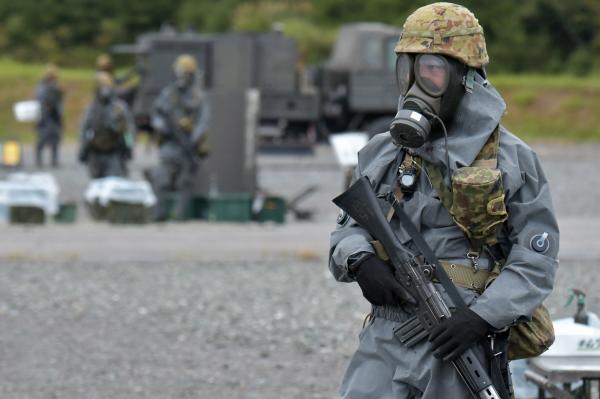
A member of Japan’s Ground Self-Defense Force takes part in a joint military exercise. Japan’s defense chief is under fire for previously suggesting a nuclear strategy for the country, and for saying a military conscription policy would not violate Japan’s constitution.
TOKYO, Oct. 12 (UPI) — Japanese Defense Minister Tomomi Inada is standing firm after opposition party politicians in Tokyo asked her to retract remarks on nuclear armament.
In an interview with Japanese magazine Seiron in March 2011, Inada had said that in the long term Japan should look into a nuclear strategy, the Tokyo Shimbun reported Wednesday.
Inada, who was appointed defense minister in August, was a lawmaker with the ruling Liberal Democratic Party at the time and has served as a Cabinet member under Japanese Prime Minister Shinzo Abe.
Shinkun Haku, a Japanese politician of the opposition Democratic Party of Japan, criticized Inada’s past statement.
“That someone with such a personal opinion became the defense chief is a problem,” Haku said, while urging Inada to retract her previous remarks.
Japan is a signatory of the Treaty on the Non-Proliferation of Nuclear Weapons and relies on the U.S. extended nuclear deterrent.
But Inada said she has no plans to withdraw the statement because the remarks were made in the context of the situation at the time, according to the Japanese newspaper.
Inada also said she is not retracting remarks she made in the interview about implementing a military conscription policy because she “doesn’t think the draft violates the constitution.”
Tokyo is concerned about North Korea’s multiple provocations and Chinese vessels that have entered Japan-claimed waters near the disputed Senkaku Islands.
In early September, a Japanese command to “destroy” incoming North Korea missiles repeatedly failed when North Korea launched three ballistic missiles that landed west of Hokkaido.
North Korea’s provocations continue to have an impact on Japanese politicians, according to a recent poll conducted by television network NHK.
A survey of Japanese citizens conducted Oct. 9-11 showed support for Abe has fallen since early September, as North Korea provocations have subsided and the country has not engaged in further tests during a national anniversary on Oct. 10.
Support for Abe was about 60 percent in September, but that figure was down by about 7 percentage points, according to the NHK poll.”
http://upi.com/6433552f
October 14, 2016
Posted by dunrenard |
Japan | Defense Minister, Nuclear Armament, Nuclear Strategy, nuclear weapons |
Leave a comment

Cellist Marek Szpakiewicz will perform a recital with pianist Jiayi Shi at Azusa Pacific University in Azusa Oct. 15 to raise funds for a three-quarter sized cello for the Soma Children’s Orchestra in Fukushima, Japan.
He was only 16 in 1986, but Marek Szpakiewicz understood the impact of the nuclear reactor meltdown in Chernobyl. Though it was less than 400 miles away from his home in Lublin, Poland, his family was unable to leave. However, Szpakiewicz was a talented cello player, and in 1991 he won a scholarship to study at the Peabody Institute of John Hopkins University in Baltimore, Maryland, and later settled in Pasadena.
In 2011, the Tohoku earthquake and tsunami in Japan kept Szpakiewciz glued to the news, moved by the survivor stories and the deaths of more than 15,800 people and recalling his own memories of Chernobyl.
“In Fukushima, there is a community there living, and they are affected by this, and we have stopped talking about it, but the kids are growing and we won’t know the consequences, we don’t know the amount of devastation,” Szpakiewicz said. “What can I do? I know music, so I can bring the music, and we know the power of music is just incredible.”
In 2012 El Sistema Japan formed the Soma Children’s Orchestra in Fukushima and Szpakiewicz immediately began lending his support. Two years later, when he spent a day with the orchestra in Japan, he noticed that mostly it was only older, bigger kids that played the cello. He also learned that one student, Risa Yoshida, was heartbroken when she’d had to give her up her half-sized cello to another child.
Szpakiewicz remembered a similar experience of his own.
“As a child, I was small and in Poland the funds are not so big and the school didn’t have the quarter-size (cello), the size I should start (with),” Szpakiewicz said. “So for a year I was practicing on the broom to practice my motions. Luckily, I was growing fast so the second year I could pick up the half-sized cello. I could finally have the cello at home from school and practice and that’s how my education started. So the pain of not having the instrument, I remember.”
In 2015, Szpakiewicz held a concert and was able to raise the money to provide Risa with a half-sized cello.
“Marek’s gift means a lot to our children in terms of ensuring a young girl’s access to quality music education,” said Yutaka Kikugawa, president of El Sistema Japan. “The new cello has broadened her horizon for music passage and made it possible for her to play the Beethoven’s 5th Symphony side-by-side with the Berliner Philharmonic in March 2016, which was certainly a lifetime experience for her.”
Szpakiewicz will perform a recital with pianist Jiayi Shi at Azusa Pacific University in Azusa Oct. 15, hoping to raise money this time for a three-quarter sized cello for the Soma Children’s Orchestra. Monrovia resident Shi also came to the United States to further her education. The two perform together often and will play selections by Chopin, Rachmaninoff, Schumann, Barber and Gershwin.
In addition to Chernobyl, Szpakiewicz lived through communist rule, which had its hold on Poland until 1989.
“From the moment I was growing up, the music was a hope for a better life,” Szpakiewicz said. “Music didn’t only play a tremendous role in my education, but my development, all the dreams and hopes that music provided for me.”
Arriving in Baltimore unable to speak a word of English, Szpakiewicz worked hard and then went on to USC, earning three degrees and a doctorate. In 2008 the U.S. government granted him permanent residency as an Extraordinary Ability Artist, and he landed a job teaching cello and serving as the director of chamber music at APU. This year he was also named an assistant professor.
“I feel the power of America, a country for foreigners. I came here, I feel so good here. My roots are in Poland, but this is my home now. This is my country,” Szpakiewicz said. “I always dreamt about coming to the States, that’s the country where I pictured myself as a child. With all the tragedy that happened in my life, I have no reason to complain because I feel privileged, I feel lucky and I feel that I have to share, so that motivates me, the kindness that I came and witnessed, so I want to pass it on.”
Szpakiewicz has a full concert schedule, including a performance with Shi in Tokyo Oct. 29. There, the Soma Children’s Orchestra, along with Risa, will join him in the encore.
http://www.dailynews.com/arts-and-entertainment/20161012/how-pasadena-based-cellist-and-chernobyl-survivor-helps-children-in-japan
October 14, 2016
Posted by dunrenard |
Fukushima 2016 | Chernobyl Survivor, Fukushima Children |
Leave a comment
Hacked: a good news. Hopefully those hackers might release crucial important data, which would change us from Tepco B.S and Japanese government censored information.

OYAMA–Personal information and nuclear research, including studies concerning the crippled Fukushima No. 1 nuclear plant, might have leaked in a cyber-attack at the University of Toyama here, the school reported Oct. 10.
The leaked data could possibly affect 1,492 students, researchers and individuals from public organizations and companies who conduct joint studies with the institution’s Hydrogen Isotope Research Center.
“We apologize for causing great trouble to associated organizations,” said Yasumaru Hatanaka, the university’s vice president.
However, the research that might have leaked, such as studies on water decontamination at the Fukushima nuclear plant, had all been previously presented at academic meetings, so there was no breach in confidentiality, the university said.
No malicious use of the data has been reported since the data breach came to light in June.
According to the university, the cyber-attack targeted a computer operated by a part-time employee specializing in tritium research at the center.
An e-mail containing malware was sent to both the worker and a professor with the facility in November 2015. The professor did not open the e-mail, but the employee did, causing the computer to become infected with a virus.
As a result, the employee’s computer became remotely accessible, and it made connections with four outside servers between November and June. The university’s investigation showed that the computer sent large amounts of data to two of these servers.
A further analysis of the computer found indications that at least 1,000 archive files had been created between last November and February.
Considering their size, nearly all the data stored in the computer may have been compressed into these files. Similar archive files were created using a different method in March, the university said.
The university became aware of the cyber-attack after an outside organization warned the school about suspicious network activities made by the employee’s computer.
http://www.asahi.com/ajw/articles/AJ201610110055.html
October 14, 2016
Posted by dunrenard |
Fukushima 2016 | Data, Fukushima Daiichi, Nuclear Studies, Nuclear Workers |
Leave a comment
Already few weeks ago a Japanese friend mentioned to me that he noticed very few insects this summer in Tokyo. This article now corroborates it.
If the wild life around Tokyo is that affected, how about the health of the people living there?

Frog having one eye only (photo by Eiki Sato, from October 10, 2016)
Ravages in Tokyo from the nuclear accident at Fukushima Daiichi 250km away.
The documentary film “Paradise Phantom” just came out. This documentary is about the stationary observations on animals by Eiki Sato, a wildlife journalist. The screening of this film took place at a movie theater in Suginami-ku, Tokyo on September 25, 2016.
Sato filmed for 170 hours various animals in the wild places of Tokyo, for example the banks of the Arakawa river, the fields near sports stadiums and Tokyo plants. These are real paradises for many living creatures, such as kestrels, shrikes, bats, frogs, dragonflies, even the gray beetles, animals that are not on the global red list threatened species.
The documentary shows that since two years animals with abnormalities are being observed . The cause of these abnormalities would be the accumulated radioactivity in the soil of Tokyo, according to Eiki Sato.
During his observations Eiki Sato found many types of deformities, due to mutations: Various insects affected with malformed or missing wing, or with curled wings, or abnormal eyes, unabling them to fly. Mosquito with bent spine, dragonflies with mishaped eyes unable to fly high. Birds with affected eyes, or feathers, unable to fly. Many also cannot reproduce, their population sharply decreasing.
http://www.tokyo-sports.co.jp/entame/entertainment/602104/
October 14, 2016
Posted by dunrenard |
environment, Fukushima 2016 | Fukushima Daiichi, Mutations, radiation, Tokyo, Wildlife |
Leave a comment
 Russian Lawmaker Says Americans Should Vote Trump or Risk Nuclear War, By Jack Phillips, Epoch Times , 13 Oct 16 An ally of Russian leader Vladimir Putin issued a warning of sorts to Americans regarding next month’s presidential election, urging them to vote for Republican Donald Trump or risk starting a nuclear war.
Vladimir Zhirinovsky, a legislator, who has been described as an ultra-nationalist ally of Putin known for his bold claims, told the Reuters news agency that Trump would be able to reduce tensions between the United States and Russia—amid disagreements and veiled threats lodged by both countries amid the war in Syria.
Zhirinovsky, who often makes outlandish claims and isn’t considered credible by a number of Russians, said Hillary Clinton could spark World War III. According to Reuters, he is used to float radical opinions to test the public’s reaction, as he is considered a stalwart political insider who has sat in the Duma for two decades
For example, he called on the Kremlin to arm the Russian population to shoot down migrant birds to prevent bird flu from spreading. And following the 2013 Chelyabinsk meteor, he said it was “not meteors falling” but “it’s the test of a new weapon by the Americans.”
This week, speaking in his office, he told Reuters: “Relations between Russia and the United States can’t get any worse. The only way they can get worse is if a war starts.”. ……. http://www.theepochtimes.com/n3/2171664-russian-lawmaker-says-americans-should-vote-trump-or-risk-nuclear-war-with-russia/
October 14, 2016
Posted by Christina Macpherson |
USA elections 2016 |
Leave a comment
 Weapons: ICRC statement to the United Nations, 2016 https://www.icrc.org/en/document/weapons-nuclear-statement-unga-2016 Statement
12 OCTOBER 2016United Nations General Assembly, 71st session, First Committee, General debate on all disarmament and international security agenda items. Statement by Ms Christine Beerli, Vice President of the ICRCI am honoured to address the First Committee today, to bring the field-based experience of the International Committee of the Red Cross (ICRC) and our expertise in international humanitarian law (IHL) to bear on some of the critical issues that will be discussed here.
For the ICRC, debates about weapons must always consider evidence of their foreseeable human costs in light of the strict limits imposed by IHL on the use of weapons.
States have a unique opportunity to make this 71st session of the UN General Assembly a turning point for progress towards prohibiting and completely eliminating the most destructive weapon ever invented – nuclear weapons.
The international community now has before it overwhelming evidence of the horrific, long-term and irreversible effects of these weapons on health, the environment, climate and food production – that is, on everything on which human life depends.
Already twenty years ago, based on evidence before it, the International Court of Justice (in its Advisory Opinion on the Legality of the Threat or Use of Nuclear Weapons) found that the effects of nuclear weapons could not be contained in space or time, and concluded that the use of these weapons “would generally be contrary to” the principles and rules of IHL.
Since then, additional new evidence of the indiscriminate effects and unspeakable suffering caused by nuclear weapons has emerged, and was presented at three international conferences on the humanitarian impact of nuclear weapons. The evidence includes a key finding of the ICRC’s own studies, and those of UN agencies, that there is no adequate humanitarian response capacity to assist the victims of nuclear weapons.
The “catastrophic humanitarian consequences of any use of nuclear weapons” were explicitly recognized six years ago by all States party to the Treaty on the Non-Proliferation of Nuclear Weapons (NPT), and in several resolutions adopted since then by a large majority of States in the First Committee. These include resolutions on “Follow-up to the 2013 high-level meeting of the General Assembly on nuclear disarmament” and on the “Humanitarian consequences of nuclear weapons”.
Having recognized these consequences, States now have a responsibility to take decisive action. And they have an unprecedented opportunity to do so, by acting on the recommendation adopted by the UN Open-Ended Working Group “Taking Forward Multilateral Nuclear Disarmament Negotiations” in August with widespread support, that the General Assembly convene a conference in 2017, open to all, to negotiate a treaty “to prohibit nuclear weapons, leading towards their total elimination”.
In 2011, the International Red Cross and Red Crescent Movement, of which the ICRC is a part, appealed to all States to “pursue in good faith and conclude with urgency and determination negotiations to prohibit the use of and completely eliminate nuclear weapons through a legally binding international agreement, based on existing commitments and international obligations”. The Movement welcomes that, five years later, such negotiations may become a reality through an inclusive process in the framework of the UN General Assembly.
Although the prohibition of nuclear weapons is only one of the measures needed to ensure they are never again used and are eliminated, it is an indispensable building block in reaching the universal goal of a world free of nuclear weapons. As with chemical and biological weapons, unambiguous prohibition is both the foundation for disarmament and a disincentive for proliferation. It would be a long-awaited step towards fulfilling the NPT’s Article VI obligation to pursue effective measures to achieve nuclear disarmament, and repeated undertakings under NPT Action Plans.
If some States are unable at this time to join negotiations for the prohibition of nuclear weapons, we nevertheless continue to call on them to urgently take interim steps to reduce the immediate risks of intentional or accidental use of nuclear weapons. Such steps include reducing the role of nuclear weapons in military doctrine and plans, and reducing the number of warheads on high alert. These and other risk-reduction measures derive from long-standing political commitments, including the Action Plan of the 2010 NPT Review Conference, and should be followed through as a matter of urgency. Given the catastrophic humanitarian consequences of nuclear weapons, any risk of use is unacceptable.
Today’s complex security environment highlights the urgency of both the prohibition of nuclear weapons and action by nuclear-armed States to fulfil their existing obligations and political commitments, leading to the elimination of nuclear weapons once and for all.
Debates in the First Committee have highlighted increasing concerns about theweaponization and hostile use of outer space, with virtually all States seeking to prevent an arms race in outer space. For the ICRC, diplomatic initiatives should give due consideration to the potentially far-reaching humanitarian consequences on earth that would result from direct attacks against “dual-use” satellites (i.e. those used for both military and civilian purposes) or incidental damage to civilian satellites, and the limits already imposed by IHL on any form of warfare, including in space. Use of force in outer space – be it through kinetic or non-kinetic means, using space- or ground-based weapons – could have significant knock-on effects on civilian infrastructure, health-care services and humanitarian operations that depend on satellite communication, navigation and timing, and imagery networks. The vulnerability of space-based systems that serve essential civilian activity on earth presents significant challenges for respecting the IHL rules of distinction, proportionality and precautions in attack, which States should thoroughly weigh up in their deliberations on outer space.
The ICRC is gravely concerned by the use of classical and improvised chemical weapons in Syria over the last three years, confirmed by fact-finding missions of the Organisation for the Prohibition of Chemical Weapons. While such use has been roundly condemned by the international community, there continue to be allegations of new use of chemical weapons in Syria and elsewhere. At this session of the First Committee, States should reaffirm the absolute prohibitions on using chemical and biological weapons in armed conflict by any actor – State or non-State – in any type of armed conflict. The ICRC urges the handful of States that remain outside of chemical and biological weapons conventions to adhere to them without delay. Under these conventions and customary IHL, every State has a duty to criminalize, prosecute and punish the use of chemical or biological weapons by any individual under its jurisdiction or control.
Current and recent armed conflicts – such as those in Syria, Ukraine, Afghanistan, Yemen, Iraq and Gaza – continue to expose the particularly devastating effects on civilians of heavy explosive weapons when used in populated areas. Large bombs and missiles, indirect-fire weapon systems such as mortars, rockets and artillery, multi-barrel rocket launchers, and certain types of improvised explosive devices, are prone to indiscriminate effects when used in population centres, owing to their wide-area effects. In addition to the high risk of incidental civilian death, injury and disability, heavy explosive weapons tend to cause extensive damage to critical civilian infrastructure, triggering debilitating “domino effects” on interconnected essential services such as health care, and water and electricity supply systems. This in turn provokes further civilian death and displacement. And these effects are exacerbated in protracted armed conflicts.
While there is no question that IHL permits parties to armed conflicts to attack military targets located in populated areas, it also constrains their choice of means and methods to do so, with the aim of protecting civilians from unacceptable harm. The ICRC welcomes that a growing number of States are engaging on this crucial humanitarian issue, and we encourage them to share how they put into practice the constraints of IHL on their choice of weapons in urban warfare. We continue to call on States and parties to armed conflict to avoid using explosive weapons with a wide impact area in densely populated areas, owing to the significant likelihood of indiscriminate effects.
It is clear that the tremendous human suffering generated by brutal armed conflicts, notably in parts of the Middle East and Africa, is also a consequence of the flow of conventional arms to warring parties that completely disregard IHL. As the ICRC is witnessing on a daily basis in its field operations, irresponsible arms transfers are facilitating serious violations of IHL, including acts of terrorism and sexual and gender-based violence. It is imperative that all States urgently fulfil their duty to ensure respect for IHL in their arms transfer decisions. This duty underlies the transfer prohibitions and export assessments under the Arms Trade Treaty, which the ICRC urges all States to join and faithfully implement. Ceasing the supply of weapons to parties to armed conflicts that violate IHL will reduce human suffering and ultimately contribute to creating the conditions for regional and global security.
October 14, 2016
Posted by Christina Macpherson |
Uncategorized |
Leave a comment
Faith groups state nuclear weapons ‘incompatible with values of faith traditions’ at UN General Assembly First CommitteeFifth joint statement highlighting moral and humanitarian aspects of nuclear weapons,Religion News Service, 13 Oct 16 NEW YORK — On October 12, a joint statement by religious organizations calling for abolition of nuclear weapons was introduced during the civil society presentations at the UN General Assembly First Committee on Disarmament and International Security.
Dr. Emily Welty, Vice Moderator of the World Council of Churches Commission on International Affairs, introduced the Public Statement in Support of the Multilateral Negotiation of a Nuclear Weapons Ban in 2017, which reads in part: “Nuclear weapons are incompatible with the values upheld by our respective faith traditions which are also foundational elements in the development of international law—the right of people to live in security and dignity; the commands of conscience and justice; the duty to protect the vulnerable and to exercise the stewardship that will safeguard the planet for current and future generations… ”
This is the fifth time the group, calling itself “Faith Communities Concerned about the Humanitarian Consequences of Nuclear Weapons,” has issued such a statement. On this occasion, individuals representing 11 faith-based organizations from the Christian, Buddhist and Islamic traditions have signed the statement so far. The statement can be read in full here……….http://religionnews.com/2016/10/13/faith-groups-state-nuclear-weapons-incompatible-with-values-of-faith-traditions-at-un-general-assembly-first-committee/
October 14, 2016
Posted by Christina Macpherson |
2 WORLD, Religion and ethics, weapons and war |
Leave a comment
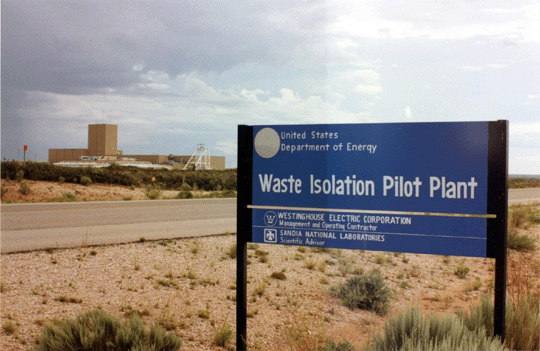
 Watchdogs concerned about readiness of New Mexico nuke dump, WP By Susan Montoya Bryan | AP October 13 ALBUQUERQUE, N.M. — A series of recent ceiling collapses at the federal government’s only underground nuclear waste repository has watchdogs calling on officials to ensure safety before moving ahead with a planned reopening later this year.
U.S. Energy Department officials and the contractor that manages the Waste Isolation Pilot Plant in southern New Mexico will update the public on the collapses during a meeting Thursday evening.
A radiation release forced the closure of the repository in February 2014. Since then, thousands of tons of waste left over from decades of nuclear weapon research and development have been stacking up at sites around the country, hampering the government’s multibillion-dollar cleanup program.
The waste is meant to be entombed in storage rooms carved out of a salt formation deep underground…….
There have been at least three collapses in recent weeks. In one case, chunks of salt dislodged from the ceiling and tore through chain link fencing that was meant to help stabilize the corridors. There were no injuries.
Don Hancock with the Albuquerque-based watchdog group Southwest Research and Information Center said the collapses are no surprise but they raise questions about whether the repository will be ready to reopen in December.
He suggested more collapses could stir up contamination and threaten workers…….https://www.washingtonpost.com/national/energy-environment/watchdogs-concerned-about-readiness-of-new-mexico-nuke-dump/2016/10/13/5f7038d6-9175-11e6-bc00-1a9756d4111b_story.html?tid=twisira
October 14, 2016
Posted by Christina Macpherson |
general |
Leave a comment
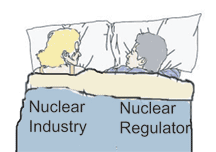
 Critics accuse nuclear safety official of acting as industry cheerleader http://www.theglobeandmail.com/news/politics/critics-accuse-nuclear-safety-official-acting-as-industry-cheerleader/article32341301/ GLORIA GALLOWAY OTTAWA — The Globe and Mail, Oct. 12, 2016 Opposition politicians and environmentalists are questioning the priorities of the man responsible for nuclear safety in Canada after a string of incidents in which he publicly defended the industry and was dismissive of concerns about potential hazards – a stance that runs contrary to his mandate at the Canadian Nuclear Safety Commission.
The CNSC was established by the federal government to protect the health and safety of Canadians and to regulate the use, possession and storage of all nuclear substances in Canada. No part of its mission entails promotion of the country’s reactors. But, in the more than eight years that Michael Binder has served as president of the CNSC, he has repeatedly extolled the merits of the nuclear industry and chastised critics who voiced concerns about potential hazards.
The Liberal government of Prime Minister Justin Trudeau stands behind Dr. Binder despite recently uncovered lapses in the CNSC’s inspection regime and an anonymous letter that accused the CNSC of skipping important safety oversights. Natural Resources Minister Jim Carr said: “We think that the regulator has done and continues to do a good job.”
But an audit released last week by the Commissioner of the Environment and Sustainable Development found the CNSC was not inspecting reactors often or thoroughly enough. Julie Gelfand, the Environment Commissioner, said CNSC inspectors have been scrutinizing the country’s nuclear facilities without the guides that list what criteria must be met, as required by the regulator.
“The fact that it’s allowed and that that data is then used to tell us that everything is all good, tells me that there is something in the way that they are managing that is not precise enough, that is not systematic enough, that is not rigorous enough,” she said.
Tom Mulcair, the Leader of the federal New Democrats, said Wednesday that the government is shirking its responsibilities by ignoring what is happening at the CNSC, an agency that reports to Parliament.
“Instead of being someone there to defend the public in an important area like nuclear safety, [Dr. Binder] acts like someone who is there to defend the industry that he is supposed to be regulating,” Mr. Mulcair said in a telephone interview, “and he even goes on to attack those people who express concerns.”
Shawn-Patrick Stensil, a senior energy analyst with Greenpeace Canada, said this week Dr. Binder has “shown a disturbing pattern of cheerleading for an industry he’s supposed to keep in check. Trudeau needs to clean up the CNSC.”
Elizabeth May, the Green Party leader, said this week she is “very concerned” about what is happening at the CNSC and the fact that no one was called in from outside the regulator to look at the concerns of the letter writers. “People to tend to sit upright,” she said, “when you tell them about a nuclear reactor that is not getting properly inspected.”
Dr. Binder refused an interview request this week. But Aurèle Gervais, a CNSC spokesman, said allegations that Dr. Binder is too close to the industry “have been raised by serial intervenors many times in the past and dealt with publicly. The Canadian Nuclear Safety Commission stands by its safety record.”
A career civil servant with a PhD in physics, Dr. Binder was appointed by the previous Conservative government in 2008 when his predecessor, Linda Keen, refused to back down on safety standards. One of his first acts was to reinstate a fast-track process for approving reactors – and there have been many times since then when he has been a promoter of the industry.
- In September, 2009, Dr. Binder attended one of several secret meetings of the Bruce County Council to discuss preparations for the upcoming approval hearings of a low and intermediate-level deep geologic repository (L&IL DGR) for nuclear waste that is being proposed for Kincardine, Ont., on the shores of Lake Huron. Dr. Binder, who heads one of the bodies that had to approve the project, is recorded in notes taken by Ontario Power Generation as having “said he hoped their next meeting with him would be at the ribbon-cutting ceremony for the L&IL DGR.”
- In 2009, when the environmental group Sierra Club Canada issued a warning against what it said were dangerous levels of radioactive tritium in drinking water, the CNSC issued a statement assuring the public that tritium releases from the nuclear power industry posed no risk to health. It went on to lambaste the Sierra Club for choosing “to ignore the important benefits of nuclear technology.”
- In March, 2011, at a Commons committee, Dr. Binder took issue with critics who opposed shipping radioactive steam generators through the Great Lakes saying “this is not about safety – this is anti-nuclear.”
- He went on to say a number of environmental activists had made a career of “scaring the hell out of people with doomsday sentiments” and that he was fed up with the misinformation they were circulating.
- In 2013, Ontario Provincial Police officers showed up at the doors of people who opposed a proposed nuclear waste dump on the shores of Lake Huron asking if they planned any demonstrations at a hearing for an environmental assessment of the project. A spokesman for Ontario Power Generation said the OPP’s “engagement” came at the request of the Canadian Nuclear Safety Commission and local municipalities.
- In 2015, Dr. Binder defended uranium mining in Quebec after Quebec’s Bureau d’audiences publiques sur l’environnement said it would be premature to develop the industry in that province. In a letter to Quebec Environment Minister David Heurtel, he said it “is very troubling to have the [provincial agency] present your government with conclusions and recommendations that lack scientific basis and rigour.”
- In January, 2015, the CNSC sent out a mass e-mail to point out that international academics were asking environmental groups to sign a letter in support of nuclear energy for its role in combatting climate change. Environmental groups called it “as an egregious indication of bias on the part of the regulator in favour of nuclear energy production and its expansion, rather than acting as a neutral objective safety regulator.”
October 14, 2016
Posted by Christina Macpherson |
Canada, secrets,lies and civil liberties |
Leave a comment
TPP would allow firms to turn to secretive international tribunals where they can sue governments for millions or billions of dollars if environmental or other public interest regulations interfere with expected future profits
The TPP undermines sound climate policy. The TPP would ramp up global warming by increasing U.S. coal, oil and gas exports to the world

7 ways the Trans Pacific Partnership threatens people and the planet, FOE USA, by Bill Waren, senior trade analyst, 13 Oct 16, The Trans Pacific Partnership trade deal is not so much about trade as it is about deregulation and forcing governments to pay corporations and wealthy investors for the cost of complying with environmental and other public interest safeguards. The TPP broadly restricts the policy space for governments to take effective environmental and climate action.
Unlike most international agreements, tribunals of trade lawyers would effectively enforce the TPP. Such tribunals could impose retaliatory sanctions like higher tariffs on the non-complying countries’ exports or award money damages that can run into millions or even billions of dollars.
Trade tribunals often treat environmental and public health regulations as trade barriers.
Until about twenty years ago, trade deals focused on reducing trade barriers like tariffs and quotas. Today’s trade deals, by contrast, focus on curbing the authority of democratic governments and legitimate courts to regulate the global marketplace. Trade tribunals often treat environmental and public health regulations as trade barriers. Trade deals like the TPP focus on dismantling many regulations that are alleged to interfere with the profits of multinational corporations and wealthy foreign investors.
Multinational corporations have lined up behind the TPP, as have Wall Street banks and Big Oil. But over 1,500 public interest organizations, such as internet freedom groups, faith-based organizations, labor unions, women’s & LBGT advocates and environmentalists, are standing up to oppose TPP……
Here are seven ways that the Trans Pacific Partnership trade deal threatens people and the planet:
1) TPP investment tribunals subvert democracy. TPP would allow firms to turn to secretive international tribunals where they can sue governments for millions or billions of dollars if environmental or other public interest regulations interfere with expected future profits. This would discourage government action like restricting oil and gas drilling, imposing pollution controls, and limiting the use of fracking (hydraulic fracturing). TransCanada, for example, is using a similar provision in the North American Free Trade Agreement to sue the U.S. for $15 billion for stopping construction of the Keystone XL pipeline.
2) The TPP undermines sound climate policy. The TPP would ramp up global warming by increasing U.S. coal, oil and gas exports to the world. The TPP is designed to protect “free trade” in such dirty energy products shipped out of West Coast ports. The result would be worsened climate change from carbon emissions across the Pacific.
3) The TPP deal threatens bees. …….
4) TPP threatens deregulation of chemical safety standards…..
5) TPP undercuts prudent food safety regulations. ….
6) TPP encourages GMOs……
7) TPP puts family farms at risk. …….
If you want to join the fight against the TPP, contact Bill Waren at wwaren@foe.org. https://medium.com/economic-policy/7-ways-the-trans-pacific-partnership-threatens-people-and-the-planet-ad49815f337b#.u2u3a5pif
October 14, 2016
Posted by Christina Macpherson |
2 WORLD, politics international, USA |
Leave a comment
 Cuomo wrong on nuclear plant bailout: View, Lohud.com Michael Shank October 12, 2016
New York state sets a trap with its plan to boost upstate nuclear plants by tacking on a fee to utility customers’ bills Bailouts are common in government — at the federal and state level and regardless of political party — and that’s what is happening now in New York for the nuclear industry.
New York’s nuclear bailout is merely the latest example of business getting off scot-free while taxpayers pick up multi-billion-dollar tabs. Gov. Andrew Cuomo is planning to bail out the aging and money-losing Ginna, FitzPatrick and Nine Mile Point nuclear plants, some of America’s oldest nuclear plants owned by Exelon and Entergy, with nearly $8 billion of New Yorkers’ hard-earned money (and another $2.8 billion if energy prices fall).
That decision was made after Exelon alone spent $430,000 in lobbying Albany over the past two years. In the same amount of time, Entergy spent $1.7 million lobbying New York state. Money talks…….
The New York nuclear bailout falls into the same trap that riddled financial industry and auto industry bailout schemes. There’s little corrective action that’s encouraged, or regulated, and so the industry is allowed to continue making the same mistakes — all at a significant cost to our economy. Nothing could be more inefficient. The most common nuclear industry bailout props up companies operating old plants — in desperate need of repair, emitting radioactive waste, leaking toxic material often and keeping cooling systems that kill massive amounts of marine life — with no conditions. And it’s done using taxpayer dollars to prop up companies — such as Fortune 100 Company Exelon with $34 billion in annual revenues — that aren’t in need of extra revenue……
Neither New York’s nuclear industry nor the utilities industry should be passing on these costs to taxpayers, nor should state governments be picking up the corporate tab. These are costs that companies should cover, not citizens. http://www.lohud.com/story/opinion/contributors/2016/10/12/cuomo-nuclear-plant-bailout/91945160/
October 14, 2016
Posted by Christina Macpherson |
business and costs, politics, USA |
Leave a comment
Washington state Attorney General Bob Ferguson says more than 50 workers at the Hanford Nuclear Reservation have been exposed to toxic vapors and the “culture of indifference to worker safety must end.”
From January through July, Hanford workers reported suspicious smells or symptoms that indicate exposure to chemical vapors, according to The Tri-City Herald. ( http://bit.ly/2dVsCtf )
U.S. District Chief Judge Thomas Rice in Spokane heard arguments on the safety issue and the federal agency’s motion to dismiss the lawsuit. Rice said he would rule at a later date.
Lawyers for the Energy Department have argued in motions that the state lacks standing to bring the lawsuit. Hanford Challenge, an advocacy group, and the United Association of Plumbers and Steamfitters Local Union 598 are also plaintiffs in the lawsuit.
The agency has said the plaintiffs in the case have not shown harm to Hanford workers from vapors. It has argued that symptoms like headaches are common and don’t necessarily indicate exposure to vapors.
The state called that claim astounding.
The trial for the case is set for Sept. 18, 2017, but Ferguson said workers can’t wait that long to have a safe workplace.
The injunction would force the agency and its contractor, Washington River Protection Solutions, to provide supplied air for all workers within certain areas. The state also seeks the installation of additional monitoring and alarm equipment to warn workers when toxic vapors are being emitted.
Hanford’s 177 underground storage tanks contain more than 50 million gallons of toxic waste, the byproducts of decades of plutonium production, Ferguson said in a statement. Over a few days in late April and May, at least 48 workers were exposed to vapors from the tanks, and more were exposed in June.
The longterm effects are not known, he said.
October 14, 2016
Posted by Christina Macpherson |
health, Legal, USA |
Leave a comment
 Mars-goers may face permanent brain damage from cosmic radiation Oct. 12, 2016 Deep space travel could cause serious, irreversible brain damage, NBC News reports. Scientists have long known that leaving Earth’s magnetosphere—the magnetic bubble of plasma surrounding our planet—strips astronauts of their protection from radioactive particles, putting them at higher risk for health issues, including heart disease. Now, a new study out this week in Scientific Reports suggests that changes at the cellular level could also lead to worsened anxiety and even brain cancer. That could be bad news for NASA and other commercial space companies that want to send humans to the Red Planet by 2030. But NASA is working on it: The agency is researching methods to prevent exposure to radiation, which could find their way into new, improved space suits. http://www.sciencemag.org/news/sifter/mars-goers-may-face-permanent-brain-damage-cosmic-radiation
October 14, 2016
Posted by Christina Macpherson |
2 WORLD, health, radiation, Reference |
1 Comment
 Ridgewood’s radioactive hotspot has been added to the state’s Superfund Program http://qns.com/story/2016/10/13/ridgewoods-radioactive-hotspot-added-states-superfund-program/ By Anthony Giudice agiudice@ridgewoodtimes.com October 13, 2016
A radioactive, former industrial site on the Ridgewood/Bushwick border that’s already part of the federal Superfund program was recently been added to the state’s Superfund initative, the Department of Environmental Conservation (DEC) announced.
October 14, 2016
Posted by Christina Macpherson |
Uncategorized |
Leave a comment












 nuclear-news