The protest was held on the 63rd anniversary of the first bomb going off Maralinga in the Woomera Prohibited Area, as part of a national day of action against nuclear dumps.
Thousands join Indigenous Australians to protest nuclear waste dumping plans
Nuclear waste dump protesters bring the fight from outback South Australia to the city, By Lauren Waldhuter http://www.abc.net.au/news/2016-10-15/nuclear-waste-dump-protesters-bring-the-fight-to-adelaide/7935954
Traditional landowners from South Australia’s outback have brought their fight against proposed nuclear storage facilities to the steps of Parliament House.
About 3,000 people rallied against proposed nuclear waste dumps, with Aboriginal families affected by nuclear testing at Maralinga among the crowd.
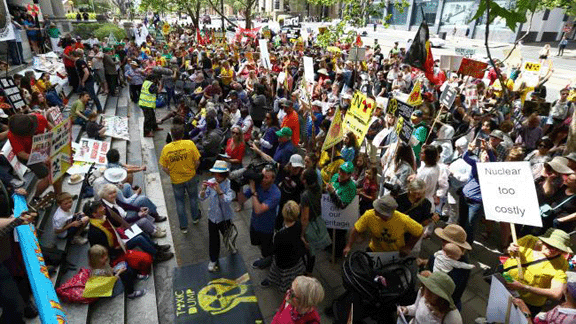
The State Government is considering whether it should store the world’s high-grade nuclear waste at a site somewhere in South Australia.
At the same time, the Federal Government is considering building its first storage facility for Australia’s low-grade radioactive waste, having short-listed Wallerberdina station, near Hawker in the Flinders Ranges, as a preferred site.
Traditional landowner Karina Lester said many people did not want to see either proposal go ahead.
“We are starting to unite and we are starting to really think about how we’re going to fight this, because it concerns us and we have a cultural responsibility,” she said.
“People travelled from the Mid North [and] from Ceduna as well to be part of this event and it was so important that they gathered here today to say ‘enough is enough’.
“Having Yalata crew, having Ceduna crew, the Yappala crew being involved is so strong for us as Aboriginal people.”
Renowned film director Scott Hicks lent his voice to the cause, with particular concern about the high-grade dump.
“To me it’s an idea that doesn’t make sense on any level I can look at it,” he said.
“It doesn’t make economic sense. We can’t even predict the price of coal a month from now. How can we predict the price of nuclear waste 100 years from now?
“Why would we want to leave a legacy for our children’s, children’s children and beyond 100,000 years, that can never be taken away?”
What is being proposed?
Federal
- Low-to-intermediate level radioactive waste generated in Australia stored in a purpose-built facility
- It would include materials such as nuclear medicine by-products
- This waste is currently stored in more than 100 sites across Australia, in metropolitan areas, regional towns and cities
- The project promises at least 15 ongoing jobs and $10 million in funding for the host community once the facility is operational
South Australia
- The Nuclear Fuel Cycle Royal Commission found SA could store the world’s high-grade nuclear waste
- Sealed waste would be stored 500 metres underground in a purpose-built facility
- The facility could create up to 5,000 jobs during construction and 600 ongoing jobs
- It is tipped to generate $5.6 billion of annual revenue for SA once established
When the law really IS an ass – International Court of Justice rejects Marshall Islands’ nuclear weapons case
 Nuclear Standoff, CounterPunch, OCTOBER 14, 2016 “…………the Republic of the Marshall Islands has lost its case in the International Court of Justice. On a technicality, no less! Phon van den Biesen, lead attorney for the tiny island nation, which had sued the world’s nine nuclear powers — the United States, Russia, China, Great Britain, France, Israel, India, Pakistan and North Korea — to begin real nuclear disarmament negotiations, said the case was dismissed earlier this month on a “micro formality,” which in my layman’s grasp of the matter might be called, instead, a desperate legal cop out.
The case, which, technically, was brought against only three of the nine nuclear powers, Great Britain, India and Pakistan (because those are the only three nations that acknowledge the binding authority of the ICJ), was dismissed — in a split decision that could be called the First World against the rest of humanity — on the grounds that there wasn’t sufficient evidence of a dispute between the parties, so the court had no jurisdiction to hear the case on its merits.
Huh?
JOHN PILGER – Breaking The Silence – 2016
The ICJ’s dissenting judges (in the case against Great Britain, the verdict to dismiss was 9-7, against India and Pakistan it was 8-8), expressed as much incredulity as I did on hearing the news.
The Marshall Islands lawsuits (a second suit was also filed, specifically against the United States, in U.S. federal court, and is still pending) demanded compliance with Article VI of the 1968 Nuclear Nonproliferation Treaty, signed by the U.S. in 1970, which reads: “Each of the Parties to the Treaty undertakes to pursue negotiations in good faith on effective measures relating to cessation of the nuclear arms race at an early date and to nuclear disarmament, and on a treaty on general and complete disarmament under strict and effective international control.”
“General and complete disarmament — do these words actually have meaning?” I asked last January. “Right now the Marshall Islands stand alone among the nations of Planet Earth in believing that they do.”
This tiny nation of islands and atolls — this former U.S. territory — with a population of about 70,000, was the scene of 67 nuclear test blasts in the 1950s, back when bigger was better. Some people’s homes were destroyed for eternity. The islanders suffered ghastly and often lethal levels of radiation and were essentially regarded, by their U.S. overlords, as human guinea pigs — a fantastic opportunity to study the effects of nuclear fallout. Eventually, the U.S. atoned for its destruction by paying the Republic of the Marshall Islands a pathetic $150 million “for all claims, past, present and future.”
Now this nation is trying to save the rest of the planet by insisting that nuclear disarmament negotiations must get underway.
In a dissenting opinion, ICJ Judge Antônio Augusto Cançado Trindade of Brazil lamented that the world needed to recognize the “prevalence of human conscience” over national interests.
As Rick Wayman of the Nuclear Age Peace Foundation pointed out, of the ICJ justices who voted not to hear the case on its merits, six were from nuclear-armed nations (the U.S., Russia, China, France, Great Britain and India) and the other two from nations (Japan, Italy) “deeply invested in the U.S. ‘nuclear umbrella.’”
The nations of the dissenting judges included Brazil, Somalia, Jamaica, Australia and Morocco…….. The human conscience is dismissed on a technicality……. http://www.counterpunch.org/2016/10/14/nuclear-standoff/
Cyber attacks on nuclear power plants “happen all the time”
NUCLEAR WARNING: Cyber risk for power plants over revelation attacks happen ‘all the time’ Express UK , By MONIKA PALLENBERG AND ZOIE O’BRIEN, 14 Oct 16, NUCLEAR power plants across the globe are being hit by cyber attacks “all the time”, Express.co.uk can reveal, after a warning from the head of the International Atomic Energy Agency (IAEA). Yukiya Amano revealed hack attempts are becoming “a serious threat” to the plants.
During a trip to Berlin he said a successful hack had the capability to disturb procedures and facilities, which could lead to serious consequences. Attacks on nuclear bases have a long history since many reactors, although built before computers, have been retrofitted.
The IAEA boss said attacks on security are “no imaginary danger” anymore. Mr Amano spoke about “disturbing, but not destructive” attacks, although admitted they had caused “considerable problems”.
Precautionary measures are in place at 23 Korean reactors, who have already fallen victims to data theft.
Although data was not critical, as the company Korea Hydro & Nuclear Power assured, but the security systems had to be strengthened.
However, those familiar with nuclear plants said attacks are frequent………http://www.express.co.uk/news/world/721341/Cyber-risk-nuclear-power-plants-attacks-frequent
Japan would pay a high price, if they decided to develop nuclear weapons
Yes, Japan Could Build Nuclear Weapons (But at What Cost?), National Interest, Nidhi Prasad October 12, 2016 “…….Japan and South Korea are American treaty allies. Both have given up the nuclear option in exchange for protection under the US nuclear umbrella. Despite possessing the technical capacity to go nuclear, Japan hasn’t displayed intent yet. …….
If Japan did decide to go nuclear, there are five critical calculations it must keep in mind.
First, Japan would have to overrule its institutional commitment to the ‘three non-nuclear principles’ declared in 1967 by then prime minister Eisaku Sato as a response to Chinese nuclear tests. This entails that Japan will not produce, possess or position nuclear weapons on its soil. A reinterpretation of Article 9 of the constitution would also be required, which currently does not allow for the maintenance of war potential and offensive weapons.
Japan’s constitution allows for a ‘minimum level of force’ necessary for self-defense. In the past, leaders from the Liberal Democratic Party of Japan have argued in favor of producing tactical nuclear weapons for self-defense purposes. But Japan is part of the Nuclear Non-Proliferation Treaty (NPT). To develop an independent deterrent capability, Japan would have to instigate Article 10 of the NPT to withdraw in light of “extraordinary events.” This path would severely damage Japan’s diplomatic capital, which hinges on a rigorous pursuit of disarmament diplomacy.
Second, a Japanese shift in nuclear policy would mean backtracking from its vigorous disarmament and non-proliferation strategies. As the only country to be the victim of an atomic bombing, Japan has developed a sense of nuclear aversion that stems from a moral and political rationale. …….
Third, Japan’s development of nuclear potential would significantly impact its security alliance with the United States. In 1968 Eisaku Sato defined Japanese nuclear policy based on four pillars, which included a reliance on US extended deterrence. Japan breaking out would mean undermining the foundations of the alliance which have become hardwired into the strategic landscape of the region. Japan’s own security policy would also have to be seriously modified.
Fourth, Japan would have to factor in the political ramifications of such a decision, particularly with respect to its relationships with China and South Korea. ………
Last, the domestic consensus on Japan’s nuclear policy would lose stability. During 1968–70 and 1995 Japan conducted domestic debates on the issue, but studies revealed the expensive trade-offs involved with such a pursuit (including the lack of strategic depth). …..
The political cost of going nuclear has become more complex in the 21st century. Japan has looked towards strengthening its insurance policies such as dependence on multilateral regimes and emphasis on US extension of its deterrent when dealing with nuclear threats. Japan’s nuclear insurance against North Korea lies in the strategic assurance of the US nuclear umbrella and the multilateral regimes currently in place. http://nationalinterest.org/blog/the-buzz/yes-japan-could-build-nuclear-weapons-what-cost-18019?page=2
Indigenous forum addresses horrors of nuclear legacy in USA
 Nuclear Standoff, CounterPunch, OCTOBER 14, 2016 “…….This week, as if in sync with the Marshall Islanders, a group called the Native Community Action Council convened the Native American Forum on Nuclear Issues, addressing half a century of lingering horror at another nuclear testing site, in Nevada. The forum addressed such issues as abandoned uranium mines and the proposed high-level nuclear waste disposal site under Yucca Mountain, “in the heart of the Western Shoshone Nation (and) a sacred site for Shoshone and Paiute peoples,” according to the organization’s press release.
“Because of U.S. nuclear testing in Nevada, the Western Shoshone Nation is already the most bombed nation on earth’” the release continues. “They suffer from widespread cancer, leukemia, and other diseases as a result of fallout from more than 1,000 atomic explosions on their territory.”
This is the reality we ignore. We’ve been ignoring it for the last 70 years and, indeed, much longer. We’ve reached the end of our ability to treat the planet, and much of its people, as disposable. Much of humanity knows this, but its leaders are refusing to listen. The human conscience is dismissed on a technicality. http://www.counterpunch.org/2016/10/14/nuclear-standoff/
Energy Efficiency – not sexy – but it works against climate change
Energy Efficiency Is Key To Taking On Climate Change—Here Are The Numbers That Matter https://www.fastcoexist.com/3064550/energy-efficiency-is-key-to-taking-on-climate-change-here-are-the-numbers-that-matter
Energy efficiency needs to account for one-third of all emissions reductions by 2040. BEN SCHILLER 10.13.16
Energy efficiency isn’t as sexy as inventing new, cleaner forms of power. But, if you care about climate change, you really ought to care about it. Efficiency will need to account for a third of emissions reductions by 2040 if we’re stay within relatively safe global warming limits, according to the International Energy Agency.

“Simply put, there are no realistic or affordable energy and climate change policy without a sizable and vigorous energy efficiency component,” the IEA says in a new report.
The good news is we are becoming smarter about energy use. Energy “intensity”—the amount of energy needed to generate a unit of global GDP—improved by 1.8% last year. That was higher than in 2014, even though energy prices have been falling, which normally encourages people to use more energy, not less.
Between 2000 and 2015, IEA countries—including the U.S. and most of Europe—improved their energy intensity by an average of 14%. That’s the equivalent of 450 million tonnes of oil, or enough to power Japan for a whole year. In all, efficiency saved $490 per person across the IEA area, or cumulative energy spending of $4 trillion.
The bad news is that even this rate isn’t enough to meet the 2040 target. The IEA calls on countries to implement more mandatory efficiency targets—likeour CAFE car efficiency standards—and to spread more efficient lighting, heating, and air conditioning technology. Best-in-class equipment could save 14% of global residential energy consumption, the report says.
See more here.
The Astronomical Cost of New Subsidies for Old Reactors: $280 Billion.

GreenWorld has covered the unfolding story of the American nuclear power industry’s clamor for new subsidies and bailouts since it started in 2014. Purely as a spectator sport, it might have been entertaining to watch the country’s largest utilities go from proclaiming a “Nuclear Renaissance” a decade ago to peddling the message that “Nuclear Matters.”
But there is just too much at stake to treat it like a game. The utility industry’s ramped-up efforts to block renewable energy and horde billions of our clean energy dollars to prop up old nukes risks both climate and nuclear disaster. Most of these proposals have been failing, thanks to the dogged persistence of grassroots activists and clean energy groups–and, it must be said, the outrageous sticker price of subsidies the industry needs. In fact, just this week, the two-year saga of FirstEnergy’s $8 billion nuclear-plus-coal bailout plan seems to have ended, with…
View original post 502 more words
October 14 Energy News

Opinion:
¶ “Canadian Hydro: A Lifeline for Northeastern Clean Energy Goals?” • States in the US Northeast are looking for creative solutions to decarbonize their electricity system and maintain affordable, reliable electricity service. They have renewed interest in an old resource, imported Canadian hydroelectricity. [Greentech Media]
 Canadian hydropower
¶ “Fossil Fuels Face More Competition from ‘Green’ Energy” • Bloomberg New Energy Finance found dramatic improvements in wind and solar technology is helping to boost the amount of power generated from each plant. That allowed installations to grow by almost 70% in the last five years even as investment flat lined. [agprofessional.com]
Science and Technology:
¶ Scientists and engineers at MIT’s Plasma Science and Fusion Center have made a new world record for plasma pressure in the Alcator C-Mod tokamak nuclear fusion reactor. The researchers said that the plasma, which lasted for two full seconds, achieved 2.05…
View original post 714 more words
Leak: Areva-Le Creusot Investigating 6,000 Nuclear Parts Files for Irregularities; US NRC to Participate in ASN Led Worldwide Inspection from Nov 28th to Dec 2nd


From a US NRC Inspection Report, October 6 – 8, 2009, by Kerri Kavanagh
US NRC on Areva-Le Creusot Potentially Defective Parts in US Reactors – Feigning Ignorance?
The US NRC had concerns over French State owned nuclear behemoth Areva’s testing and documentation at least as early as 2009, and the French Nuclear Safety Authority (ASN) was aware of these concerns. In fact, Kerri Kavanagh, who responded for the NRC in June about the potential Areva defects and who has failed to report anything since, did a presentation over 7 years ago saying: “July 2009 – French Regulator Autorité de Sûrete Nucléaire (ASN) observed NRC inspection at Creusot Forge, Le Creusot, France… Summary of Findings • 10 CFR Part 21 Program – NOV for failure to meet the requirements for implementing a procedure to evaluate deviations and failures to comply, and for imposing Part 21 in procurement documents • Control…
View original post 1,104 more words
Roundup of this week’s nuclear and climate news
 Climate change is still the Big One. But, the danger of nuclear war is also the Big One, and particularly so right now. Red Cross and Red Crescent (IRRC) statement to UN on nuclear disarmament. Religious groups unite to lobby at UN on nuclear weapons ban. Nobel Prize laureates call for an end to the insanity of nuclear weapons.
Removing CO2 From the Air seen as Only Hope for Fixing Climate Change
People and planet endangered by the Trans Pacific Partnership.
The Health Impacts Of Climate Change Are Huge And Very Real. Lord Stern – Indigenous land rights fundamental to climate safety.
Solar costs rocketing DOWN world-wide.
If they didn’t have mental problems before, Mars travellers sure will afterwards!
USA.
- All too easy for an American President to start nuclear apocalypse. Trump ‘should not have his finger on the button’ – Former nuclear launch officers. Russian legislator urges Americans to vote Trump, or risk nuclear war.
- Nuclear-powered USS Ronald Reagan to join U.S.-South Korean joint naval drills.
- Third ceiling collapse at Nuclear Waste Isolation Pilot Plant.
- Long term safety of spent nuclear fuel storage canisters is far from assured.
- Shipments of Nuclear Waste Through Hurricane Prone Atlantic to Charleston SC Almost Monthly?
- Thorium polluted site added to America’s National Priorities List. Climate Change is THE ISSUE for many young American voters.
RUSSIA. Putin orders overseas Russian officials to bring family members home. Russia moves nuclear-capable missiles to Kaliningrad , but says this is not significant. Russia’s ceremony to mark start of construction of floating nuclear power station.
NORTH KOREA on track to ramp up its nuclear weapons. Spiral of repeated failure in nuclear sanctions against North Korea.
JAPAN. Newborn baby deaths significantly increased in areas radioactively polluted by Fukushima nuclear disaster. According to a wildlife journalist, even in Tokyo some animals suffer mutations. Active Volcanoes Endanger Japan’s Operating Nuclear Power Stations: Mount Aso Awakened Explosively; Sakurajima Already Awake.
CHINA. China going allout to market nuclear reactors to Asia, Europe, Africa and Middle East
UK. Britain’s uneconomic Hinkley nuclear project really connected with its nuclear weapons aims.
CANADA. Canadian nuclear safety official in bed with nuclear industry?
SWITZERLAND. Switzerland bans new nuclear reactors.
SOUTH AFRICA. Tina Joemat-Pettersson says South African govt will not fund nuclear build. Something not quite right about South Africa’s plan for Eskom to finance nuclear build?
INDIA. India’s government seeking private investment for its costly Light Water Nuclear Reactors.
Clinicopathological Findings of Fukushima Thyroid Cancer Cases: October 2016
On September 26-27, 2016, the “5th International Expert Symposium in Fukushima on Radiation and Health: Chernobyl+30, Fukushima+5: Lessons and Solutions for Fukushima’s Thyroid Question” was held in Fukushima City. The symposium was organized by the Nippon Foundation, co-organized by Fukushima Medical University, Nagasaki University, and Hiroshima University, and supported by Fukushima Prefecture, Japan Medical Association, Japan Nursing Association, and Japan Pharmaceutical Association. Program PDF can be viewed here. Information on previous symposia can be found on the following web pages: 1st symposium, 2nd symposium, 3rd symposium, and 4th symposium.
The program featured the usual suspects from the pro-nuclear camp as some of the presenters who informed the audience that “Fukushima is different from Chernobyl” and emphasized the risk of overdiagnosis from cancer screening. This post focuses on clinical information for the surgical cases presented by Shinichi Suzuki, the thyroid surgeon at Fukushima Medical University in charge of the Thyroid Ultrasound Examination.
The last time Suzuki released such information was on August 31, 2015, and it was given in a narrative form on one sheet of paper (can be found here and translated here). This time it was given as a series of PowerPoint slides with more details than ever. Screenshots of some of the slides are shown below, accompanied by narrative explanations to put the information in context. Please note that this is neither the actual transcript of his presentation nor inclusive of all the slides shown during the presentation.
*****
“Childhood and Adolescent Thyroid Cancer after the Fukushima NPP Accident” by Professor Shinichi Suzuki, Fukushima Medical University (starts around 1:45:25 in the video embedded below, with Japanese interpretation).
http://www.ustream.tv/recorded/91672512
Note: Suzuki used the Thyroid Examination results released on June 6, 2016 with data as of March 31, 2016 during this presentation, although the new results as of June 30, 2016 were released on September 14, 2016.
Slide 1

This presentation covers 125 cases of thyroid cancer that underwent surgeries at Fukushima Medical University between August 2012 and March 2016. During this time period, 132 cases underwent surgeries, 126 at Fukushima Medical University and 6 at other medical facilities. At Fukushima Medical University, 1 case was post-operatively diagnosed as a benign thyroid nodule, leaving 125 cancer cases. (Note: The August 2015 report stated 7 cases underwent surgeries at facilities other than Fukushima Medical University, but now it is 6 cases. No explanation was given regarding this discrepancy).
As of March 31, 2016, 102 cases suspicious of cancer were operated from the first round (confirmed as 1 benign nodule and 101 cancer cases), while the second round yielded 30 cancer cases. Assuming the 6 cases operated at other medical facilities were from the first round, 125 cases presented here include 95 cases from the first round, leaving 30 cases to be accounted for by the second round. It is not clear how many of the first round and the second round cases were actually operated at Fukushima Medical University. 125 presented here may not include 30 cases from the second round. (Note: Previous sentence was crossed out and a new sentence added on October 11, 2016).
Slide 2
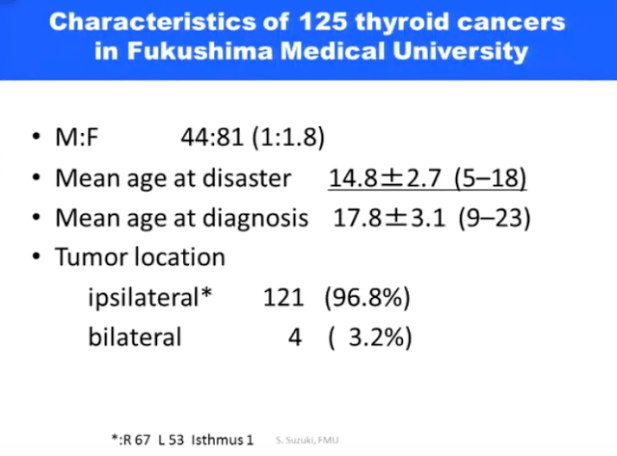
125 cases consisted of 44 males and 81 females, with the female-to-male ratio** of 1.8 to 1.
Age at the time of the accident (i.e. age at exposure) ranged from 5 to 18 years, with an average age of 14.8 ± 2.7 years. Age at diagnosis ranged from 9 to 23, with an average age of 17.8 ± 3.1 years.
Location of tumor was ipsilateral (i.e. one-sided) in 121 cases (96.8%) and bilateral (i.e. on both sides) in 4 cases. In 121 ipsilateral cases, 67 were located in the right lobe, 53 in the left lobe, and 1 in the isthmus which connects together the lower thirds of the right and left lobes.
**Thyroid cancer is known to occur more commonly in females. The female to male ratio tends to increase with age. For instance, the female to male ratio in the 2009 US study is 4.3:1 with 94.5% of cases ≥ age 10 [1] . In the 1995 study of the cancer registry data from 1963 to 1992 in England and Wales, the female to male ratio was 1.25:1 in ages 5-9 and 3.1:1 in ages 10-14 [2]. The female to male ratio is also known to decrease in the radiation exposed cases. In the 2008 study that compared thyroid cancer cases (exposed to radiation) in Belarus, Ukraine and Russia after the Chernobyl accident with unexposed cases in the same region as well as in UK and Japan, the female to male ratio was 4.2:1 overall, 2.4:1 in age <10, 5.2:1 in age ≥10 in the unexposed cases, whereas the female to male ratio was 1.5:1 overall, 1.3:1 in age <10, and 1.6:1 in age ≥10 in the exposed cases [3].
Slide 3

TNM classification is explained below. Japan has its own clinical guidelines on cancers, but the TNM classification is essentially the same with the exception of the “Ex” notation which refers to the degree of extension outside the thyroid capsule:
Ex1 means minimal extension (example: extension to sternothyroid muscle or perithyroid soft tissues) and is equivalent to T3.
Ex2 means further extension and is equivalent to T4.
Prefix “c” refers to “clinical” while “p” refers to “pathological.”
Pre-operative tumor size here refers to the largest diameter measured by ultrasound. It ranged from 5 mm to 53 mm with average of 14.0 ± 8.5 mm. (Note: The largest pre-op diameter was 45.0 mm for the first round and 35.6 mm for the second round. It is unclear where “53 mm” came from).
44 had tumor size ≤ 10 mm and limited to the thyroid.
57 had tumor size > 10 mm but ≤ 20 mm and limited to the thyroid.
12 had tumor size > 20 mm but ≤ 40 mm and limited to the thyroid.
12 had tumor size > 40 mm and limited to the thyroid, or any size tumor minimally extending outside the thyroid.
28 had metastases to the regional lymph node.
5 had lymph node metastases near the thyroid, within the central compartment of the neck.
23 had lymph node metastases to further areas of the neck.
3 had distant metastases to the lungs. This is the first time that any clinical details of the distant metastasis cases are given.
1) Male. Age at exposure 16, age at surgery 19.
Pre-operative: cT3 cN1a cM1. Tumor size > 40 mm and limited to thyroid or any size with minimal extension outside the thyroid. Metastasis to lymph nodes in the central compartment of the neck. Distant metastasis.
Post-operative: pT3 pEx1 pN1a pM1. Tumor size > 40 mm and limited to thyroid or any size with minimal extension outside the thyroid. Minimal extension outside the thyroid. Metastasis to lymph nodes within the central compartment of the neck. Distant metastasis.
2) Male. Age at exposure 16, age at surgery 18.
Pre-operative: cT3 cN1b cM1. Tumor size > 40 mm and limited to thyroid or any size with minimal extension outside the thyroid. Metastasis to the neck lymph nodes outside the central compartment. Distant metastasis.
Post-operative: pT2 pEx0 pN1b pM1. Tumor size > 20 mm but ≤ 40 mm and limited to the thyroid. No extension outside the thyroid. Metastasis to the neck lymph nodes outside the central compartment. Distant metastasis.
3) Female. Age at exposure 10, age at surgery 13.
Pre-operative: cT1b cN1b cM1. Tumor size > 1 cm but ≤ 2 cm, limited to the thyroid. Metastasis to the neck lymph nodes outside the central compartment. Distant metastasis.
Post-operative: pT3 pEx1 pN1b pM1. Tumor size > 40 mm and limited to thyroid or any size with minimal extension outside the thyroid. Minimal extension. Metastasis to the neck lymph nodes outside the central compartment. Distant metastasis.
*****
TNM classification for differentiated thyroid cancer from the American Cancer Society website.
Primary tumor (T)
T indicates the size of the primary tumor and whether it has grown into the nearby area.
T1a: Tumor ≤ 1 cm, limited to the thyroid
T1b: Tumor > 1 cm but ≤ 2 cm in greatest dimension, limited to the thyroid
T2: Tumor size > 2 cm but ≤ 4 cm, limited to the thyroid
T3: Tumor size >4 cm, limited to the thyroid or any tumor with minimal extrathyroidal extension (eg, extension to sternothyroid muscle or perithyroid soft tissues)
T4a: The tumor is any size and has grown extensively beyond the thyroid gland into nearby tissues of the neck, such as the larynx (voice box), trachea (windpipe), esophagus (tube connecting the throat to the stomach), or the nerve to the larynx. This is also called moderately advanced disease.
T4b: The tumor is any size and has grown either back toward the spine or into nearby large blood vessels. This is also called very advanced disease.
Regional lymph nodes (N)
Regional lymph nodes are the central compartment, lateral cervical, and upper mediastinal lymph nodes:
N0: No regional lymph node metastasis
N1: Regional lymph node metastasis
N1a: Metastases to level VI (pretracheal, paratracheal, and prelaryngeal/Delphian lymph nodes)
N1b: Metastases to unilateral, bilateral, or contralateral cervical (levels I, II, III, IV, or V) or retropharyngeal or superior mediastinal lymph nodes (level VII)
Distant metastasis (M)
M0: No distant metastasis is found
M1: Distant metastasis is present
*****
Slide 4
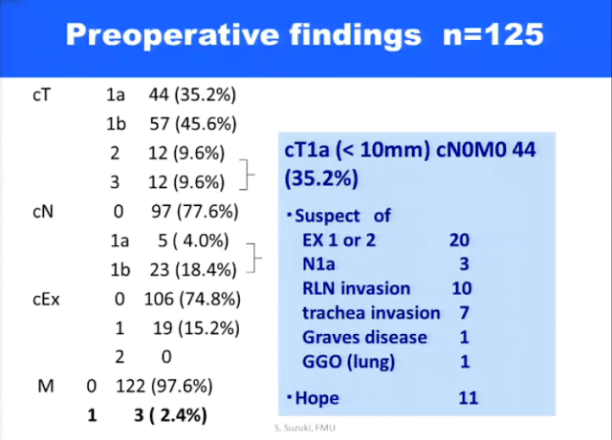
This slide is similar to Slide 3, except it describes why surgeries were conducted in 44 “cT1a cN0 cM0” cases with tumor ≤ 10 mm without any pre-operative clinical evidence of lymph node or distant metastases. (Surgery for thyroid “microcarcinoma,” i.e. cancer ≤ 10 mm, is controversial in adults).
11 of 44 cases underwent surgeries despite the recommendation of non-surgical, observational follow-ups. Remaining 33 cases had suspicion for one or more of the following conditions:
20 cases: Ex1 or Ex2 (extension beyond the thyroid capsule)
3 cases: N1a (metastases to lymph nodes within the central compartment of the neck)
10 cases: Invasion of the recurrent laryngeal nerve
7 cases: invasion of the trachea
1 case: Graves disease
1 case: Ground-glass opacity (GGO) of the lungs
1 case: Ground-glass opacity (GGO) of the lungs
Slide 5

11 underwent total thyroidectomy where both right and left lobes of the thyroid were removed. Skin incision was limited to 4-5 cm.
114 had hemi-thyroidectomy where one lobe of the thyroid was removed. Skin incision was limited to 3cm.
All cases underwent the central lymph node dissection. 24 cases also had dissection of the lateral neck lymph nodes.
Japan’s clinical guidelines use a slightly different classification system of the regional lymph node levels (described at the end). Furthermore, “D classification” or “D number” is used to describe the extent of the lymph node dissection, which apparently corresponds to the selective neck dissection (SND) defined by the American Head and Neck Society and the American Academy of Otolaryngology-Head and Neck Surgery [4]. The equivalent SND notation is shown when possible for easier understanding.
D0: No dissection, or the degree of dissection not reaching D1.
D1: Dissection of the central compartment lymph nodes (prelaryngeal, pretracheal, paratracheal and prethyroidal). Can be unilateral of bilateral. Equivalent to SND (VI).
D2a: D1 plus dissection of middle jugular and lower jugular nodes. Equivalent to SND (III, IV, VI).
D2b: D2a plus dissection of upper jugular and posterior triangle nodes. Equivalent to SND (II-V, VI).
D3a: Bilateral D2a. Equivalent to bilateral SND (III, IV, VI)
D3b: Bilateral D2b, or D2a plus contralateral D2b.
D3c: D2 or D3 plus dissection of superior mediastinal nodes.
Slide 6
This slide shows what was found during the surgery and subsequent pathological examination of the excised tissues and lymph nodes.

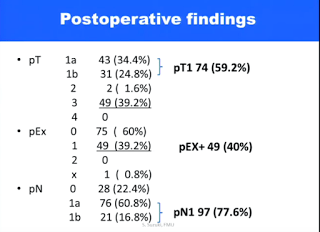
Shown here side by side with the pre-operative findings, it becomes clear that fewer cases are limited to thyroid and ≤ 20 mm, while more cases turned out to have minimal extension and the regional lymph node involvement.
Notable is the number and percentage of cases confirmed to have minimal extension outside the thyroid capsule, pEx1. This number, 49 (40%), is the same as pT3, suggesting pT3 in this group denotes any size tumor with minimal extension outside the thyroid capsule.
Even more notable is the number of regional lymph node metastases. 5 cases of cN1a turned out to be 76 cases of pN1a. Overall, 97 (77.6%) of 125 had regional lymph node metastasis.

Slide 7
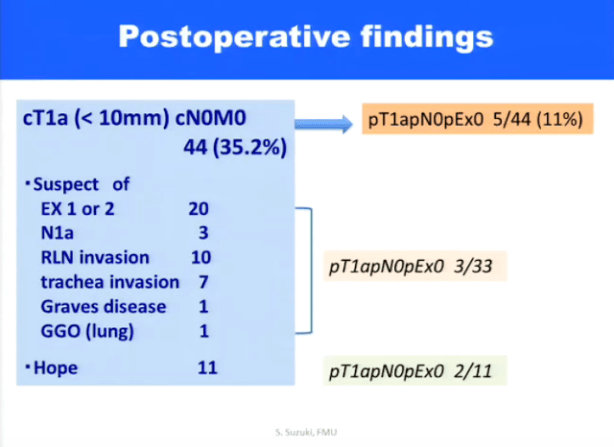
This slide shows the post-operative findings of 44 “cT1a cN0 cM0” cases with tumor smaller than 10 mm without any pre-operative clinical evidence of lymph node or distant metastases described in Slide 4.
Of 11 cases that underwent surgery against the recommendation of non-surgical, observational follow-ups, 2 cases turned out to be pT1a pN0 pEx0, meaning the tumor was ≤ 10 mm without any regional lymph node involvement or extension beyond the thyroid capsule.
Of remaining 33 cases that had indications for surgery as described in Slide 4, 3 cases turned out to be pT1a pN0 pEx0.
Overall, 5 of 44 cases with tumor size ≤ 10 mm turned out to have no lymph node involvement or extension beyond the thyroid capsule, suggesting these 5 cases might not have actually needed surgery at the time. But this is in hindsight, and it should be remembered 33 cases originally did have clear surgical indications. (Curiously, the previous report from August 2015 states this number was “8.” No explanation was given by Suzuki as to the discrepancy. However, his admittance of “a few percent of recurrence” might allow for speculation that 3 of 8 cases recurred and no longer was classified “pT1a pNO pEx0.” It should be noted this has not been confirmed by Suzuki. It is expected he might discuss clinical details such as the recurrence rate during his presentation on the Thyroid Examination at the Annual Meeting of the Japan Thyroid Association on November 13-15, 2016, in Tokyo.
Slide 8

This slide shows the types of thyroid cancer found in 125 cases. 121 had papillary thyroid cancer (PTC), 3 had poorly differentiated thyroid cancer, and 1 had “other” thyroid cancer.
It should be noted that 2 of 3 cases of poorly differentiated thyroid cancer has since been reclassified as papillary thyroid cancer with unspecified subtypes in accordance with the revision of the thyroid cancer clinical guidelines (see this post for more information).
Regarding one case of “other” thyroid cancer, it was previously explained by Akira Ohtsuru, head of the Thyroid Examination, that the patient had differentiated thyroid cancer that is not considered to be related to radiation and categorized as “other” according to the classification in the seventh revision of Japan’s unique thyroid cancer diagnostic guidelines released in November 2015.
121 cases of papillary thyroid cancer showed 4 subtypes/variants:
110 cases of classical type
4 cases of follicular variant*
3 cases of diffuse sclerosing variant
4 cases of cribriform-morular variant**
A special notation was made by Suzuki that no solid variant of PTC–the most common subtype in Chernobyl–was seen. This is one of the claims repeated by the officials to emphasize the Fukushima cancer cases are unlike those in Chernobyl, i.e. unlikely to be due to the radiation effects. However, solid variant PTC is not exclusive to radiation-induced thyroid cancer, and a high frequency of solid variant PTC observed in Chernobyl might be due to the young age of the early cases [5,6,7]. Moreover, in one study, solid variant was not seen in Japanese childhood PTC [8].
*Recently, encapsulated follicular variant of papillary thyroid carcinoma (EFVPTC) was reclassified as “noninvasive follicular thyroid neoplasm with papillary-like nuclear features” (NIFTP) [9]. However, cases of the follicular variant of papillary thyroid cancer found here are not assumed to be EFVPTC since they were never reclassified as non-cancer. This subject never came up during the Oversight Committee meetings.
**Cribriform-morular variant is usually associated with familial adenomatosis polyposis.
Slide 9
This slide shows algorithms for diagnosis and treatment of papillary thyroid cancer according to the Japanese clinical guidelines.

Slide 10
This slide shows a comparison of surgical methods between Belarus and Fukushima. Most cases in Fukushima underwent hemithyroidectomy or lobectomy, whereas total thyroidectomy was the most common surgical method in Belarus.
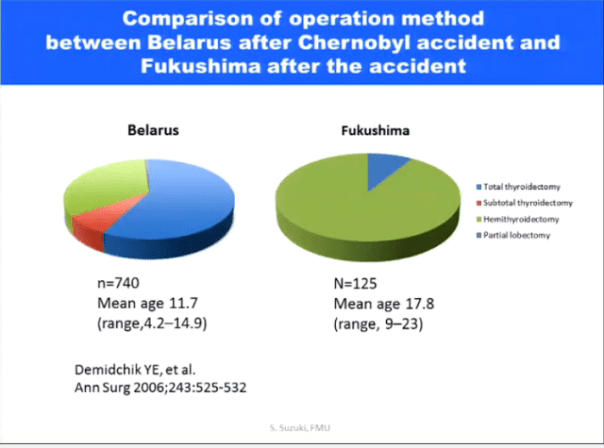
Suzuki mentioned that extra care has been taken to reduce complications from surgeries, and hemithyroidectomy was employed when possible to decrease the lifetime need for thyroid hormone supplementation. Also, this article by Japan’s top thyroid surgeons states, “At present, Western countries adopted almost routine total thyroidectomy with radioactive iodine (RAI) ablation, while limited thyroidectomy with extensive prophylactic lymph node dissection has traditionally been performed for most patients in Japan.(…) In Japan, however, limited thyroidectomy such as subtotal thyroidectomy and lobectomy with isthmectomy has been traditionally adopted as the standard. This is partially because the capacity to perform RAI therapy is limited due to legal restrictions, and RAI therapy is not considered cost effective by the healthcare system in Japan. [10]”
Slide 11
This slide shows the genetic mutation profile in different study groups. 63.2% of 52 cases from Fukushima was shown to have BRAF mutation. In the 2015 study by Mitsutake et al.[11] shown in the green box, 43 (63.2%) of 68 cases are shown to be positive for BRAF V600E point mutation. The same study also shows 10.3% was positive for RET/PTC rearrangements (6 cases of RET/PTC1 and 1 case of RET/PTC3) and 4 cases (5.9%) had ETV6/NTRK3 rearrangement. (It’s unclear where “n=52” and 8.8% of TRK fusion came from for the Fukushima column, as the Mitsutake study has n=68 and did not test for TRK fusion. It’s also unclear where the Japanese adult data came from. Literature search revealed the BRAF frequency in PTC of Japanese adults varied in a wide range: 28.8% [12], 38.2% [13], 38.4% [14] , 53% [15], and 82.1% [16]).
The official stance is that the genetic alterations observed in Fukushima cases are similar to what is seen in typical adult papillary thyroid cancer and “probably reflects genetic status of all sporadic and latent thyroid carcinomas in the young Japanese population [11].” In other words, the official assert that the genetic profile appears consistent with the official claim that screening is diagnosing spontaneous and latent cancers which might not have been detected without screening.
However, literature varies in regards to how the genetic mutations are associated with radiation exposure, age, and iodine status. RET/PTC rearrangements, frequently seen in Chernobyl, are associated with both radiation-induced and spontaneous thyroid cancer [17], more common at younger age and in iodine deficient areas [18]. BRAF mutation is known to be seen more frequently in older age, but recent studies showed BRAF V600E was present in 36.8% (median age 13.7 years) [19] and 63% (median age 18.6 years) [20] of pediatric papillary thyroid carcinoma. BRAF mutation were associated with high iodine intake in China [21], while no difference in BRAF V600E frequency was found between iodine-rich and iodine-deficient countries recently [16].

Slide 12
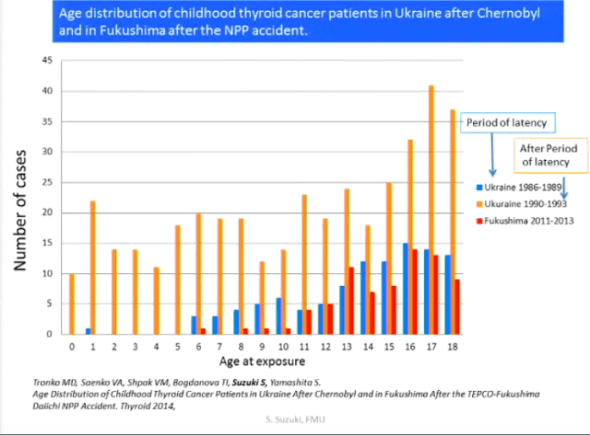
This slide shows a graph with age distribution of thyroid cancer patients in Ukraine and Fukushima in different post-accident time periods, compiled by superimposing 2 graphs from Letter to the Editor of Thyroid [21]. Blue bars are for 1986-1990 in Ukraine (first 4 years after the Chernobyl accident) and red bars are for 2011-2013 in Fukushima (first 3 years after the Fukushima accident), both time periods representing “latency” for radiation-induced thyroid cancer in children. Orange bars are for 1990-1993 in Ukraine–after the latency period–showing a large increase in thyroid cancer cases in Ukrainian residents who were 18 or younger when the accident happened. Increased number of cases in those who were age 5 or younger set this time period apart. The year 1990 is also when large-scale screening programs began, initiated by international organizations [22].
The age distribution is “strikingly similar” between the first 4 post-accident years in Ukraine (blue bars) and the first 3 years in Fukushima (red bars), as acknowledged by the letter. However, the letter is inconsistent in claiming “if thyroid cancers in Fukushima were due to radiation, more cases in exposed preschool-age children would have been expected” and defining the first 4 years as “latency.” This illogical claim is also seen in a slightly different format as a comparison between different post-accident periods [23].
Concluding summary
The official stance is that thyroid cancer cases detected after the Fukushima accident are more likely due to the screening effect, meaning the screening discovered spontaneous and latent cancers that were not causing any symptoms and would not become clinically significant until much later if it weren’t for the screening. However, clinical details show that most cases were not so innocuous: extending outside thyroid gland; metastasizing to cervical lymph nodes or even to the lungs; or invading vital structures such as the trachea and the recurrent laryngeal nerve. A few cases may represent overdiagnosis/overtreatment, but for the vast majority of the cases, surgeries were clearly indicated medically. It’s even questionable if some of the cases were truly asymptomatic. Detailed, specific questions regarding potential symptoms were not asked, at least in the information sheet submitted with the consent form. Whether further questioning about the symptoms occurred during the confirmatory examination is unknown. More transparency is warranted.
Female to male ratio seems higher than expected considering the average age of the patients. Histological type and genetic alterations commonly seen in Chernobyl may not be observed in Fukushima cases, but this could be due to variations in age, iodine status, or ethnic background between the two groups.
The phrase, “Fukushima is not Chernobyl” was frequently repeated during the symposium. Indeed, it is time that Fukushima data be given a fresh look by unbiased experts who can analyze it as is, rather than endless comparisons with Chernobyl to prematurely deny radiation effects.
*****
Classification of cervical lymph nodes by the Japanese clinical guidelines
I: Prelaryngeal nodes: LN anterior to the thyroid cartilage and the cricoid cartilage
II: Pretracheal nodes: LN anterior to trachea, dissectible posteriorly from the inferior border of thyroid
III: Paratracheal nodes: LN lateral to trachea, extending inferiorly to where it is dissectible from the neck and superiorly where recurrent laryngeal nerve enters trachea.
IV: Prethyroid nodes: LN adjacent to anterior and lateral parts of thyroid. Laterally includes LN attached to thyroid when middle thyroid artery is ligated and cut. (Equivalent to the AJCC Level IV: lower jugular nodes)
(I, II, III and IV are equivalent to the AJCC Level VI: anterior compartment LN)
V: Superior internal jugular nodes: LN along internal jugular vein but superior to the inferior border of cricoid cartilage. This is further subdivided into superior and inferior at the bifurcation of common carotid artery
Va LN: inferior to the bifurcation of common carotid artery (equivalent to the AJCC Level II: upper jugular nodes)
Vb LN: superior to the bifurcation of common carotid artery (equivalent to the AJCC Level III: middle jugular nodes)
VI: Inferior internal jugular nodes: LN along internal jugular vein, inferior to the inferior border of cricoid cartilage. Includes LN in supraclavicular fossa.
VII: Posterior triangle nodes: LN located in posterior triangle bordered by anterior border of sternocleidomastoid muscle, posterior border of trapezius muscle, and omohyoid muscle.
VIII: Submandibular nodes: LN in the submandibular triangle.
IX: Submittal nodes: LN in the submental triangle.
(VIII and IX are equivalent to the AJCC Level I)
X: Superficial cervical nodes: LN superficial to superficial layer of the deep cervical fascia enclosing sternohyoid and sternocleidomastoid muscles.
XI: Superior mediastinal nodes: LN unresectable by neck dissection
(Equivalent to the AJCC Level VII: superior mediastinal nodes)
References
[1] Hogan AR, Zhuge Y, Perez EA, Koniaris LG, Lew JI, Sola JE. Pediatric thyroid carcinoma: incidence and outcomes in 1753 patients. J Surg Res. 2009 Sep;156(1):167-72. doi: 10.1016/j.jss.2009.03.098.
[2] Harach HR, Williams ED. Childhood thyroid cancer in England and Wales. British Journal of Cancer. 1995;72(3):777-783.
[3] Williams ED, Abrosimov A, Bogdanova T, et al. Morphologic Characteristics of Chernobyl-Related Childhood Papillary Thyroid Carcinomas Are Independent of Radiation Exposure but Vary with Iodine Intake. Thyroid. 2008;18(8):847-852. doi:10.1089/thy.2008.0039.
[4] Robbins K, Clayman G, Levine PA, et al. Neck Dissection Classification Update: Revisions Proposed by the American Head and Neck Society and the American Academy of Otolaryngology–Head and Neck Surgery. Arch Otolaryngol Head Neck Surg. 2002;128(7):751-758. doi:10.1001/archotol.128.7.751.
[5] Ory C, Ugolin N, Schlumberger M, Hofman P, Chevillard S. Discriminating Gene Expression Signature of Radiation-Induced Thyroid Tumors after Either External Exposure or Internal Contamination. Genes. 2012;3(1):19-34. doi:10.3390/genes3010019.
[6] Tronko MD, Bogdanova TI, Komissarenko IV, Epstein OV, Oliynyk V, Kovalenko A, Likhtarev IA, Kairo I, Peters SB, and LiVolsi VA. Thyroid carcinoma in children and adolescents in Ukraine after the Chernobyl nuclear accident. Cancer. 1999;86:149–156. doi:10.1002/(SICI)1097-0142(19990701)86:1<149::AID-CNCR21>3.0.CO;2-A.
[7] LiVolsi, VA, et al. The Chernobyl Thyroid Cancer Experience: Pathology. Clinical Oncology. 23(4):261-267.
[8] Williams ED, Abrosimov A, Bogdanova T, et al. Morphologic Characteristics of Chernobyl-Related Childhood Papillary Thyroid Carcinomas Are Independent of Radiation Exposure but Vary with Iodine Intake. Thyroid. 2008;18(8):847-852. doi:10.1089/thy.2008.0039.
[9] Nikiforov YE, Seethala RR, Tallini G, et al. Nomenclature Revision for Encapsulated Follicular Variant of Papillary Thyroid Carcinoma: A Paradigm Shift to Reduce Overtreatment of Indolent Tumors. JAMA Oncol. 2016;2(8):1023-1029. doi:10.1001/jamaoncol.2016.0386.
[10] Ito Y. and Miyauchi A. Thyroidectomy and Lymph Node Dissection in Papillary Thyroid Carcinoma. Journal of Thyroid Research. 2011; Article ID 634170, 6 pages. doi:10.4061/2011/634170.
[11] Mitsutake N, Fukushima T, Matsuse M, et al. BRAFV600E mutation is highly prevalent in thyroid carcinomas in the young population in Fukushima: a different oncogenic profile from Chernobyl. Scientific Reports. 2015;5:16976. doi:10.1038/srep16976.
[12] Namba H, Nakashima M, Hayashi T, Hayashida N, Maeda S, Rogounovitch TI, Ohtsuru A, Saenko VA, Kanematsu T, and Yamashita S. Clinical Implication of Hot Spot BRAF Mutation, V599E, in Papillary Thyroid Cancers. The Journal of Clinical Endocrinology & Metabolism. 2003;88(9):4393-4397.
[13] Nasirden A, Saito T, Fukumura Y, et al. Virchows Arch (2016). doi:10.1007/s00428-016-2027-5.
[14] Ito Y, Yoshida H, Maruo R, et al. BRAF Mutation in Papillary Thyroid Carcinoma in a Japanese Population: Its Lack of Correlation with High-Risk Clinicopathological Features and Disease-Free Survival of Patients. Endocrine Journal. 2009;5(1):89-97.
[15] Fukushima T, Suzuki S, Mashiko M, et al. BRAF mutations in papillary carcinomas of the thyroid. Oncogene. 2003;22:6455–6457. doi:10.1038/sj.onc.1206739.
[16] Vuong HG, Kondo T, Oishi N, et al. Genetic alterations of differentiated thyroid carcinoma in iodine‐rich and iodine‐deficient countries. Cancer Medicine. 2016;5(8):1883-1889. doi:10.1002/cam4.781.
[17] Nikiforov YE, Rowland JM, Bove KE, Monforte-Munoz H, and Fagin JA. Distinct Pattern of ret Oncogene Rearrangements in Morphological Variants of Radiation-induced and Sporadic Thyroid Papillary Carcinomas in Children. Cancer Res. May 1997;57(9):1690-1694.
[18] Leeman-Neill RJ, Brenner AV, Little MP, Bogdanova TI, Hatch M, Zurnadzy LY, Mabuchi K, Tronko MD, and Nikiforov YE. RET/PTC and PAX8/PPARγ chromosomal rearrangements in post-Chernobyl thyroid cancer and their association with iodine-131 radiation dose and other characteristics. Cancer. 2013;119:1792–1799. doi:10.1002/cncr.27893.
[19] Givens DJ, Buchmann LO, Agarwal AM, Grimmer JF, and Hunt JP. BRAF V600E does not predict aggressive features of pediatric papillary thyroid carcinoma. The Laryngoscope. 2014;124:E389–E393. doi: 10.1002/lary.24668.
[20] Henke LE, Perkins SM, Pfeifer JD, Ma C, Chen Y, DeWees T, and Grigsby PW. BRAF V600E mutational status in pediatric thyroid cancer. Pediatr Blood Cancer. 2014;61:1168–1172. doi:10.1002/pbc.24935.
[21] Guan H, Ji M, Bao R, et al. Association of High Iodine Intake with the T1799A BRAF Mutation in Papillary Thyroid Cancer. The Journal of Clinical Endocrinology & Metabolism. 2009;94(5):1612-1617. doi:10.1210/jc.2008-2390.
[22] International Advisory Committee. The International Chernobyl Project. Assessment of radiological consequences and evaluation of protective measures.
Technical Report. Vienna: International Atomic Energy Agency; 1991.
[23] Takamura N, Orita M, Saenko V, Yamashita S, Nagataki S, and Demidchik Y. Radiation and risk of thyroid cancer: Fukushima and Chernobyl. The Lancet Diabetes & Endocrinology. 2016;4(8):647. doi:10.1016/S2213-8587(16)30112-7.
[12] Namba H, Nakashima M, Hayashi T, Hayashida N, Maeda S, Rogounovitch TI, Ohtsuru A, Saenko VA, Kanematsu T, and Yamashita S. Clinical Implication of Hot Spot BRAF Mutation, V599E, in Papillary Thyroid Cancers. The Journal of Clinical Endocrinology & Metabolism. 2003;88(9):4393-4397.
[13] Nasirden A, Saito T, Fukumura Y, et al. Virchows Arch (2016). doi:10.1007/s00428-016-2027-5.
[14] Ito Y, Yoshida H, Maruo R, et al. BRAF Mutation in Papillary Thyroid Carcinoma in a Japanese Population: Its Lack of Correlation with High-Risk Clinicopathological Features and Disease-Free Survival of Patients. Endocrine Journal. 2009;5(1):89-97.
[15] Fukushima T, Suzuki S, Mashiko M, et al. BRAF mutations in papillary carcinomas of the thyroid. Oncogene. 2003;22:6455–6457. doi:10.1038/sj.onc.1206739.
[16] Vuong HG, Kondo T, Oishi N, et al. Genetic alterations of differentiated thyroid carcinoma in iodine‐rich and iodine‐deficient countries. Cancer Medicine. 2016;5(8):1883-1889. doi:10.1002/cam4.781.
[17] Nikiforov YE, Rowland JM, Bove KE, Monforte-Munoz H, and Fagin JA. Distinct Pattern of ret Oncogene Rearrangements in Morphological Variants of Radiation-induced and Sporadic Thyroid Papillary Carcinomas in Children. Cancer Res. May 1997;57(9):1690-1694.
[18] Leeman-Neill RJ, Brenner AV, Little MP, Bogdanova TI, Hatch M, Zurnadzy LY, Mabuchi K, Tronko MD, and Nikiforov YE. RET/PTC and PAX8/PPARγ chromosomal rearrangements in post-Chernobyl thyroid cancer and their association with iodine-131 radiation dose and other characteristics. Cancer. 2013;119:1792–1799. doi:10.1002/cncr.27893.
[19] Givens DJ, Buchmann LO, Agarwal AM, Grimmer JF, and Hunt JP. BRAF V600E does not predict aggressive features of pediatric papillary thyroid carcinoma. The Laryngoscope. 2014;124:E389–E393. doi: 10.1002/lary.24668.
[20] Henke LE, Perkins SM, Pfeifer JD, Ma C, Chen Y, DeWees T, and Grigsby PW. BRAF V600E mutational status in pediatric thyroid cancer. Pediatr Blood Cancer. 2014;61:1168–1172. doi:10.1002/pbc.24935.
[21] Guan H, Ji M, Bao R, et al. Association of High Iodine Intake with the T1799A BRAF Mutation in Papillary Thyroid Cancer. The Journal of Clinical Endocrinology & Metabolism. 2009;94(5):1612-1617. doi:10.1210/jc.2008-2390.
[22] International Advisory Committee. The International Chernobyl Project. Assessment of radiological consequences and evaluation of protective measures.
Technical Report. Vienna: International Atomic Energy Agency; 1991.
[23] Takamura N, Orita M, Saenko V, Yamashita S, Nagataki S, and Demidchik Y. Radiation and risk of thyroid cancer: Fukushima and Chernobyl. The Lancet Diabetes & Endocrinology. 2016;4(8):647. doi:10.1016/S2213-8587(16)30112-7.
All too easy for an American President to start nuclear apocalypse
 THE REAL NUCLEAR THREAT By Lawrence M. Krauss, New Yorker, 13 Oct 16 Donald Trump’s candidacy has been a source of anxiety for many reasons, but one stands out: the ability of the President to launch nuclear weapons. When it comes to starting a nuclear war, the President has more freedom than he or she does in, say, ordering the use of torture. In fact, the President has unilateral power to direct the use of nuclear weapons under any circumstances. Cabinet members may disagree and even resign in protest, but, ultimately, they must obey the order of the Commander-in-Chief. It’s all too easy to imagine Trump issuing an ultimate, thermonuclear “You’re fired!” to China, Iran, or another nation—and perhaps to the whole human race.*……….
 Trump….. genuinely seems to be a man who speaks and acts without significant forethought. He’s also someone who—as his debate performances have shown—responds to slights by lashing out against adversaries irrationally and without thinking about the consequences. And Trump has done little to reassure us about nuclear weapons specifically. He has expressed an affinity for massive bombing, proposing to “bomb the shit” out of oil fields in Iraq to counter isis. During a March interview with MSNBC’s Joe Scarborough, he said that he would consider using nuclear weapons in Europe, of all places. More generally, he’s disengaged from the realities of international affairs……
there’s no such thing as limited use of nuclear weapons. Retaliation and escalation are extremely likely. Even the use of nuclear weapons in a “local” conflict—say, between India and Pakistan—would have disastrous consequences. Millions would die in the initial nuclear exchange, of course. But the residue from the nuclear blasts would also produce long-term climate changes that would affect global agriculture for perhaps a decade, killing as many as a billion people through starvation. If he acted on his statements, Trump would usher in a chaotic, unpredictable, and dangerous nuclear future.
The fact that Trump has so cavalierly raised concerns about nuclear weapons may have a silver lining. It underscores how dangerous and irrational our nuclear policies already are………
the Non-Proliferation Treaty didn’t just restrict non-nuclear nations from obtaining nuclear weapons but also required nations possessing them to disarm. For as long as we continue to ignore this fundamental reality, we will continue to hover at the brink of Armageddon. It should be impossible for Trump, or any President, to push us over it. http://www.newyorker.com/news/news-desk/the-real-nuclear-threat
Trump ‘should not have his finger on the button’ – Former nuclear launch officers
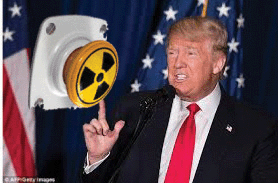 Former nuclear launch officers sign letter: Trump ‘should not have his finger on the button’ WP
The letter, issued Thursday, says the decision to use nuclear weapons requires “composure, judgment, restraint and diplomatic skill” — all qualities that the former Air Force officers who signed it said Trump lacks.
“On the contrary, he has shown himself time and again to be easily baited and quick to lash out, dismissive of expert consultation and ill-informed of even basic military and international affairs — including, most especially, nuclear weapons,” the letter says. “Donald Trump should not be the nation’s commander-in-chief. He should not be entrusted with the nuclear launch codes. He should not have his finger on the button.”
The letter is the latest in an extraordinary series of missives signed this year by diplomats and national security experts warning of the dangers they think a Trump presidency would pose. Last month, in a break from the trend, 88 retired military leaders endorsed the Republican presidential nominee. But most of the letters have reflected the views of those who consider Trump unfit to be commander in chief.
The former missileers who signed Thursday’s letter served at the nation’s four underground launch centers in the Great Plains from as long ago as the 1960s to, most recently, 2013. They do not endorse Democratic nominee Hillary Clinton, or even mention her name, in the letter………
If a president orders a missile launch, Blair said, five crews are equipped with keys used to fire a total of 50 missiles. Although the keys are interconnected, the missiles can be launched if just two crews carry out the order.
“Only the president can order a nuclear launch,” the letter states. “That order cannot be vetoed and once the missiles have been launched, they cannot be called back. The consequences of miscalculation, impulsive decision-making or poor judgment on the part of the president could be catastrophic.”
Blair said the officers are trained to put aside any personal doubts and trust in the system and the leadership.
“The presumption is, the commander in chief is acting in the national interest, and his decision should be grounded in knowledge and good advice,” he said. “Everyone would have to assume that, even though they had doubts — very strong doubts, if Trump were president.” https://www.washingtonpost.com/world/national-security/10-former-nuclear-launch-officers-sign-letter-trump-should-not-have-his-finger-on-the-button/2016/10/13/eef68fde-2468-4305-84d4-86033df53b3f_story.html
Climate Change is THE ISSUE for many young American voters

 Here’s why many young voters see climate change as THE issue in 2016, PRI, October 12, 2016 Lucía Oliva Hennelly “…….This year’s elections will have a far larger impact on the world for many reasons — but the biggest, at least for me, is that time has run out on climate change.
Where is the Responsibility of the Government and TEPCO?
It is up to each individuals to a carry glass badge to measure and avoid the irradiation. It is up to them to choose food. Now it is up to them to treat the nuclear waste.
Where is the responsibility of the government and TEPCO?

Special workshop to learn how to treat the waste resulting from the accident.
It takes only one day
No charge for the workshop and documents.
Open the black bags.
Separate the waste items.
Then break, burn or bury.
At Iwaki city: December 7th 2016
At Fukushima city: December 20th 2016
At Kôriyama city: January 24th 2017
Open to the people who:
Plan to return to the zone where the evacuation order has been or will be lifted or plan to get a job there;
Plan to get a job in 12 evacuated localities in the future ( Tamura city, Minamisoma city, Kawamata town, Hirono town , Naraha town, Tomioka town, Kawauchi village, Okuma town, Futaba town, Namie town, Katsurao village, Iitate village );
Plan to create firms in the 12 evacuated localities;
Are 18 years or older and;
Not belonging to a Yakuza organization
1 This Month

of the week – Shut Down Drone Warfare!


Tell the Ukrainian Government to Drop Prosecution of Peace Activist Yurii Sheliazhenko

Petition to revoke the licensing of the Near Surface Nuclear Disposal Facility (NSDF) at Chalk River. https://www.ourcommons.ca/petitions/en/Petition/Details?Petition=e-7247
To see nuclear-related stories in greater depth and intensity – go to https://nuclearinformation.wordpress.com
-
Archives
- April 2026 (114)
- March 2026 (251)
- February 2026 (268)
- January 2026 (308)
- December 2025 (358)
- November 2025 (359)
- October 2025 (376)
- September 2025 (257)
- August 2025 (319)
- July 2025 (230)
- June 2025 (348)
- May 2025 (261)
-
Categories
- 1
- 1 NUCLEAR ISSUES
- business and costs
- climate change
- culture and arts
- ENERGY
- environment
- health
- history
- indigenous issues
- Legal
- marketing of nuclear
- media
- opposition to nuclear
- PERSONAL STORIES
- politics
- politics international
- Religion and ethics
- safety
- secrets,lies and civil liberties
- spinbuster
- technology
- Uranium
- wastes
- weapons and war
- Women
- 2 WORLD
- ACTION
- AFRICA
- Atrocities
- AUSTRALIA
- Christina's notes
- Christina's themes
- culture and arts
- Events
- Fuk 2022
- Fuk 2023
- Fukushima 2017
- Fukushima 2018
- fukushima 2019
- Fukushima 2020
- Fukushima 2021
- general
- global warming
- Humour (God we need it)
- Nuclear
- RARE EARTHS
- Reference
- resources – print
- Resources -audiovicual
- Weekly Newsletter
- World
- World Nuclear
- YouTube
-
RSS
Entries RSS
Comments RSS
 nuclear-news