South Africa: Cabinet to DISCUSS ESKOM’S ROLE IN NUCLEAR DEAL
 CABINET TO DISCUSS ESKOM’S ROLE IN NUCLEAR DEAL AT NEXT MEETING http://ewn.co.za/2016/10/20/Cabinet-to-discuss-Eskoms-role-in-nuclear-deal-at-next-meeting
Minister Joematt-Pettersson said in October that Eskom was best-placed to drive the procurement process. Gaye Davis | 2 hours ago
CAPE TOWN – Minister in the Presidency Jeff Radebe says Cabinet will discuss a proposal that Eskom become the procurement agent for thecountry’s nuclear power programme at its next meeting.
Radebe was responding to questions after briefing on the outcomes of yesterday’s Cabinet meeting.
Energy Minister Tina Joematt-Pettersson said earlier this month Eskom was best-placed to drive the procurement process, while the Department of Energy would act as co-ordinator.
The plan to put Eskom in the nuclear driving seat is set to come before Cabinet in two weeks’ time.
Radebe says, “Eskom being the agency is going to be discussed in the next Cabinet (meeting).The minister of energy will be bringing forth those issues for finalisation by Cabinet.”
Joematt-Pettersson told Parliament’s energy committee earlier this month that Eskom will leverage its own balance sheet to raise the money needed.
Eskom says it wants the first of two nuclear reactors operational in 10 years’ time.
But a revised integrated resource plan, which tries to calculate the country’s long-term energy needs and ways of meeting them, has yet to be approved by Cabinet.
(Edited by Masechaba Sefularo)
Need for America to preserve the Iran nuclear deal
How to Ensure the Iran Nuclear Deal Survives the Next President, NYT, OCT. 20, 2016 WASHINGTON — With every presidential debate this year, Americans are reminded that the Iran nuclear deal remains as controversial as ever. Iranians, too, are watching the election, dreading the potential consequences for the deal — and for their country’s future.
With only three months before the Obama administration leaves office, the United States and Iran need to work fast to strengthen the deal’s foundations and ensure that the improvement in relations that took place over the course of President Obama’s tenure survives.
Both presidential nominees will most likely increase pressure on Tehran, but they differ on the nuclear deal. Donald J. Trump has denounced it as “one of the worst deals ever negotiated.” Hillary Clinton, on the other hand,played a role in forging it and has pledged to continue its implementation. But she has also vowed to be tough on Iran for its ballistic missile program and its support for terrorism.
Iran is also preparing for presidential elections, scheduled for May. The contenders haven’t yet announced their candidacies, but President Hassan Rouhani, a moderate, is likely to face tough conservative challengers, some of whom opposed negotiations with the Americans and believe he agreed to too many concessions. His opponents say that the deal affords Iran no tangible benefits because, although sanctions have been lifted, the economy has hardly recovered.
Against this backdrop, the nuclear agreement will enter the second year of implementation in early 2017.
But even now, there are many challenges to Iranian-American relations. Iran has tested the United States by arresting American citizens, continuing its ballistic missile program and conducting cyberattacks against American interests. For its part, the United States Congress has placed obstacles in the way of the deal’s implementation, such as trying to stall the sale of civilian aircraft to Iran. And while the State Department has tried to encourage businesses to re-enter the Iranian market, many remain reluctant because the Treasury Department has been slow to provide clarity on sanctions.
But thanks to open channels of communication between Washington and Tehran, nothing yet has derailed the nuclear deal.
Secretary of State John Kerry and Foreign Minister Javad Zarif of Iran have developed a good working relationship. In January, communication between the two led to the quick release of American sailors who were detained after entering Iranian waters. These channels are one of the greatest achievements of the nuclear talks and key to the deal’s success, allowing two adversaries to finally settle disputes diplomatically. But unless these means of dialogue are sustained, hiccups could turn into bigger crises, ultimately undoing the improvement in relations — and the nuclear deal.
To protect them, the United States and Iran should institutionalize their relationship. The State Department and Iran’s Foreign Ministry should have conversations not just at the highest levels, but across their diplomatic corps. By starting now to move interactions with Iran from top-level political appointees to others within the State Department, the United States can create the building blocks for the next administration……http://www.nytimes.com/2016/10/20/opinion/how-to-ensure-the-iran-nuclear-deal-survives-the-next-president.html?_r=0
America’s Congressional hawks rev up their anti Russia rhetoric
Amid Rising Tensions, Old Allegations Spark New Panic
Two and a half years later, tensions with Russia are on the rise again, so officials appear to have decided that the exact same 2008 test is suddenly a huge thing again, with a number of Congressional hawks issuing a letter claiming the Russian test was an “egregious” violation, and demanding that the Obama Administration “impose penalties” on Russia over it.
Russia had threatened to withdraw from the INF over NATO’s expansion into Eastern Europe, saying it changed the balance of power in the region. They were also riled by the Bush Administration’s threats to install missile defense along the Russian frontier.
The missiles in question are a multi-stage system Russia designed which are aimed to technically comply with the letter of the treaty, while expanding intermediate range capabilities in ways that the treaty was meant to forbid. The US has made similar developments over the years since 1987.
With US officials riled at Russia over Aleppo, and presenting the fighting in the city as a “holocaust,” they have also brought up several other grievances they have with Russia, accusing them of everything from treaty violations to supporting Donald Trump.
It’s interesting to note, however, that most of the grievances aren’t particularly new, and didn’t have a lot of meat to them the last time they brought them up. The effort seems to be to just keep Russia’s name out there, and always in a negative light.
USA wants meeting with Russia Over Missile Treaty Dispute
U.S. Calls For Meeting With Russia Over Missile Treaty Dispute , Radio Free Europe, 20 Oct 16 WASHINGTON — The United States has called for a special meeting with Russia over alleged violations of a landmark Cold War-era arms-control treaty, a policy reversal that echoes deepening U.S. fears about Moscow’s intentions.
The planned meeting of the Special Verification Commission, scheduled in the near future, focuses new attention on concerns about the 1987 Intermediate-range Nuclear Forces treaty (INF).
The treaty, which bans testing, producing, and possessing ground-launched cruise missiles with ranges between 500 to 5,500 kilometers, eliminated an entire class of missiles from Europe, and set up an extensive system of verification and compliance. The agreement was considered crucial in the thaw between the Soviet Union and the United States.
Two years ago, the United States first asserted that Russia was in violation of the treaty, by developing a missile system that fell within the INF prohibitions. Moscow denied the allegations, and later charged that U.S.-led efforts to install elements of a missile-defense system in Europe were in fact prohibited by the INF.
Since then, U.S. officials have pressed Russia on the alleged violations; at one point, President Barack Obama raised the issue directly with his Russian counterpart, Vladimir Putin……..http://www.rferl.org/a/us-calls-meeting-with-russia-nuclear-missile-deployment-concern-russian-nuclear-arms-buildup/28064316.html
South Korea’s State nuclear company expects to win $billions from marketing nuclear operations to United Arab Emirates
 S.Korea signs on to venture to operate UAE’s 1st nuclear power plant http://af.reuters.com/article/energyOilNews/idAFL3N1C32ZG
SEOUL Oct 20 (Reuters) – State-run utility Korea Electric Power Corp (KEPCO) agreed to invest $900 million in a company operating the first nuclear power plant in the United Arab Emirates, South Korea’s energy ministry said on Thursday.
KEPCO expects the deal to boost its revenue by nearly $50 billion over the next 60 years, according to a statement from the ministry.
KEPCO and Emirates Nuclear Energy Corp (ENEC) signed the deal to co-invest in the company managing and operating the UAE’s Barakah nuclear power plant for the next six decades, the ministry statement said.
In 2009, a KEPCO-led consortium won a contract to build the four 1,400 megawatt nuclear reactors that are being constructed at the Barakah plant to meet the UAE’s surging demand for electricity.
South Korea, the world’s fifth-biggest user of nuclear power, constructs and operates its reactors through KEPCO. (Reporting By Jane Chung; Editing by Tom Hogue)
Impact of the Fukushima Accident on Marine Life, Five Years Later
Five years ago, the largest single release of human-made radioactive discharge to the marine environment resulted from an accident at the Fukushima Daiichi Nuclear Power Plant in Japan. Approximately 80 percent of the fallout happened over the Pacific Ocean. A new study explores the environmental consequences in the marine environment of the accident. It outlines the status of current research about the impact of the fallout on plant and animal life and what remains to be done as the radioactivity continues to spread.
https://www.sciencedaily.com/releases/2016/10/161018141309.htm
What happens if you stand up to the fossil fuel industry: the Amy Goodman saga
Amy Goodman showed us the perils of standing up to the fossil fuel industry https://www.theguardian.com/commentisfree/2016/oct/18/amy-goodman-perils-standing-up-fossil-fuel-industry
May Boeve
The rights of activists and journalists are under threat wherever communities challenge Big Oil – in North Dakota and beyond. For far too long, the world had been ignoring the North Dakota anti-pipelines protests. Then the Democracy Now! host Amy Goodman captured private security forces (employed by a fossil fuel company)sicking dogs on Native Americans during a peaceful demonstration against the Dakota Access Pipeline, which encroaches on their sacred lands and waters. For that, she nearly went to jail.
The video made Goodman a target of North Dakota authorities, who brought charges of trespassing and rioting against her and the native leaders on the ground during the dog attack. Yes, a journalist was threatened with punishment for reporting on the horrific attack on indigenous people.
Authorities said Goodman didn’t deserve press protections because her opinions made her an “activist” instead of a journalist. Are we to punish every journalist who calls out state violence as he or she sees it? How could you not have an opinion in the face of such brutality? Should Walter Cronkite have gone to prison for his words about Vietnam?
Clearly not. Organizations defending freedom of the press decried the charges against Goodman. Activists like ourselves rallied behind her cause online because we understand the importance of a free press to social change. And on Monday, a North Dakota judge dropped the charges due to lack of probable cause.
It’s a win for freedom of the press, but intimidation by the fossil fuel industry and its government allies is far from over. Native leaders at the Standing Rock camps know this all too well, as they continue to face arrests by North Dakota police and pressure by Energy Transfer Partners, the company behind the pipeline.
There’s no question that Goodman’s fearless reporting helped make this act of brutality a turning point in the fight to stop the Dakota Access Pipeline. Soon after her broadcast, the Obama administration stepped in and paused the project until there could be “further consultation” of indigenous peoples. Suddenly, TV news and the mainstream media took up the story in a serious way for the first time. Thousands of more people headed out to the camp.
The trampling of our rights as activists, or as journalists, isn’t just a problem in North Dakota. It’s also a fight that’s playing out around the world wherever communities stand up to the fossil fuel industry and other corporate interests destroying our communities and climate.
We see it in the murder of activists like Berta Cáceres in Honduras. We see it in the Philippines, where anti-mining activists are being murdered by paramilitary groups. According to a report by Global Witness, 185 environmental activists in 16 countries were killed last year and the number is just going up.
Despite this violence, the movement to challenge the fossil fuel industry has continued to grow more powerful, and we’re not backing down. As the work to stop the Dakota Access Pipeline continues, I’m honored to stand in solidarity with the incredible Native American leaders at Standing Rock who are putting their bodies on the line to shut this destructive project down. The photos and videos of their brave actions have become lightning rods, channeling tremendous new energy into this movement. This is a historic fight unfolding in real time.
The images of resistance at Standing Rock are a call to action. We cannot let the rights of indigenous peoples be sidelined by the fossil fuel industry, and we can’t afford another pipeline if we want to maintain a livable planet.
We also must fiercely defend the rights of activists and journalists alike to tell stories like these, stories that often unfold in sacrifice zones far from the “halls of power”, and to tell them fairly and honestly. This won’t be the last fight against a pipeline and Amy Goodman won’t be the last journalist brought to court for reporting about the fossil fuel industry. The struggle continues, together.
America moves to silence Wikileaks
Washington moves to silence WikiLeaks, WSW, 19 October 2016
The cutting off of Internet access for Julian Assange, the founder of WikiLeaks, is one more ugly episode in a US presidential election campaign that has plumbed the depths of political degradation.
Effectively imprisoned in the Ecuadorian embassy in London for over four years, Assange now is faced with a further limitation on his contact with the outside world.
On Tuesday, the Foreign Ministry of Ecuador confirmed WikiLeaks’ charge that Ecuador itself had ordered the severing of Assange’s Internet connection under pressure from the US government. In a statement, the ministry said that WikiLeaks had “published a wealth of documents impacting on the US election campaign,” adding that the government of Ecuador “respects the principle of non-intervention in the internal affairs of other states” and “does not interfere in external electoral processes.” On that grounds, the statement claimed, the Ecuadorian government decided to “restrict access” to the communications network at its London embassy……
WikiLeaks cited reports that Secretary of State John Kerry had demanded that the government of Ecuador carry out the action “on the sidelines of the negotiations” surrounding the abortive Colombian peace accord last month in Bogota. The US government intervened to prevent any further exposures that could damage the campaign of Clinton, who has emerged as the clear favorite of the US military and intelligence complex as well as the Wall Street banks.
Whether the State Department was the only entity placing pressure on Ecuador on behalf of the Clinton campaign, or whether Wall Street also intervened directly, is unclear. The timing of the Internet cutoff, in the immediate aftermath of the release of Clinton’s Goldman Sachs speeches, may be more than coincidental…….http://www.wsws.org/en/articles/2016/10/19/pers-o19.html
The e-waste mountains – in pictures
 The e-waste mountains – in pictures https://www.theguardian.com/global-development-professionals-network/gallery/2016/oct/18/the-e-waste-reduce-waste-old-technology-mountains-in-pictures Sustainable development goal target 12.5 is to reduce waste. But with a planet increasingly dependent on technology, is that even possible? Kai Loeffelbein’s photographs of e-waste recycling in Guiyu, southern China show what happens to discarded computers Anna Leach @avleachy 19 October 2016
Containment Repair Research for Fukushima Unit 2 Ongoing
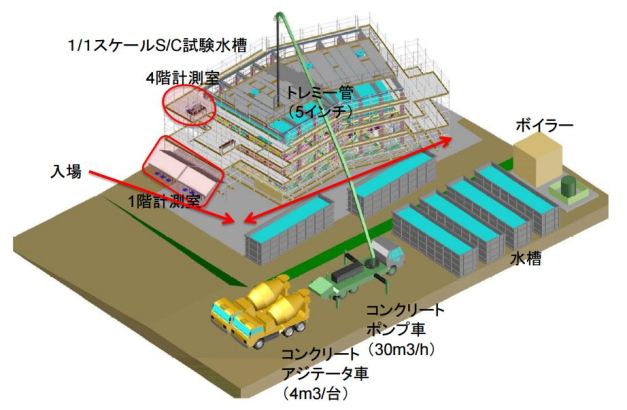
IRID announced the details of the ongoing research for repairing the unit 2 suppression chamber.
Based on their previous investigations IRID has determined that there could be a hole or series of holes of around 50mm in the unit 2 suppression chamber.
The research work is to determine if filling with concrete that structure could work. The proposed plan would use a concrete pump truck with a 5 inch diameter flexible hose to inject concrete into the suppression chamber.
Initial work took place at the Ando Hazama Technical Research Institute (Tsukuba City, Ibaraki Prefecture) on October 15th.
It seems they succeeded in layering the concrete mixture, sinking properly in the bottom of the suppression chamber tube. A 28 day pressure test will be conducted to assure the concrete properly plugs the leak.
Future work may be conducted at the new decommissioning research center at Naraha.
Source IRID :
<添付資料1:1/1スケールS/C試験に関する現場状況・概要図>
http://irid.or.jp/wp-content/uploads/2016/10/20161018_001.pdf
<添付資料2:コンクリート打設進捗に伴う時経列事象・解説図>
http://irid.or.jp/wp-content/uploads/2016/10/20161018_002.pdf
Residents Who Fled Fukushima Meltdown Fear Return to Ghost Town
Japan seeks to lure evacuees back to town near nuclear plant
Abe looks to win support for restarting mothballed reactors
Weed-engulfed buildings and shuttered businesses paint an eerie picture of a coastal Japanese town abandoned after a monstrous earthquake and tsunami triggered meltdowns in the Fukushima nuclear plant.
Namie, one of the communities hardest hit by the 2011 disaster, had 21,000 residents before they fled radiation spewing from the reactors eight kilometers (five miles) away. Prime Minister Shinzo Abe is now looking to repopulate the town as early as next year, a symbolic step toward recovery that might also help soften opposition to his government’s plan to restart Japan’s mostly mothballed nuclear industry.
“The national and local governments are trying to send us back,” said Yasuo Fujita, 64, a sushi chef who lives alongside hundreds of other Fukushima evacuees in a modern high rise in Tokyo more than 200 kilometers away. “We do want to return — we were born and raised there. But can we make a living? Can we live next to the radioactive waste?”

The main street in Namie, Fukushima
So far few evacuees are making plans to go back even as clean-up costs top $30 billion and Abe’s government restores infrastructure. That reluctance mirrors a national skepticism toward nuclear power that threatens to erode the prime minister’s positive approval ratings, particularly in areas with atomic reactors.
Mothballed Reactors
Officials in his government are calling for nuclear power to account for as much as 22 percent of Japan’s electricity supply by 2030, nearly the same percentage as before the Fukushima meltdown, in part to help meet climate goals. Only two of the nation’s 42 operable nuclear plants are currently running, leaving the country even more heavily reliant on imports of oil and gas.
A poll published by the Asahi newspaper this week found 57 percent of respondents were opposed to restarting nuclear reactors, compared with 29 percent in favor. One of Abe’s ministers lost his seat in Fukushima in an upper house election in July, and the government suffered another setback when an anti-nuclear candidate won Sunday’s election for governor of Niigata prefecture, home to the world’s largest nuclear plant.
Some 726 square kilometers — roughly the size of New York City — of Fukushima prefecture remain under evacuation orders, divided by level of radioactivity. While the government is looking to reopen part of Namie next year, most of the town is designated as “difficult to return to” and won’t be ready for people to move back until at least 2022.
“We must make the area attractive, so that people want to return there,” Reconstruction Minister Masahiro Imamura said this week. “I want to do everything I can to make it easy to go back.”

Workers are cleaning by scraping up soil, moss and leaves from contaminated surfaces and sealing them in containers. Still, the operation has skipped most of the prefecture’s hilly areas, leading to fears that rain will simply wash more contamination down into residential zones. Decommissioning of the stricken plant itself is set to take as many as 40 years.
The bill for cleaning up the environment is ballooning, with the government estimating the cost through March 2018 at $3.3 trillion yen ($32 billion). That’s weighing on Tokyo Electric Power Co. Holdings Inc., which is already struggling to avoid default over decommissioning costs.
“They are spending money in the name of returning things to how they were” without having had a proper debate on whether this is actually possible, said Yutaka Okada, senior researcher at Mizuho Research Institute in Tokyo. “Was it really right to spend this enormous amount of money?”
Namie officials, operating from temporary premises 100 kilometers away in the city of Nihonmatsu, are plowing ahead with preparations. A middle school in the town is scheduled for remodeling to add facilities for elementary pupils — even though they expect only about 20 children to attend. Similar efforts in nearby communities have had limited success.
Only 18 percent of former Namie residents surveyed by the government last year said they wanted to return, compared with 48 percent who did not. The remainder were undecided.
Staying Put
Fujita, the sushi chef, has joined the ranks of those starting afresh elsewhere. He opened a seafood restaurant near his temporary home last year, and is buying an apartment in the area. In a sign the move will be permanent, he even plans to squeeze the Buddhist altar commemorating his Fukushima ancestors into his Tokyo home.

For those that do return, finding work will be a headache in a town that was heavily dependent on the plant for jobs and money.
Haruka Hoshi, 27, was working inside the nuclear facility when the earthquake struck, and she fled with just her handbag. Months later she married another former employee at the plant, and they built a house down the coast in the city of Iwaki, where they live with their three-year-old son. They have no plans to return.
“It would be difficult to recreate the life we had before,” she said. “The government wants to show it’s achieved something, to say: ‘Fukushima’s all right, there was a terrible incident, but people are able to return after five years.’ That goal doesn’t correspond with the reality.”
LDP may lose next election if nuclear exit becomes main issue: ex-PM
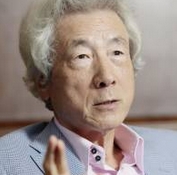
Former Prime Minister Junichiro Koizumi said the pro-nuclear ruling party of Prime Minister Shinzo Abe could lose the next Lower House election if nuclear power becomes the main election issue.
Citing recent gubernatorial election wins for candidates concerned about restarting nuclear power plants in Niigata and Kagoshima prefectures, Koizumi said during a recent interview with Kyodo News, “(Anti-nuclear) opinions are beginning to grow . . . that could influence the (next) House of Representatives election.”
If opposition parties unite in fielding anti-nuclear candidates and make complete phase-out of the country’s nuclear plants one of the top election issues, they can defeat the ruling Liberal Democratic Party by tapping into voter fears following the 20111 Fukushima meltdowns, Koizumi said.
The current term of Lower House lawmakers expires in December 2018, but some senior LDP officials have said Abe might dissolve the house for an election early next year.
Koizumi, who promoted nuclear power generation as prime minister between 2001 and 2006, has become an active anti-nuclear campaigner. He has repeatedly criticized Abe and the way his government is dealing with the aftermath of the Fukushima nuclear disaster.
“There is no way that a party which ignores the will of the public can maintain its hold on power,” said Koizumi, who retired from politics in 2009.
Koizumi also said that the main opposition Democratic Party “has not realized that the nuclear issue can be the biggest election issue.”
“The slogans by promoters of nuclear power that (nuclear power) is safe, low-cost and clean, are all lies,” Koizumi said.
He noted that the government would be forced to pour more funds into Tokyo Electric Power Company Holdings Inc., operator of the Fukushima Daiichi nuclear power plant crippled following the 2011 quake-tsunami disaster, to decontamination costs at the plant and compensation.
The government should give up its nuclear-fuel recycling policy, including the use of the Monju fast-breeder reactor, Koizumi said. The government has not decided on the fate of the trouble-prone reactor, which was intended to play a key role in the recycling policy.
On Abe’s drive to revise the war-renouncing Article 9 of the Constitution, Koizumi said it will not be possible due to a lack of sufficient public support.
Koizumi said a breakthrough on the decades-old territorial dispute over a group of Russian-held islands off Hokkaido will also be difficult as Russia will not accept Japan’s ownership of the islands.
Abe hopes to make progress on the issue, which has prevented the two countries from signing a post-World War II peace treaty, when he meets Russian President Vladimir Putin on Dec. 15 in Japan.
Kansai Electric manager’s suicide result of excess overtime
A manager working on technology for the Takahama nuclear power plant killed himself after working excessive overtime hours, sources have revealed.
The man, in his 40s, was found dead in April in a hotel in Tokyo where he was staying on a business trip.
The suicide of the Kansai Electric Power Co. manager was recognized as a work-related death by the Tsuruga Labor Standards Inspection Office in Tsuruga, Fukui Prefecture, sources said.
It had been a especially hectic time for the Osaka-based utility as two 40-plus-year-old reactors in Takahama, Fukui Prefecture, were at risk of being decommissioned if the safety screening process by the Nuclear Regulation Authority was not completed by July 7.
The company was pushing hard to have the No. 1 and No. 2 reactors at the nuclear power plant pass safety evaluations so that their operational lives could be extended by 20 years.
The dead man was the head of a department in charge of engineering regarding construction at the company, according to the sources.
He was tasked with responding to the NRA as he was responsible for having the construction plans on upgrading the two reactors approved by the nuclear watchdog.
Under the Labor Standards Law, work hours are not restricted for supervisors and managers such as the suicide victim. However, employers still have a responsibility to maintain the health of such employees by ensuring they avoid overwork.
Study: Possible water problem at storage sites in Fukushima
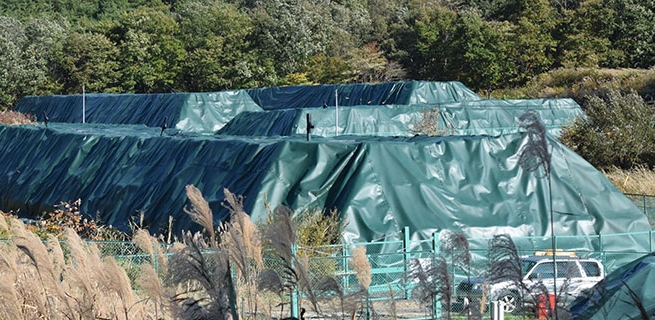
It might be difficult to measure radiation levels in water at this temporary storage site for contaminated soil in Fukushima Prefecture.
Bags of radiation-contaminated soil could be sinking into the ground at temporary storage sites in Fukushima Prefecture, allowing water to accumulate within instead of flowing to outside tanks for testing, the Board of Audit said.
No confirmation has been made that the ground at the sites is actually sinking or if contaminated water has pooled inside. But Board of Audit officials are asking the Environment Ministry to consider additional safety measures if signs indicate that this is actually occurring.
The board’s study focused on 34 of the 106 temporary storage sites that the Environment Ministry set up for soil removed through decontamination work after the disaster in March 2011 unfolded at the Fukushima No. 1 nuclear power plant.
Construction of the storage sites started in 2012, and the transfer of contaminated soil to these facilities was completed in 2015.
The temporary storage sites were designed to have a slight mound on the ground in the center to allow water from the bags to flow down into surrounding collection tanks for periodic measurements of radiation levels.
Internal Environment Ministry guidelines called for this setup at storage sites containing bags that are not waterproof.
The Board of Audit studied 34 temporary storage sites where the bags are not waterproof. These bags were piled five deep or higher at those sites.
The study showed that at 31 of the sites, the weight of the bags may have not only flattened the mound in the center, but it also could have created an indent in the ground where the leaking water could accumulate.
If the water does not flow to the tanks, it will be difficult to determine the radiation levels.
The study also noted that the foundations at the sites were soft to begin with and may be unable to support the bags of soil. The sinking phenomenon could worsen as time passes.
The Environment Ministry played down the risk of the water contaminating areas around the storage facilities.
“Even if the ground has sunk, the structure is designed so water does not leak outside the site,” a ministry official said. “Eventually, the water should collect in the tanks. We will make every effort to oversee the sites as well as use waterproof bags as much as possible.”
A total of 4.16 billion yen ($40 million) was spent to construct the 31 temporary storage sites.
The Environment Ministry designed the temporary storage sites under the precondition they would be used for only three years and then removed. For that reason, measures were not taken to strengthen the foundations to prevent the ground from sinking, even if soft farmland was chosen for a site.
The plan is to eventually return the land where the temporary storage sites have been built to its original state and return it to the landowners
However, the Board of Audit’s study adds another concern for residents, many of whom had opposed construction of the temporary storage sites in their neighborhoods.
Toshio Sato, 68, has evacuated to Fukushima city from his home in Iitate village, where four of the possible problem storage sites are located.
“There are some people who want to resume growing rice once they return home,” Sato said. “If water is accumulating, there is the possibility it could unexpectedly overflow into surrounding areas. The concerns just seem to emerge one after another.”
The government plans to lift the evacuation order for a large part of Iitate in March 2017.
Corporate climate risk is all about turning a profit, not fixing the problem #auspol #ClimateChange

Climate change poses a major threat to the future of humanity. Extreme weather, rising seas, ocean acidification and biodiversity collapse will undermine many of the systems on which we depend.
We’ve even seen a recent example of this, with South Australia’s storm and blackout illustrating the vulnerability of our society to extreme weather.
Risk has become a central construct for how businesses should respond to climate change. As Hank Paulson, former Secretary of the US Treasury has argued, “climate change is not only a risk to the environment but it is the single biggest risk that exists to the economy today”.
The G20 is currently investigating how companies are exposed to climate risk, and how they disclose that risk to consumers.
However, instead of dealing with the larger problem of rapid and systemic decarbonisation, most businesses construct climate risk solely through the lens of profitability and market opportunity.
As part…
View original post 819 more words
1 This Month

of the week – Shut Down Drone Warfare!


Tell the Ukrainian Government to Drop Prosecution of Peace Activist Yurii Sheliazhenko

Petition to revoke the licensing of the Near Surface Nuclear Disposal Facility (NSDF) at Chalk River. https://www.ourcommons.ca/petitions/en/Petition/Details?Petition=e-7247
To see nuclear-related stories in greater depth and intensity – go to https://nuclearinformation.wordpress.com
-
Archives
- April 2026 (114)
- March 2026 (251)
- February 2026 (268)
- January 2026 (308)
- December 2025 (358)
- November 2025 (359)
- October 2025 (376)
- September 2025 (257)
- August 2025 (319)
- July 2025 (230)
- June 2025 (348)
- May 2025 (261)
-
Categories
- 1
- 1 NUCLEAR ISSUES
- business and costs
- climate change
- culture and arts
- ENERGY
- environment
- health
- history
- indigenous issues
- Legal
- marketing of nuclear
- media
- opposition to nuclear
- PERSONAL STORIES
- politics
- politics international
- Religion and ethics
- safety
- secrets,lies and civil liberties
- spinbuster
- technology
- Uranium
- wastes
- weapons and war
- Women
- 2 WORLD
- ACTION
- AFRICA
- Atrocities
- AUSTRALIA
- Christina's notes
- Christina's themes
- culture and arts
- Events
- Fuk 2022
- Fuk 2023
- Fukushima 2017
- Fukushima 2018
- fukushima 2019
- Fukushima 2020
- Fukushima 2021
- general
- global warming
- Humour (God we need it)
- Nuclear
- RARE EARTHS
- Reference
- resources – print
- Resources -audiovicual
- Weekly Newsletter
- World
- World Nuclear
- YouTube
-
RSS
Entries RSS
Comments RSS
 nuclear-news