6.4 quake hits Japan southeast of Tokyo

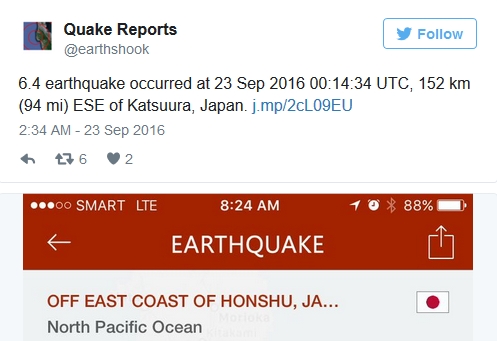

Japan’s Meteorological Agency reported that the earthquake “has caused no damage to Japan,” while adding that “slight sea-level changes in coastal regions” may be observed.
No immediate tsunami warning has been issued.
Small tremors were reportedly felt in nine Japanese prefectures, including in Fukushima and Tokyo.
Japan is located in a seismically active region at the juncture of three major tectonic plates: North American, Pacific and Philippine Sea.
https://www.rt.com/news/360331-tokyo-southeast-quake-reaction/#.V-R_nRi_Fis.facebook
http://www.jma.go.jp/en/quake/20160921012819495-210122.html
http://www.jma.go.jp/en/quake/20160923092111495-230914.html
A whole lot of shallow quakes in the trench
http://www.japanquakemap.com/week
Radioactivity Measuring From Hirono to Okuma, Fukushima Prefecture
As a result of the measurement of radioactivity from the town of Hirono to the town of Okuma.
Measurements and vido from Tarachine Medical Center, a citizen organized radiation measuring center located in Iwaki city, Fukushima Prefecture.
Credit to tarachine Medical Center
Radiocontamination of Tokyo
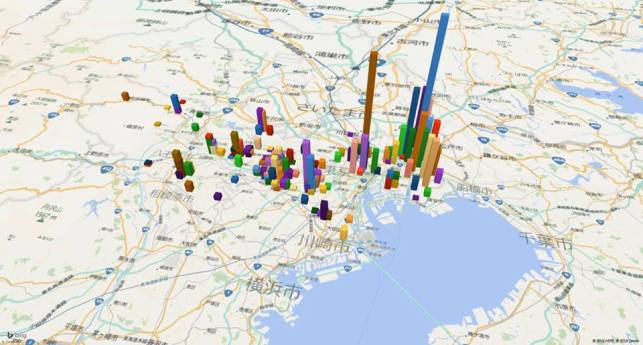
Based on the data released by everyone to the Minna-san data website, a map of the soil contamination of Tokyo by radioactivity was put together.
This data is the result of measurements from 2013 to now 2016.
You can see that the radioactive contamination spread over a wide range of Tokyo.
Particularly, Katsushika district, Edogawa district, Shinjuku district, Setagaya district and Bunkyō district.
Radioactive contamination of both radioactive cesium 134 and 137 exceeding 500Bq / kg has been confirmed.
Among other locations: Inagi city/ Katsushi district / Edogawa district / Eto district / Arakawa district / Kokubunji city / Kokuritsu City / Komae City / Mitaka City / Kodaira city/ Shinjuku district / Suginami district/ Setagaya district / Nishitama gun / Ome city / Chiyoda district / Ota District/ Oshima-cho / Machida city / Chofu city / Higashi Kurume City / Higashimurayama city / Hachioji city / Fuchu city / Musashino City / Fukuo city/ Bunkyo district / Toshima district/ Kita district / Tachikawa city.
Read more at: (in Japanese)
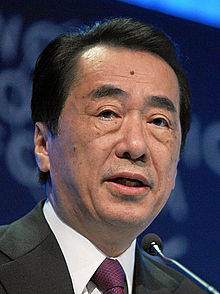
Reassessing the 3.11 Disaster and the Future of Nuclear Power in Japan: An Interview with Former Prime Minister Kan Naoto
Interview by Vincenzo Capodici, Introduction by Shaun Burnie, Translation by Richard Minear
Introduction
For more than two decades, the global nuclear industry has attempted to frame the debate on nuclear power within the context of climate change: nuclear power is better than any of the alternatives. So the argument went. Ambitious nuclear expansion plans inthe United States and Japan, two of the largest existing markets, and the growth of nuclear power in China appeared to show—superficially at least—that the technology had a future. At least in terms of political rhetoric and media perception, it appeared to be a winning argument. Then came March 11, 2011. Those most determined to promote nuclear power even cited the Fukushima Daiichi accident as a reason for expanding nuclear power: impacts were low, no one died, radiation levels are not a risk. So claimeda handful of commentators in the international (particularly English-language) media.
However,from the start of the accident at Fukushima Daiichi on March 11 2011,the harsh reality of nuclear power was exposed to billions of people across the planet, and in particular to the population of Japan, including the more than 160,000 people displaced by the disaster, many of whom are still unable to return to their homes, and scores of millions more threatened had worst case scenarios occurred. One authoritative voice that has been central to exposing the myth-making of the nuclear industry and its supporters has been that of KanNaoto, Prime Minister in 2011. His conversion from promoter to stern critic may be simple to understand, but it is no less commendable for its bravery. When the survival of half the society you are elected to serve and protect is threatened by a technology that is essentially an expensive way to boil water, then something is clearly wrong. Japan avoided societal destruction thanks in large part to the dedication of workers at the crippled nuclear plant, but also to the intervention of Kan and his staff, and to luck. Had it not been for a leaking pipe into the cooling pool of Unit 4 that maintained sufficient water levels, the highly irradiated spent fuel in the pool, including the entire core only recently removed from the reactor core, would have been exposed, releasing an amount of radioactivity far in excess of that released from the other three reactors. The cascade of subsequent events would have meant total loss of control of the other reactors, including their spent fuel pools and requiring massive evacuation extending throughout metropolitan Tokyo, as Prime Minister Kan feared. That three former Prime Ministers of Japan are not just opposed to nuclear power but actively campaigning against it is unprecedented in global politics and is evidence of the scale of the threat that Fukushima posed to tens of millions ofJapanese.
The reality is thatin terms of electricity share and relative to renewable energy,nuclear power has been in decline globally for two decades.Since the FukushimaDaiichiaccident, this decline has only increased in pace. The nuclear industry knew full well that nuclear power could not be scaled up to the level required to make a serious impact on global emissions. But that was never the point. The industry adopted the climate-change argument as a survival strategy: to ensure extending the life of existing aging reactors and make possible the addition of some new nuclear capacity in the coming decades—sufficient at least to allow a core nuclear industrial infrastructure to survive to mid-century.The dream was to survive to mid-century, when limitless energy would be realized by the deployment of commercial plutonium fast-breeder reactors and other generation IV designs. It was always a myth, but it had a commercial and strategic rationale for the power companies, nuclear suppliers and their political allies.
The basis for the Fukushima Daiichi accident began long before March 11th 2011, when decisions were made to build and operate reactors in a nation almost uniquely vulnerable to major seismic events. More than five years on, the accident continues with a legacy that will stretch over the decades. Preventing the next catastrophic accident in Japan is now a passion of the former Prime Minister, joining as he has the majority of the people of Japan determined to transition to a society based on renewable energy. He is surely correct that the end of nuclear power in Japan is possible. The utilities remain in crisis, with only three reactors operating, and legal challenges have been launched across the nation. No matter what policy the government chooses, the basis for Japan’s entire nuclear fuel cycle policy, which is based on plutonium separation at Rokkasho-mura and its use in the Monju reactor and its fantasy successor reactors, is in a worse state than ever before. But as KanNaotoknows better than most, this is an industry entrenched within the establishment and still wields enormous influence. Its end is not guaranteed. Determination and dedication will be needed to defeat it. Fortunately, the Japanese people have these in abundance. SB
The Interview
Q: What is your central message?
Kan: Up until the accident at the Fukushima reactor, I too was confident that since Japanese technology is of high quality, no Chernobyl-like event was possible.
But in fact when I came face to face with Fukushima, I learned I was completely mistaken. I learned first and foremost that we stood on the brink of disaster: had the incident spread only slightly, half the territory of Japan, half the area of metropolitan Tokyo would have been irradiated and 50,000,000 people would have had to evacuate.
Half one’s country would be irradiated, nearly half of the population would have to flee: to the extent it’s conceivable, only defeat in major war is comparable.
That the risk was so enormous: that is what in the first place I want all of you, all the Japanese, all the world’s people to realize.
Q: You yourself are a physicist, yet you don’t believe in the first analysis that people can handle nuclear power? Don’t you believe that there are technical advances and that in the end it will be safe to use?
Kan: As a rule, all technologies involve risk. For example, automobiles have accidents; airplanes, too. But the scale of the risk if an accident happens affects the question whether or not to use that technology. You compare the plus of using it and on the other hand the minus of not using it. We learned that with nuclear reactors, the Fukushima nuclear reactors, the risk was such that 50,000,000 people nearly had to evacuate. Moreover, if we had not used nuclear reactors—in fact, after the incident, there was a period of about two years when we didn’t use nuclear power and there was no great impact on the public welfare, nor any economic impact either. So when you take these factors as a whole into account, in a broad sense there is no plus to using nuclear power. That is my judgment.
One more thing. In the matter of the difference between nuclear power and other technologies, controlling the radiation is in the final analysis extremely difficult.
For example, plutonium emits radiation for a long time. Its half-life is 24,000 years, so because nuclear waste contains plutonium—in its disposal, even if you let it sit and don’t use it—its half-life is 24,000 years, in effect forever. So it’s a very difficult technology to use—an additional point I want to make.
Q: It figured a bit ago in the lecture by Professor Prasser, that in third-generation reactors, risk can be avoided. What is your response?
Kan: It’s as Professor Khwostowa said: we’ve said that even with many nuclear reactors, an event inside a reactor like the Fukushima nuclear accident or a Chernobyl-sized event would occur only once in a million years; but in fact, in the past sixty years, we’ve had Three Mile Island, Chernobyl, Fukushima. Professor Prasser says it’s getting gradually safer, but in fact accidents have happened with greater frequency and on a larger scale than was foreseen. So partial improvements are possible, as Professor Prasser says, but saying that doesn’t mean that accidents won’t happen. Equipment causes accidents, but so do humans.
Q: Today it’s five years after Fukushima. What is the situation in Japan today? We hear that there are plans beginning in 2018 to return the refugees to their homes. To what extent is the clean-up complete?
Kan: Let me describe conditions on site at Fukushima. Reactors #1, #2, #3 melted down, and the melted nuclear fuel still sits in the containment vessel; every day they introduce water to cool it. Radioactivity in the vessel of #2, they say, is 70 sieverts—not microsieverts or millisieverts, 70 sieverts. If humans approach a site that is radiating 70 sieverts, they die within five minutes. That situation has held ever since: that’s the current situation.
Moreover, the water they introduce leaves the containment vessel and is said to be recirculated, but in fact it mixes with groundwater, and some flows into the ocean. Prime Minister Abe used the words “under control,” but Japanese experts, including me, consider it not under control if part is flowing into the ocean. All the experts see it this way.
As for the area outside the site, more than 100,000 people have fled the Fukushima area.
So now the government is pushing residential decontamination and beyond that the decontamination of agricultural land.
Even if you decontaminate the soil, it’s only a temporary or partial reduction in radioactivity; in very many cases cesium comes down from the mountains, it returns.
The Fukushima prefectural government and the government say that certain of the areas where decontamination has been completed are habitable, so people have until 2018 to return; moreover, beyond that date, they won’t give aid to the people who have fled. But I and others think there’s still danger and that the support should be continued at the same level for people who conclude on their own that it’s still dangerous—that’s what we’re saying.
Given the conditions on site and the conditions of those who have fled, you simply can’t say that the clean-up is complete.
Q: Since the Fukushima accident, you have become a strong advocate of getting rid of nuclear reactors; yet in the end, the Abe regime came to power, and it is going in the opposite direction: three reactors are now in operation. As you see this happening, are you angry?
Kan: Clearly what Prime Minister Abe is trying to do—his nuclear reactor policy or energy policy—is mistaken. I am strongly opposed to current policy.
But are things moving steadily backward? Three reactors are indeed in operation. However, phrase it differently: only three are in operation. Why only three? Most—more than half the people—are still resisting strongly. From now on, if it should come to new nuclear plants, say, or to extending the licenses of existing nuclear plants, popular opposition is extremely strong, so that won’t be at all easy. In that sense, Japan’s situation today is a very harsh opposition—a tug of war—between the Abe government, intent on retrogression, and the people, who are heading toward abolishing nuclear reactors.
Two of Prime Minister Abe’s closest advisors are opposed to his policy on nuclear power.
One is his wife. The other is former Prime Minister Koizumi, who promoted him.
Q: Last question: please talk about the possibility that within ten years Japan will do away with nuclear power.
Kan: In the long run, it will disappear gradually. But if you ask whether it will disappear in the next ten years, I can’t say. For example, even in my own party opinion is divided; some hope to do away with it in the 2030s. So I can’t say whether it will disappear completely in the next ten years, but taking the long view, it will surely be gone, for example, by the year 2050 or 2070. The most important reason is economic. It has become clear that compared with other forms of energy, the cost of nuclear energy is high.
Q: Thank you.
TEPCO: Groundwater Surfaced and Possibly Leaked at Fukushima Plant During Typhoon
Fukushima Daiichi Floods, Show Lack of Preparedness
News reports indicated that groundwater at Fukushima Daiichi had risen so high it broke the surface and flowed into the port as a recent typhoon passed through the area. As TEPCO prepared to close the steel sea wall and freeze the underground frozen wall, NRA stopped the process for a review of the potential for flooding within the reactor building area.
The conclusion was that TEPCO thought they could sufficiently remove excess groundwater with the sump pump subdrain system near the reactor buildings. There were also concerns of the groundwater dropping too low, allowing contaminated water to flow out of the reactor building basements.
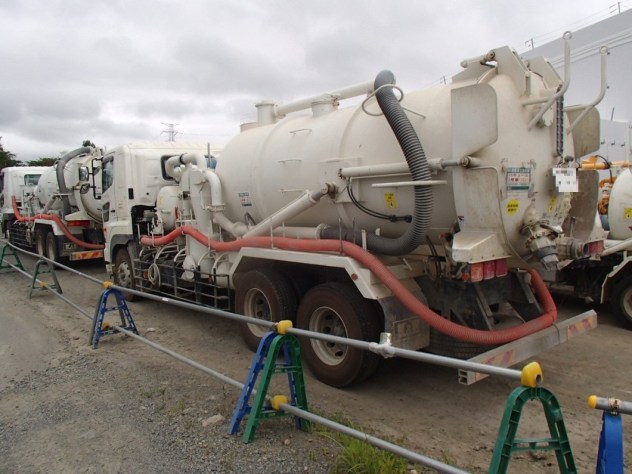
With all this review, nobody conceived a need for more water removal capacity. TEPCO ended up employing some sort of makeshift pumps and also using septic tank trucks to pump up water. This lack of anywhere for rainwater to go may have contributed to the water flowing out into the port as it built up on the surface.
Without some major changes at Daiichi this problem of groundwater rising to the surface and flowing into the port or the sea will continue to happen when significant rainfall takes place.
http://www.fukuleaks.org/web/?p=15765
Typhoon rain raises tainted Fukushima plant groundwater to surface
Heavy rain brought by Typhoon Malakas caused contaminated groundwater to rise to ground level at the radiation-hit Fukushima No. 1 nuclear plant Tuesday night, raising fears of tainted water flooding out to the plant’s port area, its operator said.
Tokyo Electric Power Company Holdings Inc. said in a press release that plant workers are doing their utmost to pump up tainted groundwater at the Fukushima compound, while trying to measure the level of radioactive substances contained in the water.
Under normal circumstances, groundwater taken from wells around the damaged reactor buildings at the Fukushima plant is filtered and stored in numerous tanks built on the compound.
Shortly before 10 p.m. Tuesday, groundwater reached the surface level at an observation well near the seawall at the power plant’s port, and at 11:30 p.m. Tuesday, groundwater stood at 3 cm above the surface level, Tepco said.
The well has a far higher wall and the ground around it is paved, the company said, playing down the possibility that any water flowed out of the well.
By 9 a.m. Wednesday, the water level had dropped to 3 cm below the surface.
Meanwhile, some rainwater may have flowed directly into the port before seeping underground, according to the company.
Tepco will continue pumping groundwater around the seawall, located near the damaged No. 1 to No. 4 reactors, and carry out close examinations of water inside the port, the company said.
In order to curb the flow of groundwater into the sea, the company has covered the seawall with water shields and carries out groundwater pumping operations.
Typhoon Malakas itself was downgraded to an extratropical depression at around 9 p.m. Tuesday as it moved along the coast of the Tokai region and swayed toward the Pacific. It was initially forecast to hit the Kanto region in the early hours of Wednesday.
The previous typhoon, Lionrock, earlier this month killed at least 17 people. Before Lionrock, two typhoons had claimed at least two lives in the northeast.
TEPCO: Possible water leak at Fukushima plant during typhoon
Tokyo Electric Power Co. said Sept. 21 it will check for radiation contamination in seawater near its crippled Fukushima nuclear plant after heavy rain from Typhoon No. 16 brought tainted groundwater to the surface.
The water reached the top of wells at the Fukushima No. 1 nuclear power plant, and there is a possibility that some of it spilled into the sea.
“We will analyze the seawater because we cannot determine whether groundwater containing radioactive materials has actually leaked,” a TEPCO official said.
The official added that the company believes most of the water that may have poured into the sea was rainwater that had not seeped into the ground.
The utility constantly monitors groundwater levels in wells around the reactor buildings at the plant to prevent overflows.
TEPCO said groundwater in wells on the seaside area of the nuclear complex reached the surface around 10 p.m. on Sept. 20 amid the heavy rain brought by the approaching typhoon. The water kept rising despite workers’ efforts to lower the level using makeshift pumps and septic tank trucks.
The groundwater level remained the same as of 7 a.m. on Sept. 21 before it finally dropped to about 3 centimeters from the surface two hours later, the company said.
According to TEPCO, about 575 millimeters of rain fell in the area of the nuclear plant from Aug. 1 to Sept. 20.
http://www.asahi.com/ajw/articles/AJ201609210047.html
Public to get new $83-billion bill for Fukushima, reactor expenses
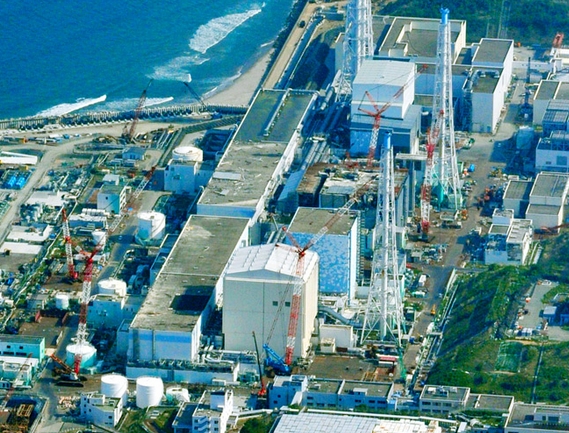
The crippled Fukushima No. 1 nuclear power plant is located in the towns of Okuma and Futaba in Fukushima Prefecture.
The government plans to make the public pay an additional 8.3 trillion yen (about $83 billion) to decommission reactors at the crippled Fukushima nuclear plant and provide compensation for evacuees of the 2011 disaster, sources said.
The public’s money will also be used for the future decommissioning of reactors at other nuclear plants, they said on Sept. 20.
The burden will also affect families that switched from nuclear power generating utilities to new electric power companies after the liberalization of the electricity retail market for families in April this year.
Major utilities that operate nuclear plants are, in principle, required to secure funds through electricity charges to decommission their reactors. Tokyo Electric Power Co., operator of the stricken Fukushima No. 1 nuclear plant, is no exception.
Under the reforms of the power industry, the new electric power companies, which do not operate nuclear plants, were exempt from shouldering any burden related to nuclear power.
But the industry ministry wants to change that arrangement.
Even people in the ruling coalition and the government are criticizing the plan as an attempt to ease the burden of utilities that had long held regional monopolies.
“The plan will damage the basic idea of the reforms,” said Taro Kono, former chairman of the National Public Safety Commission and a lawmaker of the ruling Liberal Democratic Party.
To realize the plan, the Ministry of Economy, Trade and Industry aims to submit revisions to the Electricity Business Law to the next year’s ordinary Diet session.
A government-approved organization is procuring funds from major electric power companies to assist in the eventual decommissioning of the reactors at the Fukushima No. 1 plant.
However, TEPCO has asked the government for additional support because more money will be needed for the lengthy operation.
The costs to decommission the reactors at the Fukushima plant are expected to soar to 6 trillion yen from the current estimate of 2 trillion yen, according to in-house documents of the industry ministry.
The ministry also needs an additional 3 trillion yen to cover compensation payments for evacuees from the 2011 nuclear disaster and 1.3 trillion yen to decommission reactors of other nuclear plants in the future, according to the documents.
To get the new electric power companies to pay part of the 8.3 trillion yen, the ministry plans to increase power grid “usage fees,” which are paid to major electric power companies.
“It is necessary to collect costs from all of the people fairly,” said a high-ranking official of the ministry.
Some of the consumers switched to new electric power companies because they did not want to continue using electricity produced by nuclear power plants.
But the ministry official pointed out that those consumers had been using nuclear-generated electricity until March.
New electric power companies, which do not have their own power grids, have concluded contracts with only 2 percent of all households in Japan.
The ministry is concerned that if more families switch from nuclear plant operators to the new companies, it could become difficult to secure sufficient funds to cover reactor decommissioning costs.
Under the ministry’s plan, a standard family of three in areas covered by TEPCO will be required to pay an additional 180 yen every month. In areas covered by other major electric power companies, the corresponding figure will be about 60 yen.
Japan to scrap troubled ¥1 trillion Monju fast-breeder reactor

The Monju plant in Tsuruga, Fukui Prefecture, is seen in this file photo from January. Its scrapping will leave a massive plutonium stockpile that cannot be reduced quickly
The government decided to cut its losses Wednesday on the ¥1 trillion Monju fast-breeder reactor, pulling the plug on the project after years of mishaps, cover-ups and waste.
At an extraordinary meeting, the Cabinet decided to decommission the idle facility in Fukui Prefecture but reaffirmed a national commitment to obtaining a nuclear fuel cycle.
At the end of the Cabinet meeting, Chief Cabinet Secretary Yoshihide Suga said the government will set up an expert panel on fast-breeder reactor issues that will “carry out an overall revision of the Monju project, including its decommissioning” by the end of this year.
Fast-breeder reactors like Monju are designed to produce more plutonium than they consume. The government has long envisioned them as playing a role in the nation’s nuclear profile.
During the same meeting, the government also pledged to draw up a road map of developing “demonstration fast reactors” by the end of the year.
A demonstration reactor is more advanced than a prototype reactor like Monju. Specifically, Japan is considering participating in France’s project to develop a fast-breeder reactor of the demonstration type, documents submitted to the meeting by industry minister Hiroshige Seko showed.
But given the record of Monju’s serious accidents and mismanagement scandals, Seko’s pledge to go to the next development stage — with little public explanation on the failure of the Monju project itself — is likely to draw strong criticism from the public.
Monju dates back to 1980, when work began amid the realization of a need to reduce reliance on fossil fuel. Almost all oil, coal and gas burned in Japan is imported.
Monju not only absorbed fistfuls of taxpayer money, but also suffered repeated accidents and mismanagement while only going live for a few months during its three-decade existence.
The Monju reactor reached criticality for the first time in 1994 but was forced to shut down in December 1995 after a leak of sodium coolant and fire. There was a subsequent attempt at a cover-up.
In November 2012, it emerged that the operator, Japan Atomic Energy Agency, had failed to check as many as 10,000 of Monju’s components, as safety rules require.
In November last year, the Nuclear Regulation Authority declared that the government-affiliated JAEA was “not qualified as an entity to safely operate” Monju.
It told the government either to find an alternative operator or scrap the project. The government was unable to find new management.
On Wednesday after the Cabinet meeting, education minister Hirokazu Matsuno said investments of another ¥500 billion would be needed if the Monju reactor were to be maintained.
“And it is also true we have yet to find an (alternative) entity to run Monju,” he noted.
Later the same day during a briefing for reporters, government bureaucrats emphasized that the government has yet to draw any conclusion on the fate of the Monju reactor.
But the comments of Suga and Matsuno were widely interpreted as signaling that the Cabinet is willing to eventually mothball the Monju reactor.
Meanwhile, decommissioning Monju will raise international concerns over Japan’s massive plutonium stockpile, extracted from spent fuel at the nation’s dozens of conventional nuclear power plants.
The stockpile is estimated at 48 tons of plutonium, enough to produce thousands of atomic bombs.
With no way to consume plutonium directly, the government plans to continue using MOX fuels — a mix of plutonium and uranium — in conventional nuclear reactors.
But most commercial reactors remain idle in the wake of the 2011 Fukushima nuclear crisis, and for now the rate of consumption will be slow. The No. 3 reactor of the Ikata nuclear power plant in Ehime Prefecture is currently the sole active unit that uses MOX fuel.
The Cabinet of Prime Minister Shinzo Abe hopes to reactivate more reactors once the NRA completes its safety checks.
Meanwhile, the matter remains a divisive one between government ministries.
The education and science ministry, which oversees the Monju project, reportedly opposes scrapping the reactor, arguing its importance in setting up a nuclear fuel cycle and tackling the plutonium oversupply.
But the Ministry of Economy, Trade and Industry, which oversees national nuclear policy, reportedly backs Monju’s scrapping as officials fear its tainted reputation could fuel opposition to nuclear power.
At the same time, METI wants to keep the fuel cycle policy afloat. It has reportedly argued for Japan’s participation in France’s ASTRID project to develop a demonstration fast-breeder reactor. ASTRID, or Advanced Sodium Technological Reactor for Industrial Demonstration, will use more advanced technologies than those on which Monju was based. But the project is still in the designing phase, which will continue at least until the end of 2019.
Sodium coolant used for fast-breeder reactors can catch fire easily and is very difficult to handle, which is why no countries have developed such a reactor yet.
Nuclear power in no way a cure for climate change: in fact it’s a CAUSE of climate change
How Nuclear Power Causes Global Warming, The Progressive, September 21, 2016 Harvey Wasserman
Supporters of nuclear power like to argue that nukes are the key to combatting climate change. Here’s why they are dead wrong.
 Every nuclear generating station spews about two-thirds of the energy it burns inside its reactor core into the environment. Only one-third is converted into electricity. Another tenth of that is lost in transmission. According to the Union of Concerned Scientists:
Nuclear fission is the most water intensive method of the principal thermoelectric generation options in terms of the amount of water withdrawn from sources. In 2008, nuclear power plants withdrew eight times as much freshwater as natural gas plants per unit of energy produced, and up to 11 percent more than the average coal plant.
Every day, large reactors like the two at Diablo Canyon, California, individually dump about 1.25 billion gallons of water into the ocean at temperatures up to 20 degrees Fahrenheit warmer than the natural environment.
Diablo’s “once-through cooling system” takes water out of the ocean and dumps it back superheated, irradiated and laden with toxic chemicals. Many U.S. reactors use cooling towers which emit huge quantities of steam and water vapor that also directly warm the atmosphere.
These emissions are often chemically treated to prevent algae and other growth that could clog the towers. Those chemicals can then be carried downwind, along with radiation from the reactors. In addition, hundreds of thousands of birds die annually by flying into the reactor domes and towers.
The Union of Concerned Scientists states:
The temperature increase in the bodies of water can have serious adverse effects on aquatic life. Warm water holds less oxygen than cold water, thus discharge from once-through cooling systems can create a “temperature squeeze” that elevates the metabolic rate for fish. Additionally, suction pipes that are used to intake water can draw plankton, eggs and larvae into the plant’s machinery, while larger organisms can be trapped against the protective screens of the pipes. Blocked intake screens have led to temporary shut downs and NRC fines at a number of plants.
And that’s not all.
All nuclear reactors emit Carbon 14, a radioactive isotope, invalidating the industry’s claim that reactors are “carbon free.” And the fuel that reactors burn is carbon-intensive. Themining, milling, and enrichment processes needed to produce the pellets that fill the fuel rods inside the reactor cores all involve major energy expenditures, nearly all of it based on coal, oil, or gas.
And of course there’s the problem of nuclear waste. After more than a half-century of well-funded attempts, we’ve seen no solution for the management of atomic power’s intensely radioactive waste. There’s the “low-level” waste involving enormous quantities of troublesome irradiated liquids and solid trash that must be dealt with outside the standard civilian waste stream. And that handling involves fossil fuels burned in the process of transportation, management, and disposal as well ………
There are no credible estimates of the global warming damage done by the intensely hotexplosions at the four Fukushima reactors, or at Chernobyl, or at any other past and future reactor meltdowns or blowups. …..
Overall, the idea that atomic power is “clean” or “carbon free” or “emission free” is a very expensive misconception, especially when compared to renewable energy, efficiency, and conservation. Among conservation, efficiency, solar and wind power technologies, there are no global warming analogs to the heat, carbon, and radioactive waste impacts of nuclear power. No green technology kills anywhere near the number of marine organisms that die through reactor cooling systems.
Rooftop solar panels do not lose ten percent of the power they generate to transmission, as happens with virtually all centralized power generators. S. David Freeman, former head of numerous large utilities and author of All Electric America: A Climate Solution and the Hopeful Future, says: “Renewables are cheaper and safer. That argument is winning. Let’s stick to it.”
No terrorist will ever threaten one of our cities by blowing up a solar panel. But the nuclear industry that falsely claims its dying technology doesn’t cause global warming does threaten the future of our planet.
Harvey Wasserman wrote SOLARTOPIA! OUR GREEN-POWERED EARTH. He editsnukefree.org. You can find his GREEN POWER & WELLNESS SHOW at www.prn.fm
BBC and Science Media Centre (SMC UK) are pro nuclear spruikers
the BBC Science team’s involvement in a shocking display of bad science during the commemorations of the 2011 disaster in 2016 March this year. Even though there was outrage in the scientific community at the Fukushima video, it was some months before the BBC quietly took down the video.
the public that saw the biased Fukushima video were unaware of the wrong and dangerous information that was given.
 There are many other articles out there that show the BBC defending Geraldine Thomas (BBC Expert) after the complaints came in and rebuffs for that on fissionline magazine and this was also added pressure that forced the BBC to take the Fukushima video down. (Ed note: Geraldine Thomas is currently in Australia, extolling the benefits of the nuclear industry, and downplaying the health effects of ionising radiation) )
Sellafield – Contempt of Parliament – BBC News missed 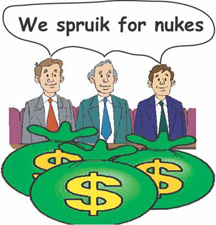 it. https://europeannewsweekly.wordpress.com/2016/09/19/sellafield-contempt-of-parliament-bbc-news-missed-it/by arclight2011part2 The nuclear industry supported press, in rebuffing the BBC Panorama teams claims of safety issues and lies to Parliament, we see some counters to the safety concerns but no response to the well documented evidence of the head of the Sellafield consortium lying to the Parliamentary committee and covering up the grave incident of plutonium release (and its cost) in November 2014.
Tony Price lies to Parliament (from Panorama Documentary) [on original]
The Spokesperson for Sellafield can be seen on the video acting a bit surprised at the questioning and revelations the Panorama reporter revealed. He just denied that any “spin” (ie lies) were said during the Parliamentary committee and that is the last word we have on this explosive revelation of criminality from the nuclear industry.
It is most surprising that the BBC News office did not pick this up as we see on the BBC web site they are fully aware of the issue of contempt of parliamentary procedure;
“….Examples of contempt include giving false evidence to a parliamentary committee, ….The Commons has the power to order anyone who has committed a contempt of Parliament to appear at the Bar of the House and to punish the offender…..”2008 BBC
Since that report was uncovered, the nuclear industry and their PR and government connections have swayed the public and eased their fears. The BBC and Science Media Centre (SMC UK) (Also called Sense About Science) was crucial to doing this and at the same time minimising the environmental and health impacts of the 2011 Fukushima disaster that had caused a huge drop in investor interest in nuclear projects.
So in the last 5 years the BBC has produced many supportive documentaries and educational materials favouring nuclear energy (Since the SMC UK started to receive large corporate funding) . In fact at the end of last year, the BBC science department was involved with promoting Sellafield and largely ignoring the many problems that existed there.
That was followed up by the BBC Science teams involvement in a shocking display of bad science during the commemorations of the 2011 disaster in 2016 March this year. Even though there was outrage in the scientific community at the Fukushima video, it was some months before the BBC quietly took down the video. Thereby, much of the public that saw the biased Fukushima video were unaware of the wrong and dangerous information that was given. Then just a couple of months ago a high profile visit to Sellafield by dignitaries was to underline the improvements and give Sellafield the all clear. Still other experts tried to combat the BBC and SMC UK PR management of all media regarding nuclear;
“The Ecologist, 12th August 2015 Dr David Lowry
Professor ‘Jim’ Al’Khalili’s ‘Inside Sellafield’ programme was a tour de force of pro-nuclear propaganda, writes David Lowry – understating the severity of accidents, concealing the role of the UK’s nuclear power stations in breeding military plutonium, and giving false reassurance over the unsolved problems of high level nuclear waste…”
The main thing for the BBC, government and nuclear industry was that the nuclear industry was still being perceived as above board and transparent. We saw a similar maneuver after the release of the Panorama Documentary on its You Tube site (Under BBC management orders?). The video was removed after just a few hours of being uploaded and after the link had been shared to an international social media audience. The video was put back up sometime later but after the interest had passed.
Although the media has largely ignored this story many experts have been commenting on the situation in Sellafield and there is a lot of well sourced data that bears the whistleblowers observations and claims (See source links below) . But it is the criminal manipulation of politicians during the Parliamentary committee process that demands our immediate attention. It undermines our Democracy.
Whilst discussing the issue of coverage, by the BBC, of the nuclear industry (with the exception of the excellent undercover investigative abilities of the BBC Panorama team) , I asked an experienced Science Media journalist and Author on how he viewed the BBC`s general coverage of nuclear matters over recent years and he had this to say;
“The BBC is guilty of a journalistic disgrace.” Karl Grossman, Professor of Journalism, State University of New York/College at Old Westbury, USA. [11th September 2016]
Meanwhile in the UK Paul Dorfman (Energy analyst spokesman for main stream UK media) said to me;
”Recent events reveal the ongoing national disgrace that is Sellafield, including the truly appalling state of the historic spent fuel ponds’….”
And Paul Dorfman was able to qualify his point through the excellent investigative work of the Panorama team. [11th September 2016]
In France an Energy systems engineer, well versed in La Hague (The French equivalent to Sellafield) and its impacts said this in response to a discussion on the Panorama revelations;
“….those plants, Sellafield and La Hague, would exterminate the whole world population in under 40 years, because there are tons of plutonium in Sellafield and tons in La Hague adding thousand times more than necessary to exterminate all animals through the world. The biggest aberration of history, the timing bomb for the global extinction, a potential aschimothusia .[“sacrifices” committed by force of a state ] …” Xavier Nast 11 September 2016
Marianne Birkby confirmed to me the ongoing “legacy” of dangerous safety practices at Sellafield;
“…The state of the Sellafield ponds is described by the BBC as an “historic legacy” but the “legacy” is ongoing with every reactor that continues to burn nuclear fuel whose waste is sent to Sellafield for reprocessing. . The now infamous photographs of the shocking state of the Sellafield ponds that were given to Radiation Free Lakeland by a brave whistleblower are not “historic.” Those shocking photographs are a graphic illustration of the continuing madness of nuclear power….” Marianne Birkby, Founder of Radiation Free Lakeland 11 September 2016
Sources for this article (Not already linked above)
The BBC Panorama You Tube documentary linkhttps://www.youtube.com/watch?v=JZ1i3HScYak
Dr Lowry http://drdavidlowry.blogspot.ie/2016/09/inside-sellafield-and-military.html?spref=tw
Dr Ian Fairlie response to the Panorama findings and historical summary on Sellafield here http://www.ianfairlie.org/news/bbc-panorama-programme-sellafield/
Critical scientific analysis of the BBC Science departments dangerous and insulting attempts of reporting on Fukushima (And the reason that the BBC had to take down the video, some months later. The comments on this video are enlightening and you can see both pro nuclear and anti nuclear people actually agreeing and making known their complaints to the BBC) – March 2016https://www.youtube.com/watch?v=qrgdAA5oiIA
Note from writer; There are many other articles out there that show the BBC defending Geraldine Thomas (BBC Expert) after the complaints came in and rebuffs for that on fissionline magazine and this was also added pressure that forced the BBC to take the Fukushima video down.. The whole story of BBC bias in Energy matters is too vast to cover here but I leave you with the above Key words and links (for the researcher) . The truth will out!! – Shaun McGee
Area not far from Tokyo hit by 6.4 earthquake

 6.4 quake hits Japan southeast of Tokyo, Rt.com 23 Sep, 2016 A powerful 6.4-magnitude earthquake rocked Japan some 230km southeast of the country’s capital, Tokyo, at a depth of 10km on Thursday night, the US Geological Survey (USGS) reported on its website.
Japan’s Meteorological Agency reported that the earthquake “has caused no damage to Japan,” while adding that “slight sea-level changes in coastal regions” may be observed.
No immediate tsunami warning has been issued.
Small tremors were reportedly felt in nine Japanese prefectures, including in Fukushima and Tokyo……..https://www.rt.com/news/360331-tokyo-southeast-quake-reaction/#.V-R_nRi_Fis.facebook
USA and South Korea to conduct mock attack on nuclear facility, (with North Korea in mind)


 South Korea, US to simulate attack on nuclear facility By Jungeun Kim, Paula Hancocks and Joshua Berlinger, CNN September 21, 2016
Story highlights
- The two countries will simulate attacks on nuclear facilities and sudden missile strikes
- The announcement comes after North Korea conducted a nuclear test this month
High Court in South Africa to hear case against government’s nuclear power plan
 Activists seek to bar plan by South African government to expand nuclear power http://af.reuters.com/article/southAfricaNews/idAFJ8N1BD01Z CAPE TOWN, Sept 22 (Reuters) – Activist groups are challenging a plan by South Africa’s government to expand the country’s nuclear power generation capacity on the grounds that the process was unconstitutional, they said on Thursday.
Earthlife Africa Johannesburg and the Southern African Faith Communities Environment Institute said in a statement that the High Court in Cape Town would hear their case on Dec. 13 and 14 this year to block plans to add 9.6 gigawatts of nuclear power. (Reporting by Wendell Roelf; Editing by James Macharia)
Warning from 375 top scientists of ‘real, serious, immediate’ climate threat
 375 top scientists warn of ‘real, serious, immediate’ climate threat http://www.skepticalscience.com/375-nas-warn-climate-threat.html 21 September 2016 by John Abraham
Yesterday, 375 of the world’s top scientists, including 30 Nobel Prize winners, published an open letter regarding climate change. In the letter, the scientists report that the evidence is clear: humans are causing climate change. We are now observing climate change and its affect across the globe. The seas are rising, the oceans are warming, the lower atmosphere is warming, the land is warming, ice is melting, rainfall patterns are changing and the ocean is becoming more acidic.
These facts are incontrovertible. No reputable scientist disputes them. It is the truth.
Despite these facts, the letter reports that the US presidential campaign has seen claims that the earth isn’t warming, or it is only a natural warming, or that climate changeis a hoax. These claims are false. The claims are made by politicians or real estate developers with no scientific experience. These people who deny the reality of climate change are not scientists.
These claims aren’t new. We see them every election cycle. In fact, for the Republican Party, they are a virtual litmus test for electability. It is terribly sad that the party of Lincoln (the president who initiated the National Academy of Sciences) has been rebuked by the National Academy today. It is sad that the party of Teddy Roosevelt, who created the National Park System, is acting in a way antithetical to his legacy. It is also sad that the party of Nixon, who created the Environmental Protection Agency, now is trying to eliminate that very organization.
What is perhaps most sad is that the party of “fiscal conservatism” is leading us on a path that will result in higher economic and social costs for all of us. What we don’t know is what the future will bring. Will the warming be gradual or sudden? Will ocean rise increase at a faster rate or not? Will we continue to see major ice shelfcollapse? Increased droughts and heat waves? Will we be able to adapt?
A rational decision maker would take action to manage the risks from climate change. This threat is to our health, our communities, and our economies. A changing climate with warming seas and an acidifying ocean will cause real economic losses for our generation and for the future.
In the letter, the scientists venture deeper into politics than scientists are generally willing to tread. They describe the inane Republican platform and the foolish position of the Republican nominee Donald Trump. Basically, Trump wishes to scrap our environmental agreements, which have resulted in reductions to our own emissions as well as very strong agreements to reduce global warming through international agreements.
Despite the excellent work over the past 7 years, we have not seen the increase in energy prices that the denialists claimed would occur. Instead, we’ve seen huge reductions in the cost of wind, solar, and other renewable energy sources.
We were right, they were wrong. We can deliver reliable energy to the USA at a low cost, with less pollution.
We scientists have warned the country and the world about the dangers of climate changefor decades. We are now seeing our predictions come true. There are no longer any reputable scientists who disagree that humans are the major factor changing the climate. Click here to read the rest
Failure of Japan’s 20 year, costly, nuclear reprocessing project
 Costly Japanese prototype nuclear reactor shuts down http://eandt.theiet.org/content/articles/2016/09/costly-japanese-prototype-nuclear-reactor-shuts-down/ By Jack Loughran, September 21, 2016
The Monju nuclear reactor in Japan, which has operated for less than a year in more than two decades at a cost of 1tn yen (£7.6bn), is set to be scrapped. The prototype fast-breeder reactor was designed to burn plutonium from spent fuel at conventional reactors to create more fuel than it consumes.
The process is appealing to a country whose limited resources force it to rely on imports for virtually all its oil and gas needs.
But Tokyo believes it would be difficult to gain public support to spend several hundred billion yen to upgrade the Monju facility, which has been plagued by accidents, missteps and falsification of documents.
There is also a strong anti-nuclear sentiment in Japan in reaction to the 2011 Fukushima atomic disaster, and calls to decommission Monju have been growing in the ruling Liberal Democratic Party, with scant results from using around 20 billion yen of public money a year for maintenance alone.
Science Minister Hirokazu Matsuno, Trade Minister Hiroshige Seko and others had decided to shift policy away from developing Monju, a fast-breeder nuclear reactor in the west of the country, the government said.
They had also agreed to keep the nuclear fuel cycle intact and would set up a committee to decide a policy for future fast-breeder development by the end of the year.
A formal decision to decommission Monju is likely to be made by the end of the year, government officials said.
The decision would have no impact on Japan’s nuclear recycling policy as Tokyo would continue to co-develop a fast-breeder demonstration reactor that has been proposed in France, while research will continue at another experimental fast-breeder reactor, Joyo, which was a predecessor of Monju.
“The move will not have an impact on nuclear fuel balance or nuclear fuel cycle technology development or Japan’s international cooperation,” said Tomoko Murakami, nuclear energy manager at the country’s Institute of Energy Economics.
Before the Fukushima disaster, Japan had planned to build a commercial fast-breeder before 2050, but according to the International Energy Agency that project may be delayed, given the difficulties at Monju.
The fallout from the Fukushima disaster is continuing. Specialised robots have been developed to retrieve some of the radioactive material from the ill-fated plant but they have been repeatedly unable to complete their task because the high levels of radiation destroys their circuitry.
Another secret and dangerous trade deal – the Trade In Services Agreement
 The new TTIP? Meet TISA, the ‘secret privatisation pact that poses a threat to democracy’ http://www.independent.co.uk/news/business/news/ttip-trade-deal-new-what-is-tisa-privatisation-pact-secret-threat-to-democracy-a7216296.html
Government insists ‘public services are under no threat whatsoever from this deal’
- Ian Johnston
- Wednesday 31 August 2016An international trade deal being negotiated in secret is a “turbo-charged privatisation pact” that poses a threat to democratic sovereignty and “the very concept of public services”, campaigners have warned.But this is not TTIP – the international agreement it appears campaigners in the European Union have managed to scupper over similar concerns – this is TISA, a deal backed by some of the world’s biggest corporations, such as Microsoft, Google, IBM, Walt Disney, Walmart, Citigroup and JP Morgan Chase.
Few people may have heard of the Trade In Services Agreement, but campaign group Global Justice Now warns in a new report: “Defeating TTIP may amount to a pyrrhic victory if we allow TISA to pass without challenge.”
Like the Transatlantic Trade and Investment Partnership, TISA is being negotiated in secret, even though it could have a major impact on countries which sign up.
- While TTIP is only between the EU and US, those behind TISA have global ambitions as it involves most of the world’s major economies – with the notable exceptions of China and Russia – in a group they call the “Really Good Friends of Services”.
The Department for International Trade dismissed the idea that public services were at risk from TISA, adding that the UK was committed to securing an “ambitious” deal.
But according to Global Justice Now’s report, the deal could “lock in privatisation of public services”; allow “casino capitalism” by undermining financial regulations designed to prevent a recurrence of the 2008 recession; threaten online privacy; damage efforts to fight climate change; and prevent developing countries from improving public services.
- Nick Dearden, director of group, said: “This deal is a threat to the very concept of public services. It is a turbo-charged privatisation pact, based on the idea that rather than serving the public interest, governments must step out of the way and allow corporations to ‘get on with it’.
“Of particular concern, we fear TISA will include clauses that will prevent governments taking public control of strategic services, and inhibit regulation of the very banks that created the financial crash.”
He suggested pro-Brexit voters should be concerned at the potential loss of sovereignty.
“Many people were persuaded to leave the EU on the grounds they would be ‘taking back control’ of our economic policy,” Mr Dearden said.
“But if we sign up to TISA, our ability to control our economy – to regulate, to protect public services, to fight climate change – is massively reduced. In effect, we would be handing large swathes of policy-making to big business. “
- The report says the widespread opposition to TTIP, a deal between only the EU and US, had not yet been repeated over TISA.
“It is vital for elected representatives, campaigners and ordinary citizens to unite against this threat,” it adds.
“TISA threatens public services. From postal services to the NHS, TISA could lock in privatisation and ensure that big multinationals increasingly call the shots on areas like health, education and basic utilities.”
A so-called “ratchet” clause in the deal means that after a service – like trains or water or energy – is privatised, this is almost impossible to reverse even if it fails.
- According to the report, a “standstill” clause also means “no new regulation can be passed that gives foreign companies worse treatment” than when TISA is passed.
“Taken together, the standstill and ratchet clauses could make it much harder for a future government to renationalise the railways, a move backed by a majority of the British public,” it says.
“Similarly, it could mean that the creeping privatisation of the NHS becomes more and more irreversible with greater involvement of companies from countries like the US. And forget taking control of the electricity system back from the big six energy firms.”
- Migrant workers could be classified as “independent service suppliers”, the report says, meaning they would not be eligible for the minimum wage or be allowed to join a union.
People going to another country may find their visa is tied to their job, so if they were sacked, they would be deported.
“This sort of system of modern indentured labour is wide open to abuse by unscrupulous employers who may get away with illegal practices safe in the knowledge that they can threaten any employee with deportation if they complain,” the report says.
“This sort of system is used in countries like Saudi Arabia, the UAE and Qatar and has resulted in working conditions that have been described as being close to slavery.”
The global economic crash of 2008 was precipitated by the sale of complex financial products linked to unsafe “sub-prime” mortgages. The report says there is a danger the final TISA deal would “undermine efforts to regulate risky financial products” with a proposal that firms should be allowed to offer “any new financial service”.
- “The danger is that TISA will deter governments from limiting the use of such ‘innovative’ financial products and leave us powerless to stop the next financial crisis,” it says.
TISA could also potentially prevent governments from favouring renewable energy over fossil fuels – despite the need to reduce greenhouse gas emissions and the health effects of air pollution.
Private firms would also be allowed to move online data from one country to another under one proposal being considered. While the original country’s privacy laws would have to be respected, the report said it was “not clear how this will be … enforced”.
While developed countries in Europe have established public services that would not be threatened unless a state’s government decided to open them up to private firms, the same is not true of many developing countries. If they signed up to the deal, it could effectively prevent them from setting up public institutions taken for granted in the West.
- The TISA negotiations were held behind closed doors for about 18 months until they were publicly revealed by the global trade union group Public Services International (PSI). Information about some of the proposals has been also disclosed through Wikileaks and similar sites.
Daniel Bertossa, PSI’s director of policy, said: “Anybody who’s interested in maintaining democratic control of national institutions should be very concerned about the Trade in Services Agreement that is being negotiated in secret.
“It will remove large sections of national sovereignty and the ability of any government, including the UK Government, to regulate important service sectors [on issues] such as energy, such as transport, such as privacy. The Trade in Services Agreement is part of a radical project to limit governments’ sovereign right to regulate and freeze it almost in permanence in the interests of foreign corporations.”
According to the European Commission, TISA is about “facilitating trade in services”.
“The EU is the world’s largest exporter of services with tens of millions of jobs throughout Europe in the services sector. Opening up markets for services will mean more growth and jobs,” its website says.
- The Independent has contacted “Team TISA”, a group of mainly American companies in favour of the deal, asking for a comment. On its website, it says: “Services are the fastest growing sector of the global economy and account for two thirds of global output, one third of global employment and nearly 20 per cent of global trade.
“The TISA provides an opportunity to expand services trade among over 50 countries, covering nearly 70 per cent of global trade in services.
“The potential expansion TISA provides will benefit not only global growth, but also US domestic growth.
“As the world’s largest services exporter, with over $1.3 trillion (about £1 trillion) in annual cross-border and foreign-affiliate sales, the US will benefit tremendously from elimination of services barriers.”
A Department for International Trade spokesperson said: “Public services are under no threat whatsoever from this deal or any other trade agreement. The UK remains committed to an ambitious Trade in Services Agreement.”
1 This Month
Chernobyl: The Lost Tapes – A good documentary on Chernobyl on SBS available On Demand for the next 3 weeks– https://www.sbs.com.au/ondemand/tv-program/chernobyl-the-lost-tapes/2352741955560

of the week–London Campaign for Nuclear Disarmament

Tell the Ukrainian Government to Drop Prosecution of Peace Activist Yurii Sheliazhenko
To see nuclear-related stories in greater depth and intensity – go to https://nuclearinformation.wordpress.com
-
Archives
- April 2026 (139)
- March 2026 (251)
- February 2026 (268)
- January 2026 (308)
- December 2025 (358)
- November 2025 (359)
- October 2025 (376)
- September 2025 (257)
- August 2025 (319)
- July 2025 (230)
- June 2025 (348)
- May 2025 (261)
-
Categories
- 1
- 1 NUCLEAR ISSUES
- business and costs
- climate change
- culture and arts
- ENERGY
- environment
- health
- history
- indigenous issues
- Legal
- marketing of nuclear
- media
- opposition to nuclear
- PERSONAL STORIES
- politics
- politics international
- Religion and ethics
- safety
- secrets,lies and civil liberties
- spinbuster
- technology
- Uranium
- wastes
- weapons and war
- Women
- 2 WORLD
- ACTION
- AFRICA
- Atrocities
- AUSTRALIA
- Christina's notes
- Christina's themes
- culture and arts
- Events
- Fuk 2022
- Fuk 2023
- Fukushima 2017
- Fukushima 2018
- fukushima 2019
- Fukushima 2020
- Fukushima 2021
- general
- global warming
- Humour (God we need it)
- Nuclear
- RARE EARTHS
- Reference
- resources – print
- Resources -audiovicual
- Weekly Newsletter
- World
- World Nuclear
- YouTube
-
RSS
Entries RSS
Comments RSS
 nuclear-news