“Too Cheap to Meter” Nuclear Power Revisited “, IEEE Spectrum 25 Sept ……The claim that nuclear electricity would be “too cheap to meter” is not apocryphal: That’s what Lewis L. Strauss, chairman of the U.S. Atomic Energy Commission in 1954, told the National Association of Science Writers in New York in September of that year. And equally audacious claims were still to come. In 1971, Glenn Seaborg, a Nobelist and chairman of the Atomic Energy Commission then, predicted that nuclear reactors would generate nearly all the world’s electricity by 2000. Seaborg envisioned giant coastal “nuplexes” desalinating sea water, geostationary satellites powered by compact nuclear reactors for broadcasting TV programs, nuclear-powered tankers, and nuclear explosives that would alter the flow of rivers and excavate underground cities. Meanwhile, nuclear propulsion would carry men to Mars.
The project to generate electricity from fission stalled during the 1980s, as demand for electricity in affluent economies fell and problems with nuclear power plants multiplied. And three failures were worrisome: Accidents at Three Mile Island in Pennsylvania, in 1979; at Chernobyl in Ukraine, in 1986; and at Fukushima in Japan, in 2011, provided further evidence for those opposed to fission under any circumstances.
Meanwhile, there have been cost overruns in the construction of nuclear plants and a frustrating inability to come up with an acceptable way to store spent nuclear fuel….In August 2016, 61 reactors were under construction worldwide, too few to make up for the capacity that will be lost as aging reactors are shut down in coming years…..
September 28, 2016
Posted by Christina Macpherson |
2 WORLD, business and costs |
Leave a comment
 Pope concerned over North Korea’s nuclear testing, Crux, Inés San Martín
September 27, 2016 VATICAN CORRESPONDENT The United States has flown nuclear-capable supersonic bombers over ally South Korea in a show of force meant to cow North Korea after its fifth nuclear test and also to settle rattled nerves in the South.
“The Holy See supports continued efforts by the international community to revive negotiations over denuclearization and to enable the IAEA to resume its critical role in nuclear verification there,” says Monsignor Antoine Camilleri, Vatican Undersecretary for Relations with States. ROME-Watching the continuing tension on the Korean Peninsula, with North Korea carrying out nuclear tests, a Vatican’s representative has expressed Pope Francis’s concerns to Vienna’s International Atomic Energy Agency.
Vatican spokesman Greg Burke said on Tuesday that he could confirm that, considering the “delicate situation on the Korean Peninsula,” the Vatican’s Undersecretary for Relations with States, Monsignor Antoine Camilleri, had reiterated in Vienna “the concern of the Holy Father and the Holy See about the continuing tensions in the area on account of the nuclear tests carried out by North Korea.”
Last Tuesday, the state-run Korean Central News Agency (KCNA) had reported that North Korea had successfully conducted a ground test of a new type of high-powered rocket engine.
Camillieri was speaking as the Vatican representative in the 60th General Assembly of the International Atomic Energy Agency (IAEG), taking place in Vienna Sept. 26-30.
“We view the situation in the DPRK [Democratic People’s Republic of Korea] with grave concern,” Camillieri said in his remarks. “The Holy See supports continued efforts by the international community to revive negotiations over denuclearization and to enable the IAEA to resume its critical role in nuclear verification there.”
The Vatican representative also said the Church welcomes the IAEA’s participation in the “verification and monitoring of Iran’s nuclear-related commitments under the Joint Comprehensive Plan of Action,” adding that the Holy See sees this agreement positively…….. Talking about disarmament, he again quoted Francis, but this time from the pontiff’s message to the Vienna Conference on the Humanitarian Impact of Nuclear Weapons in 2014, when the Argentine pope said that spending on these weapons squanders a country’s wealth.
“To prioritize such spending is a mistake and a misallocation of resources which would be far better invested in the areas of integral human development, education, health and the fight against extreme poverty. When these resources are squandered, the poor and the weak living on the margins of society pay the price,” the pope had said in the message Camillieri quoted on Tuesday. https://cruxnow.com/vatican/2016/09/27/pope-concerned-north-koreas-nuclear-testing/
September 28, 2016
Posted by Christina Macpherson |
North Korea, politics international, Religion and ethics, South Korea |
Leave a comment
Will North Korea’s Nuclear Test Tempt South Korea and Japan to Go Nuclear?The latest test may strengthen calls South Korea and Japan to develop their own nuclear weapons. The Diplomat, By Pang Zhongying September 27, 2016 North Korea’s latest nuclear test strengthened the sections of public opinion that approve of obtaining nuclear weapons in South Korea and Japan. The test, then, could bring about a chain reaction and accelerate the pace of Japanese and South Korean efforts to possess nuclear weapons. Under these circumstances, China will face not only a threat from the Terminal High Altitude Area Defense (THAAD) system, but also the further deterioration of Northeast Asia’s strategic environment.
In my opinion, the biggest challenge posed to China by this North Korean nuclear test is that South Korea’s domestic support for nuclear weapons may increase. Since Kim Jong-un assumed leadership of North Korea — especially this year — public support for possessing nuclear weapons and turning South Korea into a nuclear state has reached a certain scale. South Korea has been protected by the U.S nuclear umbrella, but now more and more people in South Korea want to build up a domestic nuclear deterrent to balance against North Korea.
On July 1, President Park Geun-hye suddenly decided to deploy the U.S. THAAD system in South Korea. In the following two months, domestic voices advocating for possessing and/or developing nuclear weapons have been constantly coming from South Korea. These voices will get even louder after the latest nuclear test in North Korea. It is said that the tested nuclear warhead was miniaturized, but its blast is estimated to be very large. Readings of the seismic activity in North Korea indicate that the test was very successful. Therefore, South Korea is currently enveloped by the sense of a national security crisis and many now believe that it is not enough to only have United States’ nuclear protection. So North Korea’s nuclear test may further stimulate South Korea to acquire nuclear weapons or develop nuclear weapons, which is also a big challenge for the United States………http://thediplomat.com/2016/09/will-north-koreas-nuclear-test-tempt-south-korea-and-japan-to-go-nuclear/
September 28, 2016
Posted by Christina Macpherson |
Japan, North Korea, politics international, South Korea, weapons and war |
Leave a comment
Iran says some sanctions under nuclear deal still in place WP, By George Jahn | AP September 26 VIENNA — Indirectly warning the United States, the head of Iran’s atomic energy agency said Monday that his country’s landmark nuclear deal with could be jeopardized by foot-dragging on sanctions relief, promised in exchange for Tehran’s commitment to curb key atomic activities. But a senior U.S. official said Washington is delivering on its commitments.
Iran complains that international financial sanctions are not being lifted quickly enough under the agreement with the U.S. and five other world powers that stipulates a removal of these and other penalties imposed over Tehran’s nuclear program. Tehran in turn agreed to limit atomic pursuits that could be used to make a bomb.
Nuclear agency chief Ali Akbar Salehi did not blame particular countries in comments to the International Atomic Energy Agency’s general conference. But other Iranian officials have faulted the United States for perceived delays in lifting financial sanctions, and Salehi warned that the deal’s “durability” depended on the other side’s “reciprocal and full implementation.”
“Comprehensive and expeditious removal of all sanctions” outlined in the agreement “have yet to be met,” even though Iran is honoring all its obligations under the pact, he said…….https://www.washingtonpost.com/world/middle_east/iran-says-some-sanctions-under-nuclear-deal-still-in-place/2016/09/26/10e92782-83d7-11e6-b57d-dd49277af02f_story.html
September 28, 2016
Posted by Christina Macpherson |
Iran, politics international |
Leave a comment
Nuclear corporation’s spending comes under scrutiny of Auditor-General, Times Live, Linda Ensor | 27  September, 2016
 The Nuclear Energy Corporation of SA (Necsa) incurred R128 million in irregular expenditure in its 2015 financial year because it failed to comply with the government’s preferential procurement regulations‚ the Auditor-General has found.
The annual report of Necsa‚ which processes nuclear material and undertakes research and development in the nuclear field‚ was tabled one year late in Parliament on Tuesday.
Necsa management and its board are currently being investigated by a task team appointed by Energy Minister Tina Joemat-Pettersson. The investigation related to “serious mismanagement”‚ the auditor-general said in his report‚ included in the annual report.
The board has been wracked by division and court battles with CEO Phumzile Tshelane put on a suspended suspension last year. No mention of these post-budget developments were made in the annual report.
The auditor-general’s report‚ which was included in the annual report‚ said the full extent of the irregularities was only quantified by the end of March 2016. The Necsa board condoned the irregularities.
Despite the auditor-general’s reservations‚ Necsa received an unqualified audit opinion on its financial statements.
The auditor-general noted that management did not take effective steps to prevent irregular expenditure and fruitless and wasteful expenditure. Non-compliance could have been prevented had compliance been properly reviewed and monitored.
The auditor-general also cast doubt on the going-concern status of the state-funded entity‚ which made a R21m net loss in the 2015 financial year…….
The state funded Necsa to the tune of R580m in 2015 and R599m in the current year.
– TMG Digital/BDLive http://www.timeslive.co.za/local/2016/09/27/Nuclear-corporations-spending-comes-under-scrutiny-of-Auditor-General
September 28, 2016
Posted by Christina Macpherson |
secrets,lies and civil liberties, South Africa |
Leave a comment
Price of nuclear power going up 180% by 2026,Ontario Clean Air Alliance, Angela Bischoff, 27 Sept 16 Ontario Power Generation (OPG) is seeking permission from the Ontario Energy Board to increase the price of its nuclear power by 11% per year for each of the next ten years.
OPG wants to raise its price for nuclear power from 5.9 cents per kWh in 2016 to 16.8 cents per kWh in 2026. That means the rate in 2026 will be almost triple (2.8 times greater) today’s price.
According to OPG, the price increases are needed to finance the continued operation of its high-cost Pickering Nuclear Station and to re-build the Darlington Nuclear Station.
OPG’s proposed price increases are based on the assumption that its $12.8 billion Darlington Re-Build Project will be completed on time and on budget. Of course, every nuclear project in Ontario’s history has been massively over budget – on average by 2.5 times. If history repeats itself, the price of nuclear power will rise by much more than three times by 2026.
Now that OPG has had to start to come clean on the real costs of keeping its aging nuclear fleet running, we can clearly see that sticking with nuclear power will be a costly choice for Ontario. Meanwhile, our neighbours in Quebec are sitting on a growing surplus of truly low-cost water power – a surplus that could easily be increased even further by improving Quebec’s energy efficiency.
It’s time for Ontario to get off the out-of-control nuclear cost escalator and make some more sensible choices, such as importing power from Quebec and exploiting our own low-cost energy efficiency potential. At a time when the Wynne government is dipping into its own tax revenues to try to keep electricity rates down, it doesn’t make sense to bank on the one source of electricity where costs are skyrocketing.
Information sourced from: OPG , “EB-2016-0152 Nuclear Rate Smoothing”, (September 23, 2016) and September 23, 2016 oral presentation to the Ontario Energy Board by Chris Fralick, Vice President, Regulatory Affairs and Randy Pugh, Director Regulatory Affairs, OPG.
September 28, 2016
Posted by Christina Macpherson |
business and costs, Canada |
Leave a comment
 Mining Awareness +
One of the sneak through provisions that some members of Congress – both Dim-witted Dems and Republicans – want to tack onto must pass spending legislation would allow the US government to lend $9 Billion to Toshiba subsidiary Westinghouse to build nuclear reactors in India. NINE BILLION US DOLLARS GUARANTEED BY THE US TAXPAYER FOR TOSHIBA TO BUILD NUCLEAR REACTORS IN INDIA! Not millions but billions. Toshiba has both admitted to and is being investigated by the US SEC-DOJ for accounting fraud!

Kamikaze suicide dive against the USS Essex, 1944
“Toshiba confirms SEC investigation as accounting woes spread to US
Securities commission and justice department examining ‘accounting problem’ at US units, says Japanese corporation, amid profit-padding crisis” https://www.theguardian.com/business/2016/mar/18/toshiba-confirms-sec-investigation-as-accounting-woes-spread-to-us
And, the US goverment wants to give them a loan to build nuclear reactors in India! A loan guaranteed by the US taxpayer. Their AP 1000s have had defects. This…
View original post 2,105 more words
September 27, 2016
Posted by Christina Macpherson |
Uncategorized |
Leave a comment
 Radiation Free Lakeland
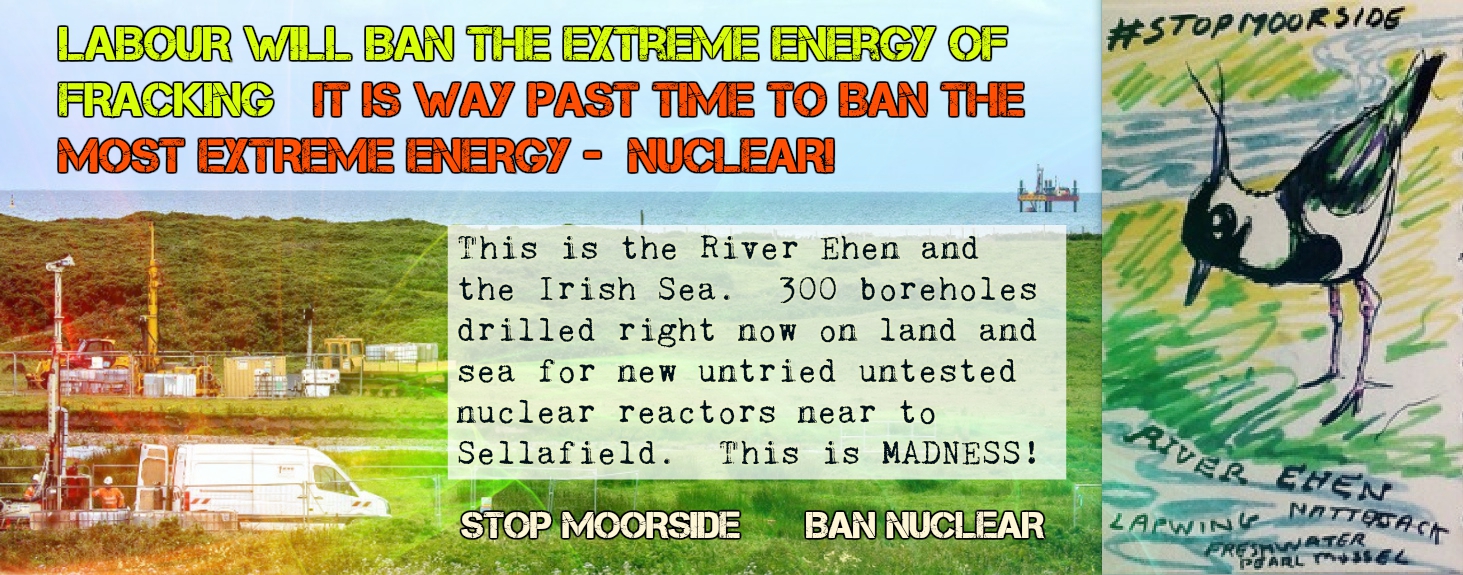
Dear Jeremy Corbyn MP, Labour Leader,
I am writing to you on behalf of Radiation Free Lakeland, a volunteer group based in Cumbria[1] to thank you whole heartedly for pledging to ban fracking which
“locks us into an energy infrastructure that is based on fossil fuels long after our country needs to have moved to clean energy”.[2]
We agree entirely with the case against fracking, as well as being fossil fuel based there are also radiation risks from unleashing large amounts of radon deep underground[3]. The nuclear industry is, like fracking, extractive and extreme. But nuclear is in a league all of its own[4].
The Electrical Trades Union in Australia (ETU) has banned its members from working in uranium mines, nuclear power stations or any other part of the nuclear fuel cycle: “We are sending a clear message to the industry and the wider…
View original post 452 more words
September 27, 2016
Posted by Christina Macpherson |
Uncategorized |
Leave a comment
 geoharvey
World:
¶ Statkraft has officially opened the 73-MW Banja hydropower plant in Albania, the first of two projects that will make up the 256-MW Devoll hydro scheme. The plant, which is located 65 kilometers southeast of the capital Tirana and is Statkraft’s first in the country, will generate about 255 GWh of electricity a year. [reNews]
 Hydro dam (Statkraft image)
¶ The Moroccan Press Agency reported that King Mohammed VI presided over a working session on the energy sector, focussing mainly on the national program for development of renewable energy. The country is rather unusual among Arab nations. It is one of the few countries in the region without its own oil or gas resources. [Eurasia Review]
¶ A sugar miller in far north Queensland plans to build a $75 million green power station near Mareeba. The power station will use bagasse, a 100% renewable sugarcane…
View original post 636 more words
September 27, 2016
Posted by Christina Macpherson |
Uncategorized |
Leave a comment
The measures quoted in this article are from the Japan Nuclear Regulatory Agency.
As every measure given by the Japanese government agencies and Tepco during the past 5 and half years, we have the right to question their exactitude and therefore the true numbers could be actually higher than the ones published.
still the fact remains that they do recognize a certain contamination of the tap water in many prefectures of Eastern Japan.
Radioactivity testing of tap water in June 2016
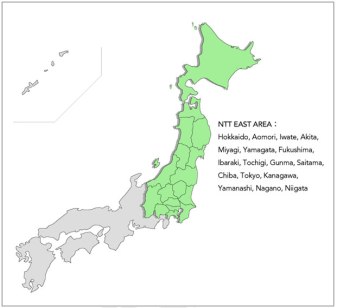
According to the radioactivity test of tap water, the Nuclear Regulatory Agency announced in June 2016 that there is some radioactivity contamination from Fukushima nuclear power plant accident in the tap water of Miyagi Prefecture, Yamagata Prefecture, Fukushima Prefecture, Ibaraki Prefecture, Tochigi Prefecture, Gunma Prefecture, Saitama Prefecture, Chiba Prefecture, Tokyo, Kanagawa Prefecture, Niigata Prefecture, where radioactive cesium has been slightly detected.
(The detection limit value of White Food: 0.5 Bq / kg).
For Tokyo traces of both Cesium 134 and Cesium 137 were detected, proving with certainty that they are from the Fukushima nuclear power plant accident.
As a result, we make sure it is not detected by the detection limit value of 0.0001 Bq / kg. So we have to check the non-detection in strontium inspection that is only carried out in the mineral water industry.
We believe that the one of the products that you sould really worry is the water that you drink every day.
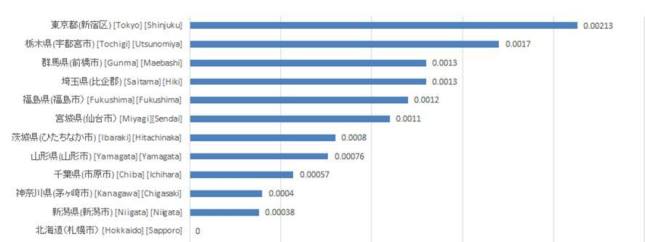
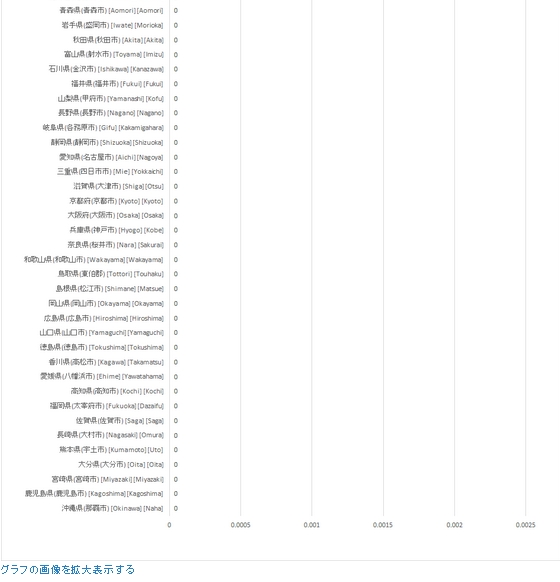
Information Source: Nuclear Regulatory Agency (→ link http://radioactivity.nsr.go.jp/ja/list/194/list-201606.html)
Readings of radioactivity level in drinking water by prefecture (January-March, 2016)
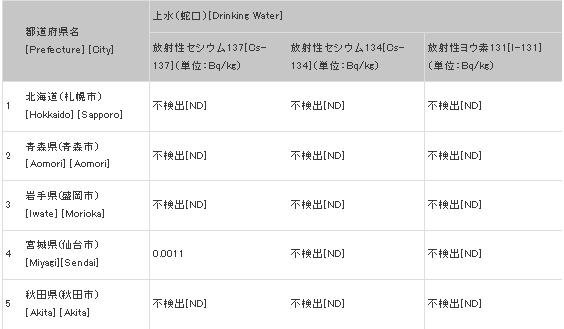
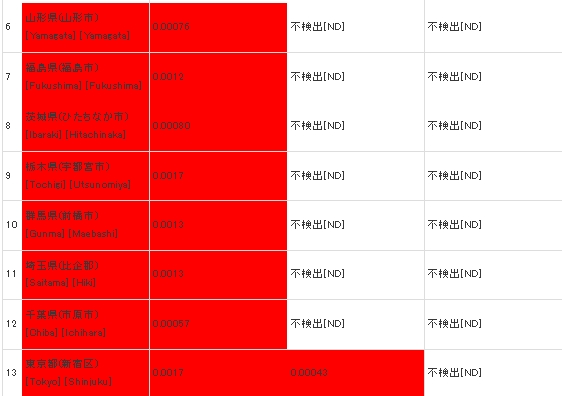
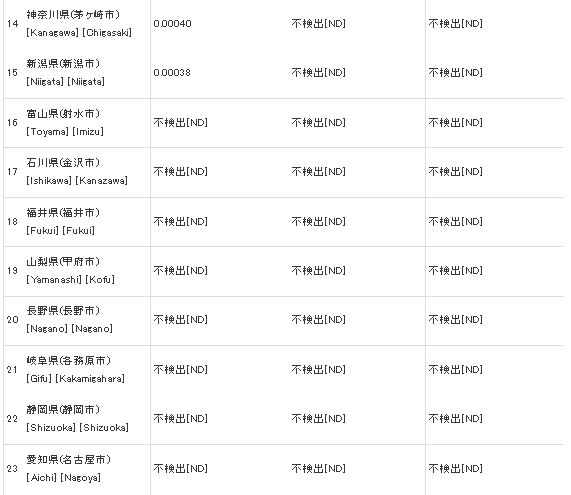
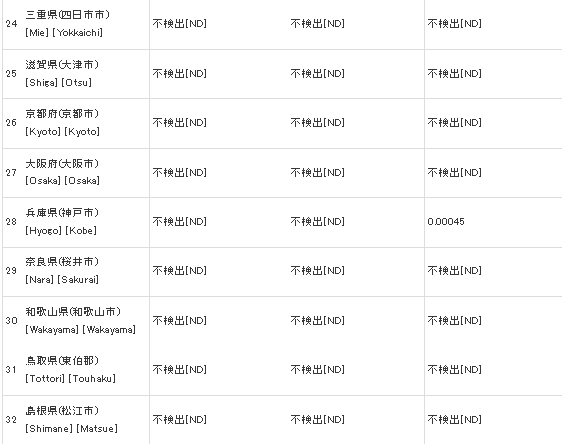
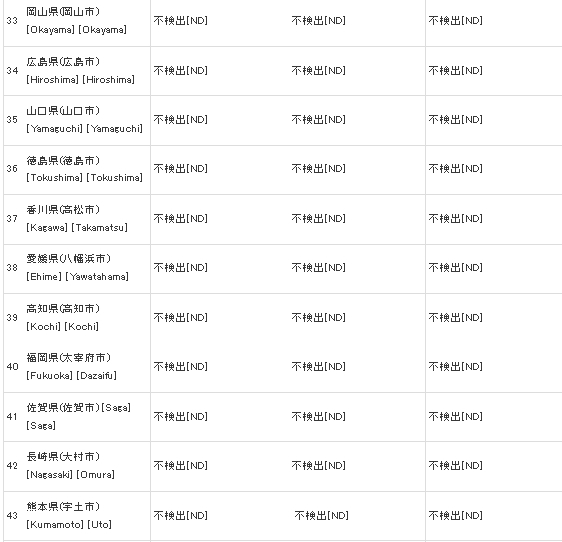
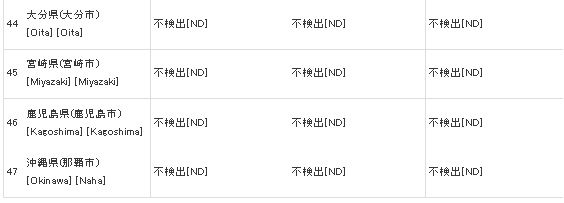
1.本データは、1Bq/LをBq/kgとみなす [1.These figures are estimated as 1Bq/liter = 1Bq/kg]
2.原子力規制委員会が各都道府県等からの報告に基づき作成 [2.The table was made by Nuclear Regulation Authority, based on the reports from prefectures.]
3.検出下限値は、 I-131、Cs-134、Cs-137すべて0.001Bq/kg未満 [3.The detection limits of I-131, Cs-134 and Cs-137 are less than 0.001Bq/kg]
(参考)水道水中の放射性物質に係る指標の見直しについて(厚生労働省)における水道水中の新たな目標値 放射性セシウム(セシウム134及び137の合計) :10Bq/kg [(Ref.)[Document created by Ministry of Health, Labour and Welfare] [Radioactive cesium (The sum of cesium134 and 137) :10Bq/kg]
情報元 : 原子力規制庁(→リンク http://radioactivity.nsr.go.jp/ja/list/194/list-201606.html)
Cesium level is highest in Tokyo tap water
https://news.whitefood.co.jp/news/foodmap/7290/
September 26, 2016
Posted by dunrenard |
Fukushima 2016 | Eastern Japan, Fukushima Contamination, Fukushima Radiation, Tap Water |
Leave a comment

About This Project
It’s time to cooperate
When we started up MDS (Minna no Data Site, Everyone’s Data Site) we constructed inclusive and shared system on measuring data of food as the first stage, as there were many people who were concerned about food intake.
However, we planned to launch the measuring data of soil as a second stage after intensively equipped the system on food.
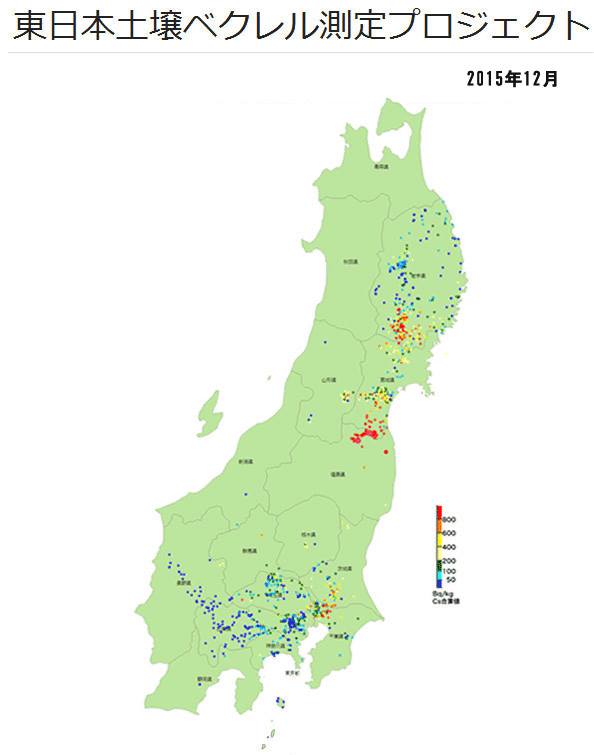
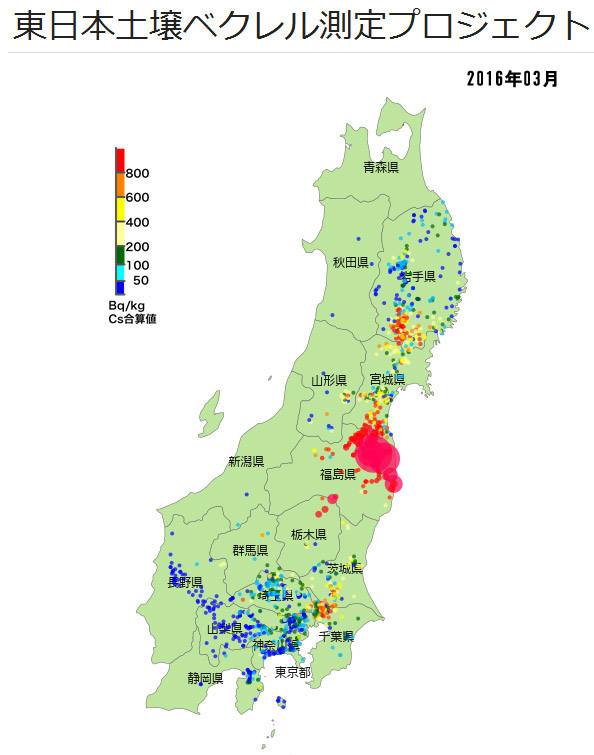
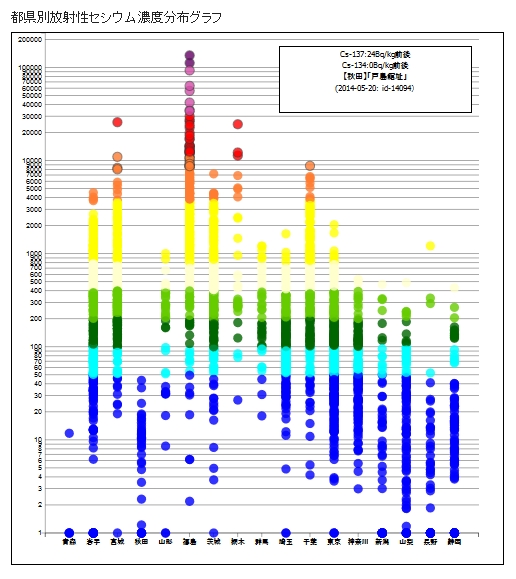
In autumn 2014, after one year from opening of MDS, we start up to platform soil measurement data. We, as citizens, try to start to map the status of soil contamination spread over East Japan.
The following is the reason why we stand up to start the East Japan Soil Becquerel Measurement Project. Objectives, outline and methodology of the project is explained.
Outline
In the Project, the method of collection is standardized in order to make comparison of data from multiple measurement laboratories. The Manual for Collection is developed by considering the easiest method of measurement within the limits of keeping accuracy, because many citizens conduct collection and measurement by themselves.
Collected soil is measured by the participating measuring laboratories of MDS. The result becomes open to the public and the report is sent to the collector.
Objectives
Radioactivity contamination by the accident of Tepko Fukushima Nuclear Power Plant is long term lasting.
The soil contamination map of broader areas is needed to understand contamination of neighborhood by measurement and comparison of data.
Though central and local governments conduct soil researches, those researches are insufficient because the value is lower by measuring deep place, or they measure only air dose.
As they decide the spot of measurement by mesh, the data what citizens want to know is lacking.
In our Project, we aim to grasp status of contamination where citizens make living every day. For example, place where children frequently play, where people pick wild grass, or where farmers work is being measured.
The Project aims that people can access necessary information as much as possible by utilizing data and database and by accumulating information which one can find at a glance and can search at ease.
We hope the result would be used as a tool for action for everyone.
Methodology
■ The depth of collection is from 0 to 5 cm, because most of cesium stays within 5 cm from surface of the earth.
Collection of soil should be conducted when it does not rain for several days, in order to avoid weight error caused by water. Less than 10 percent of moisture content is desirable.
■ Spot for collection is set at higher dose spot by measuring rate of air dose (1m、5cm).
The extreme high spot such as micro hot spots and concentrated environment are excluded.
■ Collection is made by a method to compare results of each place.
■ Samples are measured at the participating laboratories of MDS.
・Measurement accuracy of those laboratories is ensured by the MDS original examination.
・The results are accumulated in the common database.
■ The result sof measurement are open to public on MDS. MDS has Japanese and English site.
■ Mapping of data is planned after gathering enough results.
■ Trial calculation of amount of radioactivity by a square meter is planned to be conducted. (Becquerel/ Kg →Becquerel /square meter)
Target areas:17prefectures in east-Japan
* In Iwate, the Soil Project Iwate had implemented measurement at more than 300 spots in 2012 and 2013.
The project activity will be made starting from requested districts. Individuals, groups and any organization such as school and daycare can participate in measurement of proposed spots. Proposing more than 5 spots are desirable.
The measurement spots will be decided after consultation basically in the same municipality.
★ How to support us:
Collection of samples, payment of 2,000yen for measurement of one sample, payment of actual postage for samples.
★ How to feed back :
Sending result of measurement of the spots including spectrum, Reading and downloading data at MDS.
Support our site and project!
To those of you who are viewing this site from overseas, Thank you for visiting ”Minna no Data Site” (Combined Database of Independent Radioactivity Measurement Labs) .
MDS has stacked the data measured by the independent radioactivity measurement laboratories in response to the Fukushima Daiichi nuclear power plant accident, As of September 2014, the number of the food data became nearly 10,000.
For the benefit of those who worry about radioactive contamination of Japan from overseas, we opened the English site. We have started “East Japan soil measurement project” since October 2014 in addition to the food data.
From the fact that government has not done the adequate soil contamination survey for the citizens, this project promotes measuring soils of the places like parks, vacant lots, and educational facilities which are closely related to children’s daily life.
This project is based on the method of “Iwate soil measurement project “(2012- 2013) by citizens of Iwate Prefecture. If the method for collecting the soil is different, the results of monitoring vary greatly.
By using an easy-to-understand manual of the standardized method, you are able to compare, review and analysis the data from different locations. We will publish the measurement results of soil on this site.
We record the status of the radioactive contamination of Japan carefully from the standpoint of citizens, and hope that it will help people who are living with anxiety. For the people overseas, we are preparing the English version of data to show where and how much radioactively contaminated.
To run this project, big budget for measurement cost and update cost of web systems are required. There are 300 locations in each 17 prefectures in Eastern Japan, and each place costs about 4,000 yen.
Although it is planned to reduce costs and to ask for volunteers as much as possible, still the costs such as measurement costs, project management costs and Web systems costs are expected to some extent also.
It is a project of the scale that no one even challenged yet. We rely on your generosity to help funding for this project. We would appreciate your support from abroad. Thank you for your cooperation and support.
The information page of “East Japan soil measurement project” is currently in preparation. It will be published shortly.
◎Donate by the bank transfer
Postal Transfer:
Postal Transfer Account : 10090-85754261
Account Name: Minna no data site Unei Iinkai
Bank Account
Yuucho Bank Branch : Zero Zero Eight (Branch 008):
Interim : 8575426
Account Name: Minna no data site Unei Iinkai
Remittances in either USD or EUR can be made from overseas banks,.
Please note that remittances to Japan cannot be made from certain financial institutions.
For details, please ask your local bank.
http://en.minnanods.net/#mds_indx_srch
http://en.minnanods.net/soil/soil_support.html
http://en.minnanods.net/support/supportourproject.html
Japanese Site
Contact
September 26, 2016
Posted by dunrenard |
Fukushima 2016 | East Japan, Food Measurement, Fukushima continuing, radiation, Soil Measurement |
Leave a comment
Once radionuclides enter the eco-system, they move around carried by wind and water. They can’t “go away.” They can’t be “decontaminated.” They can only be moved, the biggest force moving them is nature, not clean up crews.
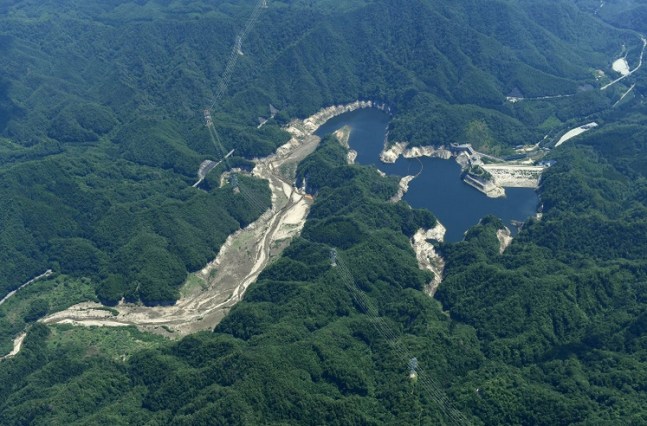
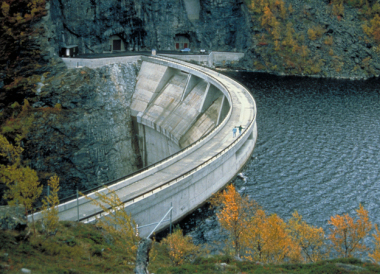
Ogaki Dam in Namie, Fukushima Prefecture, as seen from a Mainichi Shimbun helicopter in July 2016, contains high concentrations of radioactive cesium exceeding the limit set for designated waste.
High levels of radioactive cesium pooling at dams near Fukushima nuke plant
High concentrations of radioactive cesium have been accumulating at the bottom of 10 major dams within a 50-kilometer radius from the disaster-stricken Fukushima No. 1 Nuclear Power Plant, a survey by the Environment Ministry has found.
Radioactive cesium emanating from the 2011 nuclear disaster is pooling at those dams, which are used to hold drinking water and for agricultural use, after the substances flew into there from mountains, forests and rivers. The radiation levels at the bottom of those dams top those set for designated waste at over 8,000 becquerels per kilogram.
While the Environment Ministry plans to monitor the situation without decontaminating the dams on the grounds that radiation levels in dam water is not high enough to affect human health, experts are calling for the ministry to look into measures to counter any future risks.
The ministry began a monitoring survey on those dams and rivers downstream in September 2011 to grasp the moves of radioactive substances flowing into them from mountains and forests that are not subject to decontamination work. The survey samples water at 73 dams in Tokyo, Iwate and seven other prefectures about once every several months.
Among them, there were 10 dams in Fukushima Prefecture where the average concentration of cesium in the surface layer of bottom soil measured between fiscal 2011 and 2015 topped the regulated levels for designated waste. Those dams include Ganbe Dam in the village of Iitate with 64,439 becquerels per kilogram of cesium, Yokokawa Dam in the city of Minamisoma with 27,533 becquerels, and Mano Dam in Iitate with 26,859 becquerels.
Meanwhile, the surface water at those 10 dams contained 1-2 becquerels per liter of cesium, which is below the drinking water criteria at 10 becquerels.
While the total amount of cesium deposited at the bottom of those dams is unknown from the environment ministry’s survey, a separate study conducted at Ogaki Dam in the town of Namie by the Ministry of Agriculture, Forestry and Fisheries’ Tohoku Regional Agricultural Administration Office estimated in December 2013 that there was a combined 8 trillion becquerels of cesium 134 and cesium 137 at the dam. The figure came about after estimating the amount of accumulated cesium every 10-meter-square area based on cesium levels in sedimentary soil sampled at 110 locations at the bottom of the dam, which is for agricultural use.
The National Institute for Environmental Studies in Tsukuba, Ibaraki Prefecture, will shortly begin a full-scale survey on cesium concentrations at several dams.
“At the moment, it is best to contain cesium at those dams. If we dredge it, the substance could curl up and could contaminate rivers downstream,” said an Environment Ministry official.
http://mainichi.jp/english/articles/20160926/p2a/00m/0na/007000c
Anxiety soars as cesium builds up in Fukushima dams
Dams surrounding the stricken Fukushima No. 1 Nuclear Power Plant operated by Tokyo Electric Power Co. (TEPCO) have become de facto storage facilities for high concentrations of radioactive cesium as the element continues to accumulate.
With no effective countermeasures in sight, the government insists that water from the dams is safe, but to local residents, the government’s stance comes across as the shelving of a crucial problem.
“It’s best to leave it as it is,” an official from the Ministry of the Environment says, with the knowledge that in 10 dams in Fukushima Prefecture, there is soil containing concentrations of cesium over the limit set for designated waste — or over 8,000 becquerels per kilogram.
According to monitoring procedures carried out by the ministry, the levels of radioactive cesium detected in the dams’ waters, at 1 to 2 becquerels per liter, are well below the maximum amount permitted in drinking water, which is 10 becquerels per liter. The air radiation doses in the dams’ surrounding areas are at a maximum 2 microsieverts per hour, which the ministry says “does not immediately affect humans, if they avoid going near the dams.” This information is the main basis behind the central government’s wait-and-see stance. For the time being, the cesium appears to have attached itself to soil and is collected at the bottom of the dams, with the water above it blocking radiation from reaching and affecting the surrounding areas.
In a basic policy based on a special law, passed in August 2011, on measures for dealing with radioactive material following the onset of the Fukushima nuclear disaster, the Environment Ministry stipulates the decontamination of areas necessary from “the standpoint of protecting human health.” The ministry argues that as long as high concentrations of cesium at the bottom of multiple dams in Fukushima Prefecture do not pose imminent danger to human health, there are no legal problems in the ministry refraining from taking action.
“If the dams dry up due to water shortages, we just have to keep people from getting close to them,” the aforementioned ministry official says. “If we were to try to decontaminate the dams, how would we secure water sources while the work is in progress? The impact of trying to decontaminate the dams under the current state of affairs would be greater than not doing anything.”
This stance taken by the central government has drawn protests from local residents.
“The Environment Ministry only says that it will monitor the dams’ water and the surrounding areas. They say, ‘We’ll deal with anything that comes up,’ but when asked what they plan to do if the dams break, they have no answers. It’s painful to us that we can only give town residents the answers that the Environment Ministry gives us,” says an official with the revitalization division of the Namie Municipal Government. The central government is set to lift evacuation orders for a part of the Fukushima Prefecture town of Namie in spring of 2017.
According to a Ministry of Agriculture, Forestry and Fisheries survey, Ogaki Dam, an agricultural dam in Namie, was estimated to have sediment totaling approximately 8 trillion becquerels of cesium as of December 2013. The agriculture ministry plans to re-survey the dam’s accumulated cesium amounts and water safety before the water is used for agricultural purposes. Agricultural and fishery products from Fukushima Prefecture are tested to ensure that radioactive substances that they contain are below the maximum permissible amounts stipulated by law before they are shipped for distribution.
Still, one town official worries how revelations of high levels of radioactive material in local dams will affect consumers. “No matter how much they are told that the water is safe, will consumers buy agricultural products from Namie, knowing that there is cesium at the bottom of local dams?”
A 57-year-old vegetable farmer from Namie who has been evacuated to the Fukushima Prefecture city of Iwaki says, “The central government keeps on emphasizing that the dams are safe, but doesn’t seem to be considering any fundamental solutions to the problem. If this state of affairs persists, we won’t be able to return to Namie with peace of mind, nor will it be easy to resume farming.”
http://mainichi.jp/english/articles/20160926/p2a/00m/0na/011000c
September 26, 2016
Posted by dunrenard |
Fukushima 2016 | Fukushima continuing, radiation, Radionuclides, water |
Leave a comment
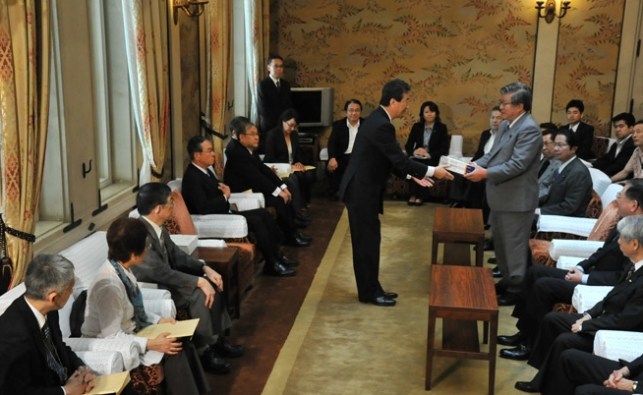
Kiyoshi Kurokawa, chairman of the Fukushima Nuclear Accident Independent Investigation Commission, presents the final report to Lower House Speaker Takahiro Yokomichi, right, in July 2012.
Five years after the accident at the Fukushima No. 1 nuclear power plant, the Diet is still sitting on a trove of raw documents and testimonies of more than 1,100 individuals who were on the front lines during the crisis.
The cache was compiled by the Fukushima Nuclear Accident Independent Investigation Commission, which released a report of its findings that totaled about 600 pages in July 2012.
The documents collected by that commission, including the testimonies of 1,167 individuals, have still not been released to the public more than four years after its disbandment.
Yasunori Sone, a political science professor at Tokyo’s Keio University, said the documents should, in principle, be released to the public because the investigation was conducted by the Diet on behalf of the people.
“The Fukushima Nuclear Accident Independent Investigation Commission was the first established in the Diet with the authority to carry out a thorough investigation,” Sone said. “Disclosure rules should be decided on quickly because it will serve as a precedent for future commissions.”
However, the documents submitted to the commission by the central government as well as Tokyo Electric Power Co., operator of the Fukushima plant, remain in storage at the National Diet Library, along with more than 900 hours of questioning of the 1,167 individuals, many of whom worked to bring the accident under control.
Some of the testimony was given on condition that it would not be released.
For that reason, after the commission disbanded, the rules and administration committees of the two chambers of the Diet were to have established rules for disclosing the commission records.
The commission had left behind a record of its investigation as well as the source of the documents it had accumulated because it felt that it would be helpful when the documents were eventually released.
“It will be possible to learn about the background to the nuclear accident from new reports or books that are written based on the documents,” said Kiyoshi Kurokawa, a professor emeritus at the University of Tokyo, who chaired the commission. “A fundamental point to not repeating mistakes is to learn from one’s past errors.”
Discussions within the rules and administration committees were disrupted when then Prime Minister Yoshihiko Noda dissolved the Lower House in November 2012 and called a snap election.
The December election brought the Liberal Democratic Party and its junior coalition partner, Komeito, back in control of government.
A multiparty group of lawmakers who were seeking to end dependence on nuclear energy asked that the rules and administration committees resume work on establishing disclosure rules. However, a subcommittee held one session that focused on presenting the opinions of members.
“Both the ruling and opposition parties are hesitant about releasing the documents because there is the possibility that they contain contents that are disadvantageous to the LDP, which had pushed nuclear energy, and the then Democratic Party of Japan, which had to deal with the nuclear accident,” said a member of that multiparty group.
The disclosure of the documents is not the only area in which the Diet has been less than aggressive.
In its report, the commission included seven recommendations, including the establishment of a new independent investigation committee, made up mainly of experts from the private sector, to conduct further studies into unanswered questions about the accident.
However, the rules and administration committees have yet to discuss the possibility of establishing such an investigative committee.
The commission also recommended the establishment of special committees in both chambers of the Diet to oversee the nuclear regulatory structure.
In 2013, a Special Committee for Investigation of Nuclear Power Issues was established separately in the two chambers.
However, those special committees have been turned into venues to promote nuclear energy. For example, committee members who were originally from labor unions of the electric power companies or who represented districts where nuclear plants were based criticized the Nuclear Regulation Authority for its strict standards regarding the resumption of operations at nuclear plants.
In a similar manner, the special committees also asked for a review of the rule that limited nuclear plants to a maximum 40-year operating life.
Tomoko Abe, a Democratic Party member who serves as secretary-general of the multiparty group seeking zero nuclear power generation, said, “Although there are some issues regarding the nuclear accident that have become clearer with the passage of time, the arena for looking into those issues has been closed off. It is the responsibility of the legislative branch to set up a structure that will continue to examine the nuclear accident.”
http://www.asahi.com/ajw/articles/AJ201609250019.html
September 26, 2016
Posted by dunrenard |
Fukushima 2016 | 311, Diet Investigation, Fukushima Daiichi, Records |
Leave a comment
 a nuclear power plant gives off twice as much energy by way of waste heat than it generates. The environment — whether the atmosphere, oceans, or rivers — would be unable to absorb that much extra heat without drastic climatic consequences
Small Sliver Of Sahara Desert Could Power Entire World With Solar Energy NYT September 24th, 2016 by Steve Hanley How big of a solar farm would you need to power the entire world with renewable energy? That’s a question addressed recently on Quora, the website that specializes in providing in depth, well researched answers to important questions. Actually, the original question was quite different. The discussion started  this way. “Could the world feasibly switch to all-nuclear power generation? If so, would that be a good counter to global warming?” For an answer, Quora turned to Mehran Moalem, PhD, a professor at UC Berkeley and expert on nuclear materials and the nuclear fuel cycle.
Professor Moalem began with this brief biographical information. “I have taught courses in nuclear engineering and a few seminar courses in alternative energies. I also worked for two years starting up six solar factories around the globe. In spite of my personal like for nuclear engineering, I have to admit it is hard to argue for it. Here is the simplified math behind it.”
Moalem then calculated that the world uses approximately 17.3 terawatts of continuous power each year. Sounds like a lot, doesn’t it? Actually it is. But, he says, a solar farm just 43,000 miles square would produce just about that amount of power. Moalem says the Sahara Desert covers 3.6 million square miles. If you’re into math, that means covering just 1.2% of the Sahara with solar power could provide the entire world with all its electrical needs.
It turns out the Sahara is also an ideal site for solar power. Because it is on the Equator, it receives 12 hours of sunlight virtually every day of the year. Also because of its location, that sunlight tends to shine directly down, meaning solar panels located there can be two to three times more efficient than those located in higher latitudes, like Europe and North America.
Moalem puts the price of such a system at $5 trillion dollars. Wow! That’s a lot of money, right? Actually, no it’s not, the professors says. Its less than the US spent to bail out banks 8 years ago. It’s about 10% of world GDP. The cost of building a nuclear power plant with a similar capacity would be more than 10 times as much.
He points out that this is a one time cost. Once such a facility gets built, the energy it produces is free. There are no ongoing costs for fuel, no generators to spin, to boilers to make steam. Moalen thinks that’s a pretty cheap price for something that could replace every other power source on earth, especially those that spew deadly pollution into the air.
Even though he is nuclear power engineer, Moalem says nuclear is not the way to meet world energy needs. One important reason is that a nuclear power plant gives off twice as much energy by way of waste heat than it generates. The environment — whether the atmosphere, oceans, or rivers — would be unable to absorb that much extra heat without drastic climatic consequences…….http://solarlove.org/sahara-desert-power-world-solar-energy/
September 26, 2016
Posted by Christina Macpherson |
2 WORLD, climate change, renewable |
Leave a comment











 nuclear-news