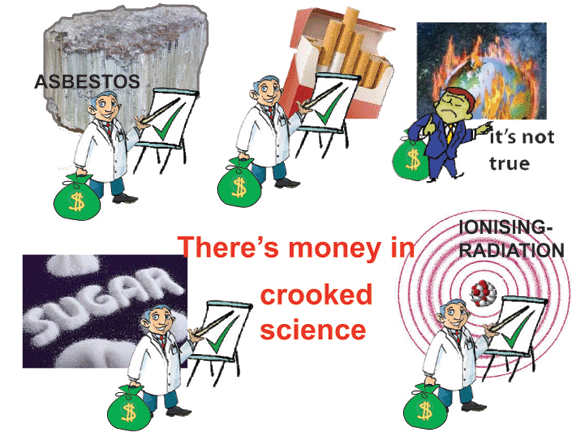
How the Sugar Lobby Skewed Health Research Archival documents reveal how the sugar industry secretly funded heart disease research by Harvard professors, Time, Alexandra Sifferlin@acsifferlinSept. 12, 2016 The sugar industry has a long history of skewing nutrition science, a new report suggests. By combing through archival documents from the 1950s and 1960s, researchers from the University of California, San Francisco (UCSF), report that the sugar industry sponsored research that turned attention away from the sweetener’s link to heart disease and toward fat and cholesterol as the bigger culprits.
The documents the researchers reviewed in their report, published Monday in JAMA Internal Medicine, included correspondence between the Sugar Research Foundation (SRF) and nutrition professors at the Harvard School of Public Health. The letters discussed the SRF’s effort to respond to growing research linking sugar to coronary heart disease.
In 1954, SRF then-president Henry Hass gave a speech to the American Society of Sugar Beet Technologists that highlighted opportunities for the sugar industry to expand by encouraging people to adopt a low-fat diet. He said:
“Leading nutritionists are pointing out the chemical connection between [Americans’] high-fat diet and the formation of cholesterol which partly plugs our arteries and capillaries, restricts the flow of blood, and causes high blood pressure and heart trouble… if you put [the middle-aged man] on a low-fat diet, it takes just five days for the blood cholesterol to get down to where it should be… If the carbohydrate industries were to recapture this 20 percent of the calories in the US diet (the difference between the 40 percent which fat has and the 20 percent which it ought to have) and if sugar maintained its present share of the carbohydrate market, this change would mean an increase in the per capita consumption of sugar more than a third with a tremendous improvement in general health.”
What appears to have happened next were efforts by the SRF to increase skepticism over sugar’s link to heart troubles. In 1967, an SRF-funded report led by Harvard nutrition professors was published in the New England Journal of Medicine. The report reviewed the available evidence that linked various nutrients to heart disease and argued that epidemiological and animal studies that linked sugar with heart disease were limited, and suggested the available science wasn’t up to snuff. The review also highlighted studies that linked saturated fat to heart problems, without the same critiques. The review was published in the journal without disclosing the sugar industry’s funding or role in making the study happen in the first place. (Later, in 1984, the NEJM began requiring disclosure of conflicts of interest.)……….
“What struck me was that I thought the evidence the researchers summarized in the review was stronger and more consistent for a sugar effect [on coronary heart disease] than for a fat effect,” says study author Stanton Glantz of UCSF. “No matter how good the evidence was linking sugar to heart disease, there was something wrong with it. But for fat, the evidence was fine. They set up a false dichotomy.”
In an editorial published alongside new study, Marion Nestle, a professor in the Department of Nutrition and Food Studies at NYU, writes that the Harvard professors who conducted the review knew what the funders wanted and provided those findings. “Whether they did this deliberately, unconsciously, or because they genuinely believed saturated fat to be the greater threat is unknown,” Nestle writes. “But science is not supposed to work this way. The documents make this review seem more about public relations than science.”………http://time.com/4485710/sugar-industry-heart-disease-research/
Four South Korea nuclear reactors suspended due to earthquakes http://www.reuters.com/article/us-southkorea-quake-nuclearpower-idUSKCN11I1X5
South Korea’s nuclear operator said early on Tuesday it suspended operation of four reactors at a nuclear power complex as a precaution late on Monday after two earthquakes struck the country’s southeast.
The earthquakes, of magnitude 5.1 and 5.8, occurred on Monday night near the city of Gyeongju, according to South Korea’s meteorological agency.
The 5.8 magnitude earthquake was the strongest recorded in South Korea, an official at the meteorological agency said.
Two injuries had been reported as a result of the quake, but no serious damage had been immediately reported, the agency said.
State-run Korea Hydro and Nuclear Power Co shut down the Wolsong No.1, Wolsong No.2, Wolsong No.3 and Wolsong No.4 reactors, with a combined capacity of 2,779 megawatts, an official with the operator said.
It was not immediately clear when the four reactors would restart. The shutdown of the four takes the number of reactors offline in the country to seven, according to KHNP website. KHNP, owned by state-run utility Korea Electric Power Corp (KEPCO), operates 25 nuclear reactors in Asia’s fourth-largest economy.
(Reporting by Jane Chung,Ju-min Park; Editing by Tony Munroe and Alison Williams)
Nuclear power vs. other carbon-free fuels While power markets do indeed undervalue low-carbon fuels, all of the other premises underlying the nuclear industry approach are flawed. In California and in Nebraska, utilities plan to replace nuclear plants that are closing early for economic reasons almost entirely with electricity from carbon-free sources. Such transitions are achievable in most systems as long as the shutdowns are planned in advance to be carbon-free.
In California these replacement resources, which include renewables, storage, transmission enhancements and energy efficiency measures, will for the most part be procured through competitive processes. Indeed, any state where a utility threatens to close a plant can run an auction to ascertain whether there are sufficient low-carbon resources available to replace the unit within a particular time frame. Only then will regulators know whether, how much and for how long they should support the nuclear units.
Closing the noncompetitive plants would be a clear benefit to the New York economy. This is why a large coalition of big customers, alternative energy providers and environmental groups opposed the long-term subsidy plan.
Today the nuclear industry claims that keeping all operating reactors running for many years, no matter how uneconomic they become, is essential in order to reach U.S. climate change targets. Continue reading →
Local governments are making progress on their goal of generating all of the prefecture’s power from renewable sources by 2040
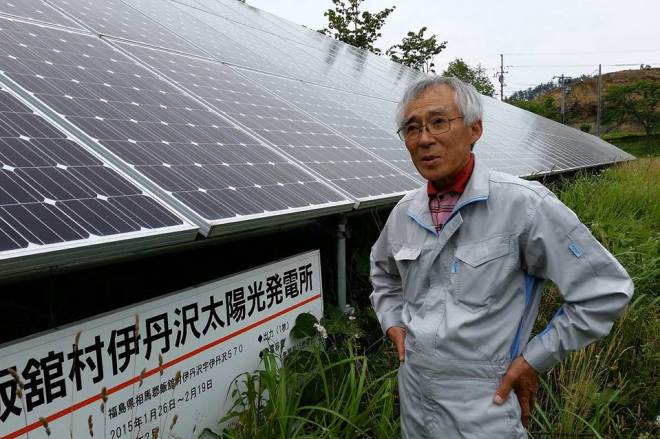
Cattle farmer Minoru Kobayashi has built solar arrays on land that can’t be used for farming
IITATE, Japan—Many residents of Fukushima prefecture are still angry about the nuclear disaster five years ago that contaminated towns, farm fields and forests. But as the cleanup continues, local governments and some business owners here are channeling their frustration into something positive: clean-energy development.
Fukushima prefecture, about 150 miles (240 kilometers) north of Tokyo and roughly the size of Connecticut, was the site of the devastating meltdown of the Daiichi nuclear-power plant following an earthquake and tsunami in March 2011. Since then, most of Japan’s 50-plus nuclear plants, which were shut down after the accident for a safety review, have remained off line.
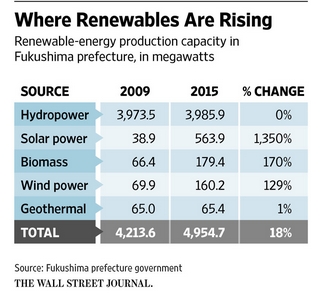
Determined to move away from nuclear energy permanently, local governments in Fukushima, as well as some local entrepreneurs, have taken advantage of national subsidies and embraced solar and wind power. Even as Japan’s overall move toward renewables appears to be stalling amid resistance from utilities and cheap fossil-fuel imports, the prefecture has made progress on its goal of generating 100% of the power its residents use from green sources by 2040.
New solar, wind and geothermal power generators, combined with Fukushima’s already abundant supply of hydropower, have boosted the share of renewable energy in the prefecture’s total power supply to more than one-quarter from one-fifth in 2009. By comparison, renewables made up just 14% of Japan’s overall energy production in the year ended in March.
Fukushima wants a “zero nuclear” power supply, says government spokesman Norihiro Nagao.
Among the business owners who have jumped into the fray is Minoru Kobayashi, 64, who ran a cattle farm about 25 miles inland from the Daiichi plant before the accident. Radioactive contamination forced him and his family to evacuate, along with their cattle, and the government tore down the family’s home and everything else within a 20-meter radius of the house.
Left with fields that couldn’t be used for farming, Mr. Kobayashi, along with a group of local farmers and investors, built four 50-kilowatt solar arrays on their land and plan to build 12 more by the end of next year. The group is selling power to the local utility at prices set by the government and expects to turn a profit by the end of this year. (The company signed power contracts with the local utility when prices were between 27 and 32 yen (26 to 31 cents) a kilowatt-hour. The current rate is 24 yen a kilowatt-hour.)
Mr. Kobayashi says solar power represents more than just a business opportunity to him and his partners. “We welcome renewable energy as a protest to the nuclear power plant,” says Mr. Kobayashi.
Elsewhere, Yauemon Sato, who ran his family’s 226-year-old sake brewery for more than two decades, started the solar-power developer Aizu Electric Power Co. in Fukushima in 2013 with a group of friends and local business associates. The company has built 21 small and medium-size solar arrays and a one-megawatt solar farm in northern Fukushima. He says the new clean-energy businesses will create jobs and boost the economy.
“We started this company as part of a social-justice movement,” Mr. Sato says.
Some business owners are even hoping renewable energy will become a tourist attraction.
In Tsuchiyu Onsen, a resort area known for its natural hot springs and proximity to national parks, local hotel owners joined forces to build a 400-kilowatt geothermal power generator and a small hydroelectric generator.
It has become a new selling point for the resort area, says Katsuichi Kato, 68, president of Genki Up Tsuchiyu Co. “There are many other hot springs towns,” he says. “We had to create a new industry: renewable energy tourism.”
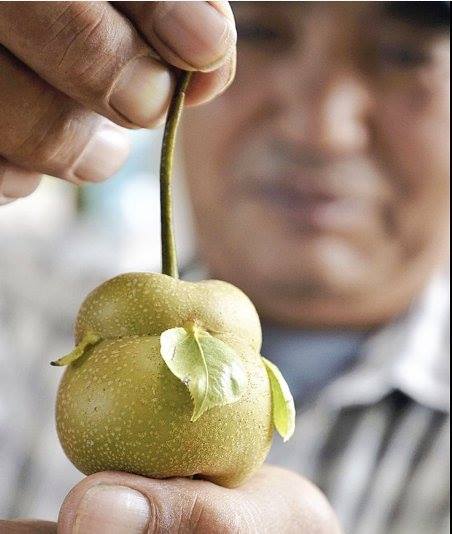
Farmers are surprised to find this snow man shaped pear.
It’s about 3 cm diameter, and leaves are growing from the hollow.
“It’s not possible to have leaves on a fruit. I wonder why…” said Mr. Sato who found this pear.
This UPI article was published on Sept. 13, 2016. I added below the source of that UPI article, the study published on the sciences website “Nature” on Sept. 12, 2016. This article is important, and should be seen by as many people as possible, as this scientific study will impact greatly the future of our anti-nuclear cause. By establishing the genetic signatures of any cancer caused by ionizing radiation, any future denial from the nuclear lobby is now impossible. Those scientifically established signatures will also be extremely helpful in court for any future suit from radiation victims.
Researchers found mutational signatures left by radiation-caused changes to DNA, which may lead to better treatment of cancers.
Researchers found mutational signatures which appear to indicate changes to DNA caused by exposure to ionizing radiation, which may allow doctors to better treat cancer caused by non-spontaneous mutations.
LONDON, Sept. 13 (UPI) — Though scientists have suspected ionizing radiation can cause cancer, experiments conducted in England are the first to show the damage it inflicts on DNA and may allow doctors to identify tumors caused by radiation.
In a study published in the journal Nature Communications, scientists showed the effects of gamma rays, X-rays and radioactive particles on DNA, deciphering patterns they think will help differentiate between spontaneous and radiation-caused tumors, allowing for better cancer treatment.
“To find out how radiation could cause cancer, we studied the genomes of cancers caused by radiation in comparison to tumors that arose spontaneously,” Dr. Peter Campbell, a researchers at the Wellcome Trust Sanger Institute, said in a press release. “By comparing the DNA sequences we found two mutational signatures for radiation damage that were independent of cancer type. We then checked the findings with prostate cancers that had or had not been exposed to radiation, and found the same two signatures again. These mutational signatures help us explain how high-energy radiation damages DNA.”
For the study, the researchers looked for mutational signatures in 12 cancer patients with radiation-associated second malignancies, and compared their tumors to 319 from patients not exposed to radiation.
The researchers found two mutational signatures they link to radiation. While one causes small deletions of DNA bases, the other — called a balanced inversion — includes two cuts to DNA, with the middle piece spinning around and rejoining in the opposite direction.
These mutations, especially balanced inversions, which do not happen naturally in the body, increase the potential for cancer to develop, the researchers say.
“This is the first time that scientists have been able to define the damage caused to DNA by ionising radiation,” said Adrienne Flanagan, a professor at the University College London Cancer Institute. “These mutational signatures could be a diagnosis tool for both individual cases, and for groups of cancers, and could help us find out which cancers are caused by radiation. Once we have better understanding of this, we can study whether they should be treated the same or differently to other cancers.”
Mutational signatures of ionizing radiation in second malignancies
« Ionizing radiation is a potent carcinogen, inducing cancer through DNA damage. The signatures of mutations arising in human tissues following in vivo exposure to ionizing radiation have not been documented. Here, we searched for signatures of ionizing radiation in 12 radiation-associated second malignancies of different tumour types. Two signatures of somatic mutation characterize ionizing radiation exposure irrespective of tumour type. Compared with 319 radiation-naive tumours, radiation-associated tumours carry a median extra 201 deletions genome-wide, sized 1–100 base pairs often with microhomology at the junction. Unlike deletions of radiation-naive tumours, these show no variation in density across the genome or correlation with sequence context, replication timing or chromatin structure. Furthermore, we observe a significant increase in balanced inversions in radiation-associated tumours. Both small deletions and inversions generate driver mutations. Thus, ionizing radiation generates distinctive mutational signatures that explain its carcinogenic potential. »
The emergency shutdown of nuclear reactors hasn’t been an emissions disaster.
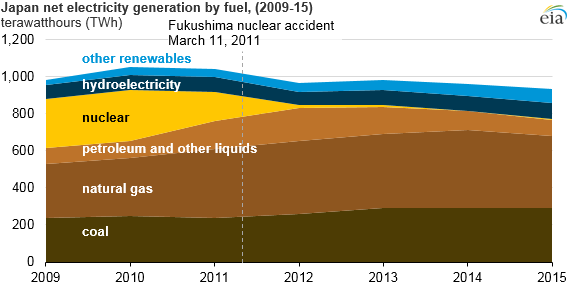
In the wake of the meltdown of the Fukushima Daiichi nuclear reactors, Japan shut down its entire nuclear fleet in order to develop more rigorous safety standards and inspect the remaining plants. As of now, plants are only beginning to come back online.
Given that Japan had recently relied on nuclear for over a quarter of its electricity, the expectation is that emissions would rise dramatically. But that hasn’t turned out to be the case. While coal use has gone up, it hasn’t risen by more than 10 percent. And a heavy dose of conservation has cut Japan’s total electricity use to below where it was at the end of last decade.
Based on the graph, it appears that nuclear was playing a decreasing role in Japan’s energy mix even prior to Fukushima, being displaced in part by natural gas and in part by petroleum. But that may be an artifact of the chart, given that nuclear was shut down entirely immediately after Fukushima, but the chart shows it persisting. In either case, post-Fukushima conservation efforts dropped Japan’s electricity use below a PetaWatt-hour, and further efforts have turned the drop in electricity use into an ongoing trend.
Fossil fuel use has gone up, but not by as much as might be expected. Coal rose by eight percent, and natural gas (transported in its liquefied form) rose by nine percent. These have largely reversed the expansion of petroleum use that began prior to the meltdown at Fukushima. Non-hydro renewables have also more than doubled their electrical production since that time. Combined with hydroelectric plants, they now provide more electricity than petroleum.
The net result of all of this? Carbon emissions have been relatively flat and have not exceeded the nation’s record year back in 2007. Thus, if nuclear plants are brought back online in significant numbers, Japan’s emissions should begin to drop considerably. If the growth of renewables and general conservation continue as well, Japan should see the drop in emissions accelerate.
And that’s going to be needed, given that Japan has pledged to drop its carbon emissions significantly from their recent peak.
North Korea’s nuclear program is targeting U.S., Japanese lawmaker says, WP. 4 By Anna Fifield September 13
TOKYO — North Korea’s nuclear program is directed at the United States, a close adviser to Kim Jong Un said after last week’s atomic test, according to a Japanese lawmaker who just returned from Pyongyang.
The warning came as two U.S. military B-1 bombers flew over the southern half of the peninsula in a show of force against North Korea, and top military brass and diplomats alike warned Pyongyang the United States was prepared to take all steps to contain and punish the regime.
North Korea defied United Nations resolutions and international warnings by detonating its fifth and largest nuclear weapon Friday, declaring that it was a warhead that could be used to counter “the American threat.”
Antonio Inoki, a former professional wrestler who now serves in Japan’s parliament, returned Tuesday from a five-day visit to Pyongyang saying that Japan need not worry about the North’s nuclear program.
Simmering US-China rivalry prompts North Korea nuclear test finger-pointing, CNBC News, Huileng Tan | @huileng_tan, 13 Sept 16 China has lashed out at the U.S. after Washington accused Beijing of not doing enough to arrest North Korean‘s nuclear ambitions, underscoring tensions between the two world powers in the geopolitically sensitive Korean Peninsula.
At the Chinese foreign affairs ministry’s regular press conference on Monday, spokesperson Hua Chunying said U.S. Defense Secretary Ash Carter was being “unnecessarily modest” for thrusting the responsibility of handling Pyongyang solely on China.
“The cause and crux of the Korean nuclear issue rest with the U.S. rather than China,” added Hua in an official transcript from the foreign affairs ministry. “The core of the issue is the conflict between (North Korea) and the U.S. It is the U.S. who should reflect upon how the situation has become what it is today, and search for an effective solution. It is better for the doer to undo what he has done. The U.S. should shoulder its due responsibilities,” she said.
Hua was responding to Carter who singled out the East Asian giant at a news conference in Norway as bearing the responsibility for North Korea’s recalcitrant nuclear testing……..
On Tuesday, two U.S. B-1 bombers flew over South Korea in a show of solidarity with South Korea while Sung Kim, the U.S. envoy on North Korea, said the world’s largest economy remained open to a meaningful dialogue with Pyongyang, Reuters reported……..
The Chinese foreign affairs ministry’s Hua urged for dialogue among all parties to address security concerns. “It has been proven time and again that sanctions alone cannot solve the problem,” she added………
“China is very worried about the North Korean regime but it does not want a collapse of that regime and a unified Korea under the current the South Korea regime which they would regard as a mortal threat to their interest (with) American security forces right alongside their border,” he told CNBC’s “Squawk Box“.
That explained Beijing’s intense opposition to the deployment of the U.S. Thaad defense system on South Korean soil even though Seoul was an ally which had repeatedly explained that the weapon was for self-defense.
“(There is) a larger sense that China feels that they are in a long term rivalry (with the U.S.)… In my view, there is a troubling chill over U.S.-China relations and I don’t see either presidential candidates really offering a sensible way to lower the temperatures in this rivalry. But if China is locked into this rivalry as it sees it, then it is taking measures that we don’t like at all,” Lyle Goldstein, a professor at the China Maritime Studies Institute at the U.S. Naval War College told CNBC. http://www.cnbc.com/2016/09/13/simmering-us-china-rivalry-prompts-north-korea-nuclear-test-finger-pointing.html
South Korea’s biggest earthquake triggers nuclear safety concerns, Reuters, By Jane Chung | SEOUL, 13 Sept 16, Two earthquakes that jolted South Korea on Monday night, including the largest ever recorded in the country, prompted concerns about the safety of nuclear plants clustered in the quake-prone southeast.
Korea’s Meteorological Agency said the two earthquakes, of magnitude of 5.1 and 5.8, occurred near the city of Gyeongju. They could be felt in the capital Seoul, over 300 km (186 miles) to the northwest.
Fourteen people were injured but there were no reports of serious damage, a Ministry of Public Safety and Security official said.
Nonetheless, Korea Hydro & Nuclear Power Co shut down four nuclear reactors at the Wolsong complex in Gyeongju as a precaution.
South Korea’s reactors are designed to withstand a magnitude 6.5 or 7.0 earthquake, according to the Nuclear Safety and Security Commission.
Orders were given to nuclear operators to upgrade old reactors to that standard after the disaster at Japan’s tsunami-crippled Fukushima Daiichi nuclear power plant in 2011.
“That will be completed by next year,” said Shim Eun-jung, a spokeswoman at the nuclear watchdog……….
As in many countries, nuclear power is controversial in South Korea, especially after a 2012 scandal over parts being supplied with fake certificates prompted shutdowns.
Park Jong-kwon, head of an anti-nuclear civic group in South Gyeongsang Province, said no more nuclear reactors should be built in southeastern cities like Ulsan and Gyeongju as they are close to an active fault line.
“Even though nuclear reactors are designed to withstand an earthquake of a magnitude 7.0, if they are hit by 4.5 and 5.8 magnitude earthquakes several times, they can be knocked down by a real 7.0 magnitude earthquake at a single blow,” Park said…….
Greenpeace Korea filed a lawsuit against the nuclear watchdog on Monday, before the earthquakes, urging it to scrap a plan to add two more reactors in Ulsan.
¶ “Meet the mom litigating the ‘biggest case on the planet'” • Julia Olson is litigating what should be considered the most important court case in the United States: She’s helping 21 kids, as young as age 9, sue the Obama administration over its insufficient action on climate change. Olson will attempt to make their case for the future. [CNN]
Julia Olson, chief legal counsel of Our Children’s Trust
World:
¶ India floated a draft document aimed at auctioning 1,000 MW of rooftop photovoltaic capacity to be installed atop government buildings. The Ministry of New & Renewable Energy issued the document, which divided the 1,000 MW capacity allocation into two modes, one based on total project cost, and the other on the tariff. [CleanTechnica]
¶ Hitachi has announced the development of a new 5 MW offshore wind turbine, the HTW5.2-136, featuring a 15% larger rotor…
Nuclear Philippines is a future full of costly risks, Inquirer.net, By: Laurence Delina@inquirerdotnet, 13 Sept 16 CAMBRIDGE, Massachusetts—The Duterte administration recently floated the revival of a white elephant of the martial law period—the Bataan Nuclear Power Plant (BNPP)—to meet the country’s burgeoning energy needs. “Revival” actually is an inapt word; the facility never went online in the first place.
Going nuclear is a highly inappropriate option because of its potential to cause catastrophic damage due to accidents, sabotage or terrorism; to produce very long-lived radioactive wastes; and to exacerbate nuclear proliferation. It is also water intensive, slow to construct, and very expensive. With many countries already phasing out nuclear power in favor of renewable energy technologies, the nuclear option is but a costly and risky diversion for the Philippines……..
Large-scale property damage and evacuation costs from nuclear accidents are the key liabilities of having a nuclear facility in an earthquake-prone country like the Philippines. In a matter of hours, a nuclear disaster could generate global fear and horror; this has been illustrated in the Great East Japan Earthquake of 2011, that brought about the meltdown of the Fukushima Daiichi nuclear power plant.
Managing radioactive waste produced by nuclear reactors is another challenge. If we cannot even effectively attend to simpler solid waste management problems, how can we ensure that we will have the capacity to store radioactive wastes for thousands of years?……
The best energy option for the Philippines is not nuclear but the already proven and demonstrated renewable energy technologies. These are relatively less risky, environmentally benign, socially acceptable, and economically plausible options. These include utility-scale and distributed solar, wind, micro-hydro, and geothermal installations. Our equatorial, geographic and archipelagic location, which translates into a tremendous renewable energy potential, is a natural blessing many countries are envious of.
Projects that transform our huge wind, water, sunlight and geothermal resources into our much-needed energy can be constructed quickly, within two to five years, but without the risks and costs attached to nuclear. Wind farms, for example, take one to three years in the development stage—that is, the time required to identify a site, purchase or lease a land, monitor winds, install transmission, negotiate a power-purchase agreement, and obtain permits—and between one and two years to construct. Solar farms take almost the same time………
Bringing the BNPP—or any nuclear energy facility for that matter—online is nothing but a risky and costly digression to an effective approach to our energy supply problem. Adopting this most expensive and very risky remedy only curbs what we can (and must) spend on the more promising approaches. For this administration to be truly concerned about the future of energy in the Philippines, renewables, not nuclear, is the way forward. http://opinion.inquirer.net/97258/nuclear-philippines-future-full-costly-risks
Feeling the heat: Downstate legislators aren’t keen on subsidies for upstate nukes Watertown Daily Times , SEPTEMBER 12, 2016 Some downstate lawmakers don’t appreciate the fact that their constituents must now subsidize a form of energy produced in upstate regions.
The legislators take issue with the state Public Service Commission’s decision to include subsidies for nuclear power in the Clean Energy Standard approved Aug. 1. The CES calls for half of New York’s energy to come from renewable sources by 2030.
The nuclear energy subsidies, though, will benefit power plants located hundreds of miles away from the districts of these legislators.
“Members of the New York State Assembly, including James Brennan from Brooklyn, Amy Paulin from Westchester County, Jeffrey Dinowitz from the Bronx, and Charles Lavine and Stephen Englebright from Long Island, sent a letter to Audrey Zibelman, chair of the New York State Public Service Commission, saying that the commission’s order forcing downstate electric customers to pay nearly 60 percent of the electric rate increase to bailout the Exelon Corp. and keep four upstate nuclear units was unfair,” according to a news release issued Wednesday. “They said there was no way downstate electric customers used 60 percent of the output of the nuclear reactors and that the amounts should be reduced. Electric generation in the NYC-Westchester service territory, and purchases of electricity from other sources, account for the overwhelming percentage of the use of electricity there. Long Island’s situation is similar — the overwhelming percentage of its power does not come from upstate New York.”…
Interview by Amy Goodman-DemocracyNow.org:
“Lakota Activist Debra White Plume from Pine Ridge: Why I am a Water Protector at Standing Rock, SEPTEMBER 12, 2016
While Democracy Now! was covering the standoff at Standing Rock earlier this month, we spoke to longtime Lakota water and land rights activist Debra White Plume, who was born and raised on the Pine Ridge Indian Reservation in South Dakota and lives along the banks of Wounded Knee Creek. She described what the Dakota Access pipeline means to her.
GUEST
DEBRA WHITE PLUME longtime Lakota water and land rights activist who was born and raised on the Pine Ridge Indian Reservation in South Dakota, and lives along the banks of Wounded Knee Creek. She is executive director of Owe Aku.
While Democracy Now! was covering the standoff at Standing Rock earlier this month, we spoke to longtime Lakota water and land rights activist Debra…
EDF may have to cut output or walk away, The Times, Robin Pagnamenta, A nuclear power station being built in France using the same design earmarked for Hinkley Point in Somerset may have to restrict its output or could be abandoned because of the costs of correcting safety flaws, experts have warned.
France’s nuclear safety regulator, the ASN, is testing the strength of steel used in the reactor pressure vessel at the plant in Flamanville in Normandy.
Last year, it warned of “very serious anomalies”, including weak spots in the steel component which houses the reactor. An investigation is under way and a decision is expected next year.






 nuclear-news