September 17 Energy News

Opinion:
¶ “Is the power of king coal overstated?” • If you want to shock and appall a politician, just suggest Australia put limits on building new coal mines. They ask, “How else will the poor countries be able to develop their economies to become rich as we are?” Short answer: by relying more on energy that emits less carbon. [The Sydney Morning Herald]
 The simple truth is that no-one knows what the future holds.
(Photo: Simon O’Dwyer)
¶ “Nuclear power station is a ‘£100bn boondoggle’ says top Scots expert” • The Tories are backing the wrong energy horse with the “£100 billion boondoggle” that is the new nuclear power station Hinkley Point C, according to one of Scotland’s leading energy experts. It risks increasing fuel poverty and consumer fuel bills. [The National]
Science and Technology:
¶ A process called “biofabrication” was devised as an alternative…
View original post 660 more words
6th Citizen-Scientist International Symposium on Radiation Protection Date: Friday, October 7 – Monday, October 10, 2016
From the Reality of Chernobyl and Fukushima
Date: Friday, October 7 – Monday, October 10, 2016
Venue: Main Hall, Fukushima Gender Equality Centre 1-196-1 Kakunai, Nihonmatsu, Fukushima, 964-0904
The Citizen-Scientist International Symposium on Radiation Protection (CSRP), a politically, financially, ideologically and religiously independent non-profit organization, has been committed to keeping to minimum the damages on health and environment caused by the Tokyo Electric Fukushima Daiichi Nuclear Power Plant disaster that followed the Great East Japan Earthquake and Tsunami in March 11, 2011.
CSRP has been inviting administrative officials, researchers, NGOs, member experts of governmental inquiry commissions and international organizations working on radiation protection, etc. Since around the 3rd CSRP, this approach has started to bear fruit, because scientists and other stakeholders with different positions and paradigms began to share the same table of discussion, thus gradually making possible constructive exchange of views.
In the course of this approach, however, we began to encounter a new challenge that may concern the premise of the CSRP; the deeper we got into scientific discussion, the higher the hurdle for participation got for the general public, especially for younger generations. Also, the diversity of voices were to be alienated from pointed scientific discussions that are decisive for the decision-making of the radiation protection of the general public. This lead us to some interrogations : “Isn’t ‘science’ given too much importance in decision-making?”; “Is ‘science’ the only way for citizens to bring today’s situation under their power?”
While always continuing to examine new scientific findings with respect to health, environmental and social impacts of low-dose exposure, we added the theme of “Between Art and Science” to the 5th symposium last year, exposed various art works inspired by nuclear power and nuclear disasters, and organized a panel discussion with artists and scientists. This was the CSRP’s new attempt to question “science” and “scientificity” with a view to reexamining the relationships between science, art and philosophy before and after the modernity. The 6th CSRP of this year, held in the city of Nihonmatsu, Fukushima Pref., will collaborate with the Institute of Regional Creation by Arts, the University of Fukushima, to cosponsor the Fukushima Biennale 2016. We hope this new attempt will bring new visions to the participants.
As a place to learn and make full use of new findings exploring the effects of low-dose radiation exposure accumulating day by day, and to think together about the rights of people facing the consequences of the nuclear accident and about what epidemiology and public health should do in order to minimize the damage, we open the 6th Citizen-Scientist International Symposium on Radiation Protection.
Photos show nuclear tragedy’s toll on pets
“They never came back because the radiation levels were too high. The animal rescue teams knew the animals were abandoned and left there, so they had three weeks to go in there to find them,” said O’Connor, who added that farm animals usually had to be euthanized.

Akira Honda, founder of Nyander Guard Animal Rescue, shows photos of animals left behind in the aftermath of the 2011 earthquake, tsunami and nuclear disaster in Japan. The photos are on display at Ventura County Animal Services’ Camarillo shelter.
Shortly after the Fukushima Daiichi nuclear disaster in 2011 in Japan, nearby residents were immediately evacuated from their homes because of the risk of radiation exposure. They were forced to leave their animals behind.
Akira Honda, nicknamed Taicho, immediately raced to the disaster area from his hometown six hours away to help, and realized the need for an animal shelter near the radiation-contaminated exclusion zone.
A month later, Taicho established the Nyander Guard Animal Rescue about 25 miles away.
Photos of the animal rescue operation in Japan are being exhibited until Tuesday at the Ventura County Animal Services shelter in Camarillo. A fundraiser is also being held for the continued care of animals at Nyander Guard.
Taicho toured the no-kill Camarillo shelter, met with Camarillo Mayor Mike Morgan and shared his story with visitors to the shelter on Saturday.
Visitors to the exhibit have an opportunity to donate to Nyander Guard, which has rescued 740 dogs and cats and currently cares for more than 200 animals.
Kerry O’Connor, a Nyander Guard volunteer from Camarillo who now lives in Japan, helped bring the photo exhibit to the Camarillo shelter. Some of the photos of animals with severe injuries are too graphic and are kept in a separate notebook that can still be viewed.
O’Connor went to Japan to volunteer after the nuclear disaster that followed an earthquake and tsunami. She said residents in Fukushima were assured they’d be back at home after a day or so, so they left their animals.
“They never came back because the radiation levels were too high. The animal rescue teams knew the animals were abandoned and left there, so they had three weeks to go in there to find them,” said O’Connor, who added that farm animals usually had to be euthanized.
“A lot of people were scared but realized saving the animals was the right thing to do,” said O’Connor, who translated for the Japanese-speaking Taicho.
She said the rescued dogs and cats had been exposed to radiation.
“But unless you had a really high dosage in a short amount of time, it really does not affect them until about 30 years later, and they don’t live that long,” O’Connor said.
Taicho had a cat rescue operation before he started Nyander Guard.
At Nyander Guard, cats are able to roam in cat rooms, while bigger dogs have spacious kennels and smaller dogs are kept indoors. The dogs are walked twice a day and sometimes taken on trips to parks.
Although five years have passed since the disaster, the shelter still rescues and feeds abandoned animals in the restricted areas, which are becoming extremely hard to enter.
In addition to Nyander Guard, Taicho recently acquired another shelter that aided in rescuing the Fukushima animals, which tripling the staff’s work.
His goal is to make Japan a place where animals shelters are no-kill and to start a national protection organization.
http://www.vcstar.com/story/news/2016/09/17/photos-show-nuclear-tragedys-toll-pets/90376664/
Study on the impact of the Fukushima Nuclear Accident On Animals:
(Adobe. 64pg. PDF.)
Information about malformations of fetus and abortions in Fukushima
This video is from April 9, 2016, 6 months ago.
Two evacuated women from Fukushima talk about their experiences. One of them gives information about malformations of fetus and abortions.
With English subtitles which are not great but you can follow the story.
Long-term stays start in Tomioka
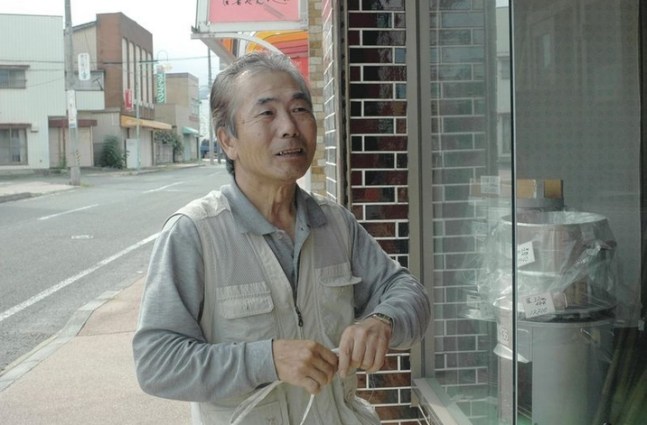
Shizuo Suzuki stands in front of his shop in Tomioka, Fukushima Prefecture, on Wednesday, with the empty shopping street visible in the background.
TOMIOKA, Fukushima — Long-term stays (see below) for residents of Tomioka, Fukushima Prefecture, started on Saturday. Evacuation orders for the town limits issued after the accident at Tokyo Electric Power Company Holdings, Inc.’s Fukushima No.1 nuclear power plant still stand.
The success of the project will hinge on how many residents the town can get back, with a view to having the evacuation orders lifted in April next year.
Shizuo Suzuki, 63, who resumed business 2½ years ago on a shopping street in the town’s Chuo district, which is part of a zone people are allowed to enter during the daytime, is hoping for some of the bustle of the town to return.
Suzuki’s hardware shop is on Chuo shopping street, which is on the west side of the JR Joban Line’s Tomioka Station. Suzuki took over the shop, which was established in 1952, after his father died in 1998. Before the 2011 Great East Japan Earthquake, the shop mainly dealt with materials such as cement, gravel and reinforced steel, supplying local building companies.
Although the earthquake didn’t do much damage to the shop, the nuclear plant accident which followed forced Suzuki and his 58-year-old wife to move out. After they drifted around various places in Fukushima Prefecture, including a gymnasium in Kawauchi, a neighboring village to the west of Tomioka, and a home of their relatives in Aizuwakamatsu, they finally settled in Iwaki.
Entering Tomioka became easier when the government eased regulations in 2013. The area around Suzuki’s shop was designated a residence restriction zone, making it possible for him to resume business there.
Suzuki, who was then working part-time at a construction company in Iwaki, decided to go back to his shop in January 2014. Although he did not know how many customers would come, he was looking forward to working in his hometown again.
“I wanted to stay positive and uphold my sense of purpose in life,” he said. Commuting from Iwaki, he cleaned up the shop and resumed business in March 2014, after decontamination of the area was complete.
Suzuki still commutes to Tomioka from Iwaki, which takes about an hour each way by car. The shop is open from 9 a.m. to 3 p.m. Five or six workers involved in decontamination work or building demolition in the neighborhood visit the shop daily and purchase items such as shovels, crowbars and ropes. As Suzuki’s shop is the only one to have resumed business in the area, the bustle of the shopping street has not yet returned.
According to the municipal government, shops that have reopened other than Suzuki’s are limited to convenience stores and gas stations. The town plans to open a commercial facility, publicly funded and privately operated, that includes a home-improvement center and restaurants at the end of November, for long-term-stay residents and in preparation for the lifting of evacuation orders.
“Streets will come back to life as people start returning for long stays. I hope other shops will resume business too,” Suzuki said. He had his home next to the shop demolished as it had decayed while he was away. He intends to rebuild his house and live in the town when other residents start to return.
■ Long-term stay
In anticipation of the lifting of evacuation orders, registered residents are allowed to stay in their houses to find out what problems they may face when they return to the town. The number of registered residents in Tomioka, Fukushima Prefecture, as of July 12 was 9,679 from 3,860 households. According to the central government, 119 residents from 56 households have applied for long-term stays as of Thursday.
LDP policy chief calls for decommissioning of Monju reactor

Toshimitsu Motegi, chairman of the ruling Liberal Democratic Party’s Policy Research Council, on Friday called for decommissioning the Monju prototype fast-breeder nuclear reactor in central Japan as a cost-effective step for the troubled facility.
In an interview, Motegi said that he cannot think of any option other than decommissioning for the reactor in Tsuruga in Fukui Prefecture, which is operated by the Japan Atomic Energy Agency.
“Now is the time to make a decision,” Motegi said.
The Monju reactor, which reached criticality for the first time in 1994, has been in operation only for 250 days so far, while more than ¥1 trillion has been spent on the reactor, a core facility for Japan’s nuclear fuel cycle policy.
He also cited a failure to find a new operator of the reactor to replace the JAEA, though the Nuclear Regulation Authority urged the education and science minister to take such a step in November last year.
The JAEA is effectively banned from restarting the reactor following a series of problems, including its failure to conduct maintenance checks properly.
Motegi said hundreds of billions of yen more would be necessary for the reactor to meet the current stricter reactor safety standards for restart.
Also in the interview, Motegi said that the LDP will start discussions Tuesday on whether to extend the maximum term of office for the LDP president.
The LDP will revise its rules at a party convention next year if it reaches a conclusion on the issue by year-end at its headquarters for political system reforms, he said.
The LDP currently sets the maximum term of its president at two consecutive three-year terms. Some party members have called for allowing Abe to serve another three years to allow him to remain prime minister when Tokyo hosts the 2020 Olympic and Paralympic Games.
Climate and Nuclear news to 18th September
 CLIMATE. Approaching the First Climate Tipping Point — On Track to Hit 1.5 C Before 2035. Low Arctic sea ice in 2016 – close to record low level. Marshall Islanders culture threatened: emigration as sea level rises. Polar bears losing habitat as sea ice melting earlier, and refreezing later. Extreme drought: the impact of climate change and El Nino on the Amazon rainforest. Climate change endangers nuclear facilities, as water supplies heat up and evaporate.
NUCLEAR. In Britain, Prime Minister Theresa May finally gave the go-ahead for the Hinkley Point C nuclear power project. This decision, like New York’s decision to subsidise the nuclear industry, will have global effects.
The decision was probably inevitable, given the circumstances. The factors at play were:
- UK government under strong pressure
- Global nuclear lobby’s pressing need for a new ‘poster’ project to start happening. American corporation General Electric ready for contracts.
- For France’s nuclear company EDF , the Hinkley project is their last chance to regain credibility, market their wares, and avoid bankruptcy.
- For China it’s an important overseas marketing coup, and a prelude to more, and lucrative, nuclear projects in Britain.
- Conflicts of interest: Costain engineering company is in Theresa May’s constituency, and is receiving contracts for work in the Hinkley C nuclear project. Top level former UK advisers and civil servants are linked with EDF, former MPs, especially, (but not only) Tories, now work as nuclear lobbyists and advisers to EDF. May’s husband, Philip, works for investment company Capital Group. It, in turn, has a nearly 10% stake in French company Schneider Electric, which has been awarded a contract at Hinkley.
For everyone else, especially the British public, it’s a very bad deal. – E3G, a leading climate change think tank sets out reasons why going ahead with Hinkley is a massive mistake. It is a megaproject which could become a “stranded asset”. After all, Hinkley still might not ever happen. Renewables are faster and better.
********************************************************
DNA damage, cancer caused by ionizing radiation identified. Linear No Threshold Theory (LNT) of ionising radiation is backed by new research.
Gloom pervades The World Nuclear Association (WNA) Symposium 2016.
USA. Hillary Clinton’s role in the Fukushima nuclear disaster cover-up. Illegal hiding of emails. Nuclear industry will grind to a halt, if no waste disposal solution. America giving up on the Mixed Oxide Nuclear Fuel (MOX) nuclear reprocessing boondoggle.
UK. It could have been an ISIS terrorist. Lucky it was only a peace protestor holding up nuclear weapons convoy
SOUTH AFRICA South Africa’s economy could be destroyed by this unnecessary nuclear power build.
IRAN. West not keeping its commitment for Iran trade, in nuclear deal.
RUSSIA. Russia has not changed its nuclear weapons doctrine -Non-Proliferation Treaty (NPT) conference
SOUTH KOREA. Earthquakes cause South Korea to halt four nuclear reactors.
CANADA. Canadian political parties forced to reimburse illegal SNC-Lavalin donations.
Nuclear power a hindrance, not a help, to climate change action
 Is nuclear crucial to climate change targets?, Japan Times, AFP-JIJI, AP SEP 16, 2016
  PARIS – As Britain greenlights its first new nuclear power plant in more than 20 years, experts diverge on the role of nuclear energy in the quest to cap global warming at less than 2 degrees Celsius.
The broad challenge in meeting that goal — the cornerstone of the Paris Agreement inked in December by 195 nations — is decarbonizing the world economy as quickly as possible.
“We need a global transition to primarily zero carbon energy sources by midcentury,” said Rachel Cleetus, lead economist and climate policy manager for the Washington-based Union of Concerned Scientists (UCS).
Along with other think tanks and advocacy groups sounding the climate change alarm, the UCS is not a champion of nuclear power……
Not all climate and energy experts, however, are convinced that nuclear is crucial for keeping a lid on global warming.
“In fact, it’s a barrier,” said Tom Burke, chairman of London-based E3G, a climate change think tank. “It takes away capital from things that would deliver faster, cheaper and smarter low carbon electricity systems,” he said. It also runs counter, he added, to a wider trend toward decentralized, flexible power generation.
For climate analyst Martin Kaiser of Greenpeace International, “the only feasible and secure way to keep global warming well below 2 degrees Celsius is a massive swing toward renewables.” A “100 percent” renewable energies revolution is still possible, he insisted.
For Williams, potential climate catastrophe trumps the risks associated with nuclear power — radioactive waste, accidents such as happened in Fukushima and Chernobyl — only with strict regulatory oversight in place.
He highlighted the contrast between gold-standard Switzerland and China, which has 30 nuclear plants built or under construction, and another 20 in the pipeline.
“China has relatively understaffed and undertrained regulatory authorities — that is worrisome,” he said.“Would I live next to a nuclear power plant if I thought that was really important to mitigate climate change? “In the first case (Switzerland) I would, but in the second I wouldn’t.” http://www.japantimes.co.jp/news/2016/09/16/business/nuclear-crucial-climate-change-targets/#.V9yIWVt97Gg
It could have been an ISIS terrorist. Lucky it was only a peace protestor holding up nuclear weapons convoy
 If just two peace protestors can get this close and hold up a nuclear weapons convoy why couldn’t ISIS?
- 78-year-old anti-nuclear campaigner lies under military truck in Stirling
- The vehicle thought to be carrying nuclear warheads was part of a convoy
- Police intervened and stopped traffic so it could continue trip to Scotland
By JESSICA DUNCAN FOR MAILONLINE 17 September 2016
The incredible moment a 78-year-old retired teacher managed to hold up four military trucks thought to be carrying nuclear warheads has emerged online.
Shocking moment retired teacher, 77, holds up nuke convoy
The vehicles with their large police convoy were spotted passing through Raploch, in Stirling, at around 5pm yesterday after they had left the Atomic Weapons Establishment Burghfield near Reading on Wednesday to make their way up to Coulport, Scotland.
But they were stopped by two activists including Brian Quail, an anti-nukes campaigner who is also believed to be a former teacher, and his younger colleague Alasdair Ibbotson, 21.
Speaking to the Mail Online Mr Ibbotson, who is a student and Green Party supporter, said: ‘I have been campaigning for nuclear weapon disarmament since I was 16. I am passionate about it because at the end of the day it causes the mass murder of millions of people, and is just wrong on every level.
‘The money spend on trident could be better spent on our NHS.
‘And if a pensioner and a student can stop them, anyone else with actually ill intent could do.
‘The MOD need to think about how this and whether they should use the road at all.‘We knew the convoy was passing through the area around that time because we have a national network tracking when they leave the Atomic Weapons Establishment Burghfield and head to Coulport in Scotland.
‘We don’t know what was on board but we do know they are currently undertaking an upgrade programme and we believe regular parts are being taken between the two bases to be reassembled.’
Mr Quail and Mr Ibbotson were seen working as a duo to stop one of the vehicles.
Mr Ibbotson first jumped out in front of one of the vans with his hands above his head while the OAP quickly lay on the floor wedging himself in front of one of the back wheels.
Police on motorbikes rushed to drag the first protester to the roundabout but it took over two minutes and more than six police personnel to remove Mr Quail from under one of the vans.
The younger man has another attempt to lie down on the road as police move him to the pavement before ten members of the police are required to get them into the back of police vans.
The incident also brought rush hour traffic to a standstill as police swarmed the area and other road users got out of their cars to see what’s happening.
It is reported that the convoy was held up for over 20 minutes as police apprehended the two protesters.
The five minute clip, posted by Stirling University Campaign for Nuclear Disarmament (CND), is filmed at a roundabout in the city and begins with the person behind the camera saying that the footage is being filmed ‘about a mile from the town centre’ over the sound of police sirens.
The police escort and first lorry make it past the protesters but the third vehicle in the convoy is forced to slam on its brakes as the two men dart out in front of it with their hands above their heads.
With the incident causing an ever-increasing tailback of rush-hour traffic, it takes over six officers to eventually remove the man and sit him up on the nearby pavement.
A spokesman for Police Scotland said: ‘Two males have been arrested and charged for a breach of the peace after a military convoy was disrupted as it made its way through Stirling on Thursday, September 15.
‘Both men, aged 21 and 78, have been reported to the Procurator Fiscal and are expected to appear in court at a later date…………. http://www.dailymail.co.uk/news/article-3792600/If-stop-Terrifying-moment-77-year-old-retired-teacher-student-21-holds-nuclear-weapons-convoy.html
Gloom pervades The World Nuclear Association (WNA) Symposium 2016
 In the news: The Nuclear Industry, Proactive Investors 16 Sep 2016 FROM THE BROKING DESK The World Nuclear Association (WNA) Symposium 2016 was held in London this week. Naturally, I took the opportunity to hop on the bus to the Park Plaza Hotel in Waterloo to gauge the mood. It was pretty sombre……….
Sadly, for the last five years this inflection point has always been ‘next year’. Utilities have not bought into the long-term contract market and will need to catch up quickly to rebuild their stockpiles. Large chunks of marginal production from majors such as Cameco have been shut down over the last two years, and the talk is that Cameco could cut supply further by closing its US operations. Kazakh production is surely peaking, potential new supply from Africa is not high enough grade and the possible new supply from the Athabasca Basin is too far off. The list of reasons why the uranium price will turn ‘next year’ goes on, and all of them make sense. But it hasn’t, has it?
 Uranium executives radiate sunny optimism at the start of each year when pitching their new project. This then disappears by the summer after it becomes clear that it’s not in fact next year, but the year after that. This time even that optimism has gone. All the executives I spoke to looked about as miserable as England football fans in the second week of a major tournament. …..
Let’s just have a quick look at the Hinkley C announcement. …..the decision to go ahead is probably a mistake, but not one the new prime minister could get out of without starting a war with France and China. The problems with Hinkley C are multiple. Yes, it is probably too expensive, yes, we should be looking at new technologies that create decentralised power generation, yes, the Chinese are probably spying on us and could turn the lights off at any time, and, yes, it just props up an ailing French nuclear industry and stops EDF from going bankrupt. Also, the, ahem, elephant in the room is that there is no actual evidence that European Pressurised Reactors even work. Bonne chance. http://www.proactiveinvestors.co.uk/columns/the-rfc-ambrian-metals-mining-and-oil-gas-overview/26047/in-the-news-the-nuclear-industry-26047.html
Britain’s nuclear gamble will cost every UK family an extra £1,000
 The £18bn Hinkley gamble: Nuclear deal will cost every UK family an extra £1,000 as May signs off on the plans to protect Britain’s national security
- Prime Minister approved plans after restricting influence of Chinese state
- Britain will guarantee EDF £92.50 per megawatt hour, up on current market price of £38.91
- Tory MP Zac Goldsmith said the plant would generate ‘most expensive energy in the history of energy generation’
By JASON GROVES DEPUTY POLITICAL EDITOR FOR THE DAILY MAIL, 16 Sept 16
Electricity bill-payers will be forced to make up the difference once the plant in Somerset comes on stream in the 2020s.
The National Audit Office has warned these subsidies will add almost £30billion to electricity bills over the project’s lifetime. That is an extra £30 for the average annual bill over 35 years – totalling more than £1,000 per household.
Last night Tory MP Zac Goldsmith said by the end of the project ‘this new power plant will have generated the most expensive energy in the history of energy generation’.
And former Tory chancellor Lord Lawson said every independent energy expert believed the Hinkley project was a ‘thoroughly lousy deal’. He said EDF was ‘hopelessly behind schedule’ on similar plants in France and Finland and called on ministers to pull the plug if it encountered similar problems here……..
Last year, the French nuclear safety authority found weaknesses in the steel used to construct the pressure vessel at the heart of the reactor. These faults could mean that either the plant would have to operate at a much-reduced capacity, or the reactor would have to be rebuilt – or worse abandoned.
In extremis, if the vessel fails critics fear it could lead to a catastrophic nuclear accident on the scale of the Chernobyl disaster.
It is the same reactor design EDF plans to use for Hinkley, a so-called European Pressurized Reactor (EPR). This is similar to the Sizewell nuclear power station on the Suffolk coast, but on a larger scale and with extra safety features.
However, the British government has agreed to pay EDF much, much more for the electricity the Hinkley version would produce than the French government has for the electricity from Flamanville.
Controversially, the Cameron government guaranteed EDF a fixed price of £92.50 per megawatt hour over a period of 35 years, whereas EDF will charge the French government only €64 (£54) per megawatt hour for the electricity it hopes to produce in Normandy……….. http://www.dailymail.co.uk/news/article-3791895/The-18bn-Hinkley-gamble-nuclear-deal-cost-UK-family-extra-1-000-signs-plans-protect-Britain-s-national-security.html
At least 4 years before UK’s Bradwell nuclear plan could be approved
China must wait four years for decision on Bradwell nuclear plant
 After Hinkley Point C go-ahead, Essex reactor would be even more significant for China – and more controversial for UK, Guardian, Graham Ruddick and Tom Phillips, 17 Sept 16 China faces at least a four-year wait to find out whether its plans to build a nuclear power station in Essex will be approved.
If it got the go-ahead, Britain would be relying heavily on Chinese investment for its future energy supply after the government approved the construction of an £18bn nuclear power station at Hinkley Point in Somerset, which will be 33% owned by China General Nuclear (CGN).
Theresa May pushed through the Hinkley Point C project despiteopposition from MPs and the public over its cost and the involvement of China. However, the project in Bradwell, Essex, is even more controversial because it would be majority owned and designed by China………
Under the deal, CGN agreed to invest £6bn inHinkley Point C in return for leading its own power plant project at Bradwell.
The Bradwell plant is considered vital by the state-owned company because it would be the first Chinese nuclear reactor to be built in a developed country and an opportunity to promote China’s technological expertise.
CGN plans formally to submit its plan for a nuclear reactor at Bradwell within weeks. However, it would take at least four years for the Office of Nuclear Regulation (ONR) to assess the proposals and possibly approve them. This means that despite the government having approved Hinkley Point C, the shape of Britain’s future energy supply will remain unresolved for some time……..
The process for the Chinese company would be the same as for other new reactors and would take around four years, as long as the group met the timetable for submissions and provided sufficient detail…….
CGN would own two-thirds of the Bradwell B project, with the French energy company EDF owning the rest. This is the reverse of Hinkley Point C, which is two-thirds owned by EDF and of a French design…….
Johnny Hon, a Sino-British entrepreneur and vice-president of the 48 Group Club, which promotes trade links between the countries, said: “Although the news is most welcome from China’s perspective, their most anticipated deal is the third potential reactor in Bradwell in Essex – whose details are yet to be confirmed.
“This reactor would be the first in a developed country to use Chinese technology and [would] be a breakthrough in establishing China as a global leader in nuclear power.”…….
General Electric, the US industrial giant, has confirmed it is in line to receive $1.9bn (£1.5bn) by building steam turbines and generators for the power plant. https://www.theguardian.com/uk-news/2016/sep/16/china-must-wait-four-years-for-decision-on-bradwell-nuclear-plant
South Africa’s economy will be destroyed by this unnecessary nuclear power build
Watch: How South Africa’s nuclear plans will destroy the economy http://businesstech.co.za/news/energy/136935/watch-how-south-africas-nuclear-plans-will-destroy-the-economy/ By Staff Writer September 16, 2016
According to Outa, it is estimated that South Africa will have to borrow as much as R1.2 trillion to fund the plans, which would cripple the economy with R100 billion a year repayments needed.
The debt would be added to the over R1.89 trillion in debt the country already has, pushing the total to R3 trillion – a ‘nuclear bombing’ of the economy.
Outa argued further, saying that the nuclear build is unnecessary (echoing sentiments from energy expert Chris Yelland), with various renewable energy projects set to contribute more than enough power to the grid to meet needs over the next 15 years.
South Africa’s ‘s Nuclear Bomb – Why Government’s #Nuclear Deal Will Destroy SA
Climate Change Think Tank sets out 10 serious mistakes in Hinkley nuclear decision
 HINKLEY GREEN LIGHT A MASSIVE STRATEGIC MISTAKE, SAYS CLIMATE CHANGE
 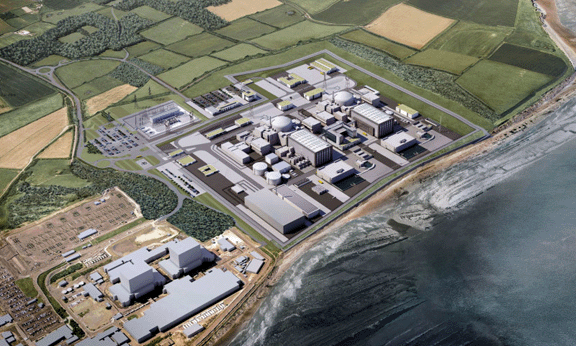 THINK TANK http://tomburke.co.uk/2016/09/15/hinkley-green-light-a-massive-strategic-mistake-says-climate-change-think-tank/ September 15, 2016 by tomburke Following reports today that the Government is about to give the green light to the Hinkley Point C nuclear power station, E3G, a leading climate change think tank said it would be a hugely expensive strategic mistake, using expensive 20th century technology that would soon be obsolete.
E3G Chairman, Tom Burke said: “It is a 20th Century solution to 21st Century problems. Bigger is no longer better. There are faster, cheaper, cleaner and smarter ways to deliver affordable, secure, low carbon electricity to Britain’s consumers.
Nothing about this deal is good for Britain’s hardworking families. They will pay the bill for decades but the jobs will go abroad. It is bad for consumers, bad for the climate and bad for the country.
The Prime Minister is missing a real opportunity to set Britain on course to a more productive and secure future. Instead she has committed us to an expensive and anachronistic energy policy that will leave Britain further behind in a rapidly changing world.”
- E3G sets out below ten reasons why this is a bad deal for British consumers and documents the range of cheaper, smarter, options for low carbon energy security that are better value for money.
HINKLEY POINT : The 10 Mistakes
The Investor Agreement that Greg Clark will sign with EDF is an irrevocable index-linked ‘take or pay’ contract to purchase 35 years’ worth of electricity from EDF at more than twice the current wholesale price. This will cost British consumers £37 billion in subsidy, four times that originally forecast[1]
- This deal binds future governments as well as the current Government. It will prevent Britain’s consumers buying cheaper electricity if it would displace that from EDF.
- It means Britain’s electricity consumers will pay more than £1 billion/year in subsidy to EDF for 35 years.
- The business case for this Agreement has never been subject to informed public scrutiny. The arguments for HPC and the rest of the nuclear programme have never been stress tested.
- The National Audit Office has already raised doubts that it represents value for money in the light of developments, including significant reductions in electricity demand forecasts, since it was first proposed[2].
- The National Infrastructure Commission has identified a package of other measures that could provide affordable, secure, low carbon electricity at lower cost.
- The National Grid has cut its forecast of the need for new centralised generation capacity in Britain by more than 50%, announcing its estimate of growth for decentralised generation was 50 times too low[3]
- EDF’s unions will argue in the French Courts that delaying a Hinkley decision until 2018 would allow for a design review to be completed that would reduce the subsidy needed from £92.50/MWh to £75/MWh[4].
- State Aids clearance for the UK subsidy is under challenge by the Austrian Government and others in the European Court. A further State Aids challenge is likely to the French Government’s re-financing of EDF. If either is successful the deal will fall.
- Hinkley will not produce electricity until 2030. There are cheaper, faster, cleaner and more reliable options available to deliver affordable, secure, low cost electricity to British consumers. These include:
- energy efficiency has reduced electricity demand by 25TWh ( 7% – the same as Hinkley will produce ) since 2010. A McKinsey report for the Government estimates that by 2030 demand could be reduced by a further 23% while reducing consumers bills;
- the National Infrastructure Commission reports that additional interconnectors could supply 2-3 Hinkleys by 2025;
- another National Infrastructure Commission report proposed investment in storage and smart grids that would provide the equivalent of 4 Hinkleys by 2030 and save £8 billion.
- Dong Energy, the world’s largest wind energy company, could replace all Hinkley’s electricity sooner and at lower cost. Offshore wind costs are continuing to fall.
- electricity from solar power is now also cheaper than Hinkley, having fallen by half in the last five years. From almost no solar panels in the UK, a third of a Hinkley has been added since 2010. Half of that was delivered in just 18 month.
- E3G is an independent global think tank, working to accelerate the transition to a low-carbon economy. E3G specializes in climate diplomacy, climate risk, energy policy and climate finance.
- In 2016, E3G was ranked the number one environmental think tank in the UK by the Go To Think Tank Index, second in Europe and sixth in the World.
Low Arctic sea ice in 2016 – close to record low level
These Images Show Near-Record Low 2016 Arctic Sea Ice, Climate Central , By Brian Kahn September 15th, 2016 Arctic sea ice is one of the grandaddy’s of climate indicators. And this grandaddy isn’t doing so good these days.This year’s sea ice extent has bottomed out as the second lowest on record, according to the National Snow and Ice Data Center. It continues a troubling trend as rapidly warming air and water eats away at the briny, frozen mantle on the top of the planet.
2016’s Arctic Sea Ice Melt Season in 9 Seconds
This year has been exceptional by many standards. March saw the lowest sea ice maximum ever recorded followed by a string of record low months. The Northwest Passage opened up, allowing a luxury cruise ship to travel from Anchorage to New York. And a freak storm in August turned ice thin and brittle near the North Pole.
Satellites show the last seven months of sea ice and reveal its steep decline this year. The late August breakup is particularly notable. Grist’s Amelia Urry compared the texture of sea ice near the North Pole to curdled milk or an exploded pillow (I’d go with broken glass personally, but to each their own)………
Most of what we tend to talk about with Arctic sea ice comes courtesy of satellites since they’re the most reliable way to monitor such a remote region. Recent research has reconstructed Arctic sea ice data back to 1850 using old ship logs, airplane survey and military records among other sources to provide a longer record than satellite data (though it does come with a little bit more uncertainty). What is certain is that there’s nothing in modern history like the recent string of low Arctic sea ice years we’ve seen.
Sea ice has declined precipitously across the Arctic, but particularly in the Beaufort and Chukchi Sea regions. In the coming decades, sea ice extent is only likely to keep shrinking and could reshape the region’s ecology, economy and ways of life for the plants, animals and people that call the region home. http://www.climatecentral.org/news/2016-low-arctic-sea-ice-20702
1 This Month
Chernobyl: The Lost Tapes – A good documentary on Chernobyl on SBS available On Demand for the next 3 weeks– https://www.sbs.com.au/ondemand/tv-program/chernobyl-the-lost-tapes/2352741955560

of the week–London Campaign for Nuclear Disarmament

Tell the Ukrainian Government to Drop Prosecution of Peace Activist Yurii Sheliazhenko
To see nuclear-related stories in greater depth and intensity – go to https://nuclearinformation.wordpress.com
-
Archives
- April 2026 (139)
- March 2026 (251)
- February 2026 (268)
- January 2026 (308)
- December 2025 (358)
- November 2025 (359)
- October 2025 (376)
- September 2025 (257)
- August 2025 (319)
- July 2025 (230)
- June 2025 (348)
- May 2025 (261)
-
Categories
- 1
- 1 NUCLEAR ISSUES
- business and costs
- climate change
- culture and arts
- ENERGY
- environment
- health
- history
- indigenous issues
- Legal
- marketing of nuclear
- media
- opposition to nuclear
- PERSONAL STORIES
- politics
- politics international
- Religion and ethics
- safety
- secrets,lies and civil liberties
- spinbuster
- technology
- Uranium
- wastes
- weapons and war
- Women
- 2 WORLD
- ACTION
- AFRICA
- Atrocities
- AUSTRALIA
- Christina's notes
- Christina's themes
- culture and arts
- Events
- Fuk 2022
- Fuk 2023
- Fukushima 2017
- Fukushima 2018
- fukushima 2019
- Fukushima 2020
- Fukushima 2021
- general
- global warming
- Humour (God we need it)
- Nuclear
- RARE EARTHS
- Reference
- resources – print
- Resources -audiovicual
- Weekly Newsletter
- World
- World Nuclear
- YouTube
-
RSS
Entries RSS
Comments RSS
 nuclear-news