Typhoons cause ‘ice wall’ to melt at Fukushima nuclear plant
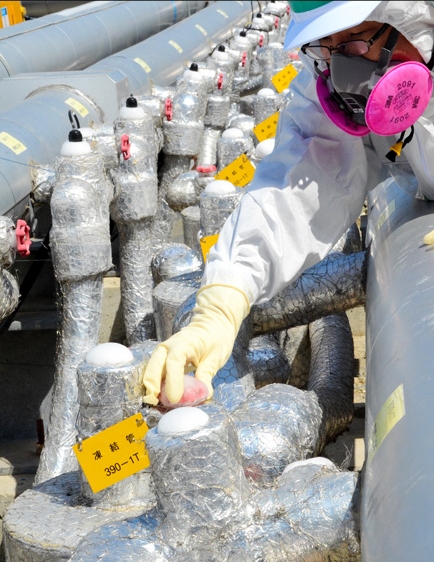
Workers examine pipes for the wall of frozen soil at the embattled Fukushima No. 1 nuclear power plant.
Rainfall from recent typhoons caused partial melting of the “ice wall” at the Fukushima No. 1 nuclear plant, allowing highly radioactive water to leak from around the damaged reactor buildings, the plant’s operator said Sept. 1.
Tokyo Electric Power Co. said melting occurred at two sections of the ice wall, which is designed to divert groundwater away from the reactor buildings.
TEPCO officials believe that during the latest typhoon, contaminated water from around the reactor buildings flowed through openings of the ice wall created by the deluge and reached downstream toward the sea.
The groundwater level near a seaside impermeable wall temporarily rose to 28 centimeters below the ground surface when Typhoon No. 10 passed the area on Aug. 30.
Before the typhoon hit, the water level was 35 cm below the surface.
Around 5.5 cm of rainfall a day fell in the area when the typhoon hit.
The groundwater level, however, actually rose by 7 cm, although 740 tons of groundwater was pumped out of the section.
“If there had been an additional 15 cm of rain, (the contaminated water) could have poured out over the ground surface” and spilled into the sea, a TEPCO official said Sept. 1.
The Meteorological Agency’s initial forecast said Typhoon No. 10 would bring a maximum 20 cm of rain a day at some locations in the Tohoku region.
The 34.5-billion-yen ($335 million) frozen wall was completed in spring to prevent groundwater from entering the reactor buildings and mixing with highly radioactive water.
TEPCO admitted the underground wall of frozen dirt is not working.
The company said the temperatures at the two sections of the frozen wall have climbed above zero since Typhoon No. 7 approached Fukushima Prefecture on Aug. 17.
The company believes that the partial melting was caused by the influx of water brought by the typhoons and heavy rain in between.
TEPCO plans to freeze the wall again by pouring chemicals into pipes that extend underground.
1 Comment »
1 This Month


18 March Webinar @ 1 PM EST: An Assessment of SMR Projects: The Case of Canada
register for the zoom:
https://us02web.zoom.us/webinar/register/WN_o8BIIOUvQ2ONJR1nta65DQ#/registration


of the week – STOP SMALL MODULAR REACTORS IN CANADA
To see nuclear-related stories in greater depth and intensity – go to https://nuclearinformation.wordpress.com
-
Archives
- March 2026 (146)
- February 2026 (268)
- January 2026 (308)
- December 2025 (358)
- November 2025 (359)
- October 2025 (376)
- September 2025 (258)
- August 2025 (319)
- July 2025 (230)
- June 2025 (348)
- May 2025 (261)
- April 2025 (305)
-
Categories
- 1
- 1 NUCLEAR ISSUES
- business and costs
- climate change
- culture and arts
- ENERGY
- environment
- health
- history
- indigenous issues
- Legal
- marketing of nuclear
- media
- opposition to nuclear
- PERSONAL STORIES
- politics
- politics international
- Religion and ethics
- safety
- secrets,lies and civil liberties
- spinbuster
- technology
- Uranium
- wastes
- weapons and war
- Women
- 2 WORLD
- ACTION
- AFRICA
- Atrocities
- AUSTRALIA
- Christina's notes
- Christina's themes
- culture and arts
- Events
- Fuk 2022
- Fuk 2023
- Fukushima 2017
- Fukushima 2018
- fukushima 2019
- Fukushima 2020
- Fukushima 2021
- general
- global warming
- Humour (God we need it)
- Nuclear
- RARE EARTHS
- Reference
- resources – print
- Resources -audiovicual
- Weekly Newsletter
- World
- World Nuclear
- YouTube
-
RSS
Entries RSS
Comments RSS
 nuclear-news
[…] Even though much less rain fell than predicted, it reportedly still had a serious impact on the Fukushima area. Bags filled with radioactive soil sit in floodwater in Iitate, Fukushima, as seen in pictures here: https://nuclear-news.net/2016/09/01/after-typhoon-lionrock-landed-in-fukushima And, the water appears to have caused the ice wall to partially melt at Fukushima, allowing “highly radioactive water to leak from around the damaged reactor buildings“, the Asahi Shimbun cites TEPCO as saying: https://nuclear-news.net/2016/09/02/typhoons-cause-ice-wall-to-melt-at-fukushima-nuclear-plant/ […]
Pingback by Typhoon Lionrock Unveils Evacuation Failures in Japan as Typhoon Namtheun Barrels Toward Sendai Nuclear Power Station and Earthquakes Strike Near It and Offshore from Fukushima | Mining Awareness + | September 2, 2016 |