
The government is considering scrapping the troubled Monju fast-breeder reactor after calculating that readying it for restart would cost several hundred billion yen, sources said Monday.
A political decision on decommissioning the reactor is now in sight, with Chief Cabinet Secretary Yoshihide Suga joining talks to determine its fate, the sources said.
The facility in Fukui Prefecture has been beset by safety problems and has only been operational for a total of 250 days since it first went critical in 1994.
Decommissioning Monju would deal a serious blow to the nation’s vaunted fuel cycle policy, in which the reactor was designed to play a central role. The plan is to develop a commercial fast-breeder reactor that produces more plutonium than it consumes.
The science ministry has been trying to find a new entity to run the reactor, which is currently operated by the government-backed Japan Atomic Energy Agency.
The ministry was ordered to do this by the Nuclear Regulation Authority in November, after the NRA expressed exasperation with the operator’s consistent failure to make the plant a success.
Nuclear safety has been a hot-button issue in Japan in the wake of the disaster in 2011 at the Fukushima No. 1 nuclear plant.
The ministry has been consulting a panel of energy experts on whether to keep Monju alive or to scrap it but has failed to identify a new entity to take over management.
In either case, substantial amounts of money are needed. The agency estimated in 2012 that it would cost around ¥300 billion to scrap the reactor in a process lasting over 30 years.
Safety problems included a major fire caused by a sodium leak in 1995.
The total of 250 operational days has come at a cost of more than ¥1 trillion in building and maintenance costs.
If Monju restarts operations, the ministry says its fuel must be replaced. In the event of a restart, new guidelines for fast-breeder reactors must also be created and any related construction will have to reflect these guidelines.
Making the building’s facilities meet the new guidelines will likely cost nearly ¥100 billion, the sources said, adding there would be further expenses for replacing old equipment.
http://www.japantimes.co.jp/news/2016/08/29/national/japan-considers-scrapping-fast-breeder-reactor-costs-mount/#.V8TSUu1VK1F
August 30, 2016
Posted by dunrenard |
Japan | Fast Breeder Reactor, Monju Reactor, Scrapping |
Leave a comment
Meanwhile, problems still persist at the nuclear plant, most notably with the ‘highly contaminated’ water being stored in tanks at the site

That includes costs for radioactive decontamination and compensation payments, the Japan Times reported.
The public cost of cleaning up the 2011 Fukushima Daiichi nuclear plant disaster topped ¥4.2 trillion (roughly $628 billion) as of March, and is expected to keep climbing, the Japan Times reported on Sunday.
That includes costs for radioactive decontamination and compensation payments. Tokyo Electric Power Company (TEPCO) will sell off its shares to eventually pay back the cost of decontamination and waste disposal, but the Environment Ministry expects that the overall price of those activities could exceed what TEPCO would get for its shares.
Meanwhile, the taxpayer burden is expected to increase and TEPCO is asking for additional help from the government.
The Times reports:
The government estimates the proceeds from TEPCO share sale at ¥2.5 trillion, but to generate the estimated gain, the TEPCO stock price needs to trade at around ¥1,050, up sharply from current market levels of some ¥360.
In addition, the Environment Ministry expects that the cumulative total of decontamination and related costs could surpass the estimated share proceeds by the March 2017 end of the current fiscal year.
[….] TEPCO and six other power utilities charged their customers at least ¥327 billion in electricity rate hikes after Japan’s worst-ever nuclear accident. Moreover, consumers paid ¥219.3 billion or more for TEPCO, chiefly to finance the maintenance of equipment to clean up radioactive water at the plant and the operation of call centers to deal with inquiries about compensation payments.
Moreover, as Deutsche Welle noted on Monday, problems still persist at the nuclear plant, most notably with the “highly contaminated” water being stored in tanks at the site.
“There are numerous problems that are all interconnected, but one of the biggest that we are facing at the moment is the highly contaminated water that is being stored in huge steel tanks at the site,” Aileen Mioko-Smith, an anti-nuclear activist with the group Green Action Japan, told DW. “They are running out of space at the site to put these tanks, the water that is being generated on a daily basis means they have to keep constructing more, and the ones that are not welded have a history of leaking.”
“The situation with contaminated water at the site is a ticking time bomb and they don’t seem to know what they can do—other than to construct more tanks,” she said.
http://www.commondreams.org/news/2016/08/29/public-cost-fukushima-cleanup-tops-628-billion-and-expected-climb
August 30, 2016
Posted by dunrenard |
Fukushima 2016 | Compensation, Cost, decontamination, Fukushima continuing, Fukushima Daiichi, Payments |
Leave a comment
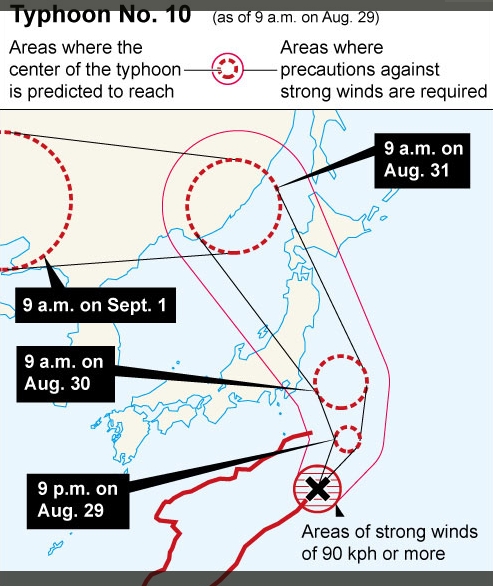
Powerful Typhoon No. 10 is expected to be the first typhoon in at least 65 years to make landfall in the Tohoku region from the Pacific Ocean side on the evening of Aug. 30.
The Japan Meteorological Agency is warning that heavy rains of 80 millimeters or more per hour are expected to fall in some parts of northern Japan, including Tohoku.
The agency is also advising commuters in the Kanto region to take precautions against strong winds and heavy rain on the morning of Aug. 30.
As of noon on Aug. 29, Typhoon No. 10 was advancing in the waters about 340 kilometers southeast of Hachijojima island at a speed of 25 kph. The atmospheric pressure at the center of the typhoon was 945 hectopascals. The maximum wind speed near the center was 162 kph. The maximum momentary wind speed was 216 kph.
Typhoon No. 10 is expected to reach waters about 360 km southeast of Choshi, Chiba Prefecture, in the morning on Aug. 30, although it is expected to slightly weaken by that time.
The typhoon is forecast to make landfall on the Tohoku region later that day and move to the Sea of Japan before dawn on Aug. 31, the agency said.
According to the agency, no typhoons have landed on the Tohoku region from the Pacific Ocean side since statistics became available in 1951.
In the period from Aug. 29 to Aug. 30, the maximum wind speed is expected to be 126 kph in the Tohoku region and 82.8 kph in the Hokkaido and Kanto regions.
The amount of rainfall during the 24-hour period until the morning of Aug. 30 is predicted to be up to 200 mm in the Tohoku and Kanto regions and Yamanashi and Nagano prefectures.
http://www.asahi.com/ajw/articles/AJ201608290030.html
Fukushima nuclear plant prepares for typhoon
The operator of the troubled Fukushima Daiichi nuclear power plant is preparing for the powerful Typhoon Lionrock.
Tokyo Electric Power Company says on Monday workers secured electric cables and hoses.
TEPCO says on Tuesday it will suspend work with cranes and other operations at the plant’s port, which could bear the brunt of strong winds and waves. Depending on weather conditions, the firm may also call off outdoor work in other areas.
It says when the most recent typhoon approached last week, heavy rain caused underground water levels to rise and threatened to flush contaminated water into the harbor.
Workers are arranging pumps to draw up more ground water, and setting up additional pumps at wells used to observe water levels.
There were concerns in the past that a downpour brought by a typhoon could cause contaminated rain water to flow through a drainage channel into the ocean.
To address these fears, TEPCO rerouted the drainage system into the plant’s inside port. It also raised the levels of barriers around tanks that store tainted water.
http://www3.nhk.or.jp/nhkworld/en/news/20160829_22/
Nearing typhoon halts work at Fukushima Daiichi
Workers at the troubled Fukushima Daiichi nuclear plant have suspended some of the decommissioning work and are bracing for rain and winds from a powerful typhoon.
Typhoon Lionrock is expected to make landfall along Japan’s northeastern coast on Tuesday afternoon, passing off Fukushima Prefecture.
Tokyo Electric Power Company says workers secured electric cables and hoses on the plant compound on Monday.
On Tuesday, the operator suspended work at the plant’s port. It also stopped the operation of a crane being used to demolish a temporary cover over one of the reactor buildings. Officials say they are closely watching to make sure the cover is not blown off by the typhoon.
TEPCO says it has also taken measures to prevent contaminated rain water and groundwater from leaking into the ocean.
In past typhoons, it was thought that contaminated rainwater flowed into the ocean through a drainage system. There were also concerns that radioactive groundwater might leak into the ocean as rain could increase the groundwater in the compound.
This time the operator has installed stronger pumps and increased their number.
The utility says as of 11 AM Tuesday, there were no changes in groundwater levels at the plant’s site.
Other measures taken earlier include rerouting the drainage system into the plant’s port instead of directly into the ocean. TEPCO also raised the barriers around tanks that store tainted water.
http://www3.nhk.or.jp/nhkworld/en/news/20160830_26/
August 30, 2016
Posted by dunrenard |
Fukushima 2016 | Fukushima continuing, Fukushima Daiichi, Typhoon |
Leave a comment
Five years after the second-worst nuclear accident in history, contaminated water is still hampering efforts to gain control of the site. Local residents are reluctant to return to their homes. Julian Ryall reports.
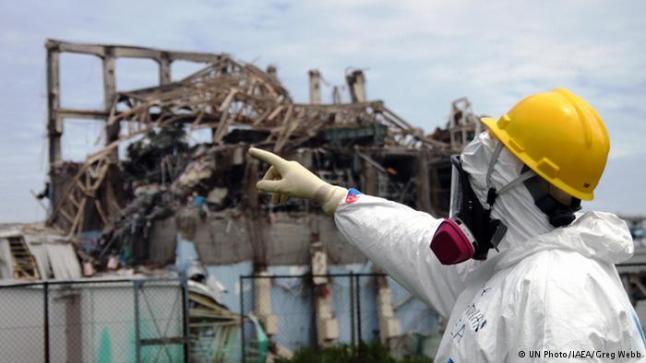
Five years after the second-worst nuclear accident in history, contaminated water is still hampering efforts to gain control of the site. Local residents are reluctant to return to their homes. Julian Ryall reports.
It has been five years and five months since three of the reactors at the Fukushima Dai-ichi nuclear plant were crippled by the biggest earthquake and tsunami to strike Japan in living memory. Work continues at the site to clean up the radioactivity that escaped into the atmosphere and to regain control of the reactors.
In its press releases, the Tokyo Electric Power Co. (TEPCO) insists that steps taken since the accident are slowly but surely having an effect. But not everyone accepts their assurances – or those of the wider nuclear industry as it seeks public support to restart reactors across the country that have been mothballed since March 2011.
“There are numerous problems that are all interconnected, but one of the biggest that we are facing at the moment is the highly contaminated water that is being stored in huge steel tanks at the site,” Aileen Mioko-Smith, an anti-nuclear activist with Kyoto-based Green Action Japan, told DW.
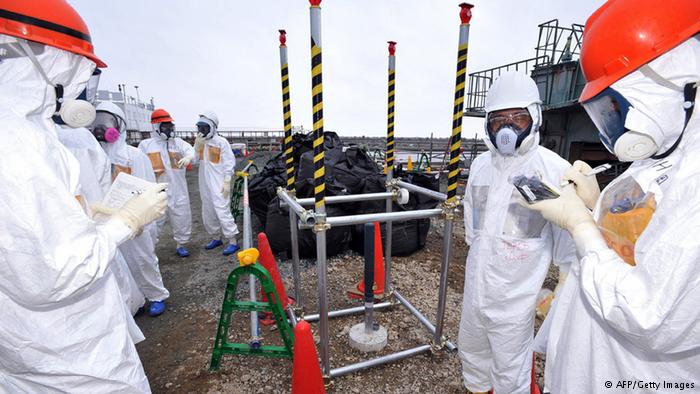
TEPCO insists that steps taken since the accident are slowly but surely having an effect
“They are running out of space at the site to put these tanks, the water that is being generated on a daily basis means they have to keep constructing more, and the ones that are not welded have a history of leaking,” she said.
‘Ticking time bomb’
“The situation with contaminated water at the site is a ticking time bomb and they don’t seem to know what they can do – other than to construct more tanks,” said Mioko-Smith.
Environmental groups are calling for TEPCO and Japan’s Nuclear Regulation Authority (NRA), which oversees the industry here, to come up with a clear plan of action so that they do not simply run out of space and believe there is no option but to release contaminated water into the Pacific Ocean.
TEPCO confirmed earlier this month that an estimated 10,000 tons of radioactive water had collected in underground trenches around the buildings that house reactors one, two, three and four. That was in addition to about 60,000 tons of water that had flooded the basement of the reactor and turbine buildings, according to an official at TEPCO.
“It is accumulating because around 100 tons of water are injected every day in order to keep the reactors in units one, two and three cool,” the official told DW. “But we are also seeing about 150 tons of ground water seeping into those same areas each day.”
While a portion of this water is being treated to remove the radioactivity, the sheer amount of water at the site makes it impossible to keep up with what is required, hence the need for storage tanks.
A panel of experts that is advising the NRA has also declared the effort to construct a frozen wall of earth around the four reactors to stop additional ground water leaking into the site to be a failure.
Frozen wall plan ‘failing’
“The plan to block ground water with a frozen wall of earth is failing,” Yoshinori Kitsuaka, a professor of engineering at Tokyo Metropolitan University and a member of the panel, said in a report. “They need to come up with another solution.”
The TEPCO spokesperson disputes the suggestion that the 34.5 billion yen (307 million euros) ice wall scheme has failed.
“We are still in the process of freezing the entire length of the wall,” the official said. “We started on the side closest to the ocean and now we are moving to the rest of the perimeter on the landward side, but we have to make sure that water levels remain constant so that contaminated water does not flow out from the area around the reactors. There are seven sections of the ice wall that are not frozen yet and we believe we will see the effects after we have completed the whole process.”
These developments have largely failed to arouse the interest of the Japanese media or the public, who have been living with the consequences of the disaster since 2011, although one recent announcement did make the news.
On August 20, the Ministry of Health, Labor and Welfare confirmed that it would provide compensation to a man who developed leukemia after taking part in emergency decontamination efforts at Fukushima immediately after the disaster struck.
The ministry recognized that the man, who is in his 50s but who has not been named, developed cancer due to exposure to radiation at the site, where he worked between April 2011 and January 2015.
The ministry is considering the cases of five additional workers who have applied for compensation to cover their health costs, while a former worker at the site was granted financial assistance in October of last year after contracting leukemia.
‘Making best efforts’
The TEPCO spokesperson says the company is “making its best efforts” to move the recovery process forward to the point at which the final procedure – removing the melted fuel debris from within the reactors – can be achieved. The scale of that problem remains huge, however, as it has never been attempted before.
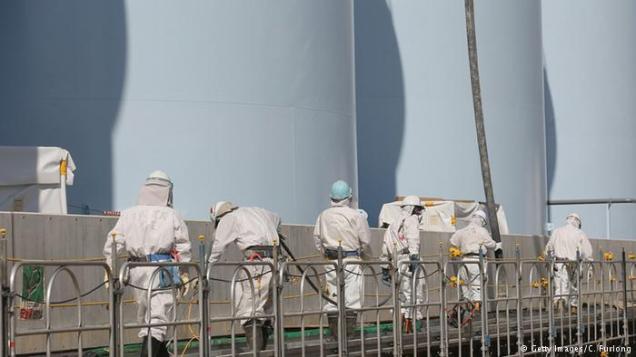
Work continues at the site to clean up the radioactivity
“We anticipate that it will take 30 to 40 years to reach that point as we are trying to do all the clean-up work at the same time as developing the technology to remove the fuel debris,” the official said.
Yet at the same time, the national government is effectively forcing people who were evacuated from their homes close to the plant to return, saying that radioactivity levels are within permissible limits and that housing subsidies and other payments that they have been receiving while unable to work will be terminated.
“Many of these people – especially those with children – do not want to go back to areas that they have been told are safe,” said Mioko-Smith, adding that there was a lack of trust in the government’s promises.
“They feel that everything is being driven by the upcoming Olympic Games and that the government has to live up to its promise to the world that everything will be back to normal by 2020 and the Tokyo Games,” she said.
http://m.dw.com/en/problems-persist-at-japans-crippled-fukushima-nuclear-reactors/a-19510555
August 30, 2016
Posted by dunrenard |
Fukushima 2016 | Catastrophe, Fukushima Daiichi, Problems |
Leave a comment
Published on 22 August 2016
Abstract
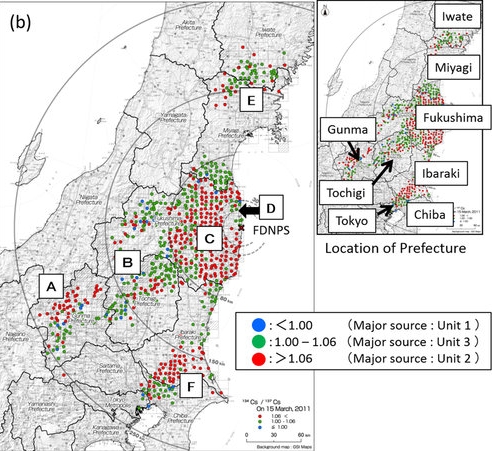
The Fukushima Daiichi nuclear power reactor units that generated large amounts of airborne discharges during the period of March 12–21, 2011 were identified individually by analyzing the combination of measured 134Cs/137Cs depositions on ground surfaces and atmospheric transport and deposition simulations. Because the values of 134Cs/137Cs are different in reactor units owing to fuel burnup differences, the 134Cs/137Cs ratio measured in the environment was used to determine which reactor unit ultimately contaminated a specific area. Atmospheric dispersion model simulations were used for predicting specific areas contaminated by each dominant release. Finally, by comparing the results from both sources, the specific reactor units that yielded the most dominant atmospheric release quantities could be determined. The major source reactor units were Unit 1 in the afternoon of March 12, 2011, Unit 2 during the period from the late night of March 14 to the morning of March 15, 2011. These results corresponded to those assumed in our previous source term estimation studies. Furthermore, new findings suggested that the major source reactors from the evening of March 15, 2011 were Units 2 and 3 and that the dominant source reactor on March 20, 2011 temporally changed from Unit 3 to Unit 2.
Introduction
Since 2011, we have been estimating the source term—temporal changes in atmospheric release rates (Bq/h) of radionuclides—caused by the Fukushima Daiichi nuclear power station (FDNPS) accident using a reverse estimation method that combines atmospheric dispersion simulation and environmental monitoring data1,2,3,4,5. Many international researchers have also tried the source term estimation and model simulation of atmospheric dispersion of radionuclides during the accident. The United Nations Scientific Committee on the Effects of Atomic Radiation (UNSCEAR) summarized sixteen results on source term estimation (Table B2 of UNSCEAR 2013 Report6). It described that the source term estimated by Terada et al.3 (which is the one from our previous study) provided a sound basis for estimation of the levels of radioactive material in the terrestrial environment where prior measurements did not exist and actually the dispersion and deposition of released material modeled by the World Meteorological Organization (WMO) based on the source term by Terada et al.3 could replicate the broad pattern of deposition density of 137Cs over the Japanese land mass. We also summarized a number of international papers lately that have carried out the source term estimation and numerical analysis of atmospheric dispersion process of radionuclides released during the accidents (Table 1 of Katata et al.5).
The accuracy of our previous study’s latest source term increased with gradual increases in the number of monitoring data after the accident and improvement of our team’s numerical simulation model that included a sophisticated atmospheric deposition scheme5. The calculated ground-shine due to the large deposition event of March 15–16, 2011 agreed with observed data within a factor of 2 at most of the monitoring points, and the model also reproduced the spatial distribution of the airborne survey’s air dose rate and 137Cs surface deposition within a factor of 5. Therefore, the simulation results of the spatiotemporal patterns of 137Cs surface deposition have enough accuracy to compare with the observed 134Cs/137Cs ratio, though some discrepancies between simulation and observation occurred because of model simulation uncertainties. Using the latest source term in Katata et al.5, several atmospheric dispersion simulations by the National Oceanic and Atmospheric Administration (NOAA), USA, Canadian Meteorological Centre (CMC), and Met Office, UK, were successfully able to reproduce the measured surface contamination distribution and time series in air concentrations of radionuclides regardless of model structure and meteorological input data5. UNSCEAR also reported for Katata et al.5 that in any further or updated assessment, the committee would recommend the use of the latest estimate as “preferential”7.
While the timing and quantities of major atmospheric releases during the FDNPS accident had been estimated, the relationships between these releases and their specifically correlated reactor units have still not been clarified. During the period of March 12–15, 2011, the temporal rises in air-dose rates measured by a monitoring car at the FDNPS boundary were partially connected to the events that occurred in the reactors8. However, after March 15, 2011, although only a few studies investigated the potential reasons why the atmospheric releases continued for such a long period afterward9,10, the precise rationale behind the event still has not been verified definitively.
Therefore, this paper focuses on the reactor units that generated large 137Cs atmospheric releases during the period of March 12–21, 2011.
To read more :
http://www.nature.com/articles/srep31376
August 30, 2016
Posted by dunrenard |
Fukushima 2016 | Atmospheric Releases, Fukushima Daiichi, March 2011, reactors |
Leave a comment
We invite all people, groups and organizations involved in the effort for a world without nuclear fission and uranium mining, to commit themselves to this effort. We also ask them to endorse this declaration and to transmit it widely in their networks.
This declaration is partly inspired by the Tokyo Appeal issued by the First Thematic World Social Form for a Nuclear-Free World held in Tokyo and Fukushima in March 2016.
People and organizations who wish to sign this statement should write to ccnr@web.ca, indicating their e-mail addresses and country.
http://www.globalresearch.ca/montreal-declaration-for-nuclear-fission-free-world/5542890 By Countercurrents.org Global Research, August 28, 2016 By Global Network for a nuclear-free world.
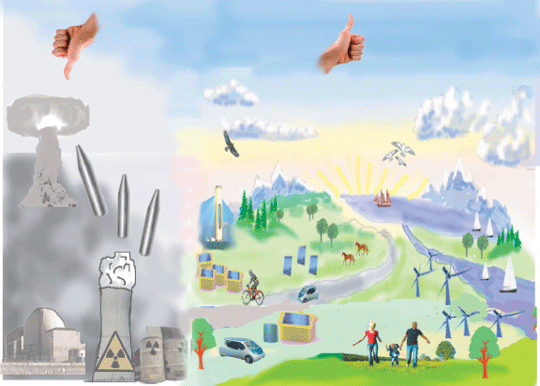
As citizens of this planet inspired by the Second Thematic World Social Forum for a Nuclear-Fission-Free World, conducted in Montreal from August 8 to August 12, 2016, we are collectively calling for a mobilization of civil society around the world to bring about the elimination of all nuclear weapons, to put an end to the continued mass-production of all high-level nuclear wastes by phasing out all nuclear reactors, and to bring to a halt all uranium mining worldwide.
This call goes out to fellow citizens of all countries worldwide who see the need, whether as an individual or as a member of an organization, for a nuclear-fission-free world. We are committed to building a global network of citizens of the world who will work together, using the internet and social media to overcome isolation, to provide mutual support and to coordinate the launching of joint actions for a world free of nuclear fission technology, whether civilian or military.
We will begin by creating communication channels to share information and educational tools on legal, technical, financial, medical, and security-related matters linked to military and non-military nuclear activities. We will pool our resources across national boundaries in a spirit of cooperation, allowing us to contribute to the formulation of a convergent and unified response to counteract the plans of the nuclear establishment that operates on a global scale to multiply civil and military nuclear installations worldwide and to dump, bury and abandon nuclear wastes.
We recognize each nuclear weapon as an instrument of brutal and unsurpassed terror, designed to kill millions of innocent men, women and children at a single stroke. We realize that even a limited nuclear war can provoke sudden extreme climate change on a global scale, crippling agricultural production and threatening the survival of all higher forms of life. We are grimly aware that a nuclear-armed world will surely destroy itself and set in motion a process that will undo four billion years of evolution. We are determined to help guide the world away from the brink of nuclear annihilation.
We recognize each nuclear reactor as a repository of the most pernicious industrial waste ever known; waste so radioactive that it spontaneously melts down if not continually cooled; waste that, when targeted by terrorists or saboteurs, or by conventional warfare, will render large portions of the earth uninhabitable for centuries; waste that contains material that can be used as a nuclear explosive at any time in the future, for thousands of years to come.
We recognize uranium as the key element behind all nuclear weapons and all nuclear reactors, and we endorse the call by the International Physicians for the Prevention of Nuclear War and by the 2015 Quebec World Uranium Symposium for a total global ban on the mining and processing of uranium.
We will use our networks
- to pressure governments everywhere to put an end to nuclear fission;
- to expose the dangers associated with the export and transport of nuclear materials and nuclear waste;
- to puncture the myths used to prop up and justify our irrational nuclear addiction;
- to tell the sobering stories of nuclear victims and nuclear refugees;
- to emphasize our moral responsibilities not to burden future generations with a poisonous nuclear legacy;
- to warn governments without nuclear facilities to realize the dangers and avoid becoming enmeshed in this technology;
- to disseminate the findings of engineers, doctors, biologists, ecologists, physicists and concerned citizens having special knowledge and appreciation of nuclear dangers;
- to promote and popularize the wide variety of renewable energy alternatives that are green and sustainable;
- to launch lawsuits and to support whistle-blowers to halt the most egregious examples of nuclear malfeasance;
- to promote non-violent conflict resolution, and
- to denounce the illegal, immoral, and insane obsession with nuclear weapons arsenals.
We invite all people, groups and organizations involved in the effort for a world without nuclear fission and uranium mining, to commit themselves to this effort. We also ask them to endorse this declaration and to transmit it widely in their networks.
This declaration is partly inspired by the Tokyo Appeal issued by the First Thematic World Social Form for a Nuclear-Free World held in Tokyo and Fukushima in March 2016.
People and organizations who wish to sign this statement should write to ccnr@web.ca, indicating their e-mail addresses and country.
August 29, 2016
Posted by Christina Macpherson |
ACTION |
Leave a comment
 The 10 most startling facts about climate in 2015 — the warmest year on record [excellent maps and graphs] WP, By Jason Samenow August 2 Last year was unequivocally the warmest year on record for Earth. The National Oceanic and Atmospheric Administration Tuesday released a 300-page report documenting the historic warmth as well as scores of other aspects of 2015’s climate.
The hefty report, State of the Climate in 2015, was produced by more than 450 scientists from 62 countries around the world — more than any previous edition.
Every single direct indicator of temperature described in the report leaves no doubt that 2015’s global surface temperature towered over any year preceding it. Numerous other climate indicators related to temperature exhibited characteristics consistent with such historic warmth.
2015’s exceptional warmth was fueled by a record-challenging El Niño event, in which warmer-than-normal tropical Pacific Ocean waters infused heat into the atmosphere, and by record-setting concentrations of heat-trapping gases from human activity.
Here are the 10 most impressive findings from this report:
1. The global temperature was the highest on record…….
2. The average ocean surface temperature was warmest on record…..
3. Upper ocean heat content was highest on record…..
4. Global sea level was highest on record…..
5. The El Niño event was among the strongest on record……
6. Greenhouse gases were highest on record……
7. Record number of major tropical cyclones in Northern Hemisphere…….
8. Arctic sea ice had its lowest maximum extent……
9. Glaciers continued shrinking….
10. Extreme temperatures were most extreme on record……
The report is available online and will be published by the Bulletin of the America Meteorological Society. https://www.washingtonpost.com/news/capital-weather-gang/wp/2016/08/02/the-10-most-startling-facts-about-climate-in-2015-the-warmest-year-on-record/
August 29, 2016
Posted by Christina Macpherson |
2 WORLD, climate change |
Leave a comment
Report Shows Whopping $8.8 Trillion Climate Tab Being Left for Next Generation
26 August 2016 http://www.skepticalscience.com/9-trillion-climate-tab.html This is a re-post from Common Dreams by Lauren McCauley
“We do not inherit the Earth from our ancestors, we borrow it from our children,” is an oft-quoted proverb, frequently used to explain the importance of environmental preservation. Unsaid, however, is how much it will impact the next generation if the Earth is bequeathed in a lesser state.
Environmental campaigners NextGen Climate and public policy group Demos published a new study that attempts to quantify the true cost of not addressing climate change to the millennial generation and their children.
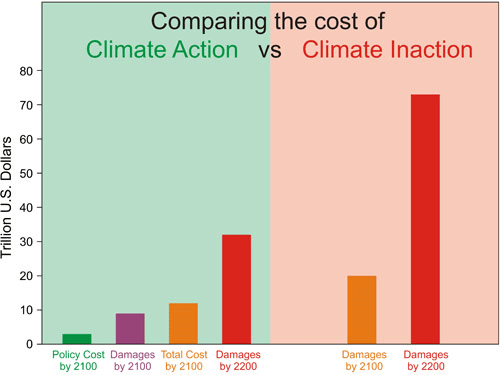
The Price Tag of Being Young: Climate Change and Millennials’ Economic Future (pdf) compares some of the high costs millennials will face in the “new inequality economy”—such as student debt, child care costs, stagnant wages, as well as financial and job insecurity—against the fiscal impacts of unmitigated global warming.
“The fact is,” the report states, “unchecked climate change will impose heavy costs on millennials and subsequent generations, both directly in the form of reduced incomes and wealth, and indirectly through likely higher tax bills as extreme weather, rising sea levels,drought, heat-related health problems, and many other climate change-related problems take their toll on our society.”
The impacts from climate costs alone, the report finds, are “comparable to Great Depression-era losses.” The study employs a model developed by researchers from Stanford University and University of California at Berkeley that measures the effects of rising temperatures on long-term economic growth and national productivity drawing on 50 years of data from 166 countries.
“no climate action” scenario found that by 2100 global per capita GDP will shrink by 23 percent relative to a scenario without climate change. The U.S. is estimated to take a 5 percent hit by 2050 that jumps to 36 percent by 2100 should no climate action occur.
This adds up to a loss of nearly $8.8 trillion in lifetime income for millennials and tens of trillions for their children.
“For the millennial generation, today’s status quo on climate and inequality is not only unjust but it is also unsustainable.”
In comparison, the cost of climate inaction overshadows the significant losses from other economic burdens, such as student debt. The report states:
According to Demos calculations, for a median- earning college graduate with median student debt, the lifetime wealth loss due to student debt is approximately $113,000, which is 40 percent less than the $187,000 lifetimewealth loss of a college- educated, median-earning 21-year-old if we fail to act on climate change.
But when these myriad forces are stacked together, they add up to a staggering burden. The report further highlights how climate inaction only exacerbates preexisting inequality:
Communities of color and low-income communities will be hit the hardest, as these communities have fewer resources to deal with the impacts of climate change […]. Further, these same communities have always had the highest exposure to coal-burning power plants and other sources of fossil fuel pollution, with sharply negative health impacts […]
If the transition to a clean energy economy is delayed, or if it is implemented unequally in keeping with historical patterns of racial exclusion, the fossil fuel economy will only deepen its toll on the health and well-being of America’s poorest and most vulnerable communities.
What’s more, the report notes, “the economic risks are compounded even further since inaction on climate change means that we are missing out on a major opportunity for much-needed new investment and millions of new jobs by transitioning to clean energy.”
August 29, 2016
Posted by Christina Macpherson |
2 WORLD, business and costs, climate change |
Leave a comment
08/28/2016 DUBAI, Aug 28 (Reuters) – Iran has arrested a member of the negotiating team that reached a landmark nuclear deal with world powers on suspicion of spying, a judiciary spokesman said on Sunday.
The suspect was released on bail after a few days in jail but is still under investigation, Gholamhossein Mohseni Ejei said at a weekly news conference, calling the unidentified individual a “spy who had infiltrated the nuclear team,” state media reported.
The deal that President Hassan Rouhani struck last year has given Iran relief from most international sanctions in return for curbing its nuclear program, but it is opposed by hardliners who see it as a capitulation to the United States.
Ejei was responding to a question about an Iranian lawmaker’s assertion last week that a member of the negotiation team who had dual nationality had been arrested on espionage charges.
Tehran’s prosecutor general on Aug. 16 announced the arrest of a dual national he said was linked to British intelligence, but made no mention of the person being in the nuclear negotiations team. On Sunday, Ejei did not explicitly confirm that the arrested person had a second nationality.
Britain said on Aug. 16 that it was trying to find out more about the arrest of a joint-national.
August 29, 2016
Posted by Christina Macpherson |
Iran, secrets,lies and civil liberties |
Leave a comment
 Hinkley supporters in last-ditch push for approval Union leaders call for an end to ‘faffing’ over £18bn scheme, Ft.com by: Andrew Ward and Jim Pickard in London, 28 Aug 16
Supporters of the proposed Hinkley Point nuclear power station have launched a last-ditch push for approval as Theresa May, prime minister, nears a decision on whether to go ahead with the £18bn project.
UK union leaders on Sunday called for an end to the “faffing” over a scheme they say is crucial to keeping Britain’s lights on, after EDF, the French company planning to build the Somerset plant, sought to ease security concerns over Chinese involvement.
The comments signalled a fight back against critics of Hinkley, whose arguments have appeared to be in the ascendancy since Mrs May ordered a review of the politically sensitive project last month………https://www.ft.com/content/216e2eb0-6d14-11e6-9ac1-1055824ca907
August 29, 2016
Posted by Christina Macpherson |
politics, UK |
Leave a comment
 Terror fears after series of security breaches at nuclear power stations, Herald Scotland Neil Mackay , 28 Aug 16, THE police force charged with guarding UK nuclear power plants has admitted to a substantial increase in the number of breaches of security last year.
There were 21 separate incidents involving stolen or lost smart phones and identity cards, up from 13 the previous year.
In one case a Blackberry was taken in a “domestic burglary”, and in another a SIM card was “accidently thrown in disposal chute at home address.” Emails containing sensitive information, including an armoury access code and personal data, were sent in breach of security protocols.
“Terrorists must be delighted with this catalogue of cock-ups,” said Dr Richard Dixon, director of Friends of the Earth Scotland.
“It seems you just have to follow some nuclear police around for a while and they’ll drop their pass in a car park, leave a work phone on the train or accidentally send secret info through Google mail. It would be laughable if it wasn’t about the safety of some of the most dangerous sites in the UK.”
The revelations uncovered by the Sunday Herald have been condemned as well as prompting alarm from campaigners and politicians. They point out that there have recently been concerns about Chinese state companies stealing nuclear industry secrets.
One of the reasons why the Prime Minister Theresa May is thought to have delayed a decision last month on a long-planned £18 billion nuclear power station at Hinkley Point in Somerset is the 33 per cent stake by the China General Nuclear Power Company. The company has been charged with nuclear espionage by the US government.
The Civil Nuclear Constabulary (CNC) is responsible for policing 11 nuclear sites across the UK. They include three in Scotland – the former fast reactor establishment at Dounreay in Caithness and the nuclear power stations at Hunterston in North Ayrshire and Torness in East Lothian.
The CNC has an annual budget of £100 million and 1,100 armed police officers with access to eight different weapons systems. Its latest annual report, published online, disclosed the 21 security breaches in the year to this April, compared to 13 in 2014-15.
Five were categorised as “loss or theft of protectively marked electronic equipment, devices or paper documents from outside secured CNC premises”. A further six breaches were “unauthorised disclosure through insecure transmission of protectively marked documents”. Ten more were said to be “low-level…….
Dr David Lowry, a senior research fellow at the US Institute for Resource and Security Studies, also highlighted security concerns about Chinese involvement. “It sets alarm bells ringing that so many security failures could have happened at a time when there are plans to expand the UK nuclear industry,” he said.
Lowry pointed out that the government watchdog, the Office for Nuclear Regulation, had stated in its 2015-16 annual report that there were areas where security arrangements at nuclear plants “did not fully meet regulatory expectations”……..http://www.heraldscotland.com/news/14709247.Terror_fears_after_series_of_security_breaches_at_nuclear_power_stations/
August 29, 2016
Posted by Christina Macpherson |
safety, UK |
Leave a comment
At San Onofre, spent nuclear fuel is getting special tomb Orange County Register, Aug. 28, 2016 ,By TERI SFORZA “……..Once, San Onofre was a marvel of modern engineering – splitting atoms to create heat, boiling water to spin turbines and creating electricity that fulfilled 18 percent of Southern California’s demand. Now, it’s a demolition project of mind-boggling proportions, overseen by a dozen government agencies.
It’s expected to cost $4.4 billion, take 20 years and leave millions of pounds of spent nuclear fuel on the scenic bluff beside the blue Pacific until 2049 or so, because the federal government has dithered for generations on finding a permanent repository.
In this vacuum, contractors from Holtec International – one of only a handful of companies licensed by the Nuclear Regulatory Commission to do dry-cask radiation storage in the U.S. – are at work. Construction of the controversial “concrete monolith” to protect San Onofre’s stranded waste has begun, over the protests of critics who decry a “beachfront nuclear waste dump.”
THE MONOLITH
The reinforced concrete pad that will support the monolith is finished.
Last week, Holtec workers used cranes and trucks to maneuver the first of 75 giant tubes into place atop it. When those tubes are bolted in, concrete will be poured up to their necks, and they’ll be topped off with a 24,000-pound steel-and-concrete lid. Earth will be piled around it so that it looks something like an underground bunker.
Southern California Edison, which operates the plant, would not share the Holtec contract or reveal its price tag, but San Onofre’s owners have recovered more than $300 million from the federal government for its failure to dispose of nuclear waste, which is why dry-cask storage must be built in the first place. San Onofre’s decommissioning plan sets aside $1.27 billion for future spent fuel management.
This is one of the first newly licensed Hi-Storm Umax dry-cask storage systems Holtec is building in the United States. Once it’s complete – expected to be late next year – workers will begin the deliberate and delicate dance of removing all spent fuel from cooling pools beside each reactor.
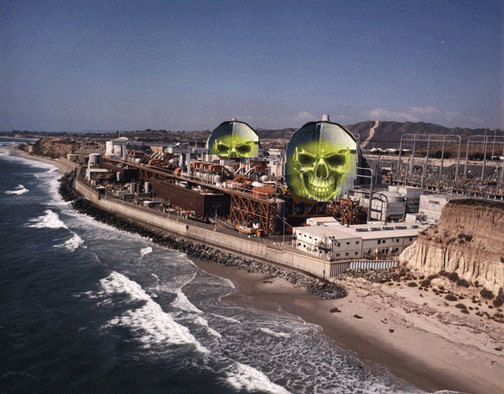
The iconic twin domes you see from the highway and the beach don’t reveal their enormity. They stand as tall as a 13-story building, and the adjacent pools holding their spent fuel are 25 feet wide, 60 feet long, about 40 to 50 feet deep and hold a half-million gallons of water.
When Southern California Edison begins removing the 2,668 fuel assemblies chilling there, bays to those enormous pools will open. Holtec storage canisters will be lowered in. Underwater, 37 spent fuel assemblies will be loaded into each canister and capped. The canister will be slipped into a “transfer cask,” lifted from the pool and drained.
Then it will be loaded onto a truck, driven a few hundred yards to the Umax and lowered into one of those 75 tubes. The waste-filled canister will remain inside. The transfer cask will be removed. The tube will be capped.
This will be repeated more than 70 times, until all the fuel in the more vulnerable pools is entombed in more stable dry-cask storage. That’s slated to be done by mid-2019.
TECHNOLOGY
The system will become something of a real-time experiment: Edison is partnering with the Electric Power Research Institute to develop inspection techniques to monitor the casks as they age. The casks’ integrity over time, while holding hotter “high burn-up” fuel, is a major concern of critics.
“Burn-up” – i.e., the amount of uranium that undergoes fission – has increased over time, allowing utilities to suck more power out of nuclear fuel before replacing it, federal regulators say. It first came into wide use in America in the latter part of the last century, and how it will behave in short-term storage containers (which, pending changes in U.S. policy on nuclear cleanup, must be used for longer-term storage) remains a topic of debate……..
ry-cask technology is not new, he said. Nuclear power plants in the U.S. have used it since 1986, and an analysis by the Electric Power Research Institute found that it would take at least 80 years before a severe crack could form in a dry storage canister.
The Umax uses the most corrosion-resistant grade of stainless steel; its design exceeds California earthquake requirements, and it protects against hazards such as water, fire or tsunamis.
Critics cast skeptical eyes on those claims.
They don’t disagree that dry storage is safer than the spent fuel pools, but activist Donna Gilmore says officials gloss over the potential for serious cracking – a bigger risk in a moist, salty, oceanfront environment such as San Onofre.
Once a crack starts, it would continue to grow through the wall of the canister, undetected, until it leaked radiation, Gilmore said.
Other countries use thicker-walled casks than those licensed in America, and she believes we should, too.
EYES FORWARD
What everyone wants is to remove the ensconced “stranded waste” from San Onofre as soon as possible, and the only way that can happen is if the federal government takes action.
Palmisano said energy is best expended pushing that forward, not arguing over canisters.
On that front, he is cautiously optimistic.
In January, the U.S. Department of Energy launched a new push to create temporary nuclear waste storage sites in regions eager for the business, currently in West Texas and New Mexico. Several of those could be up and running while the prickly question of coming up with a permanent site is hashed out.
There could be a plan, and a place, for this waste within the next 10 years, Palmisano said – but that would require congressional action, which in turn would likely require much prodding from the public.
“We are frustrated and, frankly, outraged by the federal government’s failure to perform,” he said. “I have fuel I can ship today, and throughout the next 15 years. Give me a ZIP code and I’ll get it there.”…..http://www.ocregister.com/articles/nuclear-727227-fuel-storage.html
August 29, 2016
Posted by Christina Macpherson |
Reference, USA, wastes |
Leave a comment
The great nuclear disarmament divide, “……On the one hand, there are umbrella states that are addicted to their nuclear protection, and on the other, there are umbrella states that clearly feel trapped by it, Livemint, 29 Aug 16 W.P.S. Sidhu, Austria, which remained neutral and nuclear weapon-free during the Cold War, has become the leading anti-nuclear crusader in the post-Cold War era. Last year, Austria, along with a group of non-nuclear countries—mostly from the southern hemisphere and Africa, which is entirely covered by nuclear weapon-free zones—proposed several United Nations General Assembly (UNGA) resolutions including on the humanitarian consequences of nuclear weapons. One of the significant Austrian co-sponsored resolutions proposed an open-ended working group (OEWG) to take forward multilateral disarmament negotiations.
Although this resolution was overwhelmingly supported by 138 countries, the five permanent nuclear weapon states of the UN Security Council plus Israel voted against it. While India and Pakistan abstained, North Korea, curiously, supported the resolution. Significantly, 34 states—mostly members of the North Atlantic Treaty Organization (Nato) and those protected by the US nuclear umbrella—also abstained.
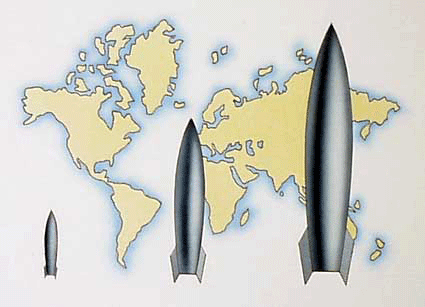
Subsequently, while all nine nuclear-armed states (including India) stayed away from the OEWG deliberations in Geneva, the group made substantial progress. By 19 August, the group’s final report had drafted far-reaching recommendations, including a call to initiate negotiations in 2017 on a legal instrument to prohibit nuclear weapons—unlike biological and chemical weapons, nuclear weapons have never been banned. There were indications that this report would be carried by consensus among the states participating in the OEWG. Clearly, a consensus report recommending a treaty to ban nuclear weapons outright would be anathema not only for the nuclear armed states but also the so-called ‘umbrella states’, which depend on the nuclear protection particularly of the US. Thus, the nuclear-armed states sought to influence the OEWG process by proxy.
Enter Australia. In the past, Australia played a leading role in pushing disarmament initiatives, for instance, when it resurrected the Comprehensive Test Ban Treaty in 1996 and co-sponsored an International Commission on Nuclear Non-proliferation and Disarmament in 2008. However, this is at odds with its dependence on nuclear weapons.
As an umbrella state, it depends on the perceived security of US nuclear weapons. In the OEWG, Australia became a proxy of nuclear weapon states and a disarmament spoiler: it called for a vote on the group’s final report even though it was evident that the majority would support the report’s recommendations.
Australia’s objective was two-fold: first, to break the emerging consensus and, second, to close ranks among all the umbrella states. Australia almost succeeded in its second goal. Although 19 Nato states plus Australia and South Korea voted against the report, several other Nato members plus Japan abstai-ned, indicating that not all umbrella states are willing to sustain nuclear weapons and deterrence in perpetuity.
The OEWG process reflects a great disarmament divide not only among the nuclear haves and have-nots, but also among the umbrella states. On the one hand, there are umbrella states that are addicted to their nuclear protection, even though it is not apparent that such security is omnipotent. On the other hand, there are umbrella states that clearly feel trapped by the protection provided, but are unsure how get out of this situation. This debate will now play out on the floor of the UNGA…..http://www.livemint.com/Opinion/4smGv8MNF3hg63Y1WpRzQL/The-great-nuclear-disarmament-divide.html
August 29, 2016
Posted by Christina Macpherson |
2 WORLD, politics international, weapons and war |
Leave a comment
 Can progress on climate change keep up with its quickening pace? WP, By Tom Steyer August 26 Tom Steyer is founder of the advocacy group NextGen Climate. July was the hottest month in recorded history, by a lot, and August isn’t looking any better. So how do we interpret that? What does it mean?
…. global climate change… may be happening faster than scientists previously predicted. Monthly global average temperatures have set records in each of the past 15 months . The concomitant climate events have been extreme: from wildfires burning in California to floods in Baton Rouge after rainfall of historic proportions to neurotoxic algae bloomschoking Florida beaches. Even the beloved moose of New Hampshire have been decimated by ticks that thrive in a warmer world……If the new analyses imply an unpredictable and riskier world, that will necessitate a more urgent, and more difficult, response. Based on initial data, it now appears possible that the climate will warm by 2 degrees Celsius over pre-industrial levels — an amount of warming that scientists consider the danger zone — not by 2050, as once predicted, but years earlier. If further analysis supports this conclusion, this would be an enormous, and scary, change…..
if scientists start to project a dramatically shorter timeline for the impacts of climate change, any comfortable replacement scenario becomes something much more daunting. If we don’t have the decades needed for the vast bulk of our productive capacity to be replaced in the normal course, we would need to replace assets that had not reached the end of their usable lives — and that would affect industries beyond purely oil and gas.
Regardless of the scientific projections, we cannot afford to repeat the painfully slow and politically motivated dance of the past 10 years. As new data and analysis become available over the next year or so, we must be prepared to act decisively even though the cautious critics will want to wait for more definitive information. We will never have 100 percent certainty, except in hindsight. …..
Even cautious scientists are debating whether the previously accepted climate timelines are overly conservative. Meanwhile, Mother Nature has a timeline of her own. And she calls the tune. https://www.washingtonpost.com/opinions/can-progress-on-climate-change-keep-up-with-its-quickening-pace/2016/08/26/f5934118-68b8-11e6-8225-fbb8a6fc65bc_story.html?utm_term=.5d5c88ee5f7b
August 29, 2016
Posted by Christina Macpherson |
2 WORLD, climate change |
Leave a comment

Solar-powered Pipe desalinizes 1.5 billion gallons of drinking water for
California, http://inhabitat.com/solar-powered-pipe-desalinizes-1-5-billion-gallons-of-clean-drinking-water-for-california/ Inhabitat, by Tafline Laylin, 29 aug 16 The infrastructure California needs to generate energy for electricity and clean water, which will be significant, need not blight the landscape. Designs like The Pipe demonstrate how the provision of public services like these can be knitted into every day life in a healthy, aesthetically-pleasing way. A finalist of the 2016 Land Art Generator Initiative design competition for Santa Monica Pier, the solar-powered plant deploys electromagnetic desalination to provide clean drinking water for the city and filters the resulting brine through on-board thermal baths before it is reintroduced to the Pacific Ocean.
“LAGI 2016 comes to Southern California at an important time,” write Rob Ferry and Elizabeth Monoian,
co-founders of the Land Art Generator Initiative. “The sustainable infrastructure that is required to meet California’s development goals and growing population will have a profound influence on the landscape. The
Paris Climate Accord from COP 21 has united the world around a goal of 1.5–2° C, which will require a massive investment in clean energy infrastructure.”
For this particular competition, LAGI asked designers to submit proposals that incorporate either an energy or drinking water component, since they are inextricably intertwined, or both.
Khalili Engineersfrom Canada chose to power an electromagnetic desalination device using
solar power. And – in keeping with the public art and educational aspect of LAGI’s overall environmental and social crusade – The Pipe is a beautiful design that allows people to seamlessly interact with their source of drinking water without any of the unpleasant side effects typically associated with energy generation.
“Above, solar panels provide power to pump seawater through an electromagnetic filtration process below the pool deck, quietly providing the salt bath with its healing water and the city with clean drinking water,” the design team writes in their brief. “The Pipe represents a change in the future of water.”
According to Khalili Engineers, their design, a long gleaming thing visible from Santa Monica Pier, is capable of generating 10,000 MWh each year, which will in turn produce 4.5 billion liters (or 1.5 billion gallons) of drinking water. Given the current drought throughout California, and the dearth of water in general, a variety of urban micro generators such as this can complement utility-scale energy generation.
“What results are two products: pure drinkable water that is directed into the city’s primary water piping grid, and clear water with twelve percent salinity. The drinking water is piped to shore, while the salt water supplies the thermal baths before it is redirected back to the ocean through a smart release system, mitigating most of the usual problems associated with returning brine water to the sea.”
The winners of LAGI 2016 will be announced on October 6, 2016 at Greenbuild 2016. + LAGI 2016: Santa Monica + Khalili Engineers
August 29, 2016
Posted by Christina Macpherson |
renewable, USA, water |
1 Comment







 nuclear-news