August 9 Energy News

Opinion:
¶ “Wisconsin Wind Industry Finally Shakes Off Koch Brothers” • Wisconsin has been a wind energy wallflower despite its prime location for wind. But now it seems cracks are beginning to appear in the state’s anti-wind armor. The state hasn’t seen a new wind farm in five years, but at least two are now in development. [CleanTechnica]
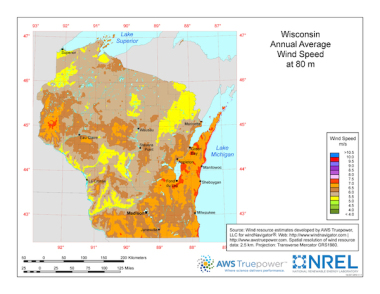 Wind potential in Wisconsin. Please click on the image to enlarge it.
¶ “Tesla Poised To Deliver Knockout Punch To Fossil Fuels In The Next Decade” • Tesla Motors has a stated mission that flies directly in the face of carbon-emitting fossil fuels. It is bringing about sustainable energy. Electric cars, battery storage, and solar power could be a potent combination in the fight to replace fossil fuels. [CleanTechnica]
World:
¶ A prolonged electricity blackout affecting two of the Aran Islands off the west coast of Ireland has…
View original post 658 more words
Nagasaki Peace Declaration 2016

Nuclear weapons are cruel weapons that destroy human beings.
The instant that the single nuclear bomb dropped by a U.S. military aircraft on Nagasaki City at 11:02 AM on August 9, 1945, exploded in the air, it struck the city with a furious blast and heat wave. Nagasaki City was transformed into a hell on earth; a hell of black-charred corpses, people covered in blistering burns, people with their internal organs spilling out, and people cut and studded by the countless fragments of flying glass that had penetrated their bodies.
The radiation released by the bomb pierced people’s bodies, resulting in illnesses and disabilities that still afflict those who narrowly managed to survive the bombing.
Nuclear weapons are cruel weapons that continue to destroy human beings.
In May this year, President Obama became the first sitting U.S. President to visit Hiroshima, a city which was bombed with a nuclear weapon. In doing so, the President showed the rest of the world the importance of seeing, listening and feeling things for oneself.
I appeal to the leaders of states which possess nuclear weapons and other countries, and to the people of the world: please come and visit Nagasaki and Hiroshima. Find out for yourselves what happened to human beings beneath the mushroom cloud. Knowing the facts becomes the starting point for thinking about a future free of nuclear weapons.
This year at the United Nations Office at Geneva, sessions are being held to deliberate a legal framework that will take forward nuclear disarmament negotiations. The creation of a forum for legal discussions is a huge step forward. However, countries in possession of nuclear weapons have not attended these meetings, the results of which will be compiled shortly. Moreover, conflict continues between the nations that are dependent on nuclear deterrence and those that are urging for a start of negotiations to prohibit nuclear weapons. If this situation continues, then the meetings will end without the creation of a roadmap for nuclear weapons abolition.
Leaders of countries possessing nuclear weapons, it is not yet too late. Please attend the meetings and participate in the debate.
I appeal to the United Nations, governments and national assemblies, and the civil society including NGOs. We must not allow the eradication of these forums where we can discuss legal frameworks for the abolition of nuclear weapons. At the United Nations General Assembly this fall, please provide a forum for discussing and negotiating a legal framework aimed at the realization of a world without nuclear weapons. And as members of human society, I ask you all to continue to make every effort to seek out a viable solution.
Countries which possess nuclear weapons are currently carrying out plans to make their nuclear weapons even more sophisticated. If this situation continues, the realization of a world without nuclear weapons will become even more unlikely.
Now is the time for all of you to bring together as much of your collective wisdom as you possibly can, and act so that we do not destroy the future of mankind.
The Government of Japan, while advocating nuclear weapons abolition, still relies on nuclear deterrence. As a method to overcome this contradictory state of affairs, please enshrine the Three Non-Nuclear Principles in law, and create a “Northeast Asia Nuclear Weapons-Free Zone”
(NEA-NWFZ) as a framework for security that does not rely on nuclear deterrence. As the only nation in the world to have suffered a nuclear bombing during wartime, and as a nation that understands only too well the inhumanity of these weapons, I ask the Government of Japan to display leadership in taking concrete action regarding the creation of a nuclear weapons-free zone, a concept that embodies mankind’s wisdom.
The history of nuclear weapons is also the history of distrust.
In the midst of this distrust between nations, countries with nuclear weapons have developed evermore destructive weapons with increasingly distant target ranges. There are still over 15,000 nuclear warheads in existence, and there is the ever-present danger that they may be used in war, by accident, or as an act of terrorism.
One way of stemming this flow and turning the cycle of distrust into a cycle of trust is to continue with persistent efforts to create trust.
In line with the peaceful ethos of the Constitution of Japan, we have endeavored to spread trust throughout the world by contributing to global society through efforts such as humanitarian aid. In order that we never again descend into war, Japan must continue to follow this path as a peaceful nation.
There is also something that each and every one of us can do as members of civil society. This is to mutually understand the differences in each other’s languages, cultures and ways of thinking, and to create trust on a familiar level by taking part in exchange with people regardless of their nationality. The warm reception given to President Obama by the people of Hiroshima is one example of this. The conduct of civil society may appear small on an individual basis, but it is in fact a powerful and irreplaceable tool for building up relationships of trust between nations.
Seventy-one years after the atomic bombings, the average age of the hibakusha, atomic bomb survivors, exceeds 80. The world is steadily edging towards “an era without any hibakusha.” The question we face now is how to hand down to future generations the experiences of war and the atomic bombing that was the result of that war.
You who are the young generation, all the daily things that you take for granted – your mother’s gentle hands, your father’s kind look, chatting with your friends, the smiling face of the person you like – war takes these from you, forever.
Please take the time to listen to war experiences, and the experiences of the hibakusha. Talking about such terrible experiences is not easy. I want you all to realize that the reason these people still talk about what they went through is because they want to protect the people of the future.
Nagasaki has started activities in which the children and grandchildren of the hibakusha are conveying the experiences of their elders. We are also pursuing activities to have the bombed schoolhouse at Shiroyama Elementary School, and other sites, registered as Historic Sites of Japan, so that they can be left for future generations.
Young people, for the sake of the future, will you face up to the past and thereby take a step forward?
It is now over five years since the nuclear reactor accident in Fukushima. As a place that has suffered from radiation exposure, Nagasaki will continue to support Fukushima.
As for the Government of Japan, we strongly demand that wide -ranging improvements are made to the support provided to the hibakusha, who still to this day suffer from the aftereffects of the bombing, and that swift aid is given to all those who experienced the bombing, including the expansion of the area designated as having been affected by the atomic bomb.
We, the citizens of Nagasaki, offer our most heartfelt condolences to those who lost their lives to the atomic bomb. We hereby declare that together with the people of the world, we will continue to use all our strength to achieve a world without nuclear weapons, and to realize everlasting peace.
Tomihisa Taue
Mayor of Nagasaki
August 9, 2016

Hiroshima Bombing 71st Anniversary

Colorful lanterns float down the Motoyasu River near the Atomic Bomb Dome in Hiroshima’s Naka Ward on the evening of Aug. 6, 2016, in memory of the victims of the U.S. atomic bombing of the city in 1945 and in prayer for peace around the globe. Hiroshima marked the 71st anniversary of the bombing with numerous memorial services across the city. Among attendees at the peace ceremony held at Hiroshima Peace Memorial Park were representatives from 91 countries and the European Union.
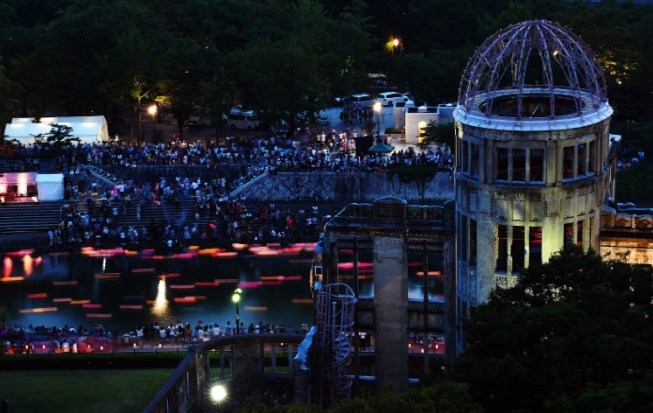
Colorful lanterns float down the Motoyasu River near the Atomic Bomb Dome in Hiroshima’s Naka Ward on the evening of Aug. 6, 2016.
Nagasaki commemorates 71st anniversary of atomic bombing
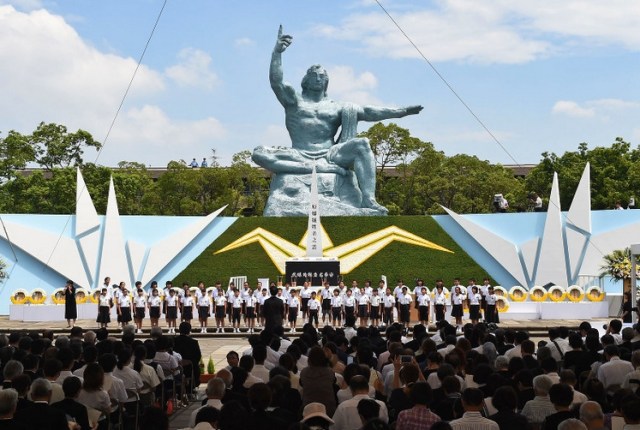
Students of Nagasaki Municipal Yamazato Elementary School sing at Nagasaki Peace Park during a memorial ceremony for the Nagasaki atomic bombing, on Aug. 9, 2016.
NAGASAKI (Kyodo) — Nagasaki began marking Tuesday the 71st anniversary of the U.S. atomic bombing of the city, with Mayor Tomihisa Taue expected later in the day to urge international society to draw upon collective wisdom in order to realize a world without nuclear weapons.
Full text of Nagasaki peace declaration on 71st anniversary of atomic bombing
http://mainichi.jp/articles/20160809/p2g/00m/0dm/054000c
In his Peace Declaration to be delivered at an annual ceremony in the city’s Peace Park, at which representatives of 53 nations and the European Union, as well as the United Nations, will attend, Taue plans to urge the Japanese government to enshrine into law its three non-nuclear principles of not producing, possessing or allowing nuclear weapons on Japanese territory.
He will also urge the government to create a nuclear weapons free zone as a security scheme without relying on nuclear deterrence.
In his speech, Taue plans to touch on the significance of U.S. President Barack Obama’s Hiroshima visit in May and call on the leaders of all countries to visit Nagasaki and Hiroshima to see the reality of atomic bombings.
Three days after the United States dropped the world’s first atomic bomb on Hiroshima, it dropped a second nuclear weapon on Nagasaki on Aug. 9, 1945. An estimated 74,000 people died from the bombing and its aftereffects by the end of the year.
The number of hibakusha — atomic bomb survivors with documents certifying they experienced a nuclear attack in 1945 — at home and abroad stood at 174,080 as of March — of which 32,547 lived in Nagasaki — and their average age was 80.86.
The Nagasaki city government has confirmed the deaths of 3,487 hibakusha over the past year, bringing the death toll to 172,230.
http://mainichi.jp/english/articles/20160809/p2g/00m/0dm/016000c
Nagasaki urges world to draw on wisdom to abolish nuclear weapons

Nagasaki Mayor Tomihisa Taue on Tuesday urged the international community to draw upon its “collective wisdom” to realize a world without nuclear weapons, as the southwestern Japan city marked the 71st anniversary of its atomic bombing by the United States in the final stages of World War II.
In his Peace Declaration delivered at an annual ceremony in the city’s Peace Park, Taue said new frameworks aimed at containing nuclear proliferation are necessary if mankind is not to destroy its future. “Now is the time for all of you to bring together as much of your collective wisdom as you possibly can, and act,” he said.
Touching on a U.N. working group on nuclear disarmament being held in Geneva, Taue said the creation of the forum to recommend legal measures to bring about nuclear weapons abolition is “a huge step forward.”
But noting that many of the nuclear powers are not attending the debate, he said that without their participation, the discussions “will end without the creation of a roadmap for nuclear weapons abolition.”
Compared to a similar declaration issued by Hiroshima Mayor Kazumi Matsui three days earlier on the occasion of the western Japan city’s own anniversary of its 1945 A-bombing by the United States, Taue was more blunt in both his suggestions for steps to achieve a nuclear-free world and his criticism of the Japanese government.
Taue criticized Japan’s policy of advocating the elimination of nuclear weapons while relying on the United States for nuclear deterrence, calling it “contradictory.” He also urged the government to enshrine into law its three non-nuclear principles of not producing, possessing or allowing nuclear weapons on Japanese territory, which are currently non-binding.
He further pressed the government to work to create what he called a “Northeast Asia Nuclear Weapons-Free Zone” as a security framework that does not rely on nuclear deterrence.
Prime Minister Shinzo Abe, in his speech, vowed to continue to make various efforts to bring about a “world free of nuclear weapons,” without referring to any concrete steps. His statements were almost identical to those he delivered during a similar ceremony in Hiroshima on Saturday.
Taue touched on the significance of U.S. President Barack Obama’s historic visit to Hiroshima in May, and called on the leaders of every country to visit Nagasaki and Hiroshima to see the reality of atomic bombings.
By visiting, the president exhibited to the world “the importance of seeing, listening, and feeling things for oneself,” Taue said, adding, “Knowing the facts becomes the starting point for thinking about a future free of nuclear weapons.”
Obama was the first sitting U.S. president to visit Hiroshima.
Taue, meanwhile, called on younger generations to listen to the testimonies of atomic-bomb survivors.
He also expressed his support for areas affected by the 2011 Fukushima Daiichi nuclear power plant disaster.
At 11:02 a.m., the exact time the bomb detonated over Nagasaki 71 years ago, participants at the ceremony offered silent prayers for the victims of the nuclear attack.
Three days after Hiroshima, the United States dropped a second nuclear bomb on Nagasaki on Aug. 9, 1945. An estimated 74,000 people were killed by the end of the year.
The number of hibakusha—atomic bomb survivors with documents certifying that they experienced the nuclear attacks in 1945—at home and abroad stood at 174,080 as of March, and their average age was 80.86. The Nagasaki city government has confirmed the deaths of 3,487 hibakusha over the past year, bringing the death toll to 172,230.
Thousands in Eastern Chinese City Protest Nuclear Waste Project

Jean-Bernard Lévy, left, chief executive of the French power company EDF, with Qian Zhimin, center, president of the China National Nuclear Corporation, and Philippe Knoche, chief executive of Areva, in Paris last year.
BEIJING — China’s efforts to expand its nuclear power sector suffered a backlash in one eastern seaboard city over the weekend, as thousands of residents took to the streets to oppose any decision to build a reprocessing plant in the area for spent nuclear fuel.
The government of Lianyungang, a city in Jiangsu Province, tried to calm residents on Sunday, a day after thousands of people defied police warnings and gathered near the city center, chanting slogans, according to Chinese news reports and photographs of the protests shared online.
They chanted “no nuclear fuel recycling project,” the state-run Global Times reported, citing footage from the scene. “It is unsafe to see another nuclear project coming and besieging us,” one resident told the paper.
Residents used WeChat, a popular Chinese messaging service, to share video footage showing downtown Lianyungang at night crowded with hundreds of people, many of them middle-aged, walking down a broad street in waves and chanting loudly, “Oppose nuclear waste, defend our home.”
The city government responded with the mix of reassurances and warnings that Chinese officials often use in the face of protests over pollution and environmental concerns. “Currently, the project is still at the stage of preliminary assessment and comparing potential sites, and nothing has been finally decided,” the city government said in a statement issued on Sunday.
But officials did not rule out that the site chosen might be somewhere near Lianyungang, and they warned against any more protests. “The relevant departments will use the law to strike hard against a tiny number of lawbreakers who concoct and spread rumors and disturb the social order,” the city government said.
On Monday, there were no signs of renewed demonstrations in the city. But the residents had made their point: Another possible building block of China’s nuclear power expansion had come under passionate public attack, defying the police warnings and government attempts to defuse alarm.
The Chinese government has said that it will accelerate building nuclear power and processing plants to wean the economy more quickly off coal. In March, the national legislature endorsed a five-year plan that promises to push forward with more nuclear power plants and a reprocessing plant for used fuel from China’s growing number of reactors. Japan also has plans to open a reprocessing plant.
But in Lianyungang and elsewhere, fears over the safety of nuclear power — magnified by the Fukushima calamity in Japan in 2011 — could frustrate those plans.
Lianyungang is just 20 miles southwest of a coastal nuclear power plant at Tianwan, which has two units operating, two under construction and approval to build two more. But the idea that used nuclear fuel might be reprocessed in the area seemed to renew anxieties about radiation risks.
A 2010 survey of 1,616 residents in the area already showed widespread apprehension about the Tianwan plant: 83.5 percent of respondents said they “worried about improper handling of nuclear waste.”
Complaints over industrial pollution, waste incinerators, toxic soil and other environmental issues have become one of the biggest causes of mass protest in China. And nuclear facilities have also become a source of worry for many.
In July 2013, officials in southern China shelved plans for a nuclear fuel fabrication plant after hundreds of nearby residents protested. Proposals for new nuclear power stations have also been met by online denunciations and petitions.
The demonstrations in Lianyungang broke out on Saturday after rumors spread that the area had been chosen as the site for a nuclear fuel processing and recycling plant to be built by the China National Nuclear Corporation, in cooperation with a French company, Areva. The companies have said construction will start in 2020 and be finished by 2030.
The companies have not reported settling on a site, nor have they revealed many other details about the proposed plant. But when China’s premier, Li Keqiang, visited France in June of last year, the companies agreed “to finalize the negotiations in the shortest possible time frame.”
Last month, a unit of the China National Nuclear Corporation said on its website that managers had visited Lianyungang to “study the proposed site.” That news appeared to sow alarm among some residents, who, in addition to the street protests, have taken to social media and online forums to voice opposition to the idea.
On Sina.com Weibo, a popular Chinese site that works like Twitter, messages have sprung up using a picture of a face in a heavy protective mask holding up a nuclear radiation sign with a red X across it. “The people of Lianyungang don’t want radiation,” the picture says.
The China National Nuclear Corporation’s nuclear fuel reprocessing unit said on its website on Saturday that the proposed plant would help the country become a “nuclear strong power.” But it emphasized that a site had not been chosen. It said places in six provinces, including Jiangsu, were under consideration.
http://www.nytimes.com/2016/08/09/world/asia/china-nuclear-waste-protest-lianyungang.html?_r=0
Japan should phase out aging nuclear reactors
Moves by the Nuclear Regulation Authority (NRA) to give the green light to the extension of operations at aging nuclear reactors have raised serious questions about the safety of atomic power plants. The extension of the lifespan of nuclear reactors, which had been regarded as an exception, now happens regularly.
The recent moves represent a departure from the new safety regulations on atomic power stations, which were enforced by drastically reviewing older regulations by learning lessons from the crisis at the tsunami-hi Fukushima No. 1 Nuclear Power Plant.
The NRA approved a draft screening document that effectively recognizes the No. 3 reactor at the Mihama Nuclear Power Plant in Fukui Prefecture — which its operator Kansai Electric Power Co. (KEPCO) intends to continue running even after its 40-year lifespan — meets new safety standards. If the reactor passes additional screening tests by the end of November 2016, KEPCO can continue operating the reactor until 2036 at the latest.
This is the third aging nuclear reactor for which the NRA has approved the extension of operations following the No. 1 and 2 reactors at KEPCO’s Takahama plant for which the authority gave the green light in June.
Following the outbreak of the Fukushima nuclear crisis in March 2011, legislation was amended to limit the lifespan of nuclear reactors to 40 years, in principle, with the aim of reducing the risks of accidents involving aging reactors. By the time of the outbreak of the nuclear disaster, about 35 to 40 years had passed since Fukushima No. 1 plant’s No. 1, 2 and 3 reactors, where meltdowns occurred, began operations.
The then administration led by the Democratic Party of Japan (DPJ) explained that the 40-year lifespan was set based on the time it is estimated to take before the reactor pressure vessel has deteriorated after being exposed to neutrons.
Apart from the DPJ, which was subsequently reorganized into the Democratic Party earlier this year, the then opposition Liberal Democratic Party (LDP) and Komeito voted for a bill to revise the relevant legislation. A clause allowing for the lifespan to be extended only once by up to 20 years as an exception upon the NRA’s approval was incorporated into the law.
Since Japan is an earthquake-prone country and has numerous volcanos, it is highly risky to continue relying on nuclear plants. Therefore, many members of the public apparently deemed that the 40-year rule was reasonable.
To enhance the safety of nuclear plants and phase out nuclear power, the government and electric power companies that operate atomic power stations should stick to the 40-year rule.
Experts have pointed out that there are limits to enhancing the safety of aging nuclear reactors, noting that it is technically difficult to change the basic design of the facilities and their arrangement although their parts can be replaced with new ones. The need to hand over maintenance techniques from generation to generation also poses a serious challenge.
If the risks involving such aging reactors are taken seriously, screenings of applications for the extension of operations at aging nuclear plants should be far stricter than those for the younger nuclear plants.
However, the NRA appears to have helped KEPCO pass the screening for the extension of the lifespans of the utility’s Takahama and Mihama plants.
July 2016 was the deadline for permitting the extension of the lifespan of the Takahama plant, and late November is the deadline for the Mihama power station shortly before the 40th year will have passed since the start of its operation.
Since the screening periods for the Takahama and Mihama nuclear plants were limited, the NRA prioritized inspections on these plants over other power stations, concentrating its personnel on the screening of these power stations.
Moreover, the NRA postponed experiments of exposing key devices at these power stations to vibrations to test their quake resistance until after the permission of the extension of their lifespan is granted in order to prevent time from running out for the screening.
The NRA says that it would not revoke its permission even if the experiments were to find that the plants were not sufficiently quake resistant, and instead reconfirm their safety after their operator takes additional safety measures. Some members of the NRA criticized the move saying that redoing the safety confirmation would damage the public’s understanding of the NRA.
It has been pointed out that cables that are easy to burn are used in aging nuclear plants. The new regulatory standards require nuclear plant operators to make all cables fire retardant. However, it takes a long time and costs much money to replace all cables at atomic power stations with flame-retardant cables. The NRA requires KEPCO to cover cables that are difficult to be replaced with flame-retardant ones with fire-proof sheets. However, questions remain as to whether the measure will ensure the same level of safety as the use of flame-retardant cables.
NRA Chairman Shunichi Tanaka had said when he assumed his post that it’s “extremely difficult to extend” the operation of aging reactors beyond the 40-year limit. However, he has since changed his view to the effect that “technical challenges can be overcome if necessary money is spent.” He appears as if he were speaking on behalf of power companies.
It has been decided to decommission six aging reactors following the outbreak of the Fukushima nuclear disaster in March 2011, in addition to those operated by Tokyo Electric Power Co., the operator of the crippled Fukushima plant. However, all these nuclear reactors are small-scale ones, each with an output of approximately 300,000 to 500,000 kilowatts.
In contrast, Mihama’s No. 3 and Takahama’s No. 1 and 2 reactors have an output capacity of about 800,000 kilowatts, larger than those that are set to be decommissioned. KEPCO estimates that it will spend over 200 billion yen for the Takahama reactors and 165 billion yen for the Mihama reactor as funds to implement safety measures. Despite such huge costs, KEPCO is determined to extend the lifespans of these plants because the plants will be effective in increasing the company’s profitability since fuel costs for nuclear plants are far lower than those for thermal power stations. If Takahama’s No. 1 and 2 reactors are put online, it is estimated to push up the company’s profits by about 9 billion yen a month.
Fifteen reactors across the country, including Mihama’s No. 3 reactor, are to surpass their 40-year lifespan over the next decade. Utilities are likely to apply for permission to extend the lifespan of many of these reactors if they deem that the extension will be profitable for the companies even if safety measures cost the operators massive amounts of money. The extension of the lifespans of the Mihama and Takahama plants will serve as role models for such efforts.
As such, decisions on whether to decommission aging reactors will be effectively left to the discretion of power companies based on economic principles, reducing the exceptional clause in the law to a mere facade.
The provision for the 40-year lifespan was incorporated in the legislation to prioritize the safety of nuclear plants over power companies’ profits.
Furthermore, the government of Prime Minister Shinzo Abe has established a goal of setting the ratio of nuclear power to Japan’s entire power supply at 20 to 22 percent in fiscal 2030. If the 40-year rule were to be thoroughly observed, the ratio would be around 15 percent even if all the existing reactors and those under construction were to be fully in operation. This will encourage power companies to extend the lifespans of their nuclear plants.
Such a policy cannot respond to the wishes of numerous members of the general public to build a society that will not rely on atomic power at an early date. As a country that has experienced a severe nuclear accident, Japan should phase out nuclear power rather than extending the lifespan of aging reactors.
http://mainichi.jp/english/articles/20160808/p2a/00m/0na/009000c
‘We know about Fukushima’: Thousands rally in China over nuclear project fears
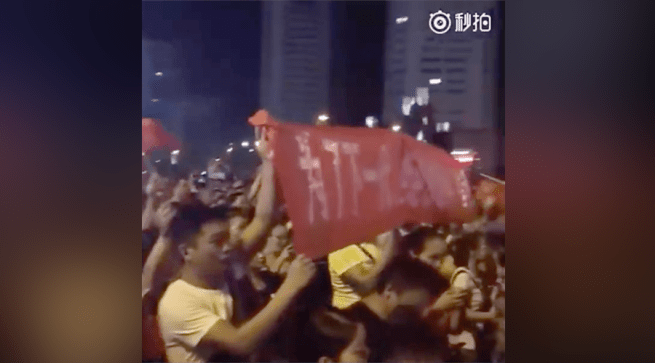
Thousands of people have taken to the streets of Lianyungang, China, to protest against a possible French-Chinese nuclear project, according to local media. Clashes have been reported between police and demonstrators.
Photos and videos on social media show crowds of people shouting slogans and waving banners.
“There were several thousand people,” a hotel worker told AFP on condition of anonymity.
Thousands in Lianyungang protest possible China-France nuclear project https://t.co/D7guEPGC9ppic.twitter.com/FYhMBftzyB
— Hong Kong Free Press (@HongKongFP) August 8, 2016
“Building a nuclear waste processing plant in Lianyungang is a recipe for disaster for future generations, local people have a right to express anger,” another witness said.
Pictures also show demonstrators surrounded by police. A local resident identified as Xu described “clashes between police and protesters.”
Rumors have emerged that one of the activists was beaten to death. Police have denied those reports, and also said that officers have not clashed with demonstrators.
The protest was staged over an agreement between French nuclear fuel group Areva and China National Nuclear Corp (CNNC), which took place in 2012. The companies agreed to build a reprocessing facility in China, but didn’t elaborate on the location.
But Lianyungang residents fear the plant will be constructed in their city, as China National Nuclear Corp (CNNC) is currently building a nuclear object nearby, AFP reported.
连云港市民抗议兴建核废料处理厂 https://t.co/braDcGZbn8
— 艺术家王鹏 (@wangpeng89) August 7, 2016
“The government kept the project a secret. People only found out about it recently. That’s why most people are worried,” local resident Sheng told The Financial Times. “Some speculate that the nuclear waste is from other countries and do not understand why the project should be built here instead of over there if it’s as safe and beneficial as they say.”
全世界唯一的核电站废料处理中心将在连云港建设!投资1000个亿工程!如果爆炸!连云港将寸草不生!辐射范围大概在800公里,连云港到上海500公里,到浙江杭州680公里,一旦爆炸意味着江苏浙江上海都将陷入万劫不复的未来 pic.twitter.com/gasVOBtda9
— 小李 (@a10024770291) August 8, 2016
Lianyungang is also situated near the Tianwan Nuclear Power Plant, built by Russia in 2006. The site is set to become one of the biggest nuclear power plants in China, with two operational units and six additional units planned.
今夜,连云港没有赢家,
只有暴力和被打者的哀鸣,
鲜血染红了某些人的顶子,
第一个遇难者不知道是谁?
一棍从后脑敲下,
三十几人拳打脚踢,
…………
呼吁理性爱国,保护自身安全!
今夜无眠
祈求连云港的这些英雄都很平安 pic.twitter.com/GcdMTZomJY
— Zhumengru (@xiaoru1989) August 8, 2016
“We already have a chemical industrial park in Lianyungang and the pollution problem is quite worrying. Nuclear waste is far worse than normal chemical pollution,” local shop owner He told The Financial Times. “Also, we all know what happened to Fukushima in Japan after the nuclear accident. We are really worried.”
Lianyungang, a port city in Jiangsu province, eastern China, has a population of around five million people. It is located some 480 kilometers (298 miles) north of Shanghai.
https://www.rt.com/news/355066-china-france-nuclear-protest/
Every baby born in 2016 contains atom bomb radiation — here’s why
Seventy-one years ago Saturday, a United States B-29 bomber named the “Enola Gay” dropped the atomic bomb “Little Boy” over the Japanese city of Hiroshima.
The bomb fell just over 29,000 feet from the plane and detonated 1,900 feet above Shima Hospital, an active medical center with a history dating back to the 18th Century. Between four and five square miles of buildings were leveled in the blast generated by just 141 pounds of highly enriched uranium. The US Department of Energy (DoE) estimates 70,000 people died in the initial blast, resulting fires, and radiation burst on August 6, 1945, but that the five-year death toll may have exceeded 200,000 people.
President Harry Truman told Japan to surrender or “expect a rain of ruin from the air, the like of which has never been seen on this earth.” Three days later, a second bomb (this time plutonium-based) dropped from an American warplane over the city of Nagasaki. The DoE estimates 40,000 people died in the immediate aftermath, and that number may have reached 140,000 within five years.
These events remain the only cases, so far, of human beings attacking other human beings with nuclear weapons. But the survivors of these attacks are from from the only people to carry the marks of nuclear warfare in their bodies.
Every person alive on the 71st anniversary of those attacks holds in their flesh radioactive remnants of the nuclear era — a period centered in the early decades of Cold War when nuclear nations conducted atmospheric tests of ever-larger bombs.
That’s the period that left us images of bright, sky-piercing mushroom clouds like the one at the top of this article, and footage like this of the devastation these weapons could wreak.
https://gfycat.com/RemoteMarriedHind
Hundreds of bombs detonated in the open air (and several more in the ocean) during the heyday of atmospheric nuclear testing — with thousands more tests conducted underground.
The 1963 Partial Test Ban Treaty put a stop to exposed American and Soviet explosions, though France and China continued atmospheric tests until 1974 and 1980, respectively. Many countries pursued underground testing through the early 1990s. Only North Korea has detonated a weapon in the 21st Century.
https://gfycat.com/VapidBrownAlpineroadguidetigerbeetle
Nuclear explosions produce radioactive substances that are rare in nature — like carbon-14, a radioactive form of the carbon atom that forms the chemical basis of all life on earth.
Once released into the atmosphere, carbon-14 enters the food chain and gets bound up in the cells of most living things. There’s still enough floating around for researchers to detect in the DNA of humans born in 2016. If you’re reading this article, it’s inside you.
That’s strange, if not a little unsettling. Though carbon-14 is completely harmless, it’s hard to wrap your mind around the idea that our species’ cruelest weapons left measurable traces in our bodies.
But it turns out that this can actually be helpful for scientists.
As Carrie Arnold reported in 2013 for Nova, the massive, unusual carbon-14 load of the era between 1955 and 1963 remains in the atmosphere. It’s called the “bomb pulse,” and it still makes its way, through plants, into the food web. But every second it decays a little more, leaving less in the atmosphere.
That means that every new cell created has a bit less carbon-14 than cells before it. And that slow decline proceeds in a predictable way.
In the last couple decades, researchers have taken advantage of that predictability to figure out exactly how old individual cells are. The process is fairly simple: Extract the cell’s DNA, measure its carbon-14 levels with a tool called a mass spectrometer, and check the result against tables of carbon-14 decay in the period since 1963.
This technique has been used, as Arnold reports, to trace the progress of cancers, advance our understanding of obesity and diabetes, and prove that brain cells continue to form through a human being’s lifetime.
However, barring a nuclear war or a rogue state conducting more dangerous above-ground tests, this method has a limited lifespan. Within a few decades, the bomb pulse will fade until it’s indistinguishable from our planet’s background carbon-14. (The researchers Arnold spoke to peg the date at 2050.)
If that happens, it will be good news for humanity. After all, it’ll mean we’ve gone long enough without a nuclear explosion that the bomb’s most widespread traces have disappeared. But for certain segments of medicine and science, it will mean the end of a once-in-history opportunity.
http://www.techinsider.io/bomb-pulse-radiation-decay-cells-2016-8
Newly released video shows the destruction of Hiroshima and Nagasaki
 https://www.yahoo.com/news/newly-released-video-shows-destruction-185919286.html Yahoo News Video•August 6, 2016
Policies of the American Presidential Candidates on the Nuclear Weapons Madness
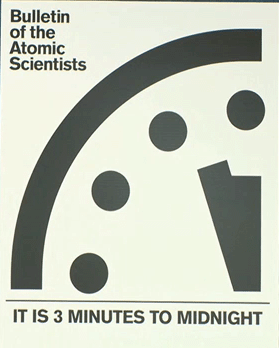 Hiroshima, Presidential Campaigns and Our Nuclear Future Common Dreams, by Robert Dodge, August 06, 2016 “………… the Bulletin of Atomic Scientists has
  moved their Atomic Doomsday Clock representing the apocalyptic countdown to nuclear annihilation to three minutes till midnight. This is the closest it has been since 1953 at the height of the Cold War after the first hydrogen bomb was exploded.
Our quadrennial presidential campaign, either unaware of the current scientific evidence on the heightened risk on the use of nuclear weapons or not caring in presenting a false veil of strength has brought the full spectrum of response to the issue of nuclear weapons.
Candidate Trump has suggested that since we have nuclear weapons he would consider using them in Europe and elsewhere and that he is okay with an arms race in Asia.
Candidate Clinton has indicated she would continue the current policies of the Obama Administration with its trillion dollar buildup.
Only former candidate Sanders proposed working to eliminate nuclear weapons, cancelling the trillion dollar funding of the new arms race and supporting the congressional S.A.N.E., Smarter Approach to Nuclear Expenditures act to reduce nuclear spending by $100 billion over the next 10 years.
President Obama also has an opportunity to lead in the final months of his presidency by declaring a “no first use” policy by the United States and taking our weapons off of hair trigger alert. These symbolic moves would send a signal to the world and provide an opportunity for our next president to build upon in realizing a world without nuclear weapons.
The ongoing existence of nuclear weapons is no longer a political issue, either Democratic or Republican; it is a survival issue. When the leaders refuse to lead, then the people must act…….http://www.commondreams.org/views/2016/08/06/hiroshima-presidential-campaigns-and-our-nuclear-future
America’s modernised thermonuclear aircraft bombs to be based in Europe
 Guess Where the US Will House Its New Modernized Nuclear Weapons Arsenal? http://www.globalresearch.ca/guess-where-the-us-will-house-its-new-modernized-nuclear-weapons-arsenal/5539984 By Sputnik Global Research, August 07, 2016
NNSA, the agency responsible for the military use of nuclear technology, has given the go ahead for the production of the upgraded B61-12 thermonuclear aircraft bomb.It said production of the first upgraded B61-12 nuclear bombs will begin in fiscal year 2020. All remaining bombs will be adapted by 2024.
Authorizing the B61-12 warhead life-extension program (LEP) is the final development phase prior to actual production.
According to reports, unlike the free-fall gravity bombs it will replace, the B61-12 is a guided nuclear bomb. A new tail kit assembly, made by Boeing, enables the bomb to hit targets far more precisely than its predecessors.
Using “Dial-a-yield” technology, the bomb’s explosive force can be adjusted before launch from a high of 50,000 tons of TNT equivalent to a low of 300 tons.
The B61-12 will have both air- and ground-burst capability. The capability to penetrate below the surface has significant implications for the types of targets within the bomb’s reach.
The B61-12 will initially be integrated with B-2, F-15E, F-16, and Tornado aircraft. From the 2020s, the weapon will also be integrated with, first, the F-35A bomber-fighter F-35 and later the LRS-B next-generation long-range bomber.
The B61-12 will replace the existing B61-3, —4, —7, and —10 bomb designs. It is thought that approximately 480 B61-12s will be produced through the mid-2020s.Currently around 200 B61 bombs are deployed in underground vaults inside around 90 protective aircraft shelters at six bases in five NATO countries (Belgium, Germany, Italy, the Netherlands, and Turkey). [These bases currently house the B61 arsenal, which when decommissioned would be replaced by state of the art B61-12, M. Ch, GR Editor]
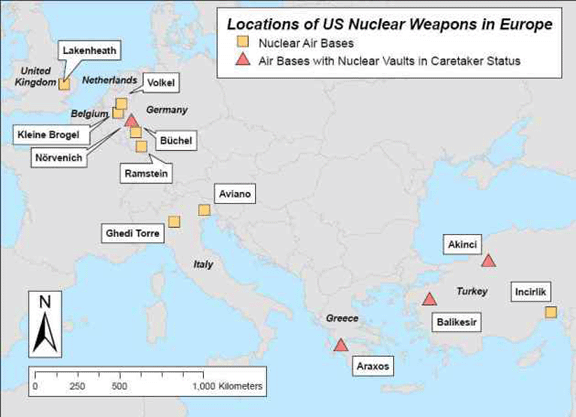
In September last year German television station ZDF cited a Pentagon budget document saying that the US Air Force would deploy modernized B61 nuclear bombs to Germany’s Buchel air force base replacing the 20 weapons already at the site.
“In other words, the American modernized thermonuclear aircraft bomb has been primarily, and for the nearest quarter of a century, destined to Europe. Washington however does not specify how and from whom the modernized nuclear bombs are going to defend the continent,” says an analytical articleon the RIA Novosti website.
“However it is easy to guess that the thermonuclear bombs will be first of all used for the ‘deterrence” of Russia and the rest of Europe will fall hostage to the circumstances orchestrated from across the ocean,” the website adds. Back in September 2015, Kremlin spokesman Dmitry Peskov characterized the move as a potential “violation of the strategic balance in Europe,” that would demand a Russian response.
“This could alter the balance of power in Europe,” Peskov then said.
“And without a doubt it would demand that Russia take necessary countermeasures to restore the strategic balance and parity.”
Bombing of Hiroshima and Nagasaki – America’s immoral sleep goes on

Hiroshima: the Crime That Keeps on Paying, But Beware the Reckoning, CounterPunch ,by DIANA  JOHNSTONE , AUGUST 5, 2016“……..The decision to destroy Hiroshima and Nagasaki was a political not a military decision. The targets were not military, the effects were notmilitary. The attacks were carried out against the wishes of all major military leaders. Admiral William Leahy, chairman of the Joint Chiefs of Staff, wrote in his memoirs that “the use of this barbarous weapon at Hiroshima and Nagasaki was of no material assistance in our war against Japan. The Japanese were already defeated and ready to surrender…” General Eisenhower, General MacArthur, even General Hap Arnold, commander of the Air Force, were opposed. Japan was already devastated by fire bombing, facing mass hunger from the US naval blockade, demoralized by the surrender of its German ally, and fearful of an imminent Russian attack. In reality, the war was over. All top U.S. leaders knew that Japan was defeated and was seeking to surrender.
The decision to use the atom bombs was a purely political decision taken almost solely by two politicians alone: the poker-playing novice President and his mentor, Secretary of State James F. Byrnes…….
the U.S. atom bombs got full credit for ending the war.
But that is not all.
The demonstrated possession of such a weapon gave Truman and Byrnes such a sense of power that they could abandon previous promises to the Russians and attempt to bully Moscow in Europe. In that sense, the bombs on Hiroshima and Nagasaki not only gratuitously killed hundreds of thousands of civilians. They also started the Cold War.
Hiroshima and the Cold War
A most significant observation on the effects of the atomic bomb is attributed to General Dwight D. Eisenhower. As his son recounted, he was deeply depressed on learning at the last minute of plans to use the bomb. Shortly after Hiroshima, Eisenhower is reported to have said privately:
“Before the bomb was used, I would have said yes, I was sure we could keep the peace with Russia. Now, I don’t know. Until now I would have said that we three, Britain with her mighty fleet, America with the strongest air force, and Russia with the strongest land force on the continent, we three could have guaranteed the peace of the world for a long, long time to come. But now, I don’t know. People are frightened and disturbed all over. Everyone feels insecure again.”[2]
As supreme allied commander in Europe, Eisenhower had learned that it was possible to work with the Russians. US and USSR domestic economic and political systems were totally different, but on the world stage they could cooperate. As allies, the differences between them were mostly a matter of mistrust, matters that could be patched up.
The victorious Soviet Union was devastated from the war: cities in ruins, some twenty million dead. The Russians wanted help to rebuild. Previously, under Roosevelt, it had been agreed that the Soviet Union would get reparations from Germany, as well as credits from the United States. Suddenly, this was off the agenda. As news came in of the successful New Mexico test, Truman exclaimed: “This will keep the Russians straight.” Because they suddenly felt all-powerful, Truman and Byrnes decided to get tough with the Russians.
Stalin was told that Russia could take reparations only from the largely agricultural eastern part of Germany under Red Army occupation. This was the first step in the division of Germany, which Moscow actually opposed.
Since several of the Eastern European countries had been allied to Nazi Germany, and contained strong anti-Russian elements, Stalin’s only condition for those countries (then occupied by the Red Army) was that their governments should not be actively hostile to the USSR. For that, Moscow favored the formula “People’s Democracies” meaning coalitions excluding extreme right parties.
Feeling all-powerful, the United States sharpened its demands for “free elections” in hope of installing anti-communist governments. This backfired. Instead of giving in to the implicit atomic threat, the Soviet Union dug in its heels. Instead of loosening political control of Eastern Europe, Moscow imposed Communist Party regimes – and accelerated its own atomic bomb program. The nuclear arms race was on.
“Have Our Cake and Eat It”……..
The bombs on Hiroshima and Nagasaki plunged the United States leadership into a moral sleep from which it has yet to awaken. http://www.counterpunch.org/2016/08/05/hiroshima-the-crime-that-keeps-on-paying-but-beware-the-reckoning/
Chines military nuclear firm invited to bid for building Small Nuclear Reactors in Britain


 Chinese firm with military ties invited to bid for role in UK’s nuclear future,
China National Nuclear Corporation on government list of preferred bidders for development funding for next-generation modular reactors, Guardian, Adam Vaughan, 8 Aug 16, A controversial Chinese company has been selected to bid for millions of pounds of public money in a UK government competition to develop mini nuclear power stations.
The China National Nuclear Corporation (CNNC) features twice in a government list of 33 projects and companies deemed eligible to compete for a share in up to £250m to develop so-called small modular reactors (SMR).
The involvement of a different Chinese company in the high-profile Hinkley Point C project in Somerset was widely believed to have prompted the government’s decision to pause the deal at the 11th hour last month.
Nick Timothy, Theresa May’s co-chief of staff, has previously expressed alarm at the prospect of CNNC having such close access to the UK’s energy infrastructure because it would give the state-owned firm the potential ability to build weaknesses into computer systems.
The company was formerly China’s Ministry of Nuclear Industry and developed the country’s atomic bomb and nuclear submarines, as well as being a key player in its nuclear power industry.
In an article on the ConservativeHome website, Timothy singled out CNNC’s military links as a reason the UK government should be wary of such involvement.
“For those who believe that such an eventuality [shutting down UK energy at will] is unlikely, the Chinese National Nuclear Corporation – one of the state-owned companies involved in the plans for the British nuclear plants – says on its website that it is responsible not just for ‘increasing the value of state assets and developing the society’ but the ‘building of national defence’,” he wrote.
Tom Burke, chairman of the environment thinktank E3G and a former British government adviser, said there were legitimate concerns over the company. “I don’t fuss very much about the Chinese owning a nuclear power station [China General Nuclear in the case of Hinkley]. But I would be much more concerned about bringing in CNNC because they are known to be much more closely involved with the military and Chinese nuclear weapons programmes,” he said.
CNNC was not involved in the original Hinkley deal but it was reported on Sunday that the company has agreed in principle to buy half of China’s 33% stake in the £24bn project if it goes ahead…….. https://www.theguardian.com/environment/2016/aug/07/chinese-firm-with-military-ties-invited-to-bid-for-role-in-uks-nuclear-future
China: thousands march in China against nuclear waste plant plan
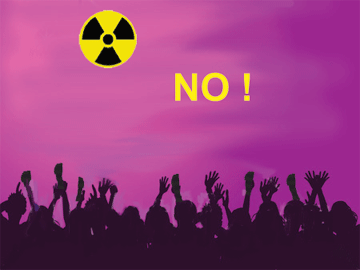 China protest against nuclear waste plant https://next.ft.com/content/dacb775a-5c7f-11e6-bb77-a121aa8abd95 Thousands take to streets in move that poses threat to country’s atomic plans by: Lucy Hornby and Luna Lin in Beijing, 7 Aug 16
Thousands of people took to the streets of an eastern Chinese city this weekend to protest against a proposed nuclear waste reprocessing facility, in a show of public opposition that China fears could derail its ambitious plans to construct dozens of nuclear reactors.
China has been building nuclear reactors at a blistering pace, part of a plan for non-fossil fuels to provide a fifth of national energy supply by 2030. The country so far lacks sufficient nuclear waste processing facilities to handle the output from its planned reactors, and is also short of enrichment facilities to process fuel for the reactors to burn.
Anti-nuclear protests in China have been few and far between but Beijing has treated them with kid gloves for fear of setting off broader public opposition to the state’snuclear plans. The only two nuclear projects that have attracted significant publicopposition in the past 10 years have been called off.
Protesters in Lianyungang, a port city to the north of Shanghai in Jiangsu province, said they were worried about the health and safety impact of the proposed Sino-French venture. Thousands of residents turned out on Saturday evening in a protest monitored but not stopped by local police, and a second protest was expected for Sunday evening.
“The government kept the project a secret. People only found out about it recently. That’s why most people are worried,” said Mr Sheng, a local resident who declined to give his full name. “Some speculate that the nuclear waste is from other countries and do not understand why the project should be built here instead of over there if it’s as safe and beneficial as they say.”
The city is about 30km west of the Russian-built Tianwan nuclear plant, a complex that will be among the largest in China when all eight planned reactors are built. Its economy has faltered along with China’s industrial slowdown. In June, a scrap steel yard in Lianyungang that was China’s largest declared it could not pay its debts.
“We already have a chemical industrial park in Lianyungang and the pollution problem is quite worrying. Nuclear waste is far worse than normal chemical pollution,” said Mr He, a local shop owner. “Also, we all know what happened to Fukushima in Japan after the nuclear accident. We are really worried.”
French nuclear fuel group Areva in 2012 agreed to co-operate with China National Nuclear Corp, which operates the Tianwan site, to develop a nuclear fuel recycling plant in China but did not specify a location. In November last year, the French company — whose reactor business has been merged with French rival EDF — said CNNC might buy a minority stake covering the areas of uranium mining, recycling and decommissioning.
Twitter: @HornbyLucy
1 This Month
Chernobyl: The Lost Tapes – A good documentary on Chernobyl on SBS available On Demand for the next 3 weeks– https://www.sbs.com.au/ondemand/tv-program/chernobyl-the-lost-tapes/2352741955560

of the week–London Campaign for Nuclear Disarmament

Tell the Ukrainian Government to Drop Prosecution of Peace Activist Yurii Sheliazhenko
To see nuclear-related stories in greater depth and intensity – go to https://nuclearinformation.wordpress.com
-
Archives
- April 2026 (152)
- March 2026 (251)
- February 2026 (268)
- January 2026 (308)
- December 2025 (358)
- November 2025 (359)
- October 2025 (376)
- September 2025 (257)
- August 2025 (319)
- July 2025 (230)
- June 2025 (348)
- May 2025 (261)
-
Categories
- 1
- 1 NUCLEAR ISSUES
- business and costs
- climate change
- culture and arts
- ENERGY
- environment
- health
- history
- indigenous issues
- Legal
- marketing of nuclear
- media
- opposition to nuclear
- PERSONAL STORIES
- politics
- politics international
- Religion and ethics
- safety
- secrets,lies and civil liberties
- spinbuster
- technology
- Uranium
- wastes
- weapons and war
- Women
- 2 WORLD
- ACTION
- AFRICA
- Atrocities
- AUSTRALIA
- Christina's notes
- Christina's themes
- culture and arts
- Events
- Fuk 2022
- Fuk 2023
- Fukushima 2017
- Fukushima 2018
- fukushima 2019
- Fukushima 2020
- Fukushima 2021
- general
- global warming
- Humour (God we need it)
- Nuclear
- RARE EARTHS
- Reference
- resources – print
- Resources -audiovicual
- Weekly Newsletter
- World
- World Nuclear
- YouTube
-
RSS
Entries RSS
Comments RSS
 nuclear-news