Fukushima tourism making strong progress on “recovery”
This is an article from the Fukushima Minpo News, the Fukushima local newspaper which is the propaganda organ of the Japanese central government. Therefore everything announced in this article should be taken with a grain of salt. Or maybe those tourists are the ones who enjoy sightseeing the numerous contaminated soil bags dump sites.

Tourism in Fukushima Prefecture approached a milestone in fiscal 2015 after recovering to nearly 90 percent of where it was before the nuclear disaster unfolded in March 2011, the prefectural government said in a recent tourism report.
In the year ended March 31, the prefecture saw 50.31 million tourists visit its resorts, sightseeing spots and leisure facilities, data compiled by the Fukushima Prefectural Government showed earlier this month.
That’s an increase of 3.42 million on the year before and nearly 90 percent of its tourism tally in fiscal 2010, when 57.17 million tourists visited, the report said.
It is also the first time the annual threshold of 50 million has been achieved since 2011, when the Great East Japan Earthquake tipped the Fukushima No. 1 power plant into a triple core meltdown on March 11.
Fukushima officials praised their promotion drive, dubbed the “Fukushima Destination Campaign,” for bearing fruit. The campaign allows its municipalities to tap the transport resources of the Japan Railway group across the country.
“We will work to draw more tourists by analyzing the effect of the Destination Campaign,” said a Fukushima prefectural official in charge of tourism promotion.
In a surprise, the Soma-Futaba region in eastern Fukushima, along the Pacific coast, drew 2.65 million tourists in fiscal 2015, up 59.9 percent from last year, the report said. Officials say the opening of a key part of the Joban Expressway between the Tomioka and Namie interchanges in March 2015 facilitated the surge. Indeed, the number of people who used drive-in facilities was 33.4 percent higher than last year, the report said.
The opening of new leisure facilities and the resumption of some onsen (hot spring) spas that suspended business in the wake of the disasters also contributed, the officials said.
Tourists were most attracted by the grand nature of Fukushima Prefecture, the data showed. The top spot in fiscal 2015 remained the Bandai Kogen highlands in the north, which drew 2.18 million visitors, up 4.6 percent from the year before.
Trump, Clinton – neither of them have a safe nuclear weapons policy
Trump, Clinton and our nuclear wake-up call By Kingston Reif, August 13, 2016 (CNN) The possibility of Donald Trump winning the presidential election this November has renewed media and public interest in one of the most important responsibilities of the president: commanding America’s massive nuclear arsenal and averting nuclear war.

Yet what has been lost in the angst that Mr. Trump might soon have the authority to launch nuclear weapons is the equally unnerving reality that the U.S. nuclear posture is already unnecessarily dangerous and redundant. Neither Trump nor Hillary Clinton have explained how they would seek to put U.S. doctrine on a safer footing and reduce global nuclear weapons risks……
The sun setting on UK’s nuclear industry? Time for clean energy
The international race toward universal grid parity may see an unsubsidised tipping point next year. Frontrunner Australia is expected to achieve a renewable energy scenario which is cheaper than conventional supply, says a recent report from Deutschebank.
UK nuclear sunset? http://www.timesofmalta.com/articles/view/20160814/environment/UK-nuclear-sunset.622012 Anne ZammitIt’s coming up to six years since badgers were relocated to make way for Britain’s next nuclear power station on the Somerset coast. In the pipeline for nearly a decade, plans for Hinkley Point took an unexpected turn in July.
Last month, as Britain’s Prime Minister, Theresa May was advised by her Chief of Staff to put a contract for the French/Chinese-backed Hinkley Point nuclear power station on hold, subject to review.
Mrs May was barely a year old when Britain’s worst ever nuclear disaster spread radioactive dust across northern Europe.
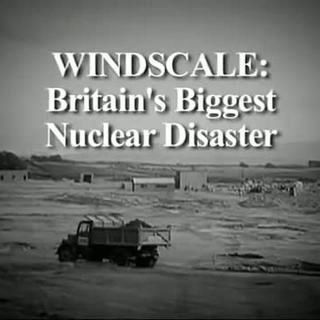 Windscale was built after WWII, to produce plutonium for England’s nuclear weapons programme. A bunker mentality still hung about the facility even after it became a provider of electric power to the public in 1956.
The following year a fire broke out at the plant and burned for three days before it could be contained. In the weeks that followed, milk from cows grazing within a 500 kilometre radius was diluted and destroyed.
Windscale, renamed Sellafield in attempt to erase dark beginnings, was put out of commission in 1973 after a dangerous  leak capped a long history of incidents. The facility switched to reprocessing of nuclear fuel. This drew bitter opposition from Ireland and Scandinavia over dumping of contaminated water into the Irish Sea.
Ireland’s complaint to the UN was verified by a UK government study which found traces of radioactive substances in salmon bred at fish farms near the plant.
Sellafield was shut down completely in 2005 after uranium and plutonium spilled from a broken pipe. (Since then an American-led multinational corporation has been overseeing the closure process which could drag on into the next century.)
That same year, advisors to Tony Blair urged that emissions targets would best be met with more nuclear power stations. This ran contrary to the UK government stance taken three years earlier when energy efficiency and renewables were tagged as the most cost efficient path to meet immediate energy priorities.
 Commenting on Mrs May’s decision to put the Hinkley Point contract on hold, energy economist Tooraj Jamasb of Durham University noted that the new government has not had time to develop a new coherent energy policy.
A 2002 review of UK energy policy veered away from further government subsidies and passed the baton to the private sector. As the UK government gave the go-ahead for a new generation of nuclear power stations to be built, environmentalists alleged unlawful State aid for the nuclear power industry in Britain, filing a complaint with the European Commission. Scotland made it clear that it would not accept any new power stations on Scottish soil.
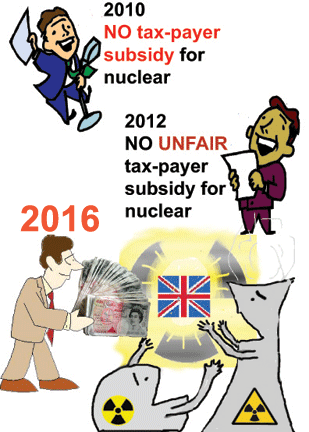 The time has come for policymakers to shift their focus to clean energy
After the 2011 Fukushima power plant disaster France vowed to scale down the share of electricity from nuclear sources and Germany announced a phase out of nuclear power by 2022.
Germany’s Federal Environment Agency has declared that the technology to make the switch to 100 per cent renewable energy is already available but requires that electricity is produced and used more efficiently. Meeting climate change targets can be done without nuclear if there are stronger efforts toward demand reduction and lifestyle changes.
The international race toward universal grid parity may see an unsubsidised tipping point next year. Frontrunner Australia is expected to achieve a renewable energy scenario which is cheaper than conventional supply, says a recent report from Deutschebank.
Viewed as covert factories for materials to build apocalyptic weapons, nuclear power stations also face resistance from groups such as the Campaign for Nuclear Disarmament. As pointed out by CND-UK the cost of nuclear power has continued to rise as the cost of renewable energy has fallen sharply.
A 2006 review by the Office of Nuclear Regulation, which led to assessment of reactor designs ahead of choosing sites, was challenged in court by Greenpeace as “seriously flawed”. Key details of the economics of nuclear power were not published until well after the review was final.
Hinkley Point nuclear power station has undergone a number of reincarnations since the first phase was built in 1956. Reactors on Hinkley Point ‘A’ were shut down permanently after an inspectorate found defects too expensive to fix in 1999. De-commissioning of a successor, Hinkley Point ‘B’ (built 1967) should have happened this year but has been extended to 2023.
The Hinkley Point C proposal by Électricité de France (EDF) and Chinese investors commits British consumers to pay more for nuclear-generated electricity than it costs to buy electricity from offshore windfarms.
Yet a study by Britain’s National Audit Office published last month cited calculations from the National Infrastructure Commission which show that if five per cent of current peak demand were met by demand flexibility then power saved would be equal to a new nuclear power station.
Households and businesses could use electricity more flexibly, using less during times of peak demand and more during times of low demand. Cutting down on use of electricity at peak times reduces the megawatt capacity needed.
The NAO also noted that the expected subsidy for Hinkley Point C has doubled to £37 billion in the past three years.
It is not just the economics of nuclear which now plague decision makers at Whitehall. As former Home Secretary and overseer of MI5, Theresa May approaches the nuclear question from a security perspective.
 Security experts have expressed concern that the Chinese could use their role in the project to build weaknesses into computer systems allowing them to shut down Britain’s energy production at will.
Fears that China could engage in cyber-sabotage may have been overblown. The bomb of public subsidy running into billions is the real gremlin in the Hinkley Point contract.
A cross-party Commons Energy and Climate Change Committee fears that failure to build new nuclear capacity by 2025 would mean greater reliance on imported gas in the medium term. This would affect energy security and force a review of how UK carbon emission targets are to be met.
On the other hand, the committee identified risk factors which could jeopardise proposals like Hinkley Point C. Sudden policy changes by the UK government, an inconsistent approach, poor transparency and lack of long-term vision have created uncertainty for investors.
Delaying or cancelling the Hinkley Point project threatens Britain’s relations with China and France. Joel Kenrick, a former advisor to the Energy Secretary, believes that the contract for Hinkley Point C will go ahead come autumn. However, he expressed doubt over whether it would actually be built with EDF’s poor track record in delivering big
projects.
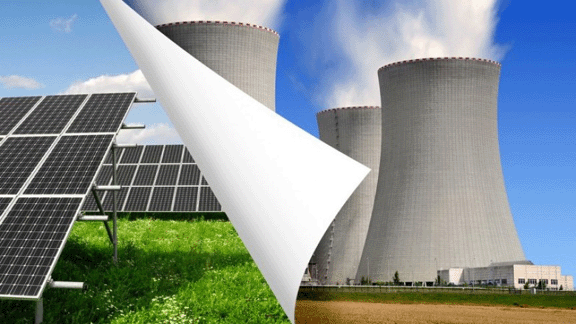 Corporate finance leader at EY Global Power & Utilities and RECAI editor Ben Warren believes that the time has come for policymakers to shift their focus to clean energy. “Market access, fair play, technology improvements and cost curves will lead to a level of renewables deployment not even imagined,” says Mr Warren. www.energypost.eu/renewable-energy-versus-nuclear-dispelling-myths
Japans dodgy deep geological nuclear waste disposal hopes and fears 2016.

Highly radioactive waste, dangerous for as long as 200,000 years, has to be isolated and guarded in every country that has dabbled in nuclear energy. Cartoon credit: www.sanonofresafety.org/nuclear-waste/
Japan is a place where not two, not three, but four plates meet with no geographical stability. Volcanoes are erupting all the time, new islands pop up in the sea and there are daily earthquakes. Forty thousand years ago, the coast line was totally different and nuclear waste storage is supposed to be safe there?
The issue of transparency
there seems to be a lack of information on the Japanese plans to bury their nuclear High Level waste. Very little has been discussed on this latest OECD report from May, However, on the JAIF website it has been given a brief mention in a very recent report from JAIF (10 August, 2016)
“When completing its report, the group also took into consideration an international peer review by the OECD/NEA in May of this year, as well as opinions and comments from relevant academic societies and other bodies.” – http://www.jaif.or.jp/en/report-completed-on-criteria-for-scientifically-promising-hlw-disposal-sites/
The issue of definition
It would appear that the Japanese Government is trying to play down the adverse comments from the OECD/NEA report from May 2016. Awkwardly enough, The NUMO report came out in March 2016 and seemed to rely on earlier findings in an older OECD/NEA report.
Well, moving on, The main issue found was with the definition and clarity of the Japanese experts terminology in making points within the report. This issue was brought up in the earlier OECD/NEA report and the March 2016 NUMO report had it had tackled the problem. This was not true as the May 2016 OECD/NEA report still mentions issues of clarity in definition.
The issue of democracy
Another issue includes allowing the public to have a say (in the NUMO, JAIF and the OECD/NEA reports) whilst at the same time, denying the public choice and instead allowing scientists to make the decisions to choose a suitable site for the geological repository. The option to self determination of local communities is being sidelined because the most of the Prefectures have resoundingly declared that they do not want to have a nuclear waste dump near their homes. But that hasnt stopped NUMO;
“In May 2015 NUMO abandoned the idea of waiting for a volunteer[Prefecture]. Instead, scientists will nominate suitable regions. According to NUMO, Japan wants to start construction of a repository in 2025 and have the facility operational by between 2033 and 2037”. – http://www.nucnet.org/all-the-news/2016/08/12/japan-plans-to-identify-multiple-candidate-sits-for-repository
The issues of Research and being thorough
Nestled some 500 meters underground are Japans existing deep Underground research Laboratories;
Mizunami Underground Research Laboratory Granite opened in 2004- Run by Jaea JAEA
Horonobe Underground Research Center opened in 2005- Run by JAEA
It might be worth noting that these two deep research labs will be initially used for research and then later will be kept open because they can do things in the underground research laboratories that they will not be able to do in the final disposal facilities. So will there be an ongoing hidden cost (to the tax payer) when the repositories are being priced for costs, perhaps?
Compared to this years measly 50 page report on Geological nuclear waste disposal in Japan written by the OECD/NEA, we can compare it with this years Swedish report (Some 170 pages long) for the same thing;
“In other words, the reactor company itself does not have the long-term capability to fulfil the obligations defined by the Nuclear Activities Act regarding safe decommissioning and dismantling of the facilities and management and disposal of spent nuclear fuel and nuclear waste” http://www.karnavfallsradet.se/sites/default/files/sou_2016_16_eng_webb.pdf
It is worth noting, that unlike the lengthy and inclusive Swedish report, that there are many areas that have seemingly not been addressed in the latest OECD/NEA report and we shall have to wait for JAIF to make public the full report in the near or distant future. So far as this article is showing that even the limited remit of the OECD/NEA report is showing signs of cracks appearing in the plan.
The issue of spontaneous volcano creation and Magma intrusion

Image source; http://www.jma.go.jp/jma/en/Activities/earthquake.html
Japan had to act after the Fukushima Prefecture suffered the nuclear catastrophe. The worlds best minds were brought to bare on this disaster and a newly formed Nuclear Regulation Association (NRA) was born. However, the only expert on geology was soon ejected from the committee because of differences in opinion. He was not replaced by another Geologist as it as found that Geologists did not know enough about Nuclear Physics. Then the worry of Pyroplastic flows blew away and Japan was able to restart a couple of reactors (but both have since been re-shut down ).
Hidden deep in the OECD/NEA report though, is this slightly worrying sentence;
“The Interim Summary acknowledges that the current understanding of magmatic processes indicates that future volcanic hazards to a repository may be present even in areas with no known Quaternary eruptive centres “
Meaning that Magma could move through previously safe areas. Surely, like Japans Tsunamis, however rare, this should be taken into account? As an example we can see the arrogance of Japans Nuclear Regulatory Association (NRA) in relation to volcanic threats as seen here;
“The NRA ruled out a major eruption over the next 30 years until the reactors reach the end of their usable life span. The surprise eruption of Mount Ontake on the border of Gifu and Nagano prefectures on Sept. 27 has renewed concerns about the volcanoes in the region. “It is simply impossible to predict an eruption over the next 30 to 40 years,” Fujii said. “The level of predictability is extremely limited.” https://nuclear-news.net/2014/10/19/sendai-reactors-vulnerable-to-eruptions-state-picked-volcanologist-warns/
And apart from the nuclear lobby and groups getting the science wrong we see basic data not being added to the report and we can only wait to see if this issue is addressed in any later JAIF reports.
“ It would be informative to provide more explanation of the data uncertainty regarding the geothermal gradients, given that relevant maps appear to be available for Japan, such as the cited Geothermal Gradient and Heat Flow Datareport (AIST, 2004). This would help explain the lack of a prescribed value to assess the thermal “areas to be avoided”.”
The issue of practicality
The definitions are important and will lay down the exact routes that need to be decided. And after Fukushima we would think that the “best” sites would be the safest sites but this is not exactly the case.
“The intent to select a site that meets Japan’s current safety standards, but not necessarily selecting the “most suitable (best) site”, is considered practical and consistent with international best practices and recommendations.”
Cost before Safety perhaps? Or are there any “best” sites in Japan?
The issue of belief in the atom
In the OECD/NEA report it talks of the need for long term protection of the deep vault by generations of specialists that could look after the vault and stop human intrusion and deal with any pollution threats. The best comparison is from Planet of the Apes that showed people worshipping a nuclear bomb many generations after a nuclear war.
It might be worth noting that because of a shortage of nuclear engineers that it would be very difficult to maintain a work force in a fixed location for some 200,00 years. However, the reports generally talk about the vague term “Mid-term” storage (maybe some hundreds/thousands of years?) concerning the expected time needed for manning the location. Without a doubt there are huge fences to hurdle in how Japan deals with its High level nuclear waste and of course the so called “lesser” contaminated waste as well, but, well… thats a whole other story.
Source to OECD/NEA report from May 2016 ; http://www.oecd-nea.org/…/2…/7331-japan-peer-review-gdrw.pdf
Source to NUMO March 2016 report; https://www.numo.or.jp/en/reports/pdf/TR-15-02.pdf
The JAIF report is in the article (2 links)
Posted by Shaun McGee aka Arclight
Posted to www.europeannewsweekly.wordpress.com
h/t Satsuki Gotto
1 This Month
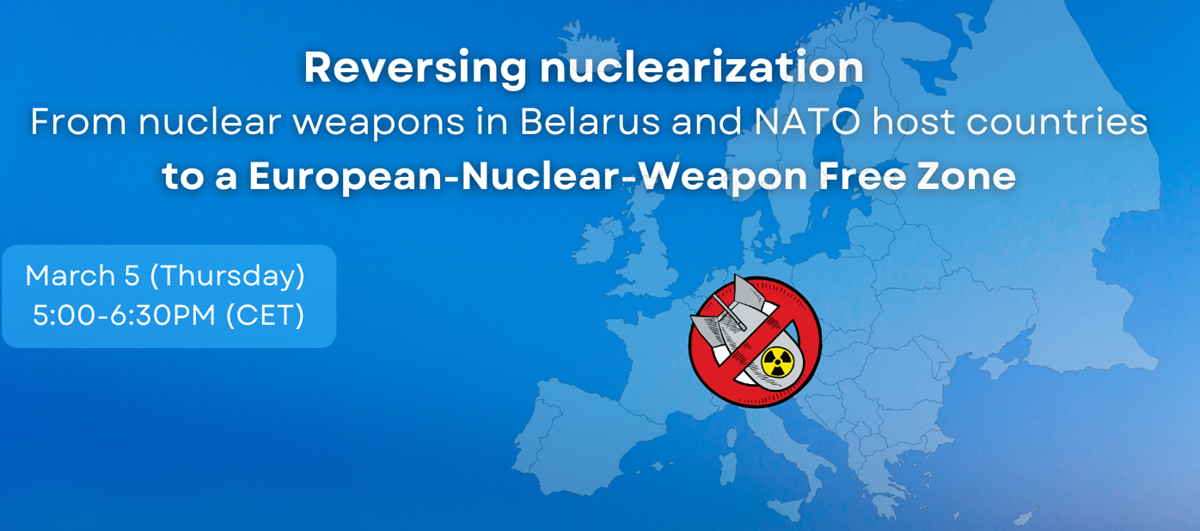
5 March -Online – Reversing nuclearization:
From nuclear weapons in Belarus and NATO host countries to a European-Nuclear-Weapon Free Zone
11am-12:30pm Eastern Time USA / 5pm-6:30pm CET

of the week – Advocating for a
nuclear free beach – https://www.samuellawrencefoundation.org/
The Samuel Lawrence Foundation advocates for a Nuclear Waste Free Beach at San Onofre, join us and take action!
10 March A LIVE WEBINAR THE REAL EFFECTS OF NUCLEAR POWER
What the Industry Isn’t Telling Us
1:00 PM Mountain, 2 pm Central, 3 pm Eastern. Live on the Keepers of the Water Facebook page


18 March Webinar @ 1 PM EST: An Assessment of SMR Projects: The Case of Canada
register for the zoom:
https://us02web.zoom.us/webinar/register/WN_o8BIIOUvQ2ONJR1nta65DQ#/registration

of the week – STOP SMALL MODULAR REACTORS IN CANADA
To see nuclear-related stories in greater depth and intensity – go to https://nuclearinformation.wordpress.com
-
Archives
- March 2026 (38)
- February 2026 (268)
- January 2026 (308)
- December 2025 (358)
- November 2025 (359)
- October 2025 (376)
- September 2025 (258)
- August 2025 (319)
- July 2025 (230)
- June 2025 (348)
- May 2025 (261)
- April 2025 (305)
-
Categories
- 1
- 1 NUCLEAR ISSUES
- business and costs
- climate change
- culture and arts
- ENERGY
- environment
- health
- history
- indigenous issues
- Legal
- marketing of nuclear
- media
- opposition to nuclear
- PERSONAL STORIES
- politics
- politics international
- Religion and ethics
- safety
- secrets,lies and civil liberties
- spinbuster
- technology
- Uranium
- wastes
- weapons and war
- Women
- 2 WORLD
- ACTION
- AFRICA
- Atrocities
- AUSTRALIA
- Christina's notes
- Christina's themes
- culture and arts
- Events
- Fuk 2022
- Fuk 2023
- Fukushima 2017
- Fukushima 2018
- fukushima 2019
- Fukushima 2020
- Fukushima 2021
- general
- global warming
- Humour (God we need it)
- Nuclear
- RARE EARTHS
- Reference
- resources – print
- Resources -audiovicual
- Weekly Newsletter
- World
- World Nuclear
- YouTube
-
RSS
Entries RSS
Comments RSS
 nuclear-news