Canada’s aging nuclear plants – renewal of licenses due, but concrete decaying

 Decaying concrete raising concerns at Canada’s aging nuclear plants, National Post Ian MacLeod, Postmedia News | July 8, 2012 Decaying concrete at nuclear power plants is the latest concern for nuclear safety authorities.
At Quebec’s sole atomic power station, Gentilly-2, eroding concrete has prompted federal licensing officials to suggest that any provincial attempt to refurbish and re-license the 30-year-old plant must satisfy federal concerns over the aging concrete’s ability to stand up to another two or three decades of service.
The move comes as economic pressures force nuclear utilities to consider refurbishing their nuclear plants and operating them well past their 25- to 30-year initial lives.
With Gentilly-2 at the end of its service life, the Quebec government is under pressure to decide soon whether to order a refit or shut down the plant permanently. Refurbishment estimates range from $2 billion to $3 billion. A shutdown is pegged at $1.6 billion.
Of particular concern for any “life extension” is the dome-shaped containment building that encloses the 675-megawatt CANDU 6 reactor. The metre-thick, steel-reinforced concrete structure serves as the final physical barrier against radioactive contamination escaping into the atmosphere around Becancour, on the south shore of the St. Lawrence River across from Trois-Rivieres and an hour’s drive northeast of Montreal.
“Special attention is needed for the containment structure in the longer term since it has been identified that containment concrete suffers from” a common type of concrete decay called alkali-silica reaction (ASR), says a 2010 report by the Canadian Nuclear Safety Commission (CNSC) in Ottawa.
Despite those long-term concerns, the CNSC last year renewed the plant’s operating licence until 2016.……..http://news.nationalpost.com/news/canada/decaying-concrete-raising-concerns-at-canadas-aging-nuclear-plants
Warning to Teresa May on climate threats to Brexit Britain

 May warned on climate threats to Brexit Britain Climate Home 12/07/2016, The incoming government must prepare for floods and heatwaves even as EU negotiations dominate politics, say advisers By Megan Darby
When Theresa May takes over as prime minister of Britain on Wednesday, climate change might not be top of her agenda.
The former home secretary has to renegotiate relations with the EU, the rest of the world and heal a divided country. But the impacts of global warming are not going away, a report by the independent Committee on Climate Change (CCC) warns.
Heatwaves like the one that killed an estimated 2,000 British citizens in 2003 are projected to become the norm by the 2040s. To prevent more excess summer deaths, government needs to regulate for cooler buildings today, the CCC advises.
It is one of six priorities for action, in a review of evidence pulled together by 80 authors over three years.
Many of the issues are unchanged since the CCC last undertook a similar assessment five years ago.
Flooding remains at the top of the list, a status only reinforced by hundreds of millions of pounds worth of damage wreaked by storms in Cumbria last December. “The risks don’t change because of Brexit,” said Lord Krebs, chair of the adaptation sub-committee. But he added: “Some of the legislation that might underpin our resilience and preparation for future climate changes is EU legislation and therefore there will be a need in due course to replace that with national legislation.”
Meanwhile, the uncertainty is denting confidence for investment in resilient infrastructure, said report co-author Swenja Surminski, from the London School of Economics………
While May has not been vocal on the issue, as a member of the National Security Council, she was involved in a 2015 review that outlined how global warming could trigger political instability, conflict and migration.
“Our long-term objective is to strengthen the resilience of poor and fragile countries to disasters, shocks and climate change,” it concluded. “This will save lives and reduce the risk of instability.” http://www.climatechangenews.com/2016/07/12/may-warned-on-climate-threats-to-brexit-britain/
Eerie images inside Fukushima’s exclusion zone
 Abandoned shops, discarded laundry and traffic lights signalling to empty streets: Eerie images inside Fukushima’s exclusion zone five years after the nuclear disaster http://www.dailymail.co.uk/travel/travel_news/article-3686045/Abandoned-shops-discarded-laundry-traffic-lights-signalling-streets-Eerie-images-inside-Fukushima-s-exclusion-zone-five-years-nuclear-disaster.html
- Photographer Keow Wee Loong explored four towns in Fukushima with friends after sneaking in during the night
- The area was evacuated in March 2011 and has been abandoned since then. It’s still cordoned off from the public
- People who left the area went very quickly. They abandoned their clothes in the dryer and left fully-stocked shelves
By QIN XIE FOR MAILONLINE, 13 July 2016
More than five years after the devastating tsunami and the 8.9-magnitude earthquake struck north-eastern Japan, causing the explosion of the nuclear power plant in Fukushima, the Japanese town remains abandoned.
Since April 22, 2011, an area within 20km (12.4miles) radius of Fukushima Daiichi Nuclear Power plant has been cordoned off from the public and listed as the red exclusion zone.
But now, Malaysian photographer Keow Wee Loong has entered into the exclusion zone to capture these eerie images.
Ratepayer ripoff: $19 billion nuclear plant for Virginia

 Virginia group says new nuclear plant would be boondoggle, WP, By Alan Suderman | AP July 12 RICHMOND, Va. — If Dominion Virginia Power goes ahead with plans to build a $19 billion nuclear plant, it would be one of the biggest ratepayer rip-offs in the history of producing electricity, a consumer group said in comments filed Tuesday.
In the comments filed with state regulators, the Virginia Citizens Consumer Council argue that Dominion Virginia Power should stop spending money on a potential new plant because it will unfairly burden the company’s customers while enriching its investors.
“The rich get richer and the ratepayers get poorer,” said Mark Cooper, a senior fellow for economic analysis with the Institute for Energy and the Environment at Vermont Law School who was hired by the VCCC as an expert witness……..
The attorney general’s office estimates that the cost of building North Anna 3, which wouldn’t be completed until 2029, would raise residential rates by 25 percent.
The Virginia State Corporation Commission’s three commissioners would have to give approval for Dominion to build North Anna 3. If approved, the company would be guaranteed a profit on all reasonable and prudent construction costs.
Cooper said the potentially large and steady cash flow from building North Anna 3 is what entices Dominion to continue to pursue the project. But he said customers would unfairly have to pay at least $6 billion more than is necessary to comply with potential federal emission rules. That would rank the project as “one of the grossest examples of enrichment by a utility” in the “entire history of energy production,” Cooper said. ………https://www.washingtonpost.com/local/virginia-group-says-new-nuclear-plant-would-be-boondoggle/2016/07/12/67986070-485e-11e6-8dac-0c6e4accc5b1_story.html?postshare=491468349029908&tid=ss_tw
At film sreening of “Indian Point” New Yorkers express their nuclear anxieties
 New Yorkers express fears of Indian Point Nuclear Power Plant at documentary screening, Crains, 11 July 16
A discussion with a nuclear operator and anti-nuclear protesters kicked off a two-week screening of Indian Point at Lincoln Center
The film offers a look inside the power plant, located 35 miles from midtown Manhattan on the Hudson River. In addition to speaking with several anti-nuclear advocates, director Ivy Meeropol gained unprecedented access inside the highly guarded plant for her 94- minute documentary.
On July 8, Meeropol and the film’s subjects, including Indian Point senior control room operator Brian Vangor, science journalist Roger Witherspoon, activist Marilyn Elie and former chairman of the Nuclear Regulatory Commission Gregory Jaczko answered New Yorkers’ anti-plant questions after the first screening of the film at Lincoln Center’s 85-seat Howard Gilman Theater. The film will have five showings daily until July 21.
With more than 50 million people living in close proximity to the facility, the Indian Point Energy Center’s continued operation has stoked a great deal of controversy in the surrounding community, including a vocal anti-nuclear contingent concerned that the kind of disaster that happened at Japan’s Fukushima nuclear plant could happen in New York.
“How do we close Indian Point down as soon as possible?” one concerned citizen asked after the film screening.
“We don’t,” Witherspoon said. “The NRC (Nuclear Regulatory Commission) is the only one who has the authority to do that.”
Meeropol was quick to explain that her film was “not about whether nuclear power is good or bad.” Instead she sought to understand the impact of the 2011 Fukushima Daiichi disaster on New York.
“The relevant questions to me [while making this film] were: Do we continue operating aging plants, especially one like Indian Point, which is situated in the middle of the largest population of any nuclear power plant in the nation, and if so, who or what organization will make sure these plants are run safely?” the director said…….http://www.crainsnewyork.com/article/20160711/ENTERTAINMENT/160719993
Nuclear power’s reality – a horrible industry
Horrible reality of nuclear power http://calcoastnews.com/2016/07/horrible-reality-nuclear-power/ JIM GRIFFIN Diablo Canyon is finally shutting down. It should never have been built in the first place, especially over two earthquake prone fault lines. In fact, as we can see now, no nuclear power plants should ever have been built.
Sooner or later they always leak radiation, and nuclear fuel waste takes 250,000 years to decay into lead — a massive and mounting problem. Nuclear waste will be a huge issue at Diablo many years after the complex closes. It is true that there in no Co2 and no addition to climate change. But there is totally toxic radiation that no container material can outlast.
Nuclear power has always been a bad idea, good on paper but only if you ignore half the story. Horrible in reality.
PG&E is an especially bad player. Think of all the people poisoned in Hinkley, Calif. (Erin Brockovich) and many other places, and all the pollution and the gas line accidents. Think of the totally cowed Public Utilities Commission (PUC) and the Nuclear Regulatory Agency, corrupted and co-opted through a cozy relationship with PG&E and other big energy corporations, who then get away with murder and receive a slap on the wrist for their crimes, if anything.
As long as PG&E and other major utilities exist as huge profit obsessed corporations they will manipulate all types of energy sources and markets, along with the media and the politicians, keeping prices high and with everything tightly in their control. The Diablo complex doesn’t begin to close for eight full years — more than enough time for PG&E to pull strings and grease palms to have the recent agreement/settlement gutted or greatly watered down. Watch and see.
In my opinion, “public” utilities should really be publically owned and run democratically, co-operatively and transparently by and in the interests of consumers, not investors and fat-cat executives. This is the only way that renewable energy, alternative energy, energy storage, and all other possibilities can be developed and provided in a socially responsible way. And nuclear power ended forever.
Jim Griffin has lived in San Luis Obispo for five years. Jim has been a progressive political activist since his mid-teens, taking part in anti-war movements, the civil rights movement, labor union struggles, and other movements for human, civil, and democratic rights.
Republicans trying to roll back the Iran nuclear agreement
Iran Nuclear Deal Faces Triple Threat in Congress on Anniversary http://www.bloomberg.com/news/articles/2016-07-12/iran-nuclear-deal-faces-triple-threat-in-congress-on-anniversary Kambiz Foroohar kambizf
-
Three measures seek to derail agreement signed a year ago
-
Iran says it still waiting for full benefits from the accord
Republican lawmakers are pushing three measures to roll back a nuclear agreement with Iran, while the Obama administration’s lead negotiator for the accord defended its implementation one year after the deal was struck.
Three bills dealing with the agreement, under which Iran agreed to curtail its nuclear program in return for an easing of economic sanctions, are scheduled for a vote this week in the House of Representatives, where Republicans have a majority. The measures would then go to the Senate, which may not take them up before September.
One of the proposals would impose new sanctions on Iran over any sponsorship of terrorism or human rights violations. Another would bar the purchase from the Islamic Republic of “heavy water,” a non-radioactive byproduct of both the manufacturing of nuclear weapons and nuclear energy. The third would block Iran’s access to the U.S. financial system, including the use of the dollar.
All three measures have been met with promises of a veto from the White House. Without the Iranian accord, “we would have been forced to confront the reality of how to address Iran’s nuclear program in a world where diplomacy had failed,” Stephen Mull, the State Department’s lead coordinator for Iran nuclear implementation, said Tuesday at a Bipartisan Policy Center conference in Washington.
‘No Better Deal’
“There was no better deal to be had,” Mull said. “If Iran continues to meet its obligation and we walk away, we walk away alone. ”
While the U.S. remains concerned about Iran’s missile program, support for terrorism and human rights violations, within the confines of the nuclear agreement, “this deal is working,” Mull added.
After a decade of isolation under U.S.-led international sanctions, Iran is now seeing greater interest from businesses and banks in its $370 billion economy. However, Iranian officials complain that six months after the economic sanctions were eased, the country has yet to witness the financial benefits many predicted.
“Iran has a lot of homework to do,” Mull said.The three bills expected to be voted on this week in the House are in addition to a measure introduced to derail Boeing Co.’s agreement last month to provide 109 aircraft to Iran’s national airline, a deal valued at more than $17.6 billion. That would be the biggest business transaction between the two countries since the 1979 Islamic Revolution and the U.S. hostage crisis.
In issuing its veto threat this week, the White House emphasized that the legislation would undermine the viability of the nuclear agreement.
The deal “is critical to ensuring that Iran’s nuclear program is and will remain exclusively peaceful, which is profoundly in the national security interest of the U.S. and the international community,” according to the statement.
Department of Energy not able to meet deadline on demolishing Hanford’s Plutonium Finishing Plant
DOE wants deadline extension for Hanford PFP demolition, TriCity Herald, 11 July 16
DOE could start demolition in fall
In talks with regulators on setting new deadline
BY ANNETTE CARY acary@tricityherald.com The Department of Energy will not be able to meet a legally binding deadline to have Hanford’s Plutonium Finishing Plant demolished by the end of September, but demolition might be ready to start then.
DOE is in talks with its regulators, the Washington State Department of Ecology and the Environmental Protection Agency, to set a new Tri-Party Agreement deadline, said DOE spokesman Mark Heeter during a media tour of the nuclear reservation Monday.
The new deadline that DOE has proposed has not been made public.
DOE had long said that its contractor, CH2M Hill Plateau Remediation Co., would start tearing the main portion of the plant down in the spring of 2016 to meet the September deadline. Now it says demolition will start in the fall.
Preparing the plant for demolition has been some of the most hazardous work performed at any of DOE’s cleanup sites, say officials on the project. The plant is the largest, most complex plutonium facility in the DOE cleanup complex, and parts of it were heavily contaminated with plutonium, including a form of plutonium that easily disperses into the air……..
Demolition of the plant will be done carefully with the building pulled apart “piece by piece,” Heeter said. What remains of the building will be disposed of either at a central Hanford landfill for low-level radioactive waste or eventually shipped to a national repository in New Mexico, the Waste Isolation Pilot Plant, for waste contaminated with plutonium.
What Radionuclides are at Drigg Nuclear Waste Dump Near the Irish Sea? Many Still Lethal After Natural Erosion Expected to Undermine It (Still Time to Oppose Drigg-Decision 15th July)

Information on how to oppose Drigg found here: https://mariannewildart.wordpress.com/2016/07/03/lock-the-gate-on-drigg-nuclear-waste-site-15th-july-in-kendal/
For the LLWR-Drigg, “radionuclides included within the radiological assessment for the groundwater pathway” in a study for the British government (EA-NDA) are: “Am-241, Am-242m, Am-243, C-14, Cl-36, Cm-243, Cm-244, Cm-245, Cm-246, Cm-248, Co-60, Cs-135, Cs-137, H-3, I-125, I-129, I-131, Nb-94, Nb-95, Ni-63, Np-237, Pa-231, Pb-210, Pu-236, Pu-238, Pu-239, Pu-240, Pu-241, Pu-242, Ra-226, Sr-90, Tc-99, Th-230, Th-232, U-233, U-234, U-235, U-238, Zr-93” http://llwrsite.com/wp-content/uploads/2013/04/1_-9451-Sorption-Parameters-for-Geosphere-KD-Issue-1-MASTER-01-02-11.pdf (Thus, these are apparently the ones believed to be present.)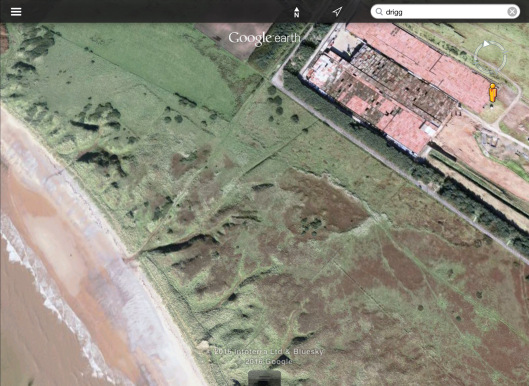
Rusting Shipping Containers of Nuclear Waste at Drigg Near the Irish Sea
As can be seen above, low level doesn’t mean low risk. Nor does it mean short-lived, as is seen below. Many have half-lives of thousands and even millions of years. Rather, this is a dilute to deceive scam so popular with illegal polluters, but this is condoned by the UK Government (as well…
View original post 1,141 more words
July 12 Energy News

Science and Technology:
¶ A 2,000-page report from the UK Climate Change Committee foresees a domino effect on key infrastructure. Bridges lost to flooding means loss of electricity, gas and IT connections. Poor farming means the fertile soils become badly degraded by mid-century. And that is if Paris climate change goals are met, a pledge that is in doubt. [BBC]
 Flooding in the UK. PA image.
World:
¶ China will ban the construction of new coal-based chemical facilities and coal-fired power plants until 2018 and continue to shed overcapacity in coal mining and oil refining, according to the state news agency, Xinhua. The ban on projects should cut coal’s share of the overall mix to 58% from the 64% it currently has. [Web India 123]
¶ Ireland’s Mainstream Renewable Power said today the 80-MW Noupoort wind farm in South Africa has achieved commercial operation. The wind…
View original post 600 more words
July 11 Energy News
Science and Technology:
¶ Scientists are investigating biofuels as alternatives to fossil fuels. Corn, soybean and sugarcane produce a range of biofuels; however, they add to water scarcity, deforestation, and increased land use. An alternative is microalgae, which can be grown in façade panels on buildings, having little negative environmental impact. [The Fifth Estate]
 The BIQ House in Hamburg.
¶ Enginuity Worldwide, of Mexico, Missouri, wants to turn agricultural waste into BioCoal, which it says looks and burns just like regular coal and could help reduce emissions from coal plants.The Nebraska Department of Environmental Quality has awarded the a $250,525 grant to research the subject. [Columbus Telegram]
World:
¶ As part of the Carbon Trust’s Offshore Wind Accelerator program, developers Dong Energy, EnBW, E.ON, Iberdrola, RWE, SSE, Statkraft, Statoil and Vattenfall have signed up to the initiative to help reduce the cost of offshore wind to…
View original post 767 more words
Nuclear Free Portugal Beats Nuclear France in More Ways Than One!
Portugal beat host country France in the 2016 Eurocup soccer final:
“Portugal stuns France with late Eder strike in Euro final”
Posted:Sun, 10 Jul 2016 18:52:56 -0400 http://feeds.reuters.com/~r/reuters/sportsNews/~3/R23thiJJJLA/us-soccer-euro-por-fra-idUSKCN0ZQ0ZK
Portugal stunned the world in May by getting all of its electricity from renewable energy for 4 days. Portugal has said no to nuclear and yes to renewables. Meanwhile, the French government belligerently continues to prop up the nuclear industry and gets a larger percentage of electricity from nuclear power than any other country. This year Portugal has gotten almost 2/3rds of its electricity from renewable energy against France’s over 2/3rds from nuclear energy.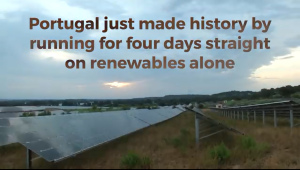


Screenshots from the Greenpeace video: http://youtu.be/lWIy94h3spk Windmills are busily spinning in the video, it just can’t be seen in the screen-shot.
Portugal Must Have Stunned the World in 1974 By Peacefully Getting Rid of the Longest Authoritarian (Fascist) Dictatorship In the West: “The name “Carnation…
View original post 1,159 more words
New governor’s Sendai plant shutdown pledge alarms utility
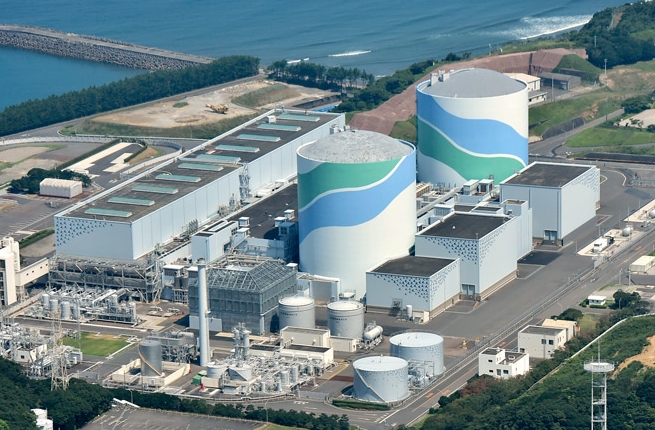
Kyushu Electric Power Co.’s Sendai nuclear power plant in Satsuma-Sendai in Kagoshima Prefecture
Concern is growing among Kyushu Electric Power Co. and the central government over the new Kagoshima governor’s pledge to request a reassessment of the Sendai nuclear plant’s safety in light of the recent Kumamoto quakes.
Satoshi Mitazono, a former political reporter with TV Asahi Corp., was elected on his campaign pledge to build a “society without nuclear energy” in the July 10 gubernatorial race, defeating incumbent Yuichiro Ito.
Mitazono, 58, wants to suspend operations at the plant for a review of its emergency evacuation plan and to re-examine its safety features.
A top Kyushu Electric executive expressed bewilderment over Mitazono’s proposal.
“A governor has no legal authority to order a halt,” the official said. “On what legal basis can the plant be shut down?”
But Mitazono’s calls reflect local residents’ mounting concerns over the Sendai plant in Satsuma-Sendai, Kagoshima Prefecture, after a series of strong tremors rocked neighboring Kumamoto Prefecture starting in mid-April.
The company allows prefectural officials to inspect the nuclear plant site, and request for it to take corrective measures based on their findings under an agreement with the prefectural and Satsuma-Sendai city governments over safety issues.
Kyushu Electric, based in Fukuoka, would likely be forced to respond in one way or another when the governor asks for the suspension of the plant, regardless of legal authority.
With two reactors in operation, Sendai is the only nuclear power station back online in the nation after it cleared the new safely regulations implemented after the 2011 Fukushima nuclear disaster.
After Mitazono emerged as the winner on July 10, Kyushu Electric’s closing stock price dropped more than 7 percent, compared to July 8, reflecting the company’s potentially gloomy prospects.
The two reactors at the Sendai plant are scheduled to be shut down in October or later for a regular check.
An official with the Ministry of Economy, Trade and Industry, which oversees the nuclear industry, said it would take a prolonged period before the plant could be restarted if a review of the evacuation plan or other demands were made.
A senior Kyushu Electric official concurred that it would not be easy to go back online on a regular time schedule if such demands were made.
“It would be difficult to reactivate the reactors amid the opposition of the local government hosting the plant,” the official said.
Evacuation order lifted in Minami-Soma after 5 years, affecting 10,000 people
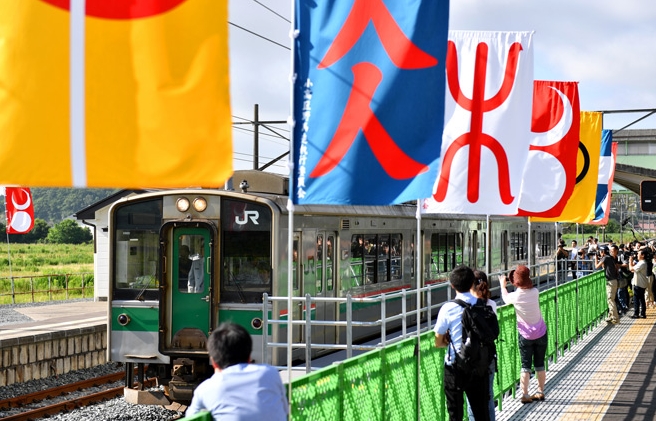
For the first time in five years, a train begins service on the 9.4-kilometer stretch between Odaka and Haranomachi stations in Minami-Soma, Fukushima Prefecture, on East Japan Railway Co.’s Joban Line at 7:33 a.m. on July 12.
Evacuation order lifted in Minami-Soma after 5 years
MINAMI-SOMA, Fukushima Prefecture–In good news for residents, an evacuation order for the southern part of the city here was lifted on July 12 for the first time since the massive earthquake and tsunami crippled the Fukushima No. 1 nuclear power plant five years ago.
However, due to lingering fears of radiation contamination, less than 20 percent of the populace are set to return to their homes.
The central government allowed residents back into the southern region of the city after midnight on July 11. It marks the sixth time that evacuation orders have been lifted for locales in Fukushima Prefecture, following such municipalities as Naraha and Katsurao.
The latest lifting in Minami-Soma affects a total of 10,807 residents in 3,487 households in all parts of the Odaka district and parts of the Haramachi district, making it the largest number of people to be let back into their homes since evacuation zones were established following the 2011 nuclear disaster.
Two residents living in a household in an area designated a “difficult-to-return” zone in the southern part of the city are still not allowed back home.
However, only about 2,000 residents signed up to stay overnight at their homes in the area ahead of the lifting of the evacuation order.
That is likely because many still fear the effects of radiation from the destroyed power plant, which straddles the towns of Futaba and Okuma to the south of Minami-Soma. In addition, five years was more than enough time for residents who evacuated elsewhere to settle down.
With at least some of the residents returning home, East Japan Railway Co. resumed service on the 9.4-kilometer stretch between Odaka and Haranomachi stations on the Joban Line for the first time in more than five years on the morning of July 12. The first train of the morning entered Odaka Station carrying 170 or so people on two cars as traditional flags used in the Soma Nomaoi (Soma wild horse chase) festival on the platform greeted passengers.
The central government is pushing to lift evacuation orders on all areas of the prefecture excluding difficult-to-return zones by March 2017.
http://www.asahi.com/ajw/articles/AJ201607120054.html
Japan lifts evacuation orders in Fukushima affecting 10,000 people
FUKUSHIMA, Japan (Kyodo) — The government on Tuesday further scaled down areas in Fukushima Prefecture subject to evacuation orders since the March 2011 nuclear disaster at the Fukushima Daiichi complex, enabling the return of more than 10,000 residents to the city of Minamisoma.
Following the move, the city will become mostly habitable except for one area containing one house. But many residents seem uneager to return, having begun new lives elsewhere.
The government is in the process of gradually lifting evacuation orders issued to areas within a 20-kilometer radius of the plant of Tokyo Electric Power Company Holdings Inc. and in certain areas beyond the zone amid ongoing radiation cleanup efforts.
Eight municipalities in Fukushima Prefecture have areas defined as evacuation zones, which are divided into three categories based on their radiation levels. The most seriously contaminated area is called a zone “where it is expected that the residents have difficulties in returning for a long time.”
In Minamisoma, the government lifted evacuation orders for areas except for the difficult-to-return zone. As of July 1, the areas had a registered population of 10,807, or 3,487 households.
To encourage evacuees to return, the central government and the city reopened hospital facilities, built makeshift commercial facilities and prepared other infrastructure.
Radiation cleanup activities have finished in residential areas, but will continue for roads and farmland until next March.
The government hopes to lift the remaining evacuation orders affecting areas other than the difficult-to-return zones by next March, officials said.
http://mainichi.jp/english/articles/20160712/p2g/00m/0dm/031000c
Court rules a third time against Takahama reactors
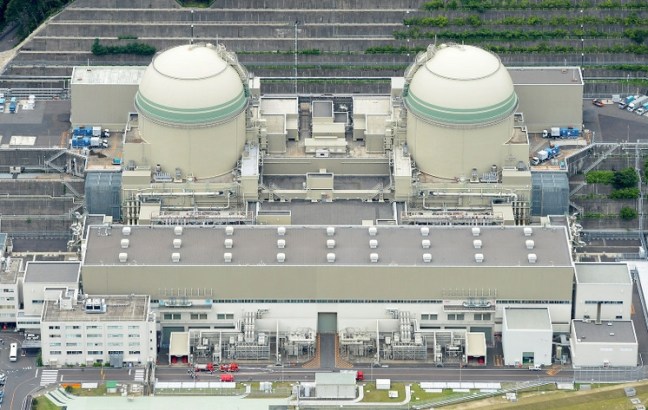
The No. 3 and No. 4 reactors at the Takahama Nuclear Power Plant, from left to right, are pictured in this photo taken from a Mainichi helicopter in Takahama, Fukui Prefecture, on June 15, 2016.
OTSU, SHIGA PREF. – The Otsu District Court ruled against Kansai Electric Power Co. for the third time in five months Tuesday, in a decision that will keep its Takahama No. 3 and 4 reactors in Fukui Prefecture shut down indefinitely.
Both sides are now gearing up for an appeal by Kepco to the Osaka High Court, where a decision could come next year, while the plaintiffs are expected to file further suits.
The utility had filed an objection to the Otsu court’s March decision, which granted a temporary injunction on the reactors, forcing Kepco to shut them down about two months after they had been restarted.
The court reaffirmed its decision in June and again made the same ruling on Tuesday after Kepco fought the June decision.
“The utility was not arguing that both reactors were safe based on expert evidence and reasonable safety standards, but that they were safe due to detailed assertions directly related to their safety and prima facie evidence,” said presiding Judge Yoshihiko Yamamoto, the same judge who has twice ruled against Kepco. “However, the new safety standards haven’t drawn the limits of what dangers should be accepted by society.”
Representatives for the plaintiffs welcomed the ruling.
“Once again, the Otsu court has ruled against the safety of restarting the reactors, especially with Lake Biwa nearby, even though Kepco has said it’ll likely appeal to the (Osaka) High Court,” said Yoshinori Tsuji, one of the chief plaintiffs.
The case boiled down to the basic question of what determines adequate safety for a nuclear power plant. It has raised questions about the way the Nuclear Regulation Authority is handling safety inspections for restarts.
http://www.japantimes.co.jp/news/2016/07/12/national/court-rules-third-time-takahama-reators/
Report: Japan court upholds injunction to halt nuclear reactors
A Japanese court on Tuesday upheld an order for the shutdown of two reactors at Kansai Electric Power Co’s Takahama nuclear plant in western Japan, a Japanese news agency reported, in a widely expected ruling that prevents the utility from restarting them.
Japan’s second-biggest utility had appealed Otsu District Court’s March 9 ruling ordering it to shut the Takahama No. 3 and No. 4 units with immediate effect, which marked the first injunction to shut a nuclear plant in operation. The court last month also denied the utility’s request for a stay of execution of the injunction.
Kansai Electric is expected to appeal the latest decision to the Osaka High Court.
http://www.asahi.com/ajw/articles/AJ201607120042.html
Court again nixes appeal to restart 2 Takahama nuclear reactors
OTSU, Japan (Kyodo) — A Japanese court again disallowed the operation of two nuclear reactors Tuesday, rejecting their operator’s request to suspend an injunction the same court had issued over the once-reactivated units at the Takahama power plant in Fukui Prefecture, western Japan.
The Otsu District Court’s decision, following the injunction issued in March over the Nos. 3 and 4 units at the Kansai Electric Power Co. plant, would continue to legally prevent the Osaka-based utility from restarting operation of the reactors on the Sea of Japan coast about 380 kilometers west of Tokyo.
Kansai Electric plans to appeal the decision to the Osaka High Court, company officials said.
In June, the district court also rejected the plant operator’s appeal to temporarily void the effects of the injunction, with public concerns lingering over the restart of nuclear power plants in Japan in the wake of the 2011 Fukushima Daiichi disaster.
Tuesday’s decision was issued under the same presiding judge, Yoshihiko Yamamoto, who made the judgments in March and June.
The March injunction was the first of its kind affecting operating reactors. One of the reactors was taken offline one day after the order. The other reactor was already offline.
The Takahama plant has cleared the post-Fukushima safety regulations, allowing Kansai Electric to reactivate the Nos. 3 and 4 reactors. But their operation was beset with problems.
Kansai Electric has announced it will remove fuels from the two nuclear power reactors in August, even though Prime Minister Shinzo Abe’s government has expressed a desire to ramp up nuclear power generation at home.
http://mainichi.jp/english/articles/20160712/p2g/00m/0dm/067000c
1 This Month
Chernobyl: The Lost Tapes – A good documentary on Chernobyl on SBS available On Demand for the next 3 weeks– https://www.sbs.com.au/ondemand/tv-program/chernobyl-the-lost-tapes/2352741955560

of the week–London Campaign for Nuclear Disarmament

Tell the Ukrainian Government to Drop Prosecution of Peace Activist Yurii Sheliazhenko
To see nuclear-related stories in greater depth and intensity – go to https://nuclearinformation.wordpress.com
-
Archives
- April 2026 (114)
- March 2026 (251)
- February 2026 (268)
- January 2026 (308)
- December 2025 (358)
- November 2025 (359)
- October 2025 (376)
- September 2025 (257)
- August 2025 (319)
- July 2025 (230)
- June 2025 (348)
- May 2025 (261)
-
Categories
- 1
- 1 NUCLEAR ISSUES
- business and costs
- climate change
- culture and arts
- ENERGY
- environment
- health
- history
- indigenous issues
- Legal
- marketing of nuclear
- media
- opposition to nuclear
- PERSONAL STORIES
- politics
- politics international
- Religion and ethics
- safety
- secrets,lies and civil liberties
- spinbuster
- technology
- Uranium
- wastes
- weapons and war
- Women
- 2 WORLD
- ACTION
- AFRICA
- Atrocities
- AUSTRALIA
- Christina's notes
- Christina's themes
- culture and arts
- Events
- Fuk 2022
- Fuk 2023
- Fukushima 2017
- Fukushima 2018
- fukushima 2019
- Fukushima 2020
- Fukushima 2021
- general
- global warming
- Humour (God we need it)
- Nuclear
- RARE EARTHS
- Reference
- resources – print
- Resources -audiovicual
- Weekly Newsletter
- World
- World Nuclear
- YouTube
-
RSS
Entries RSS
Comments RSS
 nuclear-news