Political scandal hangs over South Africa’s nuclear energy plans
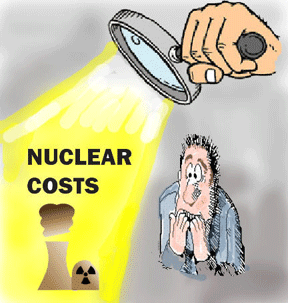 How the state capture controversy has influenced South Africa’s nuclear build , Sunday Times, 29 May 16 South Africa is facing a critical decision that could see it investing about R1 trillion – or US$60 billion to $70 billion – in a fleet of new nuclear power stations. Proponents argue that it will greatly increase electrical base-load capacity and generate industrial growth. But opponents believe the high cost would cripple the country economically.
What should be an economic decision has now been clouded by controversy, with political pressure to push through the nuclear build and the increasingly apparent rewards it would bring to politically linked individuals.
The nuclear expansion programme needs to be considered exceptionally carefully given that the required financial commitment is roughly equal to the total South African annual tax revenue. Loan repayments could place a devastating long-term burden on the public and on the economy as a whole……..
South Africa has had remarkable success with speedy, cost-effective installation of renewable energy power plants. In addition to this, technologies for harvesting South Africa’s plentiful wind and solar energy resources are rapidly becoming cheaper, raising the question of whether the country should not invest more in these options rather than in going nuclear.
The argument that nuclear energy provides a stable base load, independent of weather conditions, is mitigated by improvements in energy storage technologies……
 Zuma and the Russians The nuclear debate gained a political dimension when President Jacob Zuma and his Russian counterpart, Vladimir Putin, started to develop an unusually close relationship. It culminated in an announcement that the Russian nuclear developer, Rosatom, had been awarded the potentially highly lucrative contract to build the new reactors. The agreement was later denied.
Rosatom was considered the preferred contender, with other bidders only there to lend the process legitimacy, according to some observers. The lack of transparency surrounding the process, coupled with a history of corruption in South African mega-projects like the arms deal, has made the whole scheme seem suspicious to the broader public.
A thickening plot
A crucial thread in this saga involves the Shiva uranium mine, about 30km north-west of Pretoria, the country’s executive capital. It originally belonged to a company called Uranium One, a subsidiary of Russia’s Rosatom. It was sold in 2010 to Oakbay Resources, a company controlled by members of the politically connected Gupta family and the president’s son, in a deal that greatly surprised economists.
The mine was deemed unprofitable and thus unattractive to other mining companies. But it was still considered worth a whole lot more than the R270 million paid by Oakbay. The mine would, however, become highly profitable if it became the uranium supplier to the new nuclear power stations. Oakbay and its associates therefore have a very strong incentive for this nuclear build to happen.
 It is here that the nuclear build drama feeds into the recent major controversy surrounding alleged state capture, meaning a corrupt system where state officials owe their allegiance to politically connected oligarchs rather than the public interest. This was highlighted by the shock dismissal of Finance Minister Nhanhla Nene, a reported nuclear build sceptic, but also by subsequent allegations of ministerial positionsbeing offered to people by members of the Gupta family.
Political, legal and civil opposition
The nuclear build’s association with the Zuma faction in the ruling African National Congress (ANC) will be a political hot potato for decades to come. ……
A negative nuclear outlook
Building these plants is a risky business proposition, especially for Rosatom, which is implicated in the developing scandal. The recent political mood swing against state capture and a likely credit rating downgrade add to the risk.
Rosatom has suggested a nuclear build financing option that effectively amounts to it providing a loan. It is, however, conceivable that a future government may not honour debt repayments if there is a view that the construction deal was secured irregularly.
The narrow public support base and downright hostility in some quarters to a nuclear build has already effectively stalled local nuclear construction plans. The level of controversy, high costs and potential for further disruption mean that the planned implementation could only proceed under severe social strain.
Such a scenario could very well cost the ruling ANC the 2019 national elections. And the party is becoming increasingly aware of this. As such, it is posited that the nuclear build will not happen any time as soon as planned.
– Hartmut Winkler, Professor of Physics, University of Johannesburg http://www.timeslive.co.za/sundaytimes/opinion/2016/05/27/How-the-state-capture-controversy-has-influenced-South-Africa%E2%80%99s-nuclear-build
Hinkley nuclear project’s future is in doubt – French unions not happy with Hinkley plan


 Hinkley Point: French unions put nuclear plant’s future in doubt By Jake Morris & Chris Cook BBC Newsnight 27 May 2016
The future of the planned new nuclear power plant at Hinkley Point remains in doubt as key French unions still oppose the project, BBC Newsnight has learned.
EDF, which would build the plant, had delayed a decision on the project in Somerset until the summer while it consulted French union representatives.
The company, which is 85% French state-owned, had hoped to win support from a committee of workplace representatives.
But the committee said staff had not been reassured about the plant’s costs.
Trade union representatives hold six of the 18 seats on EDF’s board.
‘Several reservations’
Jean-Luc Magnaval, secretary of the Central Works Committee that EDF consulted with, told Newsnight that staff feared the cost of the project would cripple EDF.
He said: “We have reservations about several aspects of the project: organisation, supply chain, installation, and procurement.
“The trade unions are unlikely to give their blessing to the project in its current state.
“We are not reassured by the documents we have received. We have been given a marketing folder, not the full information we require.
“We got the documents on 9 May – we are sending EDF a request for more explanations.”…….
EDF chief executive Vincent de Rivaz also told MPs on the committee that he did not know when a final decision on the project would be made…….
While one third of the £18bn capital costs of the project are being met by Chinese investors, Hinkley Point would remain an enormous undertaking for the stressed French company……..http://www.bbc.com/news/business-36394601
The myth that nuclear weapons keep us safe.
The Manhattan Project Myth http://www.usnews.com/opinion/articles/2016-05-27/nuclear-myths-began-when-the-us-dropped-the-atomic-bombs-on-japan
America’s use of the atomic bomb started the dangerous narrative that nuclear weapons keep us safe.

By Erica Fein | May 27, 2016 Today, one of the world’s greatest concerns is the unconstrained advancement of North Korea’s nuclear arsenal. Yet, for the most part, the leaders of the eight other nuclear-armed states cling to their own weapons with the belief that the nuclear game of chicken – also known as deterrence – has worked.
The narrative that nuclear weapons are the “ultimate guarantors of security” is powerful and comforting for many. The flip side, that only luck has prevented World War III, is almost too horrible to contemplate.
Nuclear myths extend back to dawn of the atomic age. In 1945, very few people knew about America’s secret project to build the atomic bomb. The Manhattan Project’s purpose remained a mystery even to most of its hundreds of thousands of employees and members of Congress.
It is not surprising, therefore, that most Americans supported the bombings of Hiroshima and Nagasaki. War Secretary Henry Stimson quickly pronounced that this new weapon ended the war and saved 1 million American lives by averting an American invasion of Japan. Only later did details of the bombs’ destructive effects come to light – some 200,000 instant deaths, flattened cities and enormous suffering. But by then, the war-winning significance of Hiroshima and Nagasaki had seeped into the American psyche.
With the declassification of archival records, the official story is now debated by historians. Among other things, the 1946 United States Strategic Bombing Survey concluded, “even without the bombing attacks, air supremacy over Japan could have exerted sufficient pressure to bring about unconditional surrender and obviate the need for an invasion.”
Yet, 70 years later, whether the atomic bombings decisively ended the war or saved more total American or Japanese lives seems less important than the myth that their use perpetuated: nuclear weapons keep us safe.
President Harry Truman had the opportunity to try to control the spread of nuclear weapons through international agreements. Instead, he doubled-down and agreed to the development of the H-bomb, which helped to spawn the arms race.
American leadership in ending the nuclear threat is no less of an imperative today. President Barack Obama understands this and deserves credit for negotiating a modest arms reduction treaty with Russia, raising the profile of nuclear terrorism prevention, and negotiating a historic agreement that would prevent Iran from developing a nuclear weapon. However, as the president has admitted, his agenda is unfinished.
Before he leaves office, Obama can do more to head-off the possibility of renewed global nuclear competition. For example, America is planning to upgrade its entire arsenal of land, air and sea-delivered nuclear weapons at an estimated cost of nearly half a trillion dollars. Doing so would maintain excess force levels for decades to come. If Obama takes a step to reverse these unnecessary plans, such as canceling the new nuclear-armed cruise missile, he may not change many minds overnight, least of all those of our adversaries. Nonetheless, any action to lessen the significance of nuclear weapons would help lay bare their mythical power – a step in the right direction.
UN Agency Reports Iran Has Complied With Nuclear Deal

 UN Agency Reports Iran Has Complied With Nuclear Deal abc news, by GEORGE JAHN, ASSOCIATED PRESS VIENNA — May 27, 2016 Iran has corrected one violation of its landmark nuclear deal with six world powers and is honoring all other major obligations, the U.N. atomic energy agency reported Friday.
The U.N’s International Atomic Energy Agency is responsible for monitoring the agreement Iran signed last year with the United States, Russia, China, Britain, France and Germany that reduces and limits Tehran’s nuclear activities in exchange for sanctions relief…….http://abcnews.go.com/International/wireStory/agency-reports-iranian-violations-nuclear-deal-39423725
Nuclear spruikers head to Cumbria for a marketing talkfest
Carlisle to host two-day Cumbria Nuclear Conference, News & Star, 27 May 2016 The nuclear industry is coming to Carlisle this autumn, when the city hosts the first Cumbria Nuclear Conference.
The two-day event on September 21 and 22 will attract movers and shakers from across the sector and highlight the opportunities – and challenges – to businesses arising from the new nuclear plant at Sellafield.
Speakers confirmed include NuGen chief executive Tom Samson, energy minister Andrea Leadsom, the former defence secretary and Barrow MP Lord Hutton, and John Clarke, chief executive of the Nuclear Decommissioning Authority.
Carlisle MP John Stevenson has organised the event. He said: “Nuclear is a big opportunity for Cumbria – that much is widely recognised.
“But how we do maximise the benefits for the county? That’s what the conference will address. We need to raise awareness of the opportunities.”…….
NuGen – a partnership between Toshiba of Japan and the French energy company ENGIE – has plans to build three Westinghouse AP1000 reactors…….NuGen is due to make a final decision on whether to proceed with the Moorside project in 2018 and had hoped to start construction two years later and have the first reactor on stream by 2024, although it now says the target date has slipped to 2025……
ExxonMobil must be made accountable for their climate change deception
Greenwashing or Progress? Exxon Shareholders Issue Calls for Climate Accountability , 27 May 2016 By Candice Bernd, Truthout | At ExxonMobil’s annual shareholder meeting in Dallas this week, activist shareholders and investors demanded the company own up to its deceptive practices regarding climate disruption and begin to implement adaptations and regulations to mitigate climate disruption’s impacts.
Shareholders nixed nearly all of the 11 measures directly or indirectly related to climate disruption during the meeting Wednesday, but 62 percent of them passed a “proxy-access” measure that would allow investors holding at least 3 percent of shares to nominate outsiders for seats on the company’s board.
To see more stories like this, visit “Planet or Profit?”
New York City Comptroller Scott Stringer sponsored the measure, empowering investors holding at least 3 percent of company shares for more than three years to nominate up to a quarter of the board’s directors annually. While shareholder resolutions are non-binding, the measure could potentially allow a climate activist to become a director on the company’s board. Exxon CEO Rex Tillerson said the boardwould consider enacting the proposal this July.
The proposal is the first to be passed by shareholders since 2006 and breaks a 25-year pattern in which Exxon investors have systematically rejected more than 60 climate- and good-governance-related proposals. Oil giant Chevron also held its annual meeting Wednesday in San Ramon, California, with investors rejecting every climate-related measure.
While Exxon investors still rejected the vast majority of the demands, it seems they can’t entirely tamp down this year’s calls for accountability. The heated public campaign against Exxon comes at a time when the industry is taking a hit from aplunge in oil prices. Last year, Exxon earned its smallest profit since 2002 and lost its top-ranked credit score after its debt more than tripled. Still, Exxon remains one of the most profitable companies in the world.
Perhaps the company’s most contentious meeting in decades, executives contended with one of the largest coalitions between activist shareholders and large-scale investors ever, with more than $8 trillion under their management. Groups including foundations, unions and several religious organizations brought forward resolutions this year.
Still, investors rejected nearly all of the measures, including proposals that would have forced Exxon to report to shareholders how the company would plan for the future under the Paris climate agreement, support a limit on global planetary warming to 2 degrees Celsius, insert a climate expert on its board, and provide reports on its lobbying activities and hydraulic fracturing (fracking).
This week’s meeting was Exxon’s first annual meeting since the Paris agreement was brokered, and since at least three state attorneys general launched investigations into allegations claiming the company intentionally misled the public about the risks and impacts associated with climate disruption.
A series of investigative reports published last year by InsideClimate News and theLos Angeles Times revealed that Exxon began its own internal research on climate disruption as early as the 1970s and understood early on that carbon emissions from burning fossil fuels were driving planetary warming. It then took active steps to cover up its findings.
Since the reports were published, Democratic members of Congress and presidential candidates Bernie Sanders and Hillary Clinton have pressed the Department of Justice to consider bringing a civil racketeering case against Exxon. The department has since referred the requests to the FBI’s criminal division, but it could still file a civil complaint against the company.
Grandchild of Former Exxon Scientist, Flood Victim Speak Out in Dallas
Joining a group of about 80 climate justice activists outside the Exxon meeting in Dallas was Anna Kalinsky, the granddaughter of James Black, a senior Exxon scientist who warned the company about the risks and impacts associated with burning fossil fuels on the global climate system — in 1977.
“Instead of working to address climate change, [Exxon] invested in lobbyists and front groups that contradicted the very science my grandfather had warned them about,” Kalinsky told activists. “When we ignore science, and let companies and government agencies deceive us with spin about the damage that their products cause, we all lose.”
Kalinsky also addressed Exxon executives inside the shareholder meeting, going into more detail about her grandfather’s scientific findings and rebuking Exxon’s funding of groups “that spread misinformation about the science.” The company has spent tens of millions of dollars funding the climate denial networks since 1998…….http://www.truth-out.org/news/item/36204-some-exxon-shareholders-issue-calls-for-climate-accountability
Nuclear energy has no place in New York State renewable energy plan
 “The proposed Clean Energy mandate also includes a proposal to support emissions-free upstate nuclear power.”
The inclusion of nuclear power in the New York State renewable energy plan is drawing national attention.
“Hitting on state taxpayers to pay for steadily rising nuclear costs while wind and solar energy are less and less expensive makes no sense in a 21st Century economy,”
the inclusion of nuclear power in the state plan would take resources away from true clean, green energy.
Long Island as a Nuclear Park, CounterPunch, by KARL GROSSMAN MAY 27, 2016 “……..PSEG has had a very sorry record as THE Long Island utility.
This bad record is continuing with intensity.
Last month, for example, PSEG took a blow at solar energy on the island asking the state Public Service Commission to “minimize” and “later eliminate” benefits received by homeowners and business owners utilizing solar energy. PSEG wants to hike the charge to solar customers for being connected to the grid and reduce what they get for sending electricity into it.
“We should encourage homeowners and business owners to invest in rooftop solar systems—but PSEG wants to penalize them,” says Gordian Raacke, executive director of Renewable Energy Long Island. ‘This runs counter to the idea of getting more renewable energy into the grid and of the New York State energy plan which seeks to get half of the state’s electricity from renewable sources by 2030.”…….
And regarding nuclear power, a fundamental focus of LIPA was to lead in bringing safe, clean, renewable—and not nuclear—energy to Long Island. This was in keeping with its formation being instrumental in stopping LILCO’s plan to build many nuclear power plants on the island with Shoreham the first.
Another U.S. utility that’s been as bullish on nuclear power—and still is: PSEG.
In the 1970s, PSEG embarked on a plan to build a line of “floating” nuclear power plants in the Atlantic Ocean off New Jersey with the last just south of Long Island. Millions were spent before this scheme was jettisoned………
What the state is calling a “50 by 30” plan, advanced by Andrew Cuomo, is formally titled a “Clean Energy Standard.” As the Department of Public Service explained in a statement: “Governor Cuomo directed the Public Service Commission to design and enact a new Clean Energy Standard mandating that 50 percent of all electricity consumed in New York by 2030 come from clean and renewable energy sources.” However, the next line in the statement is: “The proposed Clean Energy mandate also includes a proposal to support emissions-free upstate nuclear power.” That component of the state plan drew strong criticism at the public hearing.
“Nuclear energy is neither clean nor renewable,” testified Pauline Salotti, vice chair of the Green Party of Suffolk County. “No way should it be considered renewable.”
Raacke said New York should not seek to “prop up nuclear power” and spoke of the Shoreham “nuclear folly” that went on “for years” on Long Island and the successful struggle against it. He objected to a “revisit to that past in the plan.”…..
The boosting of “upstate nuclear power” in the state plan follows Andrew Cuomo’s support for the continued operation of nuclear power plants in upstate New York despite his opposition to the Indian Point nuclear power plants downstate, 26 miles north of New York City, which he’s been demanding be shut down. ……
The Syracuse Post Standard, in an article by Tim Knauss headlined “Cuomo’s Renewable Energy Plan Includes Boost for Upstate Nuclear Plants,” quotes Syracuse attorney Joe Heath, counsel to the Onondaga Nation, as opposing this. Said Heath: “We should…not think that nukes are the answer.”
The upstate nuclear plants that Cuomo is backing—and that his plan claims produce renewable energy—include the long-troubled Nine Mile Point and FitzPatrick nuclear plants in Scriba, although the current owner of FitzPatrick want to close it this year because, says Entergy, it is not financially viable to operate……
The inclusion of nuclear power in the New York State renewable energy plan is drawing national attention. “Cuomo is mistaken to squander his political clout on beating the dead horse that nuclear power has become in the State of New York,” says Paul Gunter, director of the Reactor Oversight Project for the organization Beyond Nuclear.
“Hitting on state taxpayers to pay for steadily rising nuclear costs while wind and solar energy are less and less expensive makes no sense in a 21st Century economy,” declares Gunter. “It’s time to offer retraining to the nuclear work force to install renewable energy, expand state-of-the-art energy storage systems like Tesla’s PowerWall and make energy efficiency and conservation part of every home, business and industry in the state.” Moreover, says Gunter, the inclusion of nuclear power in the state plan would take resources away from true clean, green energy.
Karl Grossman, professor of journalism at the State University of New York/College of New York, is the author of the book, The Wrong Stuff: The Space’s Program’s Nuclear Threat to Our Planet. Grossman is an associate of the media watch group Fairness and Accuracy in Reporting (FAIR). He is a contributor to Hopeless: Barack Obama and the Politics of Illusion. http://www.counterpunch.org/2016/05/27/long-island-as-a-nuclear-park/
Japanese government to announce a shift away from nuclear power?

 Japan Nuclear Power Outlook Bleak Despite First Reactor Restart Japan to cut emphasis on nuclear in next energy plan http://www.dw.com/en/japan-to-cut-emphasis-on-nuclear-in-next-energy-plan/a-19289705
Japan is rethinking its energy diet and could announce a shift away from nuclear power as soon as next year. Scrapping nuclear would mean more renewable energy generation, but also a heavier reliance on coal.
Japan will cut its reliance on nuclear power after releasing an updated energy plan next year, the Reuters news agency reported on Friday, citing three people with knowledge of the matter.
The Japanese remain strongly opposed to nuclear power after the 2011 Fukushima disaster, and a shift in energy policy would reflect that widespread aversion. But it would also likely usher in a new era of dependence on coal-fired power plants.
Japan will never go back to nuclear energy.
Burning coal is less expensive than producing nuclear power, but a recent decision by Japan’s environment ministry to drop its opposition to coal-fired power plants has raised questions about the industry’s ability to lower its greenhouse gas emissions.
Is coal the way to go?
Japan is one of several Asian countries that are expanding their coal portfolios faster than natural gas, which is viewed as another big potential source of growth in the energy sector.
Renewables are also on the upswing, and Tokyo’s decision to move away from nuclear power would definitely see it boost its reliance on renewable energy.
A target set by Japan’s energy ministry that would have seen nuclear energy make up a fifth of the country’s electricity was widely criticized. Another target, which foresaw nuclear accounting for 10-15 percent of electricity by 2030, was also nixed.
A shift away from nuclear energy, while publicly popular, wouldn’t be without risk, according to experts.
“There is a real risk that investment in coal or fossil fuel power generation within five to 10 years will become a stranded asset, which means that they’re no longer a viable investment,” the head of the International Renewable Energy Agency (IRENA), Adnan Z. Amin, told Reuters. “You’re seeing in more and more countries around the world a determination to move out of coal.”
World wide state of nuclear weaponry confronts Obama’s nuclear-free ideals
Obama won the Nobel Peace Prize for 2009, the year he had made a speech in Prague calling for a nuclear-free planet. Yet the issue seems to have taken a back seat during his time in office. Obama apparently hoped that the Hiroshima trip would revive the momentum for arms reduction both in the U.S. and across the globe.
Obama signed the New START strategic arms reduction treaty with then-Russian President Dmitry Medvedev in 2010, adding momentum to global disarmament efforts. But the atmosphere worsened after Vladimir Putin returned to the presidency in 2012.
Bilateral relations cooled after Russia annexed the Crimean Peninsula, slamming the brakes on disarmament. Signatories to the Nuclear Non-Proliferation Treaty also failed to agree on further reductions at a review meeting last year.
Russia has already exceeded the maximum amount of warheads allowed under New START. China has abandoned the concept of minimal deterrence and is now preparing to equip nuclear submarines with sub-launched ballistic missiles. It is only a matter of time before North Korea develops warheads small enough to mount on a ballistic missile.
Presumptive Republican presidential nominee Donald Trump contends that Japan and South Korea should build nuclear arsenals of their own, utterly disregarding Obama’s calls for a world free of the weapons.
The real estate mogul ironically echoes Obama when he argues that the U.S. cannot continue to be “the policeman of the world.” The American public is increasingly turning inward from two difficult wars in Afghanistan and Iraq. Obama’s disarmament push may also be hindered by weakened U.S. leadership in the international arena and growing isolationism at home.
Australia scrubbed from UN climate change report after government intervention

 Exclusive: All mentions of Australia were removed from the final version of a Unesco report on climate change and world heritage sites after the Australian government objected on the grounds it could impact on tourism.
Guardian Australia can reveal the report “World Heritage and Tourism in a Changing Climate”, which Unesco jointly published with the United Nations environment program and the Union of Concerned Scientists on Friday, initially had a key chapter on the Great Barrier Reef, as well as small sections on Kakadu and the Tasmanian forests.
But when the Australian Department of Environment saw a draft of the report, it objected, and every mention of Australia was removed by Unesco. Will Steffen, one of the scientific reviewers of the axed section on the reef, said Australia’s move was reminiscent of “the old Soviet Union”.
Source: Australia scrubbed from UN climate change report after government intervention |…
View original post 4 more words
‘I Do Not Want Any Children to Develop Cancer Like Me’, a Fukushima Resident Says
Independent filmmaker Ian Thomas Ash has uploaded to YouTube a four-part interview with a young woman from Fukushima Prefecture who has been diagnosed with thyroid cancer. Now 20, the interviewee was 15 years old when, following the March 2011 earthquake and tsunami, the Fukushima Daiichi nuclear power complex lost power and the ability to cool fuel in the reactors. The lack of cooling caused a series of hydrogen explosions that severely damaged four of the six reactors at the Daiichi complex.
As a result of the explosions and subsequent fires, nuclear contamination was spread over a large part of Japan’s northeast. The young woman interviewed in the documentary, who wishes to remain unidentified, is one of 166 Fukushima residents who were 18 or younger at the time of the nuclear disaster who have been diagnosed with or suspected of having thyroid cancer (as of February 2016).
While some attribute the rise in cases of thyroid cancer to more rigorous screening, Ash notes that 74.5% of young people aged 18-21 as of April 1, 2014 who were living in Fukushima at the time of the nuclear accident have not yet taken part in the official thyroid ultrasound examination.
“This young woman’s reason for speaking out is to motivate the families of children who have not yet received the thyroid ultrasound examination to have their children tested,” Ash says in his introduction to the interview.
The interview has been uploaded to YouTube in four parts: part 1, part 2, part 3, part 4
The woman says according to her doctors, her cancer was caught at the right moment. Had she waited any longer, they told her, the cancer could have spread. As a result of the illness, she had part of her thyroid removed.
She will begin working in a nursery school this year, and is pained to think of any other children going through what she has endured:
I would hate if any children I taught developed cancer. To tell the truth, I do not want any children to develop cancer like me.
Ash, based in Tokyo, makes short documentaries about life in Japan after the March 11, 2011 earthquake, tsunami and nuclear disaster.

In Fukushima, even robots can’t survive nuclear mayhem
The company that runs the Fukushima plant sent 5 robots to ground zero and not a single one survived. Incredibly high radiations in the block causes heat levels to rise and this melts the robots’ wiring.
A tsunami, triggered by an earthquake on March 11, 2011, initiated the Fukushima Daaiichi nuclear disaster in Japan which led to the evacuation of over 200,000 people.
Even after 5 years, there is still a tremendous amount of cleanup work left at ground zero. The Tokyo Electric Power Co. (TEPCO) which runs the plant has managed to clean up one building but is still struggling to do the same with other buildings which has burnt fuel rods. These fuel rods are nothing but chunks of radioactive waste weighing hundreds of metric tonnes.
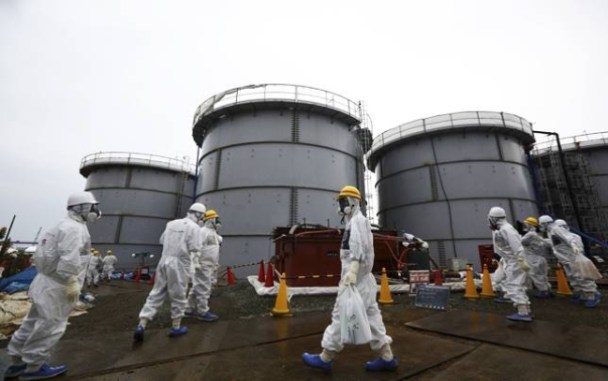
It took 2 years for TEPCO to design the robots for the job of extracting melted fuel rods and according to TEPCO’s head of decommissioning, Naohiro Masuda, the heat levels due to radiation are so extreme that it simply melts the robot’s wiring.
Japan had been trying out various methods to stop the radiations from damaging the area further. One such method was building “ice walls” to keep groundwater from reaching the reactors. A refrigerant chemical that forms an ice wall to block Fukushima’s fallout water and stop the ground water intrusion into the plant.

A million metric tonnes of irradiated water is being stored on the site and is pumped in to cool down the reactors. Disposing the radioactive water is still a challenge for TEPCO as storage tanks have already leaked some of the material into the ocean.
After TEPCO’s robots not surviving the heat levels of the radiations, it’s a place for no man or machine. Toshiba has developed new robots for picking up the fuel rods and to clean up the scene which previous robots failed to.
The entire cleanup process is expected to take around 30 to 40 years, but TEPCO is being blamed for its lukewarm response to the incident and is facing flak from the Japanese government and the people alike.
Let Them Drown The Violence of Othering in a Warming World
An impressive joining-the-dots article by Naomi Klein, connecting Palestine, climate change, fracking, the refugee crisis and “othering”. Worth reading all of this long essay, but here are some highlights for those without the time: We often hear climate change blamed on ‘human nature’, on the inherent greed and short-sightedness of our species. Or we are told we have altered the earth so much and on such a planetary scale that we are now living in the Anthropocene – the age of humans.
These ways of explaining our current circumstances have a very specific, if unspoken meaning: that humans are a single type, that human nature can be essentialised to the traits that created this crisis. In this way, the systems that certain humans created, and other humans powerfully resisted, are completely let off the hook. Capitalism, colonialism, patriarchy – those sorts of system. Diagnoses like this erase the very existence of human systems that organised life differently: systems that insist that humans must think seven generations in the future; must be not only good citizens but also good ancestors; must take no more than they need and give back to the land in order to protect and augment the cycles of regeneration.
These systems existed and still exist, but they are erased every time we say that the climate crisis is a crisis of ‘human nature’ and that we are living in the ‘age of man’. … We are running out of cheap and easy ways to get at fossil fuels, which is why we have seen the rise of fracking and tar sands extraction in the first place. This, in turn, is starting to challenge the original Faustian pact of the industrial age: that the heaviest risks would be outsourced, offloaded, onto the other – the periphery abroad and inside our own nations. It’s something that is becoming less and less possible. Fracking is threatening some of the most picturesque parts of Britain as the sacrifice zone expands, swallowing up all kinds of places that imagined themselves safe. So this isn’t just about gasping at how ugly the tar sands are. It’s about acknowledging that there is no clean, safe, non-toxic way to run an economy powered by fossil fuels. There never was. … The trouble is structural. Fossil fuels, unlike renewable forms of energy such as wind and solar, are not widely distributed but highly concentrated in very specific locations, and those locations have a bad habit of being in other people’s countries. Particularly that most potent and precious of fossil fuels: oil.
This is why the project of Orientalism, of othering Arab and Muslim people, has been the silent partner of our oil dependence from the start – and inextricable, therefore, from the blowback that is climate change. If nations and peoples are regarded as other – exotic, primitive, bloodthirsty, as [Edward] Said documented in the 1970s – it is far easier to wage wars and stage coups when they get the crazy idea that they should control their own oil in their own interests. In 1953 it was the British-US collaboration to overthrow the democratically elected government of Muhammad Mossadegh after he nationalised the Anglo-Iranian Oil Company (now BP). In 2003, exactly fifty years later, it was another UK-US co-production – the illegal invasion and occupation of Iraq. The reverberations from each intervention continue to jolt our world, as do the reverberations from the successful burning of all that oil. The Middle East is now squeezed in the pincer of violence caused by fossil fuels, on the one hand, and the impact of burning those fossil fuels on the other.
In his latest book, The Conflict Shoreline, the Israeli architect Eyal Weizman has a groundbreaking take on how these forces are intersecting. The main way we’ve understood the border of the desert in the Middle East and North Africa, he explains, is the so-called ‘aridity line’, areas where there is on average 200 millimetres of rainfall a year, which has been considered the minimum for growing cereal crops on a large scale without irrigation. These meteorological boundaries aren’t fixed: they have fluctuated for various reasons, whether it was Israel’s attempts to ‘green the desert’ pushing them in one direction or cyclical drought expanding the desert in the other. And now, with climate change, intensifying drought can have all kinds of impacts along this line. Weizman points out that the Syrian border city of Daraa falls directly on the aridity line. Daraa is where Syria’s deepest drought on record brought huge numbers of displaced farmers in the years leading up to the outbreak of Syria’s civil war, and it’s where the Syrian uprising broke out in 2011. Drought wasn’t the only factor in bringing tensions to a head. But the fact that 1.5 million people were internally displaced in Syria as a result of the drought clearly played a role. The connection between water and heat stress and conflict is a recurring, intensifying pattern all along the aridity line: all along it you see places marked by drought, water scarcity, scorching temperatures and military conflict – from Libya to Palestine, to some of the bloodiest battlefields in Afghanistan and Pakistan. But Weizman also discovered what he calls an ‘astounding coincidence’. When you map the targets of Western drone strikes onto the region, you see that ‘many of these attacks – from South Waziristan through northern Yemen, Somalia, Mali, Iraq, Gaza and Libya – are directly on or close to the 200 mm aridity line.’ The red dots on the map above represent some of the areas where strikes have been concentrated. To me this is the most striking attempt yet to visualise the brutal landscape of the climate crisis.
All this was foreshadowed a decade ago in a US military report. ‘The Middle East,’ it observed, ‘has always been associated with two natural resources, oil (because of its abundance) and water (because of its scarcity).’ True enough. And now certain patterns have become quite clear: first, Western fighter jets followed that abundance of oil; now, Western drones are closely shadowing the lack of water, as drought exacerbates conflict. Just as bombs follow oil, and drones follow drought, so boats follow both: boats filled with refugees fleeing homes on the aridity line ravaged by war and drought. And the same capacity for dehumanising the other that justified the bombs and drones is now being trained on these migrants, casting their need for security as a threat to ours, their desperate flight as some sort of invading army. Tactics refined on the West Bank and in other occupation zones are now making their way to North America and Europe. … A culture that places so little value on black and brown lives that it is willing to let human beings disappear beneath the waves, or set themselves on fire in detention centres, will also be willing to let the countries where black and brown people live disappear beneath the waves, or desiccate in the arid heat. When that happens, theories of human hierarchy – that we must take care of our own first – will be marshalled to rationalise these monstrous decisions. We are making this rationalisation already, if only implicitly. …
The most important lesson to take from all this is that there is no way to confront the climate crisis as a technocratic problem, in isolation. It must be seen in the context of austerity and privatisation, of colonialism and militarism, and of the various systems of othering needed to sustain them all. … Overcoming these disconnections – strengthening the threads tying together our various issues and movements – is, I would argue, the most pressing task of anyone concerned with social and economic justice. It is the only way to build a counterpower sufficiently robust to win against the forces protecting the highly profitable but increasingly untenable status quo.

London Review of Books Vol. 38 No. 11 · 2 June 2016 pages 11-14 | 5422 words
Let Them Drown : The Violence of Othering in a Warming World By Naomi Klein
Edward Said was no tree-hugger. Descended from traders, artisans and professionals, he once described himself as ‘an extreme case of an urban Palestinian whose relationship to the land is basically metaphorical’.* In After the Last Sky, his meditation on the photographs of Jean Mohr, he explored the most intimate aspects of Palestinian lives, from hospitality to sports to home décor. The tiniest detail – the placing of a picture frame, the defiant posture of a child – provoked a torrent of insight from Said. Yet when confronted with images of Palestinian farmers – tending their flocks, working the fields – the specificity suddenly evaporated. Which crops were being cultivated? What was the state of the soil? The availability of water? Nothing was forthcoming. ‘I continue to perceive a population of poor, suffering, occasionally colourful peasants, unchanging and collective,’ Said confessed. This perception was ‘mythic’, he acknowledged – yet it remained.
If farming was another world for Said, those who devoted their lives to matters like air and water pollution appear to have inhabited another planet. Speaking to his colleague Rob Nixon, he once described environmentalism as ‘the indulgence of spoiled tree-huggers who lack a proper cause’. But the environmental challenges of the Middle East are impossible to ignore for anyone immersed, as Said was, in its geopolitics. This is a region intensely vulnerable to heat and water stress, to sea-level rise and to desertification. A recent paper in Nature Climate Change predicts that, unless we radically lower emissions and lower them fast, large parts of the Middle East will likely ‘experience temperature levels that are intolerable to humans’ by the end of this century. And that’s about as blunt as climate scientists get. Yet environmental issues in the region still tend to be treated as afterthoughts, or luxury causes. The reason is not ignorance, or indifference. It’s just bandwidth. Climate change is a grave threat but the most frightening impacts are in the medium term. And in the short term, there are always far more pressing threats to contend with: military occupation, air assault, systemic discrimination, embargo. Nothing can compete with that – nor should it attempt to try.
There are other reasons why environmentalism might have looked like a bourgeois playground to Said. The Israeli state has long coated its nation-building project in a green veneer – it was a key part of the Zionist ‘back to the land’ pioneer ethos. And in this context trees, specifically, have been among the most potent weapons of land grabbing and occupation. It’s not only the countless olive and pistachio trees that have been uprooted to make way for settlements and Israeli-only roads. It’s also the sprawling pine and eucalyptus forests that have been planted over those orchards, as well as over Palestinian villages, most notoriously by the Jewish National Fund, which, under its slogan ‘Turning the Desert Green’, boasts of having planted 250 million trees in Israel since 1901, many of them non-native to the region. In publicity materials, the JNF bills itself as just another green NGO, concerned with forest and water management, parks and recreation. It also happens to be the largest private landowner in the state of Israel, and despite a number of complicated legal challenges, it still refuses to lease or sell land to non-Jews.
I grew up in a Jewish community where every occasion – births and deaths, Mother’s Day, bar mitzvahs – was marked with the proud purchase of a JNF tree in the person’s honour. It wasn’t until adulthood that I began to understand that those feel-good faraway conifers, certificates for which papered the walls of my Montreal elementary school, were not benign – not just something to plant and later hug. In fact these trees are among the most glaring symbols of Israel’s system of official discrimination – the one that must be dismantled if peaceful co-existence is to become possible.
The JNF is an extreme and recent example of what some call ‘green colonialism’. But the phenomenon is hardly new, nor is it unique to Israel. There is a long and painful history in the Americas of beautiful pieces of wilderness being turned into conservation parks – and then that designation being used to prevent Indigenous people from accessing their ancestral territories to hunt and fish, or simply to live. It has happened again and again. A contemporary version of this phenomenon is the carbon offset. Indigenous people from Brazil to Uganda are finding that some of the most aggressive land grabbing is being done by conservation organisations. A forest is suddenly rebranded a carbon offset and is put off-limits to its traditional inhabitants. As a result, the carbon offset market has created a whole new class of ‘green’ human rights abuses, with farmers and Indigenous people being physically attacked by park rangers or private security when they try to access these lands. Said’s comment about tree-huggers should be seen in this context.
And there is more. In the last year of Said’s life, Israel’s so-called ‘separation barrier’ was going up, seizing huge swathes of the West Bank, cutting Palestinian workers off from their jobs, farmers from their fields, patients from hospitals – and brutally dividing families. There was no shortage of reasons to oppose the wall on human rights grounds. Yet at the time, some of the loudest dissenting voices among Israeli Jews were not focused on any of that. Yehudit Naot, Israel’s then environment minister, was more worried about a report informing her that ‘The separation fence … is harmful to the landscape, the flora and fauna, the ecological corridors and the drainage of the creeks.’ ‘I certainly don’t want to stop or delay the building of the fence,’ she said, but ‘I am disturbed by the environmental damage involved.’ As the Palestinian activist Omar Barghouti later observed, Naot’s ‘ministry and the National Parks Protection Authority mounted diligent rescue efforts to save an affected reserve of irises by moving it to an alternative reserve. They’ve also created tiny passages [through the wall] for animals.’
Perhaps this puts the cynicism about the green movement in context. People do tend to get cynical when their lives are treated as less important than flowers and reptiles. And yet there is so much of Said’s intellectual legacy that both illuminates and clarifies the underlying causes of the global ecological crisis, so much that points to ways we might respond that are far more inclusive than current campaign models: ways that don’t ask suffering people to shelve their concerns about war, poverty and systemic racism and first ‘save the world’ – but instead demonstrate how all these crises are interconnected, and how the solutions could be too. In short, Said may have had no time for tree-huggers, but tree-huggers must urgently make time for Said – and for a great many other anti-imperialist, postcolonial thinkers – because without that knowledge, there is no way to understand how we ended up in this dangerous place, or to grasp the transformations required to get us out. So what follows are some thoughts – by no means complete – about what we can learn from reading Said in a warming world.*
He was and remains among our most achingly eloquent theorists of exile and homesickness – but Said’s homesickness, he always made clear, was for a home that had been so radically altered that it no longer really existed. His position was complex: he fiercely defended the right to return, but never claimed that home was fixed. What mattered was the principle of respect for all human rights equally and the need for restorative justice to inform our actions and policies. This perspective is deeply relevant in our time of eroding coastlines, of nations disappearing beneath rising seas, of the coral reefs that sustain entire cultures being bleached white, of a balmy Arctic. This is because the state of longing for a radically altered homeland – a home that may not even exist any longer – is something that is being rapidly, and tragically, globalised. In March, two major peer-reviewed studies warned that sea-level rise could happen significantly faster than previously believed. One of the authors of the first study was James Hansen – perhaps the most respected climate scientist in the world. He warned that, on our current emissions trajectory, we face the ‘loss of all coastal cities, most of the world’s large cities and all their history’ – and not in thousands of years from now but as soon as this century. If we don’t demand radical change we are headed for a whole world of people searching for a home that no longer exists.
Said helps us imagine what that might look like as well. He helped to popularise the Arabic word sumud (‘to stay put, to hold on’): that steadfast refusal to leave one’s land despite the most desperate eviction attempts and even when surrounded by continuous danger. It’s a word most associated with places like Hebron and Gaza, but it could be applied equally today to residents of coastal Louisiana who have raised their homes up on stilts so that they don’t have to evacuate, or to Pacific Islanders whose slogan is ‘We are not drowning. We are fighting.’ In countries like the Marshall Islands and Fiji and Tuvalu, they know that so much sea-level rise is inevitable that their countries likely have no future. But they refuse just to concern themselves with the logistics of relocation, and wouldn’t even if there were safer countries willing to open their borders – a very big if, since climate refugees aren’t currently recognised under international law. Instead they are actively resisting: blockading Australian coal ships with traditional outrigger canoes, disrupting international climate negotiations with their inconvenient presence, demanding far more aggressive climate action. If there is anything worth celebrating in the Paris Agreement signed in April – and sadly, there isn’t enough – it has come about because of this kind of principled action: climate sumud.
But this only scratches of the surface of what we can learn from reading Said in a warming world. He was, of course, a giant in the study of ‘othering’ – what is described in Orientalism as ‘disregarding, essentialising, denuding the humanity of another culture, people or geographical region’. And once the other has been firmly established, the ground is softened for any transgression: violent expulsion, land theft, occupation, invasion. Because the whole point of othering is that the other doesn’t have the same rights, the same humanity, as those making the distinction. What does this have to do with climate change? Perhaps everything.
We have dangerously warmed our world already, and our governments still refuse to take the actions necessary to halt the trend. There was a time when many had the right to claim ignorance. But for the past three decades, since the Intergovernmental Panel on Climate Change was created and climate negotiations began, this refusal to lower emissions has been accompanied with full awareness of the dangers. And this kind of recklessness would have been functionally impossible without institutional racism, even if only latent. It would have been impossible without Orientalism, without all the potent tools on offer that allow the powerful to discount the lives of the less powerful. These tools – of ranking the relative value of humans – are what allow the writing off of entire nations and ancient cultures. And they are what allowed for the digging up of all that carbon to begin with.*
Fossil fuels aren’t the sole driver of climate change – there is industrial agriculture, and deforestation – but they are the biggest. And the thing about fossil fuels is that they are so inherently dirty and toxic that they require sacrificial people and places: people whose lungs and bodies can be sacrificed to work in the coal mines, people whose lands and water can be sacrificed to open-pit mining and oil spills. As recently as the 1970s, scientists advising the US government openly referred to certain parts of the country being designated ‘national sacrifice areas’. Think of the mountains of Appalachia, blasted off for coal mining – because so-called ‘mountain top removal’ coal mining is cheaper than digging holes underground. There must be theories of othering to justify sacrificing an entire geography – theories about the people who lived there being so poor and backward that their lives and culture don’t deserve protection. After all, if you are a ‘hillbilly’, who cares about your hills? Turning all that coal into electricity required another layer of othering too: this time for the urban neighbourhoods next door to the power plants and refineries. In North America, these are overwhelmingly communities of colour, black and Latino, forced to carry the toxic burden of our collective addiction to fossil fuels, with markedly higher rates of respiratory illnesses and cancers. It was in fights against this kind of ‘environmental racism’ that the climate justice movement was born.
Fossil fuel sacrifice zones dot the globe. Take the Niger Delta, poisoned with an Exxon Valdez-worth of spilled oil every year, a process Ken Saro-Wiwa, before he was murdered by his government, called ‘ecological genocide’. The executions of community leaders, he said, were ‘all for Shell’. In my country, Canada, the decision to dig up the Alberta tar sands – a particularly heavy form of oil – has required the shredding of treaties with First Nations, treaties signed with the British Crown that guaranteed Indigenous peoples the right to continue to hunt, fish and live traditionally on their ancestral lands. It required it because these rights are meaningless when the land is desecrated, when the rivers are polluted and the moose and fish are riddled with tumours. And it gets worse: Fort McMurray – the town at the centre of the tar sands boom, where many of the workers live and where much of the money is spent – is currently in an infernal blaze. It’s that hot and that dry. And this has something to do with what is being mined there.
Even without such dramatic events, this kind of resource extraction is a form of violence, because it does so much damage to the land and water that it brings about the end of a way of life, a death of cultures that are inseparable from the land. Severing Indigenous people’s connection to their culture used to be state policy in Canada – imposed through the forcible removal of Indigenous children from their families to boarding schools where their language and cultural practices were banned, and where physical and sexual abuse were rampant. A recent truth and reconciliation report called it ‘cultural genocide’. The trauma associated with these layers of forced separation – from land, from culture, from family – is directly linked to the epidemic of despair ravaging so many First Nations communities today. On a single Saturday night in April, in the community of Attawapiskat – population 2000 – 11 people tried to take their own lives. Meanwhile, DeBeers runs a diamond mine on the community’s traditional territory; like all extractive projects, it had promised hope and opportunity. ‘Why don’t the people just leave?’, the politicians and pundits ask. But many do. And that departure is linked, in part, to the thousands of Indigenous women in Canada who have been murdered or gone missing, often in big cities. Press reports rarely make the connection between violence against women and violence against the land – often to extract fossil fuels – but it exists. Every new government comes to power promising a new era of respect for Indigenous rights. They don’t deliver, because Indigenous rights, as defined by the United Nations Declaration on the Rights of Indigenous People, include the right to refuse extractive projects – even when those projects fuel national economic growth. And that’s a problem because growth is our religion, our way of life. So even Canada’s hunky and charming new prime minister is bound and determined to build new tar sands pipelines, against the express wishes of Indigenous communities who don’t want to risk their water, or participate in the further destabilising of the climate.
Fossil fuels require sacrifice zones: they always have. And you can’t have a system built on sacrificial places and sacrificial people unless intellectual theories that justify their sacrifice exist and persist: from Manifest Destiny to Terra Nullius to Orientalism, from backward hillbillies to backward Indians. We often hear climate change blamed on ‘human nature’, on the inherent greed and short-sightedness of our species. Or we are told we have altered the earth so much and on such a planetary scale that we are now living in the Anthropocene – the age of humans. These ways of explaining our current circumstances have a very specific, if unspoken meaning: that humans are a single type, that human nature can be essentialised to the traits that created this crisis. In this way, the systems that certain humans created, and other humans powerfully resisted, are completely let off the hook. Capitalism, colonialism, patriarchy – those sorts of system. Diagnoses like this erase the very existence of human systems that organised life differently: systems that insist that humans must think seven generations in the future; must be not only good citizens but also good ancestors; must take no more than they need and give back to the land in order to protect and augment the cycles of regeneration. These systems existed and still exist, but they are erased every time we say that the climate crisis is a crisis of ‘human nature’ and that we are living in the ‘age of man’. And they come under very real attack when megaprojects are built, like the Gualcarque hydroelectric dams in Honduras, a project which, among other things, took the life of the land defender Berta Cáceres, who was assassinated in March.*
Some people insist that it doesn’t have to be this bad. We can clean up resource extraction, we don’t need to do it the way it’s been done in Honduras and the Niger Delta and the Alberta tar sands. Except that we are running out of cheap and easy ways to get at fossil fuels, which is why we have seen the rise of fracking and tar sands extraction in the first place. This, in turn, is starting to challenge the original Faustian pact of the industrial age: that the heaviest risks would be outsourced, offloaded, onto the other – the periphery abroad and inside our own nations. It’s something that is becoming less and less possible. Fracking is threatening some of the most picturesque parts of Britain as the sacrifice zone expands, swallowing up all kinds of places that imagined themselves safe. So this isn’t just about gasping at how ugly the tar sands are. It’s about acknowledging that there is no clean, safe, non-toxic way to run an economy powered by fossil fuels. There never was.
There is an avalanche of evidence that there is no peaceful way either. The trouble is structural. Fossil fuels, unlike renewable forms of energy such as wind and solar, are not widely distributed but highly concentrated in very specific locations, and those locations have a bad habit of being in other people’s countries. Particularly that most potent and precious of fossil fuels: oil. This is why the project of Orientalism, of othering Arab and Muslim people, has been the silent partner of our oil dependence from the start – and inextricable, therefore, from the blowback that is climate change. If nations and peoples are regarded as other – exotic, primitive, bloodthirsty, as Said documented in the 1970s – it is far easier to wage wars and stage coups when they get the crazy idea that they should control their own oil in their own interests. In 1953 it was the British-US collaboration to overthrow the democratically elected government of Muhammad Mossadegh after he nationalised the Anglo-Iranian Oil Company (now BP). In 2003, exactly fifty years later, it was another UK-US co-production – the illegal invasion and occupation of Iraq. The reverberations from each intervention continue to jolt our world, as do the reverberations from the successful burning of all that oil. The Middle East is now squeezed in the pincer of violence caused by fossil fuels, on the one hand, and the impact of burning those fossil fuels on the other.
In his latest book, The Conflict Shoreline, the Israeli architect Eyal Weizman has a groundbreaking take on how these forces are intersecting.† The main way we’ve understood the border of the desert in the Middle East and North Africa, he explains, is the so-called ‘aridity line’, areas where there is on average 200 millimetres of rainfall a year, which has been considered the minimum for growing cereal crops on a large scale without irrigation. These meteorological boundaries aren’t fixed: they have fluctuated for various reasons, whether it was Israel’s attempts to ‘green the desert’ pushing them in one direction or cyclical drought expanding the desert in the other. And now, with climate change, intensifying drought can have all kinds of impacts along this line. Weizman points out that the Syrian border city of Daraa falls directly on the aridity line. Daraa is where Syria’s deepest drought on record brought huge numbers of displaced farmers in the years leading up to the outbreak of Syria’s civil war, and it’s where the Syrian uprising broke out in 2011. Drought wasn’t the only factor in bringing tensions to a head. But the fact that 1.5 million people were internally displaced in Syria as a result of the drought clearly played a role. The connection between water and heat stress and conflict is a recurring, intensifying pattern all along the aridity line: all along it you see places marked by drought, water scarcity, scorching temperatures and military conflict – from Libya to Palestine, to some of the bloodiest battlefields in Afghanistan and Pakistan.
But Weizman also discovered what he calls an ‘astounding coincidence’. When you map the targets of Western drone strikes onto the region, you see that ‘many of these attacks – from South Waziristan through northern Yemen, Somalia, Mali, Iraq, Gaza and Libya – are directly on or close to the 200 mm aridity line.’ The red dots on the map above represent some of the areas where strikes have been concentrated. To me this is the most striking attempt yet to visualise the brutal landscape of the climate crisis. All this was foreshadowed a decade ago in a US military report. ‘The Middle East,’ it observed, ‘has always been associated with two natural resources, oil (because of its abundance) and water (because of its scarcity).’ True enough. And now certain patterns have become quite clear: first, Western fighter jets followed that abundance of oil; now, Western drones are closely shadowing the lack of water, as drought exacerbates conflict.
Just as bombs follow oil, and drones follow drought, so boats follow both: boats filled with refugees fleeing homes on the aridity line ravaged by war and drought. And the same capacity for dehumanising the other that justified the bombs and drones is now being trained on these migrants, casting their need for security as a threat to ours, their desperate flight as some sort of invading army. Tactics refined on the West Bank and in other occupation zones are now making their way to North America and Europe. In selling his wall on the border with Mexico, Donald Trump likes to say: ‘Ask Israel, the wall works.’
Camps are bulldozed in Calais, thousands of people drown in the Mediterranean, and the Australian government detains survivors of wars and despotic regimes in camps on the remote islands of Nauru and Manus. Conditions are so desperate on Nauru that last month an Iranian migrant died after setting himself on fire to try to draw the world’s attention. Another migrant – a 21-year-old woman from Somalia – set herself on fire a few days later. Malcolm Turnbull, the prime minister, warns that Australians ‘cannot be misty-eyed about this’ and ‘have to be very clear and determined in our national purpose’. It’s worth bearing Nauru in mind the next time a columnist in a Murdoch paper declares, as Katie Hopkins did last year, that it’s time for Britain ‘to get Australian. Bring on the gunships, force migrants back to their shores and burn the boats.’ In another bit of symbolism Nauru is one of the Pacific Islands very vulnerable to sea-level rise. Its residents, after seeing their homes turned into prisons for others, will very possibly have to migrate themselves. Tomorrow’s climate refugees have been recruited into service as today’s prison guards.
We need to understand that what is happening on Nauru, and what is happening to it, are expressions of the same logic. A culture that places so little value on black and brown lives that it is willing to let human beings disappear beneath the waves, or set themselves on fire in detention centres, will also be willing to let the countries where black and brown people live disappear beneath the waves, or desiccate in the arid heat. When that happens, theories of human hierarchy – that we must take care of our own first – will be marshalled to rationalise these monstrous decisions. We are making this rationalisation already, if only implicitly. Although climate change will ultimately be an existential threat to all of humanity, in the short term we know that it does discriminate, hitting the poor first and worst, whether they are abandoned on the rooftops of New Orleans during Hurricane Katrina or whether they are among the 36 million who according to the UN are facing hunger due to drought in Southern and East Africa.*
This is an emergency, a present emergency, not a future one, but we aren’t acting like it. The Paris Agreement commits to keeping warming below 2°c. It’s a target that is beyond reckless. When it was unveiled in Copenhagen in 2009, the African delegates called it ‘a death sentence’. The slogan of several low-lying island nations is ‘1.5 to stay alive’. At the last minute, a clause was added to the Paris Agreement that says countries will pursue ‘efforts to limit the temperature increase to 1.5°c’. Not only is this non-binding but it is a lie: we are making no such efforts. The governments that made this promise are now pushing for more fracking and more tar sands development – which are utterly incompatible with 2°c, let alone 1.5°c. This is happening because the wealthiest people in the wealthiest countries in the world think they are going to be OK, that someone else is going to eat the biggest risks, that even when climate change turns up on their doorstep, they will be taken care of.
When they’re wrong things get even uglier. We had a vivid glimpse into that future when the floodwaters rose in England last December and January, inundating 16,000 homes. These communities weren’t only dealing with the wettest December on record. They were also coping with the fact that the government has waged a relentless attack on the public agencies, and the local councils, that are on the front lines of flood defence. So understandably, there were many who wanted to change the subject away from that failure. Why, they asked, is Britain spending so much money on refugees and foreign aid when it should be taking care of its own? ‘Never mind foreign aid,’ we read in the Daily Mail. ‘What about national aid?’ ‘Why,’ a Telegraph editorial demanded, ‘should British taxpayers continue to pay for flood defences abroad when the money is needed here?’ I don’t know – maybe because Britain invented the coal-burning steam engine and has been burning fossil fuels on an industrial scale longer than any nation on Earth? But I digress. The point is that this could have been a moment to understand that we are all affected by climate change, and must take action together and in solidarity with one another. It wasn’t, because climate change isn’t just about things getting hotter and wetter: under our current economic and political model, it’s about things getting meaner and uglier.
The most important lesson to take from all this is that there is no way to confront the climate crisis as a technocratic problem, in isolation. It must be seen in the context of austerity and privatisation, of colonialism and militarism, and of the various systems of othering needed to sustain them all. The connections and intersections between them are glaring, and yet so often resistance to them is highly compartmentalised. The anti-austerity people rarely talk about climate change, the climate change people rarely talk about war or occupation. We rarely make the connection between the guns that take black lives on the streets of US cities and in police custody and the much larger forces that annihilate so many black lives on arid land and in precarious boats around the world.
Overcoming these disconnections – strengthening the threads tying together our various issues and movements – is, I would argue, the most pressing task of anyone concerned with social and economic justice. It is the only way to build a counterpower sufficiently robust to win against the forces protecting the highly profitable but increasingly untenable status quo. Climate change acts as an accelerant to many of our social ills – inequality, wars, racism – but it can also be an accelerant for the opposite, for the forces working for economic and social justice and against militarism. Indeed the climate crisis – by presenting our species with an existential threat and putting us on a firm and unyielding science-based deadline – might just be the catalyst we need to knit together a great many powerful movements, bound together by a belief in the inherent worth and value of all people and united by a rejection of the sacrifice zone mentality, whether it applies to peoples or places. We face so many overlapping and intersecting crises that we can’t afford to fix them one at a time. We need integrated solutions, solutions that radically bring down emissions, while creating huge numbers of good, unionised jobs and delivering meaningful justice to those who have been most abused and excluded under the current extractive economy.
Said died the year Iraq was invaded, living to see its libraries and museums looted, its oil ministry faithfully guarded. Amid these outrages, he found hope in the global anti-war movement, as well as in new forms of grassroots communication opened up by technology; he noted ‘the existence of alternative communities across the globe, informed by alternative news sources, and keenly aware of the environmental, human rights and libertarian impulses that bind us together in this tiny planet’. His vision even had a place for tree-huggers. I was reminded of those words recently while I was reading up on England’s floods. Amid all the scapegoating and finger-pointing, I came across a post by a man called Liam Cox. He was upset by the way some in the media were using the disaster to rev up anti-foreigner sentiment, and he said so:
I live in Hebden Bridge, Yorkshire, one of the worst affected areas hit by the floods. It’s shit, everything has gotten really wet. However … I’m alive. I’m safe. My family are safe. We don’t live in fear. I’m free. There aren’t bullets flying about. There aren’t bombs going off. I’m not being forced to flee my home and I’m not being shunned by the richest country in the world or criticised by its residents.All you morons vomiting your xenophobia … about how money should only be spent ‘on our own’ need to look at yourselves closely in the mirror. I request you ask yourselves a very important question … Am I a decent and honourable human being? Because home isn’t just the UK, home is everywhere on this planet. I think that makes for a very fine last word.
http://www.lrb.co.uk/v38/n11/naomi-…
Obama’s Hiroshima Visit Is a Reminder that Atomic Bombs Weren’t What Won the War
 The World Post, Gar Alperovitz Author, Political Economist, Historian05/24/2016 U.S.
  President Barack Obama’s forthcoming visit to Hiroshima offers an opportunity to reconsider some of the myths surrounding the historic decision to use the atomic bomb. Such reconsideration also helps focus attention on how we can avoid any future use of weapons that are now thousands of times more powerful than the ones used in 1945.
A good place to start is with an unusual and little-noticed display at The National Museum of the United States Navy in Washington. A plaque explaining an exhibit devoted to the atomic bombings declares: “The vast destruction wreaked by the bombings of Hiroshima and Nagasaki and the loss of 135,000 people made little impact on the Japanese military. However, the Soviet invasion of Manchuria on 9 August — fulfilling a promise made at the Yalta Conference in February — changed their minds.”
Though the surprising statement runs contrary to the accepted claim that the atomic bombs ended World War II, it is faithful to the historical record of how and why Japan surrendered. The Japanese cabinet — and especially the Japanese army leaders — were not, in fact, jolted into surrender by the bombings. Japan had been willing to sacrifice city after city to American conventional bombing in the months leading up to Hiroshima — most dramatically in the March 9 firebombing of Tokyo, an attack that cost an estimated 100,000 lives.
What Japan’s military leaders were focused on was the Red Army, which was poised to take on the best of Japan’s remaining army in Manchuria. The historical record also makes clear that American leaders fully understood this. Indeed, before the atomic bomb was successfully tested, U.S. leaders desperately sought assurances that the Red Army would attack Japan after Germany was defeated. The president was strongly advised that when this happened, Japan was likely to surrender with the sole proviso that Japan be allowed to keep its emperor in some figurehead role.
Nor was this deemed a major problem. The U.S. military had long planned to keep the emperor in such a role to help control Japan during the postwar occupation. Once the atomic bomb was successfully tested, however, assurances for the emperor that were included in the 1945 Proclamation Defining Terms for Japanese Surrender were eliminated, making it certain Japan would continue to fight. As the Navy museum plaque also accurately explains: “Truman’s political advisors overrode the views of the military leaders and foreign policy makers, insisting that Americans would not accept leniency towards the emperor.”
Although it goes on to suggest this was done for political, not military reasons, there are unresolved questions about this judgment. ……
early postwar critics pointed out that there is considerable evidence that diplomatic reasons concerning the Soviet Union — not military reasons concerning Japan — may have been important. For instance, after a group of nuclear scientists met with Truman’s chief adviser on the atomic bomb, U.S. Secretary of State James Byrnes, onereported that, “Mr. Byrnes did not argue that it was necessary to use the bomb against the cities of Japan in order to win the war … Mr. Byrnes’ … view [was] that our possessing and demonstrating the bomb would make Russia more manageable.”……..
Gar Alperovitz is the author of two major studies of the atomic bombings: “Atomic Diplomacy: Hiroshima and Potsdam“ and “The Decision to Use the Atomic Bomb,” where references to the key documentary sources in this piece can also be found. http://www.huffingtonpost.com/gar-alperovitz/obama-hiroshima-bomb_b_10067434.html
Illinois Attorney General slams nuclear bailout legislation
 Attorney General Rips Exelon Legislation http://www.wandtv.com/story/32061349/attorney-general-rips-exelon-legislation May 26, 2016
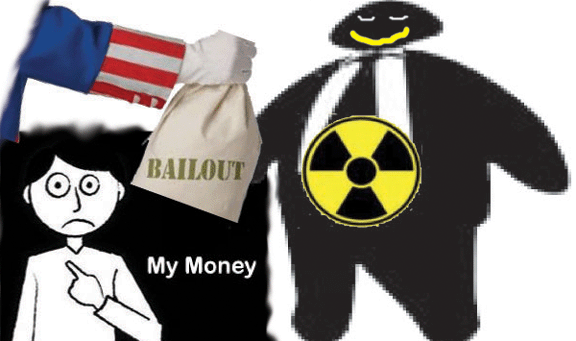
Madigan says the measure (Senate Bill 1585) would allow Exelon and its subsidiary ComEd to rack up billions of dollars in spending and profit paid for by consumers.
“It’s outrageous that Exelon and ComEd are again requesting a bailout when they are both profitable companies,” Madigan stated. “The legislature has more important matters to address than padding ComEd and Exelon’s profits.”
Exelon has argued it needs the legislation in order to keep operating the Clinton plant. Lawmakers like Senator Chapin Rose, (R) Mahomet, and Representative Bill Mitchell, (R) Forsyth, have said hundreds of jobs are on the line in central Illinois should the plant be closed. Schools say they will lose millions of dollars in property taxes.
Exelon has threatened to close the plant in 2017 if the legislation, which changes some regulations, is not passed by the legislature by the end of the legislative session this month.
1 This Month

of the week – Shut Down Drone Warfare!


Tell the Ukrainian Government to Drop Prosecution of Peace Activist Yurii Sheliazhenko

Petition to revoke the licensing of the Near Surface Nuclear Disposal Facility (NSDF) at Chalk River. https://www.ourcommons.ca/petitions/en/Petition/Details?Petition=e-7247
To see nuclear-related stories in greater depth and intensity – go to https://nuclearinformation.wordpress.com
-
Archives
- April 2026 (103)
- March 2026 (251)
- February 2026 (268)
- January 2026 (308)
- December 2025 (358)
- November 2025 (359)
- October 2025 (376)
- September 2025 (257)
- August 2025 (319)
- July 2025 (230)
- June 2025 (348)
- May 2025 (261)
-
Categories
- 1
- 1 NUCLEAR ISSUES
- business and costs
- climate change
- culture and arts
- ENERGY
- environment
- health
- history
- indigenous issues
- Legal
- marketing of nuclear
- media
- opposition to nuclear
- PERSONAL STORIES
- politics
- politics international
- Religion and ethics
- safety
- secrets,lies and civil liberties
- spinbuster
- technology
- Uranium
- wastes
- weapons and war
- Women
- 2 WORLD
- ACTION
- AFRICA
- Atrocities
- AUSTRALIA
- Christina's notes
- Christina's themes
- culture and arts
- Events
- Fuk 2022
- Fuk 2023
- Fukushima 2017
- Fukushima 2018
- fukushima 2019
- Fukushima 2020
- Fukushima 2021
- general
- global warming
- Humour (God we need it)
- Nuclear
- RARE EARTHS
- Reference
- resources – print
- Resources -audiovicual
- Weekly Newsletter
- World
- World Nuclear
- YouTube
-
RSS
Entries RSS
Comments RSS
 nuclear-news