Tepco to put some Fukushima decommissioning work on hold during G-7 summit
Japan Gov stops Fukushima work to “reduce risk” to world leaders…. what about the Japanese who live there 24/7/365?
TOKYO: The majority of decommissioning work at the damaged Fukushima No. 1 nuclear plant will be put on hold while the Group of Seven summit takes place in Shima, Mie Prefecture, on May 26 to 27, according to the Tokyo Electric Power Co.
Satoshi Togawa, a spokesman for Tepco, told The Japan Times on Friday that the planned suspension was a precaution to reduce “risks” that could disturb the meeting of leaders from the seven major advanced nations.
Such risks could include unexpected leaks of contaminated water from tanks or airborne radioactive material monitoring alarms being triggered, Togawa said.
He added that Tepco will continue other essential operations, such as injecting water to keep melted nuclear fuel cool and processing contaminated water.
He also stressed that the suspension was not designed to reduce the risk of terrorism.
“We have made the decision without any request from the government,” he added.
A 2011 massive earthquake and ensuing tsunami knocked out critical cooling functions for three of six reactors at the plant, triggering a triple meltdown.
The decommissioning effort, which involves some 7,000 workers, is expected to take more than 40 years.
Fukushima cops launch search for decontamination worker’s body
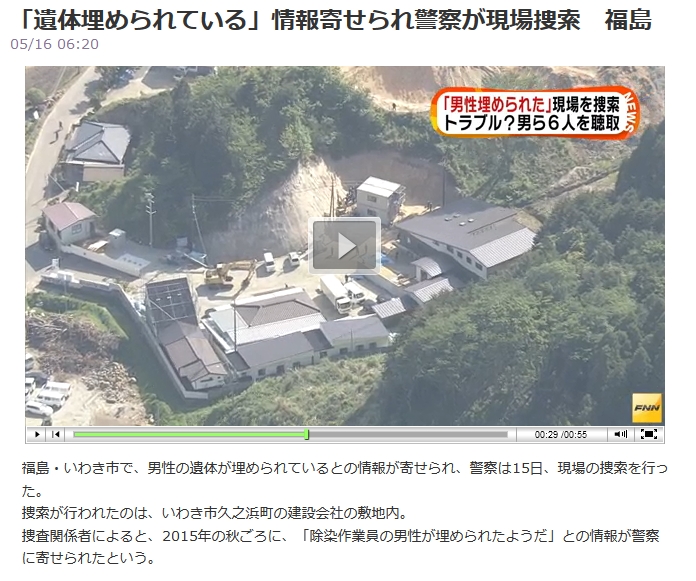
Police received a tip about the burial of the body of male decontamination employee at the office of a construction company
FUKUSHIMA (TR) – Fukushima Prefectural Police have started to excavate a yard in Iwaki City after receiving a tip about the burial of a man’s corpse, reports Fuji News Network (May 16).
On Sunday, investigators using a backhoe began digging on the premises of a construction company, located in the Hisanohama area, after receiving a tip that the body of male decontamination employee had been buried there in the fall of last year.
During the work, police discovered items belonging to the man. The search for his body is expected to continue today.
Police suspect that the case is the result of a crime involving six male decontamination employees.
http://www.fnn-news.com/news/headlines/articles/CONN00324767.html
America’s Nuclear Regulatory Commission set to exempt nuclear corporations from safety costs and liabilities

 US nuclear industry’s plan thanks to NRC: let taxpayers carry the can for closed power plants, Ecologist Linda Pentz Gunter13th May 2016 With five reactors closed in the last three years, the US nuclear industry is in shutdown mode, writes Linda Pentz Gunter – and that means big spending on decommissioning. But now the nuclear regulator is set to exempt owners from safety and emergency costs at their closed plants – allowing them to walk away from the costs and liabilities, and palm them onto taxpayers.
Aging and dangerous nuclear power plants are closing. This should be cause for celebration. We will all be safer now, right? Well, not exactly.
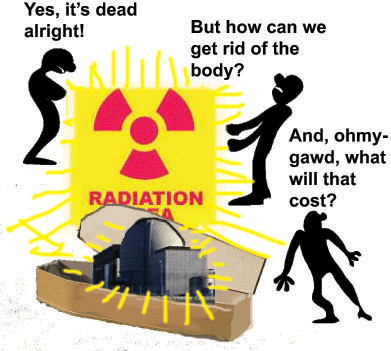 US nuclear power plant owners are currently pouring resources into efforts to circumvent the already virtually non-existent regulations for the dismantlement and decommissioning of permanently closed nuclear reactors.
And sad to say, many on the US Nuclear Regulatory Commission (NRC), the industry’s ever compliant lapdog, are trotting happily by their side.
There is an occasional lone critic. NRC Commissioner Jeff Baran, observed that the“NRC does not currently have regulations specifically tailored for this transition from operations to decommissioning. As a result, licensees with reactors transitioning to decommissioning routinely seek exemptions from many of the regulations applicable to operating reactors.”
The inevitable result is that reactor owners will successfully avoid spending money now on decommissioning as they seek to delay beginning the actual cleanup work for the next half century and maybe longer. Later, when it comes time to finish the job, the owners – and the money – could well be long gone.
US reactor owners rely on ‘decommissioning trust fund’ investments to pay for decommissioning activities. But these are failing to accrue adequate funds to do the job. Many of the trusts are incurring annual losses on their investments.
In fact, the US Government Accountability Office (GAO) has found the NRC’s financing formula for decommissioning trust funds to be fundamentally flawed, resulting in the utilities ability to accrue only 57% to 75% of the needed funds……..http://www.theecologist.org/News/news_analysis/2987679/us_nuclear_industrys_plan_thanks_to_nrc_let_taxpayers_carry_the_can_for_closed_power_plants.html
Genetic damage in children of nuclear test veterans: an investigation begins
A total 562 Royal New Zealand Navy sailors served the British Nuclear Weapons Testing Programme in the Pacific in the 1950s. Nine times they were exposed to damaging levels of radiation.
A new study from Brunel University will undertake a chromosomal analysis of cells from UK nuclear test veterans and their children.
The best evidence New Zealand sailors have is from 2007, when a study by Massey University took samples from 50 veteran sailors from Operation Grapple. Researchers discovered they had suffered chromosome damage higher than that of clean-up workers at Chernobyl.
They linked it directly to the Pacific bomb testing, saying the result “is indicative of the veterans having incurred long term genetic damage as a consequence of performing their duties relating to Operation Grapple”.
Research gives hope for nuclear test vets families http://www.stuff.co.nz/national/79829038/research-gives-hope-for-nuclear-test-vets-families CARLY THOMAS, May 15 2016
It all started with hydrogen bombs that lit up the Pacific with radiation.
Roy Sefton remembers it like it was yesterday.
Backs turned, goggles on, they waited for the countdown..”And right on cue there was this massive light that came through mine and everybody else’s hands, through the dark glasses, through the closed eyes and what I saw was an x -ray vision of my own hands,” he said.
Now, after decades of battling, New Zealand veterans who watched the blasts from the decks of the Navy ships hope they may finally be acknowledged for the effects the radiation had on them and their families.
A total 562 Royal New Zealand Navy sailors served the British Nuclear Weapons Testing Programme in the Pacific in the 1950s.Now, after decades of battling, New Zealand veterans who watched the blasts from the decks of the Navy ships hope they may finally be acknowledged for the effects the radiation had on them and their families. Continue reading
Lawsuit on Bikini Atoll nuclear tests
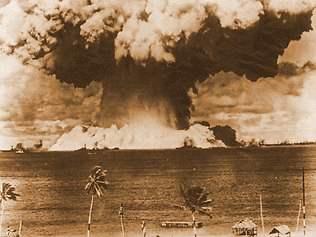 Revisiting Bikini Atoll nuclear tests Japan Times, 15 May 16 A recent lawsuit filed by former crew members and relatives of deceased crew members of fishing boats operating near the area where the United States conducted a series of nuclear weapons tests in the Pacific in 1954 — seeking compensation from the Japanese government over its questionable behavior at the time and in subsequent years — carries historical significance. More than six decades after the hydrogen bomb tests at Bikini Atoll in the Marshall Islands, beginning with a test explosion code-named Castle Bravo on March 1, 1954, the lawsuit will help shed fresh light not only on the scope of radiation exposure for Japanese fishermen but also on whether the Japanese and U.S. governments acted properly to deal with the consequences of the fallout from the tests.
Even before the court proceedings begin, the omission on the part of the Japanese government seems clear — its failure to properly examine and keep track of the potential damage to the fishermen’s health and nondisclosure for decades of the records of their radiation exposure.
In connection with the 15-megaton Castle Bravo test, which was over 1,000 times more powerful than the atomic bomb dropped on Hiroshima on Aug. 6, 1945, the tragedy of the tuna trawler Fukuryu Maru No. 5, also known as the Lucky Dragon, is widely known. The fallout from the test fell onto the vessel for a few hours, causing its 23 crew members to suffer nausea. By the time they returned to their home port of Yaizu, Shizuoka Prefecture, two weeks later, they had developed serious symptoms of radiation sickness, and the radio operator, Aikichi Kuboyama, died six months later. The Fukuryu Maru incident sowed the seed for civic anti-nuclear movements in Japan.
The islanders suffered a great deal. The H-bomb tests contaminated many areas of the Marshall Islands so badly that they became unlivable. The tests destroyed the culture of the islands and irradiated thousands of people. In the years after the tests, the U.S. told evacuated islanders that it was safe to return. But many returning residents were exposed to contaminated water, air and food due to the false assurance.
The plaintiffs in the lawsuit, the first legal action seeking state compensation over the 1954 H-bomb tests, are former crew members of fishing boats other than the Fukuryu Maru that were operating in the area around the time of the tests and family members of fishermen who have since died. Most of the fishing boats were from Kochi Prefecture……
With the lawsuit, the plaintiffs will try to bring to light the government’s omission, including its failure to conduct follow-up health surveys on the crew members and to pay compensation to those who fell ill due to causes linked to the radiation exposure. Several of the former fishermen died of cancer — although it will be difficult to establish the causal relationship because so much time has passed. At least the court proceedings should shed light on how the government acted when it negotiated the settlement with the U.S. over the Fukuryu Maru incident — as well as on why the records of the radiation exposure suffered by other Japanese fishermen were kept undisclosed for so long and why no follow-up checks on the fishermen’s health were made. http://www.japantimes.co.jp/opinion/2016/05/15/editorials/revisiting-bikini-atoll-nuclear-tests/#.VzjsOTV97Gg
India to sell nuclear reactors to Bangladesh (But what if Bangladesh is under water before long?)

 India, Bangladesh power ties with 21st-century nuclear deal Times of India Indrani Bagchi| TNN | May 15, 2016, NEW DELHI: India has concluded a nuclear agreement with Bangladesh in a sign that the bilateral neighbourhood relationship is becoming special. …..The nuclear agreement is a three-document package that has been negotiated between the MEA and the Bangladesh department of science and technology over the past few months……
Southern hemisphere CO2 level rises above symbolic 400 ppm milestone
Confirmed: Southern hemisphere CO2 level rises above symbolic 400 ppm milestone, [Excellent pictures, graphs, diagrams] The Age May 15, 2016 –Peter Hannam Environment Editor, The Sydney Morning Herald
NASA | A Year in the Life of Earth’s CO2
A significant marker of rising global greenhouse gas emissions has been passed, with a key monitoring site on Tasmania’s north-west tip recording atmospheric carbon-dioxide exceeding 400 parts per million for the first time.
As foreshadowed by Fairfax Media last week, a baseline reading at the Cape Grim station that exceeded the 400-ppm mark of the primary gas driving global warming was imminent.
As it turned out, “the unfortunate milestone” was reached on Tuesday May 10 at 8am, local time, said Peter Krummel, who heads the CSIRO team analysing data from the most important site in the southern hemisphere.
Atmospheric readings from Cape Grim, along with two stations in Hawaii and Alaska, are closely watched as they date back decades and closely track a range of pollutants from ozone-depleting chemicals to the various greenhouse gases resulting from burning fossil fuels and clearing forests.
Mr Krummel said that while mostly symbolic, the 400-ppm reading “highlights the problem of rising emissions, which are increasing more rapidly than they used to be”.
A report out earlier this year from the World Meteorological Organization noted atmospheric readings of CO2 at the Mauna Loa site in Hawaii rose 3.05 ppm in 2015 alone – the biggest increase in the 56 years of research……
Climate scientists, such as David Karoly at Melbourne University, note that when other greenhouse gases, such as methane, are included, the situation is even bleaker.
The so-called carbon dioxide-equivalent level that takes in the full global warming impact is now about 485 ppm.
Both 2014 and 2015 were record hot years globally in data going back about 130 years. With the effect of a strong El Nino overlaying long-term trends, this year is likely to be even hotter after a scorching start.
Brexit will risk UK nuclear research jobs, says UKAEA boss
BBC News 15 May 2016 Oxford, “….Prof Steve Cowley, CEO of the UK Atomic Energy Authority, spoke out over fears £55m in annual European Commission (EC) funding would be withdrawn…..(http://www.bbc.com/news/uk-england-oxfordshire-36288657)
The options for decommissioning a nuclear plant
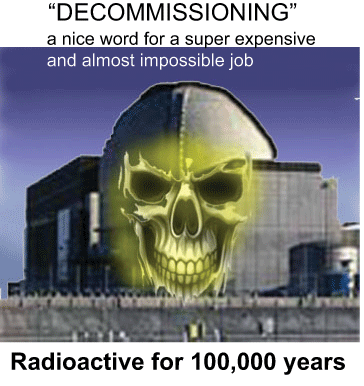 US nuclear industry’s plan thanks to NRC: let taxpayers carry the can for closed power plants, Ecologist Linda Pentz Gunter13th May 2016 “…….There are currently three decommissioning options when a reactor closes. They are known by apparent acronyms that are really just capitalized slogans, masking the flaws behind all three.
DECON refers to prompt dismantlement. This sounds promising for all sides, dispensing with the whole decommissioning process and its attendant costs, headaches and liabilities in about 10 years.
In principle DECON is supported by environmental and anti-nuclear groups, but with one giant caveat: the radioactive waste that remains on site after decommissioning of the reactor, must be adequately safeguarded.
Under the current regulatory scheme, the NRC allows the licensee to offload the irradiated nuclear fuel from the spent fuel storage pools into dry storage casks. These are not adequately protected from security threats. Nor is there any contingency to re-contain nuclear waste should it begin leaking from one of these casks.
Current casks designs are qualified for on-site nuclear waste storage for only 20 years and re-certified for four additional cycles. Some of these cask designs have already experienced degradation of protective seals and concrete shielding after less than a decade of use.
Of greatest concern, the casks are situated outside, closely congregated, on open tarmacs raising security concerns for their vulnerability to attack.
Consequently, the anti-nuclear and environmental groups that support DECON insist on the implementation of enhanced security called ‘Hardened On-Site Storage’, or HOSS to minimize these risks.
Rather than storing dozens of vulnerable dry-casks right next to each other in the open air, HOSS better secures the nuclear waste in above-ground individualized casks. These casks are fortified within modules of concentric capped silos of concrete and steel surrounded by earthen mounds.
The HOSS canisters would be dispersed over a wider area than traditional cask storage and would be better positioned to withstand a range and combination of weapons, explosives, and attacks, including anti-tank missiles, aircraft impacts, and car bombs.
Currently, reactor owners are not permitted to spend decommissioning funds on nuclear waste management as part of the DECON process. Nor do utilities want to go to the added expense of HOSS, which is not currently being considered by federal agencies, despite hundreds of petitioning groups and thousands of signatories to make HOSS a nuclear security priority at operating reactors as well as decommissioned sites.
A small number of reactors across the world have already used DECON (but without HOSS.) According to the Paris-based Organization of Economic Cooperation and Development, of the nearly 150 nuclear power reactors that have ceased operation worldwide to date, only 16 units have completed the ‘DECON’ decommissioning process with 10 of those units in the United States taking on average 10 years to complete.
What ‘SAFSTOR’ really means: ‘mothball’ and walk away
The second option, euphemistically-named SAFSTOR, or ‘safe store’, allows owners to take up to 60 years from the day the reactor closes to complete decommissioning. This would effectively enable owners to delay the start of decommissioning for 50 years, leaving the reactor and fuel pools mothballed until then and the local communities at risk.
Unsurprisingly, this is the option that is increasingly favored by reactor owners, who are petitioning the NRC for across-the-board cost cutting under SAFSTOR, regardless of the specific conditions of the individual reactor sites.
Entergy Vice President, Michael Twomey, even told Vermont state legislators in reference to the decommissioning of its Vermont Yankee nuclear reactor, that if the process is not complete in 60 years the company is fully within its rights to simply walk away, and if challenged, would litigate. Vermont Yankee closed on December 29, 2014.
The third option is ENTOMB. Without any regulatory guidance or legal framework, it allows utilities to essentially avoid decommissioning altogether. It is the option when no other options exist, as is the case at Chernobyl.
The exploded Chernobyl containment was eventually shrouded in a giant concrete sarcophagus at great expense and resulting in radiological exposure to hundreds of thousands of laborers. That structure is now being encased with a new, high-tech “Arch”, again at vast expense. However, for regular decommissioning activities, ENTOMB should be viewed as a last resort and not as a strategy for escaping liability.
Waste management is nuclear power’s most painful Achilles’ heel
The waste management aspect of the decommissioning process remains the industry’s most painful Achilles’ heel. Despite successfully suing the Department of Energy for failure to remove the waste, as promised, to a final repository site, utilities are seeking to avoid using those funds for waste management.
Instead, utilities are seeking to siphon off decommissioning trust funds to build and manage the necessary on-site Independent Spent Fuel Storage Installation (ISFSI) to house irradiated fuel from a closed reactor. An ISFSI is not currently considered part of a legitimate decommissioning process covered by the trust fund.
The delays wrought by such wrangling means that irradiated fuel sits in densely packed storage pools inside the reactor – and in the case of the 30 remaining GE Mark I and II reactors in the US, on the roof. (The GE designs are the same as those that melted down and exploded at Fukushima.)
The fuel pools are over-packed because of inadequate existing on-site storage facilities. But delays in offloading them, even while the reactor is still running, never mind when it closes, represent one of the greatest risks to public health, safety and security. A catastrophic fire, aircraft impact or other disaster that released vast amounts of radioactive fallout from the high-density storage pools could contaminate entire regions potentially indefinitely.
“The four ongoing disasters at Fukushima Daiichi have clearly shown the vulnerability of nuclear power plants that have spent nuclear fuel stored in these overcrowded and unprotected spent fuel pools”, Gundersen wrote in his comments to the NRC.
Fuel pools at closed US nuclear plants are a Fukushima waiting to happen
This is the principle reason to oppose SAFSTOR, safety experts say. Not only will the fuel remain in the pools, and in poorly protected waste casks, but protections and safety measures will be reduced. This is already exemplified in Vermont where the NRC has allowed Entergy to dismantle its emergency plan around Vermont Yankee and reduce inspections on the ventilation system near the spent fuel pool.
As Gundersen points out, the Vermont Yankee fuel pool still “contains more highly radioactive waste than was held in any of the fuel pools at Fukushima Daiichi.”
With a Fukushima-scale disaster is a real possibility even at closed reactors, critics are urging the NRC not to rubber stamp exemption requests. In the event of a nuclear catastrophe, evacuations downwind and downstream cannot be assumed to go well if emergency preparedness was discontinued months, years, or even decades earlier.
Even plans for site cleanup and decontamination are inadequate and have been watered down by the NRC itself. Site release criteria currently mandate clearing away surface soil down to three feet. But strontium-90 has been found far deeper on the Vermont Yankee site already. The NRC limit would open the way for strontium and potentially other isotopes resting deeper than three feet to migrate down into groundwater and potentially later to drinking water.
Instead, there should be more thorough post-decommissioning environmental analyses of where and how much residual radioactivity has been left behind in soil and water before power companies are allowed to walk away from accountability and liability.
To do decommissioning right, Gundersen argues that the state ratepayers should control decommissioning funds not the utility, because it is their money.
And, he says, decommissioning should be undertaken in such a way that operators “assure that those plants are promptly and safely decommissioned without unwarranted radiological contamination of the environment and extended cleanup and mitigation costs passed on to ratepayers or taxpayers.”
Linda Pentz Gunter is the international specialist at Beyond Nuclear, a Takoma Park, MD environmental advocacy group. http://www.theecologist.org/News/news_analysis/2987679/us_nuclear_industrys_plan_thanks_to_nrc_let_taxpayers_carry_the_can_for_closed_power_plants.html
Protestors demand shut-down of radiation leaky Florida Nuclear Station
 Demonstrators Demand Nuclear Plant Shut Down After Radiation Leaks May 14, 2016 MIAMI (CBSMiami) — Dozens of protesters demonstrated outside of a Florida Power & Light facility concerning leaks at the nuclear power plant at Turkey Point.
It took place Saturday morning at 4200 W. Flagler Street and comes after the company announced that customers will shell out an estimated $50 million this year alone for the cleanup of hypersaline water coming from the plant.
Environmental advocates are worried that theleaking wastewater containing radioactive isotopes is a threat to drinking water from the Biscayne aquifer.
They want the Turkey Point Nuclear Generating Station shut down.
“When our bay goes acidified, when our fish start dying, which they already are, and when are habitat goes away because of this wonderful Turkey Point plant that we have, which is a reactor that came online in 1972, an outdated reactor, it’s time to retire,” said protester Albert Gomez.
Others believe FPL is hiding something.
They’re not coming clean with what’s really going on at Turkey Point and their deceptive behavior on the solar initiatives. They sabotaged the citizen’s solar initiative and they got this scam solar amendment on the ballot in November. It’s a fake,” said Steve Malagodi, president of 350 South Florida, a group dedicated to climate change issues…….http://miami.cbslocal.com/2016/05/14/demonstrators-demand-nuclear-plant-shut-down-after-leaks/
Fears that South Carolina is to become a nuclear waste import hub
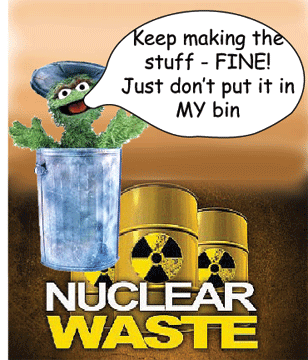 Not only are tons of highly radioactive waste still stored at SRS, the federal government continues to ship nuclear material from foreign nations to the site
Don’t let SRS serve as nuclear dump site, Post & Courier, May 15 2016
The U.S. Department of Energy made some serious promises to South Carolina when it needed a place to bring tons of highly radioactive plutonium back in 2002. And now the DOE wants to renege in nearly every way.
State officials are right to fight it all the way down the line.
Last month, DOE lawyers went to court to insist that the agency isn’t liable for a $100 million penalty owed to South Carolina for the DOE’s failure to remove nuclear waste from Savannah River Site on schedule. The federal agency contends that the agreement with the state was based on goals, not mandates.
The DOE says that its agreement with the state isn’t binding even though it is codified in federal law. In that view, the feds don’t have to pay a penalty for failing to live up to the deal’s requirement to turn weapons grade plutonium into commercial reactor fuel or to send the plutonium elsewhere.
No one who observed the intense stand-off between South Carolina and the federal government over its plans to send 34 tons of weapons grade plutonium to Savannah River Site would characterize those requirements as optional.
At the time, state leaders strongly opposed the plan, having reasonably concluded from past experience that the federal government would be more than willing to shift its nuclear waste problems permanently to South Carolina.
At one point, then-Gov. Jim Hodges threatened to stand in the middle of the highway to stop nuclear material from being trucked into South Carolina. He also ordered the S.C. National Guard to close the highways to waste shipments, if necessary.
Those histrionics were intended to underscore the state’s resolve not to willingly permit Savannah River Site to become the nation’s nuclear waste dump.
The crisis passed after the federal government pledged that the nuclear waste would be neutralized and shipped out of state on a firm timetable.
If that agreement allayed the fears of state officials in then, the situation now only intensifies the skepticism by which the DOE’s promises should be viewed in South Carolina.
Not only are tons of highly radioactive waste still stored at SRS, the federal government continues to ship nuclear material from foreign nations to the site…….http://www.postandcourier.com/20160515/160519614/dont-let-srs-serve-as-nuclear-dump-site-
Belgium getting more anxious about safety of its nuclear reactors?
EVERY BELGIAN GETS ANTI-RADIATION PILLS IN CASE OF NUCLEAR EMERGENCIES, Who.What.Why. MAY 15, 2016 | BEN HUANG Just a week after denying Germany’s request to shut down two of its oldest nuclear reactors, the Belgian government decided to distribute anti-radiation pills to its entire population. Do the authorities know something about the safety of its aging nuclear plants that it isn’t sharing ?
The two reactors in question are 40 years old, and their pressure vessels have shown signs of metal degradation, raising concerns over their safety. Belgium still gets 50 percent of its electricity from nuclear power. Germany, in contrast, has decided to shut down all of its nuclear reactors and to focus on renewable energy.
The decision to distribute the pills, which are also known as iodine pills and protect the thyroid from radioactive poisoning in case of a disaster, shows how worried Belgian officials are — and for good reason. Nuclear safety is an illusion, as two high-profile cases have shown. The Chernobyl reactor explosion 30 years ago and the ensuing radioactive fallout killed thousands and left land the size of Rhode Island unusable…….http://whowhatwhy.org/2016/05/15/every-belgian-gets-anti-radiation-pills-case-nuclear-emergencies/
True costs of nuclear-generated electricity hidden for decades
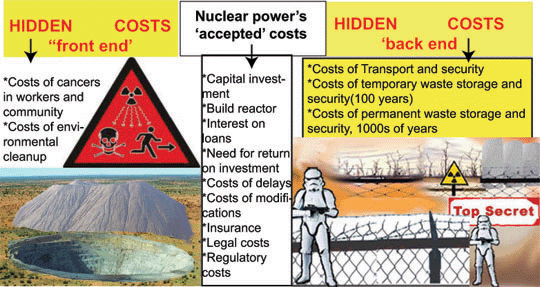
US nuclear industry’s plan thanks to NRC: let taxpayers carry the can for closed power plants, Ecologist Linda Pentz Gunter13th May 2016 “…….Using Vermont Yankee (a relatively small 620 MWe reactor) as an example, the decommissioning cost estimate in 2015 was $1.2 billion and rising. At the same time, Entergy, the plant’s owner, had just $625 million on hand.
In early May, Entergy was reprimanded (but not fined) by the NRC for violating “federal regulations last year when it prematurely took money out of the Vermont Yankee decommissioning trust fund to cover planning expenses associated with the handling of spent nuclear fuel at the closed reactor”, the Times Argus reported.
Another factor in the current struggle to pay for decommissioning is rooted in a decades-long practice by utilities of omitting the costs of decommissioning from electricity bills in order to artificially lower rates and stay competitive in the market.
Rather than preserve decommissioning trust funds for actual decommissioning work, utilities are now asking the NRC to let them raid the funds for activities outside the parameters of the reactor decommissioning process. These activities include the payment of taxes and the protracted management of orphaned nuclear waste left on site.
In addition, while at the same time delaying the start of decommissioning, the utilities have requested and received exemptions from the NRC that allow them to eliminate radiological emergency planning and drastically reduce on-site security around hundreds of tons high-level nuclear waste, all in the name of saving money.
“The Nuclear Regulatory Commission appears to be complicit in this process and is in fact providing a significant hidden subsidy to the nuclear industry when it looks the other way by allowing public trust funds to be raided in violation of the Code of Federal Regulations”, writes Arnie Gundersen of Fairewinds Associates in a document submitted to the NRC.
Gundersen, along with other groups including my own – Beyond Nuclear – have filed comments to the NRC as part of an arcane and convoluted process known as an ‘Advanced Notice of Proposed Rulemaking on Decommissioning.’ The public comment period closed on March 18, 2016.
A years long Rulemaking is underway because reactor owners are asking to streamline what were site-specific exemptions and have them issued generically instead, and across the board, without any opportunity for public review or comment. This essentially eliminates public transparency in the decommissioning process.
It further seeks to save the corporation from spending any of its electricity production profits on the costs of safety and security oversight the companies claim are no longer needed once the reactor stops power production and is defueled………..http://www.theecologist.org/News/news_analysis/2987679/us_nuclear_industrys_plan_thanks_to_nrc_let_taxpayers_carry_the_can_for_closed_power_plants.html
Radium and Lead contaminate rivers From Thousands of Fracking Wastewater Spills
Duke Study: Rivers Contaminated With Radium and Lead From Thousands of Fracking Wastewater Spills. EcoWatch Sharon Kelly, DeSmogBlog | May 9, 2016 Thousands of oil and gas industry wastewater spills in North Dakota have caused “widespread” contamination from radioactive materials, heavy metals and corrosive salts, putting the health of people and wildlife at risk, researchers from Duke University concluded in a newly released peer-reviewed study.
High levels of lead—the same heavy metal that infamously contaminated water in Flint, Michigan—as well as the radioactive element radium, were discovered near spill sites. One substance, selenium, was found in the state’s waters at levels as high as 35 times the federal thresholds set to protect fish, mussels and other wildlife, including those that people eat.
The pollution was found on land as well as in water. The soils in locations where wastewater spilled were laced with significant levels of radium and even higher levels of radium were discovered in the ground downstream from the spills’ origin points, showing that radioactive materials were soaking into the ground and building up as spills flowed over the ground, the researchers said.
The sheer number of spills in the past several years is striking. All told, the Duke University researchers mapped out a total of more than 3,900 accidental spills of oil and gas wastewater in North Dakota alone……. http://ecowatch.com/2016/05/09/radium-lead-fracking/
Degrading panel at Pilgrim Nuclear Power Station’s spent fuel pool
Report: Panel at Pilgrim degrading Problem in spent fuel pool described as ‘slow to develop’ Cape Cod Times, By Christine Legere May 14, 2016
PLYMOUTH — One of the panels designed to absorb neutrons and prevent a nuclear reaction called fission from occurring in the spent fuel rods stored in the Pilgrim Nuclear Power Station’s spent fuel pool has deteriorated, according to a report submitted by Entergy Corp. to federal regulators yesterday.
Fission would cause the rods to heat up the same way they do in a nuclear reactor. The heat would cause the water in the pool to boil and evaporate. If exposed, the rods could start a fire and release radiation.
Neil Sheehan, spokesman for the Nuclear Regulatory Commission said degradation of the panels has been a known problem for decades and one experienced by a number of nuclear plants……..It takes as little as four fuel assemblies to begin a nuclear chain reaction. Currently the racks in Pilgrim’s pool hold 3,300 spent fuel assemblies……..
The storage pools at nuclear plants, particularly older ones like the 43-year-old Pilgrim, were designed to hold spent fuel rods short term. Pilgrim’s pool was designed for about 800 assemblies. Assemblies were on large racks that relied on large spacing, about 20 inches between the spent fuel assemblies to maintain sub-critical conditions.
But as the solution to long-term storage continued to be elusive, the pools had to accommodate many more rods than “Because of the federal government’s problem to provide a disposal site for irradiated fuel, tens of thousands of tons of irradiated fuel remains where it was produced,” said David Lochbaum, director of nuclear safety for the Union of Concerned Scientists. “Spent fuel pools have been re-racked with storage racks holding irradiated fuel very close together, often closer than when it is in the reactor core. In the core, there are control rods to prevent criticality. In the spent fuel pools, other methods must be used to protect against criticality.
Solutions to the problem include the use of borated water or the insertion of sleeves containing boron over defective panels.
At this point, there is no time frame for a solution at Pilgrim. http://capecodtimes.com/article/20160513/NEWS/160519684
1 This Month

of the week – Shut Down Drone Warfare!


Tell the Ukrainian Government to Drop Prosecution of Peace Activist Yurii Sheliazhenko

Petition to revoke the licensing of the Near Surface Nuclear Disposal Facility (NSDF) at Chalk River. https://www.ourcommons.ca/petitions/en/Petition/Details?Petition=e-7247
To see nuclear-related stories in greater depth and intensity – go to https://nuclearinformation.wordpress.com
-
Archives
- April 2026 (68)
- March 2026 (251)
- February 2026 (268)
- January 2026 (308)
- December 2025 (358)
- November 2025 (359)
- October 2025 (376)
- September 2025 (257)
- August 2025 (319)
- July 2025 (230)
- June 2025 (348)
- May 2025 (261)
-
Categories
- 1
- 1 NUCLEAR ISSUES
- business and costs
- climate change
- culture and arts
- ENERGY
- environment
- health
- history
- indigenous issues
- Legal
- marketing of nuclear
- media
- opposition to nuclear
- PERSONAL STORIES
- politics
- politics international
- Religion and ethics
- safety
- secrets,lies and civil liberties
- spinbuster
- technology
- Uranium
- wastes
- weapons and war
- Women
- 2 WORLD
- ACTION
- AFRICA
- Atrocities
- AUSTRALIA
- Christina's notes
- Christina's themes
- culture and arts
- Events
- Fuk 2022
- Fuk 2023
- Fukushima 2017
- Fukushima 2018
- fukushima 2019
- Fukushima 2020
- Fukushima 2021
- general
- global warming
- Humour (God we need it)
- Nuclear
- RARE EARTHS
- Reference
- resources – print
- Resources -audiovicual
- Weekly Newsletter
- World
- World Nuclear
- YouTube
-
RSS
Entries RSS
Comments RSS
 nuclear-news