To cleanup some radioactive fallout!
There are two main problems in whatever decontamination techniques used: wash off and scrap up techniques, or phytoremediation:
80% of the Fukushima prefecture land surface is forested mountains, forested mountains which you can neither wash off and scrap up nor phytoremediate.
Forested mountains from which the accumulated contamination ruissels down or flies down with wind and rain to the low land living areas which had been previouly decontaminated, some places have already been decomtaminated up to five times, always the contamination coming back up to the pre-decontamination level.
To decontaminate well and forever you would have to cut down those mountain forests, which is a huge surface to be cut down, a gigantic impossible work, which would as an immediate effect spread a lot of the accumulated various radionuclides and make the radiation level jump high everywhere.
With either of those techniques you quickly end up with a huge quantity of contaminated waste, which accumulates quickly and for which there is no real valid solution for disposal. To reduce its volume by incineration is still re-scattering radionuclides into the environment, as there is no incinerator filter capable of blocking 100% of all radionuclides nanoparticles.


Obviously, the cleanup process is much more involved than this, but you can imagine how difficult it is to keep all that radioactive dust from getting into everything. Phil Broughton is a treasure trove of stories and information. But, if you follow his blog, you’ll learn that he takes the decontamination process very seriously. Something a graduate student learned the hard way when they made a poorly-thought out April Fool’s prank. Phil had this to say about the tremendous task of nuclear cleanup:
…everything exposed to air, everything that rain water might wash over, ALL SURFACE WATER, must be assumed to be contaminated. Want to use that car? Wash it down because it’s got a crust of radioactive crap on it, and if you try to drive it, you just climbed inside your own moving irradiator box.
This is the hard part of fallout decon[tamination] and radioactive waste in general. Nothing makes it stop being radioactive other than time, and human attention spans and lifespans are somewhat incompatible with this. Not living in the higher dose world its very hard to contemplate the “I accept this dose for me, my children, and generations to come” when planning reconstruction.
A while ago, I did a couple of comics about how plants (including tumbleweeds) were being used to help clean up radioactive material. Here’s Phil again:
Fungi, in fact, do amazing work sucking fallout products out of the soils. Instead of having roots, their hyphae draw nutrients out of a very shallow layer and do it quickly. This is also good because fallout actually doesn’t penetrate all that deep below the surface of the soil. One of the ways we monitor how much radioactive material is left in the environment is by sampling the mushrooms that grow and plotting it’s drop off following an event. You may discover that there are new sources contributing to the environment which is to say the event isn’t over yet as there’s clearly a continuing release. You can also do detoxification this way by planting, harvesting, repeat until whatever your crop is isn’t showing any uptake of materials anymore.
Of course other parts of the environment are running on different clocks. It will take quite a while for contamination to get to the ground water and then for the groundwater to be sampled by plants that can tap that deep. Annoyingly, fungi and grasses might detoxify the upper layer of soil within a decade only to have the deep tapping trees pull it up from the groundwater and recontaminate the upper layer a decade after that with their now radioactive falling leaves.
After I drew the phytoremediation comics, the number one question asked by readers was: “So, what happens with the plants after they’ve absorbed the radioactive elements?” Apparently, it’s a very real problem that cleanup crews have to work with. Here’s what Kathryn Higley said when I asked her about the sunflowers being planted at Fukushima:
I’ve looked at the discussions on sunflowers and other phytoremediation techniques. From what I’ve read, they are able to capture the ‘low hanging fruit’, but they lose effectiveness after a couple of croppings/harvesting. This is because the residual material is more strongly attached to soil particles (such as clay minerals). That being said, phytoremediation is a relatively low tech solution. The challenge is then what do you do with the contaminated biomass? When I went to Fukushima you could see large ‘super sacks’ of contaminated vegetation just sitting on the side of the road (see photo below). These large bags have a limited lifespan (~5 years) before they degrade due to UV exposure and all your stored material starts being blown around by wind.

3/11 Prime Minister Kan recognized for efforts to phase-out nuclear power

FRANKFURT – Former Prime Minister Naoto Kan was honored in Germany Saturday for his work to promote the phase-out of atomic power in Japan following the 2011 Fukushima nuclear crisis.
At a ceremony at Frankfurt City Hall, former German Environment Minister Juergen Trittin praised Kan as a “fighter” for his work on nuclear and renewable energy.
Kan, 69, pledged to continue his quest to rid Japan of atomic energy.
“The accident made a 180-degree shift in the perception that Japan’s nuclear power plants are safe,” Kan said in a speech.
Kan received a certificate from a representative of EWS, a power company in Schoenau, southern Germany, on the initiative of citizens against nuclear power.
Kan, who led the former Democratic Party of Japan, was prime minister from June 2010 to September 2011. He was the man who had the misfortune of being in office when the unprecedented March 11, 2011, Great East Japan Earthquake, tsunami and nuclear disasters struck.
Japan has battled criticism for resuming power generation at a handful of reactors that were taken offline after the Fukushima nuclear crisis. The reactors, which were restarted at the initiative of current Prime Minister Shinzo Abe’s Liberal Democratic Party, were subjected to stringent new safety standards.
The pro-nuclear Liberal Democratic Party returned to power after being overwhelming defeated by the less-experienced DPJ in 2012 on a mantra of change.
Germany looks to export reactor decommissioning technologies
BERLIN – Germany may become an exporter of technologies to decommission reactors in the future given the experience gained after its phasing out of nuclear energy, German Environment Minister Barbara Hendricks said in a recent interview with Kyodo News.
Germany believes it may be able to halt all nuclear power in the country before its 2022 target year, Hendricks said Wednesday in Berlin. She also expressed hope for cooperation with other countries in reactor decommissioning.
“I cannot exclude the possibility that the last nuclear reactor will be switched off earlier than 2022; there has been a reactor which switched off earlier than it was planned, because of the costs of running it longer,” she said.
The interview was held prior to her visit to Japan to take part in the Group of Seven environment ministers’ meeting scheduled for May 15 and 16 in Toyama on the Sea of Japan coast.
After the session, she plans to travel on to Fukushima Prefecture, home to the Fukushima No. 1 nuclear power plant, which suffered a triple-meltdown triggered by a major quake and tsunami in 2011.
“I want see the situation with my eyes and see how Japan has dealt with it,” she said.
The Fukushima disaster motivated Germany to decide the same year to abandon atomic energy by 2022.
“In Germany we have begun or finished the decommissioning of nearly 20 nuclear power units and more than 30 research reactors,” she said. “We have gathered a lot of technological experiences.
“The nuclear power phase-out is an advantage, because we have begun earlier to gather experiences on how to change a nuclear power plant to a green grass or a base for another industry,” she said.
The minister added that nuclear decommissioning “will become the next export technology” for Germany.
Asked to comment on Japan’s resumption of some reactors taken offline after the nuclear accident, she said: “Every country has to decide about their energy mix. I do not want to make advice.”
Hendricks, however, expressed “surprise” that Japan has not fully made use of renewable energy sources like solar, wind and hydropower.
The environment ministers’ meeting is one of the G-7 ministerial sessions being held in Japan in the run-up to the Ise-Shima summit May 26 and 27. The G-7 groups Britain, Canada, France, Germany, Italy, Japan and the United States.
Defunct government agency exempted from indictment over Fukushima crisis
A panel has upheld a decision by prosecutors not to indict three former senior officials of the Nuclear and Industrial Safety Agency over the Fukushima crisis. The agency was responsible for nuclear safety at the time of the accident and has since been dissolved.
The decision by the Tokyo No. 1 Committee for the Inquest of Prosecution, dated April 14, means that the agency is effectively absolved of criminal responsibility for one of the world’s worst nuclear disasters.
The three were accused of professional negligence resulting in death and injury. They include Yoshinori Moriyama, NISA’s former deputy director general for nuclear accident measures.
Tsunami waves flooded the plant on March 11, 2011, knocking out power supplies and causing three reactors to melt down.
The 11-member panel concluded that it was impossible for Moriyama and the two others to foresee that 10-meter-high waves would strike.
Three former Tepco executives, including then Chairman Tsunehisa Katsumata, 76, were indicted in February based on a decision by another committee that examined a prior decision by prosecutors not to lay charges.
Under the revised inquest of prosecution law, which took effect in May 2009, criminal charges are filed if a minimum of eight members of the judicial panel vote in favor of indictment in two consecutive rulings.
NISA was scrapped in September 2012 as the nation revamped its nuclear regulatory setup following the Fukushima crisis. Critics accused the agency of lacking teeth because it was under the umbrella of the pro-nuclear Economy, Trade and Industry Ministry and therefore was seen as hand in glove with the nuclear industry.
1 May: nuclear news for the past week
Late news flashes:
- Australia’s submarine purchase from France in cahoots with nuclear lobby‘s plan for expansion of nuclear industry, Australia as world’s nuclear trash dump, to be announced on May 6 by the sham South Australia Nuclear Fuel Chain Royal Commission.
- The seller, France’s corporation Direction des Constructions et Armes Navales (DCNS) is notorious for corruption.
Most impressive news item of the week – Central bankers, financial facts, bringing an end to the nuclear power era?
 NUCLEAR
The next nuclear disaster will probably be an intentional one.
Concern over influence on World Health Organisationby outside agencies, with financial support
UKRAINE. Ukraine’s nuclear industry remains a time bomb. The real menace of the Chernobyl nuclear situation. Mikhail Gorbachev: 30 years after Chernobyl, time to phase out nuclear power. Covering shattered Chernobyl nuclear reactor – a financial problem for Ukraine. Over 2 million people receiving benefits due to radiation effects of Chernobyl nuclear disaster.
At Chernobyl and Fukushima, radioactivity hasseriously harmed wildlife. Thyroid Cancer in Fukushima Children: When the Language and Information Gaps Mislead. Indoor playgrounds help Fukushima families to deal with their very real fear of radiation.
JAPAN. Series of earthquakes is delaying Japan’s ‘nuclear revival’. Toshiba to lose 260 billion yen due tolosses over Westinghouse nuclear power subsidiary. Fukushima plant’s new ice wall not watertight.
USA.
- A second double-shell tank leaking radiation at Hanford?
- Idaho in danger from nuclear waste, and must be protected.
- California State Senate demands removal of stored nuclear waste from San Onofre power plant.
- US Senate Efforts to Do Away with Mandatory Licensing Hearings for So-Called Advanced Nuclear Reactors-Small Modular Reactors. US Senate Bill 2795 on Deregulation of the Nuclear Industry.
UK and FRANCE. So-called “charity” nuclear front, Alvin Weinberg Foundation, group lobbies UK govt to fund Small Nuclear Reactors. Westinghouse keen to fleece UK tax-payers with Small Modular Nuclear Reactors.
France’s government says decision on Hinkley nuclear plant is again delayed. European law means it is illegal for France’s govt to fund EDF’s British Hinkley nuclear project. France’s tax-payers give €3bn to save debt-ridden nuclear corporation EDF.
GERMANY’s compromise plan to make power companies pay for nuclear waste disposal. Germany wrestles with the dilemma of disposing of dead nuclear reactors and their toxic wastes. Computer viruses have infected German nuclear power station.
BELGIUM Most of Belgium’s population to be given potassium iodide pills.
SWEDEN Vattenhall nuclear corporation in financial trouble, opposes nuclear risk premium, seeks to abolish Swedish tax.
CLIMATE. USA Republicans – half of them accept the science of climate change. Austria losing to climate change its most precious environmental resource – glaciers. Climate Feedback helps climate scientists toevaluate media stories.
RENEWABLE ENERGY A solar-powered flight across the Pacific – the Solar Impulse 2 arrives in California. USA Republicans now liking renewable energy – for financial, not climate, reasons. USA wind energy investment – over $128 Billion. Denmark’s solar energy growth – way ahead of schedule.
Australia to follow Britain into an even worse nuclear deal with France
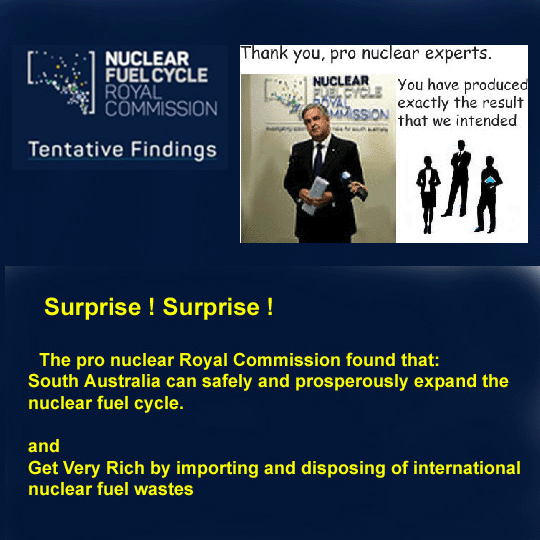
A year ago, the nuclear lobby managed to get a spurious Nuclear Royal Commission going in Australia. Stacked with pro nuclear enthusiasts, this Commission spent a heap of tax-payer money touring global nuclear companies. They especially spent time in France.
On May 6th, the Commission will announce its findings, (already decided upon at the beginning). This will be that the State of South Australia should set up the full nuclear fuel chain, but starting with importing the world’s radioactive trash, (In Australia, hardly anyone knows about this, as it has been kept as a matter for just one State, and not publicised nationally.
NOW, by a ?strange coincidence, Australia has decided to buy, at huge expense, nuclear submarines from France. They will be fuelled by diesel, not nuclear, – but the switch to nuclear can be made later, when Australia’s inconvenient anti nuclear laws have been overturned.
Just when the UK has got itself locked into a very dubious nuclear deal with France, Australia is about to do an even worse one.

 “The company involved , the Direction des Constructions et Armes Navales, now partly privatised and named DCNS, is a lady with a shady past,
1 This Month


18 March Webinar @ 1 PM EST: An Assessment of SMR Projects: The Case of Canada
register for the zoom:
https://us02web.zoom.us/webinar/register/WN_o8BIIOUvQ2ONJR1nta65DQ#/registration


of the week – STOP SMALL MODULAR REACTORS IN CANADA
To see nuclear-related stories in greater depth and intensity – go to https://nuclearinformation.wordpress.com
-
Archives
- March 2026 (146)
- February 2026 (268)
- January 2026 (308)
- December 2025 (358)
- November 2025 (359)
- October 2025 (376)
- September 2025 (258)
- August 2025 (319)
- July 2025 (230)
- June 2025 (348)
- May 2025 (261)
- April 2025 (305)
-
Categories
- 1
- 1 NUCLEAR ISSUES
- business and costs
- climate change
- culture and arts
- ENERGY
- environment
- health
- history
- indigenous issues
- Legal
- marketing of nuclear
- media
- opposition to nuclear
- PERSONAL STORIES
- politics
- politics international
- Religion and ethics
- safety
- secrets,lies and civil liberties
- spinbuster
- technology
- Uranium
- wastes
- weapons and war
- Women
- 2 WORLD
- ACTION
- AFRICA
- Atrocities
- AUSTRALIA
- Christina's notes
- Christina's themes
- culture and arts
- Events
- Fuk 2022
- Fuk 2023
- Fukushima 2017
- Fukushima 2018
- fukushima 2019
- Fukushima 2020
- Fukushima 2021
- general
- global warming
- Humour (God we need it)
- Nuclear
- RARE EARTHS
- Reference
- resources – print
- Resources -audiovicual
- Weekly Newsletter
- World
- World Nuclear
- YouTube
-
RSS
Entries RSS
Comments RSS
 nuclear-news