TEPCO draws fire after apologizing to Niigata panel
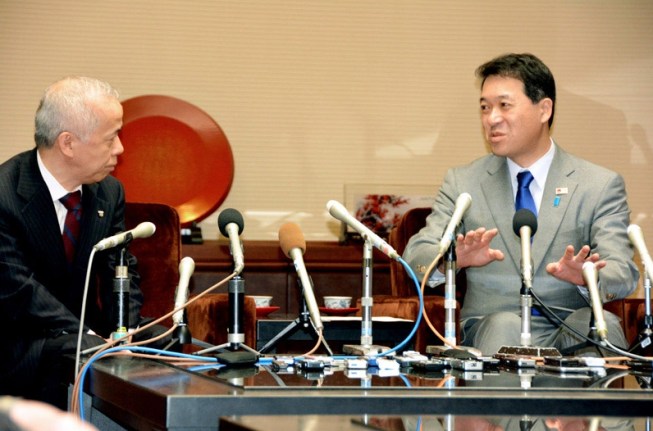
Niigata Governor Hirohiko Izumida, right, and Naomi Hirose, president of Tokyo Electric Power Co., hold a meeting at the Niigata prefectural government building in January.
NIIGATA–Even when they apologize, executives of Tokyo Electric Power Co. can still manage to draw additional criticism.
The executives, who hope to restart one of the largest nuclear power plants in the world in Niigata Prefecture, held talks here March 23 with a nuclear technology committee set up at the prefectural government.
Takafumi Anegawa, chief nuclear officer of TEPCO, offered an apology for the utility’s misleading responses to the committee’s repeated inquiries about the meltdowns at the Fukushima No. 1 nuclear power plant.
Specifically, Anegawa acknowledged that TEPCO could have declared the triple meltdown at the plant a few days after the crisis unfolded following the Great East Japan Earthquake and tsunami on March 11, 2011, instead of two months later.
TEPCO said late last month that it had found a passage detailing the criteria of a meltdown in its emergency response manual. Had the company known about that passage when the accident started, TEPCO said, it could have declared the meltdowns earlier.
When pressed by the Niigata committee on March 23 on why it took five years to find such an important passage in the emergency manual, the TEPCO executives did not give an explanation, saying the matter was still under investigation.
Committee members voiced their displeasure.
“Why did TEPCO turn it up now?” asked Masaaki Tateishi, professor emeritus of sedimentology at Niigata University. “It is out of the question for TEPCO to seek to restart its reactors, given its corporate culture.”
Mitsuhiko Tanaka, a journalist covering nuclear technology and a committee member, said TEPCO has again shown its slipshod approach toward dealing with an accident.
“TEPCO must have produced the manual but did not read it,” he said. “What it comes down to is that (its employees) had not been well trained.”
TEPCO plans to bring online two of the seven reactors at the Kashiwazaki-Kariwa nuclear plant in Niigata Prefecture and has submitted a safety screening application to the Nuclear Regulation Authority.
The Kashiwazaki-Kariwa plant has a capacity of 8.21 gigawatts.
However, Niigata Governor Hirohiko Izumida remains cautious toward restarting the nuclear plant, even if the reactors meet the NRA’s stricter safety regulations that were set following the Fukushima nuclear disaster.
The governor believes the full picture of the Fukushima disaster has not been unveiled.
The Niigata nuclear technology committee has been looking into what went wrong at the Fukushima plant, even after the Diet and the government wrapped up their investigations into the nation’s worst nuclear accident.
In autumn 2013, the committee set up an investigative panel to determine why TEPCO’s official acknowledgment of the meltdowns was delayed.
The panel demanded explanations from the company. TEPCO said in a reply in November 2015 that what constitutes a meltdown “had not been defined” within the company.
The panel kept pressing TEPCO, and in late February, TEPCO admitted that the manual used at the time of the Fukushima disaster had a passage defining a meltdown.
Anegawa told the committee on March 23 that the passage was uncovered during an investigation conducted “with the utmost care” to determine whether the delay in reporting to the government the meltdowns and other aspects of the Fukushima accident violated the law.
However, he declined to discuss details of how the company came across the passage, saying a third-party panel comprising lawyers and other experts were studying the issue.
After the meeting, Anegawa told reporters that he regretted the company’s probe “was not thorough.” He did not say when the third-party panel will release its findings.
Committee chief Ken Nakajima, professor of reactor safety at Kyoto University’s Research Reactor Institute, said the committee will continue to demand explanations from TEPCO.
“Humans are the ones who must ensure the safety (of nuclear facilities),” he told reporters. “Trust in TEPCO has been eroding. We cannot move ahead unless we are convinced of the veracity of what the company says.”
Governor Izumida, who has long questioned TEPCO’s credibility, declined an offer from TEPCO President Naomi Hirose in January to collaborate in drawing up an evacuation plan for a possible emergency at the Kashiwazaki-Kariwa plant.
“We cannot evacuate if you hide a meltdown,” the governor told Hirose during the meeting at the prefectural government building.
Izumida’s distrust of the utility runs deep.
After the Fukushima accident unfolded, Izumida confronted TEPCO officials over their previous denials over the phone that meltdowns had occurred at the plant.
The governor insisted that nuclear fuel rods must have melted, but the TEPCO officials repeated their denials by drawing a diagram of the reactors.
http://ajw.asahi.com/article/behind_news/social_affairs/AJ201603240072
TEPCO apologizes for meltdown announcement delay
Tokyo Electric Power Company has apologized to a Niigata Prefectural Government panel for not realizing sooner that 3 reactors at its Fukushima Daiichi plant had melted down in March 2011.
The panel is studying the safety of the Kashiwazaki-Kariwa nuclear plant in the prefecture. Niigata has made verification of the details of the Fukushima accident a prerequisite for the plant’s restart.
TEPCO waited 2 months after the Fukushima accident to announce the meltdowns. The panel had questioned the delay. But TEPCO insisted it had no basis for making the determination.
Last month, nearly 5 years after the disaster, the utility revealed it could have declared the reactors had melted down 3 days after the accident if it had adhered to an in-house manual.
On Wednesday, Managing Executive Officer Takafumi Anegawa apologized to the panel. He said the utility should have realized and reported the existence of the manual sooner.
Panel members asked the utility why the manual went unnoticed for 5 years. They said the utility’s longstanding and false claim that it had no standards for determining a meltdown makes it an untrustworthy nuclear plant operator.
The prefectural panel says it will resume discussions after a panel of outside experts set up by TEPCO submits a report on the cause of the delay.
http://www3.nhk.or.jp/nhkworld/en/news/20160323_30/
No comments yet.
1 This Month

of the week – Shut Down Drone Warfare!


Tell the Ukrainian Government to Drop Prosecution of Peace Activist Yurii Sheliazhenko

Petition to revoke the licensing of the Near Surface Nuclear Disposal Facility (NSDF) at Chalk River. https://www.ourcommons.ca/petitions/en/Petition/Details?Petition=e-7247
To see nuclear-related stories in greater depth and intensity – go to https://nuclearinformation.wordpress.com
-
Archives
- April 2026 (68)
- March 2026 (251)
- February 2026 (268)
- January 2026 (308)
- December 2025 (358)
- November 2025 (359)
- October 2025 (376)
- September 2025 (257)
- August 2025 (319)
- July 2025 (230)
- June 2025 (348)
- May 2025 (261)
-
Categories
- 1
- 1 NUCLEAR ISSUES
- business and costs
- climate change
- culture and arts
- ENERGY
- environment
- health
- history
- indigenous issues
- Legal
- marketing of nuclear
- media
- opposition to nuclear
- PERSONAL STORIES
- politics
- politics international
- Religion and ethics
- safety
- secrets,lies and civil liberties
- spinbuster
- technology
- Uranium
- wastes
- weapons and war
- Women
- 2 WORLD
- ACTION
- AFRICA
- Atrocities
- AUSTRALIA
- Christina's notes
- Christina's themes
- culture and arts
- Events
- Fuk 2022
- Fuk 2023
- Fukushima 2017
- Fukushima 2018
- fukushima 2019
- Fukushima 2020
- Fukushima 2021
- general
- global warming
- Humour (God we need it)
- Nuclear
- RARE EARTHS
- Reference
- resources – print
- Resources -audiovicual
- Weekly Newsletter
- World
- World Nuclear
- YouTube
-
RSS
Entries RSS
Comments RSS
 nuclear-news
Leave a comment