AREVA’s huge loss on Finland nuclear project
 Areva Posts 2.04 Billion-Euro Loss on Finnish Project http://www.bloomberg.com/news/articles/2016-02-25/areva-delays-results-by-24-hours-after-securing-bridge-loan, 25 Feb 16 Francois De Beaupuy
The company, 87 percent owned by the French government, had a net loss of 2.04 billion euros in 2015 after a loss of 4.83 billion euros a year earlier, the company based near Paris said Friday in a statement. It took a 905 million-euro charge related to the Finnish power station project due to extra operating costs and the “probable impact” of further discussions with the customer to settle the disputes over the project and bring it to completion.
Areva said it expects negative net cash flow from operations in 2016 in the range of 1.5 billion to 2 billion euros, due partly to expenses to be incurred on large projects and an unfavorable change in working capital requirements.
As a result, Areva’s credit rating was downgraded in December by Standard & Poor’s to B+, four steps below investment grade. Shares of the company have dropped 32 percent this year, extending a drop of 40 percent in 2015. The company delayed its earnings report by one day in order to finalize a bridge loan.
EDF has said it will buy a majority stake in Areva’s reactor unit provided it’s not exposed to the Finnish atomic plant project.
Radioactivity in the Ocean: Diluted, But Far from Harmless
Still, the world has never quite seen an event like the one unfolding now off the coast of eastern Japan, in which thousands of tons of radioactively contaminated water from the damaged Fukushima Daiichi nuclear power plant are pouring directly into the ocean. And though the vastness of the ocean has the capacity to dilute nuclear contamination, signs of spreading radioactive material are being found off Japan, including the discovery of elevated concentrations of radioactive cesium and iodine in small fish several dozen miles south of Fukushima, and high levels of radioactivity in seawater 25 miles offshore.
“Given that the Fukushima nuclear power plant is on the ocean, and with leaks and runoff directly to the ocean, the impacts on the ocean will exceed those of Chernobyl, which was hundreds of miles from any sea,” said Ken Buesseler, senior scientist in marine chemistry at the Woods Hole Oceanographic Institution in Massachusetts. “My biggest concern is the lack of information. We still don’t know the whole range of radioactive compounds that have been released into the ocean, nor do we know their distribution. We have a few data points from the Japanese — all close to the coast — but to understand the full impact, including for fisheries, we need broader surveys and scientific study of the area.”
Buessler and other experts say this much is clear: Both short-lived radioactive elements, such as iodine-131, and longer-lived elements — such as cesium-137, with a half-life of 30 years — can be absorbed by phytoplankton, zooplankton, kelp, and other marine life and then be transmitted up the food chain, to fish, marine mammals, and humans. Other radioactive elements — including plutonium, which has been detected outside the Fukushima plant — also pose a threat to marine life. A key question is how concentrated will the radioactive contamination be. Japanese officials hope that a temporary fishing ban off the northeastern Japanese coast will be enough to avert any danger to human health until the flow of radioactive water into the sea can be stopped…….
Studies from previous releases of nuclear material in the Irish, Kara and Barents Seas, as well as in the Pacific Ocean, show that such radioactive material does travel with ocean currents, is deposited in marine sediment, and does climb the marine food web. In the Irish Sea — where the British Nuclear Fuels plant at Sellafield in the northwestern United Kingdom released radioactive material over many decades, beginning in the 1950s — studies have found radioactive cesium and plutonium concentrating significantly in seals and porpoises that ate contaminated fish. Other studies have shown that radioactive material from Sellafield and from the nuclear reprocessing plant at Cap de la Hague in France have been transported to the North Atlantic and Arctic Oceans. A study published in 2003 found that a substantial part of the world’s radioactive contamination is in the marine environment.
How the radioactive materials released from the Fukushima plants will behave in the ocean will depend on their chemical properties and reactivity, explained Ted Poston, a ecotoxicologist with the Pacific Northwest National Laboratory, a U.S. government facility in Richland, Washington. If the radionuclides are in soluble form, they will behave differently than if they are absorbed into particles, said Poston. Soluble iodine, for example, will disperse rather rapidly. But if a radionuclide reacts with other molecules or gets deposited on existing particulates — bits of minerals, for example — they can be suspended in the water or, if larger, may drop to the sea floor.
“If particulates in the water column are very small they will move with the current,” he explained. “If bigger or denser, they can settle in sediment.”…….http://e360.yale.edu/feature/radioactivity_in_the_ocean_diluted_but_far_from_harmless/2391/
Nuclear fallout is far more toxic to the living environment than previously thought’
Nuclear Radiation Is Far More Toxic to the Living Environment Than Previously Thought. CodeShutdown March 20, 2016 ‘for reasons only partly understood, nuclear fallout is far more toxic to the living environment than previously thought’ That’s it in a nutshell
The fallout doesn’t seem to disperse to a level of non toxicity, as is commonly believed. Biological response seems to linger even after an element has decayed to very low levels, for reasons science has not adequately examined. It is known that animals can re-concentrate radioactive and non radioactive elements thousands and even millions of times, but science does not apply this knowledge adequately to risk factors. – See more at: http://nukeprofessional.blogspot.com.au/2016/03/nuclear-radiation-is-far-more-toxic-to.html#sthash.INzr7inG.dpuf
Russia funding and building new nuclear power station in Finland

 Russian nuclear corporation to start construction of Hanhikivi NPP in Finland in 2017 http://tass.ru/en/economy/864293 NOVO-OGAREVO, March 22. /TASS/. Construction of the Hanhikivi 1 nuclear power plant in Finland to be implemented by the Russian nuclear corporation Rosatom will start in 2017. Such information is contained in materials for the working visit of Finland’s President Sauli Niinisto to Moscow.
The power plant is expected to start generating electric power in 2024.
In December 2013, Rusatom Overseas [Rosatom’s subsidiary – TASS] and Finnish Fennovoima signed the contract for construction of Hanhikivi-1 nuclear power plant. Along with the construction contract, a ten-year fuel contract was signed with Russia’s company TVEL.
Russia’s revenues from the Hanhikivi-1 nuclear power plant project will amount to €17.5 bln , head of Rosatom Sergey Kiriyenko said earlier. Of this amount only taxes to the federal budget will exceed €3 bln, he added.
According to Finnish media, the project’s cost will reach €6-7 bln, of which €1.6 bln will be invested by Fennovoima and the rest by Rosatom. The commissioning of the new nuclear power plant is scheduled for 2024.
Rusatom Overseas is to supply 1,200Mt reactor for Hakhikivi-1.
New design nuclear reactors not happening for a long time (if at all)
“Our target is — can we really move the process forward and have a commercial option by 2030?” Mr. Kuczynski said. To do that, he and others say, the pace of the design process, and of the Nuclear Regulatory Commission’s review process, needs to be sped up.
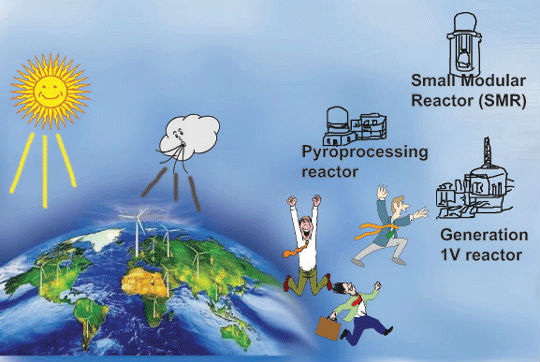
“It’s a 25-year process, no matter what,” said Michael McGough, the chief commercial officer of NuScale Power, which is the furthest along among companies working on less conventional reactors. NuScale’s design, called asmall modular reactor, uses water as a coolant, but the units are far smaller than current reactors and have advanced safety features. They could be built largely in a factory, saving money, and up to 12 of them could be installed at one site.
Mr. McGough knows all about long timetables; NuScale’s design has been under development since 2000……
Many in the industry hope that extending the licenses of existing reactors will forestall at least some closings. Nuclear plants were originally licensed for 40 years, but almost all have sought and received 20-year extensions.
The regulatory commission has begun researching what would be required to extend a plant’s life to 80 years. “We’re asking very basic questions, like how long can a reactor vessel remain acceptable since it’s being bombarded by neutrons,” said Scott Burnell, a spokesman………
Given the relatively poor economics of nuclear power, however, even if a plant could be licensed to operate up to 80 years, the question remains whether it would be financially worthwhile for it to do so, especially if expensive work is required. Skeptics cite two American plants that have been closed for economic reasons since 2012, after their licenses were extended to 60 years.
Similar economic uncertainties surround the latest generation of reactors, the Westinghouse AP1000……..
“What eventually happens with the four AP1000s will be very important,” said Matthew McKinzie, a senior scientist with the Natural Resources Defense Council. “If the economics of extending the lifetime of a plant to 80 years are poor, then what does that say about the economics of a new plant?”
Critics of nuclear power say that novel designs like molten salt reactors raise new issues, especially regarding safety, that will require much time to evaluate.
“A regulator can’t accept paper studies saying that a reactor is supersafe,” said Edwin Lyman of the Union of Concerned Scientists. “They need documentation, experimental data.”
“The industry and Department of Energy have this fantasy that you can have some general design-neutral licensing process,” he added………..http://www.nytimes.com/2016/03/22/science/nuclear-energy-power-plants-advanced-reactors.html?_r=0
Public opinion turning against nuclear power – important handicap to the nuclear industry
Nuclear power is losing popularity in the US. Here’s why. Vox, by Brad Plumer on March 21, 2016, T @bradplumer brad@vox.com “…….. Why public opinion on nuclear matters
So does this public opposition matter much? It matters quite a bit for many of the existing reactors around the country, which are currently facing brutal competition from cheap natural gas and wind power. In places like Vermont where nuclear power faces fierce local opposition, regulators have moved to shut down existing plants rather than pay for needed upgrades. (That’s typically bad news for climate change, since these reactors often get partly replaced by natural gas, which emits far more CO2.)
And, of course, if the United States is ever to build a new generation of nuclear reactors in order to help tackle global warming, then public opinion will prove even more important……..
Today, just five new reactors are under construction: two in Georgia, two in South Carolina, and one in Tennessee. These next-generation reactors are all being built at existing plant sites, which helps minimize public opposition. But these projects have also been plagued by delays and cost overruns: The two reactors at the Vogtle Plant in Georgia, for instance, are now estimated to cost $16 billion, some $3 billion over budget and three years behind schedule…….http://www.vox.com/2016/3/21/11277574/nuclear-power-public-opinion
Future for nuclear energy in South Africa is not looking good.
Future looks bleak for nuclear energy: expert, Times Live Matthew le Cordeur | 22 March, 2016 Nuclear power generation has turned into an expensive operation, even when the machines are amortised, said nuclear expert Mycle Schneider. Schneider, author of the World Nuclear Industry Status Report, told Fin24 on Monday that he questioned whether nuclear power can be seen as an alternative to a whole range of other energy options.
Schneider’s 2015 report, which was released in South Africa this month, concluded that “the promise that Generation III+ designs would be simpler and therefore easier to build appears not to have been fulfilled”.
“Real costs have increased significantly compared to their predecessors suggesting the attempt to reduce complexity was not a success.
“The ‘nuclear renaissance’ appears, in retrospect, to have been a last chance for light water reactor technology,” the report says. “Given the failure to reduce costs – and there are few who would forecast costs are going to go down at all, much less decline to the levels originally claimed – and the apparent failure to reduce the incidence of construction overruns, the future looks bleak for light water technology.”
South Africa is forging ahead to build 9.6 GW of nuclear energy, which critics believe will drain the country’s fiscus due to the large upfront infrastructure costs they say will experience time and budget overruns.
Request for proposals – which would focus on the Generation III+ designs – will be released before the end of the month, the Department of Energy said.
Nuclear for SA would only be ready by 2025
“Nuclear power has the longest lead time of any option to generate electricity,” Schneider told Fin24. “The average construction time of the 40 nuclear reactors that have been brought on line in the world in the past 10 years was about 9.5 years, to which one has to add several years of site preparation and licensing procedures.
“In other words, new nuclear would only be available in SA after 2025. Other options, especially efficiency and renewables, can be implemented within months,” he said.
Schneider said that nuclear energy’s high capital expenditure (capex), low operating expenditure (opex) paradigm is gone.
“Nuclear power generation has turned into an expensive operation, even when the machines are amortised,” he said. “As assessments by the French Energy Regulatory Commission (CRE) and the French Court of Accounts have shown, all of the cost items have increased significantly, to reach a 20.6% increase between 2010 and 2013 to reach about 60 €/MWh.
“The ‘base load’ concept is also rapidly outlived by reality in the market,” he said. “With increasing penetration of renewables, flexibility is the master word.”
Nuclear the least flexible power
“Nuclear power is the least flexible of all of the power generating technologies and is therefore hardly suitable for a future orientated power grid with high levels of decentralised renewables,” he said……..http://www.timeslive.co.za/local/2016/03/22/Future-looks-bleak-for-nuclear-energy-expert
1 This Month

of the week – Shut Down Drone Warfare!


Tell the Ukrainian Government to Drop Prosecution of Peace Activist Yurii Sheliazhenko

Petition to revoke the licensing of the Near Surface Nuclear Disposal Facility (NSDF) at Chalk River. https://www.ourcommons.ca/petitions/en/Petition/Details?Petition=e-7247
To see nuclear-related stories in greater depth and intensity – go to https://nuclearinformation.wordpress.com
-
Archives
- April 2026 (68)
- March 2026 (251)
- February 2026 (268)
- January 2026 (308)
- December 2025 (358)
- November 2025 (359)
- October 2025 (376)
- September 2025 (257)
- August 2025 (319)
- July 2025 (230)
- June 2025 (348)
- May 2025 (261)
-
Categories
- 1
- 1 NUCLEAR ISSUES
- business and costs
- climate change
- culture and arts
- ENERGY
- environment
- health
- history
- indigenous issues
- Legal
- marketing of nuclear
- media
- opposition to nuclear
- PERSONAL STORIES
- politics
- politics international
- Religion and ethics
- safety
- secrets,lies and civil liberties
- spinbuster
- technology
- Uranium
- wastes
- weapons and war
- Women
- 2 WORLD
- ACTION
- AFRICA
- Atrocities
- AUSTRALIA
- Christina's notes
- Christina's themes
- culture and arts
- Events
- Fuk 2022
- Fuk 2023
- Fukushima 2017
- Fukushima 2018
- fukushima 2019
- Fukushima 2020
- Fukushima 2021
- general
- global warming
- Humour (God we need it)
- Nuclear
- RARE EARTHS
- Reference
- resources – print
- Resources -audiovicual
- Weekly Newsletter
- World
- World Nuclear
- YouTube
-
RSS
Entries RSS
Comments RSS
 nuclear-news