Fukushima farmers grow flowers using polyester ‘soil’
I don’t think that what may be good for flowers is also good for vegetables which are to go into the stomach of people…
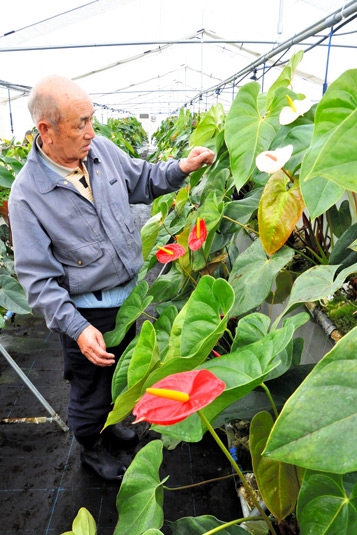
Farmer Yukichi Takahashi, 76, checks anthurium flowers grown in “soil” made up of polyester fibers in Kawamata, Fukushima Prefecture.
KAWAMATA, Fukushima Prefecture–Farmers here have started growing flowers using polyester “soil” in the hope that the cultivation method will dispel concerns among consumers about radioactive contamination from the nuclear disaster.
The farmers are being helped by a team from Kinki University’s Faculty of Agriculture in Higashi-Osaka, Osaka Prefecture, and have started cultivating anthurium ornamental plants utilizing the soil, which is made up of filamentous polyester fabrics.
“This cultivation method allows us to grow plants without concern over the negative impact of the nuclear accident,” said Yukichi Takahashi, a 76-year-old farmer who is a key member of the project. “My dream is that our flowers will be used in bouquets to be presented to athletes on the podium during the 2020 Tokyo Olympics.”
In a test run, 2,000 anthurium plants, known for their colorful, heart-shaped flowers, were grown in a 30-meter-long greenhouse in the Ojima district of Kawamata, located about 50 kilometers northwest of the crippled Fukushima No. 1 nuclear power plant.
Local farmers who participate in the project will set up an agricultural corporation later this year with the aim of eventually starting full-fledged farming and shipment.
The project began in spring 2014 after the university researchers learned about the plight of local farmers when they visited to measure radiation levels in the town, which is located on a high plateau surrounded by mountains.
“By using polyester fabrics as a cultivation medium instead of ground soil, this new method will help protect Fukushima farmers from harmful rumors that may stem from consumers’ concerns over soil contamination,” said project leader Takahiro Hayashi, a professor of horticulture at the university, which is known for its advanced aquafarming and agricultural programs.
Kawamata once prospered through livestock and tobacco farming, but the nuclear disaster, triggered by the Great East Japan Earthquake and tsunami on March 11, 2011, dealt a heavy blow to the area’s agricultural industry by spreading a large amount of radioactive fallout.
A southeastern strip of the town is still designated as a “zone being prepared for the lifting of the evacuation order,” and local residents remain evacuated from the district in temporary housing and elsewhere.
While radiation levels in the town’s agricultural produce have passed safety tests, consumers’ lingering concerns over possible contamination have undercut market competitiveness.
http://ajw.asahi.com/article/0311disaster/recovery/AJ201603200015
No comments yet.
1 This Month

of the week – Shut Down Drone Warfare!


Tell the Ukrainian Government to Drop Prosecution of Peace Activist Yurii Sheliazhenko

Petition to revoke the licensing of the Near Surface Nuclear Disposal Facility (NSDF) at Chalk River. https://www.ourcommons.ca/petitions/en/Petition/Details?Petition=e-7247
To see nuclear-related stories in greater depth and intensity – go to https://nuclearinformation.wordpress.com
-
Archives
- April 2026 (57)
- March 2026 (251)
- February 2026 (268)
- January 2026 (308)
- December 2025 (358)
- November 2025 (359)
- October 2025 (376)
- September 2025 (257)
- August 2025 (319)
- July 2025 (230)
- June 2025 (348)
- May 2025 (261)
-
Categories
- 1
- 1 NUCLEAR ISSUES
- business and costs
- climate change
- culture and arts
- ENERGY
- environment
- health
- history
- indigenous issues
- Legal
- marketing of nuclear
- media
- opposition to nuclear
- PERSONAL STORIES
- politics
- politics international
- Religion and ethics
- safety
- secrets,lies and civil liberties
- spinbuster
- technology
- Uranium
- wastes
- weapons and war
- Women
- 2 WORLD
- ACTION
- AFRICA
- Atrocities
- AUSTRALIA
- Christina's notes
- Christina's themes
- culture and arts
- Events
- Fuk 2022
- Fuk 2023
- Fukushima 2017
- Fukushima 2018
- fukushima 2019
- Fukushima 2020
- Fukushima 2021
- general
- global warming
- Humour (God we need it)
- Nuclear
- RARE EARTHS
- Reference
- resources – print
- Resources -audiovicual
- Weekly Newsletter
- World
- World Nuclear
- YouTube
-
RSS
Entries RSS
Comments RSS
 nuclear-news
Leave a comment