Nuclear Scars: The Lasting Legacies of Chernobyl and Fukushima
There is no simple or easy way to clean up an aftermath of a nuclear accident. Indeed, this report shows that there is no such thing in reality as a complete decontamination of radioactively contaminated areas. The disasters that began at Chernobyl Nuclear Power Plant (NPP) in 1986 and at Fukushima NPP in 2011 have demonstrated not only the terrible initial consequences of major nuclear accidents; they also left us with long-term consequences for human health and the environment. These scars are still with us today and will be with us long after tomorrow.
The nuclear industry likes to frame these accidents in terms of downplayed numbers of deaths, but the reality is far more complex and insidious. The impacts go far beyond the tens of thousands of fatalities and hundreds of thousands suffering health consequences. Following a nuclear disaster, people are put under overwhelming pressures. They must evacuate their communities to avoid radiation risks. They are displaced from their friends, families and communities for years.
Despite all the evidence to the contrary, the nuclear industry and its government supporters continue to hide the threats of nuclear power from the public. The real risk of nuclear power, however, is inescapable for hundreds of thousands of Chernobyl and Fukushima survivors. Despite the immense suffering that accompanies losing your home or living in a contaminated environment, the scale and seriousness of these effects continue to be played down or misrepresented.
This report seeks to clarify how governments, reactor operators and nuclear regulators were unprepared to deal with not only emergency evacuations immediately after the accidents, but with the long-term management of hundreds of thousands of displaced persons, as well as with the contaminated communities and agricultural lands.
Nuclear scars: The Lasting Legacies of Chernobyl and Fukushima
Court issues surprise injunction to halt Takahama nuclear
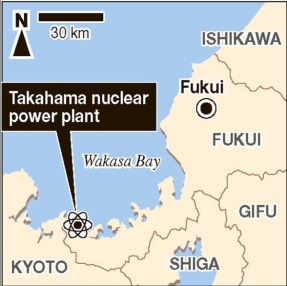 OTSU, SHIGA PREF. – In a surprise ruling that is likely to delay efforts to restart nuclear power generation nationwide, the Otsu District Court on Wednesday issued a provisional injunction ordering Kansai Electric Power Co. to shut down its No. 3 and No. 4 reactors at its Takahama facility in Fukui Prefecture.
While Kepco is expected to appeal the ruling, company officials said at a news conference that was hastily called after the decision that they would begin operations to shut down the No. 3 reactor on Thursday morning, and expected to complete the process by the evening.
The No. 3 reactor was restarted in January, and the No. 4, which had been scheduled to restart last month, was delayed due to technical problems.
“There are doubts remaining about both the tsunami response and the evacuation plan,” the ruling said.
The Otsu ruling comes just two days before the fifth anniversary of the Great East Japan Earthquake and the resulting tsunami and triple meltdown at Tokyo Electric Power Co.’s Fukushima No. 1 plant.
The jubilant plaintiffs expressed surprise and relief following the ruling, which emphasized technical problems regarding the two reactors, including issues concerning an outside power supply source in the event of an emergency. The ruling also raised concerns over the emergency protocol.
“This is a huge victory for the safety of children, people with disabilities, and the society and economy of not only the Fukui-Kansai region of Japan but the entire country,” said Aileen Mioko Smith of Kyoto-based Green Action, an anti-nuclear group. Smith was not a plaintiff in the case.
The lawsuit that sought the injunction was filed by Shiga residents who are fearful that an accident at the Takahama plant, which lies less than 30 kilometers from the northern part of Shiga Prefecture, would impact Lake Biwa, the nation’s largest freshwater body and the source of water for about 14 million people in the Kansai region, including Kyoto and Osaka.
The judgment — the first of its kind affecting reactors that were fired up under strengthened safety regulations following the March 2011 disaster — is a blow to the government’s renewed push for atomic power. The ruling could also cast doubt on the stringency of the new safety regulations.
Chief Cabinet Secretary Yoshihide Suga, however, told reporters following the ruling the government would not change its basic stance of promoting restarts.
In a separate case concerning the two reactors, the Fukui District Court issued an injunction last April banning Kansai Electric from restarting the units, citing safety concerns.
But the same court later lifted the injunction in December, allowing the utility to resume operations at both reactors. Plaintiffs appealed the court decision to the Kanazawa branch of the Nagoya High Court, where the case is pending.
Under the revamped safety regulations, which took effect in 2013, utilities are for the first time obliged to put in place specific countermeasures in the event of severe accidents such as reactor core meltdowns and huge tsunami — which was the initial cause of the crisis at the Fukushima nuclear plant.
Court orders Takahama reactor shut down, 2nd offline
A court has issued an unprecedented order for a nuclear reactor in western Japan to stop operating and ordered a second one to stay offline.
The Otsu District Court in Shiga Prefecture, which issued the injunction, said the emergency response plans and equipment designs at the two reactors have not been sufficiently upgraded despite the 2011 Fukushima crisis.
Wednesday’s order requires Kansai Electric Power Co. to shut down the No. 3 reactor immediately and keep the No. 4 offline at the Takahama plant in Fukui Prefecture, home to about a dozen reactors.
The two reactors restarted this year after a high court in December reversed an earlier injunction by another court.
The decision reflects Japan’s divisive views on nuclear safety and leaves only two of the country’s 43 reactors in operation.
http://ajw.asahi.com/article/behind_news/social_affairs/AJ201603090064
FIVE YEARS AFTER: Radioactive forests prevent logging revival in Fukushima
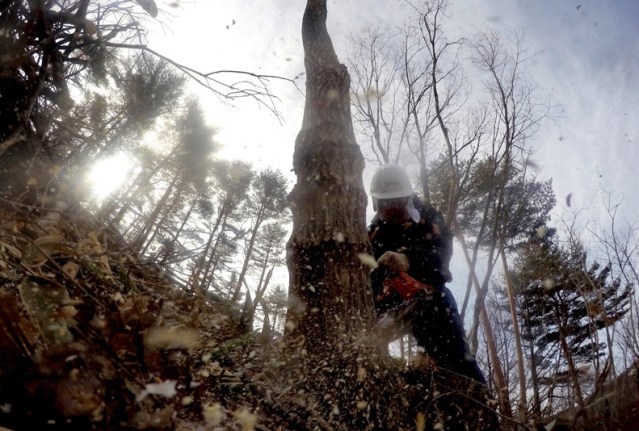
A logger cuts down a tree in a mountainous area of the Miyakoji district in Tamura, Fukushima Prefecture, in late February
TAMURA, Fukushima Prefecture–The once-thriving industry of log production for shiitake mushroom farming remains virtually nonexistent in Fukushima Prefecture after the 2011 nuclear disaster contaminated extensive mountain areas.
A year before the Great East Japan Earthquake and tsunami triggered the triple meltdown at the Fukushima No. 1 nuclear power plant on March 11, 2011, the prefecture produced logs for cultivating shiitake totaling 47,800 cubic meters, the third largest volume among Japanese prefectures.
But radioactive fallout from the nuclear accident meant that shiitake log production in the prefecture dwindled to about 1 percent of the pre-disaster level in 2014, which is having a serious impact on local industry.
In the Miyakoji district of Tamura, located about 20 kilometers inland from the crippled nuclear power plant, the lumber industry shipped around 200,000 logs annually before the 2011 disaster.
“More than 80 percent of this area’s land is covered by forests, and we cannot think of any other business opportunities that don’t involve forestry,” said Shoichi Yoshida, a 60-year-old executive of the Fukushima Central Forestry Association.
While the evacuation order covering an eastern strip of the district was lifted in 2014, radioactive levels of trees in the district remain above target levels, and the resumption of shipments is still nowhere in sight.
However, local forestry workers still routinely cut down oak and other trees, which are more than 20 years old, to maintain the mountain area’s capability of producing quality logs.
http://ajw.asahi.com/article/0311disaster/recovery/AJ201603090060
Five Years of Forgetting: The Fukushima Disaster and Nuclear Amnesia
Shunichi Yamashita, a proclaimed expert on the effects of radioactivity, was invited by the #Fukushima prefecture in the aftermath of the meltdowns to reassure rather than investigate.
“The effects of radiation,”he claimed, “do not come to people who are happy and laughing, they come to people who are weak-minded.”
“People’s understanding of disasters will continue to be constructed by media. How media members frame the presence of risk and the nature of disasters matters.” – Celine Marie Pascale, American University, Mar 10, 2015
Fearing radiation; terrified by the nuclear option. Perfectly sensible instincts that never seem to convince establishments and those who have long ceased to loathe nuclear power and its various dangerous by-products. Each nuclear disaster, such as the meltdowns at the Fukushima Daiichi plants five years ago, come with its treasure of apologetics and justifications. The reason is always the same: nuclear energy is safe and we cannot really do without it.
To that end, the emergence of “radiophobia” is a designation that dismisses as much as it supposedly diagnoses. It pokes fun at those ninnies who think that they are about to perish because of the effects of nuclear catastrophe and radiation contamination. Risk, according to this philosophy of concerted denial, is always exaggerated.
Shunichi Yamashita, a proclaimed expert on the effects of radioactivity, was invited by the Fukushima prefecture in the aftermath of the meltdown to reassure rather than investigate.
“The effects of radiation,” he claimed, “do not come to people who are happy and laughing, they come to people who are weak-minded.”
This Dr. Strangelove dismissiveness is as much an advertisement for the virtues of doom as it is about the brutal consequences, real and imaginary, of radiation poisoning. Radiation is the invisible killer that stalks the earth, but for many, it is hardly worth a thought. For one, it suggests a simple calculation in environments that are not, supposedly, that dangerous. “With low radiation doses,” argued this doctor of nuclear apologetics, “the people have to decide for themselves whether to stay or to leave.”
Despite this bubbling confidence on the part of his colleagues, Japanese American physicist Michio Kaku had little time for such views as Yamashita’s. In an interview soon after the meltdown, Kaku claimed that, “The slightest disturbance could set off a full-scale meltdown at three nuclear power stations, far beyond what we saw at Chernobyl.”
Smile with upbeat confidence, and the problem goes away. If people are depressed before radiation, suggests Yamashita, they will succumb as the negative dramatists they are. “Stress is not good at all for people who are subjected to radiation.” Then again, stress could hardly be deemed good for anybody in particular, irrespective of radiation.
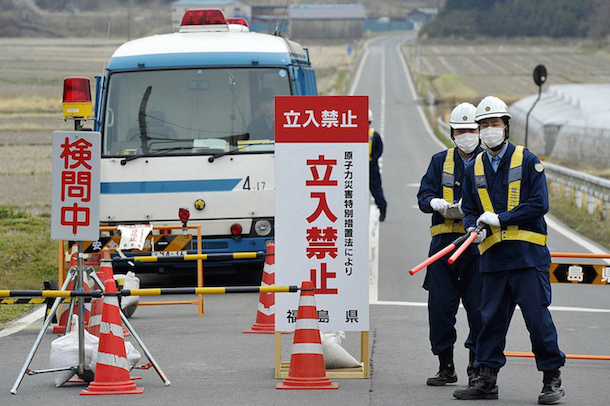
Security checkpoint outside Fukushima following the disaster.
Such fabulously misguided nonsense is central to the amnesiac context of Fukushima. Makiko Segawa put it rather poignantly in his contribution in the Asia-Pacific Journal: initial enthusiastic snaps and coverage by the press corps, an insatiable lust for disaster imagery, quietened in due course. Writing a year after the disaster, Segawa noted how “the journalists have packed up and gone and by accident of design Japan’s government seems to be mobilizing its agenda, aware that it is under less scrutiny.”
Robert Jacobs similar notes that Fukushima conforms to that litany of disasters that has afflicted the human experience, a matter of rejection and experience rather than learning and adapting. “Fukushima is taking its place alongside the many forgotten nuclear disasters of the last 70 years.”
Sociologist Celine Marie Pascale of the American University, on scouring some 2,100 news stories from four media outlets (The New York Times, Washington Post, The Huffington Post and Politico) came to the conclusion that a strategy of minimisation was underway. The implications of such an event had to be downplayed, de-emphasising the risk of massive contamination and environmental disaster. A mere 6 percent of the articles examined the health implications of the event. “We see articles in prestigious news outlets claiming that radioactivity from cosmic rays and rocks is more dangerous than the radiation emanating from the collapsing Fukushima Daiichi nuclear plant.”
A necessary process of mendacity has to come into play. The Tokyo Electric Power Plant (TEPCO), Japan’s largest power company and owner of the affected power plants, initially denied the existence of meltdowns when it knew three had taken place. It was a process of deception that continued for three months after the event, a situation made even more absurd for the fact that hundreds of thousands were evacuated in the vicinity. It is a disaster episode that keeps on giving.
Even in March 2015, their reassurances seemed less than comforting. Chief Decommissioning Officer Naohiro Masuda would claim rather blandly that, “Even if some contaminated water remains, I feel that we can reduce a substantial amount of risk.”
The nuclear genie is a creature that encourages the lie in planning establishments. There are lies about safety; there are lies about legacies. As Jacobs suggests, the Disneyfication of disaster sites affected by the nuclear or atomic scourge is all too real. The Manhattan Project that led to the development of the atomic weapons used on Hiroshima and Nagasaki became “Disney theme parks of American exceptionalism.” The quest for the nuclear option in both the military and energy contexts saw massive environmental degradation.
Even now, the ghostly sense of Fukushima should be a reminder of errors and negligence rather than dismissal and indifference. Jacobs suggests a simple but necessary formula to combat nuclear amnesia: see the impacts of radiation exposure “before they become vaguely visible as cancers nestled in health population statistics.”
The Broken Maps of Fukushima
by Robert Jacobs, March 9, 2016
When we look at maps of Fukushima what we see is disinformation. The maps of the radioactive contamination of Fukushima contain contradictions that embody our inability to understand the true nature of the dangers to people living there. This is rooted in the difficulty in understanding radiation. If we can separate the maps, we may be able to grasp the dangers more readily, and thus understand the situation in a more functional way.
Similarly, one can hold a Geiger counter up in the air in a village in Fukushima prefecture and declare that there is no radiation present. The assumption, therefore, is that there is no danger. The ways in which this can be both true, but only partial truth, are part of what we need to fully grasp to understand the situation in Fukushima.
I will begin with the Geiger counter.
Radiation is a very difficult thing to understand. For starters, we tend to assume that radiation is a “thing.” Something is radioactive or it is not. We are affected by the radiation or we are not. This is not quite accurate. Radiation is a quality: it is a process—something radiates. How it radiates can differ, and it is in this difference that half-truths can be told as whole truths. While there are many aspects to this, for the present article I will concentrate on the differences between gamma, beta and alpha radiation. Most of the discourse that you hear about radiation related to Fukushima is describing gamma radiation. The danger to most of the people continuing to live in contaminated areas is in the form of alpha or beta radiation, so when we hear people talk about radiation in Fukushima, most of the time they are not talking about what is of most concern and danger.
Here is a quick primer. Gamma radiation comes off of radioactive materials in waves. These waves can penetrate anything, and they are partially filtered by heavy materials, such as lead. You can think of gamma radiation as similar to x-rays. This is why you have a lead apron placed on you when you have dental x-rays, and why the technician goes behind a lead-lined wall. When gamma radiation passes through your body it does not stay in your body. Like x-rays, when the source is turned off, they stop and there is no more danger. To limit the damage to the body from gamma radiation we limit the total cumulative dose received, hence the person working with it protects themselves behind the lead wall; the patient receives a small dose, but if the technicians received that same small dose repeatedly every day, they would be at much higher risk.
Alpha and beta radiation comes from specific irradiated particles, such as individual atoms of plutonium, or cesium-137. These particles cannot penetrate through materials: they cannot penetrate through skin, or even paper. They are primarily dangerous when we internalize them inside of our bodies and they permanently lodge there. They generally give off a small amount of radiation because they are single atoms. If there are a lot of them present, they give off more radiation. If one is internalized into the body, it will give this small amount of radiation to the same surrounding cells for 24 hours a day. While the amount is small, 24/7 exposure to this radiation may cause mutations to these cells, and then cancer.
Gamma radiation fills an area equally, lessening quickly as you get further from the source. This is what most Geiger counters are set to measure—the levels of gamma radiation present. When you have alpha and beta-emitting particles scattered in an area, the amount of detectable radiation will likely vary. In Fukushima City last year (about 50 miles away from the nuclear plants), I held a Geiger counter at chest level on a street and found a low level of radiation. However, moments later when I placed that same Geiger counter on the ground, I found much higher levels of radiation. That is because particles fall and collect on the ground. When I then moved my Geiger counter to the gutter at the side of the street, I found dramatically more radiation. This is because rain washes the particles to the gutter. So the distribution of the particles is irregular, depending on how long ago they fell-out of the sky (fallout) and how much wind and rain there has been.
This is how you can hold a Geiger counter in the air (or place a public Geiger counter five or twenty feet in the air) and show very low levels of radiation, and yet there can still be significant dangers present. If the danger is from alpha and beta-emitting particles, the readings taken in mid-air can be low. The way that such particles are dangerous to us is if we internalize them into our bodies, typically by inhaling them, swallowing them, of having them enter through cuts in our skin. Once inside the body, they may pass through, but they may also permanently lodge there. The body is tricked into thinking that these particles are useful chemicals. Strontium-90 “mimics” calcium, and the body can put it into the bones. Since the body puts iodine into the thyroid gland, if someone has internalized iodine-131 (a radioactive form of iodine) the body may put that in the thyroid gland. Thyroid cancer is one of the first cancers to develop from internalized particles, and that is why our conversation about the health impacts in Fukushima are currently focused on thyroid cancer. Other cancers will follow as we move through their latency periods.
______________
Table 1
Some isotopes of concern after a nuclear accident:
Plutonium 239, half-life: 24,000 years, decay mode: alpha, decay energy: 5.24 MeV
Strontium 90, half-life: 29 years, decay mode: beta, decay energy: 0.546 MeV
Cesium 134, half-life: 2 years, decay mode: beta, gamma, decay energy: 0.698 MeV
Cesium 137, half-life: 34 years, decay mode: beta, gamma, decay energy: 1.76 MeV
Iodine 131, half-life: 8 days, decay mode: beta, gamma, decay energy: 971 keV
Tritium, half-life: 12 years, decay mode: beta, decay energy: 18.6 keV
Decay energy is measured in electron volts (eV), a measure of the particle’s momentum. 1 MeV is 1,000,000 eV, and 1 keV is 1,000 eV. According to the table, Plutonium 239 is the most dangerous internal emitter, but the hazards to public health depend on the relative quantities released and the relative quantities that people actually absorb. Some segments of the population are more vulnerable than others. Is it a matter of a single exposure or a continual exposure and accumulation? What parts of the body do different particles tend to go to, and how long on average do they tend to stay in the body (the biological half-life)? None of this complexity can be conveyed with a map and a simple declaration of a “safe” limit of external gamma radiation exposure. (Table added by Dianuke editor)
______________
These alpha and beta-emitters are particularly dangerous for children. Children are lower to the ground to start with, tend to put things into their mouths, and tend to play outdoors and suffer cuts and bruises, and since their bodies are growing rapidly, damage to cells can replicate faster. This is why parents agonize over whether to stay or evacuate an area that has had radiological fallout.
This is also why it is hard to be certain about the contamination to the food supply. It is virtually impossible to test all food, and so samples are tested: samples of rice from rice fields, samples of fish from catches, samples of fruit from orchards. Because the danger to these crops is not from gamma radiation, which would be equally distributed, but from their internalizing alpha and beta-emitting particles, portions of a crop, or haul of fish, can test negative while other portions contain significant amounts of radiation deposited on them or taken up through soil and water into the plant or fish itself.

Our ability to technologically determine the distribution of alpha and beta-emitting particles is limited because of the irregular deposit of the material from fallout clouds, and the subsequent scattering of the particles from wind and water. This is also why it is possible to “decontaminate” an area only to have it re-contaminated as the wind and rain redistribute the particles that fell on nearby forests. Technically it is not possible to “decontaminate” a natural area. The radioactive particles will remain dangerous for their natural life. For plutonium that is over 100,000 years. During that time, it cannot be decontaminated, it can only be moved. We can attempt to contain these particles, however most of them will long outlive the plastic bags into which we placed them, at which time they will re-enter the soil and the ecosystem and begin to cycle through it again.
Understanding the difference between the dangers from gamma, beta and alpha radiation is the key to understanding how the maps of Fukushima are broken. Below is a typical map that we see of Fukushima, produced by the Japanese government:

Map of Fukushima produced by MEXT of the Government of Japan and reproduced on the website of the IAEA.
There are two things that I want to point out. First, the concentric circles. These have the Fukushima Daiichi nuclear plant at their center. The second thing is the color coded splotches and streak. These show where the plumes of the three nuclear plant explosions deposited their fallout, in this case specifically measurements of cesium-134 and cesium-137. Notice how the representation of the areas of fallout are constrained by the outermost concentric circle.
These two things should be read separately.
Concentric circles describe relative distances from a point. In this case, distances from the nuclear plant. People were evacuated based on their distance from the plant. The mandatory evacuation zone was at 20 km and the suggested, or prepared evacuation zone was from 20-30 km (the key difference between “mandatory” and “suggested” evacuation is liability). The reason that people had to evacuate from these areas was because of the high levels of gamma radiation coming from the melted cores of the nuclear plants, and the high levels of gamma radiation where the plumes deposited the largest amounts of fallout close-by. The levels of gamma radiation near the reactors is lethally high. At this point, no human being can enter into the buildings where the nuclear cores melted. The gamma radiation levels are so high that they would be killed in minutes. We have yet to build robots capable of operating in these highly radioactive locations for longer than an hour or so. Moving away from the point at the center of these circles will decrease one’s exposure to radiation. The amount of gamma radiation coming from the plant is measurable and relatively constant across the areas at similar distances. Hence the use of circles, concentric circles marking decreasing levels of gamma radiation.
Here is a map of the evacuations:
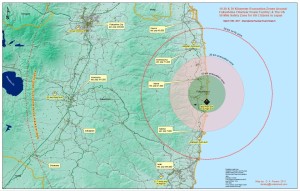
Concentric Circles Showing Areas of Evacuation, No-Fly Zone, and U.S. Safety Zone Around the Fukushima Daiichi Nuclear Plants, and the Populations of Nearby Towns.
When we look, instead, at a map of the radiological contamination of the downwind area, we are reading entirely different information. The splotches of color marking the levels of radiation from the plumes is irregular, unlike the neat and cleanly measured concentric circles. The colors mark the different grades of radiation from the fallout. They are created based on the gamma radiation from the fallout, however, the primary danger to people living in these areas is not based on the levels of the gamma radiation, but from internalizing individual alpha and beta-emitting particles. Since there is no single source, like the melted cores, but rather billions of individual particles, once the plume has fallen out and the particles have reached the ground, they begin to move through the ecosystem via the dynamic motion of wind and water, and then they are internalized in the bodies of animals. Rain will collect them along gutters and gullies and transport them. Wind will blow them along hillsides and valleys. Once these particles begin to move through the ecosystem, there is no center, no specific source that people must move away from. The dangers are unevenly distributed, and they are constantly changing. Once you are over 30 km away from the nuclear plants, surrounded by their concentric circles, moving further away from the direction of the plants may or may not provide more safety. The contamination that comes from alpha and beta-emitting particles is unpredictable, irregular, and changes over time. Each specific particle has a specific period of radioactivity and during that period, it will move through the ecosystem, being taken up by plants, moved by wind, entering soil, eaten by animals and returning to the soil when the animals die. They may move in the same direction that you are moving to get away from the center of the concentric circles, if the wind is blowing that way.
Here is a map showing the radiological contamination of the region, which differs from the specific places where the plumes first deposited:
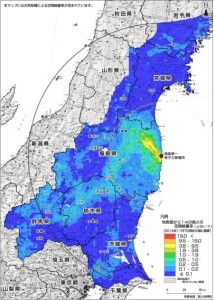
Map of Radiation Levels Downwind from the Fukushima Daiichi Nuclear Plants in 2014, Produced by the Nuclear Regulation Authority of the Government of Japan.
The maps of Fukushima are broken. These broken maps are reflections of the broken chain of information that has been provided to those living there and grappling with the dangers on a daily basis. Because these maps, and this information, are broken, disinformation can thrive and blossom. A March 7th editorial in the Yomiuri Shimbun in Japan makes use of these broken maps and the data that they convey to misinform people in Japan about the safety of former residents moving back into contaminated areas. With no sense of irony, it’s headline proclaims, “Correct Understanding of Radiation Needed to Speed Reconstruction.” Explaining that exposure to radiation is natural, the editorial claims that, “The government needs to continue carefully explaining to residents that there will be no health problems as long as the radiation exposure is at 20 millisieverts or lower.” For this reason, people need “correct understanding” to cooperate and return to areas that can only be decontaminated to 20 millisieverts. While there is significant debate about what level of gamma radiation is safe, and increasingly convincing data that no level is safe (see here), this argument ignores the fact that much of that 20 millisievert exposure is coming from alpha and beta-emitting particles, which pose an additional danger from that of the external exposure. For the people being advised to return, the areas they would return to are plagued by the more urgent risk of internalizing these particles, a danger that increases dramatically in areas where the external exposure is still measurably high. Their lives would be filled with the presence of large amounts of invisible atoms that will very likely cause cancers if inhaled or swallowed. These dangers are not factored into the 20 millisieverts the editorial writers so casually dismiss.
These broken maps, co-mingling the dangers of external and internal radiation in one graphic, present the idea that the dangers from radiation near Fukushima are fixed and knowable. This is not true. Massive amounts of radionuclides have deposited along large areas of Fukushima, and they will now pulse and fluctuate within the dynamics of that ecosystem for as long as each particle remains radioactive. Most of them will be hard to trace and difficult to control. People can be moved away from the plants, where the danger is in a fixed location and is measurable. Where the plumes deposited the particles the opposite is true. The dangers are unknowable and can move around, just like the people. This puts the health of those living there in a very different relationship to the risks.
To fix the maps, we need to fix the knowledge chain. Radiation is difficult to understand, and that difficulty allows disinformation to take root–disinformation like that contained in the editorial of the Yomiuri cited above, and in so many pronouncements from experts who omit information about alpha and beta-emitting particles and the dangers of internalized radiation when they speak down to people who must live with these dangers. For most people having to live with the radiation scattered by TEPCO’s meltdowns, clear information about internalized radiation and how these dangers persist in their communities is essential for them to map their own paths to a future of their choosing. No one should insist that they live with higher levels of radiation by changing their understanding to the “correct understanding.”
_____
Robert Jacobs is a historian of nuclear technologies and radiation technopolitics at the Hiroshima Peace Institute of Hiroshima City University.
1 This Month

of the week – Shut Down Drone Warfare!


Tell the Ukrainian Government to Drop Prosecution of Peace Activist Yurii Sheliazhenko

Petition to revoke the licensing of the Near Surface Nuclear Disposal Facility (NSDF) at Chalk River. https://www.ourcommons.ca/petitions/en/Petition/Details?Petition=e-7247
To see nuclear-related stories in greater depth and intensity – go to https://nuclearinformation.wordpress.com
-
Archives
- March 2026 (244)
- February 2026 (268)
- January 2026 (308)
- December 2025 (358)
- November 2025 (359)
- October 2025 (376)
- September 2025 (257)
- August 2025 (319)
- July 2025 (230)
- June 2025 (348)
- May 2025 (261)
- April 2025 (305)
-
Categories
- 1
- 1 NUCLEAR ISSUES
- business and costs
- climate change
- culture and arts
- ENERGY
- environment
- health
- history
- indigenous issues
- Legal
- marketing of nuclear
- media
- opposition to nuclear
- PERSONAL STORIES
- politics
- politics international
- Religion and ethics
- safety
- secrets,lies and civil liberties
- spinbuster
- technology
- Uranium
- wastes
- weapons and war
- Women
- 2 WORLD
- ACTION
- AFRICA
- Atrocities
- AUSTRALIA
- Christina's notes
- Christina's themes
- culture and arts
- Events
- Fuk 2022
- Fuk 2023
- Fukushima 2017
- Fukushima 2018
- fukushima 2019
- Fukushima 2020
- Fukushima 2021
- general
- global warming
- Humour (God we need it)
- Nuclear
- RARE EARTHS
- Reference
- resources – print
- Resources -audiovicual
- Weekly Newsletter
- World
- World Nuclear
- YouTube
-
RSS
Entries RSS
Comments RSS
 nuclear-news