TEPCO now burning thousands of radioactive work clothes
TEPCO begins burning radiation-tainted work clothes at Fukushima plant Asahi Shimbun, February 26, 2016 By HIROMI KUMAI/ Staff Writer OKUMA, Fukushima Prefecture--Tokyo Electric Power Co. has started to incinerate the thousands of boxes of lightly contaminated waste, including clothing used by workers, at the Fukushima No. 1 nuclear power plant to reduce the amount of tainted waste on the site.
TEPCO, the plant operator, fired up a special on-site incinerator on Feb. 25 to burn protective suits, gloves, socks and other work clothes worn by plant workers that became contaminated with low-level radiation.
The operation will reduce the amount of tainted work clothing accumulating at the plant during decommissioning operations since the nuclear disaster unfurled in March 2011. The garments cannot be processed outside the plant due to the radiation.
The clothing being incinerated are items with the lowest levels of contamination that have been stored in tens of thousands of 1 cubic-meter special boxes. The number of containers reached 66,000 at the end of last year…….http://ajw.asahi.com/article/0311disaster/fukushima/AJ201602260071
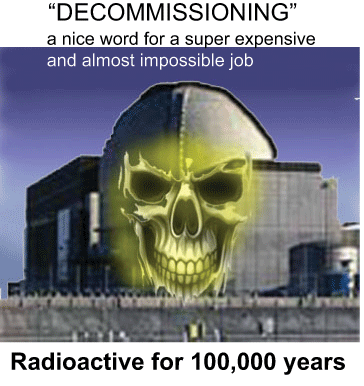
Germany’s nuclear utilities will have to transfer nuclear clean-up cash by 2022
 Nuclear commission proposes firms transfer cash by 2022 to pay for clean-up http://af.reuters.com/article/commoditiesNews/idAFB4N10000F
Mon Feb 22, 2016BERLIN Feb 22 (Reuters) – Germany’s utilities will have to transfer provisions set aside to pay for the interim and final storage of nuclear waste to a fund in cash by 2022, according to a draft report from a government-appointed committee seen by Reuters on Monday.
The report recommends that Germany’s “big four” utilities — E.ON, RWE, EnBW and Vattenfall — remain liable for the cost of up to double the 18 billion euros ($19.8 billion) allocated so far to pay for interim and final storage.
The companies will also have to set aside a further 1.3 billion euros in provisions, according to the report which is due to be presented at the end of the month. ($1 = 0.9084 euros) (Reporting by Markus Wacket; Writing by Caroline Copley; Editing by Christoph Steitz)
France promises more compensation to Pacific nuclear test victims
France pledges more compensation for Polynesia nuclear tests http://www.reuters.com/article/us-france-nuclear-idUSKCN0VV1XW, 28 Feb 16 PAPEETE, FRENCH POLYNESIA Residents of French Polynesia who suffered due to 30 years of French nuclear tests in the Pacific archipelago have a legitimate right to compensation, President Francois Hollande said on his first visit to the region on Monday.
The sensitive issue of reparations for damage caused by the atomic testing between 1966 and 1996 at Mururoa Atoll is top of the agenda of Hollande’s tour of French Pacific territories. “If France is what it is today, with this deterrent capability, it is because there were nuclear tests for a very long period,” he said on arrival in Papeete.
“It’s quite legitimate that France should make good for a number of consequences, whether social, health-related or economic,” he said in a joint news conference with Polynesian president Edouard Fritch.
Regional authorities say compensation approved by a 2010 law has been slow to arrive. An anti-nuclear pressure group said only 19 people, of whom just five Polynesians, had received payments.
An annual 150 million euro ($165.2 million) subsidy fixed when President Jacques Chirac ended nuclear tests in 1996 is set to shrink to 84 million euros this year.
Employers and trade unions that manage the regional health fund are demanding 450 million euros in costs for treating people they say are suffering from cancer due to radiation.
(Reporting by Daniel Pardon; Writing by Paul Taylor)
Growth of renewable energy rendering nuclear power obsolete
The End of the Nuclear Age, Handelsblatt, BY KLAUS STRATMANN, 28 Feb 16
Even before the Fukishima disaster, it was clear that nuclear power was dangerous, unreliable and too risky for civil use. The growth of renewable energy is now rendering them obsolete, argues Handelsblatt’s energy expert. The pictures from Fukushima are etched on the collective memory of mankind. They drastically changed the perception of civil use of nuclear power, especially in Germany.
And yet work continues on new nuclear reactors worldwide. Isn’t that paradoxical?
Five years after the reactor catastrophe caused by an earthquake, there are still unsolved problems at the site of the Japanese nuclear power station, underlining the fact that nuclear accidents render helpless even the most technically sophisticated societies.
To this day, there is still no convincing concept for the recovery of melted fuel rods in the destroyed reactors. Nor are there realistic estimates of the costs caused by the catastrophe. However, nobody seriously doubts that they will ultimately amount to a figure in the high triple-digit billions…..(registered readers only) https://global.handelsblatt.com/edition/375/ressort/opinion/article/end-of-the-nuclear-age
Crisis mode continues at Fukushima nuclear wreck
5 Years Later, the Fukushima Nuclear Disaster Site Continues to Spill Waste
The cleanup effort could take decades; meanwhile the amount of radioactive material the plant leaks grows, Scientific American By Madhusree Mukerjee on March 1, 2016 “……..
Today the disaster site remains in crisis mode. Former residents will not likely return anytime soon, because levels of radioactivity near their abodes remain high. Even more troublesome, the plant has yet to stop producing dangerous nuclear waste: its operator, the Tokyo Electric Power Company (TEPCO), currently circulates water through the three melted units to keep them cool—generating a relentless supply of radioactive water. To make matters worse, groundwater flowing from a hill behind the crippled plant now mingles with radioactive materials before heading into the sea.
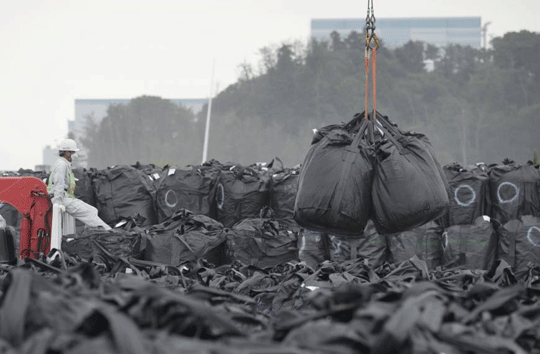
TEPCO collects the contaminated water and stores it all in massive tanks at the rate of up to 400 metric tons a day. Lately the water has been processed to reduce the concentration of radionuclides, but it still retains high concentrations of tritium, a radioactive isotope of hydrogen. Disputes over its final resting place remain unresolved. The same goes for the millions of bags of contaminated topsoil and other solid waste from the disaster, as well as the uranium fuel itself. Health reports, too, are worrisome. Scientists have seen an increase in thyroid cancers among the children who had lived in Fukushima at the time, although it is too early to tell if those cases can be attributed to the accident…….http://www.scientificamerican.com/article/5-years-later-the-fukushima-nuclear-disaster-site-continues-to-spill-waste/
Now more likely than ever – nuclear Armageddon
 Is nuclear Armageddon more likely than ever? Thye Week, 28 Feb 16 New weapons, unstable nations, and terrorism are raising the nuclear stakes. Is a doomsday attack more likely? Here’s everything you need to know about the new nuclear arms race:
How many nuclear weapons are there?
About 16,000. Russia and the U.S. have 93 percent of them, with more than 7,000 each; the rest are split between France, China, the U.K., Pakistan, India, Israel, and North Korea. The global stockpile is much smaller than it was at the height of the Cold War: In 1986, Russia and the U.S. had 64,000 nukes pointed at each other — enough to devastate every square inch of the entire globe. But there are growing fears that nuclear catastrophe is becoming increasingly likely. The established nuclear powers are modernizing their arsenals with smaller, more sophisticated weapons. The unstable regime in nuclear-armed North Korea is trying to develop a hydrogen bomb. ISIS, which is richer and more ambitious than any previous terrorist group, is trying to get hold of a nuclear device. The Doomsday Clock, the symbolic countdown to Armageddon, was last year moved from five minutes to midnight to three minutes. “We are facing nuclear dangers today that are in fact more likely to erupt into a nuclear conflict than during the Cold War,” says former Secretary of Defense William Perry……..
They’re becoming smaller and more advanced, and thus more likely to be used. Last fall, the U.S. Air Force tested its first precision-guided atom bomb, which can be remotely guided like a cruise missile to zero in on small targets. Its explosive power can be dialed up or down, from 50 kilotons to 0.3 kilotons. Critics argue that nuclear weapons should never be used as battlefield weapons — only as a deterrent. “What going smaller does,” says retired Gen. James Cartwright, “is make the weapon more thinkable.” Russia’s new weapons are also causing concerns. Last November, the Kremlin leaked plans for a nuclear torpedo designed to sneak under traditional nuclear defenses and hit cities or military installations along the coasts.
Could terrorists acquire a nuke?
It’s possible……. http://theweek.com/articles/608163/nuclear-armageddon-more-likely-than-ever
Russia and USA Pointing Nuclear Missiles at Asteroids – bonanza for Lockheed Martin etc
Why Is Russia Pointing Nuclear Missiles at Asteroids?Motley Fool 28 Feb 16
Surprise! Russia’s not the only one painting a bull’s-eye on space rocks. “…….Solid-fueled nuclear missiles, being on launch alert 24/7, are admirably suited for a last-minute launch to blast an asteroid before it turns into a meteor. Russia’s ICBMs aren’t currently programmed to aim at targets above the Earth, however, and will need to be repurposed for such missions. That’s what Russia hopes to do — and with Apophis swinging ’round in just over a decade, Russia thinks the asteroid makes a tempting target for testing its redesign.
Such an ambitious goal will cost money. Indeed, according to website DigitalTrends.com, “millions … in federal money is set to pour into detection efforts” over the coming years.National Defense magazine puts the number at at least $50 million annually, citing the recently passed fiscal year 2016 budget. This naturally raises the question in investors’ minds:
Who will get the loot?
ND identifies several likely suspects who could win these funds, including big defense contractors Lockheed Martin (NYSE:LMT) and Raytheon (NYSE:RTN). Lockheed is the company in charge of building NASA’s Space Fence, designed to keep track of man-made junk orbiting Earth. Lockheed and Raytheon both bid on the contract in 2013 — but only Lockheed won it. Similarly, Lockheed Martin and Ball Aerospace (NYSE:BLL) helped to build NASA’s NEOWISE infrared telescope,specifically designed to detect and track NEOs.
Multiple historic contract wins in the field of space-object detection make Lockheed Martin a logical beneficiary of any new contracts coming out of the PDCO office. Granted, $50 million might not sound like much to a company like Lockheed (which pulled down $46 billion last year, and is NASA’s single biggest publicly traded contractor). It might seem even less significant, given that Lockheed won’t win all the contracts coming up for bid, and might have to share some of the loot with Raytheon, Ball, or others. But $50 million could be only the starting point.
ND calls $50 million “a drop in the bucket” compared to what it will ultimately cost to categorize all NEO threats, much less develop a means of defeating them. To cite just one example of contracts moving in that direction, in 2022, NASA aims to send a spaceship to asteroid 65803 Didymous in an ambitious experiment to try to push the object into a new orbit far from Earth’s own………http://www.fool.com/investing/general/2016/02/28/why-russia-pointing-nuclear-missiles-at-asteroids.aspx
France prepared to extend life of nuclear reactors: energy minister
28 Feb 16 PARIS (Reuters) – The French government is willing to support a 10-year extension to the life of the country’s nuclear reactors, operated by utility EDF, Energy Minister Segolene Royal told France 3 television on Sunday……http://news.yahoo.com/france-prepared-extend-life-nuclear-reactors-energy-minister-140401525–finance.html
Big win for Rouhani and Reform in Iran elections
While gains by moderates and reformists in Friday’s polls were most evident in the capital, where they won all Tehran’s 30 seats according to early results, the sheer scale of the advances there suggests a legislature more friendly to the pragmatist Rouhani has emerged as a distinct possibility.
A loosening of control by the anti-Western hardliners who currently dominate the 290-seat parliament could strengthen his hand to open Iran further to foreign trade and investment following last year’s breakthrough nuclear deal.
A reformist-backed list of candidates aligned with Rouhani was on course to win all 30 parliamentary seats in Tehran, initial results released on Sunday showed. Top conservative candidate Gholamali Haddad Adel was set to lose his seat.
“The people showed their power once again and gave more credibility and strength to their elected government,” Rouhani said, adding he would work with anyone who won election to build a future for the industrialised, oil-exporting country.
“The competition is over and the phase of unity and cooperation has arrived,” state news agency IRNA quoted his key ally, Akbar Hashemi Rafsanjani, as saying. “The time after elections is the time for hard work to build the country”.
There was silence from the conservative camp.
The polls were seen by analysts as a potential turning point for Iran, where nearly 60 percent of its 80 million population is under 30 and eager to engage with the world following the lifting of most sanctions…..http://www.huffingtonpost.com/entry/rouhani-and-reformers-wins-big-in-first-irans-post-nuclear-deal-election_us_56d2e76ce4b0bf0dab326d46
Tens of Thousands Join UK Anti-Nuke Demo Billed as Biggest in Generation


From CommonDreams.org:
“Tens of Thousands Join UK Anti-Nuke Demo Billed as Biggest in Generation
by Deirdre Fulton, staff writer
‘We are not alone,’ Jeremy Corbyn tells crowd. ‘There are many people around the world…who have wanted a non-nuclear future for their country and their planet.’
In what was called “Britain’s biggest anti-nuclear weapons rally in a generation,” tens of thousands took to the streets of London on Saturday to protest the UK’s nuclear weapons system—Trident—and to call for global disarmament.
According to the Guardian, “Campaigners gathered from across the world: some said they had traveled from Australia to protest against the renewal of Trident. Others had come from the west coast of Scotland where Britain’s nuclear deterrent submarines are based.”
Organized by the Campaign for Nuclear Disarmament (CND), the demonstration comes ahead of a parliamentary decision on whether or not to replace Trident, the UK’s nuclear weapons system, comprised…
View original post 355 more words
February 28 Energy News

Opinion:
¶ Nevada must work to stay ahead of curve • The renewable energy industry has been a particularly bright spot in Nevada’s economy. The state’s $500 million investment in tax incentives has yielded a 10-to-1 return. Action on the Clean Power Plan could have similar results. [Las Vegas Review-Journal]
 Heliostats at the Crescent Dunes Solar Project, 11 miles northwest of Tonopah, Nevada. Jeff Scheid / Las Vegas Review-Journal
World:
¶ Industry analysts are now forecasting that Australia may not hit its 2020 renewable energy target. If an annual shortfall occurs major energy players are required to pay penalties to the federal government. The additional costs are to be passed on to consumers. [Sydney Morning Herald]
¶ APA, which owns and operates gas pipelines, wants a seat at the table in the multibillion-dollar investment boom in renewable energy sources as Australia moves to meet the mandated…
View original post 383 more words
Scrapping Trident and Transitioning to a Nuclear-Free World


From CommonDreams.org:
“Scrapping Trident and Transitioning to a Nuclear-Free World
As the illicit trade in nuclear weapons escalates alongside the risk of geopolitical conflict, it’s high time governments decisively prioritized nuclear disarmament
Published on, Saturday, February 27, 2016
by Rajesh Makwana-Share the World’s Resources
As geopolitical tensions escalate in the Middle East and the world teeters on the brink of a new Cold War, it’s clear that the only way to eliminate the threat of nuclear warfare is for governments to fulfill their long-held commitment to the “general and complete disarmament” [1] of nuclear weapons – permanently. A bold and essential step towards this crucial goal is to decommission Trident, the UK’s ineffective, unusable and costly nuclear deterrent submarines. Renewing Trident would not only undermine international disarmament efforts for years to come, it will reinforce the hazardous belief that maintaining a functional nuclear arsenal is essential for any nation…
View original post 1,222 more words
Survey finds “post-disaster” reconstruction slow in Tohoku prefectures
The pace of reconstruction after the powerful earthquake and tsunami that hit parts of northeastern Japan in March 2011, and the subsequent nuclear disaster, differs from community to community, with a delay forecast in Fukushima municipalities affected by radiation from the accident, a Jiji Press survey has revealed.
The survey was conducted in January and February in a total of 42 municipalities along the Pacific coast in Iwate, Miyagi and Fukushima prefectures, and around Tokyo Electric Power Co.’s Fukushima No. 1 nuclear power station, where an unprecedented triple reactor meltdown occurred following the natural disasters.
Of the 42, 12 are in Iwate, and 15 each in Miyagi and Fukushima.
Of the total, 15 municipalities said that post-disaster reconstruction will be completed by the end of fiscal 2020 in March 2021, the final year of the reconstruction period designated by the government.
Three municipalities said reconstruction will finish by the end of fiscal 2016, one by the end of fiscal 2017, six by the end of fiscal 2018 and five by the end of fiscal 2019.
The city of Soma in Fukushima said it is difficult to say exactly when the construction projects will be completed.
Meanwhile, 11 municipalities, including nine in Fukushima, noted that post-disaster reconstruction will end in fiscal 2021 or later.
Many of the nine Fukushima towns and villages cited delays in work to decontaminate areas polluted with radiation and dispose of radiation-tainted soil, and the restoration of agriculture, forestry and fishery industries.
This suggests that industry reconstruction has been tardy, affected by shipment restrictions and misinformation about radiation.
The two other municipalities projecting the completion of reconstruction after fiscal 2020 are Sendai, the prefectural capital of Miyagi, and the Miyagi town of Minamisanriku.
Sendai faces a delay in land procurement for reconstruction projects, including one for elevating roads. The central district of Minamisanriku was devastated by the tsunami.
In Iwate, nearly 50 percent of the planned public housing for people who lost their homes in the quake and tsunami has been completed. The proportion stands at about 50 percent in Miyagi and 40 percent in Fukushima.
Of the 12 Fukushima municipalities where evacuation advisories were issued after the nuclear accident, six, including the towns of Tomioka and Okuma, said that their populations at the end of 2025 are expected to decrease by 20 percent or more from current levels.
Among other municipalities in Fukushima and the two other prefectures, five, including Minamisanriku, project drops of 15-20 percent and eight foresee declines of 10-15 percent.
An official of Minamisanriku said, “The population decrease in our town will likely accelerate, because the number of children is falling and some of the residents who have been evacuated to other areas have found new homes and jobs there and therefore opted not to return to Minamisanriku.”
In Miyagi, Sendai and three nearby municipalities expect increases in their populations, on the back of inflows of evacuees from other areas and the establishment of operational hubs by construction companies.
In Fukushima, population growth is forecast in the town of Shinchi, where a liquefied natural gas storage facility is planned to be constructed.
Many of the surveyed municipalities said that they want the central government to continue securing enough reconstruction budgets and providing personnel support, and to increase flexibility in subsidy programs.
The earthquake and tsunami killed more than 15,800 people and left over 2,500 others unaccounted for.
http://www.japantimes.co.jp/news/2016/02/28/national/social-issues/survey-finds-post-disaster-reconstruction-slow-tohoku-prefectures/#.VtMsmubzN_l
Does Tohoku’s disaster tourism exploit or educate?
Disaster tourism can be an unsettling descent into voyeurism as visitors ghoulishly gawk at, and photograph, those caught up in catastrophe as if they’re at a petting zoo. The concept has prompted widespread condemnation of insensitive tourists and travel companies exploiting disasters as marketing opportunities.
In the years following the Great East Japan Earthquake of 2011, opponents of disaster tourism have claimed that its economic benefits are overstated while the ethical shortcomings are legion. Advocates counter that the economic benefits can be significant, crucial to regional recovery, and that there are important lessons to be learned.
There is no longer much to gawk at along the Tohoku region’s tsunami-ravaged coast, however, save for some shattered buildings preserved to memorialize the tragedy. Bus companies and hotel operators pocket profits, but they also generate jobs and expose outsiders to a region that has always been a neglected backwater.
Recently I witnessed large buses from one local tour company disgorging dozens of sightseers for snapshots of the skeletal disaster management center and the derelict Takano Kaikan hall in Minamisanriku, Miyagi Prefecture. These tourists are spending money in local shops and restaurants in a remote place that has poor transport links and is in the middle of a noisy, messy all-encompassing rebuilding phase. What used to be the center of town is now a vast construction site dominated by giant berms of earth that will raise the town by about five meters.
I met a young man from Osaka who came as a volunteer and then decided to remain in the area. He pointed out that for devastated local businesses, disaster tourism is a welcome lifeline. Elsewhere, a big-screen TV in a hotel lobby features a 3-D video of the tsunami that allows guests to don special glasses and watch the unfolding tragedy. I suppose this could be educational, but the prevailing holiday atmosphere dissuaded me.
Denunciation of disaster tourism in Tohoku is grounded in sympathy for the victims and concerns that devastation is an unseemly attraction, but Australia National University’s Simon Avenell, author of “Transnational Japan in the Global Environmental Movement,” says he is not a purist in this regard.
“From a financial perspective, I’m generally supportive of disaster tourism, certainly because it brings people and some money into the region, but also because it offers local people a chance to express their feelings directly (rather than mediated through the press or TV),” he says. “As time goes by, 3/11 becomes less and less of a news item, so tourism can be at least a small communication pipeline for locals.”
However, Avenell also has qualms about the potential for masking serious unresolved issues, because by promoting a sense of normalization “it could actually hamper fundamental change (and) … its political benefits might be limited or even deleterious in the long run.”
The infamous Kyushu port of Minamata, which put mercury poisoning on the global radar in the 1970s, is now perhaps the most visited sight for school excursions by Kyushu students after Nagasaki’s atomic bomb park and museum. Chris McMorran, a senior lecturer in Japanese studies at the National University of Singapore, takes his students there. He says tourism officials from Tohoku visited Minamata to learn about the city’s educational disaster tourism initiatives and the role of kataribe (storytellers) in them.
“Using an itinerary to create an opening for reflection and communication has long fit the learning objectives of overseas field learning experiences,” he says. There are “packages that continue to attract visitors to Tohoku who want to hear from survivors, witness the destruction and (most intriguingly to me) view (and photograph) disaster monuments. In some areas, there are also new shopping areas targeted at tourists, which feature locally handmade products and restaurants. It seems like these places are actively promoted by locals trying to start businesses in the absence of other major economic activity.”
McMorran posits there are phases in Tohoku’s disaster tourism.
“First, through volunteerism, then volunteer tourism (or ‘voluntourism’), then disaster (recovery/support) tourism. It’s a fascinating evolution that has effectively controlled the potential anarchy of large-scale volunteerism and steered it into consumption (via tourism and the purchase of local goods) as the preferred disaster recovery response from citizens.”
The media has played a significant role in this latter phase. Philip Seaton, a professor of modern Japanese studies at Hokkaido University, has studied the role “contents tourism” has played in Tohoku’s recovery. This is where television shows, films and anime promote an area specifically by featuring it.
Producers chose sites “in disaster zones in the hope that the ‘contents tourism’ induced by popular culture would help in the more general economic revitalization efforts of disaster areas,” Seaton says. Prime examples include NHK dramas “Yae no Sakura,” set in Aizuwakamatsu, Fukushima Prefecture, and “Amachan,” set in Kuji, Iwate Prefecture. It is estimated that the latter generated ¥30 billion in economic benefits for Tohoku as fans of the series flocked to the gorgeous coastal location to sample local delicacies from the show.
It is also clear that a variety of organizations, ranging from religious and education institutions to NPOs and activist groups, are conducting study tours in the region that are explicitly educational. As I wrote two weeks ago, the ruins of Okawa Elementary School in Miyagi Prefecture are now a site for school tours that aim to improve disaster preparation. Universities are also running study tours in the region.
Hiroko Aihara, a journalist with Japan Perspective News, notes that the Japan NGO Center for International Cooperation has issued guidelines for responsible disaster tourism but remains ambivalent over “dark tourism,” which involves places associated with death and suffering. She is concerned about a lingering radiation risk in Fukushima and worries that if tours don’t involve local residents and the evacuees, visitors might get a skewed impression that downplays the nuclear disaster — which could be “converted to political propaganda by the ‘nuclear village,’” she says, referring to pro-nuclear interests. She also cautions that schools and teachers should disclose information about the dangers of radiation exposure near the stricken nuclear plant and suggests bringing individual measurement devices. If properly led, she agrees that educational tours can be beneficial, but she is not in favor of mere casual observation.
Fukushima Prefecture is sponsoring trips to Namie, an abandoned town just 9 kilometers away from Tepco’s three nuclear meltdowns, that convey a powerful message to visitors about the hubris of nuclear safety — underscored by the continuing ban on overnight stays. Nearby Futaba, however, has taken down the iconic pro-nuclear energy welcome sign that spanned the entryway into that ghost town because it had become a favored photo op for tourists. Some disgruntled locals feel it should have been preserved for posterity to help future generations learn the lessons of Fukushima, but abashed town officials claim the aging sign had become a safety hazard. At least that’s their story, and they’re sticking to it.
http://www.japantimes.co.jp/opinion/2016/02/27/commentary/tohokus-disaster-tourism-exploit-educate/#.VtLKBubzN_l
Are Organisms Adapting to Ionizing Radiation at Chernobyl?
Numerous organisms have shown an ability to survive and reproduce under low-dose ionizing radiation arising from natural background radiation or from nuclear accidents. In a literature review, we found a total of 17 supposed cases of adaptation, mostly based on common garden experiments with organisms only deriving from typically two or three sampling locations. We only found one experimental study showing evidence of improved resistance to radiation. Finally, we examined studies for the presence of hormesis (i.e., superior fitness at low levels of radiation compared with controls and high levels of radiation), but found no evidence to support its existence. We conclude that rigorous experiments based on extensive sampling from multiple sites are required.
1 This Month

of the week – Shut Down Drone Warfare!


Tell the Ukrainian Government to Drop Prosecution of Peace Activist Yurii Sheliazhenko

Petition to revoke the licensing of the Near Surface Nuclear Disposal Facility (NSDF) at Chalk River. https://www.ourcommons.ca/petitions/en/Petition/Details?Petition=e-7247
To see nuclear-related stories in greater depth and intensity – go to https://nuclearinformation.wordpress.com
-
Archives
- April 2026 (114)
- March 2026 (251)
- February 2026 (268)
- January 2026 (308)
- December 2025 (358)
- November 2025 (359)
- October 2025 (376)
- September 2025 (257)
- August 2025 (319)
- July 2025 (230)
- June 2025 (348)
- May 2025 (261)
-
Categories
- 1
- 1 NUCLEAR ISSUES
- business and costs
- climate change
- culture and arts
- ENERGY
- environment
- health
- history
- indigenous issues
- Legal
- marketing of nuclear
- media
- opposition to nuclear
- PERSONAL STORIES
- politics
- politics international
- Religion and ethics
- safety
- secrets,lies and civil liberties
- spinbuster
- technology
- Uranium
- wastes
- weapons and war
- Women
- 2 WORLD
- ACTION
- AFRICA
- Atrocities
- AUSTRALIA
- Christina's notes
- Christina's themes
- culture and arts
- Events
- Fuk 2022
- Fuk 2023
- Fukushima 2017
- Fukushima 2018
- fukushima 2019
- Fukushima 2020
- Fukushima 2021
- general
- global warming
- Humour (God we need it)
- Nuclear
- RARE EARTHS
- Reference
- resources – print
- Resources -audiovicual
- Weekly Newsletter
- World
- World Nuclear
- YouTube
-
RSS
Entries RSS
Comments RSS
 nuclear-news