USA nuclear weapons manufacture: the job that produced 80,000 cancers
the Institute for Energy and Environmental Research has maintained that the actual number of fatal cancers caused by nuclear testing could be 17,000. Of course, a larger number of people contracted cancer from nuclear testing than actually died of it. The government study estimated that those who contracted cancer numbered at least 80,000 Americans.
Open thread for night owls: Building the U.S. nuclear arsenal has killed thousands http://www.dailykos.com/story/2016/1/4/1466115/-Open-thread-for-night-owls-Building-the-U-S-nuclear-arsenal-has-killed-thousands By Meteor Blades Jan 05, 2016 Lawrence Wittner writes—American Casualties of the U.S. Nuclear Weapons Program When Americans think about nuclear weapons, they comfort themselves with the thought that the vast, nuclear destruction of human life has not taken place since 1945—at least not yet. But, in reality, nuclear weapon-related destruction has taken place, with shocking levels of U.S. casualties.
This point is borne out by a recently-published study by a team of investigative journalists at McClatchy News. Drawing upon millions of government records and large numbers of interviews, they concluded that employment in the nation’s nuclear weapons plants since 1945 led to 107,394 American workers contracting cancer and other serious diseases. Of these people, some 53,000 judged by government officials to have experienced excessive radiation on the job received $12 billion in compensation under the federal government’s Energy Employees Occupational Illness Compensation Program. And 33,480 of these workers have died.
How could this happen? Let’s examine the case of Byron Vaigneur. In October 1975, he saw a brownish sludge containing plutonium break through the wall of his office and start pooling near his desk at the Savannah River, South Carolina nuclear weapons plant. Subsequently, he contracted breast cancer, as well as chronic beryllium disease, a debilitating respiratory condition. Vaigneur, who had a mastectomy to cut out the cancer, is today on oxygen, often unable to walk more than a hundred feet. Declaring he’s ready to die, he has promised to donate his body to science in the hope that it will help save the lives of other people exposed to deadly radiation.
Actually, workers in nuclear weapons plants constitute only a fraction of Americans whose lives have been ravaged by preparations for nuclear war. A 2002 report by the U.S. Department of Health and Human Services maintained that, between 1951 and 1963 alone, the atmospheric testing of nuclear weapons — more than half of it done by the United States — killed 11,000 Americans through cancer. As this estimate does not include internal radiation exposure caused by inhaling or swallowing radioactive particles, the Institute for Energy and Environmental Research has maintained that the actual number of fatal cancers caused by nuclear testing could be 17,000. Of course, a larger number of people contracted cancer from nuclear testing than actually died of it. The government study estimated that those who contracted cancer numbered at least 80,000 Americans.
Ralph Nader points to a book on America’s renewable energy future
 Ralph Nader: Building a renewable energy future – OpEd December 26, 2015. The U.S. has some big problems that require bold solutions. Unfortunately, books about solutions to our society’s problems are often given short shrift by reviewers or languish on our bookshelves. As I often say, this country has more problems than it deserves and more solutions than it uses. Now comes S. David Freeman. …
In January of 2016, in collaboration with his coauthor, Leah Y. Parks, he will publish a new and important book about our energy future: All-Electric America: A Climate Solution and the Hopeful Future. The book is scathing but optimistic, and manages to be bold while remaining pragmatic. …

When All-Electric America comes out … you will have a chance to make yourself knowledgeable about the real avenues available to us to transform our energy infrastructure for present and future generations by moving toward a new renewable energy economy with far more jobs, health, efficiency and security benefits than there are in relying on hydrocarbons and radioactive atoms.
To listen to my interview with David Freeman, visit ralphnaderradiohour.com
Large shipment of plutonium to travel from Japan to South Carolina
 Japan to send huge cache of plutonium to South Carolina under nuclear deal: report RAW STORY AGENCE FRANCE-PRESSE 05 JAN 2016 Japan will send a huge cache of plutonium — enough to produce 50 nuclear bombs — to the United States as part of a deal to return the material that was used for research, reports and officials said Tuesday.
The plutonium stockpile, provided by the US, Britain and France decades ago, has caused some disquiet given that Japan has said it has the ability to produce a nuclear weapon even if it chooses not to.
The shipment, which comes ahead of a nuclear security summit in Washington in March, is meant to underscore both countries’ commitment to nuclear non-proliferation and is part of a deal they made in 2014.
It will be one of Japan’s most significant overseas movements of plutonium since it transported one tonne from France in 1993 to be used in nuclear reactor experiments.
That shipment triggered an outcry at the time from countries citing environmental and security concerns.
A Japanese official confirmed the amount of plutonium to be sent to the US and said that preparations for the shipment are under way. “But we can’t comment on further details, including the departure date and route, for security reasons,” the official in the nuclear technology section at the education ministry told AFP Tuesday.
The material has been stored at the Nuclear Science Research Institute northeast of Tokyo, he added…….https://www.rawstory.com/2016/01/japan-to-send-huge-cache-of-plutonium-to-south-carolina-under-nuclear-deal-report/
Intense unpopularity of nuclear industry in South Korea
 Bitter Debate Over Nuclear Power Simmers in Rural South Korea, NYT By CHOE SANG-HUN JAN. 5, 2016“……… in 2010, the 399 mostly older people who made up the population of three villages agreed to give up their land and their centuries-old way of life to make room for something few other places wanted: a nuclear power plant.
That act plunged the surrounding Yeongdeok County into a bitter debate over whether the plant would be a savior or a death knell. The clash also revealed the depth of despair in South Korea’s increasingly empty rural communities, as well as growing misgivings about the country’s heavy dependence on nuclear power…….
villagers like Shin Wang-ki, 56, who grows pears, apples and peaches and believed that a plant would mean the end to a longstanding and cherished way of life.
“No way! Who’s going to buy fruits or crabs from an area near a nuclear power plant?” he said. “I inherited a clean land from my ancestors and want to leave it untainted for my children.”……..
In 2012, South Korea selected Yeongdeok and Samcheok, a coastal city to the north, as sites for new reactors.
Yet by then, skepticism — and anxiety — was spreading. First came the 2011 Fukushima disaster in Japan. Then came another shock: Reports that emerged after a series of scandals revealed that nuclear power plants across South Korea had been using parts whose safety test results were faked.
Last year, a new mayor in Samcheok called a referendum in which residents voted against the decision made under the previous mayor. When the mayor of Yeongdeok refused to do likewise, residents opposed to the plant began organizing and outside activists poured in. They called a referendum on their own in November.
The government and Korea Hydro & Nuclear Power Company, the country’s operator of nuclear power plants, urged residents not to take part in the referendum, which they called illegal because a state project was not subject to a county-level plebiscite. They also accused the outsiders of bringing antinuclear activism here to impede an important national project. Antinuclear villagers went on hunger strikes, accusing Korea Hydro & Nuclear Power executives of bribing older villagers with watermelons and other gifts.
“People yelled at each other,” said Kwon Tae-hwan, who runs a local Internet news site. “They waged a war of banners, every single back alley strung with rival placards.”
About 11,000 county residents participated in the referendum. Of them, nearly 92 percent voted against a nuclear power plant.
Antinuclear activists claimed victory, while the government dismissed the result and reconfirmed its plan to build a plant here.The civil disobedience in Yeongdeok represented only one of the many challenges South Korea’s nuclear power industry faced, problems it never had to confront when the first reactor went into operation in 1978 under an authoritarian government. In June, a government committee warned that beginning in 2019, old plants would run out of storage space for high-level radioactive wastes. The country urgently needed to build a new, central repository for such wastes, it said.
But the government could not even start looking. Residents of Miryang, a village in the southeast, have recently staged prolonged protests, including a self-immolation, to oppose a far smaller potential hazard: high-voltage transmission towers to carry electricity from a distant nuclear plant…….Residents on both sides of the nuclear question are waiting for parliamentary elections in April, when candidates from Yeongdeok will be asked to take sides.
“Among people here, what the government said used to be the law and truth,” said Kim Eok-nam, 47, who believed his dream of marketing organic farm produce would evaporate with the arrival of a nuclear plant. “But over this nuclear power project, we will show we are no rural pushover.” http://www.nytimes.com/2016/01/06/world/asia/south-korea-nuclear-power.html?_r=0
China’s state-owned nuclear companies get together in export marketing drive
 State-owned enterprises eye overseas power projects, Nikkei Asian Review TETSUYA ABE, Nikkei staff writer BEIJING 5 Jan 16, — The global nuclear industry is likely to be another area where China’s growing presence will be keenly felt, as the government and state-owned corporations are working hand in hand to win overseas contracts. This development worries critics who are concerned about nuclear safety issues, as well as Beijing’s seeming lack of commitment to nuclear nonproliferation.United front In their meeting on Dec. 30, Sun Qin, chairman of China National Nuclear Corp., and He Yu, his counterpart at CGN, agreed to join hands to better compete with Western rivals in their pursuit to cultivate overseas nuclear power plant markets.
The two came to the National Development and Reform Commission’s building in Beijing on that day to sign an agreement to set up a joint venture. The new company, to be capitalized at 500 million yuan ($76.5 million), will handle export of Hualong One, a pressurized water reactor model that China claims to have developed on its own.
CNNC and CGN, each of which is a major player that ranks within the top three in the Chinese nuclear industry, are coming together with an eye toward increasing the chance of winning orders in Central Asia and Eastern Europe. Continue reading
Climate change is altering Greenland ice sheet, accelerating sea level rise
Date:January 4, 2016
- Source:
- York University
- Summary:
- The Greenland ice sheet has traditionally been pictured as a sponge for glacier meltwater, but new research has found it’s rapidly losing the ability to buffer its contribution to rising sea levels, say researchers. They have also found that climate change has caused meltwater from lower elevations to run directly into the sea…….http://www.sciencedaily.com/releases/2016/01/160104130436.htm
Timeline of major incidents at Los Alamos National Laboratory
2013: A waste container at the lab is packaged with a volatile mix of nitrate salts and organic kitty litter and is shipped to WIPP.
Feb. 14, 2014: The container ruptures in the underground WIPP facility, leaking radiation. Several workers are exposed, although levels are not considered a health hazard. WIPP is closed indefinitely.
March-December 2014: Federal investigators issue scathing reports finding multiple problems with how waste is handled at the lab. One report finds workers who tried to alert supervisors to problems with waste containers were ignored.
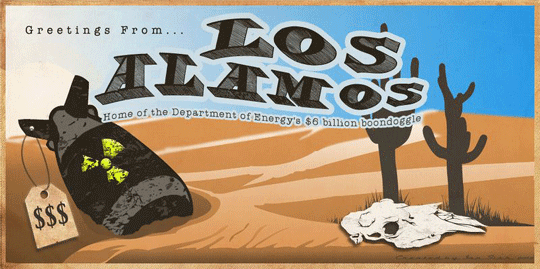
Chronology of major incidents marking Los Alamos National Laboratory’s management history, Local News, Santa Fe, New Mexico , 4 Jan 16 The New Mexican
Jan. 1, 1943: A secret national laboratory is set up in Los Alamos to design a nuclear bomb during World War II. The University of California is named the official lab manager and is paid $5 million for a one-year contract. The U.S. Department of Energy oversees the lab’s operations. J. Robert Oppenheimer is the lab’s director.
1945: An atomic bomb is tested at the Trinity Site in Southern New Mexico on July 16, ushering in the nuclear age………
1988: A new federal law gives the Department of Energy more leverage over lab contractors. The University of California at Los Alamos National Laboratory is exempted from the law. Continue reading
India’s People’s Movement Against Nuclear Energy (PMANE) aim top stop nuclear expansion in Tamil Nadu
Campaign against expanding nuclear projects in TN, THE HINDU, 5 Jan 16 As negotiations between India and Russia are in the advanced stages for installing the third and fourth units of the Kudankulam Nuclear Power Plant anti-nuclear activists have intensified their campaign against the expansion
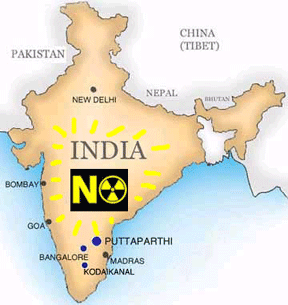 of nuclear assets in Kalpakkam and Kudankulam.
Distributing pamphlets to the public advocating against nuclear power at the Egmore Railway Station on Monday, S.P. Udayakumar, Convenor of People’s Movement Against Nuclear Energy (PMANE) said, “As the first unit in Kudankulam is not operational for over six months and the second unit is further delayed, we have serious doubts about the project.”
Claiming that the project was “inherently flawed” and the components supplied to the project were sub-standard, he said the Site Evaluation Report, Safety Analysis Report and the Environment Impact Assessment Report, which were to be made available to them as per the Central Information Commission’s order were not provided yet, as the Nuclear Power Corporation of India Limited had obtained a stay on the order in the Delhi High Court in 2014……http://www.thehindu.com/news/cities/chennai/campaign-against-expanding-nuclear-projects-in-tn/article8066591.ece
UK L:abour leader Corbyn names Trident nuclear critic as shadow defence secretary
Corbyn names Trident nuclear critic as shadow defence secretary, Ft.com By Jim Pickard, Chief Political Correspondent, 5 Jan 16 Emily Thornberry, a critic of the Trident nuclear deterrent, has been appointed as Labour’s shadow defence secretary in the most significant change in Jeremy Corbyn’s first reshuffle.
The Labour leader shifted Maria Eagle, the previous defence spokeswoman, to the culture brief as he seeks to take Labour back to its 1980s position of unilateral nuclear disarmament……..
an important step towards shifting party policy over nuclear weapons, although the leader will still face tough opposition from MPs and many union officials who back Trident. ….http://www.ft.com/intl/cms/s/0/fe69d4fe-b40f-11e5-8358-9a82b43f6b2f.html#axzz3wQGuTYie
South Africa’s nuclear energy project is not likely to succeed
Why South Africa’s nuclear energy plan will likely fail By News24Wire January 5, 2016 South Africa will likely fail in its quest to develop its nuclear energy capacity, according to emerging markets economist Peter Attard Montalto of Nomura.
Montalto told Fin24 that if the 9 600 MW nuclear procurement programme does see the light of day, it will be a “slimmed down programme spread over a longer period of time, given the affordability issue”.
“For this reason we need to remain calm, but vigilant,” he said. “The end point remains uncertain.”…..
Questioning South Africa’s transparency, Montalto said the decision to gazette so close to Christmas strengthens the perception that the government has “signed non-public agreements with Russia” to award its state-owned company, Rosatom, the nuclear contract.
Rosatom prematurely announced it had won the contract in 2014, after President Jacob Zuma secretly visited Russia. It later retracted its statement and told Fin24 in 2015 that it was a public relations mistake.
Controversy over Rosatom’s announcement intensified after a local newspaper reported Zuma personally negotiated the deal with Russian President Vladimir Putin,” AFP reported in 2014.
Regardless of these perceptions, Montalto said, there needs to be more transparency on what advice National Treasury has provided and the sequencing of their advice compared to the process of moving to tender.
“I still believe no formal sign off on affordability under any financing option has been provided by National Treasury and indeed that it remains totally unaffordable under any financing model including vendor financing,” he said.
“The next steps are likely to be murky as tenders are requested and then submitted along with financing models.
“Parliament and the courts will likely be crucial through this stage in providing transparency,” he said. http://businesstech.co.za/news/energy/108051/why-south-africas-nuclear-energy-plan-will-likely-fail/
Russia has potential to be very competitive in renewable energy market
 Russia can be one of the most energy-competitive areas based on renewables, EurekAlert, 30 d3ec15 LAPPEENRANTA UNIVERSITY OF TECHNOLOGY A fully renewable energy system is achievable and economically viable in Russia and Central Asia in 2030. Researchers from Lappeenranta University of Technology (LUT) modelled a renewable energy system for Russia and Central Asia. Results show that renewable energy is the cheapest option for the continent and can make Russia a very energy competitive region in the future.
According to the research, a 100 percent renewable energy system for Russia and Central Asia would be roughly 50 percent lower in cost than a system based on latest European nuclear technology or carbon capture and storage. Renewable energy covers electricity and industrial natural gas demand, not, for example, transport or heating.
“We think that this is the first ever 100% renewable energy system modelling for Russia and Central Asia. It demonstrates that Russia can become one of the most energy-competitive regions in the world”, emphasises professor Christian Breyer, co-author of the study.
Moving to a renewable energy system is possible due to the abundance of various types of renewable energy resources in the area. This then enables the building of a Super Grid, which connects different energy resources of the researched area……..
The research was done as part of Neo-Carbon Energy research project, which has previously shown that a renewable energy system is also economically sensible in North-East Asia, South-East Asia, South America and Finland. http://www.eurekalert.org/pub_releases/2015-12/luot-rcb123015.php
Old nuclear stations in Belgium are a worry for neighbouring Dutch
Dutch fear impact of Belgian nuclear power plant problems http://www.dutchnews.nl/news/archives/2016/01/dutch-fear-impact-of-belgian-nuclear-power-plant-problems/ January 4, 2016 The Dutch government should be involved in solving problems at the Belgian nuclear power station in Doel, according to Dutch opposition parties in the AD. One reactor at the power station, on the banks of the Schelde estuary just over the border, was shut down at the weekend just days after being restarted following repairs.
Two other reactors were closed for a time last year after hairline cracks were found. One of those was also shut down shortly after being restarted because of a leak. Capacity The power plant was first opened in 1975 and should have been decommissioned last year. However, the Belgian authorities have agreed to keep it operational for a further 10 years because of a shortage of capacity.
‘The reactors are so old that if something goes wrong, the problem will not be confined to Belgium,’ D66 parliamentarian Stientje van Veldhoven told the AD. ‘When things of such importance are at stake, its only logical to involve the Netherlands in decisions about whether it should remain open.’ The AD says the mayors of several Dutch border towns, including Roosendaal and Bergen op Zoom, also want the cabinet to get involved. Joint inspections Nos said later on Monday that agreement has been reached between the Netherlands and Belgium that a joint inspection by nuclear safety inspectors will take place on January 20.
Read more at DutchNews.nl: Dutch fear impact of Belgian nuclear power plant problems http://www.dutchnews.nl/news/archives/2016/01/dutch-fear-impact-of-belgian-nuclear-power-plant-problems/
Nuclear sub accident costs $1m, commander loses job
Down periscope: Nuclear sub accident costs $1m, commander loses job Rt.com 5 Jan, 2016 A US Navy commander has lost his job following an accident that damaged a 18,000-ton nuclear guided-missile submarine. The banged-up sub will cost taxpayers at least $1 million to repair, the Navy said.
Captain Dave Adams was relieved of his command of the USS Georgia on Monday, and was reassigned to another post with Submarine Group 10 of Naval Submarine Base Kings Bay in Georgia.
On November 25, 2015, Adams was commanding one of the two alternating crews that operate the USS Georgia when the 560-foot submarine crashed into a channel buoy on its way back to base in Kings Bay……https://www.rt.com/usa/328018-navy-submarine-crash-georgia/
America’s NRC checking cables at South Carolina’s Oconee nuclear plant
NRC checking cables at South Carolina’s Oconee nuclear plant http://www.wltx.com/story/news/2016/01/05/nrc-checking-cables-south-carolinas-oconee-nuclear-plant/78293416/ Seneca, SC (AP)- Federal regulators are doing a special inspection of a nuclear plant in South Carolina.
Officials from the Nuclear Regulatory Commission say they are going to begin a special inspection on Tuesday at Duke Energy’s Oconee nuclear plant near Seneca.
Inspectors are going to be assessing the degradation of power cables on startup transformers for two of the plant’s three units.
A plant operator making routine inspections last month discovered a disconnected cable that should have been connected to a startup transformer on Unit 3. The NRC says cables on another unit were also degraded.
Officials say all the cables have been repaired, and the transformers are available for use if needed.
The inspectors say they’ll issue a report within 45 days.
NRC says Nuclear plants along Mississippi, Missouri rivers not hurt by heavy rain
Nuclear plants along Mississippi, Missouri rivers not seen hurt by heavy rain -NRC Yahoo News 6 Jan 16 Reuters) – The nuclear plants along the Missouri and Mississippi rivers are not expected to be adversely affected by flooding and heavy rains, the U.S. Nuclear Regulatory Commission said on Tuesday….. The swollen Mississippi and rivers that feed into it caused havoc in Missouri and Illinois after late December heavy rain and severe storms brought flooding across several central U.S. states, leaving at least 33 people dead. http://news.yahoo.com/nuclear-plants-along-mississippi-missouri-rivers-not-seen-220326395–finance.html
1 This Month
23 April – WEBINAR – Why new nuclear reactors are the wrong tools for decarbonization Thursday, April 23 • 1 AM – 2 AM AEST
World Nuclear Power. Reactors 1951-2026, 75 Years of Nuclear Power.
Interactive Map– https://dv.worldnuclearreport.org/

Chernobyl: The Lost Tapes – A good documentary on Chernobyl on SBS available On Demand for the next 3 weeks– https://www.sbs.com.au/ondemand/tv-program/chernobyl-the-lost-tapes/2352741955560

of the week–London Campaign for Nuclear Disarmament

Tell the Ukrainian Government to Drop Prosecution of Peace Activist Yurii Sheliazhenko
To see nuclear-related stories in greater depth and intensity – go to https://nuclearinformation.wordpress.com
-
Archives
- April 2026 (231)
- March 2026 (251)
- February 2026 (268)
- January 2026 (308)
- December 2025 (358)
- November 2025 (359)
- October 2025 (376)
- September 2025 (257)
- August 2025 (319)
- July 2025 (230)
- June 2025 (348)
- May 2025 (261)
-
Categories
- 1
- 1 NUCLEAR ISSUES
- business and costs
- climate change
- culture and arts
- ENERGY
- environment
- health
- history
- indigenous issues
- Legal
- marketing of nuclear
- media
- opposition to nuclear
- PERSONAL STORIES
- politics
- politics international
- Religion and ethics
- safety
- secrets,lies and civil liberties
- spinbuster
- technology
- Uranium
- wastes
- weapons and war
- Women
- 2 WORLD
- ACTION
- AFRICA
- Atrocities
- AUSTRALIA
- Christina's notes
- Christina's themes
- culture and arts
- Events
- Fuk 2022
- Fuk 2023
- Fukushima 2017
- Fukushima 2018
- fukushima 2019
- Fukushima 2020
- Fukushima 2021
- general
- global warming
- Humour (God we need it)
- Nuclear
- RARE EARTHS
- Reference
- resources – print
- Resources -audiovicual
- Weekly Newsletter
- World
- World Nuclear
- YouTube
-
RSS
Entries RSS
Comments RSS
 nuclear-news