Decades to clean up former Oldbury nuclear power station?
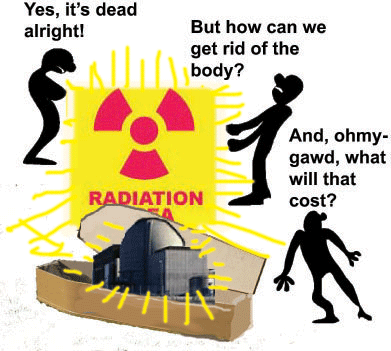 Final nuclear fuel flask leaves former Oldbury power station, BBC News 8 Jan 16 The last flask of nuclear fuel from the former Oldbury power station reactor has been sent for reprocessing.
The site was shut in 2012 after 44 years of operation, during which it produced 137.5TWh of electricity.
Operators Magnox said the final fuel shipment marked the “end of an era” but added “work was far from complete”.
Oldbury now moves to a decommissioning phase aiming to make the site “safe and secure” and free of radioactive hazard by 2027. Mike Heaton, the site director, said: “It has not been an easy task and the work at Oldbury is far from complete, but today is a significant landmark in the journey towards care and maintenance.”
Each flask carried some 200 fuel elements, and since de-fuelling began four years ago 286 flasks have been taken away from the site to be reprocessed at Sellafield in Cumbria.
This final batch of fuel elements has been in storage in a cooling pond at the site since being removed from the reactor last October. ………http://www.bbc.com/news/uk-england-bristol-35245781
‘Decluttering’ is not enough to stop the consumerism mess
Decluttering can’t save us from the consumerist mess we’ve made, Guardian, 7 Jan 16
Suzanne Moore Marie Kondo’s bestselling books sell tidying as a spiritual experience. But liberating ourselves from stuff is about more than just a neat sock drawer
“……What fascinates me is how decluttering has become yet another way of virtue signalling. The rise of mega-selling advice about decluttering is an extension of the detox, an add-on to the binge/purge cycle. For those who live on TED talks and superfood alone, then maybe tidying up really is that liberating.
For decluttering elevates the domestic sphere. This is not just cleaning. Would any woman buy a book on how to do housework?
……we hold on. We are constantly told to get more stuff and we are confused by the value of what we possess. This is acted out perversely by hoarders……
the decluttering industry can’t deal with the broader aspect of why we feel so out of control in our own homes. After all, we have merely done as we were told: consumed. Now, it has become excessive, and we are swimming in our own tat. Is this elevation of tidying enough to stop the circle of shopping, of built-in obsolescence, of fashion, of our complete lack of connection to where any of our products come from?
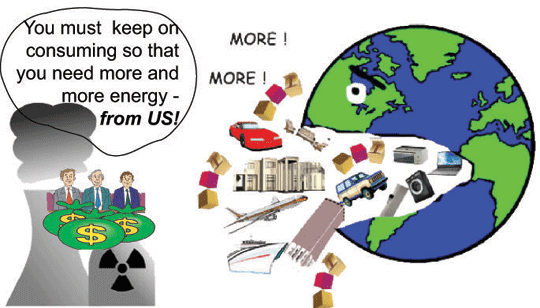
To be free from this cycle may indeed be magical. The illusion that it is up to each of us individually to sort this out may be comforting. But liberation from the mess we have made is about more than a neat sock drawer. http://www.theguardian.com/commentisfree/2016/jan/06/decluttering-cant-save-us-from-the-consumerist-mess-weve-made#comment-66332353
Entergy-Grand Gulf Nuclear Ratepayer Fleece – Bill Clinton Testimony

It’s not just the nuclear power stations of today that are years behind and over-cost. This is one of many parts of the history of nuclear power that the nuclear industry wants forgotten. This was in the mid-1980s. Billions was a lot more then.
In 1984: “Electric rate increases of 25 to 50 percent or more are looming for millions of customers in nine states because of billions of dollars in excess costs at 14 nuclear plants scheduled for completion in the next few years.”
Once one of the Grand Gulf Nuclear Reactors was completed, it was 400% over budget, five years behind and was mostly unneeded. The second one was not completed. Louisiana, Mississippi, Arkansas and New Orleans fought because no one wanted to pay for it.
In 1985: “The issue is how much people here and in neighboring states will have to pay toward the…
View original post 472 more words
January 7 Energy News

World:
¶ Enel Green Power and the mini-grid technology provider Powerhive are partnering on developing solar-powered mini-grids in rural Kenya. The $12 million project will involve work in 100 different villages in Kenya, with 93% of the financing for the project coming via Enel Green Power, and 7% via Powerhive. [CleanTechnica]
 Image by William Warby (some rights reserved)
¶ While the world’s attention is focused on Saudi Arabia’s latest flare up with Iran, many Saudis are concerned about the “economic bomb” at home. The government is slashing a plethora of perks for its citizens.The cash crunch is so dire that the Saudi government just hiked the price of gasoline by 50%. [CNN]
¶ E·ON and Samsung SDI have signed a Memorandum of Understanding to work together in the energy storage field. They will collaborate on energy storage solutions, and develop a business model together. Some of…
View original post 718 more words
Australia’s Nuclear History


Australia has a secret and scandalous nuclear history. But at the same time, Australia has a fine history of successes by the nuclear free movement. Aboriginals have been at the forefront, but not alone, as Australia also has a proud record of environmental and anti nuclear activism.
From the archives. Each week, this site will be reposting items from the past. Lest we forget:
Australia’s Parliament reported on degrading effect of uranium mining on Aboriginal people.
The1997 Australian parliament report observes: ‘(The) history of uranium mining in Australia and its impact on Aboriginal people is deplorable. Past mining in places like Rum Jungle have left areas so degraded that traditional owners are unable to use them, while mines such as Ranger (also in the Northern Territory) have been forced on traditional owners against their will.” “Even at mines such as Olympic Dam,” it adds, “…there was deep concern at…
View original post 278 more words
Nuclear Issues for 2016 – Australia’s role in them
Five big nuclear issues for 2016 — and Australia’s role in them, Independent Australia Noel Wauchope 5 January 2016, Nuclear issues got next to no discussion in Australia in 2015. That is sure to change in 2016 from five explosive factors, writesNoel Wauchope.
#1: Nuclear weapons “……….. In the event of nuclear war, Pine Gap makes Australia both a participant and a target.
What the experts call a “limited nuclear war” between India and Pakistan is always on the cards as both nations ramp up their nuclear weaponry. What does Australia do about this? The Turnbull Government, ignoring the advice of the Joint Standing Committee on Treaties (JSCOT) and pro nuclear power expert Dr John Carlson, goes ahead with insecure uranium sales to India, thus contributing to that India-Pakistan arms race.
All these considerations will matter to Australia in a number of ways in 2016. An obvious example…
View original post 375 more words
“Nuclear Medicine” – the sham reason for Australia’s hunt for a nuclear waste dump site
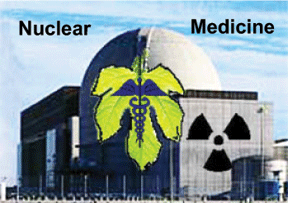
The incessant references to nuclear medicine to ‘sell’ the proposed radioactive waste repository/store amount to nothing more than emotive propaganda
10-20% of the current stockpile would be the plausible range for medical waste − closer to 10% if measuring by radioactivity (because spent reactor fuel is such a large contributor to total radioactivity) and closer to 20% if measuring by volume.
Nuclear medicine and the proposed national radioactive waste dumphttp://www.foe.org.au/anti-nuclear/issues/oz/nontdump/med Jim Green National nuclear campaigner – Friends of the Earth, Australia December 2015
To download a 2-page paper addressing these issues right-click here.
“As health organisations, we are appalled that access to nuclear medical procedures is being used to justify the proposed nuclear waste dump. Most waste from these procedures break down quickly and can be safely disposed of either on site or locally.”
− Dr Bill Williams, Medical Association for the Prevention of War
“Linking the need for…
View original post 1,799 more words
Nuclear Industry an “unacceptable risk” says Australian Ethical Super
 Australian Ethical Super Dr Stuart Palmer, Head of Ethics Research at Australian Ethical. 6 Jan 16
We agree that the nuclear energy is a complex issue given the need to transition globally to low-emissions power. However, Australian Ethical has a strong negative screen on nuclear power for a range of reasons including:
· frequent association with nuclear weapons manufacture;
· radioactive pollution from uranium mines;
· the intractability of radioactive waste;
· the potential for catastrophic failure of nuclear power stations;
· security risks associated with the operation of nuclear power stations, and with the transport and storage of nuclear waste.
In our view these concerns outweigh the potential climate change benefits of nuclear power. Even with new generation nuclear plants we still consider the level of risk to be unacceptable, particularly given rapid advancements in renewable energy and storage technology.
I hope this information is helpful in explaining…
View original post 4 more words
Busting the spin of pro nuclear Geoff Russell
the economics of new nuclear power doesn’t stack up. And we’ve got much more important things to do (like exposing the well-funded lies of some in the fossil fuel industry and planning for a much different and smaller grid), than arguing with well-intentioned but intellectually conceited proponents of nuclear energy
Nuclear And Nonsense: An Insider’s Guide On Making Renewables Work, New Matilda
By Terry Leach January 4, 2016 Renewable energy advocate Terry Leach takes up the fight for an inexhaustible power supply.
Geoff Russell’s recent New Matilda article ‘Batteries and Bulldust’ makes the argument that renewable energy can’t displace fossil fuels due to the problems of the intermittency of renewable energy and the difficulty of storing electrical energy.
Russell compares the stupidity of Germany’s renewable push to France’s wisdom in generating most of their power from nuclear. Obviously, the superior governance, cheaper electricity and lack of inefficient subsidies results in France…
View original post 459 more words
Nuclear Licensing Contractor-Consultant Wants “Safety-Related” and “Non-Safety Related” (Nuclear) “Structures, Systems and Components” Defined by the US NRC (He is trotting out a nuclear industry argument from the early 1980s)
On first glance it appears reasonable to define what “structures, systems and components” are “safety-related’ and ‘nonsafety-related”. However, coming from an alleged nuclear engineer-nuclear licensing contractor and consultant, one can guess that this is yet another poison US NRC gift for the New Year. They are full of it. Holtec is getting more dangerous safety exemptions – oh, yeah, what is safety? Preventing nuclear accident – duh!
Common sense tells us that the repercussions of a nuclear accident are so serious; so deadly and so long-lasting – some radionuclides will remain lethal for longer than humans have been on the face of the earth – that ALL structures, systems and components of nuclear reactors and other nuclear facilities are “safety-related”.
The comment deadline is apparently in 75 days. More related posts will probably be added between then and now, and this post may be updated. The post was done quickly…
View original post 999 more words
More US NRC Safety Related Exemptions for Holtec: Increase Risk of a Criticality Accident and are Illegal (Comment Deadline Feb. 5, 2016)
Forget North Korea, Holtec and its owner Kris Singh is the biggest nuclear menace. Holtec’s nuclear “spent fuel” canisters are already a flimsy 1/2 inch thick, for the sealed metal part which protects the public from radiation, even though they are huge, as seen in the picture. The concrete surrounding the inner 1/2 inch sealed canisters is vented, so that failure of the internal 1/2 inch canister exposes the public to high levels of radiation.
Nonetheless, Holtec continues to request safety-related exemptions. In particular, to not assure quality of the neutron aborber, metamic, which is supposed to prevent a criticality event.
Holtec is up to Amendment 9. The Certificate of Compliance (CoC) should not be amended at all. Amendment 8 was less than a year ago.
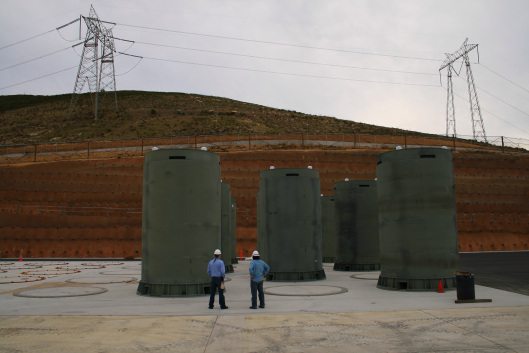
Holtec Spent Fuel Casks
To further exacerbate the dangers, Holtec (Kris Singh) wants to pack broken fuel rods. [1] Holtec wishes to further evade…
View original post 1,117 more words
January 6 Energy News
World:
¶ If Spain had no wind parks, the average annual price on the electricity market would have been 23.8% higher in 2015, according to the Spanish wind energy association. Wind farms offered the lowest wholesale electricity prices in Spain, at about €46.14 ($49.60) per MWh. [SeeNews Renewables]
 Wind turbines at work. Author: Nick Cross. License: Creative Commons, Attribution-NoDerivs 2.0 Generic.
¶ The Solar Energy Corporation of India and Russian Energy Agency have recently signed a memorandum of understanding to set up large scale solar PV projects in India between 2016 to 2022. Under the terms of the agreement, initially a 500 MW pilot solar PV project will be developed. [CleanTechnica]
¶ Earnings of utilities in central and northern Europe will fall about 7% in 2016, hampered by a reliance on coal, gas and nuclear generation. Spanish, Italian and Portuguese power companies, accounting for about 60%…
View original post 635 more words
Desperate marketing drive brings giant nuclear corporations together
 Great power relations: How the US, China and India will forge new partnerships on nuclear energy in 2016, South China Morning Post, James Wertsch, Shen Dingli and Swaran Singh say this year will see greater collaboration between the world’s three largest polluters – the US, China and India – following their pledges to move away from fossil fuels, 05 January, 2016
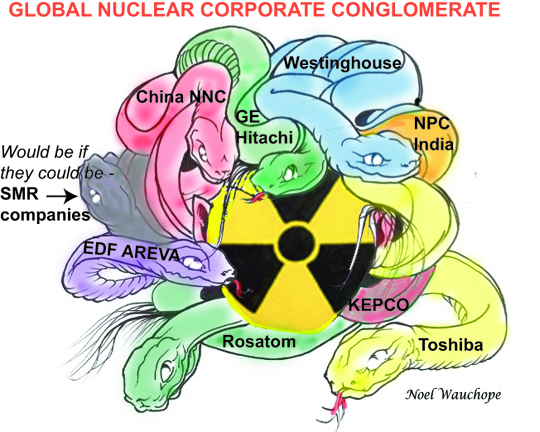
To begin with, complicated and long-winded structural integrity tests have just been declared successful for two of the four Westinghouse AP1000 nuclear power reactors being set up in China’s Zhejiang ( 浙江 ) and Shandong (山東) provinces. These should become operational in September and December respectively. Westinghouse is also in final stages of negotiations for six of the same type of reactor for Gujarat in India.
At a price tag of some US$5 billion to US$6 billion per reactor, such reports are boosting the share price of Westinghouse, which is negotiating to buy parts of the French nuclear reactor manufacturer Areva. It reportedly needs US$7.7 billion to balance its books. Areva’s losses are also allowing China’s Hualong to emerge as the new cost-effective player in the sensitive global nuclear market. That explains why US firms are tying up with China……
….US firms partly owned by Japan’s Toshiba and Hitachi, which explains the changing geopolitics as Prime Minister Shinzo Abe last month signed the long-awaited Indo-Japanese deal clearing the decks for American firms to deliver nuclear technology to India….
The coming together of the US, China and India in building nuclear partnerships has been expedited because Russian, French, Canadian and Kazakh firms have not been deterred by India’s domestic situation or legislation. Given this reality, the US – which originally facilitated India’s entry into global nuclear commerce – was beginning to look like a loser. Russia remains India’s largest supplier of nuclear reactors and the two last month signed another agreement for an additional 12 reactors.
Most interestingly, 2016 will see China entering the Indian market as well; not necessarily as a partner with US firms but as a new competitor. As well as working with India as members of the International Thermonuclear Experimental Reactor, China has a history of supplying heavy water and uranium fuel to New Delhi. The two began negotiating nuclear cooperation during President Xi Jinping’s ( 習近平 ) visit to India in September 2014 and China is keen to help build India’s energy security infrastructure. Beijing has also been exploring markets in Southeast Asia.
China’s Hualong One nuclear reactor has earned enough experience at home and prestige abroad to make it suitable for exploring new global partnerships. Last October, during Xi’s visit to the UK, he announced US$9 billion worth of investment for France’s EDF and China General Nuclear Power Corporation to build three power plants in the UK, which is expected to see Hualong-designed reactors go global.
India, as always, is never far behind. Since 2010, it has been offering to export its pressurised heavy water reactors, which may be ideal for states with smaller power grids. Last month again, during Prime Minister Narendra Modi’s visit to Moscow, Russia and India began negotiations on exploring joint third-country projects.
The recent shale revolution may have reinforced US energy supremacy, but it has also seen oil prices fall relentlessly, making large oil importers like China and India save their dollar reserves and invest in expensive nuclear technology. All this is whipping up US business interests that will redefine the proverbial “American exceptionalism”, especially in the global governance of nuclear commerce. It will also see the US explore more innovative ways in co-opting the interests of a rising China and emerging India, giving them a greater say in global nuclear decision-making.
James Wertsch is vice-chancellor for international relations at Washington University in St Louis, Shen Dingli is associate dean at the Institute of International Studies, Fudan University, Shanghai, and Swaran Singh is professor of disarmament studies at Jawaharlal Nehru University, New Delhi http://www.scmp.com/comment/insight-opinion/article/1898090/great-power-relations-how-us-china-and-india-will-forge-new
28 years later Japan’s costly nuclear recycling complex is still not working
 Japan’s $25 Billion Nuclear Recycling Quest Enters 28th Year, Bloomberg Stephen Stapczynski sstapczynski Emi Urabe January 5, 2016 It’s designed to recycle spent uranium from Japan’s nuclear power plants, consists of more than three dozen buildings spread over 740 hectares (1,829 acres), costs almost $25 billion and has been under construction for nearly three decades. Amount of fuel successfully reprocessed for commercial use: zero.
Under construction since the late 1980s, the complex is designed to turn nuclear waste into fuel by separating out plutonium and usable uranium. The start date of the project has now been pushed back for the 23rd time, with operations set to commence in 2018.
The money continuing to pour into the Rokkasho reprocessing complex in a northeast corner of Japan’s main island of Honshu is raising speculation that attention is being diverted from more-promising avenues of energy development, including renewables.
Construction on Rokkasho, the heart of the endeavor, was supposed to be completed by 1997. Delays due to technical and safety issues have kept it from operating commercially while costs ballooned to an estimated 2.94 trillion yen ($24.6 billion), according to Japan Nuclear Fuel. The Japanese government and the country’s power industry view fuel reprocessing generally, and Rokkasho specifically, as one of the only ways to lower import dependence and find a home for thousands of tons of highly radioactive spent fuel. Japan has about 17,000 metric tons of spent fuel, almost 3,000 tons of which are stored at Rokkasho.
The facility was originally intended to separate plutonium from spent fuel for use in so-called fast-breeder reactors — plants that produce more fuel than they consume.
While the nation’s first prototype fast-breeder reactor has remained closed due to its own technical issues, Rokkasho expanded construction to include a facility that processes plutonium-uranium mixed-oxide fuel, known as MOX, that can be used in some of Japan’s existing reactors…… http://www.bloomberg.com/news/articles/2016-01-04/japan-s-25-billion-nuclear-recycling-quest-enters-28th-year
The nuclear industry really has only one likely future: reactor decommissioning
Invited Expert Commentary by Mycle Schneider
The stock market did not hear the call. The claim of four climate mousquetaires at a side event of the Paris climate talks that “nuclear has tremendous potential to be part of the solution to climate change” was lost in space. One day after that enthusiastic statement by former NASA scientist James Hansen, a member of the illustrious quartet, the share value of the largest nuclear operator in the world, the French state-controlled Électricité de France (EDF), dropped to its historic low, a 42-percent plunge since the beginning of the year and an 84-percent meltdown in eight years. On Monday, December 7, Euronext ejected EDF, “pillar of the Paris Stock Exchange”, from France’s key stock market index, known as CAC40. On Tuesday, December 8, EDF shares lost another four percent of their value. Two days later, the trade union representatives at the Central Enterprise Committee of EDF—unanimously and for the first time—launched an official “economic alert procedure” considering the “seriousness of the situation.”
These latest developments come as no surprise to analysts familiar with the international nuclear industry. Credit-rating agencies have warned for years that the launch of nuclear new-build projects are considered “credit-negative.” In October 2015, investment bank Investec advised clients to sell EDF shares amid fears that its connection with the nuclear plant project at Hinkley Point in the UK could put payouts to shareholders under threat. One month later, the French and British governments announced the signature of a framework agreement on a financing package including Chinese partners for the construction two French-built European Pressurized water Reactors (EPR) at Hinkley Point. The federation of EDF employee-shareholders EAS said in a statement that the interests of their company would be “gravely threatened” by the Hinkley Point project, calling it “a financial catastrophe foretold.” EAS asked the management of EDF “to stop this risky project, whose financial risks are too big for our company and which could put EDF’s very survival at risk.” Is EDF facing its Waterloo 200 years after Napoleon’s defeat?
Launched as a response to the Chernobyl disaster almost 30 years ago, not a single so-called Generation-III+ EPR reactor is generating power anywhere in the world.
In the meantime, the self-proclaimed “global leader in nuclear energy,” the French state-controlled AREVA, went bankrupt. After a cumulate loss of €8 billion ($8.7 billion) over the past four years, equivalent to its annual turnover, and a debt load of €6 billion ($6.5 billion), the company will not survive the year in its current form. AREVA is already deep in “junk” territory when it comes to its credit-rating, and its share value has eroded by 92 percent since 2008, hitting a new low on December 17. The government’s rescue strategy—forcing EDF to absorb AREVA’s reactor business—is in-turn increasing the risk for EDF. A significant barrier for the conclusion of the rescue deal remains the multibillion-euro liability of the Hinkley Point predecessor projects in Olkiluoto, Finland, and Flamanville, France. The EPR construction in Finland started 10 years ago. The plant was to begin generating carbon-free electricity by 2009 and was part of the country’s greenhouse gas abatement strategy. Now, the plant is scheduled to produce power in “late 2018.” The sister plant in France is not doing any better—on the contrary. Construction started in 2007 with completion planned for 2012. Officially, the current target date is the same as for the Finnish project. The investment-cost estimate exploded by more than a factor of three to €10.5 billion ($11.4 billion), and this is likely not the last word. In addition, EDF struggles with a €37.5 billion ($40.7 billion) debt burden, rapidly increasing production costs in its aging nuclear fleet, significant post-Fukushima and other investment needs, and a shrinking client base, with declining consumption levels over the past four years in a row.
The international outlook is not any rosier. There have been 40 reactors connected to the world’s power grids in 10 years—representing a negligible share of the overall added electricity generating capacity—after an average construction time of close to 10 years. Some 60 units now under construction have been in the building stage for an average of 7.5 years; at least three-quarters are delayed, four have been listed as “under construction” for over 30 years. The Organisation for Economic Co-operation and Development’s International Energy Agency projects in its “New Policy Scenario” a net addition of 222 GW over the coming 25 years. This compares with the net nuclear addition of 22 GW over the past 25 years—which illustrates the level of wishful thinking in current international projections.
You can spend a euro or a dollar only once. The investment in new nuclear reactors leads to an increase in greenhouse gas emissions as other options—notably intelligent energy services (like daylighting) that don’t depend on active systems, end-use and production efficiency, and now renewables—are not only considerably cheaper, they are much faster to implement.
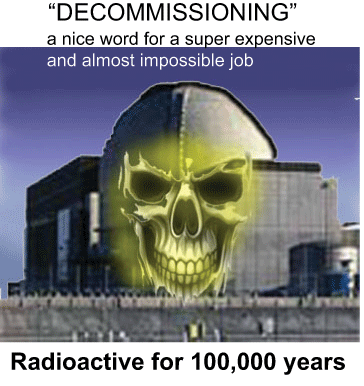
Nuclear utilities and the nuclear industry in general badly need a reality check. The traditional utilities, nuclear or not, need to learn to sell something other than kilowatt-hours or they will not survive the ongoing energy revolution. And the reactor-building industry might want to turn to a safe haven: reactor decommissioning. Building these machines has turned out to be too expensive and too slow. The deconstructing business will only expand. Guaranteed.
1 This Month
23 April – WEBINAR – Why new nuclear reactors are the wrong tools for decarbonization Thursday, April 23 • 1 AM – 2 AM AEST
World Nuclear Power. Reactors 1951-2026, 75 Years of Nuclear Power.
Interactive Map– https://dv.worldnuclearreport.org/
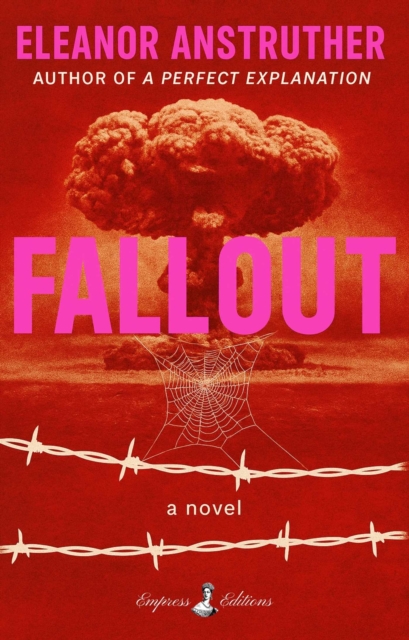
Chernobyl: The Lost Tapes – A good documentary on Chernobyl on SBS available On Demand for the next 3 weeks– https://www.sbs.com.au/ondemand/tv-program/chernobyl-the-lost-tapes/2352741955560

of the week–London Campaign for Nuclear Disarmament

Tell the Ukrainian Government to Drop Prosecution of Peace Activist Yurii Sheliazhenko
To see nuclear-related stories in greater depth and intensity – go to https://nuclearinformation.wordpress.com
-
Archives
- April 2026 (231)
- March 2026 (251)
- February 2026 (268)
- January 2026 (308)
- December 2025 (358)
- November 2025 (359)
- October 2025 (376)
- September 2025 (257)
- August 2025 (319)
- July 2025 (230)
- June 2025 (348)
- May 2025 (261)
-
Categories
- 1
- 1 NUCLEAR ISSUES
- business and costs
- climate change
- culture and arts
- ENERGY
- environment
- health
- history
- indigenous issues
- Legal
- marketing of nuclear
- media
- opposition to nuclear
- PERSONAL STORIES
- politics
- politics international
- Religion and ethics
- safety
- secrets,lies and civil liberties
- spinbuster
- technology
- Uranium
- wastes
- weapons and war
- Women
- 2 WORLD
- ACTION
- AFRICA
- Atrocities
- AUSTRALIA
- Christina's notes
- Christina's themes
- culture and arts
- Events
- Fuk 2022
- Fuk 2023
- Fukushima 2017
- Fukushima 2018
- fukushima 2019
- Fukushima 2020
- Fukushima 2021
- general
- global warming
- Humour (God we need it)
- Nuclear
- RARE EARTHS
- Reference
- resources – print
- Resources -audiovicual
- Weekly Newsletter
- World
- World Nuclear
- YouTube
-
RSS
Entries RSS
Comments RSS
 nuclear-news