Not much headway in India’s much-touted nuclear power project
‘Make in India’ for affordable nuclear power: Expert Zee News January 6, 2016 – Mysuru: More nuclear power could be generated if foreign suppliers make technology and products affordable for setting up reactors, an expert said on Tuesday.
“The stumbling block is economics, as installing a nuclear plant has to be affordable to sell its power at a competitive rate,” former Atomic Energy Commission chairman Srikumar Banerjee told IANS at the 103rd Indian Science Congress here, about 140 km from Bengaluru.
In spite of hype over the India-US nuclear deal and opening up of the civilian nuclear industry to foreign suppliers, barring two recent agreements on setting up two more units at the Russian-backed Kudankulam plant in Tamil Nadu and the French-backed Jatipur project in Maharahstra, not much headway has been made over the years.
As setting up nuclear power plants involves not only technology transfer and making components in the country, but also operating them by the state-run Nuclear Power Corporation of India Ltd. (NPCIL), consensus has been eluding stakeholders owing to high cost and liability clause…….http://zeenews.india.com/news/science/make-in-india-for-affordable-nuclear-power-expert_1842048.html
Ontario Clean Air Alliance urges Ontario to abandon $13-billion Darlington nuclear rebuild
Environmentalists urge Ontario to abandon $13-billion Darlington nuclear rebuild, National Post Keith Leslie, The Canadian Press | January 5, 2016 TORONTO — Environmentalists want the Ontario government to abandon plans for a $13-billion refurbishment of four nuclear reactors at the Darlington generating station east of Toronto and instead import more electricity from Quebec.
The Ontario Clean Air Alliance says nuclear projects always run over budget, and it doesn’t want to see taxpayers on the hook to pay for rebuilding the Darlington reactors that are owned and operated by Ontario Power Generation.
“Every single nuclear project in Ontario’s history has gone massively over budget by two and a half times,” said Alliance president Jack Gibbons. “OPG says this project will cost $12.9 billion, but if history repeats itself it will be $32 billion.”
Gibbons said even if the refurbishment came in on budget, the cost to taxpayers of maintaining about 2,225 jobs at Darlington would work out to nearly $6 million per job.
Greenpeace Canada, meanwhile, is concerned about the safety and health risks posed by nuclear power generation in the event of an accident, and says refurbishing the aging reactors at Darlington is not worth the risk.
“The government agencies mandated to protect the public are helping push the project through by concealing Darlington’s true risks from the public,” said Greenpeace spokesman Shawn-Patrick Stensil.
Quebec is the fourth-largest producer of electricity generated by water in the world, has the lowest power rates in North America, and could sell Ontario enough electricity to replace what would be generated by a refurbished Darlington, said Gibbons.
“We should sign a long-term deal with Quebec which would enable us to cancel the Darlington rebuild project, keep our lights on and reduce our electricity bills,” he said………
Bruce Power announced plans last month to spend $13 billion to refurbish the nuclear reactors at the generating station it operates in Kincardine, on Lake Huron, and the private company will assume all risks of cost overruns.
Ontario’s only other nuclear station, in Pickering, is also scheduled to be decommissioned by 2020, and there are no plans to rebuild its reactors to extend their lives……. http://news.nationalpost.com/news/canada/environmentalists-urge-ontario-to-abandon-13-billion-darlington-nuclear-rebuild-2
Toronto anxious about city’s unreadiness for a nuclear emergency.
Is Toronto ready for a nuclear radiation emergency? http://www.metronews.ca/news/toronto/2016/01/05/is-toronto-ready-for-a-nuclear-radiation-emergency.html
As KI pill orders skyrocket, critics say Ontario’s nuclear emergency response plan desperately needs a post-Fukushima update. By: Torstar News Service, Published on Tue Jan 05 2016. For 44 years, the Pickering Nuclear Generating Station has operated just five kilometres from Toronto’s eastern edge. The Darlington Nuclear Generating Station sits just over 30 km away. While these plants are essential for keeping the lights on in Toronto, councillors are only just beginning to question the city’s readiness for a nuclear emergency.
On Dec. 1, the city’s executive committee asked the city manager to report back on issues with the Provincial Nuclear Emergency Response Plan, Toronto’s own nuclear emergency response protocols and whether it might be appropriate to expand distribution of potassium iodide (KI) pills beyond the current 10-km radius.
In October, Ontario Power Generation (OPG), which operates both Pickering and Darlington, mailed KI pills — which, taken in the aftermath of a nuclear disaster, can reduce the risk of thyroid cancer — to 200,000 homes and businesses within 10 km of the GTA’s two nuclear power plants.
Anyone living within 50 km of the two plants — an area inhabited by more than 4.5 million people, including the entire city of Toronto — can order them free from preparetobesafe.ca. While just over 600 orders had been placed before a Nov. 10 Torstar News Service story on KI pills, nearly 11,000 additional orders were made by Nov. 15.
“Lessons can be learned from nuclear tragedies in other parts of the world, lessons that can better prepare us and ensure the safety of Toronto residents,” 11 city councillors wrote in their nuclear safety agenda item. “We can also learn from international best practices that shape the emergency response of other regions to ensure we are doing all we can to keep our residents safe.”
Outside city hall, critics are also arguing that the response plan needs to be updated — something the province promised to do after a reactor disaster struck Fukushima, Japan, following a catastrophic tsunami nearly five years ago. Originally drafted in the early 1980s, the provincial response plan hasn’t been revised since 2009.
“Significant work has been done in the past two years related to reviewing and assessing” the response plan, a Ministry of Community Safety and Correctional Services (MCSCS) spokesperson told Torstar. “The objective of this review is to ensure that the PNERP is reflective of a severe, multi-unit nuclear accident comparable to Fukushima.”
The review is expected to be completed this month, with public consultations on a draft plan to begin mid-year. The province would not disclose the details of this new plan.
Although the aging Pickering plant is slated to close in 2020, the multibillion-dollar refurbishing project will extend Darlington’s life by three decades. To critics, a response plan update can’t come soon enough.
Critics on the top issues
Big release of radiation? Big shortcomings
“The province is not planning for an actual big terrible accident like Fukushima,” warns Theresa McClenaghan, executive director of the Canadian Environmental Law Association (CELA). “There’s no detailed planning, resourcing or testing for a big accident that has big emissions out to the atmosphere.”
The emergency plan is based on scenarios in which plant operators would be able to contain and control radioactive releases, McClenaghan says.
“They like to think that if something goes really wrong, they can still control events enough to hold onto any radioactive emissions from the plants for a period of time… But based on Fukushima and Chernobyl, you can’t count on something’s going wrong and everything else going right.
The province’s position:
“(I)n a recent study, the Canadian Nuclear Safety Commission (CNSC) determined that the PNERP would adequately and effectively address a Fukushima type incident.”
Drinking water dangers
“Millions of people get their drinking water from Lake Ontario, but there’s no credible plan on how to deal with tap water contamination in the event of a nuclear accident,” says Greenpeace Canada’s senior nuclear analyst, Shawn- Patrick Stensil.
Both the Darlington and Pickering nuclear power plants sit next to Lake Ontario, and so do three aging nuclear power plants in upstate New York. According to environmental advocacy group Lake Ontario Waterkeeper, nine million Canadians and Americans rely on the lake for their drinking water. Many would be without alterative sources in the event of severe radioactive contamination.
“There’s no planning for this at all,” McClenaghan says. “I have to conclude that they’re assuming that dilution will be the answer.”
The province’s position:
“The PNERP identifies that the Ministry of the Environment (MOE) is responsible for dealing with contaminated water supplies.”
Lack of public awareness
According to a recent poll of 500 people within 10 km of the Darlington Nuclear Generating Station, a majority was unaware of decontamination procedures, the location of monitoring stations or emergency shelters or evacuation plans and routes. Some 80 per cent said they had no emergency plan; 58 per cent admitted to being totally unprepared.
“The polling our group did… shows that there needs to be ongoing and consistent education on what people in the GTA need to do to prepare themselves for a nuclear emergency,” says Durham Nuclear Awareness co-ordinator Janet McNeill.
urham Region is also listed as one of the areas slated for dense growth in the province’s Places to Grow plan.
“They are still putting additional population density in this region, which to me is just an appalling circumstance when we have such poor emergency planning,” McClenaghan adds.
The province’s position:
“The evacuation zones were scientifically determined.”
Expand KI pill distribution
In October, residents and businesses within 10 km of the Pickering and Darlington plants received free supplies of potassium iodide (KI) pills to help prevent thyroid cancer in the event of a radioactive release. While this measure is welcome, it lags behind other jurisdictions.
For example, those within 20 km of New Brunswick’s Point Lepreau Nuclear Generating Station receive pills, while people living within 50 km of Switzerland’s four nuclear power plants get them. On Dec. 1, Toronto’s executive committee voted to study whether the 10-km zone should be expanded to 50 km.
“Even if you did 30-km pre-distribution to every household and 50-km pre-distribution to vulnerable communities and schools, we’d still be far better off than we are today,” McClenaghan says.
The province’s position:
“The current planning basis review is addressing this as well.”
Belgium’s nuclear power plants ‘falling to bits’
Belgium’s nuclear power plants ‘falling to bits’ – German officials 30 Dec, 2015 The German government is preparing “critical questions” to the Belgian authorities on operational safety at the nation’s two active nuclear power plants, following a number of recent successive incidents at nuclear facilities.
After incidents at both Belgian nuclear power plants, German Environment Minister Barbara Hendricks has again put her concerns point-blank, demanding whether security is guaranteed at the Belgian NPPs, proposing Brussels to get rid of the nuclear energy altogether. ……https://www.rt.com/news/327457-belgium-nuclear-power-hendricks/
US DNFSB (Defense Nuclear Facilities Safety Bd) Worries About WIPP Fire Safety-Repeat Thermal Event


On October 31, 2015 the DNFSB reported:”Surface Fire Water System. There have been eleven fire water loop failures since 2008 (4 in lead-ins, 4 in loop piping, 1 PIV bonnet and 2 hydrants). NWP has signed a contract with an engineering firm to evaluate the condition of all fire water equipment, including pumps, tanks, buried piping and fire detection and control equipment. Recommendations to repair or replace the system are due in November, 30% conceptual design is planned to complete in late December and 90% design in July 2016. The staff is concerned about the timing of upgrade completion and the receipt of offsite waste for disposal.
Consolidated Evaluation of the Safety of the Situation (ESS). During October the staff conducted a review of the consolidated ESS and participated in a teleconference with the site. Radiological risk in the underground is dominated by the potential for a repeat thermal…
View original post 556 more words
January 5 Energy News

Science and Technology:
¶ Thousands of power plants around the world may face severe reductions in their ability to generate electricity by mid-century due to water shortages, new research published in Nature says. Hydro-electric, nuclear, coal, gas, and biomass-fueled power plants are vulnerable to dwindling water supplies. [The Guardian]
 The Itaipu hydroelectric dam on the Parana River, Brazil border. Most hydro-plants are in regions forecast to see water shortages. Photograph: Norberto Duarte / AFP / Getty Images
World:
¶ Russia is touting nuclear power as a way to cut carbon emissions, but a study from Finland’s Lappeenranta University of Technology says Eurasia as a whole would be better served by a less expensive, less risky renewable energy “super-grid,” that relies on wind power even over battery storage. [CleanTechnica]
¶ The UK’s government has repeatedly cited official forecasts of rising energy costs to justify cuts to subsidies…
View original post 470 more words
Degraded Emergency Management-Response at Savannah River Nuclear Site – But You Can Go Deer Hunting There; And Almost One Ton of Japan’s Plutonium May Arrive There Soon
According to the Defense Nuclear Facilities Safety Board:
“The SRS emergency management programs have degraded over the last few years in part due to limited resources and lack of staffing. Although DOE-SR and DOE Headquarters personnel conducted oversight of emergency management during this time, these interactions were not sufficient to prevent this degradation.” http://www.dnfsb.gov 12/22/2015 (doc at bottom)
But, Deer Hunting Still Allowed at SRS and Japanese, German and Swiss Plutonium May Be on its Way:

Savannah River Nuclear Site Deer Hunt and on site (Radioactive) Cesium testing.
It is public deer hunting as deer control.
http://www.srs.gov/general/deer_hunt/gallery.htm
See: https://miningawareness.wordpress.com/2015/12/21/rudolph-the-red-nosed-radiation-bioindicator-radioactive-cesium-radioactive-carbon-radioactive-water-and-more-lethal-gifts-left-by-the-nuclear-industry/
Posted 12/22/2015


http://www.dnfsb.gov/sites/default/files/Board%20Activities/Reports/Staff%20Issue%20Reports/Savannah%20River%20Site/2015/sir_20151222_29086_116_0.pdf 12/22/2015 Emergency Preparedness and Response at the Savannah River Site, Joyce L. Connery, Staff Issue Report
Perhaps high turn-over is related to Welfare to work and/or excess radiation exposure of workers? Those on welfare…
View original post 56 more words
January 4 Energy News
World:
¶ The development of wind energy projects in Lennox and Addington County could move forward in 2016 as Ontario seeks to bolster its supply of renewable energy. Proposals from three different companies could see major wind energy projects built at both ends of the county. [The Kingston Whig-Standard]
 Wind energy projects in Lennox and Addington County could move forward in 2016. (Whig-Standard file photo)
¶ Qinghai Electric Power, the sub-company of China’s State Grid Corporation, aims to install 7.1 GW of renewable energy in 2016. The majority of the new capacity will be solar PV. Qinghai province’s cumulative capacity of 6 GW, 5.6 GW of which is ground-mounted solar PV, the rest being wind. [pv magazine]
¶ The Irish wind industry launched a publicity campaign to highlight its potential to replace fossil fuels. The Irish Wind Energy Association worked with Rothco to created “Power To…
View original post 441 more words
America’s secret plutonium experiments on humans
Then there is the horrifying reality that these experiments were taking place in the shadow of Nazi Germany; some of the scientists involved in the radiation experiments were the very men whose earlier experimental designs had tormented prisoners of concentration camps. Welsome describes Operation Paperclip, conducted under the auspices of the U.S. government. Paperclip imported Nazi scientists and supported their work, helping to confer, in the words of scientist Joseph G. Hamilton, “a little of the Buchenwald touch” on American medicine.
This valuable work represents an elegy to lost ideals, lost health, and lost trust. One can only hope it will serve as a cautionary tale.
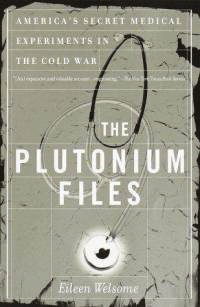 The Plutonium Files: America’s secret medical experiments in the Cold War N Engl J Med 1999; 341:1941-1942 December 16, 1999 Harriet A. Washington
The Plutonium Files: America’s secret medical experiments in the Cold WarBy Eileen Welsome. 580 pp. New York, Dial Press, 1999. $26.95. ISBN: 0-385-31402-7
Amid the embarrassments of Monicamania and of multiple public mea culpas, the past few years have not been exemplary ones for American journalism. This fact makes the triumph of The Plutonium Files all the sweeter, because this superlative book is a reminder of the purpose of investigative journalism.
This richly detailed, subtly nuanced history of government-engineered radiation experiments on unwitting Americans is based on the Pulitzer-prize–winning series Eileen Welsome wrote for the Albuquerque Tribune. Welsome’s tenacious and resourceful detective work has unveiled the saga of a sordid, tragic, yet fascinating chapter in the history of American medical science. The book succeeds on many levels. It is a gripping exposé of governmental exploitation and of medicine’s moral failures in an era in which blind trust defined the normal relationship between physicians and patients.
Between April 1945, scant months before the bombing of Hiroshima, and July 1947, the scientists of the Manhattan Project followed the construction of the atomic bomb with a chilling second act: medical experimentation on hundreds of unsuspecting Americans. Continue reading
Secret radiation experiments carried out on people
Some of the classified government experiments included:
 * Exposing more than 100 Alaskan villagers to radioactive iodine during the 1960s.
* Feeding 49 retarded and institutionalised teenagers radioactive iron and calcium in their cereal during the years 1946-1954.
* Exposing about 800 pregnant women in the late 1940s to radioactive iron to determine the effect on the fetus.
* Injecting 7 newborns (six were Black) with radioactive iodine.
* Exposing the testicles of more than 100 prisoners to cancer-causing doses of radiation. This experimentation continued into the early 1970s.
* Exposing almost 200 cancer patients to high levels of radiation from cesium and cobalt. The AEC finally stopped this experiment in 1974.
* Administering radioactive material to psychiatric patients in San Francisco and to prisoners in San Quentin.
* Administering massive doses of full body radiation to cancer patients hospitalised at the General Hospital in Cincinnati, Baylor College in Houston, Memorial Sloan-Kettering in New York City, and the US Naval Hospital in Bethesda, during the 1950s and 1960s. The experiment provided data to the military concerning how a nuclear attack might affect its troops.
* Exposing 29 patients, some with rheumatoid arthritis, to total body irradiation (100-300 rad dose) to obtain data for the military. This was conducted at the University of California Hospital in San Francisco.

—In preparing America for nuclear attack during the Cold War years following World War II, thousands of US citizens became the innocent victims of over 4,000 secret and classified radiation experiments conducted by the Atomic Energy Commission (AEC) and other government agencies, such as the Department of Defense, the Department of Health, Education and Welfare, the Public Health Service (now the CDC), the National Institutes of Health, the Veterans Administration (VA), the CIA, and NASA.
Millions of people were exposed to radioactive fallout from the continental testing of more than 200 atmospheric and underground nuclear weapons, and from the hundreds of secret releases of radiation into the environment. Over 200,000 “atomic vets” who worked closely with nuclear detonations at the Nevada test site during the 1950s and 1960s were especially vulnerable to radiation fallout.
Also affected were the thousands of so-called “downwinders”, who lived in nearby small towns in Nevada, Utah, Colorado and New Mexico. These downwinders (along with the animal populations) suffered the worst cumulative radioactive effects of fallout, along with a contaminated environment teeming with radioactive food and farm products. The plight of these poor country people exposed to government-induced radiation sickness has been recorded in Carole Gallagher’s remarkable photo-essay American Ground Zero: The Secret Nuclear War (The Free Press, 1993).
In reviewing declassified AEC records (now the Department of Energy) from the 1950s, Gallagher was shocked to discover one document that described the people downwind of the Nevada Test Site as “a low use segment of the population.” Her shock at such callous bigotry caused her to eventually move West to research, investigate and document those who lived closest to the Test Site, as well as workers at the site, and soldiers repeatedly exposed to nuclear bombs during the military tests.
Disinformation and Nuclear Fallout
In the nuclear arms race, government doctors and scientists brainwashed the public into believing low dose radiation was not harmful. Some officials even tried to convince people that “a little radiation is good for you.” Totally ignored was the knowledge that the radiation from nuclear fallout could lead to an increased risk of cancer, heart disease, neurological disorders, immune system disease, reproductive abnormalities, sterility, birth defects, and genetic mutations which could be passed on from generation to generation. The full extent of this radiation damage to the American public during the Cold War years will never be known. Continue reading
Cold war fears of Nuclear Armageddon ( that risk remains now)
 Memories of Whistling Past Nuclear Armageddon, NYT By FRANCIS X. CLINESJAN. 2, 2016 No one called it terrorism back then, but the angst of day-to-day existence during the Cold War was chillingly recalled with the release last month of the government’s top-secret nuclear target list for 1959. “Population” was the obscenely brief title of target category No. 275 — population, as in the citizens of major cities who war planners estimated would necessarily die by the millions……..
“Duck and cover” jokes and tight-lipped laughter became the real civil defense in the Cold War. It felt smarter to seek survival in satire like Stanley Kubrick’s “Dr. Strangelove.” Or in Mort Sahl’s stand-up skewering of Dr. Wernher von Braun, the captured German rocket scientist, who metamorphosed into an American space-age hero. Mr. von Braun said in his best-selling autobiography that “I aim at the stars.” “But,” Mr. Sahl amended, “sometimes hit London,”……..

the notion of nuclear Armageddon reappeared with the discovery by the New York State Assembly during a routine session that the state, in 1963, had actually constructed a bomb shelter with 4½-foot-thick walls and drawn up a list of 700 or so people who would be privileged to survive in it.
The long-forgotten shelter was a quiet, pet project of Gov. Nelson Rockefeller, who was also one of the era’s chief promoters of bunkers. Immediately, questions arose among the lawmakers: Why didn’t I know about this until now? More urgently: How do I get on the list?…….http://www.nytimes.com/2016/01/03/opinion/sunday/memories-of-whistling-past-nuclear-armageddon.html?_r=0
Radiation Risk : Linear No Threshold (LNT) Model Tested
Radiation Risk: Linear No Threshold (LNT) Model Tested
Fukushima Diary. Prime Minister Abe says that Fukushima nuclear station is ‘not settled’
 JP PM Abe “It is not proper to say Fukushima is settled” http://fukushima-diary.com/2015/02/jp-pm-abe-proper-say-fukushima-settled/ Iori Mochizuki The Prime Minister of Japan, Abe commented Fukushima is not settled.
This is the statement made in the Budget Committee of the House of Representatives on 1/30/2015.
Abe stated variety of problems are remaining unresolved in Fukushima plant, such as decommissioning, compensation, contaminated water etc.. Problems are piled up. Numbers of people are still forced to live outside of the hometown. It is not proper to say Fukushima is settled.
Related to this article.. Tepco inquired JP Gov about PM Abe’s statement to IOC “Contaminated water is entirely blocked” [URL]
http://www.shugiin.go.jp/internet/itdb_kaigiroku.nsf/html/kaigiroku/001818920150130003.htm
http://search.shugiin.go.jp/ja/search.x?q=%97%5C%8EZ%88%CF%88%F5%89%EF&ie=Shift_JIS
Are governments still allowing secret medical radiation experiments?
For over twenty years the law allowed the US Department of Defense (DoD) to use Americans as “guinea pigs.” This law (the US code annotated Title 50, Chapter 32, Section 1520, dated 30 July, 1977) remained on the books until it was repealed under public pressure in 1998. The new and revised bill prohibits the DoD from conducting tests and experiments on humans, but allows “exceptions.”
Unethical and dangerous experimentation undoubtedly continues in secret up to the present time, ostensibly under the guise of “national security.”
 The Human Radiation Experiments By ALAN R. CANTWELL Jr., M.D.October 8, 2001 By davidjones “……. Does Secret Medical Experimentation Continue? To this day there are no adequate safeguards to protect people from secret government experimentation. ……. What is clear from studying the Committee’s Final Report is that the medical and scientific professions collaborated with the government and the military to abuse and harm US citizens. In the process, the nuclear establishment literally got away with murder. And there is simply no end to the secrets that still emerge from the Cold War years that began 58 years ago with the Manhattan Project.
In January 2000, the government presented the results of a statistical study showing that atomic workers employed in the nuclear weapons industry during the Cold War were more likely to suffer a higher rate of cancer, due to their exposure to cancer-causing radiation and chemicals.
From the 1940s up to the present time, government lawyers and scientists have repeatedly rejected the claims of workers who became sick as result of nuclear radiation and exposure to deadly uranium, plutonium, and fluorine. As many as 600,000 workers in 14 nuclear weapons plants are now affected by the government’s final admission of wrongdoing in exposing these people to cancer and other chronic illnesses.
According to a Los Angeles Times report, “workers told of spending years trying to get compensation payments from the state, of having to hire attorneys to get disability pay, of going to clinics that forced them to sign away rights to a portion of any future disability payment before they could be treated.”
Kay Sutherland, a worker at the Hanford plutonium plant in central Washington State, told a hearing that “the people in this area have been forced into poverty because they’ve had to retire in their 30s, 40s, and 50s, too young to get a retirement, and too young to get Social Security. They fall through the cracks and they die.” Sutherland has lost four of her five family members to disease, and has an enlarged liver and multiple tumours. She considers herself “a Holocaust survivor for the American Cold War.”
How can we stop these nuclear and biological horrors, which have condemned thousands of innocent people to disease and death? Why must decades of government-sanctioned medical abuse be kept secret and covered-up by scientists and physicians who claim to be concerned about the health of the public?
One way to prevent abuse might be to bring the physician-scientist perpetrators of these experiments to justice in a court of law. However, unless the public is aroused, this is unlikely to happen.
Writing in the Columbia Journalism Review, Geoffrey Sea notes: “A startling fact about the experiments is that, despite the documentation of hundreds of cases of unethical conduct resulting in lasting damage to thousands of people, not a single physician or nurse, scientist or technician, policy maker or administrator has yet come forward to admit wrongdoing.”
For over twenty years the law allowed the US Department of Defense (DoD) to use Americans as “guinea pigs.” This law (the US code annotated Title 50, Chapter 32, Section 1520, dated 30 July, 1977) remained on the books until it was repealed under public pressure in 1998. The new and revised bill prohibits the DoD from conducting tests and experiments on humans, but allows “exceptions.” One of the exceptions is that a test or experiment can be carried out for “any peaceful purpose that is related to a medical, therapeutic, pharmaceutical, agricultural, industrial, or research activity.” Thus, the 1998 law has obvious loopholes which allow secret testing to continue. For details on the restrictions (and exceptions) for human testing for chemical and biological agents, consult the Gulf War Vets website at http//www.gulfwarvets.com/1520a.htm.
Unethical and dangerous experimentation undoubtedly continues in secret up to the present time, ostensibly under the guise of “national security.” Thus, it would seem prudent for patients to think twice before signing-up for government-sponsored medical studies, particularly at leading medical institutions. Enlightened patients might also view doctors (and scientists) with a healthy dose of skepticism, and a touch of paranoia. As weird as all this sounds, it could save your life! http://www.newdawnmagazine.com/articles/the-human-radiation-experiments
Documents reveal sloppy unsafe radiation management at San Onofre Nuclear Station
“My general impression from what I have seen in that report is San Onofre was very very sloppy, very very careless in handling radioactive material,” he told NBC 7 Investigates. “You basically had hundreds of pieces of contaminated equipment.”
The radiation levels around the concrete cubicle were so elevated “the inspector did not perform a survey inside,” according to the document
 Documents Detail How Nuclear Material Was Handled at San Onofre Nuclear Generating Station, 7 San Diego
Expert tells NBC 7 Investigates handling of nuclear material was “sloppy”
By JW August and Lynn Walsh Documents newly obtained by NBC 7 Investigates during secret talks about the condition of the land where the San Onofre Nuclear Generating Station (SONGS) sits detail how nuclear material was handled at the plant since the 1980s.
The documents were released to individuals involved with the secret negotiations about the current condition and future handling of the 25-acre property. According to a source familiar with the negotiations, the secret meetings have been going on for about 20 months and involve all the players with a stake in the prime coastal property.
Those players include the U.S. Navy, which owns the property; the U.S. Marines, whose base surrounds the property; and Southern California Edison (SCE) and San Diego Gas and Electric (SDG&E), both of which hold the lease to the property. Continue reading
1 This Month
23 April – WEBINAR – Why new nuclear reactors are the wrong tools for decarbonization Thursday, April 23 • 1 AM – 2 AM AEST
World Nuclear Power. Reactors 1951-2026, 75 Years of Nuclear Power.
Interactive Map– https://dv.worldnuclearreport.org/

Chernobyl: The Lost Tapes – A good documentary on Chernobyl on SBS available On Demand for the next 3 weeks– https://www.sbs.com.au/ondemand/tv-program/chernobyl-the-lost-tapes/2352741955560

of the week–London Campaign for Nuclear Disarmament

Tell the Ukrainian Government to Drop Prosecution of Peace Activist Yurii Sheliazhenko
To see nuclear-related stories in greater depth and intensity – go to https://nuclearinformation.wordpress.com
-
Archives
- April 2026 (231)
- March 2026 (251)
- February 2026 (268)
- January 2026 (308)
- December 2025 (358)
- November 2025 (359)
- October 2025 (376)
- September 2025 (257)
- August 2025 (319)
- July 2025 (230)
- June 2025 (348)
- May 2025 (261)
-
Categories
- 1
- 1 NUCLEAR ISSUES
- business and costs
- climate change
- culture and arts
- ENERGY
- environment
- health
- history
- indigenous issues
- Legal
- marketing of nuclear
- media
- opposition to nuclear
- PERSONAL STORIES
- politics
- politics international
- Religion and ethics
- safety
- secrets,lies and civil liberties
- spinbuster
- technology
- Uranium
- wastes
- weapons and war
- Women
- 2 WORLD
- ACTION
- AFRICA
- Atrocities
- AUSTRALIA
- Christina's notes
- Christina's themes
- culture and arts
- Events
- Fuk 2022
- Fuk 2023
- Fukushima 2017
- Fukushima 2018
- fukushima 2019
- Fukushima 2020
- Fukushima 2021
- general
- global warming
- Humour (God we need it)
- Nuclear
- RARE EARTHS
- Reference
- resources – print
- Resources -audiovicual
- Weekly Newsletter
- World
- World Nuclear
- YouTube
-
RSS
Entries RSS
Comments RSS
 nuclear-news