Japan Moving People Back to Fukushima Restricted Zones
Radiation Impact Studies: Chernobyl and Fukushima, Dissident Voice, by Robert Hunziker / September 23rd, 2015 “…….Japan’s Abe government has started moving people back into former restricted zones surrounding the Fukushima Daiichi Nuclear Power Station even though it is an on-going major nuclear meltdown that is totally out of control.
Accordingly, Greenpeace Japan conducted a radiation survey and sampling program in Iitate, a village in Fukushima Prefecture. Even after decontamination, radiation dose rates measured ten times (10xs) the maximum allowed to the general public.
According to Greenpeace Japan:
The Japanese government plans to lift restrictions in all of Area 2 [2], including Iitate, where people could receive radiation doses of up to 20mSV each year and in subsequent years. International radiation protection standards recommend public exposure should be 1mSv/year or less in non-post accident situations. The radiation limit that excluded people from living in the 30km zone around the Chernobyl nuclear plant exclusion zone was set at 5mSV/year, five years after the nuclear accident. Over 100,000 people were evacuated from within the zone and will never return.2
http://dissidentvoice.org/2015/09/radiation-impact-studies-chernobyl-and-fukushima/
Republican politicians trying to remove Wisconsin’s ban on new nuclear power stations
Lawmakers introduce bills to lift state’s nuke ban LaCrosse Tribune 9 Oct 15 By Chris Hubbuch Republican lawmakers have introduced legislation that would end Wisconsin’s 32-year-old effective ban on the construction of new nuclear plants.
Companion bills sponsored by Sen. Frank Lasee of De Pere and Rep. Kevin Petersen of Waupaca would eliminate a 1983 requirement that the Public Service Commission not approve construction of a new nuclear plant unless there is a facility with sufficient capacity to receive the spent fuel from all nuclear plants in the state.
The bills also would change the state’s energy priority policy, requiring regulators to consider atomic energy options before nonrenewable combustible resources.
Neither lawmaker responded to requests for comment Thursday……..
With the 2013 closure of the Kewaunee power station, Wisconsin has only one operational nuclear plant, the Point Beach generating station in Two Rivers.
The La Crosse Boiling Water Reactor in Genoa — the state’s first nuclear plant — was shut down in 1987 and is in the midst of a decommissioning process expected to take at least another five years.
In 2012, Dairyland Power Cooperative transferred the spent fuel rods into dry casks in the culmination of a $40 million, five-year project. Dairyland spends about $2 million a year to store the nearly 120,000 pounds of nuclear waste until the federal government makes good on a contract to transfer it to a permanent storage site.
With a capacity of just 50 megawatts, LACBWR was less than a tenth the size of Wisconsin’s other nuclear plants and was considered too small to be cost-effective.
Dairyland spokeswoman Deb Mirasola said regardless of any changes to state law, the company has no plans for a new nuclear generator.
Nuclear power facilities at risk from floods
 Flood Risk at Nuclear Power Plants, UCS
However, water can quickly turn dangerous when floods occur. Flooding can damage equipment or knock out the plant’s electrical systems, disabling its cooling mechanisms. This is what happened at the Fukushima Dai-ichi plant in Japan as a result of the March 2011 tsunami, causing severe damage to several of the plant’s reactors.
Floods due to natural causes
While tsunamis are not a significant risk for most U.S. nuclear power plants, there are other natural weather events that can lead to flooding. Heavy rain or snow can cause rivers to overflow, and tropical storms or nor’easters can cause storm surges that threaten coastal plants.
Floods from such natural weather events have caused problems at several U.S. nuclear power plants in recent years. In June 2011, unusually high water on the Missouri River, caused by a combination of heavy spring rains and Rocky Mountain snowmelt, inundated the Fort Calhoun plant in Nebraska. And in October 2012, flooding from Hurricane Sandy caused two New Jersey nuclear plants, Salem andOyster Creek, to shut down when high water levels threatened their water intake and circulation systems………
The NRC’s responsibility
Almost as worrisome as the threat of dam failure itself is the fact that the NRC apparently was aware of the increased risk for years before addressing it—and passages indicating this were blacked out in the 2011 report on its original release, according to an NRC engineer, Richard Perkins, who contacted the agency’s Inspector Generalin September 2012. The NRC had claimed that the redactions were necessary for security reasons, but Perkins asserted that the agency’s real motive was to avoid embarrassment.
The NRC should fulfill its responsibility to the public and act to ensure that the threat of flood risk is adequately addressed at our nation’s nuclear plants.http://www.ucsusa.org/nuclear-power/nuclear-power-accidents/flood-risk-at-nuclear-power-plants#.VhhFHOyqpHw
The madness of Europe hosting USA’s nuclear weapons
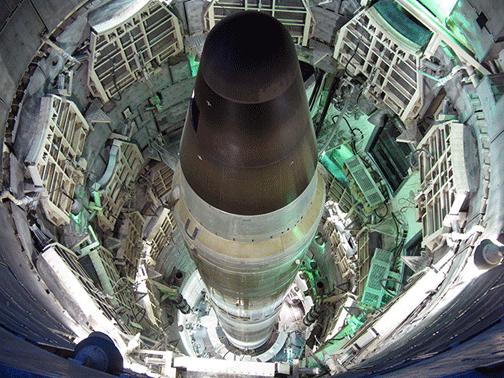 Time for nuclear sharing to end https://www.opendemocracy.net/can-europe-make-it/xanthe-hall/time-for-nuclear-sharing-to-end#.Vhg51kDhUXc.twitter openDemocracy XANTHE HALL 8 October 2015 You have to keep threatening to use nuclear weapons to make nuclear deterrence work. A view from Germany on the planned deployment of new US nuclear weapons. It was already announced some years ago, but last week Germany woke up to the fact that new US nuclear weapons are actually going to be deployed at its base in Büchel. Frontal 21, a programme on the second main TV channel reported last Tuesday that preparation for this deployment was due to begin at the German air force base. The runway is being improved, perimeter fences strengthened, new maintenance trucks arriving and the Tornado delivery aircraft will get new software.
It is a little known fact: Germany (and four other European countries) host nuclear weapons as part of NATO “nuclear sharing”. This means that in a nuclear attack the US can load its bombs onto German (or Belgian, Italian, Turkish and Dutch) aircraft and the pilots of those countries will drop them on an enemy target. This arrangement pre-dates the Non-Proliferation Treaty (NPT), which explicitly disallows any transfer of nuclear weapons from a nuclear weapon state to a non-nuclear weapon state, thus undermining the spirit of the treaty.
This new nuclear bomb – the B61-12 – is intended to replace all its older versions and be able to destroy more targets than previous models. It is touted by the nuclear laboratories as an “all-in-one” bomb, a “smart” bomb, that does not simply get tossed out of an aircraft, but can be guided and hit its target with great precision using exactly the right amount of explosive strength to only destroy what needs to be destroyed. Sound good?
Not to us – a guided nuclear bomb with mini-nuke capability could well lower the threshold for use. And the use of any kind of nuclear weapon would lead to the use of more nuclear weapons – this we know from the policies and planning of all nuclear weapon states. It has already been well established by three evidence-based conferences in recent years on the humanitarian impact of nuclear weapons that any use of nuclear weapons would have catastrophic humanitarian consequences.
This new “magic bomb” is not yet with us. It is still being developed and is planned to be deployed in five years time, if there are no more delays. The development of the B61-12 – euphemistically called a “Life Extension Programme” although it is a full redesign not just an update – has fortunately taken longer than intended, giving us more time to convince European leaders what a bad idea it is to deploy new nuclear weapons in Europe.
The debate is already under way in the “host” countries, most prominently in the Netherlands where the parliament has already voted not to task the new F35 aircraft with a nuclear role. However, the Dutch government is not listening. The German Bundestag voted in 2010 to get rid of the B61, and the government was nominally in favour, but after the change of government in 2013, Foreign Minister Steinmeier put the decision on ice, quoting the new security situation.
Yet the current confrontation between NATO and Russia needs deescalation, not rearmament. Sending a signal to Russia that NATO is modernising its European infrastructure and deploying new high-tech bombs is bound to elicit a reaction. Even as we write, reports are coming in that Russia will respond by withdrawing from the INF-Treaty, basing SS-26/Iskander missiles in Kaliningrad (didn’t they already do that?) and targeting Germany with nuclear weapons.
And what will be the NATO response to all of those threats? When will this escalation become hysteria and the first ‘shot across the bows’ start a nuclear war? Nuclear deterrence is the archetypal security dilemma. You have to keep threatening to use nuclear weapons to make it work. And the more you threaten, the more likely it is that they will be used.
This is the moment where nuclear weapon-free countries need to call out for a ban on nuclear weapons to stop this madness. It is also the right time for nuclear co-dependents, like Germany, to make up its mind to give its nuclear dependency up.
Deploying new nuclear weapons is forbidden by the NPT, which obligates its members to end the arms race. The transfer of nuclear weapons from the US to Germany and any plans to do so also undermine the NPT. As a responsible member state of this important treaty, it is time to denounce nuclear weapons and to join the international community of nuclear weapon-free countries that is signing the ‘Humanitarian Pledge’, calling for the legal gap to prohibit and eliminate nuclear weapons to be closed. Time for Germany to show some real leadership for nuclear disarmament.
If you enjoyed this article then please consider liking Can Europe Make it? onFacebook and following us on Twitter @oD_Europe
Contradictions in Japanese govt’s nuclear planning

 Government Fails to Address Contradictions Over Japan’s Nuclear Future, nippon.com Kikkawa Takeo [2015.10.08] The August 2015 restart of the Sendai Nuclear Power Plant in Kyūshū ended a two-year shutdown of all nuclear reactors in Japan. As commentators debate whether this will prompt other plants around the country to come back online, the current administration appears unwilling to take responsibility for dealing with contradictions between the need to shut down aging facilities and the nation’s continued reliance on nuclear power……
Many Japanese news organizations predicted at the beginning of 2015 that nuclear energy would make a full-fledged comeback during the year, with operations resuming at Sendai and other nuclear plants one after another. The projections appear to have been slightly too hasty, however, as restarting reactors has proved to be more difficult than anticipated…….
The 2012 revisions to the Act on the Regulation of Nuclear Source Material, Nuclear Fuel Material, and Reactors require all nuclear power plants to be taken out of service after 40 years, with a one-time-only, 20-year extension being granted in exceptional cases when certain conditions are met. The maximum number of years that a plant can remain in operation is thus 60 years. Of the 48 reactors in Japan as of January 2015, only 18 will be under 40 years old at the end of December 2030. If the revisions are strictly enforced, 30 reactors will need to be decommissioned by then. Two reactors are currently under construction—Unit 3 of Chūgoku Electric Power’s Shimane Nuclear Power Plant and Electric Power Development’s Ōma Nuclear Power Plant—but even if they come online, that would still mean just 20 reactors as of the end of 2030. Assuming that these 20 units operate at 70% capacity (which was roughly the average prior to the Fukushima accident), they would only be able to generate 15% of the nearly 1 trillion kWh projected to be required in 2030.
If the 40-year rule is applied strictly, nuclear power will meet just 15% of the nation’s energy needs in 2030. The additional 5%–7% needed to meet METI’s 20%–22% outlook is thus premised on either building new reactors or extending the life of existing ones beyond 40 years. Since the administration has announced that it has no plans now to build additional reactors, one can then conclude that it intends to cover the 5%–7% shortfall by extending the life of existing plants…….
The resumption of operations at Kyūshū Electric’s Sendai plant thus will not trigger a spate of restarts at other plants, and 2015 is hardly likely to mark the full-fledged return of nuclear power in Japan.
(Originally written in Japanese and published on September 22, 2015 http://www.nippon.com/en/currents/d00196/
Dangers of UK-China plan for nuclear power at Bradwell Estuary

 Will Bradwell get a Chinese Reactor? nuCLEAR news No 2 nulcear power October 2015 It is now pretty clear that David Cameron will sign an agreement with the Chinese Government, at the time of the State Visit of President Xi Jinping on 20th October, that will enable two Chinese state-owned nuclear companies to develop the site at Bradwell which is currently owned by EdF, says the Blackwater Against New Nuclear Group. (BANNG)
The development could happen rather quicker than anyone might have imagined, says the group because of the financial problems and delays with Hinkley Point. “Cameron’s folly means the sacrifice of the Blackwater estuary,” said Professor Andy Blowers, Chair of the Blackwater Against New Nuclear Group (BANNG). “Basically, the estuary will be trashed if this goes ahead.”
“This love-in between the British and Chinese Governments takes absolutely no account of the impact and implications that will be unleashed on the Blackwater estuary. The obstacles, including the problems of cooling water from such a shallow estuary, are massive”. Barry Turner, Vice Chair of BANNG, commented: “For BANNG, the simple fact is that the Bradwell site is totally unsuitable for a new power station no matter who the developer might be.
The delicate Blackwater estuary cannot cope with the demands of a new nuclear power station without its effective destruction. The long-term risks from rising sea-levels and coastal change will be phenomenal leaving not only a power station with all its inherent dangers but an everlasting residue of dangerous radioactive wastes on a site that is likely to disappear over the next two centuries. There is no thought for the future in this and it is immoral to be undertaking such an enterprise on such a location.
Bringing such a monster to the Blackwater is nothing short of monstrous”. In return for helping out with the increasingly expensive Hinkley Point plant in Somerset, the Chinese have been told they can use the site of an old nuclear power station at Bradwell-on-Sea, on the Blackwater estuary, to build a reactor of their own design. “I am not worried about the Chinese. I am worried about us”, says Charles Clover writing in the Sunday Times.
For it is an open question whether British standards of regulation are up to the expectations of people who live in places such as West Mersea, just across the water from Bradwell. “We have some excellent regulations in Britain, but the problem is that all too often we choose to ignore them. I believe the public can live with the risks of the nuclear industry as long as there is transparency, and that there is not an instant return to the culture of secrecy and political influence over regulators that some of us remember from Sellafield in the bad old days. For if we wish to have both electricity and oysters, the problem is ourselves, not the Chinese.” (2) A peaceful protest including a flotilla of boats was held on Mersea Island by campaigners on 4th October. (3)…. http://www.no2nuclearpower.org.uk/nuclearnews/NuClearNewsNo78.pdf
Nuclear lobby’s claim about ‘baseload power’ is obsolete
New Nobel laureate in literature warned about nuclear power’s dangers
Nobel winning writer warned of dangers of nuclear power during Japan visit http://ajw.asahi.com/article/behind_news/people/AJ201510090039 October 09, 2015 THE ASAHI SHIMBUN
The new Nobel laureate in literature warned that even a minor natural disaster could lead to a nuclear catastrophe during her visit to Japan in 2003, according to a doctor who met the writer.
Svetlana Alexievich, a journalist born in Ukraine and raised in Belarus, the nations affected by the Chernobyl nuclear disaster, published “Voices from Chernobyl–Chronicle of the Future” in 1997 about the consequences of the calamity.
“I vividly remember that she said peaceful use of nuclear power and nuclear weapons are two sides of a coin, completely identical,” said Minoru Kamata, a medical doctor and chairman of the Japan Chernobyl Foundation, a nonprofit organization that provides medical assistance to those affected by the disaster.
“She continued to say that in Japan (the danger of) nuclear power generation is covered up in the name of peaceful use, but even a minor natural disaster could lead to a serious accident,” he added.
Alexievich, 67, was named the recipient of this year’s Nobel Prize in Literature on Oct. 8 “for her polyphonic writings, a monument to suffering and courage in our time.”
Kamata said the award of a Nobel Prize to a critic of nuclear power should strike a chord with people in Japan who experienced the Fukushima nuclear disaster in March 2011 and are now watching as the government begins to reactivate nuclear reactors.
During her visit to Japan, Alexievich also met traditional Japanese storyteller Kaori Kanda twice–in Matsumoto, Nagano Prefecture, and in Nagoya.
One of Kanda’s noted tales is a story about Chernobyl based on Alexievich’s book.
Kanda, who is from Iwaki, Fukushima Prefecture, had long harbored doubts about the safety of nuclear power stations even before the Fukushima triple meltdown.
When Kanda performed her Chernobyl tale during Alexievich’s visit, the journalist commended it, saying, “You told a tale that exemplified exactly what I wanted to convey through my book.”
A nuclear power plant project in India is stalled
Nalco’s foray into nuclear energy hits legal roadblock Proposed Rs 12,000-cr nuclear energy plant in a JV with Nuclear Power Corporation in limbo Business Standard, India, Dilip Satapathy | Bhubaneswar October 9, 2015 National Aluminium Company (Nalco)’s plan to foray intonuclear energy generation has hit a legal roadblock.
Though the aluminium major proposed to set up a Rs 12,000 crore nuclear energy plant in joint venture withNuclear Power Corporation of India Ltd (NPCIL), it is unable to go ahead with the project with the present act restricting the sector to only a couple of its own fully owned subsidiaries under the Atomic Energy Department…….
Though NPCIL is keen to involve other public sector firms like Nalco, IOCL and NTPC, with whom it has signed MoUs, for setting up of nuclear power plants in a bid to expand its nuclear power footprint in the country, the present act does not allow this.
The Atomic Energy Act, framed in 1962, also prohibits private control of nuclear power generation though it allows them minority investment……….Apart from the fuel supply issue and protests over establishment of nuclear power plants, changes in the act to allow JVs formed by NPCIL with other PSUs to make them workable is another hurdle, the India government has to take care if the country wants to achieve 20 GWe nuclear energy capacity by 2020, sources said.
Besides nuclear energy, the aluminium major has identified renewable energy as its next focused area.
“We have set up wind mills in Andhra Pradesh (50.4 Mw) and Jaisalmer (47.6 Mw) in Rajasthan. We plan to set up solar plants in Rajasthan and Maharashtra (50 Mw each) and Madhya Pradesh (20 Mw). We are also in the processing of installing a 14 Mw wind power mill at Damanjodi,” Chand said. http://www.business-standard.com/article/companies/nalcos-foray-into-nuclear-energy-hits-legal-roadblock-115100900777_1.html
1 This Month
23-25 October – on Zoom – World BEYOND War’s annual global conferenc

To see nuclear-related stories in greater depth and intensity – go to https://nuclearinformation.wordpress.com

Say No to NASA’s Reckless Nuclear Reactor on the Moon
Say No to NASA’s Reckless Nuclear Reactor on the Moon
-
Archives
- October 2026 (160)
- September 2026 (339)
- August 2026 (330)
- July 2026 (355)
- June 2026 (287)
- May 2026 (306)
- April 2026 (356)
- March 2026 (251)
- February 2026 (267)
- January 2026 (308)
- December 2025 (358)
- November 2025 (359)
-
Categories
- 1
- 1 NUCLEAR ISSUES
- business and costs
- climate change
- culture and arts
- ENERGY
- environment
- health
- history
- indigenous issues
- Legal
- marketing of nuclear
- media
- opposition to nuclear
- PERSONAL STORIES
- politics
- politics international
- Religion and ethics
- safety
- secrets,lies and civil liberties
- spinbuster
- technology
- Uranium
- wastes
- weapons and war
- Women
- 2 WORLD
- ACTION
- AFRICA
- Atrocities
- AUSTRALIA
- Christina's notes
- Christina's themes
- culture and arts
- Events
- Fuk 2022
- Fuk 2023
- Fukushima 2017
- Fukushima 2018
- fukushima 2019
- Fukushima 2020
- Fukushima 2021
- general
- global warming
- Humour (God we need it)
- Nuclear
- RARE EARTHS
- Reference
- resources – print
- Resources -audiovicual
- Weekly Newsletter
- World
- World Nuclear
- YouTube
-
RSS
Entries RSS
Comments RSS

