NRC approves Maryland nuclear station, despite safety concerns
NRC says North Anna nuclear plant passes muster , The Daily Progress, Charlottesville, Virginia, September 5, 2015 By Bill McKelway, Richmond Times-Dispatch RICHMOND — The Nuclear Regulatory Commission has set aside multiple concerns raised by an anti-nuclear power group about operations at Dominion Energy’s North Anna nuclear generating facility.
In a petition filed four years ago after the meltdown of the Fukushima Dalichi facility in Japan and the 5.8-magnitude Louisa County earthquake that tripped the Louisa County nuclear facility offline, the effort by Maryland-based Beyond Nuclear came up empty-handed.
The NRC notified the group and Dominion late last month that none of 12 areas of concern reviewed by the NRC warranted changes in North Anna operations.
The group sought a re-analysis of the North Anna operation’s design basis for earthquakes, its spent fuel storage facility, its reliability of seismic activity measures, an assessment of boil-off or drain-downs of the spent fuel pool and a review of emergency evacuation plans, among other issues.
The NRC review completed late last month rejected a need for changes in 12 specific areas that the NRC agreed to look into. Beyond Nuclear had sought a suspension of operations at the plant, where a third nuclear facility is in the planning stages………
Paul Gunter, a leader with Beyond Nuclear, said the decision to close out the review “comes as no surprise.”
“The NRC continues to ignore growing concerns about high-density storage and overcrowding of high-level nuclear waste spent fuel pools on site,” he said in a written statement. Radioactivity released by a fire or explosion from a drain-down or boil-off “would produce widespread contamination that would likely overwhelm current emergency plans,” he wrote.
He said the group’s effort at least establishes a “public record for what we believe to be ‘willful negligence’ on the part of the nuclear industry and the current federal regulator.”……….http://www.dailyprogress.com/news/local/nrc-says-north-anna-nuclear-plant-passes-muster/article_d6ea2456-542e-11e5-b7c6-b7cab0860a58.html
Pacific Island Forum: theme will be Australia’s Inaction on Climate CHnage
Australia’s inaction on climate change set to dominate Pacific Island talks, Guardian, 6 Sept 15 Australia and New Zealand are expected to face strong criticism from Pacific Island leaders disappointed the nations are not doing more to combat climate change.

The issue will likely dominate this week’s Pacific Islands Forum leaders summit in Port Moresby, ahead of the United Nations climate change conference in Paris later in the year.
Pacific leaders want the world to work on restricting the global warming temperature rise to 1.5C, fearing a 2C target will risk the survival of many tiny islands.
Natural disaster recovery will be fresh on their minds. The summit starts on Monday, six months after Cyclone Pam, which flattened much of Vanuatu and caused heavy flooding on Tuvalu, Kiribati and the Marshall Islands.
Host nation Papua New Guinea is grappling with the opposite problem – what could be its worst drought in 20 years and a potential food crisis.
The prime minister, Peter O’Neill, has said El Niño conditions have been exacerbated by the effects of climate change.
The Solomon Islands and Vanuatu are also experiencing a dry spell………
The Pacific Island Forum runs from 7-11 September. http://www.theguardian.com/world/2015/sep/06/australias-inaction-on-climate-change-set-to-dominate-pacific-island-talks
Long-time residents of Naraha facing dilemma with lifting of evacuation order
 Shukan Sakanushi, head priest of the Dairakuin temple in Naraha, performs a ceremony on Sept. 5 praying for the rebuilding of his hometown.
With the lifting of the evacuation order for the Fukushima Prefecture town of Naraha on Sept. 5, Shukan Sakanushi, head priest of the Dairakuin temple in Naraha, decided to return home.
At midnight, he chanted Buddhist sutras in a ceremony praying for the rebuilding of the town.
“Those who live in temples have to go to where the people are,” Sakanushi, 44, said. “Today is a milestone of sorts. I will return to the temple from today.”
However, because only a small number of long-time residents have returned to Naraha, many parts of the town are quiet and lonely at night. Community bonds remain severed, making a return to Naraha difficult for former residents such as Teruyuki Ishizawa, 75, who now lives in temporary housing in Iwaki.
“I want to return but cannot,” he said. “The town is so dark that I cannot allow my wife to walk outside by herself.”
The lifting of the evacuation order for residents who fled in the wake of the accident at the Fukushima No. 1 nuclear power plant following the 2011 Great East Japan Earthquake and tsunami does not mean that all 7,400 residents can simply return home.
Some evacuees have established comfortable lives elsewhere and want to continue with that daily routine.
Others are discouraged by the likelihood that only a few neighbors will return to their communities even with the evacuation order lifted.
For Sakanushi, March 11, 2011, was a special day, but not because of the twin disasters that changed his life. That was the day he was officially appointed head priest of Dairakuin by the headquarters of the Buzan sect of Shingon Buddhism to which the temple belongs.
He intended to take over most of the duties performed by his father, Myokan, 78, who had served as head priest of Dairakuin for 50 years.
However, after the evacuation order was issued for Naraha, Sakanushi’s family of six moved away.
Sakanushi is also an employee of the Naraha town government. He temporarily moved to Aizu-Wakamatsu where he provided support to other evacuees. Subsequently, he moved to Kita-Ibaraki, Ibaraki Prefecture, where his wife, Chisaki, 39, daughter, Mayu, 11, and son, Homare, 7, had evacuated to. Sakanushi’s parents eventually settled in Iwaki, Fukushima Prefecture, after initially evacuating to Gunma Prefecture.
Although the evacuation order has been lifted, Sakanushi is now the only family member to return to Naraha.
No decision has yet been made about whether to have his two children return. The town government plans to resume the elementary and junior high schools in town from spring 2017. But Homare has no memories of life in Naraha, because he evacuated four and a half years ago.
“I do hold the feeling of wanting to live together as a family,” Sakanushi said. “However, the children have become accustomed to life in Ibaraki. I will think about whether we should all return by the time school resumes here.”
Many of his temple’s followers have also not returned to Naraha. Some are still concerned about the radiation, while others are worried about the inconveniences associated with returning to a community that has been deserted for more than four years.
Sakanushi plans to maintain the temple “annex” that was established in Iwaki, where about 80 percent of Naraha residents have evacuated to.
The tsunami and Fukushima nuclear accident have drastically altered the appearance of Naraha.
Homes along the coast remain flattened from the tsunami. Areas that once were rice paddies now are filled with black plastic bags holding dirt contaminated by radiation.
After the nuclear accident, lodging facilities and offices of companies involved in reactor decommissioning and decontamination work related to the Fukushima No. 1 nuclear power plant have been constructed in Naraha. More than 1,000 workers now reside in Naraha, exceeding the number of long-time residents who returned. Those workers also frequent the temporary shopping arcade that has been set up in town.
A couple who now reside in Nagoya have all but given up hope of ever returning to Naraha.
Yoshiharu and Nobuko Matsumoto fled to Nagoya because their oldest daughter lives in Aichi Prefecture.
At first, Nobuko, 79, would say to Yoshiharu, 80, “We will return after a year or so.”
However, their lives as evacuees have now lasted for four and a half years.
Their oldest daughter, who returned temporarily to Naraha to sell off furniture and clean up, told them how their home has deteriorated.
Mold has grown on the house, which has also been damaged by rats. Shrubs have grown taller than the height of the Matsumotos.
This spring, the Matsumotos were told it would cost 10 million yen ($84,000) to repair the home.
That was when Nobuko decided, “I will remain in Nagoya.”
Yoshiharu was still determined to return to Naraha.
In early August, the entire family returned to Naraha with the intention of completing the clean-up work.
Even though he had back problems, Yoshiharu made the trip to Naraha, but he could not stop the tears from flowing when he saw his home for the first time in more than four years.
A next-door neighbor had begun destroying their home. The neighbor across the street had also decided to do the same. Of the family of five who used to live in the back of the Matsumoto home, only the grandmother in her 80s is planning to return.
In total, only one neighbor among their acquaintances was planning to return to Naraha.
“I want to return, but if I cannot farm and there are no friends, I would not be able to go on living there,” Yoshiharu said. “When I saw our home, I felt we had moved far away.”
He still has not decided whether to tear down the home because he fears that would anger his ancestors. Yoshiharu has asked his children to, at the very least, leave the family grave in Naraha.
Source: Asahi Shimbun
http://ajw.asahi.com/article/0311disaster/fukushima/AJ201509060018
Radiation fears as report shows Fukushima fir trees to be growing strangely

TOKYO — Following the events of the 2011 Tohoku earthquake and tsunami and the subsequent meltdowns at the Fukushima Daiichi nuclear power plant complex, radiologists in Japan have been closely observing the area for potential changes. A new report by the National Institute of Radiological Sciences now suggests that the fir trees in Fukushima may be exhibiting strange growth patterns, with the radiation from the disaster being named as a possible factor.
The report, published on the organisation’s website on August 28, states that when comparing fir trees from within the affected zone to those from areas with lower radioactivity, the fir trees in the affected area were increasingly found to be stunted and exhibiting signs of morphological change, particularly bifurcation, the splitting of a body into two parts, i.e. “branching.”
Each year of a healthy fir tree’s growth sees it growing directly upward while also putting out two horizontal branches. Scientists have noted, however, that some of the trees in the affected areas are only branching off into two separate directions at the tip, and exhibiting lack of upward growth.
The changes can be identified in the images above left, which were included with the report. Image A shows a normal example of growth. Note the vertical central branch. Photo B shows a trunk which has entirely split into two, and photo C shows horizontal growth only, with a distinct lack of vertical growth. The red arrows indicate where bifurcation has occurred. You can see in image C how the central, vertical branch of the tree which should be growing upward is missing entirely.
The investigation was conducted in January of this year, with trees examined in Okuma, Fukushima (3.5 kilometres from the nuclear plant), and two locations in Namie, Fukushima (8.5 and 15 kilometres from the plant). Radiation levels in Okuma were recorded at 33.9 microsieverts, and in Namie, the levels were 19.6 and 6.85 microsieverts, respectively. These trees were compared against trees in the north of neighbouring Ibaraki Prefecture from an area with a microsievert reading of 0.13.
Between 100 and 200 trees in each location were examined for changes, with the effect seen more often in the areas with higher levels of radiation. 90% of the trees examined in Okuma exhibited some degree of morphological change, a number which fell to 40% and 30% in Namie, and to less than 10% in northern Ibaraki Prefecture.
The correlation between the frequency of the morphological change and the proximity to the Fukushima Daiichi site/level of radiation recorded suggests that it is likely — but as yet not confirmed — that the changes are connected to the increase in background radiation.
However, the report notes that this particular morphological change has been identified in other areas and can be attributed to a range of other factors including environmental changes and as a result of pest damage. The report states that rather than attributing this change directly to the nuclear disaster, researchers are instead presenting evidence that proves that this change is seen more often when radiation is a contributing factor.
Source: Report on Morphological Changes to Fir Trees in Areas with High Radiation, National Institute of Radiological Sciences
Source: Japan Today
Japan lifts evacuation order for town near doomed nuke plant
NARAHA, Japan (AP) — Japan’s government on Saturday lifted a 4 1/2-year-old evacuation order for the northeastern town of Naraha that had sent all of the town’s 7,400 residents away following the disaster at the nearby Fukushima nuclear plant.
Naraha became the first to get the order lifted among seven municipalities forced to empty entirely due to radiation contamination following the massive earthquake and tsunami that sent the plant’s reactors into triple meltdowns in March 2011.
The central government has said radiation levels in Naraha have fallen to levels deemed safe following decontamination efforts.
According to a government survey, however, 53 percent of the evacuees from Naraha, which is 20 kilometers (12 miles) south of the nuclear plant, say they’re either not ready to return home permanently or are undecided. Some say they’ve found jobs elsewhere over the past few years, while others cite radiation concerns.
Naraha represents a test case, as most residents remain cautious amid lingering health concerns and a lack of infrastructure. In the once-abandoned town, a segment of a national railway is still out of service, with the tracks covered with grass. Some houses are falling down and wild boars roam around at night.
Only about 100 of the nearly 2,600 households have returned since a trial period began in April. Last year, the government lifted evacuation orders for parts of two nearby towns, but only about half of their former residents have returned.
Naraha Mayor Yukiei Matsumoto said that Saturday marked an important milestone.
“Our clock started moving again,” he said during a ceremony held at a children’s park. “The lifting of the evacuation order is one key step, but this is just a start.”
Matsumoto said he hoped Naraha could set a good example of a recovering town for the other affected municipalities.
About 100,000 people from about 10 municipalities around the wrecked plant still cannot go home. The government hopes to lift all evacuation orders except for the most contaminated areas closest to the plant by March 2017 — a plan many evacuees criticize as an attempt to showcase Fukushima’s recovery ahead of the 2020 Tokyo Summer Olympics.
Matsumoto said that fear of radiation and nuclear safety was still present, and that Naraha had a long way to go in its recovery. The town will be without a medical clinic until October, while a new prefectural hospital won’t be ready until February.
A grocery store started free delivery services in July, and a shopping center will open next year. Still, many residents, especially those who don’t drive, face limited options for their daily necessities.
Residents have been given personal dosimeters to check their own radiation levels. To accommodate their concerns, the town is also running 24-hour monitoring at a water filtration plant, testing tap water for radioactive materials.
Toshiko Yokota, a 53-year-old homemaker who had to leave her Naraha house after the disaster, said Saturday that she came back to attend the ceremony and clean her home, and that she eventually wants to move back with her husband. Their house was damaged by rats, bugs and rainwater leaks in their absence, and still needs to be fully renovated, but she hopes to return in a few years.
“My friends are all in different places because of the nuclear accident, and the town doesn’t even look the same, but this is still my hometown and it really feels good to be back,” said Yokota, who currently lives in another town in Fukushima prefecture.
“I still feel uneasy about some things, like radiation levels and the lack of a medical facility,” she said. “In order to come back, I have to keep up my hope and stay healthy.”
Source: AP
Japan census conducted every five years likely to show first population plunge since 1920
Japan will on Thursday kick off a national census conducted once every five years that is expected to be the first showing a drop in the nation’s population since the survey began in 1920.
The upcoming census, covering all residents and households in the country, regardless of nationality, will also be the first in which an online response system will be made available nationwide.
According to estimates by the internal affairs ministry, the nation’s population has fallen annually in recent years. Preliminary population figures based on the new census data are to be released in February.
The census “will provide basic data needed for various policies, including welfare services and disaster prevention, which are essential to the creation of Japan’s future,” a ministry official said, calling for cooperation in the survey.
The census will be taken household by household, covering the names, birthdays, occupations and other questions.
In the previous census, online responses were accepted only in Tokyo. This time, the ministry projects more than 10 million households will submit answers online, including via personal computers and smartphones.
If the number reaches the expected level, the census would be one of the biggest online surveys in the world that use similar techniques, the official said.
The forthcoming census will also be the first one since the March 2011 earthquake and tsunami and the subsequent atomic crisis at Tokyo Electric Power Co.’s Fukushima No. 1 nuclear power plant, both of which forced the evacuation of many people in the Tohoku region.
The survey is expected to help deepen understanding of population movements triggered by the disaster.
Source: Japan Times
Evacuation order lifted in Fukushima’s Naraha Town
Japan’s government has lifted an evacuation order for Naraha Town, near the crippled Fukushima Daiichi nuclear power plant.
The measure took effect on Friday at midnight. Nearly all of the area is located 20 kilometers from the plant in Fukushima Prefecture and was subject to the March 2011 evacuation order.
The government says decontamination has been completed in the area. Officials say the town’s environment is almost ready for residents to return to their homes.
This is the third evacuation order to be lifted since the accident. The previous 2 were the Miyakoji district in Tamura City and the eastern part of Kawauchi Village.
But Naraha is the first municipality among the 7 towns and villages around the plant to have its evacuation order lifted.
These 7 municipalities totally emptied of residents, as well as local government workers. The evacuation was ordered by the central government soon after the disaster.
The lifting of the evacuation order allows the town’s approximately 7,300 residents to return to their homes. It also permits them to resume commercial and business activities.
At the same time, the town faces the challenge of addressing residents’ concerns about radiation and building a safe environment for its residents. It also faces the task of resuming the town’s commercial and medical services for the first time in 4-and-a-half years.
An evacuation order remains in place for about 70,000 people in 9 municipalities surrounding the Daiichi plant.
The central government plans to lift the order for the remaining municipalities once decontamination is complete and services are capable of supporting people’s lives.
Source: NHK
http://www3.nhk.or.jp/nhkworld/english/news/20150905_07.html
Plant operator to reactivate another reactor
The operator of Japan’s only active nuclear power station plans to prepare to restart a second reactor at the plant.
Kyushu Electric Power Company on Friday told the Nuclear Regulation Authority, or NRA, of its plan to start putting fuel rods into the Number 2 reactor of the Sendai plant in the southwestern prefecture of Kagoshima on September 11th.
The company says loading the 157 units of fuel rods into the facility will take 4 days.
NRA officials are to then inspect emergency equipment and procedures for handling severe accidents. If no problems are found, the utility plans to reactivate the reactor in mid-October, aiming at starting commercial operations in mid-November.
The firm restarted the plant’s Number 1 reactor on August 11th. The reactor is to undergo final checks by the NRA next Thursday and, if it passes them, become the first in Japan to supply electricity in 2 years.
The 2 reactors are the first to meet regulations introduced after the nuclear accident at the Fukushima Daiichi power plant in 2011.
Source: NHK
http://www3.nhk.or.jp/nhkworld/english/news/20150904_32.html
Evacuation order lifted in Naraha, but few returning home

NARAHA, Fukushima Prefecture–Authorities lifted an evacuation order for 7,400 residents of this small town close to the crippled Fukushima No. 1 nuclear power plant on Sept. 5, but very few homeowners have indicated they plan to return anytime soon.
Most of Naraha is located within the 20-kilometer-radius evacuation zone surrounding the stricken plant. Even though the evacuation order was lifted at midnight for the entire town, there are lingering fears of radiation contamination and concerns over a lack of essentials that would allow residents to pick up the threads of their former lives.
Of the seven Fukushima municipalities where all residents were ordered to evacuate after the triple meltdown triggered by the 2011 earthquake and tsunami disaster, Naraha is the first one to have the evacuation order removed.
One evacuee who did return to his Naraha home was 68-year-old Fusao Sakamoto.
“Looking back, I feel my four-and-half-years as an evacuee was agonizingly long,” the landscape gardener said.
According to the town government, only 780 residents of 351 households, or just over 10 percent of the entire population, were registered at the end of August with the town’s program to allow them to stay overnight to prepare for permanent resettlement.
It was the third removal of an evacuation order among areas in the former no-go zone set within 20 km of the plant operated by Tokyo Electric Power Co.
The number of residents allowed to return home is the largest with the lifting of the Naraha evacuation order. It is expected to set a precedent for large-scale resettlement of Fukushima evacuees.
Almost all Naraha residents fled from their hometown on March 12, the day after the nuclear disaster unfolded. The Fukushima plant is located in the nearby towns of Okuma and Futaba.
Naraha was initially designated as a no-entry zone, which in principle prohibited residents from entering the town. But it was redesignated as a zone being prepared for the lifting of the evacuation order in August 2012, which meant that residents were allowed to enter the town during daytime hours.
With decontamination work and restoration of basic infrastructure largely completed, evacuees were allowed to return home for long-term stays in April to prepare for permanent resettlement.
On Sept. 5, the town government, which relocated its functions to Iwaki and other municipalities in Fukushima Prefecture, began to resume operations at the town office building in central Naraha.
“The clock has just started ticking again for our town with the lifting of the evacuation order after many months,” Mayor Yukiei Matsumoto told town officials. “We will accelerate efforts to achieve full recovery of the town.”
Source: Asahi Shimbun
http://ajw.asahi.com/article/0311disaster/fukushima/AJ201509050035
Fukushima: Japan ends evacuation of Naraha as ‘radiation at safe level’
The town’s 7,400 residents are allowed to return to their homes after the four-year-old evacuation order was lifted on Saturday
 A man lights candles in Naraha, Japan. Residents of Naraha will return from Saturday to live in the town near the Fukushima nuclear power plant for the first time since the 2011 disaster.
The Japanese town of Naraha has lifted a 2011 evacuation order that sent all its 7,400 residents away after the nearby Fukushima nuclear plant was crippled by a tsunami that led to a meltdown and contamination.
Naraha was the first among seven municipalities forced to empty entirely due to radiation contamination following the massive earthquake and tsunami that sent the reactors into meltdown.
The government says radiation levels in town have fallen to levels deemed safe following decontamination efforts, and on Saturday lifted the four-year-old evacuation order.
The town represents a test case, as most residents remain cautious amid lingering health concerns and a lack of infrastructure. Only about 100 of the nearly 2,600 households have returned since a trial period begun in April.
The Naraha mayor, Yukiei Matsumoto, said Saturday marked an important milestone. “Our clock started moving again,” Matsumoto said during a ceremony held at a children’s park. “The lifting of the evacuation order is one key step but this is just a start.”
He said fear of radiation and nuclear safety was still present and the town had a long way ahead for recovery. It would be without a medical clinic until October and a new prefectural hospital would not be ready until February next year.
A grocery store started free delivery services in July, and a shopping centre will open in 2016. Still, many residents, especially those who do not drive, face limited options for their daily necessities.
Residents are given personal dosimeters to check their own radiation levels. To accommodate their concerns the town is also running 24-hour monitoring at a water filtration plant, testing tap water for radioactive materials.
In 2014 the government lifted evacuation orders for parts of two nearby towns.
Source: The Guardian
Nearly 700,000 tons of radioactive water stored at Fukushima plant

OKUMA, Fukushima Prefecture–Almost 700,000 tons of radiation-contaminated water have accumulated at the crippled Fukushima No. 1 nuclear power plant, Tokyo Electric Power Co. disclosed Sept. 4.
The water is stored in rows of massive tanks on the plant’s premises.
Contaminated water has been a persistent problem since the 2011 earthquake and tsunami disaster triggered a triple meltdown at the plant, resulting in a vast amount of radiation being spewed from the facility.
Each day, about 300 tons of groundwater still seeps into the basements of the reactor buildings, where it mixes with melted nuclear fuel and becomes highly contaminated, the utility officials said.
The storage tanks TEPCO has constructed to store the water are 10 meters tall and positioned on the inland, and not seaward, side of the reactor buildings.
The plant operator said it had lowered the radiation level of a large portion of the contaminated water using a multinuclide removal apparatus called ALPS (advanced liquid processing system) and other equipment.
The utility completed processing the most highly contaminated water stored in tanks by the end of May.
TEPCO has also worked to replace flange-type bolted storage tanks that are susceptible to leakage with welded tanks to reduce the risk of accidental seepage.
To intercept clean groundwater before it flows into contaminated reactor buildings, TEPCO started a “subdrain plan” Sept. 3 to pump tons of groundwater from “subdrain wells” before it reaches the contaminated reactor buildings each day. The water will be released into the sea after undergoing decontamination treatment
Source: Asahi Shimbun
http://ajw.asahi.com/article/0311disaster/fukushima/AJ201509050017
Nuclear lobby’s wishful thinking about Small Modular (SMR) and Generation IV reactors
 Nor should the industry look for help from the trendy new kids on the block: small modular reactors (SMRs) and Generation IV technologies. The report predicts that electricity costs from SMRs will typically be 50-100% higher than for current large reactors, although it holds out some hope that large volume production of SMRs could help reduce costs–if that large volume production is comprised of “a sufficiently large number of identical SMR designs…built and replicated in factory assembly workshops.” Not very likely unless the industry accepts a socialist approach to reactor manufacturing, which is even less likely than that the approach would lead to any significant cost savings.
As for Generation IV reactors, the report at its most optimistic can only say, “In terms of generation costs, generation IV technologies aim to be at least as competitive as generation III technologies….though the additional complexity of these designs, the need to develop a specific supply chain for these reactors and the development of the associated fuel cycles will make this a challenging task.”
So, at best the Generation IV reactors are aiming to be as competitive as the current–and economically failing–Generation III reactors. And even realizing that inadequate goal will be “challenging.” The report might as well have recommended to Generation IV developers not to bother……..
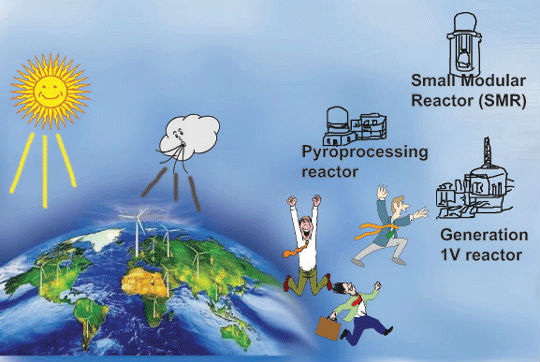
Nuclear advocates fight back with wishful thinking. Green World, Michael Mariotte September 3, 2015 It must be rough to be a nuclear power advocate these days: clean renewable energy is cleaning nuclear’s clock in the marketplace; energy efficiency programs are working and causing electricity demand to remain stable and even fall in some regions; despite decades of industry effort radioactive waste remains an intractable problem; and Fukushima’s fallout–both literal and metaphoric–continues to cast a pall over the industry’s future. Continue reading
Japan’s Monju nuclear reprocessing reactor, plagued by safety errors, offline for most of 20 years
Errors found in safety management of Monju reactor http://www3.nhk.or.jp/nhkworld/english/news/20150903_28.html Sep. 3, 2015 Japan’s nuclear regulators have found fresh faults with the safety management of the country’s fast-breeder reactor, which is currently offline. They say they have found thousands of errors in safety classifications of the equipment and devices at the Monju reactor.
The operator of the prototype reactor in Fukui Prefecture, central Japan, has been banned from conducting test runs since 2013 following discoveries of a large number of safety inspection oversights.
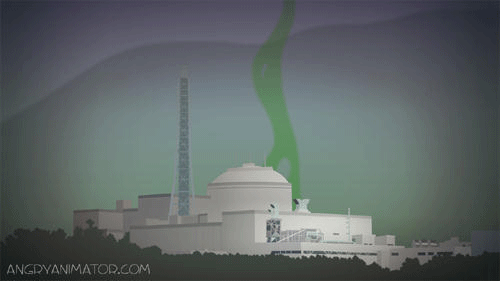
The Nuclear Regulation Authority says it has recently found at least 3,000 mistakes with safety classifications of equipment and devices at the reactor during its regular inspections which are conducted 4 times a year. Its officials say, equipment and devices with high importance were, in some cases, classified in lower ranks in the 3-level system, which suggest the operator might have failed to carry out necessary inspections for them.
The errors found recently include those going as far back as 2007. The fact suggests that government inspectors have also overlooked the operator’s mistakes. The operator, Japan Atomic Energy Agency, built the Monju fast-breeder reactor in the early 1990s to reuse the spent nuclear fuel MOX, a mixture of plutonium extracted from spent fuel and uranium.
But it has been offline for most of the period after it underwent a fire from a leak of sodium, the reactor’s coolant, in 1995.
The operator aims to conduct the reactor’s test run by next March. But it is uncertain when the ban by the authority will be lifted. The plant’s director, Kazumi Aoto, says he will take the government’s report seriously. An NRA inspector, Yutaka Miyawaki, says the regulators will try to identify the actual effects of the errors.
New nuclear power plants – a distraction from real climate action – Naomi Klein
Naomi Klein will be appearing at the Festival of Dangerous Ideas on Saturday, September 5. The talk will also be streamed live online.
Naomi Klein says building new nuclear power plants ‘doesn’t make sense’ http://www.news.com.au/technology/environment/naomi-klein-says-building- new-nuclear-power-plants-doesnt-make-sense/story-fnjwvztl-1227512110264 SEPTEMBER 04, 2015 BUILDING new nuclear power plants to create a carbon-free world “doesn’t make sense” and just serves as a distraction from the risks, Canadian author Naomi Klein says.
The activist and author of This Changes Everything, was asked what she thought about the possibility of building a nuclear  power plant in South Australia, which a Royal Commission in the state is currently considering.
Backers of nuclear power often spruik it as an alternative to renewables because it does not produce greenhouse gases, unlike coal-fired power stations.
But Klein said building new nuclear plants did not make any sense to her.
“What’s exciting about this renewables revolution spreading around the world, is that it shows us that we can power our economies without the enormous risk that we have come to accept,” she told media on Thursday.
- These risks are sometimes called “sacrifice zones” and this is actually a phrase that was used in government policy documents in the United States, Klein said.“Fossil fuels have always required those sacrifice zones,” she said, and these huge risks were often borne by certain groups of people, who were overwhelmingly the most vulnerable people in society.”
She said these included indigenous and the poorest people who were the ones who had their lands mined and dealt with the health impacts.
“Nuclear carries those same risks and that same logic … so no, I don’t think that’s the solution,” Klein said.
She said the latest research showed renewables could power 100 per cent of the world’s economies.
“We can do it without those huge risks and costs associated with nuclear so why wouldn’t we?” she said.
- While there was still debate over the timing of when renewables should be introduced, and whether existing nuclear power plants should be taken offline first, Klein said it didn’t make sense to her to build new nuclear facilities.“People are constantly holding this promise of next generation nuclear which supposedly doesn’t have the risk of our current generation nuclear but at this point it’s notional, that’s not what’s being constructed and I think in large part that serves as a distraction from the risk associated with actual nuclear power.”
In her book, Klein argues there is a conflict between what the planet needs in order to continue supporting human life, and what the current economic system needs to thrive, which is short term growth and “putting profits above all else”.
“Our economic system and our planetary system are now at war,” she writes. RELATED: Naomi Klein says she hopes Tony Abbott is still paying attention “The International Energy Agency warns that if we do not get our emissions under control by a rather terrifying 2017, our fossil fuel economy will ‘lock in’ extremely dangerous warming.”
In her book she said people needed to start speaking about climate change in terms of “right and wrong”, not of pragmatism and cost-benefits. But contrary to some people’s views, Klein said it was possible to have a stronger, fairer, more stable economy, and still act on climate change.
“Every time he (Prime Minister Tony Abbott) tells Australians that they need to choose between the economy and climate action, that is a lie,” she said. “The latest studies show we would create six to eight times more jobs if we invested in those sectors than if we invest the same amount of money in the extractive sectors (like mining).
“The problem we’ve had is only those extractive jobs have all too often been the only jobs on the table.”
Klein said Germany was already getting 30 per cent of its daily electricity from renewables. On sunny days renewables can make up to 80 per cent.
“They’ve created … 400,000 jobs in this transition, they’ve also deepened their democracy because they have taken back control of their energy grids in hundreds of cities and towns in Germany and are able to keep the profits of energy generation and use them to pay for services,” she said.
“So this is not just about flipping the switch from one energy model to another, it’s also about changing our economy to make it fairer.
“It is true that some of the most powerful actors in our current economic system … stand to lose a lot.” Naomi Klein will be appearing at the Festival of Dangerous Ideas on Saturday, September 5. The talk will also be streamed live online.
In Japan’s hot summer, solar power ramped up its contribution to electricity

 Solar power supplies 10 percent of Japan peak summer power: Asahi http://news.yahoo.com/solar-power-supplies-10-percent-japan-peak-summer-030520802–finance.html?utm_content=buffer78331&utm_medium=social&utm_source=twitter.com&utm_campaign=buffer September 2, 2015 TOKYO (Reuters) – Solar power generation contributed to about 10 percent of peak summer power supplies of Japan’s nine major utilities, equivalent to more than 10 nuclear reactors, the Asahi newspaper reported on Thursday.
Though solar power accounts for about 2 percent of annual generation of all power sources, summer’s favorable sunlight conditions increased power output, generating up to about 15 gigawatts of power in total in early August, the paper said.
Japan has been pouring billions of dollars in clean-energy investment after introducing a feed-in tariff (FIT) program in 2012, aiming to help the world’s third-biggest economy shift away from its reliance on nuclear power after the March 2011 Fukushima disaster.
Asahi’s survey showed that the ratio of solar power at peak hours was as low as Hokuriku Electric Power’s <9505.T> 5.9 percent and as high as Kyushu Electric Power’s <9508.T> 24.6 percent, depending on access to ample land with favorable sunlight conditions.
The installed capacity of solar power taking advantage of FIT scheme has reached more than 24 gigawatts at the end of April, government data showed, up from about 5 GW before the scheme started.(Reporting by Osamu Tsukimori; Editing by Gopakumar Warrier)
1 This Month
Chernobyl: The Lost Tapes – A good documentary on Chernobyl on SBS available On Demand for the next 3 weeks– https://www.sbs.com.au/ondemand/tv-program/chernobyl-the-lost-tapes/2352741955560

of the week–London Campaign for Nuclear Disarmament

Tell the Ukrainian Government to Drop Prosecution of Peace Activist Yurii Sheliazhenko
To see nuclear-related stories in greater depth and intensity – go to https://nuclearinformation.wordpress.com
-
Archives
- April 2026 (139)
- March 2026 (251)
- February 2026 (268)
- January 2026 (308)
- December 2025 (358)
- November 2025 (359)
- October 2025 (376)
- September 2025 (257)
- August 2025 (319)
- July 2025 (230)
- June 2025 (348)
- May 2025 (261)
-
Categories
- 1
- 1 NUCLEAR ISSUES
- business and costs
- climate change
- culture and arts
- ENERGY
- environment
- health
- history
- indigenous issues
- Legal
- marketing of nuclear
- media
- opposition to nuclear
- PERSONAL STORIES
- politics
- politics international
- Religion and ethics
- safety
- secrets,lies and civil liberties
- spinbuster
- technology
- Uranium
- wastes
- weapons and war
- Women
- 2 WORLD
- ACTION
- AFRICA
- Atrocities
- AUSTRALIA
- Christina's notes
- Christina's themes
- culture and arts
- Events
- Fuk 2022
- Fuk 2023
- Fukushima 2017
- Fukushima 2018
- fukushima 2019
- Fukushima 2020
- Fukushima 2021
- general
- global warming
- Humour (God we need it)
- Nuclear
- RARE EARTHS
- Reference
- resources – print
- Resources -audiovicual
- Weekly Newsletter
- World
- World Nuclear
- YouTube
-
RSS
Entries RSS
Comments RSS
 nuclear-news