Tepco reports that contamination levels in the unit 1 discharge canal has been rising significantly….
*Cesium 137 was at 91,000 bq/liter Beta radiation was at 110,000 bq/liter Both readings taken July 24th.
*Cesium 137 was at 79,000 bq/liter Beta radiation was at 94,000 bq/liter Both readings taken July 22th.
*Cesium 137 was at 28,000 bq/liter Beta radiation was at 36,000 bq/liter Both readings taken July 15th.
*Cesium 137 was at 29,000 bq/liter Beta radiation was at 37,000 bq/liter Both readings taken July 13th.
*Cesium 137 was at 20,000 bq/liter Beta radiation was at 26,000 bq/liter Both readings taken July 10th.
Tepco also admitted that subdrain pit #16 has seen a rise in contamination since May
Why either of these locations are now rising does not yet have a definitive cause. Work to concrete in the sea front trenches at the plant could be pushing contaminated water to take other routes. The freezing in progress of the frozen wall could be having an impact on the migration of contaminated water.
Workers at the Fukushima Daiichi nuclear power plant on Sunday will start the removal of a fuel exchanger inside the Number 3 reactor building. The 20-ton device fell into the fuel pool during the 2011 disaster.
The device has since been a major obstacle for workers at Tokyo Electric Power Company in the start of removal of extremely radioactive rubble left in the storage pool. 566 fuel rods remain inside the spent fuel pool.
Workers cannot directly take part in the process as the site is highly radioactive. The work will require 2 remote-controlled cranes that will lift and remove the device, which is some 14 meters long.
The work poses a challenge as spent fuel may suffer damage if the device falls back into the pool during removal.
Workers accidentally dropped a 400-kilogram device into the pool last August. Though none of the rods suffered damage, removal was postponed for 4 months.
TEPCO has been preparing for the removal by developing equipment tailored to grip the device. Cushions have also been placed on top of the fuel rods.
TEPCO officials say all other work to decommission the plant will be suspended while the removal takes place as a hydrogen explosion in 2011 left the pool without a roof.
Source : NHK http://www3.nhk.or.jp/nhkworld/english/news/20150730_05.html
Tepco handout (pdf), summary translation by Fukushima Diary, Jul 21, 2015 (emphasis added): Tepco announced Fukushima plant area has irregularly sunk since 311… The report reads Reactor 1 turbine building sank by 730 mm [2.40 ft], Reactor 2 by 725 mm, Reactor 3 by 710 mm, Reactor 4 by 712 mm.
IAEA Headquarters (pdf), 2015: We know that the buildings will decay and become less stable… there is the dilemma of 1) gathering more information… and 2) acting earlier and maybe not having enough information to make good decisions.
IAEA Nuclear Energy Series (pdf), 2014: The impact of the salt on the corrosion of structural materials had to be assessed and measures taken accordingly to retain integrity.
Lake Barrett, Tepco adviser (pdf): Reactor building structure has likely been degraded… Explosions Weaken RB Structure… Aftershock May Cause Building Failure… — Issues: … Aftershock Structural Integrity… — Safety Challenges: … Containment Degradation
US National Research Council, 2014: Substantial structural damage occurred… particularly Units 3 and 4… The explosions [were] extremely destructive. The complex structure of the lower part of the reactor buildings is well suited to cause flame acceleration… Ironically, having a strong structure with multiple compartments can greatly enhance the damage… this result, although not intuitive, is now well established.
Kazuhiro Suzuki, IRID managing director (pdf), 2014: Estimation of structural strength decline by sea water inflow; Evaluating device/structural integrity and remaining life…
Sugiura Machine Design Office: We obtained results [using a] flying robot. We already have started to work on plant deterioration investigation with major manufacturer.
p. 94: Assessing structural integrity of RPV/PCV… data on corrosion rate will be collected… to evaluate aseismatic strength, taking into consideration long-term wall thinning by corrosion… stainless steel [components] may already be cracked
p. 95: Overall structural integrity… Building behavior analysis (building damage simulation)… Influence of corrosion [and] high-temperature strength deterioration
p. 98: Structural integrity of PCV structures… Corrosion wall thinning… Estimated thinning of Unit 1 dry well [and] suppression chamber… Generated stress… of the suppression chamber support structures was higher [than allowable]… reinforcement (such as burying the torus chamber with cement materials, etc.) will be studied
p. 99: Structural integrity of RPV pedestal… influences of corrosion by molten fuel debris are not taken into account and further study is needed
Part 6: “One more important point I need to cite is to assure the stability of the site… because of the presence of the ocean water, corrosion could take place… preventative measures against the corrosion need to be taken.“
Part 85-87: “Next is assessing structural integrity of RPV and PCV [and] get qualitative data of corrosion rate. There is sea water injected so corrosion may gradually proceed… To be prepared against future possible earthquakes we have to evaluate whether this is tolerant or not… We must consider corrosion.”
Part 91: “PCV [integrity] is generally alright, but in some parts — for instance the column support of the suppression chamber — it [doesn’t meet standards].”
Part 92: “This is the pedestal of RPV… The molten debris may be causing corrosion.”
Source:
Status of R&D Projects Related to Debris Fuel removal
Hey Tepco. You have made steady profits since 2012 when the Taxpayers bailed you out. How about you spend that money and DO something about your 3 melting reactors? Or give it to the hundreds of thousands of people whos lives you have totally destroyed. No. That would be the proper thing to do. Can’t have that.
Tepco is making steady profits since 2012 while still receiving money from the Japanese Government, shouldered by the Japanese Taxpayers:
Japan approves increase in Fukushima compensation to $57 billion
TOKYO (Reuters) – Japan on Tuesday approved an increase in compensation payments for the Fukushima crisis to 7.07 trillion yen ($57.18 billion), as tens of thousands of evacuees remain in temporary housing more than four years after the disaster.
Tokyo Electric Power Co (Tepco), the operator of the wrecked Fukushima Daiichi nuclear station, will receive 950 billion yen more in public funds on top of the 6.125 trillion agreed earlier, the utility and the government said.
Tepco’s Quarterly Profit Triples as Fuel Prices Plunge
Tokyo Electric Power Co., operator of the wrecked Fukushima Dai-Ichi nuclear plant, said first-quarter operating profit tripled as a drop in fuel prices helped cut costs.
Tepco, as Japan’s biggest utility is known, posted an operating profit of 228.3 billion yen ($1.85 billion) for the three months ended June 30, compared with 70.7 billion yen a year ago, the company said in a statement Wednesday.
The company benefited from a more than 45 percent plunge in liquefied natural gas prices after crude oil fell to a record low. More than a third of Tepco’s power generation capacity comes from LNG, compared with 14 percent from oil and 8 percent from coal.
Factoring in the impact of a weaker yen, the plunge in oil prices alone boosted current profit by 276 billion yen, Tepco said.
“With the drop in the price of crude and a minimization of costs, the operating profit is in the black for the second year in a row,” the company said in the statement.
Fuel Spending
Tepco spent 35 percent less on LNG purchases in the first quarter, while consumption of the fuel fell by 5 percent. The company’s spending on crude oil rose by 7.5 percent, while its use was up 25 percent, the company said.
The utility’s purchases of coal rose 4.9 percent to 1.75 million metric tons, resulting in a 3.9 percent increase in spending on the fuel.
Indonesia was Tepco’s largest crude supplier last year, while Australia was the top coal provider.
Total sales dipped 1.1 percent to 1.55 trillion yen as the company generated 6 percent less capacity in the quarter.
Japan’s power consumption dropped 1.8 percent in the quarter from a year earlier, the fifth straight quarterly decline, to 189 terawatt hours, according to industry figures. That’s the lowest quarterly use since 2000.
With Tepco struggling to win approval to restart its nuclear reactors, the drop in fuel costs provides relief.
In June, the price of LNG imported into Japan dropped to $7.60 per million British thermal units, the lowest level in two years. Power utilities with a high ratio of LNG will see an increase in profits, Syusaku Nishikawa, an analyst at Daiwa Securities Co., said by e-mail.
Tepco’s first-quarter net income was 203.3 billion yen, compared with a net loss of 173 billion yen a year ago. The company’s net income is influenced by costs related to the payout to those affected by the Fukushima nuclear accident more than four years ago.
The nuclear complex is organized around money and the seduction of absolute power over matter. The profit motive seems greater today than the latter organizing principle, as illustrated by relentless pressures on profitability at Toshiba, a company that includes nuclear engineering in its portfolio:
Current and former executives and high-ranking employees at the Toshiba group say its various divisions had been under enormous pressure from top board members to achieve unreasonably high profit goals, forcing them to pad their profits.
“I never want to go back to such a life,” said a man, who once served as president of a subsidiary of Toshiba Corp. that is under fire for padding profits through accounting irregularities….
A report released by a third-party panel that investigated the profit overstating scandal describes in detail how Tanaka and other top-ranking executives set unreasonably high profit goals — called a “challenge” — for each division and subsidiary and forced those responsible to pad their profits through accounting irregularities….
The crisis at the tsunami-ravaged Fukushima No. 1 Nuclear Power Plant that broke out in March 2011 also contributed to Toshiba executives’ excessive pursuit of profits.
Toshiba’s nuclear plant division, which executives regarded as a key division that would grow steadily, suffered a setback following the outbreak of the disaster. “We had thought that the division’s future would be rosy but it began to take a thorny path,” a high-ranking official of Tohiba says.
Majia here: The relentless pursuit of profit (i.e., greed) infuses the entire nuclear industry.
Today, aging nuclear plants are being “up rated” and having their lives extended far beyond design specifications so that utilities and government do not have to face the problems and prohibitive costs of nuclear decommissioning.
Tiny uprates have long been common. But nuclear watchdogs and the U.S. Nuclear Regulatory Commission’s own safety advisory panel have expressed concern over larger boosts — some by up to 20% — that the NRC began approving in 1998. Twenty of the nation’s 104 reactors have undergone these “extended power uprates.”
…In an uprated reactor, more neutrons bombard the core, increasing stress on its steel shell. Core temperatures are higher, lengthening the time to cool it during a shutdown. Water and steam flow at higher pressures, increasing corrosion of pipes, valves and other parts…
“This trend is, in principle, detrimental to the stability characteristics of the reactor, inasmuch as it increases the probability of instability events and increases the severity of such events, if they were to occur,” the Advisory Committee on Reactor Safeguards, which is mandated by Congress to advise the NRC, has warned.
Majia here: Aging nuclear plants are routinely spewing tritium into the environment:
According to Tepco, they started removing the main part of cover of Reactor 1 on 7/28/2015.
They announced that there was no significant change in dust monitoring data and radiation monitoring post readings.
The former Fukushima worker “Happy11311″ commented on Twitter that the high level of contamination might be retained on the ground floor with rain after they take the cover away.
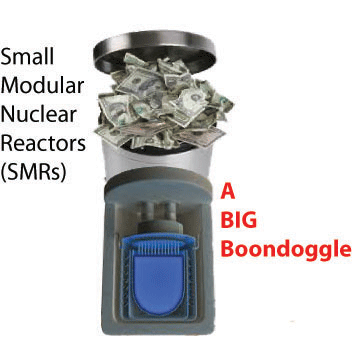
Prefab Nuclear Plants Prove Just as Expensive Modular method has run into costly delays and concerns about who will bear the brunt of the expense., WSJ, By REBECCA SMITHJuly 27, 2015
Building nuclear reactors out of factory-produced modules was supposed to make their construction swifter and cheaper, leading to a new boom in nuclear energy.
But two U.S. sites where nuclear reactors are under construction have been hit with costly delays that have shaken faith in the new construction method and created problems concerning who will bear the added expense.
“Modular construction has not worked out to be the solution that the utilities promised,” said Robert B. Baker, an energy lawyer at Freeman Mathis & Gary LLP in Atlanta and former member of the Georgia Public Service Commission, the state utility authority.
The new building technique calls for fabricating big sections of plants in factories and then hauling them by rail to power-plant sites for final assembly. The method was supposed to prevent a repeat of the notorious delays and cost overruns that marred the last nuclear construction cycle in the 1980s.
It hasn’t worked. Georgia Power Co., a unit of Southern Co. that is building one of the nuclear power plants, reports that construction is three years behind schedule, although it is making steady progress.
“The promise of modular construction has yet to be seen,” said Joseph “Buzz” Miller, executive vice president of nuclear development for Georgia Power. The Georgia plant’s delay will increase the project’s financing costs, potentially adding $319 annually to each residential bill, according to the public interest advocacy staff of the state utility commission. The utility is seeking to recover $778 million in total added financing costs from vendors. It hopes customer bills won’t rise more than 8% to pay for the plant.
Georgia Power expects to spend $7.5 billion for its 46% share in the Vogtle power plant, which is adding two nuclear reactors adjacent to an existing plant near Waynesboro, Ga. That tab is $1.4 billion higher than the spending limit state regulators approved in 2009.
The cost of the V.C. Summer plant that South Carolina Electric & Gas Co. is building near Jenkinsville, S.C., now stands at $6.8 billion for the company’s 55% stake, up $1.1 billion from a 2012 estimate. The company recently agreed to trim its profit margin on the project if regulators approve a revised construction schedule and cost estimate. The commission heard testimony last week but has yet to rule………
U.S. utilities proposed building more than two dozen reactors five years ago before the shale-gas revolution drove down the price of natural gas and made plants that burn gas a more attractive option for the power industry. Last month, the Nuclear Regulatory Commission said it was folding a division to manage construction of new reactors back into the division from which it was pulled a few years ago, acknowledging a nuclear renaissance hasn’t materialized. Write to Rebecca Smith at rebecca.smith@wsj.comhttp://www.wsj.com/articles/pre-fab-nuclear-plants-prove-just-as-expensive-1438040802
What is spectacular is the extent to which the nuclear industry and many decision-makers are appearing to ignore the financial and technical realities of 2015, and the generalized move toward decentralized electricity generation and storage. The industry’s track record of delays and cost overruns, coupled with the urgency of replacing fossil fuels with efficiency improvements and low-carbon sources of energy, do not bode well for the long-term future of the industry.
Deconstructing the nuclear industry, Bulletin of the Atomic Scientists, 27 July 15 Mycle Schneider Antony FroggattReleased on July 15, the World Nuclear Industry Status Report 2015 (WNISR 2015) is the latest independent assessment of nuclear energy trends in a series first published in 1992. This year’s report comes at a time when most energy and environmental experts shy away from the words “nuclear renaissance” but some view nuclear power as an indispensable substitute for fossil fuels in global efforts to combat climate change. Current trends, however, suggest that a rapid ramp-up of nuclear power is unlikely, and that renewable energy is surging past nuclear power in many countries. Here are a few of the report’s key findings: Continue reading →
What made things worse for Japanese doctors who tried to ease the suffering of atom-bomb victims is that information about the bomb and its effects was censored by the American administration occupying Japan
It was bad enough for the Americans to have killed so many people, and then hide the gruesome facts for many years after the war. To forget about the massacre now would be an added insult to the victims. Southard has helped to make sure that this will not happen yet.
‘Nagasaki: Life After Nuclear War,’ by Susan Southard, NYT, By IAN BURUMAJULY 28, 2015 “………..Susan Southard’s harrowing descriptions give us some idea of what it must have been like for people who were unlucky enough not to be killed instantly: “A woman who covered her eyes from the flash lowered her hands to find that the skin of her face had melted into her palms”; “Hundreds of field workers and others staggered by, moaning and crying. Some were missing body parts, and others were so badly burned that even though they were naked, Yoshida couldn’t tell if they were men or women. He saw one person whose eyeballs hung down his face, the sockets empty.”
Gen. Leslie Groves, the director of the Manhattan Project, which had developed the atom bomb, testified before the United States Senate that death from high-dose radiation was “without undue suffering,” and indeed “a very pleasant way to die.”
Many survivors died later, always very unpleasantly, of radiation sickness. Their hair would fall out, they would be covered in purple spots, their skin would rot. And those who survived the first wave of sickness after the war had a much higher than average chance of dying of leukemia or other cancers even decades later. Continue reading →
Japan increases Fukushima compensation to US$57 billion, Malaysian Insider, 28 July 2015 Japan on Tuesday approved an increase in compensation payments for the Fukushima crisis to 7.07 trillion yen (RM218 billion), as tens of thousands of evacuees remain in temporary housing more than four years after the disaster.
Tokyo Electric Power Co (Tepco), the operator of the wrecked Fukushima Daiichi nuclear station, will receive 950 billion yen (RM29 billion) more in public funds on top of the 6.125 trillion agreed earlier, the utility and the government said.
The increase, agreed after a request by Tepco, adds to the bill for taxpayers for the disaster in March 2011, when three reactors melted down after an earthquake and tsunami, in the worst nuclear crisis since Chernobyl in 1986, destroying businesses and livelihoods….
Prime Minister Shinzo Abe’s government and Tepco, which was bailed out by taxpayers in 2012, are undertaking an unprecedented cleanup to lower radiation levels in towns closest to the plant, although some areas will likely remain off limits for decades.
Inside the plant, Tepco has struggled to bring the situation under control and it is estimated removing the melted fuel from the wrecked reactors and cleaning up the site will cost tens of billions of dollars and take decades to complete.
With the South African build is set to cost anywhere up to R1-trillion, that would mean the same cost (adjusted upward with inflation) would have to be born near the end of this century, he says. “Except then you will have no income coming in. Just the cost of powering the reactors while you wind down operations. And the endless cost of looking after the nuclear waste.”
“This is a dying industry and there are just too many unanswered questions for South Africa to go down this path. Except we know the element of corruption can always be present in the nuclear industry,”
Nuclear a ‘technology of the past‘, Mail & Guardian, 27 JUL 2015 SIPHO KINGSA Russian nuclear activist has labelled South Africa’s pursuit of new nuclear capacity – with Russian support – as “naive” and advised against it. “Nuclear is not technology of the future. This is technology of the past, of the Cold War.” This is the conclusion Vladimir Slivyak, of the Russian environmental group Ecodefense, reaches when talking about nuclear technology. Continue reading →
This new nuclear-armed US bomb may be the most dangerous weapon in America’s arsenal, Business Insider,JEREMY BENDER, 27 July 15 The US just introduced a new type of bomb into its already extensive arsenal, and it may just be the most alarming US weapon yet, Zachary Keck writes for The National Interest.
The new bomb is the B61-12. On its surface, the bomb does not appear to be as dangerous as other weapons in the US arsenal. Although the B61-12 is nuclear-armed, it has a yield of 50 kilotons — tiny compared to the largest nuclear bomb that the US possesses, which has a yield of 1,200 kilotons.
But as Keck notes, that difference in explosive power doesn’t tell the entire story.
Ocean acidification is impacting phytoplankton now http://www.enn.com/wildlife/article/48810Steve Williams, Care2, July 26, 2015 Scientists are warning that ocean acidification is impacting microorganisms in our ocean known as phytoplankton and, as they pay a key role in ocean habitats, any future loss or change in species numbers could impact marine life in a big way.
Ocean acidification isn’t always mentioned in conjunction with phytoplankton blooms, and the U.S. Government has been slow to link the two, but MIT researchers say acidification of our oceans could impact phytoplankton in a big way, and that will be bad news for our marine life.
Publishing in the journalNature Climate Change, the scientists say their research shows that ocean acidification–where our oceans absorb gasses like carbon dioxide and sulphor dioxide that are released during the burning of fossil fuels–will increase to such an extent that by 2100 several species of phytoplankton will die out, robbing several larger marine species of a vital food source, while other phytoplankton species will rapidly increase in number, threatening the delicate balance of marine habitats and even potentially threatening the bird populations that depend on marine life.
According to the National Ocean Service (NOAA), phytoplankton are organisms that function in much the same way as the plants we see around us. They contain chlorophyl and depend on sunlight. For that reason they tend to float close to the surface of the water where they can get as much sunlight as possible. They also take in nutrients like nitrates, phosphates and sulfur.
In marine environments phytoplankton play a key role and are a food source for a number of species, from tiny animals like shrimp and snails, all the way up to jellyfish and even whales.
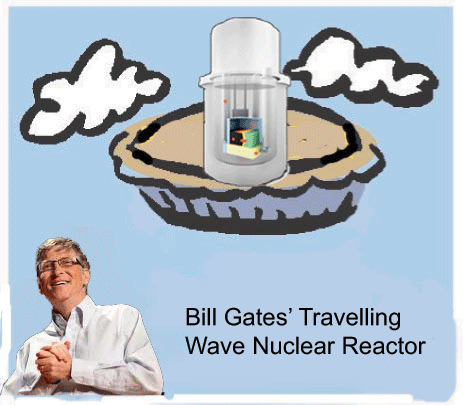
Could Next-Gen Reactors Spark Revival In Nuclear Power?, National Geographic By Wendy Koch, JULY 24, 2015 Tech titans like Bill Gates are helping fund a new generation of commercial nuclear reactors,………..These are complex systems…They look good on paper but could be difficult to realize in practice.
Matthew McKinzie “These are complex systems,” says Matthew McKinzie, director of the nuclear program at the Natural Resources Defense Council, an environmental group that prefers solar, wind and energy efficiency—rather than nuclear—as climate solutions.
“They look great on paper but could be difficult to realize in practice,” he says of the advanced reactors. “A lot of projects in the past have led to disappointment.” He says reactors that don’t use the light-water design common in today’s nuclear power plants will need prototypes for testing and their private funds aren’t enough to cover the cost.
In addition, “molten salt is corrosive and messy to work with,” says McKinzie, who holds a doctorate in experimental nuclear physics..
Russ Bell, senior director of new plant licensing for the Nuclear Energy Institute says many new reactor designs are safe and “extremely innovative,” but since they need to be prototyped, it will take 20 to 25 years to bring them to market……
Bill Gates has visited China several times to seek its cooperation in developing a next-gen reactor. He chairs TerraPower, which has designed a traveling wave reactor that runs on depleted uranium and produces very little nuclear waste……
“It’s American technology. I personally want the United States to get it first,” says Leslie Dewan. Her company, Transatomic, plans five more years of experimental and design work before aiming to build a 20-megawatt prototype.
“We’ve been talking with the national labs about it,” she says, noting the Department of Energy has a new loan guarantee program for advanced nuclear reactors. “There’s really good buy-in from DOE for developing a wide range of technologies.”
Even if all goes well, Dewan says, it will take at least a decade to develop a commercial molten salt reactor.
Congress’s Other Nuclear Test A pending 30-year deal with China requires oversight too. WSJ 26 July 15 “……The deal’s basic purpose is to allow China to keep buying nuclear power plants from U.S. suppliers such as Westinghouse Electric, a slice of bilateral trade responsible for thousands of U.S. jobs, according to industry estimates. Yet civil-nuclear business carries proliferation risks, as technology used in power plants can also serve various military purposes.
Republican Senators Marco Rubio and Tom Cotton oppose the deal given China’s record of proliferating to Iran, North Korea and Pakistan. China has also secretly diverted U.S.-produced nuclear-reactor cooling pumps to make its naval submarines more quiet and therefore more stealthy, as confirmed in Congressional testimony by Assistant Secretary of State Thomas Countryman in May. Such diversion violated China’s commitment to “peaceful use” of imported nuclear technology……..
A House amendment to the defense spending bill would require that the DNI and the Chief of Naval Operations weigh in on interagency approvals of future civil-nuclear sales to China, with the aim of mitigating risks of military diversion.










 nuclear-news