nuclear-news

The News That Matters about the Nuclear Industry Fukushima Chernobyl Mayak Three Mile Island Atomic Testing Radiation Isotope

Plutonium levels 10,000,000 times normal in water below Fukushima reactors

Plutonium levels 10,000,000 times normal in water below Fukushima reactors — Plutonium hit record high off coast in 2014 — “Has been transported relatively long distances” – Every sample taken from rivers flowing into Pacific had Pu-239, Pu-240, Pu-241,and Pu-242 from plant


 Scientists from Japan’s National Institute of Radiological Sciences, Hirosaki University, and Peking University (pdf), May 2015 (emphasis added): Pu Distribution in Seawater in the Near Coastal Area off Fukushima… the amount of Pu isotopes directly released into the marine environment remains unknown. In the high level radioactive accumulated water collected at the FDNPP after the accident, high level radioactivities of Pu isotopes (ca. 10-3 Bq/mL) were detected. These values were 6 to 7 orders of magnitudes [1,000,000 – 10,000,000 times] higher than that of the seawater in the western North Pacific. In addition, a new study on Pu isotopes… suggested there was a potential sediment-borne Pu supply from Fukushima coastal rivers to the Pacific Ocean. Thus more attention should be paid to the contamination situation of Pu isotopes in the marine environment off Fukushima since the FDNPP accident… Pu isotopes in seawater… needs to be routinely investigated… There are two sampling sites close to the FDNP… 239+240Pu concentrations in seawater were reported in 2012-2014 and the range was from detection limit to 14 mBq/m3 except 31 mBq/m3 observed at T-2-1 site on 10 April 2014.

Scientists from Japan, Belgium, and French gov’t (pdf), 2015: Tracing the dispersion of contaminated sediment with plutonium isotope measurements in coastal catchments of Fukushima Prefecture — The Fukushima Dai-ichi Nuclear Power Plant (FDNPP) accident led to important releases of radionuclides into the environment, and trace levels of plutonium (Pu) were detected in northeastern Japan… In this study, we measured Pu isotopic ratios in recently deposited sediments along rivers draining the most contaminated part of the inland radioactive plume… Results showed that the entire range of measured Pu isotopes (i.e. 239Pu, 240Pu, 241Pu, and 242Pu) were detected in all samples, although in extremely low concentrations. The 241Pu/239Pu atom ratios measured in sediment deposits (0.0017 – 0.0884) were significantly higher than the corresponding values attributed to the global fallout (0.00113 – 0.00008 on average in the Northern Hemisphere between 31-71 N)… These results demonstrate that this radionuclide has been transported relatively long distances… and deposited in rivers representing a potential source of Pu to the ocean.

t21

Source: Enenews

http://enenews.com/experts-plutonium-levels-10000000-times-normal-water-below-fukushima-reactors-plutonium-ocean-japan-hit-record-high-2014-pu-transported-relatively-long-distances-every-sample-rivers-flow-pacific

July 11, 2015 Posted by | Japan | , , | Leave a comment

Japan’s 17,000 Tons of Nuclear Waste in Search of a Home

Welcome to Japan, land of cherry blossoms, sushi and sake, and 17,000 metric tons of highly radioactive waste.

That’s what the country has in temporary storage from its nuclear plants. Supporters of atomic power say it’s cleaner than fossil fuels for generating electricity. Detractors say there’s nothing clean about what’s left behind, some of which remains a deadly environmental toxin for thousands of years.

Since atomic power was first harnessed more than 70 years ago, the industry has been trying to solve the problem of safe disposal of the waste. Japan has been thrown into the center of the conundrum by its decision in recent months to retire five reactors after the Fukushima disaster in 2011. It also decided this week to begin the restart process of one reactor despite public opposition.

“It’s part of the price of nuclear energy,” Allison Macfarlane, a former chief of the U.S. Nuclear Regulatory Commission, said in an interview in Tokyo on atomic waste. “Now, especially with the decommissioning of sites, there will be more pressure to do something with this material. Because you have to.”

For more than half a century, nuclear plants in more than 30 countries have been humming away — lighting up Tokyo’s Ginza, putting the twinkle into New York’s Broadway and keeping the elevators running up the Eiffel Tower. Plus powering appliances in countless households, factories and offices around the world.

In the process, the world’s 437 operating reactors now produce about 12,000 tons of high-level waste a year, or the equivalent of 100 double-decker buses, according to the World Nuclear Association.

Fukushima Disaster

Most countries now agree burying atomic waste deep underground is the best option. Other ideas like firing it into space or tossing it inside a volcano came and went.

The U.S., with the most reactors, spent an estimated $15 billion on a site for nuclear refuse in Yucca Mountain, Nevada. Local opposition derailed the plan, meaning about 49,000 tons of spent fuel sits in cooling pools at nuclear plants around the country.

Japan faces another challenge. Four years ago, the country had a nuclear accident unlike anything seen before. An earthquake and tsunami ripped through the engineering defenses at the Fukushima plant north of Tokyo and caused the meltdown of three reactors.

It will need billions of dollars and technology not yet invented to clean up Fukushima. How long that will take is disputed. The operator, Tokyo Electric Power Co., estimates 40 years. Greenpeace says it could take twice that time.

‘Ethical Responsibility’

All Japan’s 43 operational reactors have been offline since September 2013 for safety checks after the disaster. The government has said atomic power is essential to energy supply and reactors that meet safety standards will be allowed to restart.

The first in line belongs to Kyushu Electric Power Co., which today said it has finished refueling one of its units in southern Japan. It plans to restart the plant in August, which means generation of more nuclear waste.

It will be a “failure in our ethical responsibility to future generations,” to restart reactors without a clear plan for waste storage, the Science Council of Japan said in April.

No Thanks

Japan’s Nuclear Waste Management Organization, known as NUMO, has been searching for a permanent storage site for years, initially inviting districts to apply as a host.

In 2007, it got one when the mayor of a town called Toyo submitted interest. Like the residents near Yucca Mountain in the U.S., Toyo’s citizens didn’t like the idea and voted him out of office. His successor canceled the plan.

Now facing the accelerated shutdown of some reactors post-Fukushima, NUMO in May ditched the idea of waiting for a volunteer. Instead, scientists will nominate suitable regions.

“We’d like all citizens to be aware and feel ownership of this situation,” said Takao Kinoshita, a NUMO official. “We should feel grateful for the community that’s doing something for the benefit of the whole country and respect their bravery.”

Deep Underground

NUMO’s plan for a final underground repository was drawn up in 2007 and would cost 3.5 trillion yen ($29 billion).

It would contain about 40,000 canisters, each weighing half a ton and holding waste at temperatures above 200 degrees Celsius (392 Fahrenheit). The contents would give off 1,500 sieverts of radiation an hour, a level that would instantly kill a human being.

The canisters need to cool in interim storage for as long as 50 years before heading 300 meters below ground. Their stainless steel inner layer is wrapped in bentonite clay to make sure water can’t leak inside.

“That’s the biggest risk we see, water leaking through,” said Kinoshita.

Finland and Sweden are the only two countries so far to have selected and reached a public agreement on a final site and storage technology for high-level nuclear waste. Finland’s is expected to open in 2020.

Taking apart a reactor, known as decommissioning, produces a few tons of highly radioactive material, usually the used fuel and coolant. The buildings and equipment account for thousands of tons of so-called low-level waste.

Disposal Confusion

Japan’s government is responsible for dealing with the most radioactive waste. The plant operator handles the rest.

“Even in the low-level category there is the relatively higher-level waste and the nation’s technical solutions are not ready,” Makoto Yagi, the president of Kansai Electric Power Co., said at a June briefing in Tokyo.

Shaun Bernie, senior nuclear specialist with Greenpeace Germany, said this shows Japan’s reactor program and high-level nuclear waste policy is “in a state of crisis.”

Without a clear disposal strategy, costs to take apart the reactors can end up being double original estimate, said Colin Austin, senior vice president at Energy Solutions, which has worked on every decommissioning project in the U.S.

Another wrinkle in Japan for finding a final disposal site is that the country sits on a mesh of colliding tectonic plates that make it one of the most earthquake-prone countries in the world.

Former NRC chief Macfarlane, who is also a seismologist, said that doesn’t make it impossible to bury the waste. A repository hundreds of meters underground is partly protected against quakes in the same way submarines are during high storms, she said.

Leaving nuclear waste on the surface indefinitely means it will get into the environment so Japan has to solve this, she said.

“An adequate place underground is better than waiting for the best possible place.”

Source: Bloomberg Business

http://www.bloomberg.com/news/articles/2015-07-10/japan-s-17-000-tons-of-nuclear-waste-in-search-of-a-home

July 11, 2015 Posted by | Japan | | Leave a comment

Sellafield workers join Fukushima clean-up operation

Sellafield workers are helping clean up the destroyed ‪#‎Fukushima‬ nuclear plant A group of Sellafield Ltd workers have spent five days at the tsunami-stricken Fukushima plant in Japan, which is in the process of “being decommissioned” after being devastated in 2011.
The trip is part of Sellafield Ltd’s ongoing commitment to support Tepco FDEC (Fukushima Daiichi Decontamination and Decommissioning Engineering Company), the company charged with the task of cleaning up the site.
During the most recent visit, Sellafield Ltd experts toured the facility and surrounding area, seeing first hand a decontamination effort of unprecedented scale, while providing advice and technical expertise on environmental management and radiation protection.
This was a follow-up to a successful trip to west Cumbria last year by their Japanese counterparts, who are already implementing some of the environmental practices used at the Sellafield site.
Members of the leadership team, including the recently appointed Managing Director, Paul Foster, also toured the plant to see the progress being made and provide a more long-term, strategic insight into decommissioning programme.
“My first impression of Fukushima was something I will never forget,” said Mr Foster.
“We’ve probably all seen the news footage of the reactor buildings which were severely damaged by the explosions, but to actually be there and see it first hand was a humbling experience.
“We’re keen to help them as much as we can and the fact that they are so keen to access the skills and expertise that exists in west Cumbria is something of which I am extremely proud.”
Although there is much more work to be done, the progress at Fukushima to date indicates that the benefits of the arrangement are already being realised, with experts from west Cumbria actively contributing to the clean-up.
Mr Foster added: “During the visit we shared our approach to managing large, complex programmes as well as some of our technical and tactical issues. They want to learn from us and, in time, we will learn much from them.”
“Seeing the sheer scale of the task at Fukushima highlights why we must continue to share experience and technical expertise amongst the global nuclear family, and this now resonates with me more strongly than ever.
“This was always the intention of the agreement and the benefits already emerging prove that it is happening in reality, making us both better equipped to deliver our respective missions.”
This mutual commitment between Sellafield Ltd and Tepco FDEC was formalised in a co-operation agreement, signed by the two companies in 2014, which would see them exchange knowledge, experience and skills on an on-going basis to ultimately help “decommission both plants as quickly and safely as possible.” 

Source: News and Star

http://www.newsandstar.co.uk/news/1.1222143

July 11, 2015 Posted by | Japan | | Leave a comment

Kyushu Electric finishes loading fuel into nuclear reactor

Kyushu Electric has completed loading nuclear fuel into a reactor at Sendai Nuclear Station,
The last rod assembly —the 157th — was embedded into the reactor at 12:12 a.m. Friday, ending an operation that engaged some 50 workers around the clock since the loading process started Tuesday at the station in Kagoshima Prefecture, a company official said.
Subject to inspection clearance by the government’s Nuclear Regulation Authority in the coming days, Kyushu Electric is envisaging firing up the reactor around Aug. 10 to start trial power transmission three days later.
The reactor is expected to be geared up to full steam later in the month before starting commercial power transmission in September, a move that would likely bring relief to the company, which has been reeling from losses caused by hefty fossil fuel costs to run conventional power plants with all its six nuclear reactors idled.
The resumption of the reactor — one of the two at the Sendai plant — will mark the restart of nuclear power generation in Japan that has been at a standstill due to safety concerns following the ongoing triple meltdown disaster at the Fukushima plant. None of Japan’s commercial reactors has been online for nearly two years.
If the nuclear authority finds any problem, Kyushu Electric will be required to address it and this may result in the restart being delayed.
The utility is aiming to reload fuel into the second reactor at the Sendai plant in early September and reboot it in mid-October. 

Source: Japan Times 

http://www.japantimes.co.jp/news/2015/07/10/national/kyushu-electric-finishes-loading-fuel-nuclear-reactor/#.VZ_o5PmFSM9

July 11, 2015 Posted by | Japan | , | Leave a comment

Brief notes on the past week’s nuclear news

Christina Macpherson's websites & blogs

Christina Macpherson’s websites & blogs

WORDS. on the theme the power of words – here are a few news items: New names for nuclear weapons – covering up the $billions spent on them. Russia’s nuclear industry to “educate” South Africans. Book “Atomic Comics” shows corporate influence, glossing over nuclear dangersMainstream media is complicit in cover-up of effects of Fukushima radiation.

WORLD. Ionising Radiation & Risk of Death from Leukaemia & Lymphoma in Radiation-Monitored Workers (INWORKS): anInternational Cohort Study

NIGERIA‘ s Akwa Ibom State Leaders Caucus says NO to nuclear power.

FRANCE: Grim future for France’s nuclear companies AREVA and EDF. When France shuts its nuclear reactors, it will be left with amonumental radioactive trash problem.

UK. Game Over for UK’s Hinkley Point Nuclear power project? Hinkley Point nuclear project could be delayed by years, due to Austrian legal action. Revelations on the dirty work given to Windscale nuclear cleanup workers – and at Hanford.

UKRAINE. Increased ionising radiation in Chernobyl area, following wildfires.

MARSHALL ISLANDSNuclear Waste Tomb in Marshall Islands – becoming more dangerous because of climate change

JAPAN.  Fukushima

SOUTH AFRICA. Investigation at last into radioactive pollution of Johannesburg, from uranium mining.

FINLAND. Russia’s Rosatom behind the funding for Finland’s Fennovoima nuclear project.

USA. NASA cancelling solar space missions, favouring plutonium fuelled space flights !  A losing bet – Bill Gates’ gamble on nuclear power. USA’s faith groups unite in push for clean energy. Why the nuclear industry keen to save US government’s Export-Import Bank.

CANADA.  Canada’s last shipment of weapons grade uranium. Medical radioisotopes to be made in cyclotron, not nuclear reactor. Organization of Canadian Nuclear Industries (OCI) to work with Romania to market nuclear reactors.

RUSSIA. Russia trying to sell nuclear reactors to Europe, but financing them is a snag

July 10, 2015 Posted by | Christina's notes | Leave a comment

New names for nuclear weapons – covering up the $billions spent on them

text-relevantWhen politicians are telling us that they’re trying to create a world without nuclear weapons, it’s misleading for the military to just give nuclear weapons new names. It’s even more misleading to spend billions of dollars rebuilding and renaming old nuclear weapons, just so that those politicians can say that we’re not creating any new ones.

The Air Force Just Dropped an Expensive (and Useless) Nuke in Nevada http://gizmodo.com/the-air-force-just-dropped-an-expensive-and-useless-n-1716527174 Adam Clark Estes  7/08/15 In the face of mounting criticism, the Air Force just completed the first test flight of the B61 Mod 12 mock up nuclear bomb in the Nevada desert. This marks the next step in updating a cold war-era weapon that many experts consider to be completely useless today. The military might as well drop a nuke on a pile of taxpayer dollars.

The whole situation is frustrating, in part, because it’s based on some scary assumptions about an impending nuclear apocalypse. Since its development in 1963—a year after the Cuban missile crisis—the B61 has been one of top weapons in the U.S. nuclear arsenal. Capable of carriage in supersonic aircraft and a two-stage radiation implosion, this is a bad bomb that we might’ve dropped on Moscow if things had escalated with the Soviets.

However, as the New York Times editorial board explained things a couple years ago, the bombs are “the detritus of the cold war.” The updated B61s are also a very, very expensive detritus. President Obama is already throwing hundreds of millions of dollars at this program to keep these nukes on life support. The total cost of the program is expected to be as high as $11 billion by its completion in the 2020s, while the true nature of the upgrade is being masked.

This is a nonsensical decision, not least because it is at odds with Mr. Obama’s own vision. In a seminal speech in Prague in 2009 and a strategy review in 2010, Mr. Obama advocated the long-term goal of a world without nuclear arms and promised to reduce America’s reliance on them. He also promised not to field a new and improved warhead.

wobblyBut refurbishing warheads from the 1960s is apparently cool. Meanwhile, the National Nuclear Security Administration (NNSA) and the Air Force still insists on referring to these types of weapons as “gravity bombs” in this modern era. This is misleading since a gravity bomb is really any unguided bomb. Really, it’s a nuke wrapped in a gravity bomb wrapped in a euphemism.

So it’s basically bullshit when Obama and friends talk up their anti-proliferation efforts. In truth, the government is still spending billions on nukes tuned towards the former USSR, while also doing nothing to influence with China, India, or Pakistan (or Israel) to rein in their nuclear programs. An expert gave a lengthy Congressional Testimony on this very topic just a few months ago. Similarly, the Air Force is actively updating its nuclear weapons operation in order to fight a nuclear war when the time is right. As Maj. Gen. Sandra Finan, the commander of the Air Force Nuclear Weapons Center, put it in an April press release, “Our mission is still to deliver nuclear capabilities and winning solutions that warfighters use daily to deter our enemies and assure our allies.”

This is what brings us back to those assumptions about a scary nuclear apocalypse. When politicians are telling us that they’re trying to create a world without nuclear weapons, it’s misleading for the military to just give nuclear weapons new names. It’s even more misleading to spend billions of dollars rebuilding and renaming old nuclear weapons, just so that those politicians can say that we’re not creating any new ones.

Just call a nuke a nuke. The Air Force just dropped an expensive and inevitably useless nuke in the Nevada desert. There was no mushroom cloud this time. But there’s always a next time.


July 10, 2015 Posted by | spinbuster, USA, weapons and war | Leave a comment

Russia’s nuclear industry to “educate” South Africans

Russian-Bearflag-S.AfricaNuclear deal – 200 South Africans to be “educated” during excursions to Russia http://www.biznews.com/briefs/2015/07/09/nuclear-deal-200-south-africans-to-be-educated-during-excursions-to-russia/ ALEC HOGG JULY 9, 2015 Cape Town – The Department of Energy announced in a statement on Thursday that it has signed two memoranda of understanding with Russian state nuclear energy corporation Rosatom at the 7th summit of the Brics (Brazil, Russia, India, China and South Africa) countries in the Russian city of Ufa.

According to the first document, Russia and South Africa aim to implement several joint projects for education in the nuclear power industry.

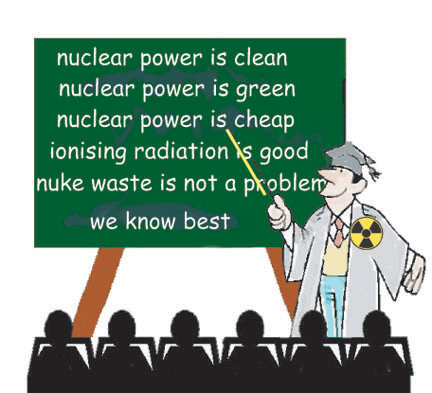
nuclear-teacher

The countries will cooperate to provide training for five categories of specialists for the South African nuclear industry: nuclear power plant personnel, engineers and construction workers, staff for operations not related to the power industry, personnel for nuclear infrastructure, students and teachers.

There will also be education programmes for 200 South African candidates at Russian universities and educational organisations. This memorandum stipulates the development of educational materials and scientific literature on nuclear power, student exchange programmes for students of various levels of training, organisation of internships and summer courses, student competitions and teacher training.

The second memorandum signed in Ufa stipulates joint efforts of the parties to promote nuclear power in South Africa, increasing the awareness of local residents of modern nuclear technologies used in the power industry and in other industries, and ensuring public acceptance of nuclear power.

In particular, the parties have agreed to work out a plan for the implementation of a joint communication programme to be launched in South Africa. This will involve the organisation of round tables and other events aimed at promoting nuclear power and modern nuclear technologies.

A nuclear energy information centre in South Africa is also under consideration. “The parties seek to exchange information and best practices in the nuclear industry by organising working visits and international conferences and exhibitions,” said the Department of Energy.   Source: http://www.fin24.com/Economy/Rosatom-seeks-to-educate-SA-on-nuclear-power-20150709

July 10, 2015 Posted by | politics, Russia, South Africa | Leave a comment

Nigeria’s Akwa Ibom State Leaders Caucus says NO to nuclear power

logo-NO-nuclear-SmNigeria: Caucus Rejects Siting of Nuclear Plant in Akwa Ibom All Africa, By Idongesit Ashameri, 7 July 15

Uyo — The Akwa Ibom State Leaders Caucus has rejected plans by the Nigerian Atomic Energy Commission (NAEC) to site a Nuclear Power plant in Itu local Government Area of the state. The group attributed their rejection of the Nuclear Power plant to disastrous consequences that failure of nuclear plants had brought in other parts of the world.

The leaders’ caucus questioned why Nigeria, which they said had a perennial incompetence in matters of safety and security, could venture into such a risky project, while countries with known competences, like Germany, Italy, USA, Russia and Japan are shutting down such plants.

 Addressing a press conference in Uyo, the Akwa Ibom State capital on last week Thursday, the Leaders Caucus represented by Senator Anietie Okon said that for Nigeria with its famed lack of maintainable culture, to dabble into such risky venture was a clear and deliberate invitation to disaster of monumental proportions……..http://allafrica.com/stories/201507071359.html

July 10, 2015 Posted by | Nigeria, opposition to nuclear | Leave a comment

Investigation at last into radioactive pollution of Johannesburg, from uranium mining

uranium-ore

“[Johannesburg] is undoubtedly the most uranium-contaminated city in the world,”

Bench Marks, which receives support from UK charity Christian Aid, is mid-way through a three-year impact assessment of pollution levels in an around Johannesburg’s Soweto district. By systematically tracking air and water contamination, Bench Marks hopes to provide a scientific basis for the alleged health impacts of the tailings

Radioactive city: how Johannesburg’s townships are paying for its mining past, Guardian,  , 6 July 15 

Much of the waste from 600 abandoned mines around South Africa’s largest city is piled high next to residential communities – most of which are poor and black Plaatjies is one of tens of thousands in Johannesburg’s impoverished townships who are paying a high cost for the city’s rich mining past. More than 600 abandoned mines surround South Africa’s largest city, with much of their waste now piled up high next to residential communities – most of which are poor and black.

Residents here fear the wind most. When it blows, fine particles from these man-made dumps are carried up into the air and deposited on to residents’ homes. It is no ordinary dust, either: the residue of decades of mining, it can contain traces of everything from copper and lead to cyanide and arsenic.

“During August and September, the dust is terrible. You stop cleaning the floor after a while. It’s just useless,” says Plaatjies.

In the local clinic, respiratory cases such as tuberculosis and asthma are ubiquitous across all age groups, says Musa Mbatha, chairman of the clinic’s civic committee. Rashes and skins diseases are commonplace, too.

“People can’t afford to buy food every day, so they leave the food and it gets contaminated,” Mbatha adds. “The government said that it would do a survey of the health impacts of the mining dust, but until today it hasn’t happened.”

An even more dangerous pollutant is lurking in Johannesburg’s mine dumps, however: radioactive waste. According to one university study, an estimated 600,000 metric tonnes of radioactive uranium are buried in waste rock in and around Johannesburg – around three times what was exported during the Cold WarContinue reading

July 10, 2015 Posted by | environment, Uranium | Leave a comment

TEPCO’s plan for decommissioning Fukushima nuclear Unit 3

Chairman Allison Macfarlane and other NRC officials stand in the darkened interior of Reactor 4 at the Fukushima Dai-ichi nuclear complex northeast of Tokyo Dec. 13, 2012. Photo courtesy of TEPCOFukushima Unit 3 Decommissioning Plan Released, Simply Info,  July 8th, 2015 [Excellent graphs and photos] TEPCO released significant new information about the plan and progress for dealing with unit 3′s spent fuel pool. The report was buried among other documents related to periodic reporting and didn’t receive any press in Japan.

Radiation levels are a constant problem for this work effort. A significant portion of the planning has gone into ways to lower the radiation doses on the refueling floor even though work such as crane operations will be done remotely from another building. Damage to the building structure is another major challenge. The defueling building and any shielding must be designed to not further damage unstable portions of the building.

The defueling building will span over the existing remains of unit 3. Footings will run down to the ground on one side and to an accessory building on the other. Radiation levels are going to be a problem not just for any workers that might have to do some sort of hands on work but to equipment installed over time. High levels of radiation can damage electronics.

The actual defueling building has already been built. A dry run assembly was done in 2014 at the storage facility at Onahama Port near Fukushima Daiichi. The building now sits disassembled at the port waiting for installation on site………..http://www.fukuleaks.org/web/?p=14857

July 10, 2015 Posted by | Fukushima 2015 | Leave a comment

Russia’s Rosatom behind the funding for Finland’s Fennovoima nuclear project

That’s not the end of nuclear problems in Finland. The country is suffering through a protracted mess with Areva, the French nuclear company, over the building the Olkiluoto 3 nuclear plant. The project is years late and billions over budget with no end to the problems in sight.

With lessons like those from Rosatom and Areva’s Finnish nuclear projects, it is no wonder that in Finland the public majority is against nuclear.

Russian-Bearflag-FinlandCount on the nuclear industry to have strange things happen http://www.greenpeace.org/international/en/news/Blogs/nuclear-reaction/Rosatom-Finnish-nuclear-project/blog/53456/?__surl__=Igtmc&__ots__=1436367733419&__step__=1

by Brian Blomme – 7 July, 2015 

It has been said often on the Nuclear Reaction blog but bears repeating: the nuclear industry really can’t be trusted. A good case in point is the bizarre antics in Finland right now. On June 30th, Fennovoima, a Finnish utility, submitted an application to the government to build a nuclear plant. One of the utility’s partners is Rosatom, the Russian state nuclear corporation.

To apply for a license, the government requires the project to be 60% owned by companies from the European Union or the European Trade Association. The 60% criterion was put in place by the Finnish government in order to control Russian influence over the country’s energy policy. And that means that Rosatom can’t be the biggest player in this game.

But, a strange thing happened on the filing deadline of June 30. Out of the blue, a new financing partner was found so that the project could meet the 60% rule and could go ahead. At least, that’s the claim.

Greenpeace Nordic decided to take a closer look at this strangely fortuitous development for Rosatom’s Finnish nuclear project. We uncovered what appears to be quite a different story, from a serendipitous turn of events in the form of a new nuclear investment partner.

Instead of a viable European company with a track record that would suggest it is a credible business partner, Greenpeace found a Croatian company, Migrit Solarna Energija, that operates out of an apartment block in Zagreb. It has no employees, capital stock of only 26,000 Euros, and absolutely no income in 2012-2013. And yet, this company is supposedly going to be able to contribute 150 million Euros to the project?

More importantly, Greenpeace found what appear to be strong ties between this tiny company holed up in an apartment complex, and Russia’s nuclear giant, Rosatom.   Continue reading

July 10, 2015 Posted by | Finland, secrets,lies and civil liberties | Leave a comment

Hinkley Point nuclear project could be delayed by years, due to Austrian legal action


justiceflag Austriaflag-UKAUSTRIAN LEGAL ACTION COULD DELAY HINKLEY POINT NUCLEAR FOR THREE TO FOUR YEARS, Power Engineering  
09/07/2015 

International Digital Editor Based on the average data associated with such cases, the legal objection made by Austria this week against the European Commission to facilitate Hinkley Point C nuclear power plant could delay the progress of the facility for around three to four years.

That timeframe is based on the average expectation associated with such cases, as confirmed this week by a legal expert who had been advising the Austrian government on the matter. It is less than the worst case scenario timeframe of five to eight years but that delay is not beyond the bounds of possibility as the subsequent decision could still be challenged.

Dr Dorte Fouquet, Partner, BBH Brussels who has been advising Vienna on the matter of their objection to Britain’s flagship nuclear power project on the basis of State Aid contravention told Power Engineering International, “From the publication on average statistics from the European Court in State Aid cases the duration can be on average between 31,5 und 50,3 months.”

Dr Fouquet quoted the information from the 2013 Annual report of the European Court of Justice, (pg. 186).

She had told an audience at Platts Power Summit in central London at the end of April that if Vienna pressed on with its challenge it could set back construction of the Hinkley Point C project for even longer than that average.

“Based on whether a party was unhappy with that, it could then go again before the European Court of Justice, which could also take years, though probably not as much as the first; this is based on average procedures.”……….

Dr. Reinhard Schanda, a partner at the Vienna-based law firm Sattler & Schanda told PEi that a three to four year delay is ‘optimistic’. ……..http://www.powerengineeringint.com/articles/2015/07/austrian-legal-action-could-delay-hinkley-point-nuclear-for-three-to-four-years.html

July 10, 2015 Posted by | EUROPE, Legal, UK | Leave a comment

Japanese public not well informed on the grim realities of Fukushima

see-no-evilflag-japanView from Inside Fukushima Prefecture: Vastly Different from Govt. Pronouncements, UK Progressive,   by Robert Hunziker, 8 July 15  Because of Japan’s unconscionable open-ended new secrecy law, it is very likely journalism in the nation has turned tail, scared of its own shadow. Nevertheless, glimmers of what has happened, of what is happening, do surface when brave people come forward.

On May 22nd 2015 Hiromichi Ugaya, a photojournalist who is well-informed, insightful, and engaging, was interviewed about what he witnessed in the aftermath of one of the world’s most horrendous disasters……..

Naïveté of Public Continue reading

July 10, 2015 Posted by | Japan, secrets,lies and civil liberties | Leave a comment

Multiple dangers of MOX fuel used in Fukushima’s No 3 nuclear reactor

MOX fuel rods used in Japanese Nuclear Reactor present multiple dangers, DC Bureau By March 15th, 2011 The mixed oxide fuel rods used in the compromised number three reactor at the Fukushima Daiichi complex contain enough plutonium to threaten public health with the possibility of inhalation of airborne plutonium particles. The compromised fuel rods supplied to the Tokyo Electric Company by the French firm AREVA.

Plutonium is at its most dangerous when it is inhaled and gets into the lungs. The effect on the human body is to vastly increase the chance of developing fatal cancers.

Plutonium diabolical

Masashi Goto, a reactor researcher and designer for Toshiba, told the Foreign Correspondents Club in Toyko the mixed oxide (MOX) fuel used in unit 3 of the Fukushima Daiichi nuclear facility uses plutonium, which is “much more toxic than the fuel used in the other reactors.”

Goto said that the MOX also has a lower melting point than the other reactor fuels. The Fukushima facility began using MOX fuel in September 2010, becoming the third plant in Japan to do so, according to MOX supplier AREVA.

Part of the process of making MOX fuel is to grind plutonium into a fine power before it is robotically inserted into fuel rods. Experts agree these tiny plutonium particles once airborne are extremely dangerous to human health. One of the unique characteristics of mixed oxide fuel is that relatively little of the plutonium in the fuel rods is used up in the fuel cycle in a reactor. “When the plutonium in the fuel rods goes into a reactor for commercial power, a very little of it is going to be consumed. I don’t know what percentage, maybe half percentage or something like that, but it’s going to generate an extraordinary amount of contamination throughout the fuel rods…,” says William Lawler, an expert on radioactive waste…….

Mixed oxide fuel is a combination of finely ground up plutonium particles and uranium oxide fabricated into fuel rods at an AREVA subsidiary in La Hague, France.  The fuel is made from reprocessing old reactor fuel. Reprocessing was abandoned by the United States in the 1970s because of the dangers of weapons proliferation.

The CIA has reported that Japan’s nuclear power program was not limited to the peaceful production of electrical power. The program had its roots in a secret weapons program that caused the CIA to conclude as far back as 1964 that Japan could assemble within months a nuclear weapon.

Because of the Japanese public’s fear of nuclear weapons, the various subsequent Japanese governments have kept the program secret and have repeatedly denied its existence when news organizations made inquiries. http://www.dcbureau.org/20110315782/natural-resources-news-service/mox-fuel-rods-used-in-japanese-nuclear-reactor-present-multiple-dangers.html#sthash.NydPfWmn.dpuf

July 10, 2015 Posted by | - plutonium, Japan, safety | 2 Comments

Uranium mining company BHP supports Paris climate talks – in order to promote nuclear power?

Christina Macpherson's websites & blogs

Christina Macpherson’s websites & blogs

As a proud non-subscriber to THE AUSTRALIAN, I haven’t been able to read this article. But on past performance of BHP, I reckon that I can have a pretty good guess on what BHP’s enthusiasm for climate action really means.

Last month, all the nuclear big-wigs met somewhere in Europe to plan a campaign about the Paris Climate Summit in December . The idea is to have nuclear power established as a solution to climate change.

BHP would love that – otherwise they couldn’t give a damn about climate change.

BHP embraces climate debate, THE AUSTRALIAN, ? 8 July 15  
The private sector needs to play a part in this year’s Paris climate talks, says BHP Billiton’s Dean Dalla Valle…. (subscribers only) 

July 10, 2015 Posted by | AUSTRALIA, climate change | Leave a comment