Human caused global warming hardly dinted by a new grand solar minimum
 A grand solar minimum would barely make a dent in human-caused global warming, Guardian, Dana Nuccitelli, August 2014
So, in order to trigger another LIA, a new grand solar minimum would have to cause about 1°C cooling, plus it would have to offset the continued human-caused global warming of 1 to 5°C by 2100, depending on how our greenhouse gas emissions change over the next century.
In the Jyllands-Posten article, Henrik Svensmark (the main scientist behind the hypothesis that the sun has a significant indirect impact on global climate via galactic cosmic rays) was a bit more measured, suggesting,
“I can imagine that it will become 0.2°C colder. I would be surprised if it became 1–2°C”
So these two articles are suggesting that a grand solar minimum could have a net cooling effect in the ballpark of 1 to 6°C, depending on how human greenhouse gas emissions change over the next century. Is it plausible that a grand solar minimum could make that happen?
The short answer is, ‘No.’
Fortunately, Solar Output is Stable
We’re fortunate that the amount of solar radiation reaching the Earth’s surface is very stable. Climate contrarians will often ask if we’d prefer if the planet were warming or cooling, suggesting that global warming is a good thing because at least the planet isn’t getting colder. This is a false dichotomy – an ideal climate is a stable one………
Peer-Reviewed Research Says Global Warming will Continue
There have been several studies in recent years investigating what impact another grand solar minimum would have on global surface temperatures, since solar research suggests it’s possible we could be due for another extended solar minimum. Generally these studies will run climate model simulations under a given greenhouse gas emissions scenario with stable solar activity, then run the same scenario with the sun going into a grand minimum, and look at the difference in resulting global surface temperature changes.
Using this approach, Feulner & Rahmstorf (2010) (PDF available here) estimated that another solar minimum equivalent to the Dalton and Maunder minima would cause 0.09°C and 0.26°C cooling, respectively………
Human Influence on Climate Change is Bigger than the Sun’s
The bottom line is that the sun and the amount of solar radiation reaching Earth are very stable. Even during the Maunder and Dalton grand solar minima, global cooling was relatively small – smaller than the amount of global warming caused by human greenhouse gas emissions over the past century.
A new grand solar minimum would not trigger another LIA; in fact, the maximum 0.3°C cooling would barely make a dent in the human-caused global warming over the next century. While it would be enough to offset to about a decade’s worth of human-caused warming, it’s also important to bear in mind that any solar cooling would only be temporary, until the end of the solar minimum.
The science is quite clear that the human influence on climate change has become bigger than the sun’s. At this point, speculation about another mini ice age is pure fantasy. http://www.theguardian.com/environment/climate-consensus-97-per-cent/2013/aug/14/global-warming-solar-minimum-barely-dent
Highest Strontium-90 density detected in seawater of Fukushima plant port / 1,500,000 Bq/m3

From Tepco’s report published on 7/17/2015, Strontium-90 density in seawater of Fukushima plant port became the highest since they started measuring.
The sampling location was between water intake of Reactor 3 and 4, and also screen of Reactor 4, which are in front of Reactor 3 & 4.
The samples were collected on 6/1/2015. This analysis result has not been published for over a month.
1,500,000 Bq/m3 of Strontium-90 was detected from both of the samples.
The previous highest reading was 1,000,000 Bq/m3, which was detected at the same sampling location on 5/4/2015.
http://www.tepco.co.jp/nu/fukushima-np/f1/smp/2015/images/2tb-east_15071701-j.pdf
Source: Fukushima Diary
Highest Strontium-90 density detected in seawater of Fukushima plant port / 1,500,000 Bq/m3
Transfer of radiation-tainted soil from Fukushima Prefecture school starts
TANAGURA, FUKUSHIMA PREF. – The Environment Ministry on Saturday started work to transport radiation-tainted soil and other waste from an elementary school in Fukushima Prefecture, home to Tokyo Electric Power Co.’s Fukushima No. 1 nuclear power plant damaged in the March 2011 earthquake and tsunami, to an interim storage site in the same prefecture on a trial basis.
The ministry plans to finish the work before the end of August while schoolchildren are taking their summer holidays, officials said. A total of 1,500 cu. meters of soil and other tainted items from decontamination work are kept at Yashirogawa elementary school in the town of Tanagura.
This marks the first transportation of tainted soil from a Fukushima school to the interim storage site that straddles the towns of Okuma and Futaba.
Trial work to move polluted soil will begin also at four other Fukushima elementary schools soon. The amount of contaminated waste at the four schools in the city of Koriyama and the town of Asakawa totals about 1,500 cu. meters.
According to the Fukushima Prefectural Government, a total of 316,400 cu. meters of tainted soil is being stored at 1,173 locations in the prefecture, including schools and kindergartens, as of the end of March. The amount to be transferred to the interim storage site during fiscal 2015, which ends March 31, will be limited, prefectural officials said.
Decontamination at Yashirogawa elementary school was conducted from January to June this year. Soil and other waste from the cleanup work is kept mainly in sacks.
On Saturday, some 20 workers were engaged in the transportation work. The school is about 150 km from the interim storage site.
The prefecture launched the experimental transportation program in March. About 43,000 cu. meters of waste from 43 cities, towns and villages will be transferred to the storage site within fiscal 2015. The work has been completed in six municipalities, including Okuma and Futaba.
Source : Japan Times
http://www.japantimes.co.jp/news/2015/07/19/national/science-health/transfer-of-radiation-tainted-soil-from-fukushima-prefecture-school-starts/#.Vavnv_mFSM9
Fukushima Daiichi Decommissioning: Follow The Money
Are the meltdowns at Fukushima Daiichi over? The answer is no. In Fairewinds’ latest video, Chief Engineer and nuclear expert Arnie Gundersen updates viewers on what’s going on at the Japanese nuclear meltdown site, Fukushima Daiichi. As the Japanese government and utility owner Tokyo Electric Power Company push for the quick decommissioning and dismantling of this man-made disaster, the press and scientists need to ask, “Why is the Ukrainian government waiting at least 100 years to attempt to decommission Chernobyl, while the Japanese Government and TEPCO claim that Fukushima Daiichi will be decommissioned and dismantled during the next 30 years?”
Like so many big government + big business controversies, the answer has nothing to do with science, and everything to do with politics and money. To understand Fukushima Daiichi, you need to follow the money.
Source: Fairewinds
The use of words to trivialise the Fukushima nuclear catastrophe
 Lies and censorship have from the very beginning been entwined with all manner of nuclear issues.
expert disagreements and self-interest and narrow specialist perspectives conjoin with endemic and ordained secrecy and censorship. Nuclear electricity was at birth intertwined with nuclear weapons, and provides material for and cover for nuclear weapons production: thus, nuclear energy became subject to the hallowed deceptions ‘mandated’ by ‘military considerations’, ‘national insecurity’ and so on.
The global mass media have remained almost entirely true to their despicable selves and avoided like the plague integrity and quality journalism regarding Fukushima
 Our Nuclear Heritage: The Fukushima Catastrophe, Too Clever By A Half-Life By Robert Snefjella 14 July, 2015 Countercurrents.org
“The unleashed power of the atom has changed everything save our mode of thinking and we thus drift towards unparalleled catastrophe.”- Albert Einstein
Has the Fukushima nuclear disaster, beginning in March 2011, been extremely harmful and is it extremely ominous? Or  will the Fukushima ‘problem’ have negligible health impact, as offered by various ‘experts’ and ‘prominent’ institutions and commentators.
On the one hand, massive numbers and large varieties of lifeforms in the North Pacific Ocean, in the post-Fukushima period, are already extensively destroyed, dead or dying, or deformed. [1] Several large nuclear reactors blew up with, among many other nasty elements, plutonium [2] on board, and have now for four years been melting down and emitting massive amounts of radiation into the global environment. [3] This ensures more mutations, more deformities, more cancers, more health problems. In 2015 the situation at Fukushima is described by Japanese engineers as still out of control. “The chief of the Fukushima nuclear power plant has admitted that the technology needed to decommission three melted down reactors does not exists….” [4]
On the other hand, in support of the contention contained in the second question, we select first a “spokesperson for the Nuclear Energy Institute, who declared three months after the accident ‘no health effects are expected among the Japanese people as a result of the events at Fukushima.’”5] And Gerry Thomas, head of the Chernobyl Tissue Bank at Imperial College. London, in 2013, offered this: “Fukushima is nothing compared to Chernobyl.” [6] And here is George Monbiot at the Guardian in 2011 explaining how the accident has converted him to be pro nuclear: “Atomic energy has just been subjected to one of the harshest of possible tests, and the impact on people and the planet has been small.” [7]
So what’s going on here? It’s not easy to find out. Let’s take a stroll down explanation lane:
We now live in a geopolitical and cultural environment of global reach where the art and science of ‘public perception management’ has achieved impressive capabilities. Duplicitous and diversionary ‘news’ and ‘information’ via mass media, and censorship of critical information, are now indispensable bulwarks of the dominant global system. [8] Continue reading
Global investment is going to renewables, much less is going to nuclear power
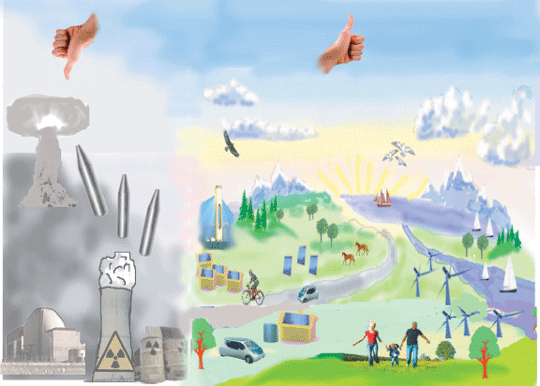 Around the World, Nuclear Can’t Compete With Growing Renewables“What is spectacular is the extent to which the nuclear industry is appearing to ignore reality.” Katherine TweedGreentech Media, July 16, 2015 [excellent diagrams & graphs]
Global investment in new nuclear is an order of magnitude less than renewable energy investment. That is just one of the findings of a new independent report on the state of the worldwide nuclear industry that was issued on Thursday. No matter which aspect of the nuclear industry is assessed, the picture isn’t pretty.
Despite talk of a nuclear renaissance in the 1990s, no single Generation III reactor has come into service in the past 20 years. Most are delayed three to nine years and are far over budget.
“The impressively resilient hopes that many people still have of a global nuclear renaissance are being trumped by a real‐time revolution in efficiency‐plus‐renewables‐plus-storage, delivering more and more solutions on the ground every year,” Jonathon Porritt, co-founder of the Forum for the Future and former Chairman of the U.K. Sustainable Development Commission, wrote in the forward to the World Nuclear Industry Status Report 2015. “[The report] remorselessly lays bare the gap between the promise of innovation in the nuclear industry and its delivered results.”
China, which leads the world in new nuclear builds, spent about $9 billion in 2014, but invested more than $83 billion on wind and solar in the same year. China’s non-hydro renewable fleet produces more energy than its nuclear capacity.
What’s more, Germany, Brazil, India, Mexico, the Netherlands, Spain and Japan all generate more electricity from non-hydro renewables than from nuclear. Those countries make up nearly half of the world’s population and three of the world’s largest economies.
For nuclear that is being built, the word “boondoggle” seems to come up frequently, especially in the West. “The project is in shambles,” the report said of the U.K.’s Hinkley Point C reactor, which was meant to be the first new nuclear in the country in decades. Now, the company building it, Areva, is bankrupt. Areva’s Olkiluoto 3 project in Finland and Flamanville 3 in France are also both way over budget and still not in operation.
“What is spectacular is the extent to which the nuclear industry is appearing to ignore reality,” the report states. In 2013, Areva’s then-CEO predicted reactors would be coming back on-line in Japan by the end of the year and that his company would be taking new orders in the next few years. In 2015, Japan has been nuclear-free for the first time in more than four decades. Areva has had no new orders.
Despite the issues with Areva reactors, there are more than 60 reactors currently under construction. Of those reactors, most have been under construction for more than seven years. Three-quarters of the building sites are delayed and, amazingly, five have been listed as “under construction” for more than 30 years. http://www.greentechmedia.com/articles/read/renewables-outpace-nuclear-in-major-economies
Despite USA’s Congress, tyhe Iran nuclear deal is to become international law
 Iran deal set to become international law http://www.cbsnews.com/news/un-security-council-vote-iran-nuclear-deal-resolution-us-congress-objections/ UNITED NATIONS, 18 July 15 — The U.N. Security Council scheduled a vote for first thing Monday morning on a resolution endorsing the Iran nuclear deal.
 The resolution was circulated to council members Wednesday by the United States. Members were also briefed by both Iran and the other countries that negotiated the landmark agreement to curb Iran’s nuclear program.
With all five veto-wielding permanent members of the Security Council involved in the marathon Iran negotiations, the resolution’s adoption Monday was almost certain.
The resolution implements an intricate deal that places restrictions on Iran’s nuclear program while allowing relief from sanctions that the country’s leaders say have hurt its economy.
Monday’s vote will come despite calls from some U.S. lawmakers to delay Security Council approval until Congress reviews the deal.
CBS News foreign affairs analyst Pamela Falk says the resolution will make the Iran nuclear deal international law, but will delay its official implementation for 90 days, to allow for the U.S. Congress’ consideration.
Falk explained that while Congress cannot block the implementation of the deal, if the legislative body votes against it and has enough votes to override a promised veto from President Obama, it is not clear what would happen next.
A U.S. official told CBS News that American law doesn’t “trump” U.N. resolutions, but if Congress were to vote against the measure — and garner enough votes to override a presidential veto — lawmakers could stop U.S. sanctions being lifted, which could prompt Iran to declare the U.S. as non-compliant with the terms of the deal and to back out.
If U.S. lawmakers were to decide after Monday’s vote that they wanted changes to the terms of the agreement, it would essentially be too late, because it would require the Security Council to propose a new resolution — and there would likely be little appetite for such deliberations among the other negotiating partners.
The chairman of the Senate’s foreign relations committee, Bob Corker, on Thursday wrote a letter to President Obama saying, “We urge you to postpone the vote at the United Nations until after Congress considers this agreement.”
But the chief U.S. negotiator in the Iran talks, Wendy Sherman, rejected that idea Thursday.
She told reporters: “It would have been a little difficult when all of the (countries negotiating with Iran) wanted to go to the United Nations to get an endorsement of this, since it is a product of the United Nations process, for us to say, ‘Well, excuse me, the world, you should wait for the United States Congress.’”
Sherman said the council resolution allows the “time and space” for a congressional review before the measure actually takes effect.
The groundbreaking nuclear deal is of great benefit to ordinary people in Iran

 Ordinary Iranians the big winners in groundbreaking nuclear peace pact, Irish Independent Mary Fitzgerald18/07/2015 The images from Tehran after news broke of an historic deal on Iran’s nuclear programme this week told their own story. Exuberant crowds took to the streets, cheering and dancing in celebration of an agreement that means their nation will now come in from the cold of international sanctions.
Many carried a large, wooden key, the symbol of president Hassan Rouhani’s election campaign two years ago, during which he put a nuclear deal on the top of his priority list.
The accord announced in Vienna was the fruit of 19 days of intense negotiations and four missed deadlines. It is designed to contain Iran’s nuclear programme, which Tehran has long insisted is only for energy purposes, for at least a decade, and will involve more comprehensive UN inspections to monitor its nuclear facilities.
As part of the deal, Tehran will get relief from the international sanctions that have crippled its economy for almost 10 years. The agreement is not only a victory for Rouhani, it is also a vindication of US President Barack Obama’s policy of engagement and marks Washington’s first real success in dealing with Tehran since the seizing of the American embassy there in 1979.
Anyone who has visited Iran in recent years will know how much sanctions have affected ordinary Iranians. Isolation from the international banking system and the loss of oil revenues have caused Iran’s currency, the rial, to plummet by two-thirds of its value against the dollar since sanctions were tightened in 2011.
Inflation has soared and the prices of fuel and basic foodstuffs have rocketed. Some estimates hold that the most recent round of sanctions brought Iran’s GDP down by 20pc and contributed to a jobless rate of 10.3pc, hitting young Iranians the hardest.
Between 2009 and 2013, more than 300,000 Iranians emigrated in search of better prospects elsewhere, and today, 25pc of Iranians with a post-graduate education are to be found living and working outside Iran.
By some estimates, the re-entry of Iran to the global marketplace means its economy will grow to more that 5pc GDP within a year. With the fourth-largest crude oil reserves in the world, the end to sanctions means Iran could increase its production to around 4pc of global output within months, thus lowering oil-price forecasts by $5-$15 per barrel.
The reopening of Iran and its consumer market of 78.5 million people means there will be a flurry of interest from investors. The country’s creaking infrastructure – particularly in its energy sector – means it needs all the help it can get……..
While the agreement does not mean diplomatic relations will be restored or Washington will shy away from criticising Tehran’s support for militant groups and its human rights abuses at home, it may usher in some form of coordination in relation to the battle against Islamic State in Iraq……….http://www.independent.ie/world-news/middle-east/ordinary-iranians-the-big-winners-in-groundbreaking-nuclear-peace-pact-31386064.html
Renewables powering more parts of the world than nuclear power is
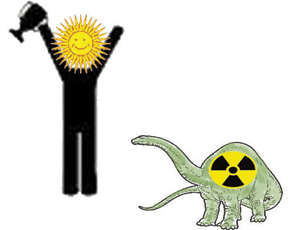 Half the world already gets more power from renewables than from nuclear, Quartz, 17 July 15 The dream of a low-carbon future thanks to nuclear power is already looking dated. The two most populous countries in the world—China and India—plus Japan, Germany, Spain, the Netherlands, Mexico, and Brazil already generate more electricity from (non-hydro) renewable sources than they do from nuclear, according to a global nuclear industry report (pdf). That’s 45% of the world’s population that rely on wind, solar, and other green energy more than they do on radioactive atoms.
the trend toward more renewable power will likely continue for some time. First, global opinion on nuclear energy soured after the Fukushima disaster in Japan, and as a result plenty of potential nuclearpower plants aren’t getting built. Power-hungry China, for instance, isslow to approve new nuclear power plants due to both government and public safety concerns. At the same time, though, it is investing heavily in wind power.
UK’s plan for Hinkley C nuclear power station runs into more and more trouble
 UK’s proposed Hinkley C nuclear power plant faces resistance on all sides http://www.greenpeace.org/international/en/news/Blogs/nuclear-reaction/uks-proposed-hinkley-c-nuclear-power-plant-fa/blog/53534/
The plans for new nuclear reactors at Hinkley in the UK are too expensive, too late, won’t help cut greenhouse gas emissions, violate EU competition law, and will distort Europe‘s energy markets. On 6 July 2015, Greenpeace Energy, together with German and Austrian energy utilities, filed a legal challenge in the European Courts against the EU Commission’s decision to rubberstamp billions of euros in state subsidies for new nuclear reactors at the Hinkley nuclear power plant in the UK.
The filing argues these massively subsidised reactors will influence energy prices in Europe and grossly distort competition.
In a similar filing, the Austrian government submitted a complaint to the European Court against the European Commission for failing to properly implement EU law when it approved the UK’s nuclear welfare package. As Austrian Chancellor Werner Faymann said in a statement, nuclear power “is not an innovative technology and is therefore not worthy of subsidy.”
In short, the Hinkley reactors threaten to block the road to a safe, clean renewable future. “The EU Commission’s decision threatens to have negative consequences for our environmentally sound production plants,” says Dr. Achim Kötzle, Managing Director of Stadtwerke Tübingen on behalf of the eight municipal utilities in the action.
Here’s the situation:
The price of the electricity generated by the new Hinkley C reactors has been guaranteed by the British government for 35 years. This means that, no matter the fluctuations in the price of electricity, Hinkley owner EDF will always get its money.
With renewable energy getting cheaper all the time, and the Hinkley reactors not expected to be in operation before the middle of the next decade, you can see why EDF wanted to fix its prices.
Figures commissioned by Greenpeace Energy (an organisation independent of Greenpeace) show that this is a gift to EDF of some 108 billion euros of public funds. In addition, the British government has made guarantees of more than 20 billion to investors in the construction of the new nuclear plant. As Sönke Tanger, Managing Director of Greenpeace Energy says: “We are taking legal action against these exorbitant nuclear subsidies because they appear to be ecologically and economically senseless and signify serious disadvantages for other energy providers, for renewables, and for consumers.”
The approval of this state funding of nuclear reactors also sets a bad example for the rest of Europe. If Hinkley succeeds, countries such as Poland, the Czech Republic and Hungary are likely to follow.
There are also huge doubts about the European Nuclear Reactor (EPR) technology EDF wishes to build at Hinkley C. The ones being built in Finland and France are massively over budget, years behind schedule, and have experienced huge technical problems.
Why wait ten years (at least) for new expensive and unsafe nuclear reactors when renewable energy projects are ready to go right now? Hinkley C must be stopped before it irreparably damages our future.
Fukushima delegation to Switzerland, to learn about transition plan from nuclear to renewable energy
Fukushima team studies Swiss nuclear experience By swissinfo.ch, with reporting by Fumi Kashimada , 16 July 15
A Japanese delegation from Fukushima, site of a nuclear disaster in March 2011, has visited Switzerland to discuss energy policies, technologies and the development of renewable forms of energy.
“Almost five years after the explosions in the Fukushima Daiichi nuclear power plant, 110,000 people still can’t return to live in their homes,” Masao Uchibori, mayor of the prefecture of Fukushima since November, toldswissinfo.ch in Solothurn.
“The inhabitants of zones with raised levels of radioactivity can’t lead a normal life.”
While most foreign reports on Fukushima focus on the reconstruction of the destroyed power plant, Uchibori points out that “time hasn’t stood still in Fukushima – we’ve made progress on rebuilding the infrastructure”.
Uchibori said the prefecture of Fukushima had set itself the ambitious target of getting 100% of its energy from renewable sources by 2040. To that end, the delegation is interested in Switzerland’s experiences in withdrawing from nuclear power. ……..
“The most important thing is that no nuclear power station accident happens ever again – it doesn’t matter whether it’s in Japan or another country. Countries should cooperate so that the world isn’t dependent on nuclear power.” http://www.swissinfo.ch/eng/nuclear-safety_fukushima-delegation-studies-swiss-nuclear-experience/41552346
Fukushima plant abnormalities – due to ionising radiation fallout?
Yahoo News: Mutated plants near Fukushima gain internet fame — Pics show centers fused together, petals growing out of sides, ring-shaped flower with 4 stems — US Gov’t Expert: Plant abnormalities can be induced after only 24 hours of exposure to radioactive fallout (PHOTOS) http://enenews.com/yahoo-news-mutated-plants-fukushima-gain-internet-fame-pics-show-centers-fused-together-petals-growing-sides-flowers-govt-expert-abnormalities-be-induced-after-only-24-hours-exposure-radioactive?utm_source=feedburner&utm_medium=email&utm_campaign=Feed%3A+ENENews+%28Energy+News%29
Yahoo News, Jul 13, 2015: Deformed daisies from Fukushima disaster site gain Internet fame… one Japanese amateur photographer has captured something a bit more unique than a beautiful bloom. Twitter user @san_kaido posted a photo of mutated yellow daisies last month, found in Nasushiobara City, around 70 miles from Fukushima… The photos show daisies with fused yellow centres and with the petals growing out the side of the flower…
Tweet from @san_kaido, translated by Fukushima Diary: “The right one grew up, split into 2 stems to have 2 flowers connected each other, having 4 stems of flower tied beltlike. The left one has 4 stems grew up to be tied to each other and it had the ring-shaped flower. The atmospheric dose is 0.5 μSv/h at 1 m”…
Taka Katsumi, former aide to Member of Japan’s Parliament, Jun 21, 2015: Deformed Margaret flowers found 130 km from Fukushima Daiichi plant at Nasu Shiobara on May 26, 2015.
Video from Nasushiobara City: Sep 2012, I measured radiation in front of SEKIYA elementary school of Nasushiobara… The monitor indicates… 6.94 on mud in the road side garter, 8.10 micro Sievert per hour on dusts of the school road.
More on Plant Fasciations (emphasis added)
> Univ. of Chicago w/ grant from Rockefeller Foundation (pdf), 1933: All vegetative parts are subject to injury by x-rays. Root tips may become bulbous and swollen, with tumor-like enlargements in which giant cells may occur. Stems become fasciated… flowers of plants rayed in seed or seedling stages may show fasciation…
> Japan’s National Institute of Agrobiological Sciences, 2009: The proportion of plants showing stem fasciation increased with gamma-irradiation… Each single mutant also showed stemfasciation at a low frequency without gamma-irradiation, while gamma-irradiation induced stem fasciation. Importantly, in wild-type plants, the frequency of stem fasciation was very low (<0.1%) [but] were induced by gamma-irradiation.
> Affidavit of James Gunckel, Brookhaven National Lab (pdf), 1984: I have carefully examined… plants, collected shortly after the [1979] accident at TMI and compared them with specimens collected more recently. The current abnormalities [5 years post-accident] are probably carried forward by induced chromosomal aberrations. There were a number of anomalies entirely comparable to those induced by ionizing radiation — stem fasciations [etc.]… Most of the stem abnormalities… are induced by relatively high doses of X or gamma rays extending over a period of usually 2-3 months. Notable exceptions, however, are similar responses to beta ray exposure from radioisotopes… for only 24 hours. In other words, it would have been possible for the types of plant abnormalities observed to have been induced by radioactive fallout on March 29, 1979… I am the world authority on modifications of plant growth and development induced by ionizing radiations…
Migrit rejected for nuclear investment in Finland – “a front for Russian capital”.
 Finnish officials reject nuclear plant investor Ft.com By David Crouch in Gothenburg, July 16, 2015 Finland’s plan to build a nuclear power station with help from Russia has been thrown into doubt after officials in Helsinki rejected a mysterious investor that it is alleged has links with Moscow.
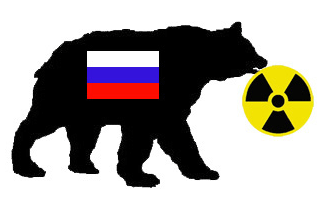 The move raises a fresh obstacle to the project, which has been dogged by accusations that Finland is placing Russian interests before EU foreign policy objectives.
Finland’s economics ministry said on Thursday that the ownership of Migrit Solarna Energija, a Croatian group listed as owning almost 9 per cent of the Fennovoima project, could not be “adequately verified”.
The ministry said it could not establish with certainty that the company was “factually controlled” from inside western Europe.
Finland’s government has insisted that 60 per cent of the €6bn–€7bn cost of the nuclear plant should be borne by companies residing or domiciled in the EU or the wider European Free Trade Association, which includes Norway, Iceland and Switzerland.
However, without Migrit, this requirement will not be met — which means either a new investor or additional investment from existing shareholders.
“We cannot speculate on who Migrit is controlled by,” said Herkko Plit, a senior civil servant in the economics ministry. “It has many relations to foreign countries, not just Russia. But . . . those people who founded it originally were Russians. The current owners are also Russian citizens to the best of our knowledge.”
Fennovoima plans to begin construction of a 1,200-megawatt reactor at Pyhaejoki in northern Finland in 2018, with operation due to begin in 2024.
But the company has struggled to find backers after the main original shareholder, the German utility Eon which had a 34 per cent stake, withdrew in 2012 after energy prices fell. Rosatom, the Russian state-owned nuclear company that will build the plant, now owns a 34 per cent stake.
Olli Rehn, a former European commissioner who in April became economics minister in Finland’s rightwing coalition government, said a decision on the future of the Fennovoima project would be referred to a meeting of the government on August 6.
“It seems that behind the Croatian company are Russian financiers,” Mr Rehn told YLE, the Finnish broadcaster, although he declined to say whether he believed that Migrit was linked to Rosatom………..
anti-nuclear campaigners said the new doubts about the project should be enough to kill it off. “It should be a sign to the government — if they cannot find investors the plant is not viable,” said Sini Harkki, Greenpeace programme manager for Finland.
She said it appeared that Migrit was “a front for Russian capital”.
“Fennovoima has had several years to find investors, and all it has found was this small Croatian company,” she added. http://www.ft.com/intl/cms/s/0/601da0a4-2bda-11e5-acfb-cbd2e1c81cca.html#axzz3g6DMCh5d
Small Modular Nuclear Reactors unlikely to be commercially developed
Around the World, Nuclear Can’t Compete With Growing Renewables “What is spectacular is the extent to which the nuclear industry is appearing to ignore reality.” Katherine Tweed Greentech Media, July 16, 2015 “……..For the reactors that are in operation, many are aging rapidly. The mean age for reactors worldwide is about 29 years, and most were designed for life spans of 40 years, but many will operate beyond that. The cost of going beyond 40 years isn’t cheap — about $1 billion to $5 billion per reactor. By 2050, nuclear’s share of global electricity generation is expected to be similar to its role today, which amounts to about 10 percent.
Given the cost and time necessary to build large reactors, many in the industry have argued for a move to small modular reactors. Yet SMRs have also suffered from higher-than-expected costs and long development timelines, the report states.

The U.S. Department of Energy has been one of the proponents of this technology, yet none of the designs it said in 2001 could be available by the end of the decade were deployed. Of the two companies the DOE chose years later for SMR development funding, one slashed its spending on SMRs in 2014. NuScale, the other SMR manufacturer, is still continuing with development. Even so, “there is no evidence that SMRs will be constructed in the United States anytime soon,” the report states.
The picture is not rosier in other countries that have lent support to SMRs. South Korea, for example, has been developing an SMR since the 1990s, and while it was approved in 2012, no orders have yet been received. Saudi Arabia did say earlier this year it would test the technology in a three-year pilot.
“The static, top-heavy, monstrously expensive world of nuclear power has less and less to deploy against today’s increasingly agile, dynamic, cost-effective alternatives,” wrote Porritt. “The sole remaining issue is that not everyone sees it that way — as yet.”http://www.greentechmedia.com/articles/read/renewables-outpace-nuclear-in-major-economies
70th anniversary of the start of the nuclear age
The nuclear age turns 70 today, Ars Technica On July 16th 1945, the US tested the world’s first atomic bomb. by Jonathan M. Gitlin – Jul 17, 2015 Seventy years ago this morning, the world fully entered the nuclear age with the detonation of the first atomic bomb in Alamogordo, New Mexico. The bomb was the product of the Manhattan Project, a top-secret research program tasked with developing a bomb more powerful than any that had come before. The test, called Trinity, happened at 5:30am local time and yielded an explosion equivalent to 20,000 tons of TNT (20kT).
Robert Oppenheimer, a physicist chosen to lead the bomb’s development, greeted the appearance of a second sun over the desert of New Mexico with a quote from a Hindu scripture, the Bhagavad Gita: “Now I am become Death, the destroyer of worlds.”
Trinity was the first human-made nuclear explosion on Earth, but far from the last. …….
Growing worries about the harmful effects of radioactive fallout drove nuclear tests underground in 1963 with the passage of the Partial Nuclear Test Ban Treaty, and in 1996 most of the world signed onto the Comprehensive Test Ban Treaty (while the US signed the latter, it has never been ratified by the Senate).http://arstechnica.com/science/2015/07/the-nuclear-age-turns-70-today/
1 This Month
Chernobyl: The Lost Tapes – A good documentary on Chernobyl on SBS available On Demand for the next 3 weeks– https://www.sbs.com.au/ondemand/tv-program/chernobyl-the-lost-tapes/2352741955560

of the week–London Campaign for Nuclear Disarmament

Tell the Ukrainian Government to Drop Prosecution of Peace Activist Yurii Sheliazhenko
To see nuclear-related stories in greater depth and intensity – go to https://nuclearinformation.wordpress.com
-
Archives
- April 2026 (126)
- March 2026 (251)
- February 2026 (268)
- January 2026 (308)
- December 2025 (358)
- November 2025 (359)
- October 2025 (376)
- September 2025 (257)
- August 2025 (319)
- July 2025 (230)
- June 2025 (348)
- May 2025 (261)
-
Categories
- 1
- 1 NUCLEAR ISSUES
- business and costs
- climate change
- culture and arts
- ENERGY
- environment
- health
- history
- indigenous issues
- Legal
- marketing of nuclear
- media
- opposition to nuclear
- PERSONAL STORIES
- politics
- politics international
- Religion and ethics
- safety
- secrets,lies and civil liberties
- spinbuster
- technology
- Uranium
- wastes
- weapons and war
- Women
- 2 WORLD
- ACTION
- AFRICA
- Atrocities
- AUSTRALIA
- Christina's notes
- Christina's themes
- culture and arts
- Events
- Fuk 2022
- Fuk 2023
- Fukushima 2017
- Fukushima 2018
- fukushima 2019
- Fukushima 2020
- Fukushima 2021
- general
- global warming
- Humour (God we need it)
- Nuclear
- RARE EARTHS
- Reference
- resources – print
- Resources -audiovicual
- Weekly Newsletter
- World
- World Nuclear
- YouTube
-
RSS
Entries RSS
Comments RSS
 nuclear-news