Is Fukushima radiation affecting Arctic wildlife?
UNIVERSITY OF ALASKA SCIENTISTS: FUKUSHIMA RADIATION MAY BE MAKING ALASKA SEALS  SICK http://www.infowars.com/university-of-alaska-scientists-fukushima-radiation-may-be-making-alaska-seals-sick/ Washington’s Blog January 26, 2014
American sailors on the USS Reagan got really sick after having snowball fights with radioactive snow blowing off of the coasts of Fukushima. University of Alaska professors Doug Dasher, John Kelley, Gay Sheffield, and Raphaela Stimmelmayr theorize that radioactive snow might have also caused Alaska’s seals to become sick er plant resulting in a major nuclear accident that included a large release of airborne radionuclides into theenvironment.
Within five days of the accident atmospheric air masses carrying Fukushima radiation were transiting into the northern Bering and Chukchi seas. During summer 2011 it became evidentto coastal communities and wildlife management agencies that there was a novel disease outbreak occurring in several species of Arctic ice-associated seals. Gross symptoms associated with the disease included lethargy, no new hair growth, andskin lesions, with the majority of the outbreak reports occurring between the Nome and Barrow region. NOAA and USFWS declared an Alaska Northern Pinnipeds Usual Mortality Event (UME) in late winter of 2011.
The ongoing Alaska 2011 Northern Pinnipeds UME investigation continues to explore a mix of potential etiologies (infectious, endocrine, toxins, nutritious etc.), including radioactivity. Currently, the underlying etiology remains undetermined [i.e. scientists don’t yet know what caused the seals’ sickness, but they think it might have been Fukushima radiation]. We present results on gamma analysis (cesium 134 and 137) of muscle tissue from control and diseased seals, and discuss wildlife health implications from different possible routes of exposure to Fukushima fallout to ice seals. Continue reading
Japan’s agricultural industries affected by radiation levels
Green tea plantations were first highlighted as suffering from potential radiation contamination last month following the results of sample tests in Kanagawa prefecture. The authorities discovered around 570 becquerels of caesium per kilogram in leaves grown in the city of Minamiashigara – compared to the legal limit of 500 – and started a recall of tea products.
Tea leaves are the latest agricultural products in Japan to be affected by problems surrounding the still-damaged Fukushima Daiichi nuclear power plant.
From milk to spinach, a raft of items have fallen under the spotlight due to radiation fears although Japanese authorities have assured the public and its export nations that it is strictly regulating products.
While it seems that areas around the nuclear crisis will never recover, tens of thousands of farmers have lost their livelihood due to soil contamination and food safety fears.
Just another serious blow on the global food supply that seems to be diminishing. Source: natural society http://planetsave.com/2012/06/12/japan-green-tea-exports-banned-due-to-high-radiation-levels/
Unstoppable warming of oceans due to climate change
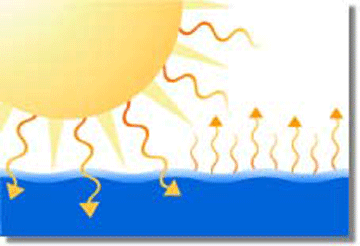 Warming of oceans due to climate change is unstoppable, say US scientistshttp://www.theguardian.com/environment/2015/jul/16/warming-of-oceans-due-to-climate-change-is-unstoppable-say-us-scientists Suzanne Goldenberg, 17 July 15 Globally 90% of the excess heat caused by the rise in greenhouse gas emissions is absorbed by the oceans.
Seas will continue to warm for centuries even if manmade greenhouse gas emissions were frozen at today’s levels, say US government scientists The warming of the oceans due to climate change is now unstoppable after record temperatures last year, bringing additional sea-level rise, and raising the risks of severe storms, US government climate scientists said on Thursday.
The annual State of the Climate in 2014 report, based on research from 413 scientists from 58 countries, found record warming on the surface and upper levels of the oceans, especially in the North Pacific, in line with earlier findings of2014 as the hottest year on record. Continue reading
USA’s reputation at stake, if Congress votes against Iran nuclear deal
 White House: Congressional vote against Iran nuclear deal would be ‘devastating’ By Dave Boyer – The Washington Times – Friday, July 17, 2015
The White House said Friday that Congress would devastate the U.S. leadership role in the world if lawmakers vote to reject the Obama administration’s historic nuclear deal with Iran.
“For the United States, because of a congressional action, to isolate our country on such an important issue, would be devastating to our standing in the world,” said White House press secretary Josh Earnest. “If Congress killed this agreement, it would have a terrible impact.”
The U.S. struck the deal in cooperation with Russia, China, Germany, France and the United Kingdom.
Republicans and some Democrats are expressing serious concerns about the agreement, which will lift economic sanctions against Tehran in exchange for imposing limits on Iran’s nuclear program. President Obama said it’s the best way to ensure that Iran cannot build a nuclear weapon for at least the next 10 years.
Mr. Earnest said international sanctions “would collapse” if the U.S. kills the agreement.
“Iran would still obtain the financial benefits of sanctions relief,” he said. “Iran will get all the benefits of this deal without having to give up anything.”
Such action by Congress would “allow Iran to get off scot-free,” Mr. Earnest said……….
The president’s spokesman also said the administration isn’t trying to disregard Congress by requesting the U.N. Security Council to approve the agreement before Congress can review it. Congress has 60 days to debate the accord.
A win for non-proliferation – the Iran nuclear deal
Iran nuclear deal a win for non-proliferation THE AUSTRALIAN JULY 20, 2015 CHRIS PATTEN
THE AUSTRALIAN JULY 20, 2015 Let us give praise where it is richly deserved. Despite all the criticism they faced, US President Barack Obama and his Secretary of State, John Kerry, stuck doggedly to the task of negotiating a deal with Iran to limit its nuclear program. Together with representatives of Britain, Russia, China, France, and Germany, they have now succeeded.
The main terms of this historic agreement, concluded in the teeth of opposition from Israel, Iran’s regional competitors (particularly Saudi Arabia), and the political Right in the US, seek to rein in Iran’s nuclear activities so that civil capacity cannot be swiftly weaponised. In exchange for inspection and monitoring of nuclear sites, the international economic sanctions imposed years ago on Iran will be lifted.
This is a significant moment in the nuclear age. Since 1945, the terrifying destructive force of nuclear weapons has encouraged political leaders to search for ways to control them…………
We know how the Bush strategy turned out. The talks collapsed: no compromise, no agreement. Today, a deal has been concluded; but it is less good than the deal that could have been reached a decade ago — a point worth keeping in mind as the likes of former vice-president Dick Cheney and Israeli Prime Minister Benjamin Netanyahu start hollering from the sidelines.As it is, not only will an agreement add cement to the NPT; it could also open the way to the sort of understanding with Iran that is essential to any broad diplomatic moves to control and halt the violence sweeping across western Asia.
Chris Patten, a former EU commissioner for external affairs, is Chancellor of the University of Oxford Project Syndicate http://www.theaustralian.com.au/news/world/iran-nuclear-deal-a-win-for-non-proliferation/story-e6frg6ux-1227448140771
Nuclear power station running out of space for radioactive trash fuel rods
 Peach Bottom nuclear power plant could run out of spent fuel storage space in 2019 There is no available off-site storage for spent fuel rods, ydr.com Local News, By Brett Sholtis bsholtis@ydr.com @BrettSholtis on Twitter 07/18/2015 Most
 people will never get a chance to stare down at nuclear fuel rods submerged in the eerie blue water of a spent fuel pool.
For Peach Bottom Atomic Power Station employees, however, working near tens of thousands of used fuel rods — still lethally radioactive — is business as usual.
Some of those rods have been in the fuel pool since 1976, according to Krista Connelly, spokeswoman for the southern York County power plant.
But with nowhere off-site to store the fuel, Connelly said Peach Bottom is running out of places to put it. Continue reading
Danger for China, in planning inland nuclear facilities
 Drought and earthquakes pose “enormous risk” to China’s nuclear plans, China Dialogue Wang Yi’nan 27.02.2013


China’s nuclear industry is shifting inland, away from the crowded coast. It’s a risky move, argues Wang Yi’nan When the Fukushima nuclear disaster struck, China was building new nuclear power capacity at a rate unprecedented in world history: 40% of all reactors planned or under construction were in China. Targets for installed nuclear generation capacity by 2020 were raised repeatedly – from 40 gigawatts in 2007 to 80 gigawatts in 2010.
Preparations were also under way for more than 20 inland nuclear power plants. The 41-plus gigawatts of capacity already completed or under construction lies along China’s seaboard. Space is running out.
But Fukushima sent shockwaves through the nuclear industry. In China, focus shifted from the speed and scale of expansion to questions of safety and quality. The government placed a moratorium on approvals for new nuclear plants, which lasted for more than a year, a period during which debate on what to do raged – over safety, scale of expansion, technology, site locations and, most crucially, whether or not the process of considering applications to build new inland nuclear power plants should be restarted.
China’s nuclear moratorium may have been lifted, but those arguments continue today……..China’s realities warn against inland nuclear development.
Figures from the China Earthquake Administration’s Institute of Geology show that, since 1900, China has been hit by almost 800 earthquakes of magnitude six or above, causing destruction in all regions except Guizhou, Zhejiang and Hong Kong. Despite having only 7% of the world’s landmass, China – where three tectonic plates meet – gets more than a third of all strong continental earthquakes.
Moreover, China’s per-head freshwater resources are only one quarter of the global average. Inland nuclear power plants require a failsafe, 100% reliable and never-ending supply of water for cooling. Even if a reactor stops operating it still requires water to carry off heat. If the water dries up, we could see a Fukushima-style disaster, with terrible consequences: radioactive pollutants released into nearby rivers and lakes, affecting the safety of water on which hundreds of millions rely.
In June last year, Reuters covered a report by European and US scientists on the vulnerabilities of nuclear and thermal power to climate change. According to the report, “under climate change, a lack of water for cooling is severely restricting generating capacity at nuclear power plants in the EU and US. In the summer seasons of 2003 to 2009, many inland nuclear power plants were forced to shut down due to a lack of cooling water.”
The authors predicted that “due to a lack of water for cooling, between 2030 and 2060 nuclear and thermal generating capacity will drop 4-16% in the US, and 6-19% in the EU,” and went on to stress that “opting to build nuclear and other thermal power plants by the sea is an effective and important strategy to cope with climate change.”
China is densely populated and prone to both drought and earthquakes, making the development of inland nuclear power inadvisable. It has also long sought to emulate the EU and US, regions which have now realised the outlook for inland nuclear power is bleak. China should not make the same mistake………
Safety standards still not being met
Moreover, there are still limits to China’s ability to run nuclear power plants.
During the State Council’s safety audit of 41 reactors in operation or under construction, some plants and fuel recycling facilities were found not to meet new safety standards for flood and earthquake resilience, while some plants did not have procedures for preventing or mitigating major accidents. Others had not evaluated tsunami risks and responses.
The Taishan Nuclear Power Plant has no guidelines for managing a major accident, for example. The Taishan No.2 reactor, Ling’Ao and Tianwan Nuclear Power Plants have procedures only for certain types of major accident……..
China has better and more realistic options to relieve energy shortages and cut emissions. These include more efficient use of resources including coal; the promotion of energy-saving techniques such as the use of energy performance contracting(where energy savings from new buildings systems pay for the cost of a building renewal project) a tool which, if used in China as it is in the EU, would save the equivalent of several Three Gorges Dams’ worth of energy.
Comprehensive clean-energy solutions, incorporating solar power, wind power, bioenergy, pumped-storage hydropower and natural gas peak power plants, can provide China with the clean, reliable and efficient energy it needs for a new type of industrialisation.
China’s development must be built on genuinely safe, reliable, clean and efficient energy. Blindly opting for nuclear power in response to energy shortages and emissions pressures is to drink from a poisoned chalice. https://www.chinadialogue.net/article/show/single/en/5746-Drought-and-earthquakes-pose-enormous-risk-to-China-s-nuclear-plans
Legal action against Canada’s plan for radioactive trash dump near Lake Huron

 Group taking battle over nuclear waste burial plan to court http://london.ctvnews.ca/group-taking-battle-over-nuclear-waste-burial-plan-to-court-1.2419411 Scott Miller, CTV London June 12, 2015
Plans to build Canada’s first permanent nuclear waste storage facility are heading to court.
A citizen’s group called Save Our Saugeen Shores has asked the Federal Court of Canada to put the project on ice.
They are appealing for a judicial review of the Joint Review Panel decision of May 7th, which recommended approval of the multi-million dollar project. Following six weeks of public hearings and months of deliberation a three-person panel recommended Ontario Power Generation be allowed to build an underground facility near Lake Huron to house all of Ontario’s low- and intermediate-level nuclear waste.
If approved by the federal government, it would be Canada’s first permanent nuclear waste storage facility.
Save our Saugeen Shores argues the Joint Review Panel erred in their decision because of “multiple legal errors, bias-tainted process, and its acceptance of evidence of, and reliance on, deceptive and unlawful conduct.”
Jill Taylor is president of Save our Saugeen Shores. She says “If the federal government is not prepared to respect its own environmental laws and processes, how can they expect Canadian industry and the Canadian public to do so?”
The federal environment minister has moved a deadline to make a final decision on the project until early December. The deadline was initially early September, before October’s federal election.
Save our Saugeen Shores wants the Joint Review Panel decision quashed and a new, more thorough process to be undertaken before allowing Ontario Power Generation to proceed with construction.
If built, 200,000 cubic metres of low- and intermediate-level nuclear waste would be buried within 1.5 kilometres of Lake Huron on the Bruce Power site north of Kincardine. If approved by the federal Ministry of the Environment, construction could begin by 2018.
Canada’s nuclear safety plans don’t stand up to scrutiny
 Are Canada’s nuclear power plants ready in case of disaster?, The Star.com
 Meltdown at Fukushima forced nuclear facilities across the country to review their fail-safe measures, but the modifications being put in place might still be inadequate. By: Kevin Bissett The Canadian Press, Jul 18 2015
FREDERICTON—More than four years after an earthquake and tsunami triggered a meltdown of three nuclear reactors in Japan, lessons learned are still being put into place at nuclear power plants in Canada.
But one critic is questioning whether the industry and the Canadian Nuclear Safety Commission have gone far enough in preparing for potential disasters, particularly in light of climate change.
Shawn-Patrick Stensil, a nuclear industry observer with Greenpeace, said that, while the technical changes mandated by the commission are good, there also needs to be a new mindset in the nuclear industry after what happened at the Fukushima Dai-ichi facility.
Using a recent licence-renewal hearing for the Bruce nuclear plants in Ontario as an example, he said discussions on tornado strengths were inadequate and more severe weather must be considered as a result of climate change.
“Fukushima should be a warning that we should be looking at these new, more extreme weather events in the risk assessments of all plants globally, and we haven’t done that yet,” Stensil added.
Ramzi Jammal, executive vice-president of the commission, said it launched a review of Canadian nuclear power plants shortly after the March 2011 accident at Fukushima. Two years later, it produced a report and identified changes that must be completed by the end of this year.
“We need to expect the unexpected,” he said.
Before Fukushima, Jammal said the emphasis in the nuclear industry was on design and prevention, but now it’s on prevention and mitigation. “Now we’re saying accidents are going to occur. We are going to design and put into place emergency measures to deal with off-site consequences,” he said.
The effort is to make nuclear power plants completely self-sufficient in situations that would stress a facility beyond most reasonable and probable scenarios, Jammal said.
He said that means making each facility able to provide its own backup power, cooling water and other key safety measures to protect a reactor in the event of earthquakes, tornadoes, blackouts and even terrorism. They need to be self-sufficient for three days to a week, depending on how remote the facility is located.
At New Brunswick’s Point Lepreau nuclear power plant, it has meant a number of measures including increasing the number of diesel generators to four from two, adding a new building for emergency equipment, installing a large diesel storage tank, and adding pumps and hoses to ensure a supply of water to maintain cooling of radioactive fuel…………
Stensil said the industry in Canada must not dismiss possible events because they have a low probability of happening.
There has also been little examination by the nuclear safety commission of an accident involving multiple reactors, said Stensil, who is based in Toronto.
“We have 10 reactors in the GTA (Greater Toronto Area). They’ve never provided data on whether emergency planning can cope with that scale of accident,” he said……..http://www.thestar.com/news/canada/2015/07/18/are-canadas-nuclear-power-plants-ready-in-case-of-disaster.html
Effect of ionising radiation on immune system
Could Nuclear Fallout Make Infectious Diseases More Devastating?, Radiation Prevention, July 15 In this post we explore the adverse health effects of ionizing radiation on the body and its ability to combat disease.
As of late, the spread of deadly contagious diseases have been accelerating, with an increased number of viral outbreaks all within the last few months (February – July 2014).
In contrast, so has the risk of exposure to ionizing radiation, so I decided to take a deeper look at how this exposure might play a role in concurrent viral epidemics and pandemics. There is a domino-effect currently unfolding; nuclear fallout could increase the potency of infectious diseases, in addition to further propelling a heightened cancer epidemic which has been underway for decades.
8 Deadly Outbreaks and Counting…….
With the lifespan of man made radiation measured in the hundreds and thousands of years, there is no doubt in my mind that radiation will have a key role in how quickly viruses spread, and how deadly their efficacy. If this isn’t already happening today, my guess is that it will in the future.
A Correlation?The immune system is responsible for protecting your body from bacterial, viral, and fungal infections, in addition to aiding the body in healing wounds and damage to your skin and internal organs. Your bone marrow makes about one thousand million white blood cells every single day, of varying types, each with a unique purpose. Some of these white blood cells are called macrophages, and they constantly patrol your body and destroy germs as they come across them.
This is your ‘natural’ or inborn immunity. If an infection begins to proliferate, your body fights back with an even more powerful defence of T-cells and B-cells. These cells grant your body an immunity, so that the same germ can never make you as sick again. It’s a pretty genius defence mechanism.
On the other hand, radiation works by damaging DNA cells and killing host bone marrow, where white blood cells come from. Radiation prohibits their ability to replenish themselves, along with other rapidly dividing cells such as hair, or cells lining a hosts gastrointestinal tract —which is why cancer patients receiving radiation therapy lose their hair and throw up often.
With an immune system compromised to such a degree, the host is more susceptible to infections the average person is less susceptible to; Infections such as giardia, toxoplasmosis, cryptococcus, candida, JC virus, progressive multifocal leukoencephalopathy —although you are much more likely to get a common disease before any of these like a strep or staph infection.
Other diseases associated with radiation exposure include non-malignant thyroid nodular disease, parathyroid adenoma, posterior sub capsular cataracts, tumours of the brain and central nervous system, and all other cancers.
Fukushima MonkeysOne recent study of Japanese macaques (Macaca fuscata) compared 61 monkeys living 70km (44 miles) from the the Fukushima Daiichi nuclear power plant with 31 monkeys from the Shimokita Penisula, over 400km (249 miles) from Fukushima. The monkeys from areas in the 70km (44 mile) range impacted by fallout from the Fukushima Daichii meltdown exhibited low white and red blood cell counts, low hemoglobin levels, and tested positive for radioactive caesium.
It is believed that the presence of caesium can be linked to the soil in their habitats, as well as the tree buds and bark which the macaques feed on. This research is considered inconclusive, although both malnutrition and disease were ruled out as causes of the blood abnormalities the monkeys were experiencing. Only through time and the process of elimination will we better understand the adverse health effects on wildlife local to the area.
Source: The Guardian, RT
Common SenseIn conclusion, research is inconclusive and I cannot say there is a scientific correlation between radiation and the proliferation of ‘super viruses’.
I can only make an average joe ‘common sense correlation’: If radiation exposure weakens your immune system, and both a proliferation of deadly viral outbreaks and increased exposure of radioactive isotopes is occurring the world over —it’s pretty clear that anything which lowers our immune system is going to pose a serious challenge for our bodies to overcome this new wave of robust viruses. And because radiation has the potential to do this to us, imagine what it’s doing to weaken the natural systems and defences of the earth and its ocean.http://radiationprevention.com/correlation-radiation-immune-response-super-virus-outbreaks/
White lungs on Fukushima’s dead dolphins indicates radiation poisoning
Each dolphins lungs were white, which is according to scientists, an indication of loss of blood to the organs – a symptom of radiation poisoning.
The translated article comes from EneNews:
Apr 11, 2015 (emphasis added):
Google Translate: Ibaraki Prefecture… for a large amount of dolphin which was launched on the shore… the National Science Museum… investigated… researchers rushed from national museums and university laboratory, about 30 people were the anatomy of the 17 animals in the field. [According to Yuko Tajima] who led the investigation.
“the lungs of most of the 17… was pure white ischemic state, visceral signs of overall clean and disease and infections were observed”… Lungs white state, that has never seen before.
Fukushima Diary, Apr 12, 2015: According to National Science Museum, most of the inspected 17 dolphins had their lungs in ischaemia state… The chief of the researching team stated “Most of the lungs looked entirely white”… internal organs were generally clean without any symptoms of disease or infection, but most of the lungs were in ischaemia state. She said “I have never seen such a state”.
Wikipedia: Ischemia is a vascular disease involving an interruption in the arterial blood supply to a tissue, organ, or extremity that, if untreated, can lead to tissue death.
Many reports have been published on the links between ischemia and radiation exposure:
“It has been shown that the ionizing radiation in small doses under certain conditions can be considered as one of starting mechanisms of… IHD [ischemic heart disease].” -Source
“Radiation risks on non-cancer effects has been revealed in the [Chernobyl] liquidators… Recently, the statistically significant dose risk of ischemic heart disease… was published.” -Source……….http://www.neonnettle.com/sphere/366-dead-dolphins-in-fukushima-stranding-found-with-white-radiated-lungs
Human caused global warming hardly dinted by a new grand solar minimum
 A grand solar minimum would barely make a dent in human-caused global warming, Guardian, Dana Nuccitelli, August 2014
So, in order to trigger another LIA, a new grand solar minimum would have to cause about 1°C cooling, plus it would have to offset the continued human-caused global warming of 1 to 5°C by 2100, depending on how our greenhouse gas emissions change over the next century.
In the Jyllands-Posten article, Henrik Svensmark (the main scientist behind the hypothesis that the sun has a significant indirect impact on global climate via galactic cosmic rays) was a bit more measured, suggesting,
“I can imagine that it will become 0.2°C colder. I would be surprised if it became 1–2°C”
So these two articles are suggesting that a grand solar minimum could have a net cooling effect in the ballpark of 1 to 6°C, depending on how human greenhouse gas emissions change over the next century. Is it plausible that a grand solar minimum could make that happen?
The short answer is, ‘No.’
Fortunately, Solar Output is Stable
We’re fortunate that the amount of solar radiation reaching the Earth’s surface is very stable. Climate contrarians will often ask if we’d prefer if the planet were warming or cooling, suggesting that global warming is a good thing because at least the planet isn’t getting colder. This is a false dichotomy – an ideal climate is a stable one………
Peer-Reviewed Research Says Global Warming will Continue
There have been several studies in recent years investigating what impact another grand solar minimum would have on global surface temperatures, since solar research suggests it’s possible we could be due for another extended solar minimum. Generally these studies will run climate model simulations under a given greenhouse gas emissions scenario with stable solar activity, then run the same scenario with the sun going into a grand minimum, and look at the difference in resulting global surface temperature changes.
Using this approach, Feulner & Rahmstorf (2010) (PDF available here) estimated that another solar minimum equivalent to the Dalton and Maunder minima would cause 0.09°C and 0.26°C cooling, respectively………
Human Influence on Climate Change is Bigger than the Sun’s
The bottom line is that the sun and the amount of solar radiation reaching Earth are very stable. Even during the Maunder and Dalton grand solar minima, global cooling was relatively small – smaller than the amount of global warming caused by human greenhouse gas emissions over the past century.
A new grand solar minimum would not trigger another LIA; in fact, the maximum 0.3°C cooling would barely make a dent in the human-caused global warming over the next century. While it would be enough to offset to about a decade’s worth of human-caused warming, it’s also important to bear in mind that any solar cooling would only be temporary, until the end of the solar minimum.
The science is quite clear that the human influence on climate change has become bigger than the sun’s. At this point, speculation about another mini ice age is pure fantasy. http://www.theguardian.com/environment/climate-consensus-97-per-cent/2013/aug/14/global-warming-solar-minimum-barely-dent
Highest Strontium-90 density detected in seawater of Fukushima plant port / 1,500,000 Bq/m3

From Tepco’s report published on 7/17/2015, Strontium-90 density in seawater of Fukushima plant port became the highest since they started measuring.
The sampling location was between water intake of Reactor 3 and 4, and also screen of Reactor 4, which are in front of Reactor 3 & 4.
The samples were collected on 6/1/2015. This analysis result has not been published for over a month.
1,500,000 Bq/m3 of Strontium-90 was detected from both of the samples.
The previous highest reading was 1,000,000 Bq/m3, which was detected at the same sampling location on 5/4/2015.
http://www.tepco.co.jp/nu/fukushima-np/f1/smp/2015/images/2tb-east_15071701-j.pdf
Source: Fukushima Diary
Highest Strontium-90 density detected in seawater of Fukushima plant port / 1,500,000 Bq/m3
Transfer of radiation-tainted soil from Fukushima Prefecture school starts
TANAGURA, FUKUSHIMA PREF. – The Environment Ministry on Saturday started work to transport radiation-tainted soil and other waste from an elementary school in Fukushima Prefecture, home to Tokyo Electric Power Co.’s Fukushima No. 1 nuclear power plant damaged in the March 2011 earthquake and tsunami, to an interim storage site in the same prefecture on a trial basis.
The ministry plans to finish the work before the end of August while schoolchildren are taking their summer holidays, officials said. A total of 1,500 cu. meters of soil and other tainted items from decontamination work are kept at Yashirogawa elementary school in the town of Tanagura.
This marks the first transportation of tainted soil from a Fukushima school to the interim storage site that straddles the towns of Okuma and Futaba.
Trial work to move polluted soil will begin also at four other Fukushima elementary schools soon. The amount of contaminated waste at the four schools in the city of Koriyama and the town of Asakawa totals about 1,500 cu. meters.
According to the Fukushima Prefectural Government, a total of 316,400 cu. meters of tainted soil is being stored at 1,173 locations in the prefecture, including schools and kindergartens, as of the end of March. The amount to be transferred to the interim storage site during fiscal 2015, which ends March 31, will be limited, prefectural officials said.
Decontamination at Yashirogawa elementary school was conducted from January to June this year. Soil and other waste from the cleanup work is kept mainly in sacks.
On Saturday, some 20 workers were engaged in the transportation work. The school is about 150 km from the interim storage site.
The prefecture launched the experimental transportation program in March. About 43,000 cu. meters of waste from 43 cities, towns and villages will be transferred to the storage site within fiscal 2015. The work has been completed in six municipalities, including Okuma and Futaba.
Source : Japan Times
http://www.japantimes.co.jp/news/2015/07/19/national/science-health/transfer-of-radiation-tainted-soil-from-fukushima-prefecture-school-starts/#.Vavnv_mFSM9
Fukushima Daiichi Decommissioning: Follow The Money
Are the meltdowns at Fukushima Daiichi over? The answer is no. In Fairewinds’ latest video, Chief Engineer and nuclear expert Arnie Gundersen updates viewers on what’s going on at the Japanese nuclear meltdown site, Fukushima Daiichi. As the Japanese government and utility owner Tokyo Electric Power Company push for the quick decommissioning and dismantling of this man-made disaster, the press and scientists need to ask, “Why is the Ukrainian government waiting at least 100 years to attempt to decommission Chernobyl, while the Japanese Government and TEPCO claim that Fukushima Daiichi will be decommissioned and dismantled during the next 30 years?”
Like so many big government + big business controversies, the answer has nothing to do with science, and everything to do with politics and money. To understand Fukushima Daiichi, you need to follow the money.
Source: Fairewinds
1 This Month


Tell the Ukrainian Government to Drop Prosecution of Peace Activist Yurii Sheliazhenko

Petition to revoke the licensing of the Near Surface Nuclear Disposal Facility (NSDF) at Chalk River. https://www.ourcommons.ca/petitions/en/Petition/Details?Petition=e-7247


of the week – STOP SMALL MODULAR REACTORS IN CANADA
To see nuclear-related stories in greater depth and intensity – go to https://nuclearinformation.wordpress.com
-
Archives
- March 2026 (212)
- February 2026 (268)
- January 2026 (308)
- December 2025 (358)
- November 2025 (359)
- October 2025 (376)
- September 2025 (258)
- August 2025 (319)
- July 2025 (230)
- June 2025 (348)
- May 2025 (261)
- April 2025 (305)
-
Categories
- 1
- 1 NUCLEAR ISSUES
- business and costs
- climate change
- culture and arts
- ENERGY
- environment
- health
- history
- indigenous issues
- Legal
- marketing of nuclear
- media
- opposition to nuclear
- PERSONAL STORIES
- politics
- politics international
- Religion and ethics
- safety
- secrets,lies and civil liberties
- spinbuster
- technology
- Uranium
- wastes
- weapons and war
- Women
- 2 WORLD
- ACTION
- AFRICA
- Atrocities
- AUSTRALIA
- Christina's notes
- Christina's themes
- culture and arts
- Events
- Fuk 2022
- Fuk 2023
- Fukushima 2017
- Fukushima 2018
- fukushima 2019
- Fukushima 2020
- Fukushima 2021
- general
- global warming
- Humour (God we need it)
- Nuclear
- RARE EARTHS
- Reference
- resources – print
- Resources -audiovicual
- Weekly Newsletter
- World
- World Nuclear
- YouTube
-
RSS
Entries RSS
Comments RSS
 nuclear-news