Language of USA’s Republicans give away their desire to bomb Iran
Who cares if no Republican has read the full text of the deal, which won’t be given to Congress for days?
 Many of the Republicans’ statements on Iran in the past few months have just a word salad of insults – “evil”, “malevolent”, “corrupt”, “terrorists”, “the devil” – as though there were a contest to see how many despicable adjectives they could fit into one paragraph.
Republicans hate the Iran nuclear deal because it means we won’t bomb Iran Trevor Timm,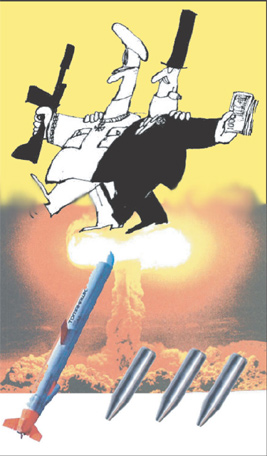 Guardian 14 July 2015
The Administration’s agreement with Iran would curtail the latter’s nuclear program. The only people who can hate that are the kind who just love war As soon as President Obama announced the historic nuclear agreement between the US and Iran on Tuesday, Republican presidential candidates raced to see who could get out the most hyperbolic, foaming-at-the-mouth condemnation of the potential for peace.
Republicans frontrunner Jeb Bush was first out of the gate, more than 24 hours before the deal was actually signed. He boasted on his YouTube channel: “History is full of examples of when you enable people or regimes who don’t embrace democratic values you get a bad result…it’s called appeasement.” Continue reading
The staggeringly huge problem of Los Alamos’ radioactive contamination

 ‘Los Alamos will never be clean’, Local News, Santa Fe New Mexican, By Staci Matlock 13 July 15 “……….The scientists knew this canyon was contaminated back in the 1950s and ’60s,” said Greg Mello, a former inspector with the state Environment Department and now a partner in the nuclear watchdog Los Alamos Study Group with his wife, Trish. “Their children played here.”
As people this year commemorate the 70th anniversary of the first atomic bomb, which helped lead to the end of World War II, often left out of the conversation is the legacy of environmental waste left behind from the making of that bomb and the thousands that followed.
Acid Canyon is among more than 2,000 dumpsites around the lab’s 43-square-mile property and thousands of other dumpsites at 108 locations in 29 states around the nation where waste from the Manhattan Project and subsequent nuclear weapons research was discharged, tossed or buried.

Efforts to clean up the contamination have taken decades and billions of dollars. The work isn’t finished yet, and it may never be complete in some places. Millions of cubic meters of hazardous waste still await cleanup, along with hundreds of contaminated buildings demolished or awaiting demolition at Savannah River in South Carolina, the Hanford plutonium processing plant along Washington’s Columbia River, Los Alamos and a dozen other sites.
A legacy of waste
Air, land, water and people all were exposed to hazardous and radioactive waste products while scientists and engineers were producing the Trinity test bomb and subsequent nuclear weapons.
Uranium miners, scientists, lab technicians and people living near research facilities or test sites around the United States during the heyday of the Manhattan Project were exposed to the highest immediate levels of radiation. They’ve sought compensation from the federal government for a litany of maladies and cancers related to their work on nuclear weapons.
The waste dumped in canyons, buried in unlined trenches or discarded in out-of-the-way places has represented longer-term hazards to people living in or near places where the components of nuclear weapons were processed. In the 1980s, the U.S. Department of Energy and the Army Corps of Engineers began cleaning up the waste sites around the country.
The danger from the waste depends on its radioactivity and how much of it people or animals are exposed to. People regularly are exposed to some level of radiation, which occurs naturally in the environment, such as uranium in soil and radon gas. The legacy waste adds to natural radiation levels in the environment and, left untreated, can increase the risks of cancers and other health problems.
At Los Alamos, lab workers dumped waste in trenches and pits, including those at Area G, a 63-acre dumpsite that opened in 1957. This includes thousands of cubic feet of low-level and mixed transuranic waste such as old lab coats, tools and other debris.
Nuclear waste is exempt from many federal environmental laws such as the Clean Water Act. The New Mexico Environment Department, after a court battle, gained some measure of regulatory control over the lab’s legacy waste only because it is mixed with other hazardous chemical waste. Under an agreement with the state, the lab in 2014 was on track to remove 3,706 cubic meters of hazardous and radioactive waste stored in above-ground containers and ship it to the nation’s only underground nuclear waste repository near Carlsbad when a lab container ruptured at the underground facility, halting operations.
A lab official said last year LANL still had thousands of cubic feet of contaminated waste left in 35 pits and 200 shafts at Area G. “The main concern is that Area G is smack dab over the regional aquifer,” said Scott Kovac, of Nuclear Watch New Mexico, noting the groundwater table is between 900 and 1,000 feet below the surface.

The Department of Energy and state environment officials are grappling with whether the increasing costs of cleanup at the lab and at other legacy waste sites outweighs the health risks of leaving waste where it is and capping it. Mello, who issued the first notice of violation to the lab for noncompliance with federal hazardous waste regulations in 1984, contemplated the trade-off: “Los Alamos will never be clean. It will always have tons of buried waste. Whether the waste is a health hazard is debatable.”
Costs of nuclear cleanup
The legacy costs of the Trinity Site test and the Cold War can be counted in human and environmental price tags……….
“It is costing a lot of money, taking a lot of time, and we’re leaving behind a lot of workers who have suffered,” Alvarez said.
Uranium miners and millers developed lung cancer and kidney cancers, among other illnesses. Scientists and other workers exposed to radiation from above-ground tests developed cancers of the lung, thyroid, esophagus, stomach and pancreas, as well as leukemia and other maladies.
More than 107,141 nuclear research workers and their families have received some of more than $11.6 billion in compensation and medical coverage as of July 5, according to the U.S. Department of Labor. More than a fourth of workers filing claims have cancer types recognized by the federal government as ones that can be caused by exposure to radioactive materials.
More than 4,900 former Los Alamos National Laboratory workers from World War II to the present have received $566 million for health problems related to their work at the lab……..
The costs of cleaning up legacy waste continue to climb. The Department of Energy’s life-cycle environmental liability for thousands of contaminated facilities and management of massive quantities of radioactive waste rose to $427 billion in 2014 from $297 billion in 2006, according to the agency’s fiscal report. The life cycle includes all of the department’s liabilities until the waste is finally cleaned up to federal standards — a process still years away in some locations.
The estimated liability for the legacy waste is higher than the combined state budgets of New Mexico, Texas, California, Arizona and Colorado.
The total life-cycle costs of managing environmental cleanup of legacy waste at Los Alamos were estimated at $2.9 billion in the Department of Energy’s fiscal year 2016 budget request to Congress. For Hanford, it is $63 billion, and for the Savannah River site, it is $71 billion.
“We keep on spending and yet the estimated environmental liability keeps growing,” said Jay Coghlan, executive director of Nuclear Watch New Mexico…………. Contact Staci Matlock at 986-3055 or smatlock@sfnewmexican.com. Follow her on Twitter @StaciMatlock. http://www.santafenewmexican.com/news/local_news/los-alamos-will-never-be-clean/article_a3cc7ce1-8af0-5113-8f38-5d4aa673fd7a.html
Nuclear fuel core melted through bottom of Fukushima reactor – documents show
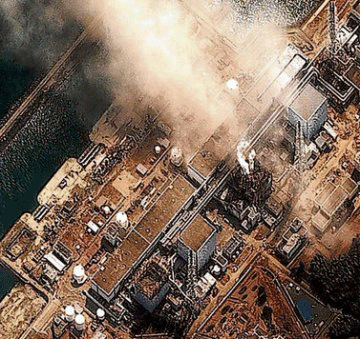 Document shows nuclear fuel burned through bottom of containment vessel under Fukushima reactor — Official: Leakage we observed indicates melt-through by ‘shell attack’ — “This is a very big problem… fuel debris in the PCV is doing something bad” (VIDEO) http://enenews.com/official-document-shows-molten-nuclear-fuel-burned-bottom-containment-vessel-fukushima-tepco-leaks-coming-reactor-indicate-melt-shell-attack-very-big-problem-fuel-debris-pcv-doing-bad-video?utm_source=feedburner&utm_medium=email&utm_campaign=Feed%3A+ENENews+%28Energy+News%29
[Good diagrams]
Shunichi Suzuki, Tokyo Electric Power Co., 2014 IRID Symposium (emphasis added):
• Part 30 – “This is the current situation… This is Unit No. 1, this shows the the lower part of the PCV [primary containment vessel]… Based on the results of research so far… the ‘sand cushion drain’… water is leaking here, which means that this section above there is damaged — so that is highly possible. Therefore, this is a very big problem, because if this is damaged, then one possibility is that shell attackhas happened [see drawing by General Electric at bottom right]. So the debris in the PCV is doing something bad to this, so we have to take that into consideration for investigation.”
• Part 31 – “Unit 2… the water level [in the suppression chamber] and the water level in the torus room is about the same . What that means is that at the bottom [of the S/C], there could be a hole. Not only there, but also there is a pump room and there are other pipings here, so that needs needs to be considered as well when they conduct the investigation.”
• Part 42 – “Unit 1… there is little fuel remaining in the core… Fuel debris exists even outside the pedestal. Therefore we give priority to outside pedestal investigation. I talked about suppressionchamber earlier, shell attack has happened perhaps— I said that — shell attack in Unit 1 is something like this. Debris may exist around here so… there is some fuel that has penetrated outside the pedestal… If debris is outside the pedestal we can’t reach it, therefore we have to consider opening a side area – it’s very unique… Regarding Unit 2 and 3… in Unit 3 we presume that more fuel than we expected has fallen down to the PCV… we cannot deny the possibility that fuel has gone outside the pedestal.”
• Part 55 – “This is a MAAP example [computer code used for estimating fuel debris position]. Improvement points… the height is increasing, we had a single transfer path [for the molten fuel], but it is going to be multiple paths. And also debris, a uniform debris deposit was the assumption, now however asymmetrical distribution has to be considered. And alsodebris below the PCV bottom [see TEPCO drawing at middle right], the behavior has to be considered.”
• Part 95 – “The level of damage is high so it may not be able to stop water… and it may not be possible to fully cover the fuel debris. In such a case innovative approaches could be considered.”
And: Image published by embassy in Japan shows Fukushima melted fuel deep underground
World a little safer as deal agreed on with Iran – Obama
 Obama praises diplomacy of Iran nuclear deal, Sky News, , 15 July 2015 US President Barack Obama has lauded a landmark nuclear agreement with Iran as vindication of his diplomatic approach and a chance for a ‘new direction’ in decades of vexed relations with Tehran.
Obama said the deal – which would curb Iran’s nuclear program in return for substantial international sanctions relief – cut off ‘every pathway’ to an Iranian atomic weapon. ‘Today, because America negotiated from a position of strength and principle, we have stopped the spread of nuclear weapons in this region,’ he said in a White House address on Tuesday.
Describing a ‘difficult history’ between Iran and the United States that ‘cannot be ignored,’ Obama shaped it as a diplomatic victory that showed ‘it is possible to change.’ ‘This deal offers an opportunity to move in a new direction. We should seize it,’ he said……..
Obama came to office vowing to talk directly to Tehran and to try to reach a negotiated deescalation – a marked shift from his predecessor, who rejected a similar deal struck by European countries. ‘This deal demonstrates that American diplomacy can bring real and meaningful change,’ he said.
But, he warned, if Iran steps back from measures agreed in the lengthy agreement, all sanctions ‘will snap back into place.’ Obama insisted the alternative to diplomacy was more violence in a region already beset by instability. ‘Put simply, no deal means a greater chance of more war in the Middle East,’ he said………
Obama said the deal was based on verification, not trust, and noted that differences between the two countries were ‘real.’
Analysts have also warned that Iran’s leaders may need to toughen anti-American rhetoric to ensure the backing of regime hardliners angered at the prospect of a deal with a power they view as the ‘Great Satan.’http://www.skynews.com.au/news/top-stories/2015/07/15/obama-lauds-diplomacy-of-iran-nuclear-deal.html#sthash.xM86hsdW.dpuf
Nuclear agreement finally reached between Iran and world powers

 Iran nuclear agreement: powerful diplomats reach a deal,news.com.au. JULY 15, 2015 THE world’s major powers have struck a long-awaited nuclear deal with Iran after more than two weeks of intense talks in Vienna.
Iranian state television has broadcast US President Barack Obama’s statement on the deal live, only the second such occasion since the Islamic revolution of 1979.
The state broadcaster had also aired Obama’s comments on an April 2 framework accord that led to Tuesday’s historic agreement, paving the way for an easing of crippling Western sanctions and for Iran to come in from the cold…….Iranians have poured onto the streets of Tehran after the Ramadan fast ended at sundown to celebrate the historic nuclear deal…….
- What the deal meansAfter 18 days of intense and often fractious negotiation, diplomats declared that world powers and Iran had struck a landmark deal to curb Iran’s nuclear program in exchange for billions of dollars in relief from international sanctions.
The agreement was designed to avert the threat of a nuclear-armed Iran and another US military intervention in the Muslim world.
The accord will keep Iran from producing enough material for a nuclear weapon for at least 10 years and impose new provisions for inspections of Iranian facilities, including military sites.
The so-called Joint Comprehensive Plan of Action was reached after more than two weeks of furious diplomacy, during which negotiators blew through three self-imposed deadlines.
Zarif and US Secretary of State John Kerry, who conducted most of the negotiations, both threatened to walk away while trading accusations of intransigence.
- Breakthrough came after several key compromisesDiplomats said Iran agreed to the continuation of a UN arms embargo on the country for up to five more years, though it could end earlier if the International Atomic Energy Agency definitively clears Iran of any current work on nuclear weapons. A similar condition was put on UN restrictions on the transfer of ballistic missile technology to Tehran, which could last for up to eight more years…….
- Another significant agreement will allow UN inspectors to press for visits to Iranian military sites as part of their monitoring duties, something the country’s supreme leader, Ayatollah Ali Khamenei, had long vowed to oppose………http://www.news.com.au/world/iran-nuclear-agreement-powerful-diplomats-reach-a-deal/story-fndir2ev-1227442050742
Residents unhappy with inadequate radiation decontamination in city of Date, Fukushima
伊達市- みんなの声 Voices of the Residents in Date, Fukushima, Evacuate Fukushima, Jul 13, 2015Nelson Surjo 子どもの未来を守る会inだて kodomonomiraiwomamorukai by Kurumi Sugita Nos Voisins Lointains 311
The City of Date has divided its territory into three zones to program decontamination work: Zone A where the measurement of ambient radioactivity exceeds 20 mSv/yr, the area adjacent to the B zone A and zone C where radioactivity does not exceed 5 mSv/yr.
In zone C, instead of decontaminating entire areas, the municipality only cleans hot spots that exceed 3μSv/h measured at 1cm off the ground. For example, if a measurement exceeds this limit on a rooftop, it won’t be decontaminated.
During the election campaign of January 2014, the incumbent Mayor Shôji NISHIDA promised to work on decontaminating the entire specified C areas. However, since his re-election, he did not fulfill his promise.
Frustrated by the lack of response from the mayor on their repeated requests for him to fulfill his promise, some residents of Date city gathered to found the “Association to Protect the Future of Children in the Date city” (Kodomo no Mirai wo kai mamoru in Date). They began installing flags and signs across town, calling for effective decontamination work. The association brings together their voices and publish on their website and Facebook page.
The following is a sample of these voices trying to pierce the ongoing deafening silence.
みんなの声 Voices of the Residents………. http://www.evacuate-fukushima.com/2015/07/voices-residents-date-fukushima/
Confusing that Republicans support uneconomic thorium nuclear reactors
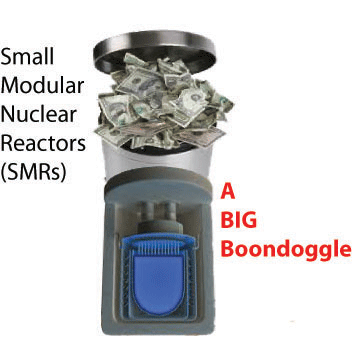 Why GOP support for subsidized nuclear energy is confounding Bangor Daily News, By Peter Bradford, July 11, 2015,
Two unusual bills promoting nuclear power were introduced in the Maine Legislature this session. One, from Sen. Eric Brakey, R-Auburn, would have fast tracked Maine’s path to a reactor using thorium to create a uranium isotope different from those that fuel nearly all of today’s power reactors. The other, from the office of Gov. Paul LePage, would have exempted “small modular reactors” from the referendum process Maine requires for other nuclear power plants.
Neither bill passed as proposed.
Still, what on earth is going on here? No license applications for these designs have ever been filed at the Nuclear Regulatory Commission. No one knows what they would cost or how reliably they would operate.
New, conventional reactors being built at customer expense in South Carolina and Georgia will have to charge well over twice the prevailing and projected market price of electricity in New England. No private company wants to build or finance a reactor under anything resembling New England power market rules. Large subsidies will be essential to the development of new reactors, including thorium and small modular reactors.
When it comes to much smaller subsidies for solar energy, LePage has vetoed legislation that would have added a surcharge amounting to less than one-tenth of a percent to Maine electric bills. He asserted that the legislation “unilaterally selects solar above other solutions that have proven to be more cost effective.” He is equally dismissive of support for wind energy or energy efficiency.
What is it about taxpayer subsidy and big government cronyism that pose such an irresistible attraction for conservatives only when directed to nuclear power? Like a reverend preaching temperance from a barstool, LePage vetoes and disparages government support for proven technologies while embracing an unproven and subsidy-addicted reactor technology as a solution to Maine’s electricity needs.
Subsidies for today’s reactors pale beside past nuclear largesse. Reactors — including thorium reactors — and nuclear fuel enrichment facilities were invented in government laboratories and given to private industry in combination with massive incentives to build power plants. The federal government made unique commitments to own and dispose of the waste fuel while limiting liability for serious accidents. States were preempted from any safety judgements about nuclear power. When electric industry restructuring threatened nuclear profitability in the 1990s, a multibillion-dollar surcharge was added to customer electric bills to cushion the impact on investors. A Congressional Research Service Report estimates that half of all federal energy expenditures on energy research and development have gone to nuclear power………….
given Maine’s experience with past nuclear mirages, the state should not anoint any single technology without an even-handed evaluation of the alternatives.
Peter Bradford chaired the Maine and New York utility regulatory commissions and was a member of the U.S. Nuclear Regulatory Commission. He is an adjunct professor at Vermont Law School. http://bangordailynews.com/2015/07/11/the-point/why-gop-support-for-subsidized-nuclear-energy-is-confounding/
12 miles from Fukushima’s shattered nuclear reactors, World’s Largest Offshore Wind Turbine gives hope
World’s Largest Offshore Wind Turbine Comes Online Near Fukushima Daiichi -bureau EnviroNews World News by Emerson Urry on June 28, 2015 – http://environews.tv/world-news/worlds-largest-offshore-wind-turbine-comes-online-near-fukushima-daiichi/ Fukushima Prefecture, Japan — A mere 12 miles from the full-blown triple nuclear reactor “melt-through” at Fukushima Daiichi on the eastern coast of Japan, sits a bafflingly huge, 620-foot-tall, 1,500-ton bladed beast — floating on a 5,000 ton platform in the water. The world’s largest floating wind turbine has three 270 foot long blades, can withstand 200 mile-per-hour winds, and will be able to generate “up to 7 megawatts of electricity,” making it the biggest offshore wind turbine on earth, according to Gizmodo, a popular science and technology blog.
Additionally, the downright lies and coverup perpetrated by both TEPCO and the Japanese Government surrounding the Fukushima crisis, have left a bad taste in the mouth of the population, leaving trust in the government at an all time low. Perhaps more government-backed, non-lethal energy innovations like the one just activated in Fukushima can start to rebuild the people’s trust in the government. Time will tell. – http://environews.tv/world-news/worlds-largest-offshore-wind-turbine-comes-online-near-fukushima-daiichi
Surprising countries where solar and wind are booming.
Renewable energy is taking off in both wealthy and developing economies.
Across the globe, renewable energy is expanding faster than fossil fuels. It’s even taking off in countries that may surprise you.
http://news.nationalgeographic.com/energy/2015/07/150714-surprising-countries-leading-way-solar-wind/ &http://www.dailyclimate.org/t/7717466609608186573
Nuclear deal in South Africa – briefing reveals nothing much about this multi-trillion Rand nuclear project.
 South Africa: Nuclear Deal Briefing Offers No Answers, Just Tired Rhetoric http://allafrica.com/stories/201507141432.html By Gordon Mackay, democratic Allianc, Capetown, 15 July 15
The DA notes that today’s media briefing by the Energy Department (DoE) and the South African Nuclear Energy Corporation (Necsa) on a so-called “status update” on the Nuclear New Build Programme contained no new answers to pressing questions on a multi-trillion Rand nuclear project.
While this briefing was a perfect opportunity for government to dispel widely held public opinion that South Africa’s largest-ever procurement deal is tainted with secrecy and unfolding behind closed doors, today saw nothing more than restatements of the same old rhetoric with nothing new to add.
That being said, it was plainly put that the State cannot divulge how much has been budgeted for this programme, nor can it disclose the exact cost of the anticipated programme.
The DA believes that any action taken by government ought to be conducted in an honest and transparent manner. Until all vital information regarding the nuclear deal is disclosed, we cannot be assured of this.
Mysterious die-off of whales in the pacific: US scientists test for radiation
TV: US scientists testing for radiation in dead whales as mysterious die-off in Pacific continues — Now 14 carcasses reported, expert warns “death toll could still rise” — “Whales may have consumed something toxic… trying to find an explanation for this unusual event” (VIDEO) http://enenews.com/tv-scientists-testing-radiation-mysterious-whale-die-pacific-continues-14-carcasses-reported-expert-warns-death-toll-could-rise-whales-consumed-toxic-trying-find-explanation-unusual-event-video?utm_source=feedburner&utm_medium=email&utm_campaign=Feed%3A+ENENews+%28Energy+News%29
KTUU, Jul 10, 2015 (emphasis added): 5 more dead whales found in Alaska waters since June; total 14 dead; Researchers try to understand mysterious whale deaths… Kate Wynne, a Marine Mammal Specialist for the Alaska Sea Grant Marine Advisory Program, told Channel 2 News that since the June 18 announcement of the nine dead fin whales, four humpback whales and another fin whale have been found dead. According to Wynne, the five whales appeared to have been dead for the same amount of time as the previously discovered whales… After the first two whales were discovered… it triggered a response from numerous agencies… “The good news is that this has gotten a lot of us to talk toeach other, and be alert,” Wynne said… Wynne thinks the whales may have consumed something toxic… Tests on tissue from one of the whales have proven negative for domoic acid, a biotoxin, and results on two other tests, for Paralytic Shellfish Poisoning (PSP) and Cesium-137 radioactivity, are still pending.
Alaska Dispatch News, Jul 10, 2015: More whales found dead in southern Alaska waters – Scientists investigating the mysterious deaths of nine endangered fin whales… report that the death toll has increased… five additional whales — one fin whale and four humpbacks — have been reported… So far, the only sample taken from any of the dead animals… came back negative for domoic acid, a toxin that is produced by algae… Results from other tests are still pending… [Scientists] have been trying to find an explanation for the unusual event. Wynne said it’s possible the toll could still rise. “The number of now-rotten carcasses may continue to climbas more people travel around the area and submit reports of carcasses they see,” she said.
AP, Jul 11, 2015: More whale carcasses found in Gulf of Alaska… [Wynne] said it’s possible that more carcasses will be reported as people continue to travel around the area.
AP, Jul 11, 2015: Whale deaths in Gulf of Alaskapuzzle scientists – More dead whales have been found in the Gulf of Alaska following the sightings of nine fin whale carcasses… five additional dead whales [were reported] over the past several weeks, including four humpbacks and one fin whale… Wynne says it’s possible that more whale carcasses could be reported soon.
CBC, Jul 11, 2015: Reports of whale carcasses off Alaska raise whale death toll to 14; Scientists don’t know what’s been killing humpback and fin whales
Watch a report from ABC San Diego on NOAA scientists on the way to study whales in Alaska
Southern Ohio’s Piketon enriched uranium plant will get on-site radioactive trash disposal
On-site Piketon uranium disposal OK’d in decades-long plan Columbus Dispatch, By Kantele FrankoAssociated Press • Monday July 13, 2015 Waste from the decontamination and decommissioning of a Cold War-era uranium plant in southern Ohio will go to an on-site disposal facility under a U.S. Department of Energy plan approved by the Ohio Environmental Protection Agency.The Portsmouth Gaseous Diffusion Plant in Piketon produced enriched uranium until 2001, and the shutdown left behind old buildings, industrial chemicals and radioactive areas……..The disposal plan had support from local officials and lawmakers representing the area. Pike County Commissioner Blaine Beekman said the long-awaited decision is critical to get the cleanup rolling and to support lawmakers’ efforts to secure continued federal funding for the project.
But unanswered questions remain, including which types of waste will go where, said United Steelworkers local president Herman Potter, who represents hundreds of Piketon workers……..Some area residents and environmental activists also have objected.
U.S. Sen. Rob Portman, a Republican from southwestern Ohio, said the community agreed to on-site disposal to accelerate the cleanup but remains concerned about the site’s future now that the Energy Department estimates the work will take another three decades. http://www.dispatch.com/content/stories/local/2015/07/13/on-site-disposal-okd-in-decades-long-plan.html
EPA’s Clean POwer plan is still being lobbied by the nuclear industry
The nuclear industry is still lobbying for a bailout in EPA’s Clean Power Plan. Maybe you should be lobbying too. GreenWorld, Michael Mariotte, 14 July 15
The final language of the EPA’s Clean Power Plan (CPP) is supposed to be released next month, which means most of the text (and more importantly, the concepts behind it) is already completed.And, more specifically, it isn’t stopping the nuclear power industry from pushing for changes that would benefit new reactors in particular, although it still holds out some fading hope for help for its older, uneconomic and obsolete reactors as well.*Edison Electric Institute and utility CEOs and representatives from American Electric Power Co. Inc., DTE Energy, Berkshire Hathaway Energy and Duke Energy Corp.That’s a lot of heavyweight nuclear utilities right there. A bunch of other industry groups got to make their case as well……….
- *MJ Bradley & Associates and electric utilities that are members of its Clean Power Plan Initiative, including the CEOs or senior executives of Dominion, National Grid, NextEra, Exelon, PSEG, Pacific Gas and Electric Co. and Calpine Corp.
- As evidence, E&E Publishing Friday published a story headlined White House opens doors to eleventh-hour pleas on Clean Power Plan. Among the bevy of recent visitors pleading their cases were:
- But that isn’t stopping industry, and the occasional environmental group, from continuing to press their cases for changes from the draft proposal.
- Oh, and NEI thinks power uprates at existing reactors should be considered “new” as well.We, however, are expecting something quite different, and you should be too: if the CPP is meant to be the nation’s first climate change roadmap, then it should be pointing the path to a nuclear-free, carbon-free energy future, not figuring out how to do more of the same failed policies of the past……….
- Fertel and NEI’s ultimate goal is to make sure the U.S. nuclear fleet doesn’t continue its recent downward trend. “He noted that currently nuclear is about 20 percent of the electricity mix in the U.S. ‘Our goal is that it never drop below 20, that it pick up and maybe be more than that, but that it’s in the 20 to 20+ range as we go forward. So that’s what we are expecting.’”
- While the public comment period ended December 1, 2014, and since unlike giant utilities and the occasional big green group the public doesn’t get access to EPA officials or the White House, we thought we’d give the public another chance to comment anyway. You can send your e-mail to President Obama and EPA Administrator Gina McCarthy here, and let them know that we expect the final version of the Clean Power Plan to contain no help for nuclear whatsoever……… http://safeenergy.org/2015/07/13/the-nuclear-industry-is-still-lobbying/
Secretive South Africa hides costs of nuclear build programme
SA remains tight-lipped over nuclear build costs, Business Day Live
BY STAFF WRITER, JULY 14 2015, THE deputy director-general of nuclear energy‚ Zizamele Mbambo, made it clear on Tuesday that SA was forging ahead with its nuclear build programme‚ but kept mum on how the country’s new nuclear reactors would be financed….
Fifty trainees have been sent to China for Phase 1 nuclear training in April‚ and an additional 250 trainees will be sent to China this year.
Russia has offered 10 new scholarships for Master’s Degrees in Nuclear Technology‚ while South Korea has an existing programme to train South African students for Master’s Degrees in Nuclear Engineering.
France has put in place 14 bursaries for young people from previously disadvantaged groups. In addition‚ South African engineers already engaged in nuclear activities will pursue training in France. http://www.bdlive.co.za/business/energy/2015/07/14/sa-remains-tight-lipped-over-nuclear-build-costs
Contamination of groundwater and sea discharges
The tritium contamination of the control well No. 10 upstream of the reactors continues to rise and has just beaten two new records with 1,800 Bq / L (sampling of 6 July) and 1,900 Bq / L (sampling of 9 July).
http://www.tepco.co.jp/nu/fukushima-np/f1/smp/2015/images/pump_well_15070802-j.pdf
http://www.tepco.co.jp/nu/fukushima-np/f1/smp/2015/images/pump_well_15071101-j.pdf
These are the fourth and fifth successive records.
This exceeds the limit for dumping at sea, which is 1 500 Bq / L, but TEPCO relies on dilution with water from other wells:
The tritium contamination of the waste water dumped into the sea is around 100 Bq / L.
http://www.tepco.co.jp/nu/fukushima-np/f1/smp/2015/images/weighted_average_150707-j.pdf
Further upstream, the tritium contamination of groundwater can reach 20 000 Bq / L in the E10 control well (sampling of 7 July).
http://www.tepco.co.jp/nu/fukushima-np/f1/smp/2015/images/around_h4_15070901-j.pdf
At the foot of the reactors, the tritium contamination also broke a record in the control well No. 3 with 8,500 Bq / L (sampling of 1 July)
http://www.tepco.co.jp/nu/fukushima-np/f1/smp/2015/images/2tb-east_15070601-j.pdf
The cesium also broke its own record in the control well 1-8 with respectively 170 and 670 Bq / L for cesium-134 and -137 respectively (levy of 6 July).
http://www.tepco.co.jp/nu/fukushima-np/f1/smp/2015/images/2tb-east_15070701-j.pdf
Cesium contamination of the seawater at the mouth of the port continues to oscillate.
http://www.tepco.co.jp/nu/fukushima-np/f1/smp/2015/images/port_entrance_150711-j.pdf
Furthermore, Fukushima Dairy reported that the frozen underground wall in the testing phase at the foot of reactor No. 4 does not take after two months of cooling. This is bad news because TEPCO will not be able to limit groundwater infiltration leaking.
http://fukushima-diary.com/2015/07/underground-wall-not-frozen-for-2-months/
Source: L’ACROnique de Fukushima
http://fukushima.eu.org/contamination-de-leau-souterraine-et-rejets-en-mer/
1 This Month



Tell the Ukrainian Government to Drop Prosecution of Peace Activist Yurii Sheliazhenko

Petition to revoke the licensing of the Near Surface Nuclear Disposal Facility (NSDF) at Chalk River. https://www.ourcommons.ca/petitions/en/Petition/Details?Petition=e-7247


of the week – STOP SMALL MODULAR REACTORS IN CANADA
To see nuclear-related stories in greater depth and intensity – go to https://nuclearinformation.wordpress.com
-
Archives
- March 2026 (212)
- February 2026 (268)
- January 2026 (308)
- December 2025 (358)
- November 2025 (359)
- October 2025 (376)
- September 2025 (258)
- August 2025 (319)
- July 2025 (230)
- June 2025 (348)
- May 2025 (261)
- April 2025 (305)
-
Categories
- 1
- 1 NUCLEAR ISSUES
- business and costs
- climate change
- culture and arts
- ENERGY
- environment
- health
- history
- indigenous issues
- Legal
- marketing of nuclear
- media
- opposition to nuclear
- PERSONAL STORIES
- politics
- politics international
- Religion and ethics
- safety
- secrets,lies and civil liberties
- spinbuster
- technology
- Uranium
- wastes
- weapons and war
- Women
- 2 WORLD
- ACTION
- AFRICA
- Atrocities
- AUSTRALIA
- Christina's notes
- Christina's themes
- culture and arts
- Events
- Fuk 2022
- Fuk 2023
- Fukushima 2017
- Fukushima 2018
- fukushima 2019
- Fukushima 2020
- Fukushima 2021
- general
- global warming
- Humour (God we need it)
- Nuclear
- RARE EARTHS
- Reference
- resources – print
- Resources -audiovicual
- Weekly Newsletter
- World
- World Nuclear
- YouTube
-
RSS
Entries RSS
Comments RSS
 nuclear-news