India being dudded by Westinghouse, GE and Areva on nuclear power program?
Globally, nuclear power is set to face increasing challenges due to its inability to compete with other energy sources in pricing. Another factor is how to manage the rising volumes of spent nuclear fuel in the absence of permanent disposal facilities. ……. nuclear power is in no position to lead the world out of the fossil fuel age.
 False promise of nuclear power, THE HINDU, BRAHMA CHELLANEY 19
Nov 14
“…….Westinghouse, GE and Areva also wish to shift the primary liability for any accident to the Indian taxpayer so that they have no downside risk but only profits to reap. If a Fukushima-type catastrophe were to strike India, it would seriously damage the Indian economy. A recent Osaka City University study has put Japan’s Fukushima-disaster bill at a whopping $105 billion.
To Dr. Singh’s discomfiture, three factors put a break on his reactor-import plans — the exorbitant price of French- and U.S.-origin reactors, the accident-liability issue, and grass-roots opposition to the planned multi-reactor complexes. Continue reading
Nuclear power promoter DOE to run research into health effects of radiation
 House passes bill to study low-dose radiation http://thehill.com/blogs/floor-action/house/224411-house-passes-bill-to-study-low-dose-radiation
By Cristina Marcos November 17, 2014,The House on Monday passed legislation by voice vote to authorize Department of Energy research on the risks of low-dose ionizing radiation.
Under the measure, H.R. 5544, the Department of Energy’s Office of Science would conduct research on low-dose radiation. Rep. Paul Broun (R-Ga.), the bill’s sponsor, said there isn’t enough scientific data regarding exposure to low levels of radiation.
The director of the Energy Department’s Office of Science would be required establish an agreement with the National Academies on a long-term strategy for low-dose radiation research within 60 day’s of the bill’s enactment. Such a study would have to be completed within 18 months.
The measure encountered no opposition during House floor debate.
Uranium the “dead cat” investment
Of all the problems confronting uranium, and a reason to stay clear, the biggest is the energy glut and the fact that most alternatives forms of power are easier to develop and require much less government scrutiny than nuclear power.
Uranium Is Hot, But Not For Investors, Forbes, Tim Treadgold, 18 Nov 14 At a time when most commodity prices are falling it is hard to ignore a metal outlier that has just had its best week in 18 years, but in the case of uranium ignorance could save you money.
Last week’s 14% rise in the price of the nuclear fuel took most observers by surprise though when
 analyzed it seems that the much of rise in the short-term price from $36.75 a pound to $42/lb was in a category called dead-cat bounce.
For anyone unfamiliar with market slang a dead-cat bounce is the height a cat rises off the footpath after falling 20 floors – it’s an irrelevant recovery, and the cat’s still dead………
even as Japan re-fuels its fleet of nuclear reactors, and China presses ahead with a major nuclear building program, there are four reasons to be cautious about the uranium outlook, and even more wary of uranium exploration and mining companies.
Firstly, there is a global energy glut with prices for oil, coal and gas depressed by an over-supply of all fossil fuels hitting a sluggish global economy.
Secondly, the uranium market is divided into three distinct categories of short, medium and long-term and what happened last week was a sharp price movement, in very thin trading, at the short end of the market with no price change, yet, in medium or long-term pricing.
Thirdly, there is no shortage of uranium in the world, and while squeeze points could develop, such as Russia withholding high-grade fuel in a tit-for-tat reaction to the sanctions slowing its economy, there is plenty of other material available.
Fourthly, most uranium mines still in the planning stage require a price of at least $60/lb to be profitable, or attract the finance to fund their development.
Other factors weigh on the uranium industry, including a long line of projects-in-waiting which were taken through to the planning stage a decade ago when the price hit $135/lb but cancelled when the price collapsed……..
Of all the problems confronting uranium, and a reason to stay clear, the biggest is the energy glut and the fact that most alternatives forms of power are easier to develop and require much less government scrutiny than nuclear power.
If the short-term price rises closer to the $60/lb mark it might be time to take uranium seriously, but only if the long-term price moves higher as well. http://www.forbes.com/sites/timtreadgold/2014/11/17/uranium-is-hot-but-not-for-investors/
Japan’s Prime Minister Abe is banking on getting a new voter mandate
Abe is banking on getting a new voter mandate BY REIJI YOSHIDA, JAPAN TIMES 18 NOV 14 “…….Abe would never admit in public what is widely believed to be the real reason for the snap election: A campaign as early as next month will likely strengthen the ruling camp and Abe himself.
The prime minister plans to submit controversial bills to the Diet in the spring, including those based on his reinterpretation of the Constitution to expand Self-Defense Forces’ missions overseas.
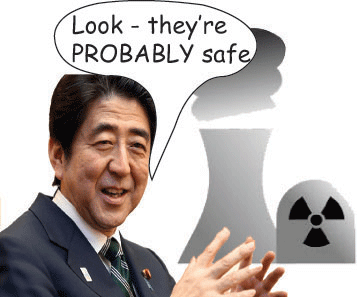 Next year, Abe also plans to reactivate some of the nuclear reactors that have mostly sat idle since the Fukushima meltdowns, a hotly contested move that would likely sap support from the Liberal Democratic Party in a national election next year……..
There is little doubt that the LDP-Komeito ruling camp will retain power, and Abe could even strengthen his political base within the LDP.
“An (early) election will basically give an advantage to the ruling parties,” Sasaki said.
The situation, however, might not be as good as Abe thinks………http://www.japantimes.co.jp/news/2014/11/18/national/politics-diplomacy/abe-dissolve-lower-house-friday-dec-14-election/#.VG0mpzTF8nl
Did PG&E secretly alter Earthquake Standards for Diablo Canyon nuclear plant?

 PG&E May Have Secretly Altered Earthquake Standards for California’s Last Nuclear Power Plant, AlterNet The aging plant is located on an intricate network of earthquake fault lines. October 29, 2014 |
This week a group of environmental activists brought a lawsuit against PG&E and the Nuclear Regulatory Commission because, as it turns out, federal regulators secretly revised Diablo’s license “to mask the aging plant’s vulnerability to earthquakes,” as the San Francisco Chronicle put it.
“The suit claims that the Nuclear Regulatory Commission and [PG&E] last year changed a key element of the plant’s license related to seismic safety without allowing public input as required by law — or even notifying the public at all. The changes concern the strength of earthquakes that the plant … can withstand,” reports the Chronicle.
The public PG&E failed to notify consists of my parents, cousins, teachers, childhood friends, and their children. It’s heartbreaking to read about a nuclear disaster an ocean away, but it’s terrifying to realize that the same thing could happen here in California because of a greedy, negligent corporate coverup.
The lawsuit was filed in U.S. District Court of Appeals for the District of Columbia, which is specifically set up to review the decisions of federal agencies. The group behind the suit wants the court to shut down the plant until the necessary changes are in place. They want public hearings to take place to amend Diablo Canyon’s license. So far PG&E denies all of the allegations………
“Environmentalists have long argued that the plant wasn’t designed to survive the shaking that some of the newly discovered faults could produce,” states the Chronicle. “And last year, Michael Peck, one of the Nuclear Regulatory Commission’s inspectors at Diablo, recommended shutting down the plant until the commission determined that its equipment could withstand a strong quake from those faults. The commission rejected the idea.”……http://www.alternet.org/environment/pge-may-have-secretly-altered-earthquake-standards-californias-last-nuclear-power-plant
“Superfuel” thorium is super-expensive, and does have weapons proliferation risks
 Is the “Superfuel” Thorium Riskier Than We Thought? A new study in Nature says that using thorium as a nuclear fuel has a higher risk for proliferation into weapons than scientists had believed. Popular Mechanics, By Phil McKenna December 5, 2012
 “It may not be as resistant as touted and in some cases the risk of proliferation may be worse than other fuels,” says Stephen Ashley of the University of Cambridge. Continue reading
Iran nuclear talks – the state of plan

 Iran nuclear talks – the Guardian briefing Julian Borger andSaeed Kamali Dehghan Tuesday 18 November Iran and a six-nation negotiating group are trying to reach an agreement that could bring an end to 12 years of deadlock over Iran’s nuclear programme. Read a brief history of the standoff and find out why the outcome of the talks is still in the balance
What’s the story?
The international negotiations over the future of Iran’s nuclear programme are approaching a deadline of 24 November. A deal would curb the Iranian programme – to reassure the rest of the world that Tehran does not intend to build nuclear weapons – in return for sanctions relief. Success would diminish the threat of a new war in the Middle East and significantly improve US-Iranian relations after a 35-year freeze. That in turn could lead to better cooperation in Syria, Iraq, Afghanistan and beyond. Inside Iran, the lifting of sanctions would immeasurably strengthen the hand of pragmatists, led by the president, Hassan Rouhani, who want to re-engage with the west.
How did we get here?……..http://www.theguardian.com/world/2014/nov/18/-sp-iran-nuclear-talks-briefing
The role of ozone depletion in climate change
 The ozone hole leaves a lasting impression on southern climate, The Conversation, Sharon Robinson Professor at University of Wollongong, 8 November 2014, Many people think of sunburn and skin cancer when they hear about the ozone hole. But more ultraviolet (UV) radiation isn’t the only problem.
The ozone hole has also led to dramatic changes in Southern Hemisphere weather patterns. These in turn are altering natural ecosystems and food production. These climate changes are likely having a similar if not greater impact than more UV radiation.
We discuss some of these changes in a paper published today in Global Change Biology.
This week the parties to the Montreal Protocol will meet in Paris, to consider the latest report from the United Nations Environment Programme Environmental Effects Assessment Panel. This report summarises the impact of both ozone loss and the associated increase in ultraviolet radiation on the environment and human health.
The Montreal Protocol continues to be effective at phasing out ozone depleting chemicals and has decreased levels of these greenhouse gases in the atmosphere. But while the Montreal Protocol is a success story, the Southern Hemisphere still faces the threat of climate change from rising greenhouse gases. There is still much to do.
Changing the weather
In recent years, climate scientists have shown that the ozone hole has had a profound impact on weather systems throughout the Southern Hemisphere, especially during summer.
The ozone hole has pulled the polar jet stream further south, increasing its strength. These winds isolate Antarctica and help to keep most of it cold as the rest of the world warms. This has prevented sea ice melt and rising sea-levels. By changing atmospheric circulation, the ozone hole modifies wind, rain and snowfall patterns across the Southern Hemisphere. The changing pattern and strength of winds has caused shifts in the regions that get plenty of rain or snowfall, and those that stay dry. …….
A world avoided
The Montreal Protocol (1987) is a major success story. As a result of this international agreement, the ozone hole is likely to recover by the middle of this century.
Ultraviolet (UV-B) radiation damage to all living organisms, including humans, has been minimised since the region where major ozone depletion occurred is over the sparsely-populated Antarctic. Even there the impacts on terrestrial life are thought to be small, probably less than a 6% loss in productivity in plants.
By controlling the release of ozone depleting chemicals the Montreal Protocol has made a large contribution to reducing greenhouse gases.
The world is cooler now than it would have been without the Montreal Protocol’s controls on emissions of ozone depleting chemicals. This is because many of the chemicals that break down ozone are also potent greenhouse gases (such as chlorofluorocarbons — CFCs).
Climate change in the Southern Hemisphere can be attributed to ozone depletion, as well as increasing greenhouse gases. Decades after the ozone hole was identified and action was taken, we are still discovering how profound its implications are both in terms of the “world avoided”, and unanticipated climate change.
Prompt action was taken in 1987 but the lag time for recovery is still long (see also here)………
Sharon Robinson and Dr. David Erickson, Oak Ridge National Laboratory, USA present this work in the scientific journal Global Change Biology. They are both members of the UNEP-EEAP. ttp://theconversation.com/the-ozone-hole-leaves-a-lasting-impression-on-southern-climate-34043
24 November UK demonstration against transport of nuclear fuel

 Demo at Carlisle Railway: From Darkest Peru to Darkest Cumbria – Stop Nuclear Madness! http://mariannewildart.wordpress.com/2014/11/17/demo-at-carlisle-railway-from-darkest-peru-to-darkest-cumbria-stop-nuclear-madness/Radiation Free Lakeland will be holding a demonstration and leafletting at Carlisle Railway Station on Monday 24th November from 11am to 1pm – Please come and join us
This demonstration in Carlisle coincides with a week of actions at train stations throughout the UK by groups and concerned citizens including in Wigan, Preston and Lancaster to oppose the continued transport of radioactive materials by train.. (look back here for times etc tbc)
What Continued Nuclear Madness Means to the North West:
1. Drives the push for uranium mining worldwide eg. Peru (being aggressively eyed up) , The Grand Canyon USA, Niger, Australia, Russia
2.Uranium arrives at Ellesmere Port Dock by ship where it is transported by road to Capenhurst. It is enriched at Capenhurst and then taken again by road to the Springfields fuel rod conversion plant near Preston. During all these processes it in the form of a Uranium Hexaflouride
3. The Fuel Making Process produces radioactive wastes which are released to the River Ribble and dumped in Clifton Marsh landfill. Depleted Uranium is stored at Capenhurst.
4. The fuel is taken to nuclear reactors including Heysham which is being restarted despite “a crack in the boiler spine, a metal rod supporting the weight of the reactor” (Institution of Engineering and Technology). 5. Once the fuel is burnt (spent fuel) it travels by rail through towns and villages to Sellafield where it is reprocessed increasing the volume of waste x180. Sellafield uses over £30M of gas every year.
6. Spent fuel has travelled by plane from Carlisle airport which is still authorised to carry radioactive materials. In a three year period, 1995-8 at least “8 shipments of nuclear fuel assemblies included passage by air from Carlisle Airport from West Cumbria to Switzerland” (Freedom of Information Response from the Nuclear Decommissioning Authority to RaFL 17th Sept 2014)
6. Next to Sellafield is 500 acres of beautiful farmland, hedgerows and ancient tracks. This land should be a buffer zone around the worlds most dangerous stockpile of nuclear waste. Instead the government plan to sell it to the same companies responsible for Fukushima in order to build 3 new nuclear reactors.
7. There is no “solution” to the problem of nuclear waste apart from distributing it to the environment. Not only to the air and sea but also to landfill. And then there is melting down radioactive scrap metal and selling it onto the open market. Finally, the proposal for deep burial of heat generating nuclear wastes.
World’s largest renewable energy developer? SunEdison on track for this title
 SunEdison To Be World’s Largest Renewable Energy Developer http://www.energymatters.com.au/renewable-news/sunedison-first-wind-em4596/ November 19, 2014 SunEdison, Inc. (NYSE: SUNE) and TerraForm Power, Inc. (Nasdaq: TERP) have announced the signing of a USD $2.4 billion agreement to acquire First Wind, one of the USA’s leading developers, owners and operators of wind farms.
SunEdison says it will purchase over 1.6 GW of First Wind pipeline and backlog projects for Terraform Power, which are expected to be operational in 2016-2017. Also included in the transaction is an additional 6.4 GW of project development opportunities.
SunEdison’s portion of the total transaction is $1.5 billion, with Terraform Power acquiring First Wind’s operating portfolio for an enterprise value of $862 million. TerraForm Power is a yieldco* that is majority owned by SunEdison.
“The acquisition of First Wind transforms both SunEdison and TerraForm Power into diversified renewable energy companies and will make SunEdison the leading renewable power plant developer in the world,” said Ahmad Chatila, President and Chief Executive Officer of SunEdison.
First Wind is understandably quite chuffed about the acquisition as well.
“We are excited to become part of the SunEdison team,” said Paul Gaynor, Chief Executive Officer of First Wind. “This new strategic organization will allow us to join with SunEdison to develop and invest in new, long-term-contracted, well-sited and well-run renewable energy projects that deliver clean energy to homes and businesses across the country and internationally.”
Announcements of major milestones, projects, deals and technology advancements from SunEdison have rapidly flowed in 2014. Just since the beginning of October this year, SunEdison has announced:
- new polysilicon technology.
- zero white space solar panels.
- its Renewable Operations Center portfolio surpassing 3 gigawatts.
- a joint venture in China.
- several major solar projects in California.
- signing of an MoU to develop 5GW of solar projects in India.
- the closing of $130 million in financing for one of the largest solar power plants in Latin America.
- awarded 150 megawatts of solar projects in Karnataka India .
- completed 3 more school installations in California.
- a partnership to develop up to 300 megawatts of utility scale solar in the Philippines.
SunEdison has solar installations, manufacturing plants, and 39 offices located throughout North America, Europe and Asia
* A yieldco is a publicly traded company formed to own operating assets that produce a predictable cash flow.
Source: SunEdison
Chance of nuclear war too close for comfort
Historians of the Cold War have shown that mistakes and miscalculation have brought the world closer to accidental nuclear warfare more often than is commonly realised. A recent report by Britain’s Royal Institute of International Affairs, titled, ‘Too close for comfort’ documents several incidents. Some involved computer malfunctions that led either the US or the USSR to believe that they were under nuclear attack. As the report notes: “Individual decision making, often in disobedience of protocol and political guidance, has on several occasions saved the day.” Several of the most dangerous near-misses took place during periods of heightened political tension between Moscow and Washington. The most famous such incident was the Cuban Missile crisis of 1962. A more recent instance — with a stronger contemporary resonance — was the Able Archer incident of November 1983. In September of that year, the Soviet Union had shot down a Korean Air civilian airliner, killing 267 people. That tragedy, like the shooting down of a Malaysian Airlines flight over Ukraine this year, had significantly raised East-West tensions with the Russians, then as now, accusing America of militarism and plans for world domination.
Against this background, Nato staged a military exercise that acted out a western nuclear strike on the USSR. Operation Able Archer was so thorough and so realistic that many in Moscow interpreted it as preparation for a Nato first-strike. In response, the Russians readied their own nuclear weapons. It appears that intelligence services alerted the West to how Able Archer was being seen in Moscow, allowing for de-escalation.
One lesson of that episode is that the existence of a “hotline” between Moscow and Washington is no guarantee that the two sides will not blunder. Another is that any ambiguous move, involving nuclear weapons, can cause a dangerous panic.
My parents’ generation got grimly used to living in the shadow of the bomb. But for my generation, the very idea of nuclear warfare seems like something from science-fiction or even dark comedy, such as Dr Strangelove. But the world’s nuclear arsenals were not abolished after the Cold War. Sadly, we may now be returning to an era in which the threat of nuclear warfare can no longer be treated as the stuff of science fiction. http://gulfnews.com/opinions/columnists/the-nuclear-gun-is-back-on-the-table-1.1414436
Correction on some statements on UK Hacking and Manipulation of Independent Scientists in the UK mentioned on Nuclear Hotseat report by Shaun McGee
OpEd by Shaun McGee (aka arclight2011)
19th November 2014
posted to nuclear-news.net
I am using this chance to make a correction to some comments made in last weeks Nuclear Hotseat report by Shaun McGee. The claims of manipulation of finances of these two Scientists (Chris Busby and Ian Fairlie) still stand. Also, Ian Fairllie had his recent bullet proof peer reviewed report on increased Leukemia in children around nuclear power plants disappear and become unavailable after some 200 odd downloads by the science community.And Chris Busby has been removed as a scientific witness to the Atomic veterans in the UK courts with no independent scientist allowed to offer non UK government backed Science data. I might add that Mr Gundersen from the USA tells us in the same Nuclear Hotseat Podcast, linked above, that his Tokyo sourced radioactive samples mysteriously disappeared showing that this criminal behaviour is happening on both sides of the Atlantic.
There are many other examples of UK blocking of emails and disruption of nuclear stakeholder groups that will be reported in depth in further articles posted exclusively on this blog, in the near future.
In the report this statement;
“.. even in the face of growing evidence reluctantly released by the UK government showing that there is indeed damage caused by U234 fallout from the Atomic Bomb program..”
Should have said;
The UK government is being challenged by the British Nuclear Test Veterans Association for a paltry 25 million Pounds Sterling (40 million US dollars Approx ) for damage to the veterans and their descendent’s for up to 20 generations, any funds needed above that need to be raised by the Veterans and their families.
And the statement that immediately followed;
“.. Also, this underpinned by recent findings and admissions by the UK government that Depleted Uranium has caused similar genomic problems in Iraq veterans due to DU..”
This statement was wrong, however, 2 soldiers from the first Iraq war were part compensated for Depleted Uranium health effects to themselves whilst cleaning out effected Tanks. And 2,000 others were awarded health pensions due to “war damage” (Quotes and links below).
A report from Going Underground claims that the UK will not be using DU in Iraq in further military actions;
Hundreds of tons of depleted uranium has been dropped in Iraq by US and UK forces, contaminating an estimated 300 sites, with a huge increase in cancer rates and a 17 fold increase in birth defects. The MoD denies any connection between the two. And the UK is one of only 4 countries ruling out banning the use of the weapon, which can disperse toxic dust and contaminate sites for years.
And below is some evidence to support the correction to the Nuclear Hotseat report above;
Exposure to depleted uranium in 1991 Gulf War killed UK soldier – inquest rules
A Black Country soldier died as a result of exposure to depleted uranium during the first Gulf War, an inquest has ruled. Stuart Dyson, of Cherwell Drive, Brownhills, formerly a Lance Corporal in the Royal Pioneer Corps, died of colon cancer in June last year aged only 39. His family has sought to prove his belief that he was dying because of being exposed to the lethal substance while cleaning tanks in the Gulf between January and May 1991. A jury, sitting at Smethwick Council House, heard medical evidence that cancer-inducing particles from uranium in tank shells had been breathed in and swallowed by Mr Dyson and that the onset of cancer in such cases could typically take ten years to show. (Birmingham Post, Sep 11 2009)
Pension award for British soldier’s depleted uranium poisoning claim
Scots ex-soldier Kenny Duncan has become the first veteran to win a pension appeal after being diagnosed with depleted uranium (DU) poisoning during the 1991 Gulf war.
Mr Duncan’s case relied on blood tests carried out by Dr Albrecht Schott, a German biochemist, which revealed chromosome aberrations caused by ionising radiation.
Dr Schott’s research formed part of a study of 16 British veterans of conflicts in the Gulf, Bosnia, and Kosovo. The test results were dismissed by the MoD as “neither well thought out nor scientifically sound”. (Glasgow Herald, Feb. 4, 2004)
UK Gulf War veterans to abandon legal battle for compensation claims
An eight-year, multimillion pound legal battle by more than 2,000 veterans for compensation for Gulf war syndrome has collapsed because there is not enough scientific evidence to prove their case in court.
The Legal Services Commission (LSC), which is estimated to have spent around £4m on the case, is expected to withdraw legal aid this month after being told by the veterans’ lawyers that the action has no real chance of success.
To succeed in their claim against the Ministry of Defence, the veterans would have to produce scientific evidence not only that their illness was caused by their service in the 1991 Gulf war, but also that the MoD had been negligent. The burden of proof would be on them as claimants to prove their case.
More than 2,000 Gulf veterans have been awarded “no fault” war pensions, granted to those whose health has been affected by war service. This week the first war pension for the effects of depleted uranium was awarded to a former soldier, Kenny Duncan, who claimed he was poisoned from inhaling DU dust from burnt-out tanks.
But winning a war pension is no pointer to success in a high court compensation claim. The burden of proof is reversed in pension cases, putting the onus on the MoD to prove the illness is not linked to Gulf service, and there is no need to prove negligence. (The Guardian Feb. 5, 2004)
H/t http://www.wise-uranium.org/dissgw.html for the three articles above.
Of course, the UK government has commissioned, what i believe to be, biased reports claiming no effect of Depleted Uranium although they claim that this weapon will not be used in any further attacks on Iraq. The Science Media backed Scientists connected to the UK governemnt are trying to cover up the effects of radiation and toxic effects of nuclear materials and this will also be reported on in the future exclusively to nuclear-news.net followers.
PS its nice to be back 🙂
Tepco unable to halt tainted water flowing into tunnels at Fukushima
Nov 18, 2014
Tokyo Electric Power Co. appears unable to stem the flow of radioactive water from the No. 2 reactor building to underground tunnels at the Fukushima No. 1 power plant, officials said.
Tepco has injected cement into the joints that connect the tunnels, which are used to run cables, and the building to halt the flow of contaminated water and remove accumulations from the tunnels.
But water levels suggest the effort has remained unsuccessful so far, the officials said. The company began the cement injections after failing to create an “ice wall” over the summer by freezing water inside the joints that would have blocked the flows.
After the cement injections, Tepco pumped 200 tons of tainted water out of the tunnels Monday, causing levels inside to fall around 20 cm, the officials said.
However, if the joints were completely sealed, water levels would have fallen roughly 80 cm, the officials said, indicating the possibility that contaminated water is still flowing into the tunnels.
The officials also noted the possibility that groundwater may be flowing into the tunnels. However, recent data has shown that the amount of radioactive materials in the tunnel water was very high, an official in the Nuclear Regulation Authority said.
“Concentrations should have been lower if large amounts of groundwater are really flowing in,” the official noted.
If the cement injections end in failure, too, Tepco plans to remove radioactive water while injecting cement into the tunnel — an operation that could put plant workers at greater risk of radiation exposure.
The tunnels are believed to contain some 5,000 tons of tainted water. Some observers believe the water may be leaking into the ground and reaching the Pacific.
Source: Japan Times

Op-Ed: Fukushima disaster — Ignorance is bliss despite the dangers
 The Sendai nuclear power plant will become the first of Japan’s 48 commercial reactors to be restarted after they were all shut down since the Fukushima disaster in 2011
Little is reported in the media about the clean up after the Fukushima Power Plant disaster. After three years of cover-ups and misleading information, released to quell public fears, there is still reason to be wary. The danger is still very real.
The Fukushima Daiichi nuclear power plant disaster in 2011 is still impacting lives today. Over 120,000 people from the area are living in a nuclear limbo, according to the guardian. Once close-knit families are now forced to live apart in temporary housing complexes, many of the homes hastily thrown up in an effort to get people out of radiation “hot-spots.”
Japan’s population has been inundated with half-truths and sometimes, outright lies, concerning the progress being made in the clean-up efforts in Fukushima. For the thousands of workers tasked with the laborious details of doing the actual work, just knowing their efforts are inadequate must be mind-numbing.
Fukushima Daiichi’s manager, Akira Ono is the man in charge of the clean up efforts, and he admitted to the Guardian that there is little cause for optimism. No matter what the workers do, there is still a huge problem with contaminated water. Over 400 tons of groundwater flow every day from the hills outside the plant and into the basements where the three stricken reactors are located.
There, the water mixes with the coolant water being pumped in to keep the melted fuel from overheating and causing another nuclear accident. TEPCO says “most of the water” is pumped out into holding tanks, but ever-increasing amounts end up seeping into maintenance trenches, and then into the ocean. This has to be depressing for Ono and the men and women walking into the facility every day.
While Americans have been sitting back and ignoring the ongoing disaster that is Fukushima, other countries have taken notice. Germany and Italy are looking at the viability of continuing to depend on nuclear power, and are opting instead for other more eco-friendly sources. And surprisingly, the news media in other countries is also paying attention to what has been going on at the Fukushima power plant.
Arnold Gunderson, a former high-level nuclear industry executive, was cited in an article written in Al-Jazeera English, entitled “Fukushima: It’s much worse than you think,” in June, 2011. In the story, Gunderson is quoted as saying, the Fukushima disaster was “the biggest industrial catastrophe in the history of mankind. Twenty nuclear cores have been exposed at Fukushima.” Gunderson also points out that the site’s many spent-fuel pools give Fukushima 20 times the radiation release potential of Chernobyl.
If people on the North American coast think they are safe from the effects of radiation from the Fukushima disaster, not only are they dreaming, but they are going to be in for a rude awakening. Yes, there were a few stories telling us the radiation levels reaching our west coast were “tiny amounts,” But how many additional infants are going to die, and how many more people, children and adults are going to end up with unexplained cancers before someone wakes up to what is happening?
And the American public needs to wake up right now. We have nuclear disasters just waiting to happen in our own back yard. From the Diable Canyon power plant in California, to the Cooper Nuclear Station near Brownville, Nebraska that was almost inundated with floodwaters in June, 2014, the list is getting longer and longer. The Nuclear Regulatory Committee has been forced to ease up on some regulations or just ignore them when it comes to helping power plants in the U.S. to meet what officials call “unnecessarily conservative” standards. Yes, ignorance is bliss. That is scary, folks,
Source: Digital Journal
Contaminated water swamps Fukushima No. 1 cleanup
 The Advanced Liquid Processing System of the Fukushima No. 1 plant is seen Wednesday
Nov 16, 2014
More than three years into the massive cleanup of the Fukushima No. 1 power plant, only a tiny fraction of the workers are focused on key tasks such as preparing for the dismantling of the wrecked reactors and removing radioactive fuel rods.
Instead, nearly all the workers at Fukushima No. 1 are devoted to a single, enormously distracting problem: coping with the vast amount of contaminated water, a mixture of groundwater running into recycled water that becomes contaminated and leaks after being pumped into the reactors to keep their melted cores from overheating.
A number of buildings housing water treatment machines and hundreds of huge blue and gray industrial storage tanks to store the excess water are rapidly taking over the grounds at the plant, which saw three of its six reactor cores suffer meltdowns from the 3/11 quake and tsunami. Workers were still building more tanks during a visit to the complex Wednesday by a group of foreign media.
“The contaminated water is a most pressing issue that we must tackle. There is no doubt about that,” said Akira Ono, head of the plant. “Our effort to mitigate the problem is at its peak now. Though I cannot say exactly when, I hope things start getting better when the measures start taking effect.”
The numbers tell the story:
6,000 workers
Every day, about 6,000 workers pass through the guarded gate of Fukushima No. 1, located on the Pacific coast, two to three times more than when it was actually generating electricity.
On a recent workday, about 100 workers were dismantling a makeshift roof over one of the reactor buildings, while about a dozen others were removing fuel rods from a cooling pool. Most of the rest were dealing with contaminated water-related work, said Tatsuhiro Yamagishi, a spokesman for plant operator Tokyo Electric Power Co.
The work threatens to exhaust the supply of workers for other tasks, since they must stop working when they reach annual radiation exposure limits. Experts say it is crucial to reduce the amount and radioactivity of the contaminated water to decrease the risk of exposure to workers and the environmental impact before the decommissioning work gets closer to the highly contaminated core area.
40 years
The plant has six reactors, three of which were offline when disaster struck on March 11, 2011, a magnitude-9.0 earthquake that triggered huge tsunami that swept into the plant and knocked out its backup power and cooling systems, leading to core meltdowns in the three active reactors.
Decommissioning and dismantling all six of the reactors is a delicate, time-consuming process that includes removing the melted fuel from a highly radioactive environment as well as all the extra fuel rods, which sit in cooling pools situated at the top of the reactor buildings.
The entire job still requires finding out the exact conditions of the melted fuel debris and developing remote-controlled and radiation-resistant robotics to deal with them, and the work is expected to take at least 40 years.
500,000 tons
The main problem is an abundant inflow of groundwater into the contaminated water that doubles the volume and spreads it to vast areas of the compound. Workers have jury-rigged a pipe-and-hose system to continuously pump water into the reactors to cool the clumps of melted fuel inside.
The water becomes contaminated upon exposure to the radioactive fuel, and much of it pours into the reactor and turbine basements, and maintenance trenches that extend to the Pacific Ocean. The plant recycles some of the contaminated water as cooling water after partially treating it, but groundwater is also flowing into the damaged reactor buildings and mixing with contaminated water, creating a huge excess that needs to be pumped out.
So far, more than 500,000 tons of radioactive water have been stored in nearly 1,000 large tanks that workers have built, which now cover most of the sprawling plant premises. After a series of leaks from the storage tanks last year, they are now being replaced with costlier welded tanks.
That dwarfs the 9,000 tons of contaminated water produced during the 1979 partial meltdown at Three Mile Island in the United States. In that incident, it took 14 years for the water to evaporate, said Lake Barrett, a retired U.S. nuclear regulatory official who was part of the early mitigation team there and has visited Fukushima No. 1.
“This is a much more complex, much more difficult water management problem,” Barrett said.
¥10 trillion
An estimated ¥2 trillion will be needed just for decontamination and other mitigation of the water problem. Altogether, the entire decommissioning process, including compensation for area residents, reportedly will cost about ¥10 trillion.
All this for a plant that will never produce a kilowatt of energy again.
The work threatens to exhaust the supply of workers for other tasks, since they must stop working when they reach annual radiation exposure limits. About 500 workers are digging deep holes in preparation to build a taxpayer-funded ¥32 billion underground “frozen wall” around the four reactors and their turbine buildings to try to keep the contaminated water from seeping out.
Tepco is developing systems to try to remove most radioactive elements from the water. One, the Advanced Liquid Processing System (ALPS), has been trouble-plagued, but utility officials hope to achieve a daily capacity of 2,000 tons when it enters full operation next month. Officials hope to be able to treat all contaminated water by the end of March, but that is far from certain.
Source: Japan Times
-
Archives
- February 2026 (228)
- January 2026 (308)
- December 2025 (358)
- November 2025 (359)
- October 2025 (376)
- September 2025 (258)
- August 2025 (319)
- July 2025 (230)
- June 2025 (348)
- May 2025 (261)
- April 2025 (305)
- March 2025 (319)
-
Categories
- 1
- 1 NUCLEAR ISSUES
- business and costs
- climate change
- culture and arts
- ENERGY
- environment
- health
- history
- indigenous issues
- Legal
- marketing of nuclear
- media
- opposition to nuclear
- PERSONAL STORIES
- politics
- politics international
- Religion and ethics
- safety
- secrets,lies and civil liberties
- spinbuster
- technology
- Uranium
- wastes
- weapons and war
- Women
- 2 WORLD
- ACTION
- AFRICA
- Atrocities
- AUSTRALIA
- Christina's notes
- Christina's themes
- culture and arts
- Events
- Fuk 2022
- Fuk 2023
- Fukushima 2017
- Fukushima 2018
- fukushima 2019
- Fukushima 2020
- Fukushima 2021
- general
- global warming
- Humour (God we need it)
- Nuclear
- RARE EARTHS
- Reference
- resources – print
- Resources -audiovicual
- Weekly Newsletter
- World
- World Nuclear
- YouTube
-
RSS
Entries RSS
Comments RSS
 nuclear-news