 Onagawa town assembly member Mikiko Abe stands against the backdrop
of Tohoku Electric Power Co.’s Onagawa nuclear power plant.
October 18, 2014
POINT OF VIEW/ Mikiko Abe:
ONAGAWA, Miyagi Prefecture–As an opponent of atomic energy, I have watched this town for more than four decades–from before Tohoku Electric Power Co. began constructing the Onagawa nuclear power plant here.
It is my hope that our town can stand on its own without the massive subsidies associated with the installation of nuclear reactors and fixed asset taxes paid by the power utility. It’s not about asking if we can revert to that state of things. I believe we have to do it now.
I live in temporary housing because my home was swept away by the tsunami generated by the Great East Japan Earthquake.
I was elected to the town assembly eight months after the March 2011 disaster, which claimed the lives of some of my fellow activists. In the hope of conveying their anti-nuclear message to younger generations, I ran in the assembly election as an independent candidate.
The disaster left nearly 10 percent of Onagawa’s 10,000 population dead or missing, and nearly 90 percent of homes here were damaged. Some residents believe that a restart of the nuclear plant is essential for rebuilding the town.
Around 1970, when the Onagawa plant had yet to be built, local fishermen banded together to express opposition to the nuclear facility. Thousands took part in a protest rally held near the seashore. About 10 buses, each with 50 seats, arrived from a neighboring town to join it.
But Tohoku Electric began approaching nuclear opponents and secured agreement to engage in small talk from some people. They included, for example, owners of large fishing vessels that operated far from coastal waters. They had large crew and held senior positions in the local fishermen’s union.
There is no significant opposition movement in Onagawa now.
I studied at a university in Tokyo after I graduated from senior high school. I took an interest in the issue of Minamata disease (caused by mercury pollution) and joined a sit-in outside the head office of Chisso Corp., the chemical company responsible for the pollution. I thought the economy was being put ahead of humans–the same picture that applies to atomic power generation.
After I graduated in 1975 and returned home, I found my community polarized between nuclear opponents and proponents. I was told that residents living along the same seashore had been so estranged that they no longer even spoke to each other when they attended funerals of people in the other camp.
The opposition movement gradually cooled its heels after the fishermen’s union decided to accept financial compensation, and after construction of the No. 1 reactor of the Onagawa nuclear plant began in 1979.
Some people had relatives working for the nuclear plant, while others supplied food to the plant workers.
They could no longer openly state they were opposed, even if they felt differently in their hearts.
A sense of resignation gradually spread. In the words of Tohoku Electric: “We obtained their understanding through persistent dialogue.”
The Onagawa nuclear plant now has three reactors.
The Great East Japan Earthquake damaged part of the power supply systems at the Onagawa plant, although it was spared from being swamped directly by the tsunami triggered by the March 11, 2011, quake.
I was driving a car in the neighboring city of Ishinomaki at the time. I returned home in the evening after being caught in a traffic jam and found it had been swept away by the tsunami. I lived for some time on the second floor of a relative’s home, whose ground floor had been flooded. I listened to news about the Fukushima nuclear disaster on the radio, but somehow, the situation at the Onagawa nuclear plant never crossed my mind.
Tohoku Electric has been boasting that the Onagawa nuclear plant “withstood the quake and tsunami.” I have also been told that a gymnasium on the grounds of the plant served as an evacuation shelter for more than 300 residents for three months. Some inhabitants are thankful for that.
But I later learned that the plant grounds lay only 80 centimeters above the towering tsunami, which measured 13 meters in height, and only one of the five external power supply systems survived without damage. Perhaps it was a matter of sheer chance that a serious accident was avoided.
The town government has so far received 21 billion yen ($195 million) in subsidies associated with the installation of nuclear reactors. This is in line with three laws governing the siting of nuclear power plants. The town also has a huge revenue source as a result of fixed asset taxes paid by Tohoku Electric. Sumptuous facilities that exceed our means have popped up one after another.
In looking to the future and making decisions about the town’s finances, a key consideration is whether we should bank on cash revenue from a future restart of the Onagawa nuclear plant.
When I attended a debate session in the assembly, I raised an objection to a young man who called for community development based on coexistence with the nuclear plant. Nobody presented follow-up opinions. And that was the last time the nuclear plant issue was raised. It remains difficult to this day to speak your mind.
But some people have begun reflecting on the future of the nuclear plant, even though they don’t speak out. The president of a company that does business with the nuclear plant once blurted out, when he was alone with me, “We cannot rely on the nuclear plant forever.”
Three of the 12 members of the Onagawa town assembly are opposed to the nuclear plant. Some of the other nine are taking a wait-and-see attitude and are less than wholeheartedly pro-nuclear.
I believe that, with the nuclear plant idled in the wake of the quake and tsunami disaster, now is a good opportunity for the townspeople to discuss their own future among themselves.
* * *
Mikiko Abe, 62, operates a liquor shop and a shipping agency, which markets fish caught from outside Onagawa, with her parents. Abe has one son and four daughters.
(This article is based on an interview by Ryoma Komiyama.)
Source: Asahi Shimbun
http://ajw.asahi.com/article/views/opinion/AJ201410180014
October 19, 2014
Posted by dunrenard |
Japan | Idled, Onagawa Nuclear Plant, Tepco |
Leave a comment
 October 18th, 2014 | ◆
Toshitsugu Fujii, a professor emeritus at the University of Tokyo
A prominent volcanologist disputed regulators’ conclusion that two nuclear reactors are safe from a volcanic eruption in the next few decades, saying Friday that such a prediction is impossible.
A cauldron eruption at one of several volcanoes surrounding the Sendai nuclear plant in Kagoshima Prefecture could not only hit the reactors, but also cause a nationwide disaster, said Toshitsugu Fujii, a professor emeritus at the University of Tokyo who heads a state-commissioned panel on eruption prediction.
The Nuclear Regulation Authority last month said two Sendai reactors fulfilled tougher safety requirements set after the 2011 Fukushima crisis began.
The NRA ruled out a major eruption over the next 30 years until the reactors reach the end of their usable life span.
The surprise eruption of Mount Ontake on the border of Gifu and Nagano prefectures on Sept. 27 has renewed concerns about the volcanoes in the region.
“It is simply impossible to predict an eruption over the next 30 to 40 years,” Fujii said. “The level of predictability is extremely limited.”
He said eruptions can only be predicted in hours or days, at best.
Studies have shown that pyroclastic flow from an eruption 90,000 years ago at one of the volcanoes near the Sendai plant reached as far as 145 km (90 miles) away, Fujii said.
He said that a pyroclastic flow from Mount Sakurajima, an active volcano that is part of the larger Aira cauldron, could easily hit the nuclear plant, which is only 40 km (25 miles) away.
Heavy ash falling from an eruption would make it impossible to reach the plant, and could also affect many parts of the country, including Tokyo, he said. Many nuclear power plants could also be affected in western Japan.
The Sendai reactors are the first to pass the safety checks, which added resistance to volcanic eruption as part of the new evaluation.
Prime Minister Shinzo Abe is pushing to restart any viable reactors deemed safe, saying nuclear power is stable and relatively cheap compared to other energy sources and key to Japan’s recovery. Ironically, the utilities, many of which operate atomic plants, are revolting against the feed-in tariff system — for producing a solar energy glut.
Kyushu Electric Power Co., which runs the Sendai plant, promised steps to ensure worker access in up to 15 cm (6 inches) of ash and a monitoring system to detect changes in volcanic activity.
It also promised to transfer fuel rods to safer areas ahead of time if eruption signs are detected — a time-consuming process experts say is unrealistic.
Fujii said 10 cm (4 inches) of ash will render any vehicle except tanks virtually inoperable. Power lines would be cut by the weight of the ash, causing blackouts that could shut reactor cooling systems.
Only after approving the reactors’ safety did the NRA establish a volcano panel to discuss eruptions and countermeasures.
Fujii, a member of that panel, said experts are opposed to the NRA’s views.
Even though a catastrophic eruption might occur only once in 10,000 years, the likelihood of one cannot be ruled out either, he said.
“Scientifically, they’re not safe,” he said of the Sendai reactors. “If they still need to be restarted despite the uncertainties and risks that remain, it’s for political reasons, not because they’re safe, and you should be honest about that.”
Source: Japan Times
http://www.japantimes.co.jp/news/2014/10/18/national/science-health/reactor-safety-near-japans-volcanoes-disputed-by-prominent-expert/#.VEJynq0cSM8
October 19, 2014
Posted by dunrenard |
Japan | Reactors Restart, Sendai, Volcanic Activity |
2 Comments

MOSCOW, October 18 (RIA Novosti), Ekaterina Blinova – Radiation levels at Japan’s notorious Fukushima Nuclear Power Plant jumped after the plant was hit earlier this month by two typhoons: Phanfone and Vongfong.
“The back-to-back weather disturbance typhoons Vongfong and Phanfone had triggered the elevated radiation quantities at the plant,” writes the International Business Times, citing NHK, Japan’s state-run media outlet.
According to Japan’s JIJI agency, levels of cesium, a radioactive isotope that causes cancer, are three times higher than their previously registered rates and are currently 251,000 becquerels per liter, while levels of tritium, another dangerous isotope, have grown as high as 150,000 becquerels.
Tepco’s (Tokyo Electric Power Co.) spokesperson emphasized that heavy rainfall triggered by Typhoon Phanfone had apparently impacted Fukushima’s groundwater.
“In addition, materials that emit beta rays, such as strontium-90, which causes bone cancer, also shattered records with a reading of 1.2 million becquerels,” JIJI agency pointed out, adding that the wells that groundwater samples had been taken from were located close to the nuclear plant’s port in the Pacific.
Asahi Shimbun underscores that Tepco’s task of decontaminating all the radioactive water stored at the Fukushima No. 1 plant by the end of this fiscal year will be “increasingly difficult” to accomplish.
“According to a Tepco estimate made in February, the amount of highly contaminated water should have been reduced to 300,000 tons by about now, but the water cleaning procedure is currently a month behind the original schedule,” the media outlet stresses.
Asahi Shimbun reveals that another problem is that the groundwater flow into the plant’s reactor building is increasing the amount of highly radioactive water by 400 tons a day. Although the corporation claims that it has succeed in reducing the influx by 130 tons a day due to its various counter-measures and its “underground water bypass project,” these estimations have not been verified, the media source notes. The ambitious water-decontamination plans have yet to be completed and it remains to be seen when Tepco will be able to accomplish its task.
Source: RIA Novosti
http://en.ria.ru/society/20141018/194266755/Higher-Fukushima-Radiation-Levels-Triggered-By-Typhoons.html
October 19, 2014
Posted by dunrenard |
Japan | Fukushima Daiichi, Radiation Levels, Typhoons |
1 Comment
 October 17, 2014
Radiation from Japan’s Fukushima nuclear disaster is approaching the West Coast, the Woods Hole Oceanographic Institution is reporting.
A sample taken Aug. 2 about 1,200 kilometers west of Vancouver, B.C. tested positive for Cesium 134, the Fukushima “fingerprint” of Fukushima.
It also showed higher-than-background levels of Cesium 137, another Fukushima isotope that already is present in the world’s oceans from nuclear testing in the 1950s and 1960s.
The sample is the first of about 40 offshore test results that will be made public next month, said Ken Buesseler, a chemical oceanographer at Woods Hole.
Further results, which Buesseler will release at a conference Nov. 13, will show offshore Fukushima radiation down the coast into California, he said, including some samples that are closer to shore.
Buesseler emphasized that the radiation is at very low levels that aren’t expected to harm human health or the environment.
“I’m not concerned,” he said.
And no samples from West Coast shorelines have found Fukushima radiation.
“There is definitely offshore Fukushima cesium now,” Buesseler said. “It’s not on the beaches, but it’s offshore.”
Massive amounts of contaminated water were released from Fukushima following a March 2011 earthquake and tsunami. Radioactive water has continued to leak and be released from the complex.
No state or federal agency is testing Pacific waters for radiation from the crippled Japanese nuclear plant.
So earlier this year Buesseler launched a crowdfunded effort to collect surf samples to be tested at his lab in Massachusetts.
Processing was completed on about 30 of those samples, from the Bering Strait to San Diego, including one from Oregon. More samples are awaiting testing
Then, last summer, the captain of a research vessel out of Moss Landing Marine Lab in California offered to collect offshore samples down the entire coast in conjunction with other research work he was doing.
Buesseler said he hesitated at first, because analyzing those samples would cost about $30,000 his lab didn’t have.
“We decided to send him the containers anyway,” Buesseler said.
Buesseler was able to use a $12,000 donation from U.K.-based Lush Fresh Handmade Cosmetics to begin processing the samples.
He’s still looking for funding to make up the difference.
The Aug. 2 sample is the project’s first to identify Fukushima radiation.
The sample was collected at a depth of 25 meters.
It showed levels of cesium 134, the Fukushima fingerprint, at 2.2 becquerels per cubic meter (Bq/m3).
Levels of cesium 137 were 3.9 Bq/m3. Background levels range between 1 and 2 Bq/m3.
Scientist expect the radiation to reach West Coast beaches this year or next year.
Source: Tracy Loew, Statesman Journal
http://www.statesmanjournal.com/story/tech/science/environment/2014/10/17/fukushima-radiation-nearing-west-coast/17437081/
October 19, 2014
Posted by dunrenard |
Uncategorized | Fukushima Radiation, West Coast |
1 Comment
 Former NHK anchor Jun Hori speaks at a TEDx event in Kyoto, Japan,
about opening Japanese journalism to non-traditional sources.
October 17, 2014
No one is telling Shiga Kamematsu the truth.
It’s been three-and-a-half years since 83-year-old Kamematsu left his home, with its rice patties, vegetable fields and 10 cows, fleeing the disaster at the nearby Fukushima Daiichi nuclear reactor. He still can’t go back.
When will it be ready for people again? No one seems to know — or be interested in telling him. “I can’t take my land with me,” he says, “so I don’t know what to do. I can’t see ahead.”
Kamematsu is one of about 80,000 people in Japan still officially displaced by the nuclear crisis. Questions remain about radiation levels, the clean-up process and when residents can return home. Yasuhiko Tajima, a professor of media studies at Tokyo’s Sophia University, says many Japanese are frustrated by what they see as a lack of information.
Japanese journalists did what Tajima calls “announcement journalism” in reporting on the crisis. He says they were reporting the press releases of big companies and the people in power. And he’s not the only one who thinks so.
“I am a newscaster, but I couldn’t tell the true story on my news program,” says Jun Hori, a former anchor for NHK, the Japanese state broadcaster.
Hori says the network restricted what he and other journalists could say about Fukushima and moved more slowly than foreign media to report on the disaster and how far radiation was spreading. The attitude in the newsroom was not to question official information
“I was on the ground in Fukushima, and a lot of people kept asking me, why didn’t you tell us earlier about what is happening?” Hori says.
Out of frustration, Hori started tweeting uncensored coverage. “I got a huge response,” he says, “but then my superiors said the NHK was getting complaints from politicians about what I was saying. They told me I had to stop.”
Hori eventually quit the NHK and started his own website for citizen journalism — 8-Bit news. He says Fukushima showed people in Japan that they had to be proactive about getting information. Anyone can submit videos and news content to his site.
“Until now, the Japanese thought someone was doing it: companies, the government, someone,” Hori says. “But once you peeled back the cover, you saw that nobody was doing it.”
That’s backed up by outside observers as well: Japan has dropped 31 places since 2011 in a World Press Freedom ranking compiled by the group Reporters Without Borders. The group cites “a lack of transparency and almost zero respect for access to information on subjects directly or indirectly related to Fukushima.”
In a statement, NHK said it covered the event accurately and promptly reported a meltdown. It did not address claims that it faced outside pressure from politicians to restrict Hori’s Twitter account.
Hori’s 8-Bit is part of wave of new media launched since Fukushima, spanning everything from blogs and social media to documentaries. Yasumi Iwakami started one of the first efforts. He took live streaming video of press conferences and other coverage and loaded them up to a site called the Independent Web Journal.
“We just kept the cameras running all the time,” Iwakami says. “Even during the breaks at press conferences. We interviewed everyone we could.”
If you want to say something clearly and directly in Japan, Iwakami says, it takes a lot of effort. You have to do something drastic — like start a streaming news site run on donations. “That’s very crazy!” he says.
It is a big change from Japan’s traditional media, says Benjamin Ismail, head of the Asia-Pacific desk for Reporters Without Borders. He says that in covering Fukushima, self-censorship was a big issue.
“Some of the journalists really believed they had a duty not to create a global panic,” Ismail says, “and therefore they had to withhold some of the information they obtained.”
Ismail hopes Japan’s alternative media can gain steam, especially because there’s not much time to act. Prime Minister Shinzo Abe is moving ahead on restarting the nuclear industry, and the first reactors are projected to be back online by next year.
Sources:
1. PRI’s The world
http://www.pri.org/stories/2014-10-16/frustrated-japans-coverage-fukushima-crisis-japanese-news-anchor-started
2. “Newsroom revolution” — empowering the people: Jun Hori at TEDxKyoto 2013
https://www.youtube.com/watch?v=Dg8whKEQYPg#t=45
October 19, 2014
Posted by dunrenard |
Japan | Fukushima Daiichi, Japanese Media, News Coverage |
Leave a comment
 As Communities Block Nuclear Restart, Japan’s 48 Operable Reactors Idle, Forbes, 17 Oct 14, Nothing is as hotly debated in Japan right now as the restarting of the 48 inactive nuclear plants which closed one after the other for scheduled maintenance after the Fukushima disaster three years ago. Near Kyushu Electric Power’s Sendai plant in southwest Japan, communities are thwarting revival plans despite Prime Minister Shinzo Abe urging on the restart plan after Sendai was found to meet the new safety guidelines set by the independent nuclear regulator.
The Sendai plant, located about 600 miles from Tokyo, is the first to receive the clearances but with the consensus process involving communities and local governments has become complex. The reactor’s restarting could be months away. Over three years have lapsed since the nuclear reactors run by the Tokyo Electric Power Co in Fukushima suffered a meltdown following an earthquake-triggered-tsunami. The accident in May 2011 was the worst disaster since Chernobyl. The contaminated towns near Fukushima are still out of bounds and could be for years while the clean-up process continues.
Since the Fukushima disaster, regulatory lapses have come to light and communities have rallied against plants and fought to keep the reactors idle as they closed for regular maintenance. The last of the reactors shut a year ago.
There is also the fact that Japan is prone to natural disasters and frequently hit by earthquakes and typhoons. After the volcanic eruption in Mount Ontake in September, fresh fears are being raised on nuclear safety during volcanic activity. Sendai, for instance, is about 30 miles from an active volcano……..http://www.forbes.com/sites/saritharai/2014/10/16/as-communities-block-nuclear-restart-japans-48-operable-reactors-idle/
October 18, 2014
Posted by Christina Macpherson |
Japan, opposition to nuclear |
Leave a comment
 Agency: Fukushima workers urgently trying “to prevent groundwater from leaking into ocean” — Levels of nuclear waste surge next to sea — Strontium-90 shatters previous record by over 5 Billion Bq/m3 — Now 25 million times EPA limit http://enenews.com/agency-fukushima-workers-urgently-trying-prevent-groundwater-leaking-ocean-levels-nuclear-waste-skyrocket-next-sea-strontium-90-shatters-previous-record-5-billion-bqm3?utm_source=feedburner&utm_medium=email&utm_campaign=Feed%3A+ENENews+%28Energy+News%29
Jiji Press,Oct. 14, 2014: Cesium Level Rises in TEPCO Plant Well — [TEPCO] on Tuesday reported a sharp rise in cesium levels in water collected from an observation well near the sea [on] Monday [with] a record 251,000 becquerels of radioactive cesium per liter, 3.7 times the cesium level… [last] Thursday… Monday’s reading was the highest level… from any of these wells… The samples in question also contained 7.8 million becquerels of beta particle-emitting radioactive substances, such as strontium-90, per liter, also a 3.7-fold increase.ITAR-TASS (Russian News Agency), Oct. 14, 2014 (emphasis added): Highest radiation inground water at Japan’s NPP after nuclear disaster… The highest radiation level was registered in subsoil water taken from a technical well at 1st and 2nd power units at Fukushima-1.., [TEPCO] said on Tuesday. The underground water sample was taken on October 13… Company’s experts said that a surge in radiation was linked with the impact of a typhoon raging in the locality, when heavy rain triggered spread of radiation-contaminated particles in underground water. Now nuclear plant’s specialists are pumping out ground water urgently to prevent it from leaking into the ocean.
Kyodo News, Oct 14, 2014 (Google translation): … record high values of cesium, the influence of the typhoon in Fukushima first nuclear power plant… from the water of the well in the seawall of the Fukushima Daiichi nuclear power plant Units 1 and 2 [cesium is 251,000] becquerels per liter… manganese 54 is… 700… cobalt 60 [is 3,600]… [TEPCO] found under the influence of typhoon No. 18 earlier this month, contaminated water that has accumulated in the piping has been spreading. Both record high values in groundwater…
Note that the most recent stontium-90 test results for well No. 1-6 published by Tepco on Oct. 1show that levels of Sr-90 are virtually equal to Gross Beta. This means the Oct. 13 Sr-90 levels are near 7,800,000 Bq/L — 26,000,000 times the EPA limit for Sr-90 in water (0.3 Bq/L).
See also: Officials: Typhoon caused significant increase in radioactive releases from Fukushima — Record levels of ‘highly toxic’ nuclear material found in ground outside reactor
October 18, 2014
Posted by Christina Macpherson |
Fukushima 2014 |
2 Comments
 Japan’s nuclear restart unlikely this year, local vote expected in December http://planetark.org/enviro-news/item/72335 16-Oct-14 JAPAN Kentaro HamadaAs Japan pitches an unpopular nuclear restart to residents near Kyushu Electric Power Co’s Sendai plant, local politicians say approval is unlikely until December, delaying an already fraught process to revive the country’s idled reactors.
More than three years after the nuclear meltdowns at Fukushima, the worst disaster since Chernobyl, Japan’s nuclear plants remain offline nationwide even as Prime Minister Shinzo Abe pushes to restart reactors that meet new safety guidelines set by an independent regulator.
The focus has switched to townships located near the Sendai reactors, the nation’s first to receive safety clearance from regulators. The debate over restarts pits host communities that get direct benefits from siting reactors against other nearby communities that do not reap the benefits but say they will be equally exposed to radioactive releases in the event of a disaster. Continue reading →
October 18, 2014
Posted by Christina Macpherson |
Japan, politics |
Leave a comment
Funding woes delay new Chernobyl cover, DW 17 Oct 14 The casing around the ruined nuclear reactor at Chernobyl is crumbling, causing a renewed radioactive contamination risk. A new cover for the site is under construction – but the project is running out of funding. “There’s no precedent for this anywhere in the world,” Jochen Flasbarth said. “Of course there is uncertainty.”
The German Ministry of the Environment’s senior civil servant was talking about the New Safe Confinement – a new protective cover that is to be built over the stricken reactor at the Chernobyl nuclear power plant in Ukraine: 100 meters high, 165 meters long, built at a safe distance from the still radioactive ruin.
The cover will slide over the reactor on rails. It will be three times as large as St. Peter’s Basilica in Rome – if it is finished. But at the moment there is no money – that’s the “uncertainty” Flasbarth was talking about.
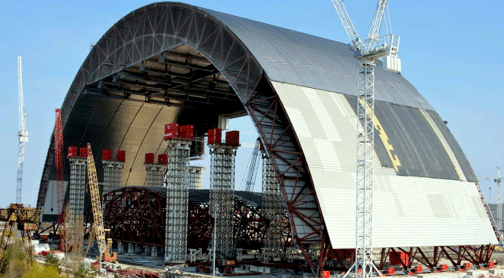
There will be a shortfall of 600 million euros by the end of the year. Construction is proving to be more expensive than expected, and funding more difficult to obtain. A Ukrainian government construction freeze now threatens the project.
New containment, new money
Flasbarth, who is responsible for energy issues at his ministry, intends to speak with his counterparts from the G7 Group on Nuclear Issues in Bonn in mid-October. The G8 – as it was known before Russia was ejected from the group earlier in 2014 – had promised years ago to help Ukraine build the containment system. Now new money is required……….
The total damage has been estimated at 180 billion dollars. The area around the stricken reactor is still highly contaminated, and the concrete sarcophagus poured over the reactor in a rush after the accident has become unstable.
Years of effort
That’s why a French consortium has spent the last few years building the new protective cover. One part is finished, and a second is still being worked on. Meanwhile, Reactor 4 is crumbling – and threatening to expose 200 tons of highly radioactive material to the environment, including the destroyed fuel rods.
The removal of these materials can begin only when the New Safe Confinement is finished, which means over 30 years will have passed since the accident. No one now expects the construction to be finished next year as planned……..http://www.dw.de/funding-woes-delay-new-chernobyl-cover/a-17997493
October 18, 2014
Posted by Christina Macpherson |
safety, Ukraine |
Leave a comment
 Luxembourg hands out iodine pills over fears of French nuclear mishap TONY PATERSON http://www.independent.co.uk/news/world/europe/luxembourg-hands-out-iodine-pills-over-fears-of-french-nuclear-mishap-9802668.html FRIDAY 17 OCTOBER 2014 A series of accidents at France’s controversial Cattenom nuclear power station has prompted the government in neighbouring Luxembourg to take the unprecedented step of issuing free iodine pills to its half a million citizens to help protect them in the event of a serious nuclear incident at the plant. Continue reading →
October 18, 2014
Posted by Christina Macpherson |
EUROPE, safety |
Leave a comment
Contain your excitement
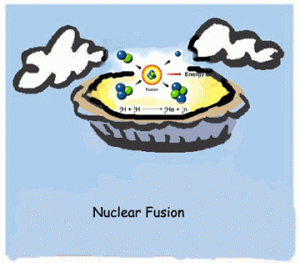
While the rewards of fusion power are substantial, so are the challenges of making it a reality. The deuterium-tritium reaction is the easiest fusion reaction to initiate, yet the optimal temperature needed is 100 million degrees C, which is six to seven times hotter than the core of the Sun.
Don’t get too excited, no one has cracked nuclear fusion yet, The Conversation, Matthew Hole 17 October 2014 Senior Research Fellow, Plasma Research Laboratory at Australian National University Aerospace giant Lockheed Martin’s announcement this week that it could make small-scale nuclear fusion power a reality in the next decade has understandably generated excitement in the media. Physicists, however, aren’t getting their hopes up just yet.
I recently returned from the International Atomic Energy Agency’s Fusion Energy Conference in St Petersburg, Russia, the world’s leading conference on the development of fusion power. There was no announcement of research by Lockheed Martin, and the company did not field any scientists to report on their claims. Continue reading →
October 18, 2014
Posted by Christina Macpherson |
2 WORLD, technology |
Leave a comment

 New United Nations depleted uranium resolution calls for states to help with clean-up A fifth United Nations resolution has been tabled which calls for states to provide assistance to countries affected by contamination and for research into DU’s health and environmental effects. 17 October 2014 – ICBUW
October 18, 2014
Posted by Christina Macpherson |
2 WORLD, depleted uranium |
Leave a comment
 I can’t understand why the world is not curbing its gargantuan appetite for storing every little bit of trivia that anybody ever put on the internet – every little email, comment etc. Even years after you’re dead, all your useless stuff will be there. But not sweetly up in the sky – No, stored in some dirty great data pile of computers somehwere – using up space and gobbling electricity.
It’s good that tech firms are going for efficiency and renewable energy. But for goodness sake, can’t we all just eliminate a lot of this cyber rubbish ?
For tech firms, the cloud makes carbon curbs compulsory BY VALERIE VOLCOVICI NEW YORK Thu Oct 16, 2014 (Reuters) – As mobile devices proliferate and big business turns to cloud computing to cut costs and improve efficiency, technology companies are facing a double challenge: powering energy-hungry data centers to expand the cloud while keeping carbon emissions from skyrocketing.
Cloud computing has paved the way for technologies such as video conferencing and smart building management that can make corporations greener. But it is also shifting a larger share of electricity consumption – and the carbon output associated with it – onto firms such as Google (GOOGL.O) and Microsoft (MSFT.O) that run the data centers or manufacture computer servers.
The trend has made low-carbon energy access and conservation a competitive necessity in the technology sector. Faster, smaller servers and renewable energy contracts accomplish both, industry sources said.
“As you take a look at the fact that the cloud today uses as much energy as the country of Japan every year, you know it doesn’t take much longer until we run out of energy,” Gabi Zedlmayer, chief progress officer at Hewlett Packard (HPQ.N), said in an interview as part of the Reuters Global Summit on Climate change from Oct 13. to Oct. 16………
THE CLOUD IS SIXTH-LARGEST ELECTRICITY USER
The growth of cloud computing and current use of the Internet results in a electricity demand that would rank sixth as a country in current rankings, according to an April report on greening the Internet by environmental group Greenpeace.
Demand could grow by 60 percent or more by 2020, the report said, as the online population grows globally.
The group said there is a compelling business case for companies to rapidly shift to renewable energy to power their data centers since renewable energy costs are dropping……..http://www.reuters.com/article/2014/10/16/us-climatechange-summit-cloud-computing-idUSKCN0I51Z620141016
October 18, 2014
Posted by Christina Macpherson |
2 WORLD, ENERGY |
Leave a comment

 Vladimir Putin’s quest for a nuclear monopoly, Mail & Guardian, South Acfrica 17 OCT 2014 00:00 QAANITAH HUNTER Somehow Russia has persuaded President Jacob Zuma into agreeing to a deal for a nuclear fleet that the treasury opposed. The Russians are coming. The nuclear deal with Russia is to dominate the agenda when the South Africa-Russia joint intergovernmental committee on trade and economic co-operation meets next month.
Even though the South African government insists it has not entered into the procurement phase for the nuclear fleet, it has become clear that Russian President Vladimir Putin managed to sway President Jacob Zuma and Energy Minister Tina Joemat-Pettersson into giving Russia the entirety of the deal.
Zuma and his most trusted Cabinet ministers went against the strict advice of the national treasury and his senior advisers when a nuclear energy “agreement” was signed with Russia last month.
Two sources who also advised against it revealed this week to the Mail & Guardian that an initial bid made by Russian nuclear company Rosatom last year was rejected by the treasury and a number of Zuma’s advisers. A third credible source who was close to the negotiations confirmed their version of events.
The treasury this week did not deny advising against the initial Russian proposal.
“Nuclear would be a substantial financial commitment and government can only make that kind of commitment after careful and thorough-going modelling and an affordability assessment,” said spokesperson Jabulani Sikhakhane.
He said they had yet to discuss how the treasury would pay for nuclear energy.
Exclusive rights
It has emerged that the Russians wanted exclusive rights to South Africa’s nuclear industry. This was substantiated by a statement made by Putin in March last year, following his visit to South Africa, saying his country did not want to merely build the nuclear plants but would bid to run the entire nuclear industry here.
South Africa plans to enhance its energy mix by creating 9.6 gigawatts of nuclear energy by 2030.
The M&G spoke to three highly placed sources – all of them indicated that:
- The initial Russian proposal was not affordable and the treasury rejected it;
- The technology proposed was sub standard and dangerous;
- It would exclude and be damaging to local industries; and
- Even public servants who seemed loyal to Zuma had concerns about it.
One source close to the nuclear talks said the signing of the agreement was a result of about two years of courting by the Russians……….http://mg.co.za/article/2014-10-16-vladimir-putins-quest-for-a-nuclear-monopoly
October 18, 2014
Posted by Christina Macpherson |
marketing, Russia, South Africa |
Leave a comment
 Officials from the state of Nevada, which has fought against Yucca Mountain, challenged the report. Robert Halstead, director of Nevada Agency for Nuclear Projects, said the NRC staff did not fully consider all the probabilities that could affect safety.
“It’s a pretty meek endorsement,” Halstead said. A review of the license application by state scientists and lawyers came up with 229 technical challenges, or contentions, that Nevada is prepared to pursue if the Yucca program moves forward.
The release of only a partial report “creates a false impression that the safety review has been completed,”
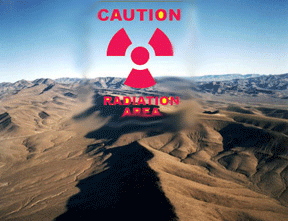
NRC staff: Yucca Mountain could meet safety needs http://www.reviewjournal.com/news/nevada/nrc-staff-yucca-mountain-could-meet-safety-needs by STEVE TETREAULT STEPHENS WASHINGTON BUREAU WASHINGTON 17 Oct 14 — A long-awaited report issued Thursday by the Nuclear Regulatory Commission found the Yucca Mountain site — once considered by the government but halted by the Obama administration — could be safe to store nuclear waste.
The federal agency released a staff analysis of a plan that the Department of Energy submitted for a license in 2008 but later disavowed. The 781-page document concluded that the site 100 miles northwest of Las Vegas “with reasonable expectation” could satisfy licensing rules.
The report immediately was seized by supportive lawmakers on Capitol Hill and executives in the nuclear industry as evidence the Yucca Mountain program largely dismantled by the Obama administration should be reassembled.
Sen. Lisa Murkowski, R-Alaska, said the NRC study shows the Nevada site is “a safe, worthwhile investment” that should be allowed to move forward.
If Republicans capture Senate control in the midterm elections next month, Murkowski would likely become chairwoman of the Senate Energy and Natural Resources Committee. Other Republicans have said that fresh votes on Yucca would be among the priorities in a GOP-controlled Congress.
Officials from the state of Nevada, which has fought against Yucca Mountain, challenged the report. Robert Halstead, director of Nevada Agency for Nuclear Projects, said the NRC staff did not fully consider all the probabilities that could affect safety.
“It’s a pretty meek endorsement,” Halstead said. A review of the license application by state scientists and lawyers came up with 229 technical challenges, or contentions, that Nevada is prepared to pursue if the Yucca program moves forward.
The NRC staff report analyzed the most far-reaching aspect of the repository plan: Whether the natural geology of Yucca Mountain coupled with a system of man-made barriers that would be built within the mountain could keep decaying radioactive particles from leaking into groundwater over periods of up to a million years.
After dissecting relevant parts of the license application, NRC analysts concluded it was reasonable to expect it “satisfies the requirements” for long-term nuclear waste storage.
Other aspects of the plan are still being studied by the NRC staff, and are expected to be discussed in other evaluation reports scheduled to be released before the end of the year. The report issued Thursday was Volume 3 of what is envisioned to be a five-volume study. Continue reading →
October 18, 2014
Posted by Christina Macpherson |
USA, wastes |
Leave a comment







 nuclear-news