Belgium struggles with the problem of old, dangerous nuclear reactors
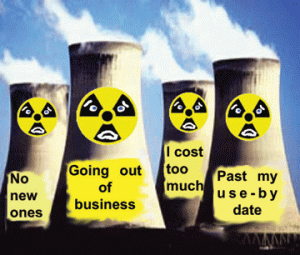 Belgium’s nuclear reactors are phasing themselves out http://m.greenpeace.org/international/en/High/news/Blogs/nuclear-reaction/belgiums-nuclear-reactors-are-phasing-themsel/blog/50589/#.VBRe2697tK4.twitter tby Eloi Glorieux – On Wednesday 10 September 2014, Greenpeace activists in Brussels visited the politicians currently negotiating a new federal governmental agreement about the country’s nuclear power supply. We were there to make it clear that nuclear power is not only dangerous but also unreliable.
Belgium’s over-dependence on nuclear power has resulted in a potentially severe energy supply problem. Politicians are now panicking and confusing the cause of the problem with the solution…..
This is the impression we get from the government negotiations currently taking place in Belgium. A cartoon summarized it this way:
“So finally we will extend the lifetime of the oldest reactors!”
“Oh, but why not extend the lifetime of the younger reactors?”
“Because they are obsolete!”
Indeed,the party leaders negotiating the new agreement said they intend to extend the lifetime of two 40-year-old reactors, Doel 1 and 2. Only a few months ago, the previous government had confirmed that all nuclear reactors reaching the age of 40 would be phased out, with the exception of the Tihange 1 reactor, which can remain open for 50 years.
The politicians are changing the phase-out policy because of the forced shut down of three other reactors. Two, Doel 3 and Tihange 2, were off line nearly a year between 2012 and 2013, due to the discovery of thousands of cracks in the reactors’ steel containment vessels. They were shut down again in March 2014, and so far it appears they may never restart again.
To add to the woes of politicians and the nuclear industry, sabotage on 5 Aug. by an unidentified member of staff severely damaged the steam turbine of the Doel 4 reactor, causing its automatic shut down. Nobody knows when it will be able to restart, but it will certainly not be before the end of the year.
Three reactors down, four to go…
This brings us to the Doel 1 and 2 reactors, which, according to the Belgian nuclear phase-out law, must be decommissioned at the age of 40 in 2015. However, because no one expected that 3000 MW of electricity from Doel 3, Doel 4 and Tihange 2 would be unavailable, the grid operator has said it cannot guarantee the security of electricity supply at all times during the next two winters.
This has inspired the politicians to reconsider the nuclear phase-out law and to grant lifetime extensions to Doel 1 and 2.
In order to convince the party leaders and future ministers of the new government not to make this mistake, Greenpeace activists blocked the entrance of the building where the negotiations were taking place.
Before they were able to enter the building, and in front of massive media attention, the politicians listened to us. Our talks were short but to the point and most of the politicians were open to our arguments:
- The reason for the potential electricity supply problem is Belgium’s excessive dependency (55%) on unreliable nuclear power.
- A political decision to extend the lifetime of two old reactors will not mitigate this acute supply problem. It will take at least a year to implement the necessary safety upgrades, and to order and fabricate new fuel for them.
- Extending the legally fixed phase-out calendar will undermine investment in real climate solutions such as energy efficiency and renewables.
The negotiators later emphasized to the press that they had not yet taken a final decision on the lifetime extension. Watch this space. Eloi Glorieux is Senior Energy Campaigner for Greenpeace Belgium.
Radiologists call to drastically radiation exposure of children
 Call to Reduce Radiation Exposure of Children Indian Express, VELLORE, 14 Sept 14 : The focus of the 12th Annual conference of the Indian Society of Pediatric Radiology (ISPR) held at the Christian Medical College (CMC) on Friday, was to ensure reduction to radiation exposure of children through new technologies.By Express News Service……CMC director Dr. Sunil Thomas Chandy in his speech, said that the science of pediatrics and child health requires a different dosage of radiation and drugs.
The need for exposing children to drastically reduced radiation levels has assumed importance even as the new branch of pediatric radiology was developing with a new thrust. He also predicted that pediatric radiology would compete with adult sciences in radiology in future……http://www.newindianexpress.com/states/tamil_nadu/Call-to-Reduce-Radiation-Exposure-of-Children/2014/09/14/article2430734.ece
Nuclear regulatory Commission rejects expert advice on California earthquake danger
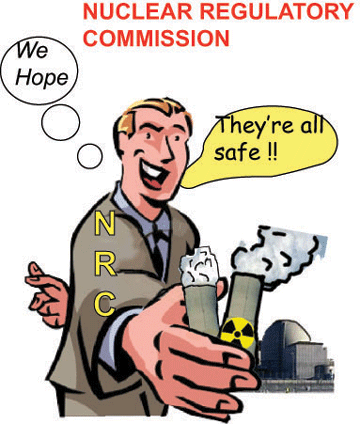 Regulators reject call for nuke plant shutdown By MICHAEL R. BLOOD, Associated Press September 10, 2014 LOS ANGELES (AP) — The Nuclear Regulatory Commission on Wednesday rejected a senior federal expert’s recommendation to shut down California’s last operating nuclear power plant until the agency can determine whether its twin reactors can withstand powerful shaking from nearby earthquake faults……..
Peck, now a senior reactor instructor for the NRC in Tennessee, argued the NRC is not applying safety rules it set out for the plant’s operation……..The agency’s ruling was issued on the same day that PG&E released hundreds of pages of scientific research that found a fault 650 yards from the reactors, known as the Shoreline, is twice as long as initially believed, making it capable of producing potentially stronger earthquakes, and intersections between some faults in the region could create larger earthquakes than previously considered. PG&E said in a statement that the plant remains seismically safe and able to withstand the largest potential earthquakes in the area.
Former California Sen. Sam Blakeslee, a geophysicist who has previously raised seismic concerns at Diablo, said “it’s premature to declare the plant is safe in light of this new information.”…….http://www.sfgate.com/business/energy/article/Regulators-reject-call-for-nuke-plant-shutdown-5746362.php
Masao Yoshida’s fears of nuclear catastrophe
Top-Secret Fukushima Interview: All the melted nuclear fuel will escape from containment vessel … it’s completely exposed — Nuclear annihilation of entire eastern part of Japan envisioned http://enenews.com/top-secret-fukushima-interview-all-nuclear-fuel-will-melt-escape-containment-vessel-fear-nuclear-annihilation-entire-eastern-part-japan?utm_source=feedburner&utm_medium=email&utm_campaign=Feed%3A+ENENews+%28Energy+News%29
Asahi Shimbun,
Sept 12, 2014 : Yoshida feared nuclear ‘annihilation’ of eastern Japan, testimony shows Continue reading
UK military chiefs want Trident nuclear weapons moved to USA, if Scots win independence
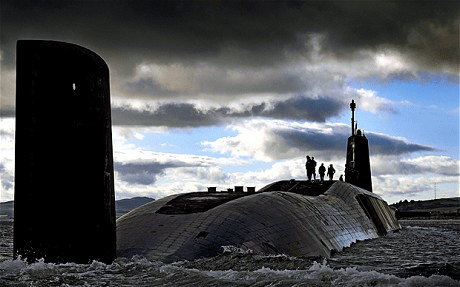
 Send British nukes to US if Scotland votes Yes say military chiefs BRITAIN’S independent nuclear deterrent should be moved to the United States if Scotland gains its independence next week, senior military figures have said. Sunday Express, By: Marco Giannangeli, September 14, 2014 BRITAIN’S independent nuclear deterrent should be moved to the Unites States if Scotland gains its independence next week, senior military figures have said.
Speaking to the Sunday Express they said the plan would ensure that our four Trident missile-carrying Vanguard submarines would not remain in the hands of a Non-Nato foreign country and deprive Scottish First Minister Alex Salmond of any “leverage” in post -independence negotiations.
The call, which one senior US politician last night said would be “overwhelmingly supported” in Congress, comes only two days after Ministry of Defence chiefs finally green-lighted an impact assessment study on Britain’s defence in the event of a Yes vote on Thursday.
Last night Whitehall sources confirmed they were “very alive” to the US option, though, officially, the Ministry of Defence refused to confirm it was making any provisions for independence.
Speaking last night, Air Commodore Andrew Lambert, now attached to the UK National Defence Association, said: “The great leverage that Alex Salmond currently has over the British Government is the location of our nuclear defence base at Faslane. If the vote is Yes, we should move heaven and earth to move all our submarines out of Faslane as quickly as possible…….
A recent report by the Royal United Services Institute think tank estimated that recreating the facilities to house Britain’s nuclear deterrent south of the border would cost around £3bn and take up to ten years. But the costs of “renting space” in the US would be relatively small.
Last night Republican Congressman Jim Sensenbrenner, chair of the House Subcommittee on Crime, Terrorism, and Homeland Security said the move would command overwhelming support in the United States.
“I emphatically think this is a good idea,’ he said………http://www.express.co.uk/news/uk/510636/Nuclear-weapons-should-move-to-US-if-Scotland-independent
Hopes of uranium market revival likely to be dashed
 Rally in Uranium Prices Is Unlikely to Last, WSJ, 14 Sep 14 Gains Fueled by Ukraine Crisis, Mine Unrest Don’t Offset Oversupply SYDNEY—A multiweek rally in uranium prices fanned by the Ukraine conflict and labor unrest at a large mine in Canada looks unlikely to continue for long as the reality of oversupply and lackluster demand sinks in among buyers of the nuclear fuel.
Industry analysts and some uranium producers believe that even as supplies fall, a substantial increase in demand is needed to drive prices up to levels that would make new investments worthwhile, when many operations are running at a loss……..
Demand for the fuel hasn’t recovered since the disaster at Japan’s Fukushima Daiichi nuclear-power plant in 2011, which sparked nuclear-plant closures across the country and tarnished uranium’s image globally…….
state governments in resource-rich Australia have been encouraging the growth of the nation’s uranium industry. A decadeslong ban on uranium production in Queensland was lifted in July, opening the door to new applications to build mines in the state. The government of New South Wales this month said it would invite six companies to apply for exploration licenses.
Still, there is expected to be little investment in new projects until the market stages a more substantial comeback. Cameco said it would need to see much higher uranium prices before it started construction of its proposed Kintyre uranium mine in Western Australia.
“The nuclear industry is still in the midst of upheaval,” said Jonathan Hinze, senior vice president at nuclear-research firm Ux Consulting Co. …http://online.wsj.com/articles/rally-in-uranium-prices-is-unlikely-to-last-1410726782
Dangerous legacy of nuclear weapons testing: ban must be continued
 Close the door on nuclear dangers http://thehill.com/blogs/congress-blog/foreign-policy/217596-close-the-door-on-nuclear-dangers By Ambassador Kairat Umarov, Daryl G. Kimball and Paul F. Walker . 14 Sept 14, It is widely understood that nuclear weapons have only been used twice in wartime and with terrible consequences.
The dangerous health and environmental legacy of nuclear testing is a reality today. With strong bipartisan support, the United States government monitors the health of downwind populations in Utah and Nevada and elsewhere. The government and people of Kazakhstan also bear a heavy, ongoing health and land rehabilitation burden from the era of Soviet nuclear testing.
Through the years, nuclear testing also fueled the development and spread of new and more deadly types of nuclear weapons. Today, the world’s nuclear-armed states still possess nearly 20,000 nuclear weapons – the vast majority of which are held by the United States and Russia. Continue reading
Des milliers danger dans le transport des déchets nucléaires
En vadrouille sur les routes du nucléaire http://fabrice-nicolino.com/index.php/?p=1779 le 14 septembre 2014 par Charlie Hebdo le 3 septembre 2014
Faut bien dégager les déchets nucléaires, pas vrai ? Un rapport officiel chiffre à 777 000 par an les transports de matières radioactives en France. À Drancy comme ailleurs, il vaut mieux croire les mensonges sur la sécurité.
Hé ben, pas grave. Lundi 23 décembre 2013, cadeau anticipé de Noël pour les habitants de Drancy (Seine-Saint-Denis) : un wagon déraille en pleine gare de triage. Le menu problème, c’est qu’il est chargé de déchets nucléaires. Tête du maire UDI de Drancy, Jean-Christophe Lagarde : « Qu’on n’attende pas qu’il y ait des morts pour que ces wagons dégagent ! ». Et d’ajouter qu’en cas d’accident grave, « trente mille personnes sont en danger de mort ».
Et c’est d’autant moins grave que la préfecture de Saint-Denis affirme aussitôt qu’il s’agit d’un simple incident technique, sans conséquence sur la sécurité : « Tous les relevés de radioactivité effectués par les pompiers sont négatifs ». Sauf que quinze jours plus tard, l’Autorité de sûreté nucléaire (ASN) annonce avoir retrouvé des traces de radioactivité dans le wagon accidenté. D’où vient-elle ? Mystère et boule de gomme. Les « colis » de déchets nucléaires sont intacts, et supposément étanches. On n’en saura jamais plus.
L’ASN, agence publique créée par une loi de 2006 est en charge de la sécurité collective, et publie sans arrêt des rapports. Le tout dernier, qui date de quelques jours, mérite le détour (1). On y apprend en sursautant que 777 000 transports de matières radioactives ont lieu chaque année en France. Pas de panique, pas encore. Il s’agit d’un fourre-tout géant qui mêle produits radio-pharmaceutiques envoyés dans les hostos, convoyage d’appareils de détection du plomb, et tout ce qui touche bien sûr à l’industrie nucléaire proprement dite.
Au total, la bagatelle de 430 000 transports – 55 % du total – concerne la détection du plomb dans les peintures. L’industrie nucléaire ne représente « que » 12 % des 980 000 colis et 3 % de la totalité des transports, dont 60 % par la route et 30 % par une combinaison route, mer et rail. Le tout implique évidemment des milliers de possibilités d’accidents comme celui de Drancy. L’uranium naturel piqué au Niger débarque ainsi à Sète, celui volé ailleurs au Havre, les centrales nucléaires envoient leurs innombrables déchets à La Hague, le nitrate d’uranyle rejoint Pierrelatte, le MOX – un combustible – file de Marcoule, etc.
Une évidence saute aux yeux : l’enquête de l’ASN est biaisée, car elle repose essentiellement sur un questionnaire adressé « à un grand nombre de détenteurs ou de transporteurs de substances radioactives ». En français précis, « un grand nombre » ne signifie pas grand-chose. Et les autres ? Et les oublis, volontaires ou non, dans les réponses ? Une approximation précédente du Commissariat à l’énergie atomique (CEA) fixait à 400 000 le nombre de « colis » radioactifs annuels circulant en France, soit moins de la moitié des chiffres de l’ASN.
Les problèmes ne s’arrêtent pas là. Pour la CriiRad (http://www.criirad.org), le grand labo (vraiment) indépendant, les estimations de l’ASN ne sont pas seulement sous-évaluées. Dès le 30 mai 2012, dans un courrier adressé à Marisol Touraine, ministre de la Santé, la CriiRad réclamait « la baisse des limites réglementaires », et rappelait que, selon ses mesures, les cheminots sont exposés « à leur insu, à des flux de rayonnements gamma et de neutrons tout à fait inacceptables ».
Et bien entendu, pas question d’ennuyer si peu que ce soit le grand pouvoir caché qu’est l’armée française. On apprend en janvier 2012 (2) qu’un accident pour le coup renversant s’est produit le 9 juin 2010. Un semi-remorque de transport de munitions nucléaires termine alors un voyage de 600 km sur les routes de France, qui l’a conduit par Bourges, Lyon, Mâcon, Orange. Juste avant d’entrer dans la base militaire d’Istres (Bouches-du-Rhône), le camion, qui roulait à 72 km/h, au lieu d’une limite imposée de 30 km/h, se couche sur la route. Trois soldats sont blessés. Des officiers de sécurité nucléaire et du renseignement militaire bouclent la zone et empêchent la diffusion de la nouvelle, qui sera connue fortuitement, 15 mois plus tard.
Y a-t-il une morale ? Oui, il faut dare-dare changer de planète. Si on trouve.
Access to renewable energy the key to world’s electricity needs – IRENA report
In an accompanying media release, IRENA Director-General Adnan Amin said speeding up the adoption of renewable energy technologies is the most feasible way of reducing carbon emissions and avoiding catastrophic global warming.
 Speeding Up Renewable Energy Access Critical for Climate, Health and Economy: Report DESMOGBLOG.com Chris Rose, 14 Sep 14 Renewable energies are increasingly seen as the best solution to a growing global population demanding affordable access to electricity while reducing the need for toxic fossil fuels that are creating unsustainable levels of greenhouse gas emissions.
That’s the underlying message of a new report — REthinking Energy: Towards a New Power System — published this week by the Abu Dhabi-based International Renewable Energy Agency (IRENA).
“Rapid technological progress, combined with falling costs, a better understanding of financial risk and a growing appreciation of wider benefits, means that renewable energy is increasingly seen as the answer,” the 94-page report says.
“Not only can renewable energy meet the world’s rising demand, but it can do so more cheaply, while contributing to limiting global warming to under 2 degrees Celsius – the widely cited tipping point for climate change,” the report adds.
“A technology once considered as niche is becoming mainstream. What remains unclear is how long this transition will take, and how well policy makers will handle the change.”……..
The report said renewable energy technologies have grown more robust and more efficient in the last decade and are increasingly able to generate power even in suboptimal conditions such as low wind speeds and low solar irradiation. Energy storage technologies are improving fast, it added, while costs have plummeted.
“Worldwide, renewable power capacity has grown 85% over the past 10 years, reaching 1,700 GW in 2013, and renewables today constitute 30% of all installed power capacity,” the report said, noting the challenge today is how to finance and accelerate the continued deployment of renewables.
Total investment in renewable energy rose from $55 billion in 2004 to $214 billion in 2013 (excluding large hydropower), said the report, which also pointed out that $550 billion is needed annually until 2030 to double the global share of renewable energy and avert catastrophic climate change.
The report added that politicians have an important role to play. “If they make it clear that renewable energy will be a larger part of their national energy mix, and commit to long-term, non-financial support mechanisms, they could reduce uncertainty and attract more investors.”
Deploying renewables also stimulates economic activity, creates jobs, provides power for those left off the grid, the report said. Most renewables do not deplete finite resources and they also reduce the risk of ecological disasters.
“The changes at hand offer the potential for a new industrial revolution – creating a renewables-based system, which enhances access, health and security, creates jobs and safeguards the environment,” the report said. “The technology is ready to deploy. People, businesses and governments must now embrace its potential.”
In an accompanying media release, IRENA Director-General Adnan Amin said speeding up the adoption of renewable energy technologies is the most feasible way of reducing carbon emissions and avoiding catastrophic global warming.
“A convergence of social, economic and environmental forces are transforming the global energy system as we know it,” Amin was quoted as saying. “But if we continue on the path we are currently on and fuel our growing economies with outmoded ways of thinking and acting, we will not be able avoid the most serious impacts of climate change.” http://www.desmogblog.com/2014/09/14/speeding-renewable-energy-access-critical-climate-health-and-economy-report
UK’s Renewable Energy Association (REA)’s blueprint for the next government
 Renewable manifesto sets out blueprint for next government http://blueandgreentomorrow.com/2014/09/14/renewable-manifesto-sets-out-blueprint-for-next-government/ Sunday, September 14th, 2014 By Charlotte Malone Ahead of next year’s general election, the Renewable Energy Association (REA) has published a blueprint for the next government, outlining plans to create jobs, investment and growth whilst helping the UK catch up in the global energy race.
Blue & Green Tomorrow is currently running a crowdfunder to ensure its survival. Please pledge.
The UK currently gets 5% of its energy from a renewable industry that supports over 100,000 jobs and has received over £30 billion of private investment since 2010.
In order to meet a legally binding target of having 15% of the national energy demand met by renewables by 2020, the UK must more than double the share of renewable electricity, more than double the share of renewable transport fuels and more than quadruple the share of renewable heat.
REA states, “The next government will be responsible for the UK succeeding – or failing – in meeting its 2020 renewable energy targets. It could also be the government that turns the government that turns the budding renewable energy industry into the main economic engine for creating jobs and growth in the energy sector and reducing the UK’s reliance on imported fossil fuels.”
Currently the UK is 26th in the EU renewables league tables, but by REA argues that with forward-thinking policies the UK can move up the rankings and benefit as a result. Nina Skorupska, REA chief executive, said, “From clean power infrastructure to Zero Carbon Homes and from heat networks to sustainable transport, this is the most comprehensive guide a government could wish for if they’re seeking to maximise the value of this young, vibrant and innovative industry.
“Looking out to 2020, this manifesto sets out how the government can keep up the progress on renewable electricity, and accelerate the roll-out of renewable heating technologies and transport fuels.”
Orlando City Council dumping their investment in Duke nuclear power plant
 Orlando moves to dump stake in Duke’s nuke plant By Kevin Spear Orlando Sentinel, September 14, 2014 The Orlando City Council is expected to approve a plan Monday to dump city ownership in Duke Energy’s crippled nuclear generator for an amount far less than the original purchase value.
Duke’s nuke plant near Crystal River was bedeviled with concrete failures even before it started up in 1977, two years after Orlando’s electric utility bought a small share of the reactor. Disabled by epic calamity that began five years ago, the unit was supposed to run until at least 2036 and, depending on overhauls, possibly many years beyond then……….
the Florida Municipal Power Agency, which provides wholesale electricity to 30 cities, suggested the Duke plant could turn into a liability quagmire.
“There is much uncertainty and risk involved in decommissioning a nuclear power plant,” the agency stated in a memo to its directors.
“The project is planned to take up to 60 years to complete, and involves complex dismantling and transportation of contaminated material.”…….
Company officials determined that further repairs would cost $1.5 billion to $3.4 billion and take as many as eight years.
After much suspense, Duke Energy finally announced last year that the nuke was beyond saving and would be “placed in a safe, stable condition for 60 years until decommissioning work is completed in 2074.”
During a tour of the nuclear generator in 2011, plant operators said that more than 1,300 bundles of used uranium fuel were stored in a pool 30 feet deep.
That fuel pool, cooled to 101 degrees and blended with boron to stop the splitting of atoms, will remain a long-term maintenance and security concern for Duke Energy.
Asked Friday about the status for that highly radioactive fuel, Duke spokeswoman Heather Danenhower declined to provide further information.
“For security reasons, we do not disclose the number of nuclear fuel assemblies in our spent fuel pool,” Danenhower said.
New book: Fukushima: Dispossession or Denuclearization?
 Fukushima: Dispossession or Denuclearization? http://www.lulu.com/shop/nadesan-boys-mckillop-wilcox/fukushima-dispossession-or-denuclearization/ebook/product-21800492.html By eBook (ePub)
The Fukushima nuclear power plant explosions and the Hiroshima/Nagasaki bombings are intimately connected events, bound together across time by a nuclear will to power that holds little regard for life. In Fukushima: Dispossession or Denuclearization? contributors document and explore diverse dispossession effects stemming from this nuclear will to power, including market distortions, radiation damage to personal property, wrecked livelihoods, and transgenerational mutations potentially eroding human health and happiness. Liberal democratic capitalism is itself disclosed as vulnerable to the corrupting influences of the nuclear will to power. Contributors contend that denuclearization stands as the only viable path forward capable of freeing humans from the catastrophic risks engineered into global nuclear networks. They conclude that the choice of dispossession or denuclearization through the pursuit of alternative technologies will determine human survival across the twenty-first century.
The contributors are:
Majia Nadesan, Adam Broinowski, Richard Wilcox, Tony Boys, Chris Busby, Paul Langley, Harvey Wasserman, Christian T. Lystbaek, Andrew McKillop, The Fukushima Five, William Banzai 7.
This book available as an e-book. but also as print version The book (printed version) is available at http://www.lulu.com/shop/nadesanboysmckillopwilcox-editors/fukushima-dispossession-or-denuclearization/paperback/product-21798972.html
All proceeds after costs go to the Fukushima Collective Evacuation (Trial Team)http://www.youtube.com/watch?feature=player_embedded&v=rGuvFn8nJJA
Toshio Yanagihara- Katsumi Hasegawa: “The 2nd Fukushima Collective Evacuation Trial”
Uncompetitive nuclear industry is rigging regulations and “spinning” media in order to survive
 Killing the Competition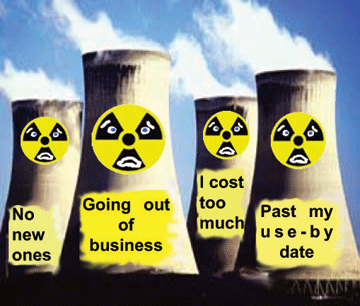
Exelon and Entergy see sustainable energy solutions—renewable energy, efficiency, conservation, etc.—as a long-term threat to
their profits. This is not because of excessive regulations or safety requirements on nuclear power: the industry has not had to implement a single safety upgrade due to the Fukushima meltdowns and faces less regulatory enforcement than it did twenty years ago. The closure of a record number of reactors since 2013 has exposed fundamental economic problems facing the industry, and a growing number of nuclear plants simply cannot compete with modern, efficient, cost-effective
energy resources.
USA’s Waste Isolation Pilot Plant sent plutonium to city 30 miles away!
 Plutonium found in city nearly 30 miles from US nuclear site — Newspaper: Explosion ‘melted through’ container causing radioactive release — More Pu-241 went airborne than all other types of plutonium combined, yet not included in test results http://enenews.com/plutonium-detected-city-30-miles-nuclear-site-explosion-melted-container-released-four-types-plutonium-officials-testing-pu-241-leaked-all-others-combined?utm_source=feedburner&utm_medium=email&utm_campaign=Feed%3A+ENENews+%28Energy+News%29
Carlsbad Current-Argus, Sept. 9, 2014: DOE will provide WIPP update next week — It appears the Waste Isolation Pilot Plant is far from reopening… According to photographic evidence made public by the DOE, it appears a chemical reaction caused an explosion inside one of the waste drums. The explosion melted through portions of the drum, and the incident triggered a small release of americium and plutonium into the outside air about half a mile from the facility.
“Plutonium… about half a mile from the facility”? Recently published air monitoring data from the state of New Mexico indicates that soon after the WIPP radioactive release 3 types of plutonium were found nearly 30 miles away in Carlsbad, the state’s 10th largest city. The levels were similar to those found within the nuclear site’s boundary:
- WIPP NW Border, 2/21-2/28: Plutonium-238 = 0.015 pCi/sample (Lab minimum detectable activity [MDA] = 0.0082)
- WIPP site, 2/21-2/28: Plutonium-239/240 = 0.0092 pCi/sample (MDA = 0.0062)
- WIPP site, 2/28-3/11: Plutonium-238 = 0.027 pCi/sample (MDA = 0.024)
- Carlsbad, 25+ mi. away, 2/28-3/11: Plutonium-238 = 0.016 pCi/sample (MDA = 0.0074)
- Carlsbad, 25+ mi. away, 2/28-3/11: Plutonium-239/240 = 0.022 pCi/sample (MDA = 0.0074)
More Plutonium-241 was released from WIPP than all other plutonium isotopes combined, yet officials have not included it in any publicly available test results:
- Plutonium-241 = 15,900 dpm
- Plutonium-239/240 = 11,600 dpm
- Plutonium-238 = 514 dpm
Until at least 2026 radioactive plume will continue to flow across Pacific
 assive Radiation Plume from Fukushima Heading Toward American West Coast According to a Scientific Report By David Gutierrez Global Research, September 11, 2014 According to scientific modeling systems used by the European Union, the radioactive ocean plume released by the 2011 Fukushima nuclear disaster is likely to remain a massive clump of radioactivity until it slams into the West Coast of the United States in late 2017. On March 11, 2011, a massive earthquake and tsunami struck Japan, knocking out power and cooling capability to the Fukushima Daiichi nuclear plant. Within three days, multiple meltdowns and reactor explosions had taken place. By March 25, massive amounts of radioactive material were observed leaking directly into the Pacific Ocean.
In 2013, the Nansen Environmental and Remote Sensing Center in Norway used computer models to project the movement and dispersion of this radioactive plume. Although the results of this study have been cited in official Chinese government documents, they have not been widely publicized.
Levels to remain high through at least 2026
The researchers used two separate scenarios to model leakage of radioactivity from the Fukushima plant into the Pacific. The first scenario assumed continuous and constant leakage for 20 days, while the second assumed continuous and constant leakage for one year.
Although delivering differing estimates of total radiation, both models concluded that the pollution would remain in a relatively unified mass and take the same path across the ocean until crashing up against western North America. Both models show the plume colliding with the U.S. West Coast and beginning to spread out starting around late 2017, with a maximum concentration of radiation hitting the coast toward the end of 2018……..http://www.globalresearch.ca/massive-radiation-plume-from-fukushima-heading-toward-american-west-coast-according-to-a-scientific-report/5401006
1 This Month
26 April – Chernobyl: Inside the Meltdown airs on National Geographic on Sunday 26th April from 4pm

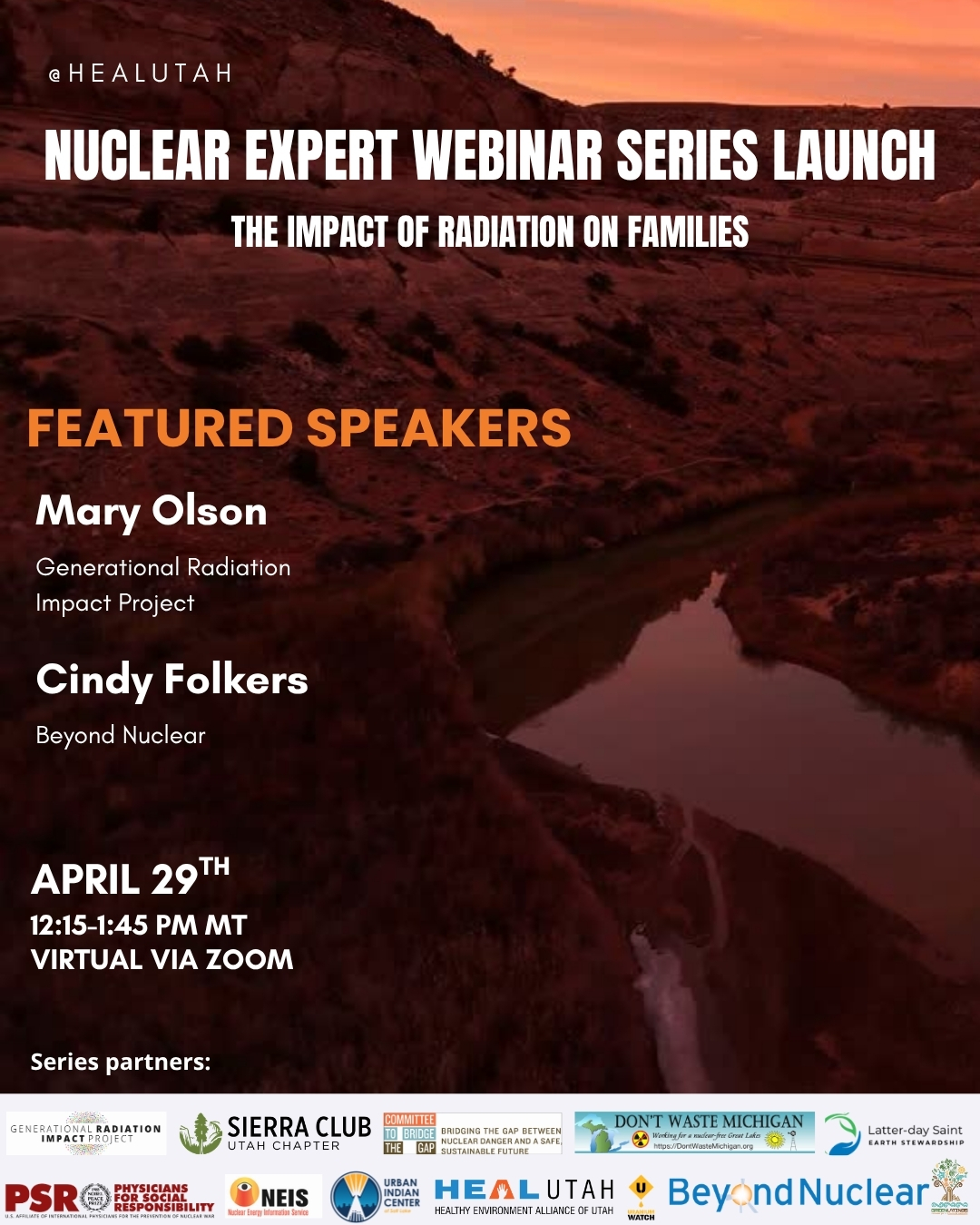
29 April – Nuclear Expert Webinar #1 – Radiation Impacts on Families with Mary Olson and Cindy Folkers
- 12:15 PM MT – 1:45 PM MT
- Location: Virtual – REGISTER TODAY

4 May -West Suburban Peace Coalition to discuss Iran war at May Educational Forum
Monday, May 4, 7:00 – 8:00 PM Central Standard Time
Title: : How Trump’s Narrative Tries to Shape the Reality of the War on Iran.
Contact Walt Zlotow, zlotow@hotmail.com 630 442 3045 for further information
14 May – online event From Bombs to Data Centres: the Face of Nuclear Colonialism
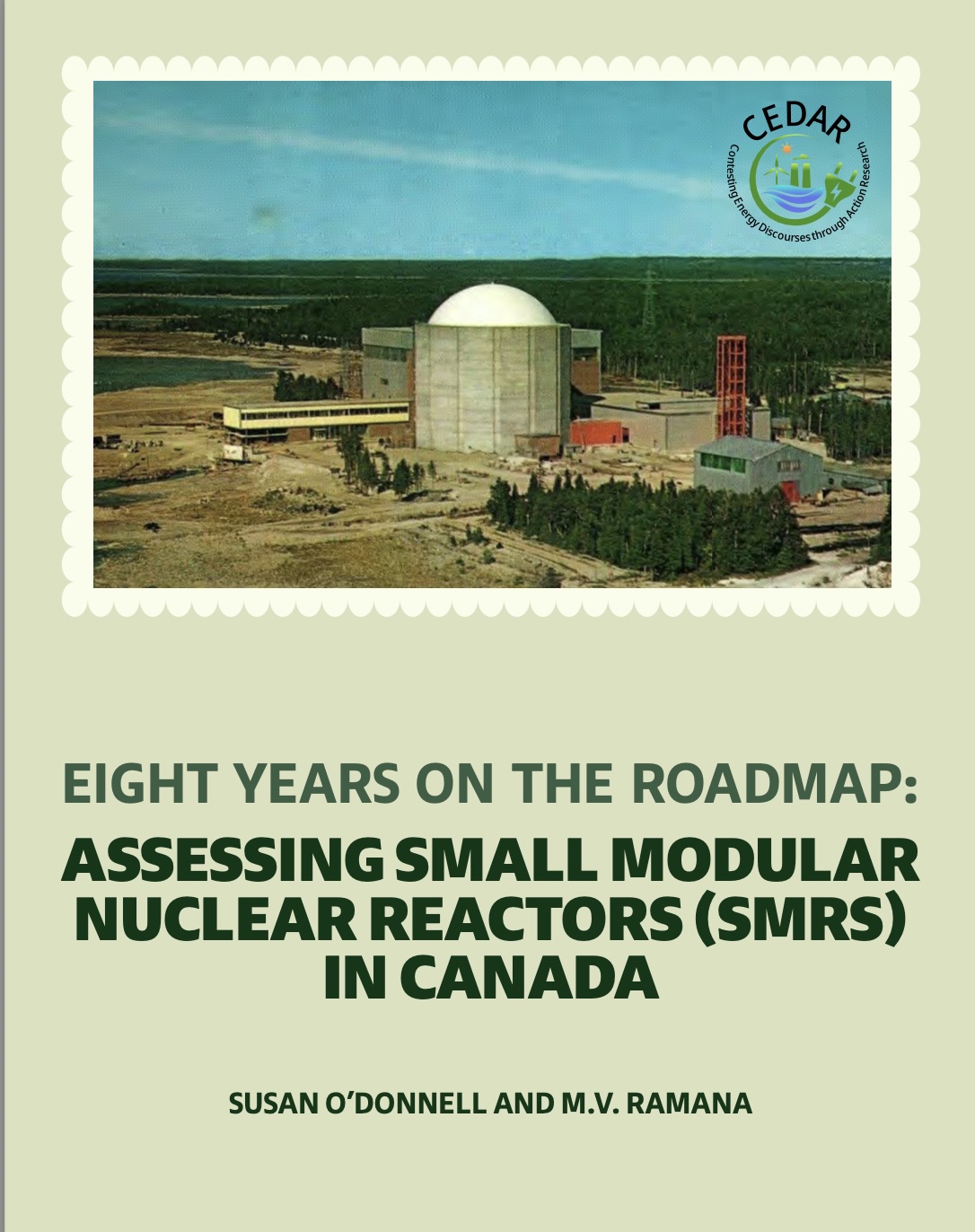

Pine Ridge Uranium is the real threat, not Tehran- Tell Burgum: Stop the Extraction.
Chernobyl: The Lost Tapes – A good documentary on Chernobyl on SBS available On Demand for the next 3 weeks– https://www.sbs.com.au/ondemand/tv-program/chernobyl-the-lost-tapes/2352741955560
To see nuclear-related stories in greater depth and intensity – go to https://nuclearinformation.wordpress.com
-
Archives
- April 2026 (288)
- March 2026 (251)
- February 2026 (268)
- January 2026 (308)
- December 2025 (358)
- November 2025 (359)
- October 2025 (376)
- September 2025 (257)
- August 2025 (319)
- July 2025 (230)
- June 2025 (348)
- May 2025 (261)
-
Categories
- 1
- 1 NUCLEAR ISSUES
- business and costs
- climate change
- culture and arts
- ENERGY
- environment
- health
- history
- indigenous issues
- Legal
- marketing of nuclear
- media
- opposition to nuclear
- PERSONAL STORIES
- politics
- politics international
- Religion and ethics
- safety
- secrets,lies and civil liberties
- spinbuster
- technology
- Uranium
- wastes
- weapons and war
- Women
- 2 WORLD
- ACTION
- AFRICA
- Atrocities
- AUSTRALIA
- Christina's notes
- Christina's themes
- culture and arts
- Events
- Fuk 2022
- Fuk 2023
- Fukushima 2017
- Fukushima 2018
- fukushima 2019
- Fukushima 2020
- Fukushima 2021
- general
- global warming
- Humour (God we need it)
- Nuclear
- RARE EARTHS
- Reference
- resources – print
- Resources -audiovicual
- Weekly Newsletter
- World
- World Nuclear
- YouTube
-
RSS
Entries RSS
Comments RSS
 nuclear-news