At last – thorough research into cancers caused by world’s first atomic-bomb test
a sadness that still hangs over Tularosa.
“Whole families have died here,”

 Decades After Nuclear Test, U.S. Studies Cancer Fallout http://online.wsj.com/articles/decades-after-nuclear-test-u-s-studies-cancer-fallout-1410802085
Examination Will Probe Radiation Exposure Near 1945 Trinity Blast in New MexicoBy
DAN FROSCH Write to Dan Frosch at dan.frosch@wsj.com Sept. 15, 2014 TULAROSA, N.M.—Nearly 70 years after the U.S. conducted the world’s first atomic-bomb test here in the New Mexico desert, federal researchers are slated to visit the state this month to begin studying whether some residents developed cancer due to the blast.
As part of the long anticipated project, scheduled to start Sept. 25, investigators with the National Cancer Institute will interview people who lived in the state around the time of the 1945 Trinity test and assess the effects of consuming food, milk and water that may have been contaminated by the explosion.
For years, residents of the rural, heavily Hispanic villages near the test site have claimed that a mysterious wave of cancer has swept through this dusty stretch of south-central New Mexico, decimating families and prompting calls for the government to determine whether radiation exposure played a role. Continue reading
India’s uranium legacy of birth defects
 India’s nuclear nightmare: The village of birth defects The Star.com By: Raveena Aulakh on Mon Sep 15 2014 Indian court trying to unravel mystery of sick and disabled children, miscarriages and fatal cancers around the country’s first uranium mine……..Now, an Indian court wants to unravel the mystery of what is happening in Jadugora, the hub of India’s uranium mining industry since the late 1960s……..
Today, nuclear power provides less than 5 per cent of India’s electricity. The aim is to make it 25 per cent by 2050. This month, Australia signed an agreement giving India access to its vast supplies of uranium.
But activists say Jadugora is paying the price for India’s nuclear dreams……….
Until a decade ago, miners took their uniforms home to be washed by their wives or daughters, says Xavier Dias, a political activist who has worked for decades with the indigenous people who made up the majority of the mine’s workforce.
“They never wore masks then … or boots. Or even gloves.”
The workers were free to take building materials from the mine and even waste material, which they used to build their homes, he says.
When people began to notice that young women were having miscarriages, witches and spirits were blamed. Prayers were said to ward off the “evil eye.” But people had lesions, children were born with deformities, hair loss was common. Cows couldn’t give birth, hens laid fewer eggs, fish had skin diseases.
“If you ask the tribals (as the indigenous people are known) who have lived there for decades, long before uranium was discovered, they will tell you that they lived healthy lives, drank from the rivers, ate fruits and vegetables … and they never saw the inside of a hospital,” says Dias……
In Jadugora, tailing ponds take up more than 65 hectares — and they are all uncovered with easy access for people and animals. A few homes stand fewer than 50 metres from the pond’s edge. There are some no-trespassing signs, but children still play cricket or hopscotch nearby. Another tailing pond a few kilometres away sits beside a busy street with pipes constantly delivering more sludge.
The tailing ponds tend to overflow, especially during monsoon season, say villagers. If that happens, radioactivity can seep out and contaminate the groundwater and rivers. River water is used for washing and bathing, sowing and irrigation — and sometimes for drinking.
Trucks filled with yellow cake or mine waste trundle day and night along the highway. The cakes are covered with flimsy plastic covers; sometimes bits of rubble fall off………
The Jharkhand High Court is also looking for answers.
In March, it sent a notice to UCILasking for an explanation for the deformities, cancers and miscarriages around the Jadugora mine. It based the notice on local media reports, which included shocking pictures of children who were sick or deformed. (The demand was made by the court unilaterally, without a filing by officials or victims, in what is known as a suo moto action.)
According to local reports, UCIL told the court that the radiation emitted through its mining is under permissible limits and contained within a safe zone. The court refused to accept the submissions because they were old.
In August, the court also asked that the company disclose the radiation levels and the presence of any heavy metals in soil and water in the cluster of villages around Jadugora. It also asked UCIL to explain how it ensures the safety of those who live near radioactive waste.
The answers are due in November……….
While families of children with deformities will tell their stories to reporters, the families of women who have been unable to get pregnant or who have had unexplained miscarriages often don’t.
Since Jadugora’s health problems made the local newspapers, few families receive marriage offers for their daughters. In a country where not being able to bear children is such a stigma that women are either thrown out by their in-laws or banished to their parents’ homes, Jadugora women are now tainted and unwanted……….http://www.thestar.com/news/world/2014/09/15/indias_nuclear_nightmare_the_village_of_birth_defects.html
South Africa’s nuclear power plans clouded in secret deals

 Eskom not taking part in nuclear acquisition BUSINESS DAY BY CAROL PATON, 15 SEPTEMBER 2014, ESKOM, FORMERLY DESIGNATED THE “OWNER AND OPERATOR” OF SA’S NUCLEAR PROGRAMME, WILL NOT BE INVOLVED IN THE UP COMING NUCLEAR PROCUREMENT, SAY DEPARTMENT OF ENERGY OFFICIALS, EXCEPT AS THE PURCHASER OF POWER FROM A NEW — POSSIBLY FOREIGN — NUCLEAR ENTITY.
The Cabinet subcommittee on energy security is deep into the technical work needed to procure a massive nuclear fleet. Key to the procurement going ahead will be the financing arrangements, as the construction of nuclear plants has enormous capital costs.
While the Nuclear Energy Policy for SA of 2008 designates Eskom as the “owner and operator of nuclear power plants in SA”, department acting director-general Wolsey Barnard said recently that both Eskom’s financial circumstances and the availability of alternative financing arrangements for energy meant this would have to change.
“The nuclear policy has not yet changed, but what needs to be realised is that the financial position of Eskom has deteriorated since 2008 and to expose Eskom to such a project at this stage would not be sustainable. ……..
Insufficient consultation
Though the government feels confident that public opinion has been taken into account, neither business nor labour agrees that consultation has been sufficient.
The National Development Plan urged caution on nuclear power, saying other options — such as natural gas — should be explored first.
Business Unity SA (Busa) acting CEO Cas Coovadia said “an effective debate on our energy options in the long term” was urgently required. Busa is working to draft an energy policy both for SA’s immediate and long-term needs, he said.
National Union of Mineworkers general secretary Frans Baleni, whose union is a leading opponent of nuclear energy in the Congress of South African Trade Unions, said the union was dead-against nuclear power over safety and cost issues.
“As a country we have not had a dialogue on nuclear power. The process is not transparent and will be easily corrupted. It will make the arms deal look like a Sunday picnic. And the National Development Plan (NDP) is not positive on nuclear. Government can’t pick and choose on the NDP; if they do it is not a plan,” said Mr Baleni……….
Eskom spokesman on nuclear power Tony Stott. said there would be another opportunity for comment through the National Nuclear Regulator’s and Nersa’s licensing processes.
However, these will be long after the contracting is completed. http://www.bdlive.co.za/business/energy/2014/09/15/eskom-not-taking-part-in-nuclear-acquisition
South Africa’s very suspect plan for vendor-financed nuclear power
A nuclear tale that sounds too good to be true Business Day BY CAROL PATON, 15 SEPTEMBER 2014, BUILD now, pay much later. That is the good news story about nuclear energy being told to SA’s decision-makers. In this model, a nuclear vendor and a financier — usually the government of the country of the vendor or a state-owned enterprise or bank — come as a package. The loan from the financier is repaid from the electricity tariff over the long term, 15 to 20 years, and repayments begin when electricity is produced.
The vendor-financed option has made the scary R1-trillion price tag, wielded by Department of Energy and Treasury officials as a warning to their political principals, disappear in a puff of smoke. The nuclear option appears even more attractive when vendors move onto the next part of the story: as operating costs for nuclear energy are low, and the expense lies in construction, once the loan is repaid, energy becomes a virtual “cash cow” for the operator, and any private investors, for up to 30 years………
The clear frontrunners in this are French company Areva and Russian state-owned enterprise Rosatom. Both offer technology and finance in one package, with some differences. At the heart of both is a power purchase agreement in which the operator of the grid, Eskom, would make an irrevocable commitment to purchase the electricity at an agreed tariff………
An important part of the financing package for vendors interested in SA is the government’s commitment in the nuclear policy of 2008 to a fleet approach. Vendors are able to offer better prices if a fleet of reactors is procured as they get better at building them. Some vendors will not consider SA at all without a fleet procurement.
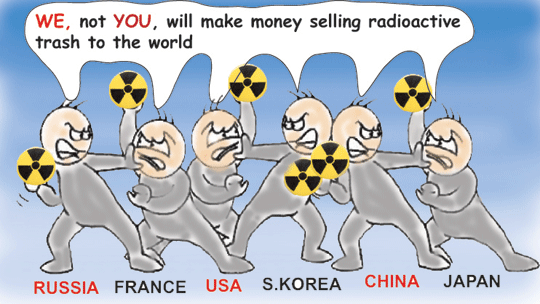
This is what lies behind SA’s curious decision in the IRP 2010, SA’s electricity plan, to include 9,600MW of nuclear power in the energy mix. This would amount to a fleet of six Areva reactors (or more, if other vendors with smaller reactors are selected). As electricity demand is far from certain, and has not grown as expected over the past two years or more, overbuilding capacity is a risk.
Independent analysts, such as Prof Harald Winkler of the University of Cape Town, argue that even a nuclear fleet would be more expensive than other options and would lock SA into even higher electricity prices with negative effects on the economy.
Costs such as insurance in the event of a nuclear accident, dealing with the waste, and decommissioning the plant, are not built into the construction prices.
The conclusion of all of this is that the magnitude of the government guarantees required in a R400bn-R800bn nuclear plant building exercise remain very difficult to estimate. Whatever the size of the guarantee and its purpose — for construction or as a guarantee to purchase the power — it would have to find its way onto SA’s contingent liabilities……..
Despite the good “build now, pay later” message being punted by nuclear vendors, the probability is that it will be business and consumers that not only pay later, but pay much more. http://www.bdlive.co.za/business/energy/2014/09/15/news-analysis-a-nuclear-tale-that-sounds-too-good-to-be-true
Nuclear power in America: condition terminal?
 If it’s not Sustainable, its condition is Terminal.http://geoharvey.wordpress.com/ September 15, 2014
¶ The most recent reported status of US nuclear power plants can be found at the US Nuclear Power Report. It is a distressingly dull digest of information from the NRC, posted most weekdays and Saturdays, most recently on September 15. Latest information is that out of 100 US reactors, 11 were at reduced output and 5 were not operating.
¶ By NRC reckoning, Vermont Yankee (VY) is running at 100% of capacity. When the NRC rates output at 100%, it means it is 124% of specification. The plant is at 106% of its intended lifespan and the spent fuel pool has 500% of its intended load.
¶ Video: Energy Week with George Harvey and Tom Finnell, September 11
¶ Comments: End Life Support for the Fossil Fuel Industry, September 7
geoharvey is one of George Harvey’s Blogs.
Kiev threatens to restart nuclear weapons program
 ‘Inmates running the asylum’: Kiev threatens to restart nuclear weapons program RT.com September 15, 2014 Kiev’s promise to restart its nuclear weapons program if it doesn’t get enough support from the West is completely insane, be it real or just an empty threat, political commentator Daniel Patrick Welch told RT.
“If we cannot protect Ukraine today, if the world doesn’t help us, we will have to go back to the development of nuclear weapons, which will protect us from Russia,” Ukrainian Defense Minister Valery Geletey said in an interview with Ukrainian TV, also claiming that NATO members have already started supplying Kiev with conventional weapons.
NATO members start supplying weapons to Kiev – Ukrainian Defense Minister ……http://rt.com/op-edge/187772-ukraine-nuclear-program-us/
Political risk for Finland’s government in Russian nuclear build deal
 Finnish Greens Warn Over Russian Nuclear Project Junior Party Opposes Reactor to Be Built by Finnish-Russian Consortium WSJ By JUHANA ROSSI Write to Juhana Rossi at juhana.rossi@wsj.com Sept. 15, 2014
HELSINKI—Finland’s Prime Minister Alexander Stubb said he is confident his government will remain in office despite a junior party’s threat to quit the government over a proposal to allow a Finnish-Russian consortium to proceed with its controversial nuclear power-plant project in Finland.
 Finland’s Minister of the Environment Ville Niinisto said Monday he will take the Greens of Finland out of government if it issues on Thursday a preliminary permit for Fennovoima Oy to build a nuclear reactor on a greenfield site on the west coast of Finland. The Greens party is a junior partner in Finland’s five-party coalition government…..
Mr. Niinisto said that the Greens cannot abide by a potential government decision. In case the decision goes against the Greens’ wishes, Mr. Niinisto said he would submit a request at a party meeting this weekend for the Greens to withdraw from the government. If the Greens choose to exit, the government will command a razor-thin majority of 101 votes in Finland’s 200-seat parliament…….
The escalation of the Ukraine crisis this year has cast further doubt over Fennovoima. Mr. Niinisto cited Rosatom’s close links with Russian government as one of the reasons why he is firmly opposed to Fennovoima’s project…….
Deterred by risks and the potentially high costs associated with nuclear power, several of Fennovoima’s Finnish investors have backed away from the project in recent years. As a result, now only 54 percentage points of Voimaosakeyhtio SF’s 66% stake in Fennovoima have actually been subscribed to by Finnish investors, while remaining 12 percentage points don’t have an assigned investor.
Mr. Vapaavuori said that at least 60% of Fennovoima has to be owned by investors from Finland or more broadly from the EU. Otherwise Fennovoima won’t be granted a building permit, the final stage in the approval process for a new nuclear reactor. http://online.wsj.com/articles/finnish-greens-warn-over-russian-nuclear-project-1410805908
The high financial risk of nuclear power
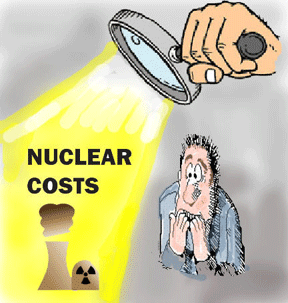 A nuclear tale that sounds too good to be true Business Day BY CAROL PATON, 15 SEPTEMBER 2014, “…….The World Nuclear Industry Status Report 2014, sponsored in part by the anti-nuclear Green Party in the European Parliament, contains dire warnings on accepting these undertakings at face value. The report shows that nuclear energy globally is in decline due in the most part to nuclear accidents, the scale of the finance required, and the enormous risk of cost and time overruns during construction. The world has 50 fewer nuclear plants today than in 2002, with an installed capacity less than two decades ago.
The high risk in the construction of nuclear plants means that the only way that nuclear power plants are built any more is when the vendors bring the financing.
“Commercial banks will not finance it; development banks won’t finance it. Not only are these very large loans, but nobody knows what the plant will cost in the end. The only options for financing are through government subsidies or when the vendor brings its own backing,” the report’s lead writer, energy analyst Mycle Schneider, said in an interview.
Of the 67 reactors under construction, eight have been under construction for more than 20 years and 49 have encountered construction delays, most of them significant, says the report.
Who bears the risk of cost and time overruns? With international experience indicating that cost overruns are between 50% and 200%, the Treasury would need to assume at least a 100% overrun. How this risk is managed will depend on contracting arrangements. While vendors insist there are models in which the vendor takes all the risk, this has not persuaded Treasury officials.
Apart from the fact that nuclear vendors usually want governments to share the construction risk, the undertaking to purchase the power they produce is irrevocable. The key way in which vendors have tried to mitigate risk is through the agreed feed-in tariff. In the example of the Hinkley Point power plant under construction in the UK, the guaranteed tariff will be £92.50/MWh, more than double Eskom’s average electricity price and much more expensive than other base-load options considered in SA’s electricity plan, the Integrated Resource Plan (IRP). It is also roughly twice the current bulk level price in the UK, says Mr Schneider, and “by the time the reactors are scheduled to generate power in 2023, the price will reach a staggering £121/MWh”.
Rosatom’s Turkey project, where construction has not begun, involves a 15-year power purchase agreement, with a guaranteed tariff of $123.5/MWh rising to $153.3/MWh if necessary to ensure payback of the project. The higher limit is 50% higher than the wholesale price for electricity in Turkey in 2010…………http://www.bdlive.co.za/business/energy/2014/09/15/news-analysis-a-nuclear-tale-that-sounds-too-good-to-be-true
USA’s Dept of Energy handing out funds to universities for nuclear education
ISU awarded nuclear research grant http://www.localnews8.com/news/isu-awarded-nuclear-research-grant/28065212 Kaitlin Loukides Sep 15, 2014 POCATELLO, Idaho –
Idaho State University could soon give schools such as M.I.T a run for its money, after the U.S. Department of Energy’s Nuclear Energy University Program awarded ISU more than $600,000 in grant money this week.
Out of that, $400,000 will go toward the Dept. of Nuclear Engineering, where students and faculty will research ways to create benchmarks future nuclear designers around the world can measure the accuracy of their own models.
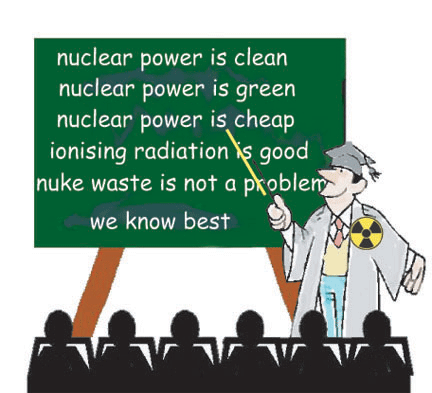
In layman’s terms: these guys will use this money to do a bunch of research way over most people’s heads in order to set a new standard everyone else in the world will use to make sure their nuclear computer models are on-par.
ISU nuclear science associate professor Dr. Chad Pope said these grants are extremely difficult to obtain since ISU is competing for that funding against every other university in the nation.
He said this research will not only help the nuclear world, but will also benefit local communities who will reap the benefits of ISU’s industry-changing research.
We’re already on the map, and this keeps us there,” Pope said. “It helps us push the science forward and become preeminent in this field. It’s great for the university, it’s great for the community, and it will really help us establish ourselves as a prominent science university.”
Pope said the close connections ISU has with the INL and the Argonne National Laboratory in Chicago could have also helped the department get recognized for this grant.
The money will span over a three-year time period, and once the research is complete, it’s expected to become published in the International Handbook of Evaluated Reactor Physics.
Nuclear disaster was just missed 7 times during the cold War
7 close calls in the nuclear age The Cold War could have turned mighty hot on more than one occasion
1. SUEZ CRISIS…..
3. U2 SPY PLANE ACCIDENTALLY VIOLATES SOVIET AIRSPACE…..
4. WHEN CAMPING, MAKE SURE TO HIDE YOUR NUCLEAR WEAPONS……
5. A TERRIFYING CRASH……
7. COMP FEAR, PART 2…… http://theweek.com/article/index/267815/7-close-calls-in-the-nuclear-age
Children with birth defects – Britain’s nuclear veterans still wait for compensation
Nuclear test veterans STILL waiting on £25million compensation fund as David Cameron suns himself BNTVA Recognition Campaign 15 Sept 14
“De-coupling” – de-linking profits from sales in the energy utilities
 SINK THE ‘FLOATING NUKES’ WITH CLEAN ENERGY, EFFICIENT USE http://www.njspotlight.com/stories/14/09/14/opinion-sink-the-floating-nukes-with-clean-energy-efficient-use/ R. WILLIAM POTTER | SEPTEMBER 15, 2014
Decoupling sales from volume can help utilities embrace energy efficiency and solar power, while ambitious targets can give them a reason to do so In 1976 I was a rookie attorney with the newly formed Department of the Public Advocate — later abolished by Republican governors Christy Whitman in 1991 and (after brief resurrection under Gov. Jim McGreevey) by Chris Christie in 2008.
One of my first cases was to oppose plans by the state’s electric utilities to encircle New Jersey with a flotilla of “floating nuclear plants” anchored on barges along the coast, including two within sight of Atlantic City and another in Bayonne Harbor.
While these plans may seem absurd in hindsight, at the time many state officials praised the idea of barge-mounted nukes as the only way to meet ever-rising consumer electric needs without polluting New Jersey’s degraded air quality.
In response, we petitioned the state Public Utility Commission — now called the Board of Public Utilities (BPU) — for an order compelling those utilities to invest enough in energy conservation to reduce demand for power, which would eliminate the need for the floating nukes or, for that matter, many land-based power plants, thereby saving ratepayers billions of dollars while also protecting the environment.
Needless to say, the utilities opposed the idea of saving energy on the customer side of the meter as the better way of meeting ratepayer needs, an idea I had picked up from a small band of alternative energy innovators, such as Amory Lovins (author of “Soft Energy Paths”). I can recall the utility witnesses in the PUC hearings testifying that conservation has the effect of “penalizing” utilities and their shareholders. Conserve more, earn less summarized their positions.
And here’s the rub, they were right. This is because traditional rate-base/rate of return regulation — going back to Woodrow Wilson’s era — ties utilities’ profits to the amount of power sold from a fixed set of capital investments (rate base) in power plants, power lines, and other hard assets.
In other words, “the financial health of most gas and electric utilities was tied directly to retail sales because their fixed costs are recovered through charges based on how much people use,” as summarized in a blog by an attorney for the Natural Resources Defense Council (NRDC), one of the premier environmental organizations in the nation.
As a result, utilities could not be blamed for promoting increased sales, even as they paid lip service to saving energy. And they could not be blamed for pushing ever-more-ambitious capital construction programs, such as the ill-fated floating nukes project, which eventually were canceled largely due to mounting technical problems and soaring cost overruns.
Fast-forward to 2014: After all these years there is now a practical way of delinking profits from sales volume and rewarding utilities for investing their dollars — called “patient capital” by PSE&G’s visionary president, Ralph Izzo — in “energy efficiency and renewable energy, notably solar photovoltaic systems.”
“Decoupling” is the name for the process of ending the historic linkage between electric and gas sales volume and the ability of the utility to earn profits on its capital investments in the infrastructure — power plants, wires, poles, substations, and the like. (Note: a decade ago, New Jersey’s electric utilities split off their power generation function into standalone “nonutility” companies that compete for contracts to sell to consumers and deliver through utility power lines.)
As it turns out decoupling is remarkably simple to implement: To de-link profits from sales or “throughput,” the utilities would be allowed to earn a given level of revenues set by the BPU based on the number of customers served, regardless of actual sales to those customers. And if profits fall short of targets set by the BPU or if the utilities over-earn in a given period, the BPU would hold a “true-up” proceeding to reset rates and revenues up or down.
Now for the big question: What is the likely impact on consumers of decoupling revenues from sales? Not much. According to another NRDC report, “25 states had adopted some form of decoupling for at least one electric or natural gas utility by the end of 2012, and the rate impacts for consumers have been ‘small to minuscule.” Moreover in nearly 40 percent of the true-up cases the NRDC studied, the ratepayers received refunds as part of periodic true-ups.
The beauty of decoupling is that it “helps keep the utilities’ profits ‘whole’ while their customers are saving energy,” as the NRDC report summarizes. That’s because there is no longer an economic incentive for utilities to boost power sales and oppose effective energy efficiency and renewable energy programs that would cut into those sales. In fact, with decoupling, utilities will have an incentive to get into the energy-efficiency and renewable energy business, by dispatching crews to install home insulation and building solar projects that could reduce electric power sales.
But “a decoupling mechanism alone” is not enough; “it only removes the utilities’ disincentive to support energy efficiency and solar energy,” according to the Solar Energy Industries Association (SEIA) in a recent posting. “To be most effective in promoting [energy-efficiency and renewable-energy] policies, decoupling should be linked with specific targets and also create rewards for utilities for achieving environmental targets beyond their mandates,” SEIA concludes.
In short, there is a pressing need to couple decoupling reforms with vibrantly pro-energy-efficiency and pro-renewable-energy policies such as those contained in the proposed “Renewable Energy Transition Act” (RETA), which sets enforceable targets and timetables for using energy efficiency and renewable energy to meet 80 percent of New Jersey’s power generation needs by 2050.
With this two-pronged approach — decoupling revenues from sales volume and setting ambitious targets for saving energy and developing solar power — New Jersey can show the nation how to curtail global warming by reducing the pollution emanating from fossil-fuel power plants. It’s also a kind of insurance policy protecting us against the perceived need to build risky power plants like the failed floating nukes efforts of yesteryear.
World Nuclear Association Symposium hears of true dangers of low level radiation
Public needs radiation risk awareness World Nuclear Association, World Nuclear News 12 September 2014 Educating the public on the risks of radiation should be a long-term process and not just take place in the aftermath of a major nuclear accident, a panel of radiation protection experts agreed. Speaking during a panel session at the World Nuclear Association’s 2014 Symposium, Roger Coates, vice president of the International Radiation Protection Association (IRPA), said that the nuclear industry and governments “have not been honest in presenting the risks of radiation at low levels.”

Japan’s anniversary – a year of nuclear-free, and with renewable energy increasing
 the people’s dedication to energy efficiency – the cheapest and quickest way to reduce costs and carbon emissions – has led to a reduction in electricity demand equal to 13 nuclear reactors. At the same time, citizens are installing thousands of micro solar PV every month.
Happy nuclear free birthday to the people of Japan http://www.greenpeace.org/international/en/news/Blogs/nuclear-reaction/one-year-nuclear-free-Japan/blog/50594/ by Kendra Ulrich – 15 September, 2014 Every birthday is special – but today Japan is celebrating something unique. Japan has been nuclear-free for one year.
Nuclear-free – a phrase that in its simplicity carries a devastating message for the worldwide nuclear industry, and an inspiring lesson for people across the globe. The future can indeed be free of the threat of another Fukushima disaster.
One year ago today, the last commercial nuclear reactor operating in Japan was shutdown. It joined the other 47 nuclear reactors that had been idled for most of the period since the devastating Fukushima catastrophe in March 2011.
Japan is the world’s third largest economy, with 130 million people, and with the largest number of nuclear power plants after the United States and France.
Except none have operated for 12 months. And, not only were there were no electricity blackouts, but Japan came in second worldwide for installing solar PV in 2013 (only China installed more). This was a massive and rapid expansion.
In fact, the total collective time when Japan’s 48 reactors have not been operating amounts to 152 years – over a century and a half when they generated zero electricity. (One reason why nuclear reactors are not built by the market but subsidized by the state and/or foisted onto ratepayers.)
What sort of industry can believe it still has a future when all of its nuclear assets stop generating, on average, for three and half years?
An industry that for decades has sucked billions from taxpayers and has defied logical justification, whether it be judged on economic, environmental, security or human health grounds.
And in Japan, the nuclear industry has collapsed. Continue reading
Japan just does not know what to do with its masses of radioactive trash
With no plans, designated waste sits by farms Japan News, September 12, 2014 The Yomiuri Shimbun Most radioactive-contaminated materials being kept at temporary storage sites in Fukushima and nearby prefectures still have nowhere to go.

In the Tohoku and Kanto regions, the 2011 crisis at the Fukushima No. 1 nuclear power plant has produced a massive amount of waste tainted with radioactive substances that were released into the air from the power plant.
However, the central government is having difficulty finding locations to build final disposal sites, where the waste will be buried underground. At this stage, there are no clear prospects for construction plans anywhere in the regions.
“Authorities say it’s safe, but will it really be safe, even when we’re hit by tornadoes or typhoons? I hope it moves somewhere else soon,” said a rice farmer in his 60s in Tome, Miyagi Prefecture, referring to one of the warehouses of “designated waste” that stand in an area of farmland near his rice paddies. The city is one of the most famous rice-producing areas in the prefecture.
Covered in sheets of silver foil designed to protect against the sun’s rays, the warehouses store the designated waste — rice straw that was originally supposed to be used as livestock feed. The city government initially explained that the warehouses would be kept in the farmer’s vicinity for only two years — until January this year.
Waste with cesium levels higher than 8,000 becquerels per kilogram will receive an environmental ministry designation based on the special measures law on handling environmental pollution caused by radioactive substances. The amount in Tokyo and 11 other prefectures totaled about 146,000 tons as of June 30, according to the Environment Ministry……..
As a construction plan for final disposal site has been substantially delayed, the contaminated rice straw will remain in the warehouses for the time being…….http://the-japan-news.com/news/article/0001561227
1 This Month
26 April – Chernobyl: Inside the Meltdown airs on National Geographic on Sunday 26th April from 4pm

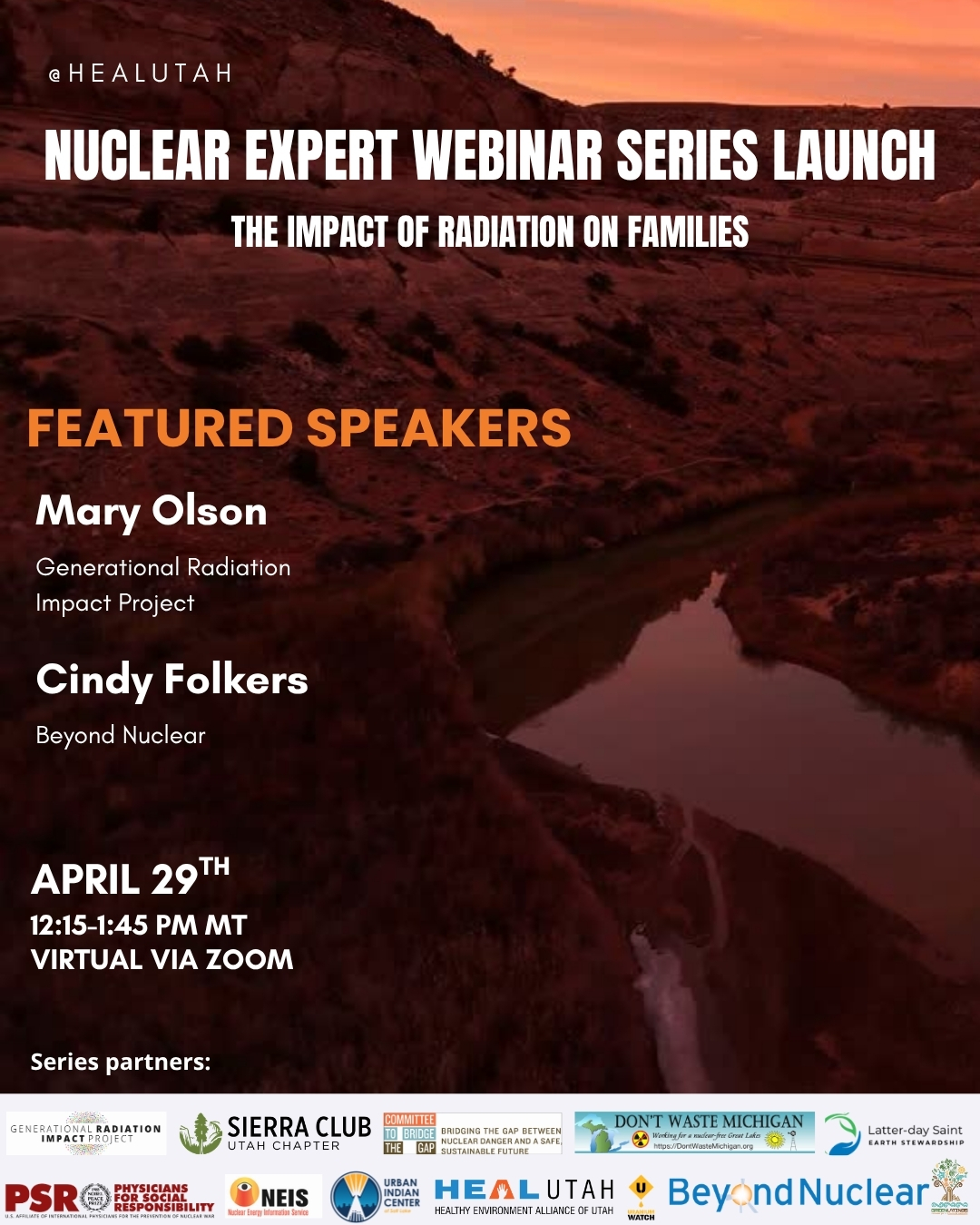
29 April – Nuclear Expert Webinar #1 – Radiation Impacts on Families with Mary Olson and Cindy Folkers
- 12:15 PM MT – 1:45 PM MT
- Location: Virtual – REGISTER TODAY

4 May -West Suburban Peace Coalition to discuss Iran war at May Educational Forum
Monday, May 4, 7:00 – 8:00 PM Central Standard Time
Title: : How Trump’s Narrative Tries to Shape the Reality of the War on Iran.
Contact Walt Zlotow, zlotow@hotmail.com 630 442 3045 for further information
14 May – online event From Bombs to Data Centres: the Face of Nuclear Colonialism

Pine Ridge Uranium is the real threat, not Tehran- Tell Burgum: Stop the Extraction.
Chernobyl: The Lost Tapes – A good documentary on Chernobyl on SBS available On Demand for the next 3 weeks– https://www.sbs.com.au/ondemand/tv-program/chernobyl-the-lost-tapes/2352741955560
To see nuclear-related stories in greater depth and intensity – go to https://nuclearinformation.wordpress.com
-
Archives
- April 2026 (288)
- March 2026 (251)
- February 2026 (268)
- January 2026 (308)
- December 2025 (358)
- November 2025 (359)
- October 2025 (376)
- September 2025 (257)
- August 2025 (319)
- July 2025 (230)
- June 2025 (348)
- May 2025 (261)
-
Categories
- 1
- 1 NUCLEAR ISSUES
- business and costs
- climate change
- culture and arts
- ENERGY
- environment
- health
- history
- indigenous issues
- Legal
- marketing of nuclear
- media
- opposition to nuclear
- PERSONAL STORIES
- politics
- politics international
- Religion and ethics
- safety
- secrets,lies and civil liberties
- spinbuster
- technology
- Uranium
- wastes
- weapons and war
- Women
- 2 WORLD
- ACTION
- AFRICA
- Atrocities
- AUSTRALIA
- Christina's notes
- Christina's themes
- culture and arts
- Events
- Fuk 2022
- Fuk 2023
- Fukushima 2017
- Fukushima 2018
- fukushima 2019
- Fukushima 2020
- Fukushima 2021
- general
- global warming
- Humour (God we need it)
- Nuclear
- RARE EARTHS
- Reference
- resources – print
- Resources -audiovicual
- Weekly Newsletter
- World
- World Nuclear
- YouTube
-
RSS
Entries RSS
Comments RSS
 nuclear-news