Rolls Royce exposed workers to harmful radiation
Rolls-Royce pleads guilty to exposing workers to radiation at Derby site By Derby Telegraph July 30, 2014 ROLLS-ROYCE has admitted breaching safety regulations that led to employees being exposed to radiation.
The company’s Marine Power Operations business in Sinfin Lane faced seven charges in the case, which was brought by the Health and Safety Executive and the Environment Agency.
The charges centre on the management of risk of exposure of employees to ionising radiation from radioactive sources used in industrial radiography.
Derby Crown Court heard that a harmful radiation source was lost from its safety container when a test of a component was carried out…….. http://www.derbytelegraph.co.uk/Rolls-Royce-radiation-exposure-case-latest/story-22017839-detail/story.html#ixzz39Cl4Sfui
Denmark’s wind power soon to be half the cost of fossil fuel energy
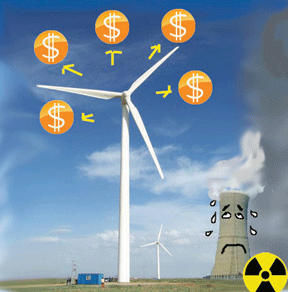 In Two Years, Denmark’s Wind Power Will Be Half the Cost of Fossil Fuels http://motherboard.vice.com/en_au/read/in-two-years-wind-power-will-be-half-the-cost-of-fossil-fuels-in-denmark BRIAN MERCHANT SENIOR EDITOR July 30, 2014 Wind power is officially the cheapest source of energy in Denmark, according to the nation’s government—and by 2016, it claims the electricity whipped up by its newest turbines will be half the price of fossil fuels like coal and natural gas.
Denmark’s Energy Association (everything about Scandinavia is friendlier, even its DEA) announced the news last week, and it’s an achievement worth highlighting. Wind and solar are achieving grid parity with fossil fuels—that is, it’s just as cheap—in many places around the world. Even without the tax breaks, declining manufacturing costs and growing scale have rendered wind power just as cheap as natural gas in many states right here in the gas-rich US. And at least one analyst determined that this is the “beginning of the grid parity era” for solar, worldwide.
But Denmark is blowing past grid parity and towards a scenario in which clean energy is actually much, much cheaper: When its two massive offshore wind farms come online, they’ll be the nation’s most inexpensive energy source by a wide margin, analysts say.
“Electricity from two new onshore wind power facilities set to begin operating in 2016 will cost around 5 euro cents per kilowatt-hour,” Yale 360 explains. “Wind power would remain the cheapest energy option even if interest rates on wind power projects were to increase by 10 percent, the report found.”
That’s good news for a nation that’s hoping to get 50 percent of its power from wind turbines by 2050. Right now, the nation already boasts an impressive clean energy mix of 43 percent. “Wind power today is cheaper than other forms of energy, not least because of a big commitment and professionalism in the field,” Rasmus Peterson, Denmark’s energy minister, said at a press conference. “This is true for researchers, companies and politicians. We need a long-term and stable energy policy to ensure that renewable energy, both today and in the future, is the obvious choice.”
Importantly, the DEA’s analysis “was not based on a full cost-benefit assessment of different technologies that included an assessment of environmental benefits, taxes or subsidies.” That is, the agency did not factor in the health and environmental costs of burning fossil fuels—which are considerable—and instead looked directly at the market forces in the country.
Natural gas and coal are much more expensive in Denmark than it is in the US, which helps make wind such an economic bargain, and the nation has explicitly pursued wind power for decades. But improving technology, falling costs, and the strong, consistently blowing offshore winds that will turn the new turbines are making the case airtight.
Yesterday brought the good news that Germany was meeting a full 28.5 percent of its energy needs with clean sources. Now Denmark is proving that running your nation on clean energy can be cheaper than we possibly could have imagined, even ten years ago.
Radiotherapy loses out to Chemotherapy in funding even though it works better – Genetic cancer research funding even less!
It goes on to suggest that the Government is wrongly ploughing funds into chemotherapy which would be more effective if invested in increasing radiotherapy provision.
It says: “The radiotherapy budget is about £350m a year, compared with a cancer drug budget of about £2bn. Forty per cent of major cancers are cured by radiotherapy and just 11% by chemotherapy.”
Radiotherapy Board responds to ‘A Vision for Radiotherapy 2014-2024’
|
|
The Radiotherapy Board has welcomed a joint report by NHS England and Cancer Research UK. ‘A Vision for Radiotherapy 2014-2024’ is a strategic outline of how future radiotherapy services might be best configured and delivered. The Board, which was established by the Society and College of Radiographers, the Royal College of Radiologists and the Institute of Physics and Engineering in Medicine, looks forward to working to turn the report’s aspirations into reality. The Board’s response says: “The report provides both an opportunity and a framework to support the development of radiotherapy services enabling evidence-based treatments to be delivered to patients in a timely manner and using modern, advanced radiotherapy techniques.” Commenting on the report’s publication, Dr Diana Tait, Chair of the Radiotherapy Board and Vice-President, Clinical Oncology, RCR and consultant clinical oncologist said: “The Radiotherapy Board welcomes this vision document with its aspirations for investment in state of the art radiotherapy equipment, reduced maintenance costs and down-time. “However, we strongly believe that the proposed rationalisation, standardisation and development of NHS radiotherapy services can only be achieved with the necessary investment in a skilled workforce. “Therapeutic radiographers, clinical oncologists and medical physicists already work closely together in a clinical setting. The workforce in all three professional groups needs to grow to deliver the Vision for Radiotherapy. The value of this integrated model of working can already be seen in better patient outcomes” SCoR Professional and Education Manager Charlotte Beardmore commented: “It is really positive that the report sets out a 10 year strategy that will carry on the work started by NRAG and NRIG. It shows a continuing commitment to the drive to deliver the highest quality radiotherapy treatment to all patients. “This vision puts a national focus on radiotherapy development and innovation, and therapeutic radiographers have an important role to play. As a professional body, the SCoR will continue to work with its partners in the Radiotherapy Board to drive innovation and service improvement. “As professionals, therapeutic radiographers must continue to work with their clinical oncology and physics colleagues to develop their services and ensure they are delivering high quality patient care.” Click here to read ‘A Vision for Radiotherapy 2014-2024’ Click here to download the Radiotherapy Board’s response. Anticipating the release of the report, the Sunday Times printed an article which criticises the Government for breaking David Cameron’s pledge that all cancer patients would have access to advanced radiotherapy techniques by April 2013. The article suggests that the lack of radiotherapy provision has contributed to lower Cancer survival rates in Britain and highlights some cases where patients who have been refused funding for advanced radiotherapy techniques have died. It goes on to suggest that the Government is wrongly ploughing funds into chemotherapy which would be more effective if invested in increasing radiotherapy provision. It says: “The radiotherapy budget is about £350m a year, compared with a cancer drug budget of about £2bn. Forty per cent of major cancers are cured by radiotherapy and just 11% by chemotherapy.” The Radiotherapy Board has responded to the article. Their letter, which was sent directly to the Sunday Times and added to the comments section of the article, praises the work which the radiotherapy community has already done to meet David Cameron’s target but emphasises the need for more investment. It adds: “The timeframe of less than six months was challenging. In that time the needs of each of the 50 radiotherapy centres had to be assessed, the necessary facilities purchased, the appropriate workforce trained, and the services to be in effective clinical use. “This was a complex programme and for anyone with experience of introducing change into a stretched healthcare system, it could be judged as phenomenally successful. The fact that the targets were not fully met for another six months is hardly surprising and should not be seen as a failure of this initiative.” The letter welcomes the ‘Vision for Radiotherapy’ report as an opportunity to address what still needs to be done and states the three organisations that form the Radiotherapy Board are ready to work with all stakeholders to make the vision a reality. It concludes by calling for a examination of the way funding is allocated. It says: “There needs to be a major look at cancer services funding with such a disparity between the annual funding for radiotherapy (£350 million) and the cancer drugs fund (more than £2 billion) and the reasons justifying this enormous differential. “As clinical oncologists deliver both chemotherapy and radiotherapy to cancer patients, this is not about professional competition between two non-surgical cancer treatments. It is a call for a realistic examination of the way precious NHS resources are allocated.” Click here to read the Radiotherapy Board’s letter to the Sunday Times. Although the letter did appear in the Sunday Times (9 March) it was edited down to just two short paragraphs. |

And while radiotherapy gets 350 million pounds a year (about 700 million dollars), genetic research into non nuclear therapies gets only 100 million a year (for three years)… Why is the UK trying to slow down the pace of genetic research, whilst claiming success? Why isnt the international community working on this project to speed the research – Arclight2011
“……Drugs that target cancer without harming healthy cells and triggering distressing side effects could be a reality in 20 years, claim British scientists.
A landmark project to map 100,000 complete DNA code sequences is set to transform treatment of cancer and rare diseases, meaning chemotherapy could be obsolete within a generation.
David Cameron said it will make Britain the world leader in genetic research as he announced a package of deals worth £300million to carry out the work, expected to be completed by 2017…..”
Pictures from Tamioka after the Fukushima disaster may 2014

Image shows over 5.4 microsieverts per hour (5 mcSv/h) on official Geiger counter
http://crisisreliefjapan.com/2014/05/17/tomioka-eerie-images-show-what-is-left-of-japanese-city-abandoned-after-tsunami-and-fukushima-nuclear-meltdown/ (More images on link)
Looking at these pictures from the Daily Mail, I wondered how the residents left everything behind in a hurry, never to return.
Being from a radiation zone, they might find it hard to be accepted by society at large.
It was a city known for its beautiful beaches and boasts one of the longest cherry blossom tree tunnels in Japan.
But after a tsunami and a nuclear disaster both struck in the space of 12 months, Tomioka was turned into a ghost city.
These eerie images, captured by a drone, show what is left of the area near Fukushima that had to be abandoned overnight.
More than 15,000 residents living in 6,000 houses were forced to evacuate in March 2011 because of safety fears concerning dangerous radiation levels.
Three years on, schools and business are still prevented from returning while parks, playgrounds, roads and the city’s train station have been left covered in overgrown grass.
A total of 300,000 people have been evacuated from the east coast of the country since the disasters and 15,884 have died.

Road to nowhere: The way into Tomioka, Fukushima, has been blocked off, preventing residents from going back because of dangerous radiation levels
1 This Month
26 April – Chernobyl: Inside the Meltdown airs on National Geographic on Sunday 26th April from 4pm

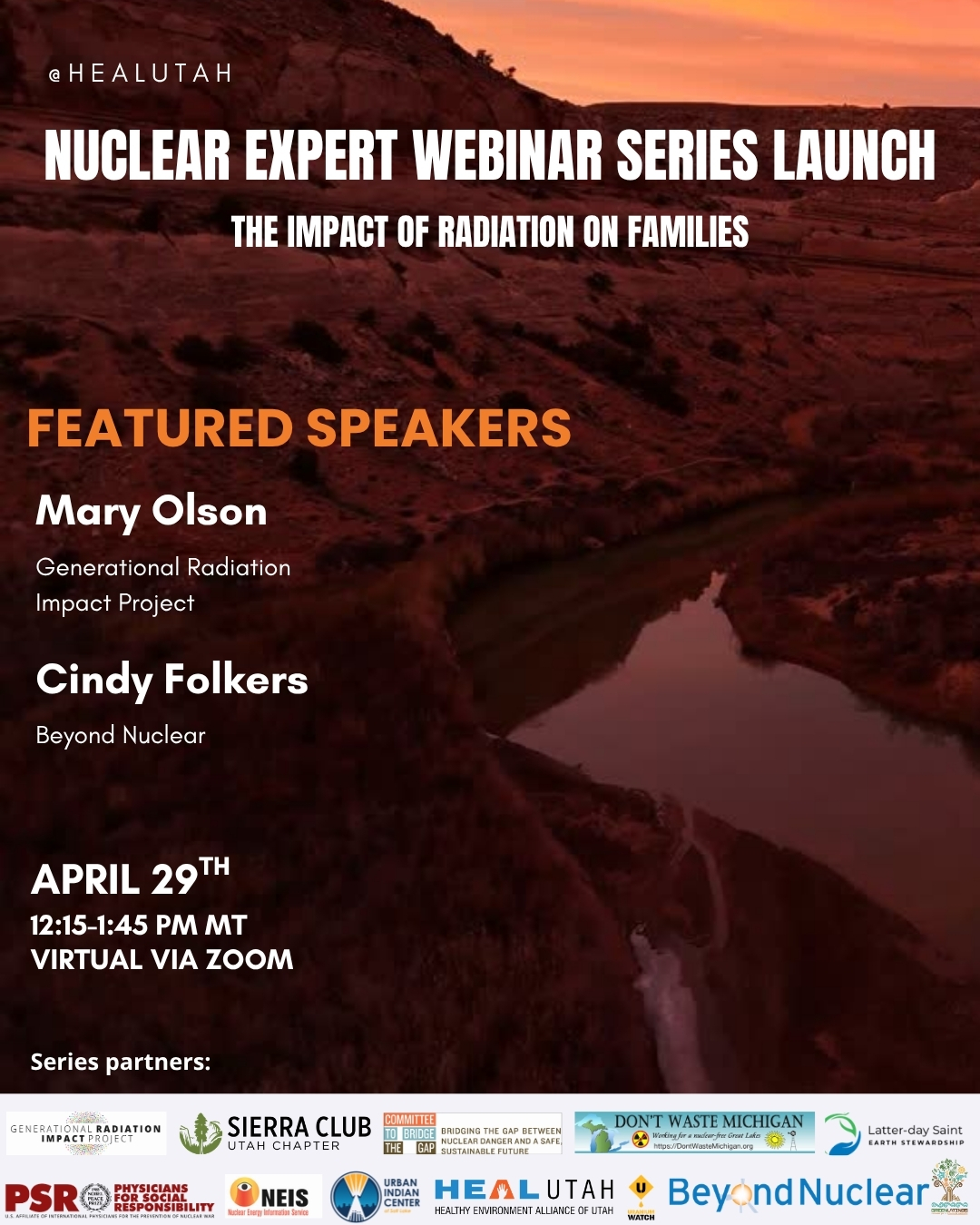
29 April – Nuclear Expert Webinar #1 – Radiation Impacts on Families with Mary Olson and Cindy Folkers
- 12:15 PM MT – 1:45 PM MT
- Location: Virtual – REGISTER TODAY

4 May -West Suburban Peace Coalition to discuss Iran war at May Educational Forum
Monday, May 4, 7:00 – 8:00 PM Central Standard Time
Title: : How Trump’s Narrative Tries to Shape the Reality of the War on Iran.
Contact Walt Zlotow, zlotow@hotmail.com 630 442 3045 for further information
14 May – online event From Bombs to Data Centres: the Face of Nuclear Colonialism

Pine Ridge Uranium is the real threat, not Tehran- Tell Burgum: Stop the Extraction.
Chernobyl: The Lost Tapes – A good documentary on Chernobyl on SBS available On Demand for the next 3 weeks– https://www.sbs.com.au/ondemand/tv-program/chernobyl-the-lost-tapes/2352741955560
To see nuclear-related stories in greater depth and intensity – go to https://nuclearinformation.wordpress.com
-
Archives
- April 2026 (288)
- March 2026 (251)
- February 2026 (268)
- January 2026 (308)
- December 2025 (358)
- November 2025 (359)
- October 2025 (376)
- September 2025 (257)
- August 2025 (319)
- July 2025 (230)
- June 2025 (348)
- May 2025 (261)
-
Categories
- 1
- 1 NUCLEAR ISSUES
- business and costs
- climate change
- culture and arts
- ENERGY
- environment
- health
- history
- indigenous issues
- Legal
- marketing of nuclear
- media
- opposition to nuclear
- PERSONAL STORIES
- politics
- politics international
- Religion and ethics
- safety
- secrets,lies and civil liberties
- spinbuster
- technology
- Uranium
- wastes
- weapons and war
- Women
- 2 WORLD
- ACTION
- AFRICA
- Atrocities
- AUSTRALIA
- Christina's notes
- Christina's themes
- culture and arts
- Events
- Fuk 2022
- Fuk 2023
- Fukushima 2017
- Fukushima 2018
- fukushima 2019
- Fukushima 2020
- Fukushima 2021
- general
- global warming
- Humour (God we need it)
- Nuclear
- RARE EARTHS
- Reference
- resources – print
- Resources -audiovicual
- Weekly Newsletter
- World
- World Nuclear
- YouTube
-
RSS
Entries RSS
Comments RSS
 nuclear-news