Japan wants to measure individuals’ radiation exposure, not air doses
Ministry seeks to focus on individual radiation exposure The Yomiuri Shimbun 2 Aug 14 The Environment Ministry has compiled a report calling for decontamination work in areas affected by the crisis at Tokyo Electric Power Co.’s Fukushima No. 1 nuclear power plant to be based on measurements of individuals’ radiation exposure doses, instead of air doses. Continue reading
Fukushima children having an holiday in Australia
The Rainbow Stay Project is designed to give the children a chance to do things they can no longer do at home, due to the fear of radiation poisoning……..The group of children, aged between ten and sixteen, are here on a charity-sponsored trip.
It is world away from the ongoing fear of radiation which affects their daily lives back home………..
Kazuki says the threat of radiation still affects her life in many ways.
“I was really sad because everything was polluted by radioactive material. I couldn’t swim in the sea anymore and my mum told me to stay inside and not touch the soil.”
There have been several trips like this since 2011, thanks to a Japanese woman living in Sydney.
Yukiko Hirano set up a Rainbow Stay Project with the aim of giving the children new hope.
” I tried to invite the Fukushima children to come over to Sydney. Beautiful environment, and no fear of radiation earthquake. They can enjoy entire holiday, without fearing those kind of things.”……..Andrew Vickers is from the Construction, Forestry, Mining and Energy Union which helped make the trip a reality.
“They can’t eat fish from the sea, they can’t pick up plants and flowers, they can’t touch any wild animals for fear of further radiation poisoning – so it’s not just coming to another country, it’s a totally new experience” http://www.sbs.com.au/news/article/2014/08/01/fukushima-children-visit-australia
Upgrading USA nuclear power is costing $billions
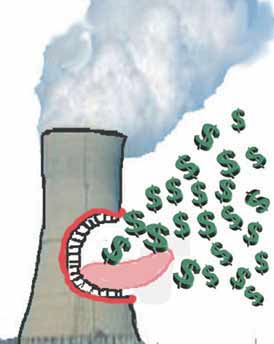 US nuclear industry spends billions on post-Fukushima upgrades Washington (Platts)–31Jul2014 The US nuclear power industry has so far spent about $3 billion taking actions and making plant modifications to address lessons learned from the 2011 Fukushima I accident in Japan, a utility official told the US Nuclear Regulatory Commission during a briefing Thursday.
NRC ordered US nuclear power plant operators in March 2012, almost exactly a year after the accident, to comply with new requirements designed to strengthen their ability to keep reactors and spent fuel cooled during severe external events, such as the earthquake and tsunami that hit the station in Japan………
Pete Sena, president and chief nuclear officer of FirstEnergy Nuclear Operating Company, told the commission during the briefing Thursday that since the March 2011 accident, in which three of six reactors at Fukushima suffered fuel damage and released radioactivity, FENOC has spent about $125 million to increase the safety margin of the four nuclear power reactors it operates.
If those figures are an accurate average cost for all 100 operating nuclear power reactors in the US, the industry has spent around $3 billion or more on post-Fukushima safety upgrades, Sena said.
Jim Scarola, executive director at NEI and co-chair of the industry’s Fukushima response steering committee, said during the briefing that the industry “does not look at this task as finished. It is a continuous improvement.” …….http://www.platts.com/latest-news/electric-power/washington/us-nuclear-industry-spends-billions-on-post-fukushima-21004195
How nuclear power is going out of style – charts from Vox
The rise and fall of nuclear power, in 6 charts, Vox by Brad Plumer on August 1, 2014, Nuclear power is slowly going out of style. Back in 1996, atomic energy supplied 17.6 percent of the world’s electricity. Today that’s down to just 10.8 percent — and it could drop even further in the years ahead. That’s according to the World Nuclear Industry Status Report 2014, which charts the rise and fall of nuclear power over time.
What’s more, nuclear power has been eclipsed by other energy sources — particularly coal and natural gas. Back in 1996, nuclear power provided 17.6 percent of the world’s electricity. Today, that’s down to around 10.8 percent………
The United States has also seen the early retirement of 5 nuclear reactors since 2012 — in Florida, Wisconsin, Vermont, and two in California. Some of those reactors were simply too pricey to keep open in the face of rising maintenance costs and competition from cheap natural gas and wind power………
The chart above [in original article] shows the number of “reactors under construction” worldwide. The number has grown since 2005 — and reached 67 in 2014. That’s way below the peak in the 1970s and 1980s.
It’s also worth noting that this number can mask many of the difficulties in building new reactors. Eight of those reactors have been “under construction” for more than 20 years — including the US Watts Bar Unit 2project in Tennessee, which began in 1972, was stalled for years and then restarted recently, missed a deadline in 2012, and is hoping to get connected to the grid by 2015.
All told, the report notes that 49 of those reactors under construction have met with significant delays, ranging from several months to several years. Nuclear reactors are expensive and take a long time to build. They can face all sorts of obstacles in the meantime — from cost overruns to complex licensing processes to regulatory hurdles to popular opposition (the latter recently blocked construction of two reactors in Taiwan).
“Past experience shows that simply having an order for a reactor, or even having a nuclear plant at an advanced stage of construction, is no guarantee for grid connection and power production,” the report notes….http://www.vox.com/2014/8/1/5958943/nuclear-power-rise-fall-six-charts
It’s easy to find the world’s nuclear targets for terrorism
To Find America’s Nuclear Missiles, Try Google Maps NPR by GEOFF BRUMFIEL July 31, 2014 “……in truth, the location of these weapons is no secret.

The missiles and their command bunkers have been in the same place “for decades,” Air Force Capt. Edith Sakura of the 90th Missile Wing Office of Public Affairs wrote in an email. “They are near county and state roads that are public access to people. You need security clearances to access the sites; however, it would be hard to ‘hide’ such facilities.”
Moreover, as other commenters noted, the sites are already visited by foreign militaries. Russian officers regularly inspect U.S. missile silos to make sure America is adhering to international arms-control treaties. (And the U.S. sends its own observers to Russia.)……http://www.npr.org/blogs/thetwo-way/2014/07/31/336847318/to-find-america-s-nukes-try-google-maps
Japan returning to a new age of fascism with Shinzo Abe’s policies?
The most important question is no longer whether each of Abe’s policies is good or bad, but rather whether we are going to condone the prime minister’s basic attitude that negates the common sense of a modern state and will lead to turning Japan into a barbaric nation.
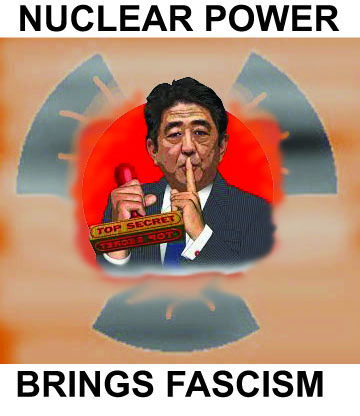
 Abe undermining rule of law, Japan Times, BY JIRO YAMAGUCHI JUL 31, 2014 A recent series of events has demonstrated the deterioration of Japan as a nation. At the root of the problem appears to be a bottomless nihilism on the part of those in power characterized by their thinking that the powers that be can ignore the rules and norms of society and polity.
On July 1, the Abe administration made a Cabinet decision to pave the way for Japan engaging in collective self-defense. This is an act that alters the foundation of Japan’s national security policies developed over the past 60 years, and an outrageous move that way oversteps the power of a single Cabinet.
How vague and sloppy the decision itself is was illustrated by the Budget Committee debates in both chambers of the Diet held two weeks later……..
The new conditions for the use of force overseas set under the LDP-New Komeito agreement will never serve as an effective brake on Japan’s military actions overseas.
Questions and answers in the Diet showed that the text of the Cabinet decision allows different people to interpret it in their own way.
If so, the norms set by the Cabinet over Japan engaging in collective self-defense will be meaningless. In the first place, Abe does not have the idea that government leaders must exercise their power in accordance with rules that are set down in words…….
If the content of norms and rules of a nation can be freely changed by those who interpret them, the nation is no longer under the rule of law; it’s under the rule of man.
Meanwhile, the Nuclear Regulation Authority screened Kyushu Electric Power Co.’s Sendai Nuclear Power Plant in Kagoshima Prefecture in accordance with the NRA’s plant design standards updated in the wake of the 2011 Fukushima nuclear disaster and announced that the Sendai plant has cleared the screening. Thus the NRA has paved the way for restarting the idled plant.
At the same time, NRA Chairman Shunichi Tanaka said NRA cannot determine whether the plant is safe to restart. The NRA chief insists its screening standards are not safety standards.
Yet, the Abe administration, which had repeatedly said it would reactivate nuclear power plants that have cleared “the safety standards,” is expected to push for a quick restart of the Sendai plant. The government says that NRA screening has confirmed the safety of the Sendai plant.
As with the issue of the exercise of the right to collective self-defense, each of the people involved in the nuclear power policy is allowed to interpret the rules in his or her own way.
All these events demonstrate that people in power in this country — in particular Abe — do not recognize that they are bound by rules. They defiantly argue that even if certain things are prohibited under rules, they can do them simply by first changing the interpretation of the rules. Or, if they cannot win a game, they think that it’s because the rules and the referee are wrong. They then think that if the referee is replaced, things will be all right.
The most important question is no longer whether each of Abe’s policies is good or bad, but rather whether we are going to condone the prime minister’s basic attitude that negates the common sense of a modern state and will lead to turning Japan into a barbaric nation.
Jiro Yamaguchi is a professor of political science at Hosei University. http://www.japantimes.co.jp/opinion/2014/07/31/commentary/world-commentary/abe-undermining-rule-law/#.U9xbVuNdUnk
Ukraine Parliament considering Bill to renew nuclear ambitions

 Bill reviving Ukraine’s nuclear power ambitions goes to parliament July 31, 20:20 UTC+4 KIEV, July 31. /ITAR-TASS/. A bill restoring Ukraine’s nuclear power status was registered in the national parliament on Thursday amid the ongoing military conflict in the south-eastern regions and strained relations with Russia.
The bill, reviving Ukraine’s nuclear ambitions, was forwarded to the parliament’s security and budget committees………
Nikolai Filatov, head of the all-Ukraine Union of Strategic Missile Forces Veterans, said the restoration of the nuclear power status would take much effort and cost at least one or two annual national budgets but “maintaining [strategic missile forces] in combat readiness would be much less expensive,”
He said that Ukraine was able to create land-based mobile missile systems, “which will pose a threat to a potential enemy”……
Ukraine, which had the world’s third-largest nuclear arsenal after the breakup of the USSR, abandoned nuclear weapons under the 1994 Budapest Memorandum in exchange for security guarantees from the United States, Russia and Britain.http://en.itar-tass.com/world/743128
Cover-up of Fukushima effects parallels the cover-up of Hiroshima’s
Fukushima disaster colors A-bomb anniversaries Parallels can be drawn between control of information during Occupation and today BY JASON BARTASHIUS JAPAN TIMES JUL 30, 2014 Over the past three years, the atomic bombing anniversaries in August have increasingly become a time to ask new questions. How did the only country to experience nuclear bombings come to embrace nuclear power, a decision that ultimately led to the ongoing crisis at the Fukushima No. 1 plant? Does Japan have the capability or political will to create its own nuclear arsenal? Is it morally acceptable to export nuclear technology to countries that are prone to natural disasters or may later decide to manufacture atomic weapons?
And what about censorship? Based in large part on its attempts at withholding or manipulating information related to the Fukushima disaster, the country has seen itself spiral down the Reporters Without Borders Press Freedom Index, falling a staggering 31 places between 2012 and 2013.
The situation can only worsen with the recent passage of the state secrets law. Will the law be used to keep important information regarding radiation and the safety of power plants secret? What impact will it have on anti-nuclear activism? And how do the new law, the overall lack of transparency and the handling of Fukushima compare to U.S. Occupation policies — especially those that squashed discussions of the atomic bombings?
One way history has repeated itself is in the way in which individuals and agencies have rushed to assure the public that radiation levels posed little or no threat to health………
As for the situation in Fukushima, the government hasn’t always been enthusiastic about radiation-related medical research. On Dec. 19, 2012, the Mainichi reported, “The Fukushima prefectural government has tried to kill a proposal by a local assemblyperson to store local children’s milk teeth to examine their internal radiation exposure stemming from the Fukushima nuclear disaster, it has been learned.” Fortunately, more recently, plans for a large-scale study to test milk teeth for cesium, strontium-90 and other isotopes were revealed to the public. But, understandably, the public has grown very suspicious of government involvement in research.
There are also parallels between the suppression of protests against the use of the atomic bomb by the U.S. and the potential for the state secrecy law to negatively impact upon the anti-nuclear movement……
orried about what impact the law may have on anti-nuclear activism. Johnston writes, “Receiving less attention is the question of whether ordinary citizens who are involved in anti-nuclear protests might be targeted and investigated under the new law.”
Koichi Nakano, professor of political science at Sophia University, is also concerned.
“You find a similar power with the Japanese government as existed during the U.S. Occupation,” Nakano said in an interview. “Self-censorship will become more prevalent. Journalists will censor themselves before asking questions. The activists who try to find out information about the nuclear industry may get in trouble, they may not, but they’ll worry about what they otherwise wouldn’t.” http://www.japantimes.co.jp/community/2014/07/30/voices/fukushima-disaster-colors-bomb-anniversaries/#.U9xcrONdUnk
No plain sailing for japan’s nuclear restart as Fukushima’s waste problems continue
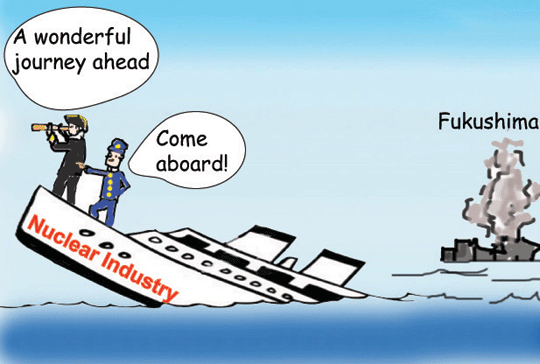 Persistent Nuclear Waste From Fukushima Inhibits Restarts Fukushima’s long-term problems will make public acceptance of a general nuclear restart difficult.http://thediplomat.com/2014/07/persistent-nuclear-waste-from-fukushima-inhibits-restarts/ By Clint Richards July 30, 2014 After months of attempting to negotiate with local residents in Fukushima, the Japanese government has abandoned its attempt to purchase land to store nuclear waste from the stricken Fukushima Daiichi reactors. Storing nuclear waste and preventing groundwater from entering the disaster site continue to be persistent problems for the government, with no clear solution. This inability is a key factor explaining why public sentiment remains so strong against restarting Japan’s nuclear reactors, despite newer and much more robust safety standards from the Nuclear Regulatory Authority (NRA).
Instead of purchasing nearby land, Environment Minister Nobuteru Ishihara and Reconstruction Minister Takumi Nemoto met with Fukushima Governor Yuhei Sato and the mayors of Futaba and Okuma and proposed a 30 year lease for 230 billion yen ($2.25 billion). The Jiji Press reported that local residents had refused to selltheir land because they believed the temporary storage facilities would become permanent if the land was owned by the state. The mayors of the respective towns said they would submit the proposal to their residents, but that it would take time to gain acceptance.
Additionally, on Monday Tokyo Electric Power Co. (TEPCO) finally admitted that an operation underway since May to divert groundwater from entering into reactor buildings was unsuccessful. TEPCO had been attempting to intercept the water before it entered the tainted facilities and divert it into the ocean, but so far “the utility has yet to see tangible results,”according to the Japan Times. There are reportedly 400 tons of water flowing into the contaminated area on average every day, with TEPCO’s operation intended to reduce that amount by as much as 100 tons. Instead, the company hopes to stop groundwater from entering by solidifying the nearby hillside soil with concrete.
The government’s piecemeal approach to the waste problem generated by the Fukushima Daiichi reactors has done little to inspire the confidence of the Japanese population about plans to restart some of its reactors in the coming months. While Kyushu Electric Power Co.’s Sendai nuclear power plant passed the NRA’s new, more stringent safety inspections on July 16, 59 percent of Japanese people oppose the restart, according to an Asahi Shimbun poll conducted July 26 and 27. Even though the Sendai reactors only need to gain local acceptance in order to restart, these poll numbers indicate that a more general restart will continue to be met with resistance. The government has further plans to stem the flow of contaminated groundwater, for instance revamping its “ice wall” beneath the Fukushima Daiichi reactors by adding additional pipes and dumping as much as 10 tons of ice a day. However, until Japanese people feel there is an effective, long-term solution to the nuclear disaster in place, public opposition to nuclear energy will remain.
Nuclear safety specialist fired from Los Alamos for pushing Obama’s Nuclear Agenda

 Fired From Los Alamos for Pushing Obama’s Nuclear Agenda, The Daily Beast, 31 July 14 The President says he wants to get rid of the world’s A-Bombs. But when an employee at the nation’s premier nuclear lab suggested the same thing, he got axed. By Douglas Birch, Center for Public Integrity

James E. Doyle’s ordeal with Washington began one morning in early February last year, when his supervisor stopped by his desk at Los Alamos National Laboratory and told him that senior managers wanted copies of all his publications.
The 55-year-old political scientist asked the reason for the request, and he eventually was told that someone at the House Armed Services Committee wanted to see the publications. But Doyle said officials refused to tell him who it was or why.
Later that day at the lab’s New Mexico campus, he said, two members of a Security Inquiries Team abruptly arrived with a special, silver-colored briefcase for secure documents, and pulled out an article he published a few days earlier on the website of a London nonprofit group.
They claimed that the article, an impassioned critique of the political theories undergirding the nuclear arms race and a defense of President Obama’s embrace of a nuclear weapons-free future, contained classified information.
The assertion astonished Doyle, since the laboratory’s security authorities had already reviewed the article and declared it unclassified. But it was the start of a series of events in which Doyle first had his pay docked and his security clearance withdrawn, and then eventually was fired.
He got that final news on July 8, a day after the Center for Public Integrity asked the Energy department’s National Nuclear Security Administration, which runs the nation’s nuclear labs, about the dispute over his article. “I was shocked,” he said, shortly afterward. “I am still shocked.”
Experts say Doyle’s treatment raises questions about the commitment of the nuclear weapons labs—which face increased competition for resources amid declining military interest in their key product—to intellectual independence in their workforce………..
Doyle, who holds a doctorate in international studies from the University of Virginia, has been at Los Alamos for the past 17 years. Before he joined the lab, he said, he wrote the Department of Energy’s strategic plan for keeping weapons-grade uranium and plutonium stored at hundreds of sites scattered across the former Soviet Union from falling into the wrong hands. He referred to this risky state of affairs as “the babushka-with-uranium-in-the-chicken-shed” problem.
As a nuclear safeguards and security specialist in the lab’s Nuclear Nonproliferation Division, which has 250 employees and an annual budget of about $185 million, Doyle has studied ways to verify reductions in United States and Russian nuclear weapons stockpiles beyond the current levels. He also edited a textbook, Nuclear Safeguards, Security and Nonproliferation: Achieving Security with Technology and Policy, which, he said, is used in three dozen universities in the U.S. and abroad. http://www.thedailybeast.com/articles/2014/07/31/fired-from-los-alamos-for-pushing-obama-s-nuclear-agenda.html#sthash.o3ZKvqHu.dpuf
Japan’s Prime Minister Abe pinning his political future on nuclear power restart
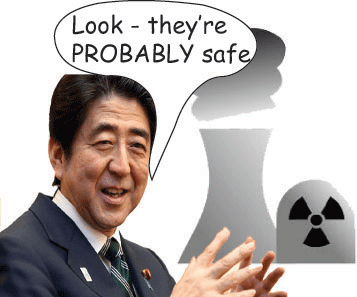 Flicking the switch Restarting nuclear plants is unpopular but crucial for Shinzo Abe The Economist Aug 2nd 2014 | SATSUMASENDAI|”……. The pro-nuclear government of Shinzo Abe, the prime minister, hopes a restart at the Sendai plant can open the way for a dozen or more reactors to resume operations……..The cost of closure to the local economy means that officials who favour nuclear power overwhelmingly outnumber opponents in the local assemblies that will vote in the autumn. Yet on the national stage, Mr Abe may still pay a price. His popularity has recently flagged. Last month his Liberal Democratic Party lost a gubernatorial election in Shiga prefecture, partly due to rising anti-nuclear sentiment. Some three-fifths of people are against the Sendai restart, according to a recent nationwide poll of public opinion.
Back in Kyushu, the possibility of an imminent restart was driven home this week when the prefecture handed out iodine tablets to households near the plant to protect against thyroid cancer in case of an accident. Other plans are incomplete, most notably on basic evacuation routes in case of a nuclear emergency. The plant is likely to restart without an earthquake-proof off-site emergency centre, though these were mandated after the Fukushima disaster. Japan lies in one of the world’s most seismically active areas, but insufficient discussion has been held about the risks posed by a surrounding group of five calderas and by Sakurajima, an active volcano only 50 kilometres (31 miles) away from the Sendai plant.
The central government has to date relied on the NRA and on Kagoshima officials to make the case for the restart. Yet the governor, Yuichiro Ito, now says the authorities in Tokyo must convince the public of the plant’s safety. In 2012, before two reactors at Oi in Fukui prefecture were switched back on for a while, the governor there ensured that the then prime minister, Yoshihiko Noda, reassured the public over the plant’s safety. Mr Abe may have to dip deep into his political capital if reactors across the country are to be fired up. http://www.economist.com/news/asia/21610329-restarting-nuclear-plants-unpopular-crucial-shinzo-abe-flicking-switch
Uranium miner Rio Tinto lies about its “sustainability”
Unsustainable: the ugly truth about Rio Tinto‘, also reveals that Rio Tinto’s sustainability reporting contrasts sharply with the company’s actual performance in all four categories. It shows how Rio Tinto’s reckless pursuit of profit at any cost has caused disputes with numerous unions as well as environmental, indigenous and community groups. Most of the disputes covered in the report are ongoing. Rio Tinto has continued to provoke disputes in the three months since the report was released:
- with South African regulators by illegally operating a coal mine for a decade;
- with injured Australian workers by systematically targeting them in a layoff;
- with leaders in Zimbabwe by reportedly reneging on a pledge to support community development programs;
- and with the people of Papua New Guinea by rejecting calls for an investigation into the company’s role in a bloody civil war.
Rio Tinto will go on provoking disputes and operating in an unsustainable manner unless it believes that doing so could threaten its license to operate. To reform Rio Tinto, first we must threaten its ‘license to operate’
 Rio Tinto’s ‘Sustainable Mining’ Claims Exposed By Kemal Özkan http://www.globalresearch.ca/rio-tintos-sustainable-mining-claims-exposed/5394301 July 31, 2014 Global mining giant Rio Tinto markets itself as a ‘sustainable company’. But serious failures in its reporting, and its attempt to hold an Australian indigenous group to ransom, reveal a very different truth: the company is driven by a reckless pursuit of profit at any cost. Rio Tinto uses its sustainability reporting to bolster the argument that it is a responsible company and therefore entitled to a license to operate. Now, a global campaign is demanding that Rio Tinto live up to its sustainability claims.
Rio Tinto subsidiary, Energy Resources of Australia (ERA), has threatened the Mirarr people that if it is not allowed to expand its Ranger uranium mining operations underground, it may be unable to fully fund rehabilitation of the open pit mine. The Ranger mine is located in the traditional lands of the Mirarr, the world heritage-listed Kakadu national park in Australia’s Northern Territory. If ERA does not complete rehabilitation of the site, which suffered a radioactive spill last year, the water, air quality and soil in the area could be scarred with toxic radiation for generations. Continue reading
Chem-Nuclear ordered by Court to protect groundwater from radiation

 Court urges Chem-Nuclear safety The Augusta Chronicle, By Sarita Chourey Morris News Service Thursday, July 31, 2014 COLUMBIA — The South Carolina Court of Appeals is ordering Chem-Nuclear to better protect the groundwater from contamination at the Barnwell County’s low-level radioactive waste disposal site. Under the order, the site operator and the S.C. Department of Health and Environmental Control have 90 days to turn in a plan to reach compliance.
The Sierra Club, represented by the South Carolina Environmental Law Project, had not asked for Chem-Nuclear’s license to be revoked, but rather that it improve waste-handling procedures at the 235-acre site near the town of Snelling.
In its ruling Wednesday, the three-person court said DHEC had not enforced the law on several parts of the regulation, and that the Administrative Law Court was wrong when it found Chem-Nuclear to be in compliance.
In one part of Wednesday’s decision, the court said the trenches at the site have no system to collect liquids that have drained or percolated through radioactive materials.
“DHEC and Chem-Nuclear argue Chem-Nuclear is justified in not having a … collection system due to ‘concerns regarding the radioactive exposure to workers handling and processing (it),’” wrote the court. “We fail to see how the danger of radioactive contamination to workers actually justifies releasing it into the groundwater without testing and remediation. Rather, it seems the danger to health and safety requires testing and remediation.”………
Tritium results from the manufacture of nuclear power, and is found in radioactive waste generated by nuclear power plants.
In 1999 a nearby church property was contaminated by radioactive material due to Chem-Nuclear’s disposal practice of pumping contaminated water out of a trench into lined ponds. ……. http://chronicle.augusta.com/latest-news/2014-07-31/court-urges-chem-nuclear-safety?v=1406837686
Germany reaches record in share of renewable energy
 Renewable energy share reaches record high in Germany, PV Magazine 31. JULY 2014 New installations coupled with favorable climatic conditions helped boost the share of renewables to a record 28.5% in the first half of 2014. The share of renewable energy in gross domestic energy consumption is expected to rise to a record high of 28.5% in the first half of 2014, according to a preliminary survey by the German Association of Energy and Water Industries (BDEW).
The construction of new renewable installations coupled with favorable climatic conditions helped boost the share of renewables to record levels by mid-year. In the first half of 2013, the renewables share of gross domestic energy consumption was at 24.6%.
Producing 18.3 billion kilowatt hours, photovoltaic power generation increased by 27.3%, while wind grew by 21.4% to 31 billion kilowatt hours. Biomass energy generation increased 5.2% to 22 billion kilowatt hours in the period……..
Energy generation by conventional plants on decline
The production by conventional power plants is declining significantly, BDEW reported……..
Gas and electricity consumption saw a general decline in the period: Natural gas consumption amounted to 445.7 billion kilowatt hours, down some 20% from 555.5 billion. The BDEW attributed the drop to significantly warmer weather in 2014, which lowered overall heating demand, especially compared to the very cold first half of 2013. A decline in production in Germany’s chemical industry likewise contributed to lower gas use. Adjusted for temperature, natural gas consumption still fell nearly 7%.
Electricity consumption in the period dropped 5% to 268 billion kilowatt hours, down from 282 billion a year ago, due mainly to the mild weather.
UK has record year for renewable energy
 Record year for UK renewables http://renews.biz/71533/uk-renewables-output-hits-18-1twh/ Renewables claimed a record 14.9% of the UK generation mix in 2013, figures from DECC reveal.Some 53% of this came from onshore (32%) and offshore wind (21%), accounting for 7.9% of the nation’s electricity. Offshore wind generation surged by 52% and onshore by 40%. Overall renewables output was up 30% on 2012.
Meanwhile, figures for the first quarter of 2014 showed a renewables share of 19.4%, up 43% to 18.1TWh on the 12.7TWh in the first quarter of 2013.
Onshore wind rocketed 62% in the quarter, from 4.1TWh to 6.6TWh, as a result of “much increased capacity and high wind speeds”. Offshore wind was up 53% from 2.9TWh to 4.4TWh.
Energy Secretary Ed Davey said: “The government’s investment in renewable energy is paying off. Renewable electricity has more than doubled in just four years.
“Having a strong UK renewable sector helps to reduce our foreign imports of energy, improving our energy security as well as helping us tackle climate change and creating hi-tech green jobs. A green energy future that once seemed impossible for Britain is fast becoming a reality.”
RenewableUK welcomed the figures, which it said should “make those in government who have failed to support wind energy sit up and take notice”.
R-UK director of policy Gordon Edge said: “More than half of Britain’s clean electricity now comes from onshore and offshore wind. We’re now on course to hit 10% of electricity from wind alone this year.
“That’s why it’s particularly puzzling to see some politicians fail to back the cheapest and most successful renewable technology, onshore wind, at a time when a majority of voters from all the main parties are telling them to support it.”
Installed renewables capacity in the UK increased by 27% (4.2GW) to 19.7GW in 2013, due mainly to a 27% increase in onshore wind capacity and a 23% increase in offshore wind capacity. For the first time, more than 5% of the total energy supply, covering electricity, heat and fuel for transport, came from renewables, up from 4.2% in 2012 to 5.2% in 2013. The UK needs to meet a legally binding target of 15% of all energy from renewables by 2020.
Meanwhile, figures for the first three months of 2014 showed high rainfall in Scotland led to hydro output increasing by 78% to a record quarterly level of 2.2TWh.
Renewable electricity capacity was 20.8GW at the end of the period, a 15% increase on the corresponding window in 2013 and a 5.4% increase on the previous quarter.
Some 145MW of capacity joined the feed-in tariff scheme, increasing the total to 2386MW or 11% of all installed renewable capacity. Solar PV contributed 107MW, wind 13MW and anaerobic digestion 7MW.
Overall UK electricity generation for the quarter was 93.3TWh, a dip of 8.2% on a year ago due to the warmest first three months seven years.
1 This Month
26 April – Chernobyl: Inside the Meltdown airs on National Geographic on Sunday 26th April from 4pm

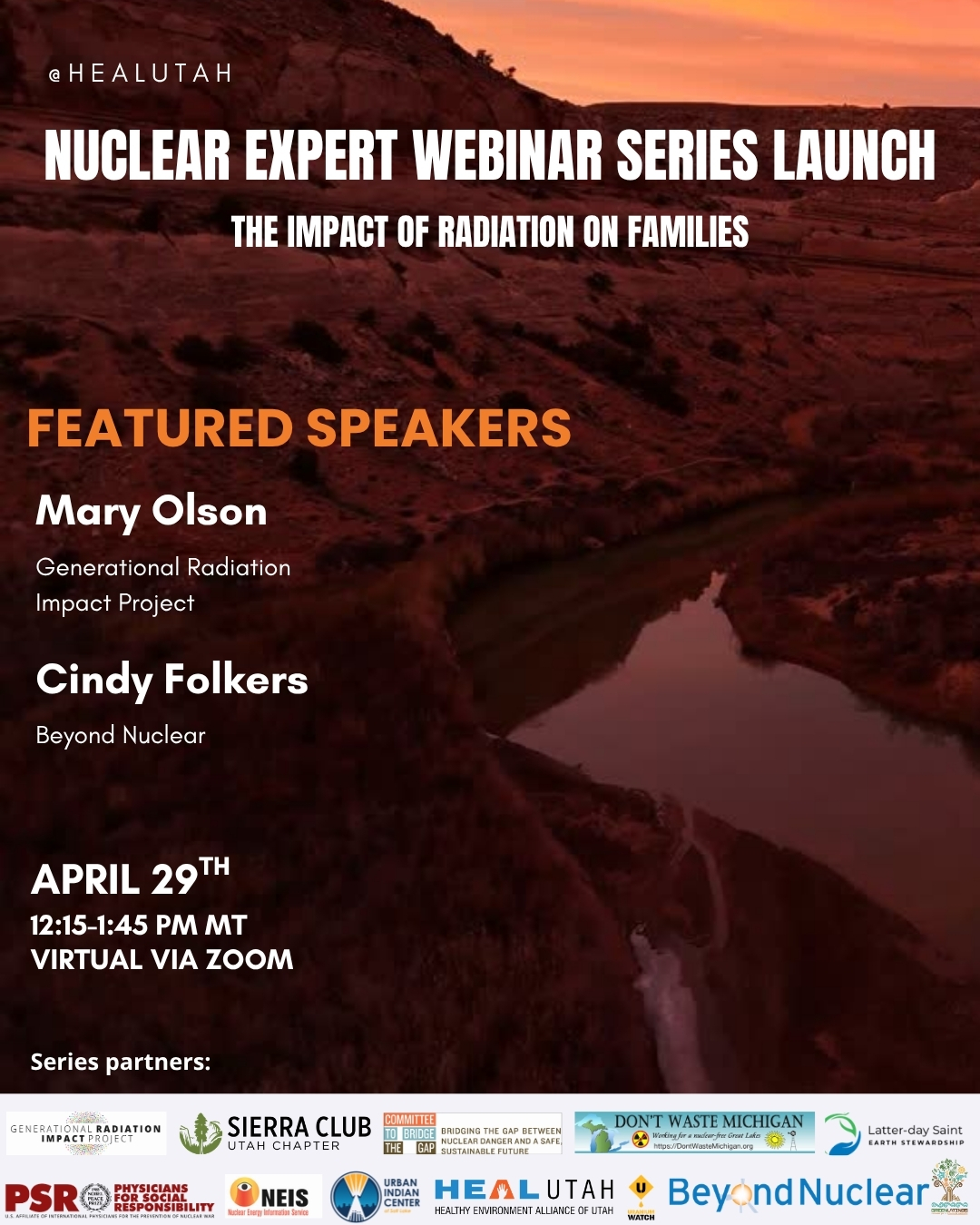
29 April – Nuclear Expert Webinar #1 – Radiation Impacts on Families with Mary Olson and Cindy Folkers
- 12:15 PM MT – 1:45 PM MT
- Location: Virtual – REGISTER TODAY

4 May -West Suburban Peace Coalition to discuss Iran war at May Educational Forum
Monday, May 4, 7:00 – 8:00 PM Central Standard Time
Title: : How Trump’s Narrative Tries to Shape the Reality of the War on Iran.
Contact Walt Zlotow, zlotow@hotmail.com 630 442 3045 for further information
14 May – online event From Bombs to Data Centres: the Face of Nuclear Colonialism

Pine Ridge Uranium is the real threat, not Tehran- Tell Burgum: Stop the Extraction.
Chernobyl: The Lost Tapes – A good documentary on Chernobyl on SBS available On Demand for the next 3 weeks– https://www.sbs.com.au/ondemand/tv-program/chernobyl-the-lost-tapes/2352741955560
To see nuclear-related stories in greater depth and intensity – go to https://nuclearinformation.wordpress.com
-
Archives
- April 2026 (288)
- March 2026 (251)
- February 2026 (268)
- January 2026 (308)
- December 2025 (358)
- November 2025 (359)
- October 2025 (376)
- September 2025 (257)
- August 2025 (319)
- July 2025 (230)
- June 2025 (348)
- May 2025 (261)
-
Categories
- 1
- 1 NUCLEAR ISSUES
- business and costs
- climate change
- culture and arts
- ENERGY
- environment
- health
- history
- indigenous issues
- Legal
- marketing of nuclear
- media
- opposition to nuclear
- PERSONAL STORIES
- politics
- politics international
- Religion and ethics
- safety
- secrets,lies and civil liberties
- spinbuster
- technology
- Uranium
- wastes
- weapons and war
- Women
- 2 WORLD
- ACTION
- AFRICA
- Atrocities
- AUSTRALIA
- Christina's notes
- Christina's themes
- culture and arts
- Events
- Fuk 2022
- Fuk 2023
- Fukushima 2017
- Fukushima 2018
- fukushima 2019
- Fukushima 2020
- Fukushima 2021
- general
- global warming
- Humour (God we need it)
- Nuclear
- RARE EARTHS
- Reference
- resources – print
- Resources -audiovicual
- Weekly Newsletter
- World
- World Nuclear
- YouTube
-
RSS
Entries RSS
Comments RSS
 nuclear-news