Britain’s intractable and expensive problem of accumulating nuclear waste

 Britain’s nuclear waste, a problem proving hard to bury, The Conversation, Stuart Haszeldine Professor of Geology at University of Edinburgh 1 Aug 14
A proposal for radioactive waste to appear at a burial site nearby, would be likely to fill the great majority of the UK population with thoughts of danger, cancer – and falling house prices. This illustrates the huge problem of public misperception to overcome when disposing of radioactive waste. Britain’s nuclear reactors have generated low-carbon electricity since 1956, in doing so creating around 260,000m3 (about the size of 700 double-decker buses) of intermediate-level wasteand 3,000m3 of highly radioactive high-level waste, as well as spent fuel, plutonium and uranium. The price for decommissioning past and existing nuclear power plant and disposing of that waste is around £70 billion – the single largest item of expenditure for the UK Department of Energy and Climate Change.
What to do with radioactive waste is a problem that has so far proved to be intractable to successive generations of civil servants and ministers. In the mid-1970s, it was decided that deep burial would provide the optimum secure solution.
Here, radioactive waste would be packaged and contained for one million years, sealed by multiple chemical and physical barriers within a repository dug out around 500 metres below ground level. A serious attempt was made to investigate a site in West Cumbria close to Sellafield in the 1990’s, but that foundered on the complexity of the geology and flow of deep groundwater, making it difficult to predict how well sealed the waste would be into the far future……….
Another review and public consultation was undertaken during 2013-14, from which emerged the White Paper “Implementing Geological Disposal” published in July 2014. The results show the government has done some serious listening, and it provides some distinctly new approaches.
First, a new body Radioactive Waste Management Ltd will be created to pursue a disposal site. The company will be wholly owned by the government and could propose more than one facility for different types of waste. This has been tried in the 1980s and 1990s with UK Nirex – a limited company wholly owned by UK government, which spent £400m investigating just one site. Can you spot any difference? So how this operates will be more important than the definition.
Second, the government states it is keen to “listen and respond to views and concerns”. Yet in the future this search will now become defined as a nationally significant infrastructure project, which means that many powers of local people to decide or influence could be restricted or removed. Specifically, the control and influence of local councils has been removed, combined with a statement that no tier of government will have the right to veto a project. So the responsibility of regional council authorities for managing this waste, and the associated road and rail and excavation infrastructure is also removed.
Third, the search for a site will become national, with a two-year period of geological survey and screening to identify suitable regions (not specific sites). Identifying secure regions may become difficult if the extensive fracking of England goes ahead for shale gas and oil, as, any effect on the underlying geology could affect a site’s long term secure storage potential………
Potentially the most significant statement of all comes from the secretary of state for energy and climate change, Ed Davey, stating that arrangements for waste disposal have to be in place before planning consent will be given for new nuclear power stations. Does this mean that one or more sites need to be specifically identified before construction can start on the new nuclear reactors planned at Hinkley Point and elsewhere? If formal discussions with new volunteers do not even start until 2016, and could conclude as late as 2030 – by which time Hinkley Point C should be generating power – that seems impossible.
Perhaps ministers of the future be satisfied merely to know that the UK “has a plan”? If the past is any guide to the future, relying on such a plan didn’t help to find a nuclear mausoleum in 1978, 1996, or 2012. https://theconversation.com/britains-nuclear-waste-a-problem-proving-hard-to-bury-29917
UK White paper – Implementing Geological Disposal
Written statement to Parliament UK
Publication of Implementing Geological Disposal White Paper 2014
- Department of Energy & Climate Change and The Rt Hon Edward Davey MP
- Delivered on:
- 22 July 2014
- History:
- Published 24 July 2014
- Part of:
- Managing the use and disposal of radioactive and nuclear substances and waste, Energy, Environment and Public
 safety and emergencies
 - Statement by Edward Davey on the publication of a white paper on geological disposal.
I am today publishing a White Paper on implementing geological disposal of higher activity radioactive waste.The White Paper – Implementing Geological Disposal –follows a public consultation that my department carried out during 2013 on potential amendments to the existing siting process established in 2008 for a geological disposal facility (GDF) and reflects key messages from that consultation, as well as lessons learned during the previous siting process.
The UK Government remains committed to geological disposal as the right policy for the long-term, safe and secure management of higher activity radioactive waste……….
- ……….With regard to new nuclear power, UK Government policy is that, before development consents for new nuclear power stations are granted, I will need to be satisfied that effective arrangements exist or will exist to manage and dispose of the waste they will produce…….
- The White Paper is issued jointly by the UK Government and the Northern Ireland Executive. The Welsh Government is currently considering a wider review of its higher activity radioactive waste management policy. The Scottish Government has a separate higher activity radioactive policy.
Today I am also publishing the latest annual report on the geological disposal programme, covering April 2013 to March 2014. This will be laid in the libraries of the House. https://www.gov.uk/government/speeches/publication-of-implementing-geological-disposal-white-paper-2014
Tough times for nuclear giant AREVA – shares plunge, sales wither
 Areva’s stock plunges on sales warning, solar exit PARIS, Aug 1 (Reuters) – Shares in French nuclear power group Areva closed 20 percent lower on Friday, the worst fall since the company was formed in 2001, as it posted a first-half loss, exited a thermal solar power business and cut sales targets.
The shares were down by as much as 23 percent earlier in the session with trading the busiest by volume since late February, when Areva posted a net loss of nearly half a billion euros.
Chief Executive Luc Oursel dropped a long-held target to sell 10 nuclear reactors by 2016, saying it would “take a few more years” and the firm warned that 2014 revenue would fall 10 percent, more than the 2-5 percent decline forecast in February.
 Areva, which has not sold a new nuclear reactor since 2007, hopes French utility EDF will get the green light from European Union competition authorities this year to build two Areva reactors in Britain, but its reactor sales are suffering badly from the aftermath of the 2011 Fukushima disaster.
Billions of cost overruns and multi-year delays in four projects involving its flagship EPR reactor have also hit the state-owned firm’s image, whileRussian, Korean and American reactor builders are winning orders at its expense……..
Revenue fell 12.4 percent to 3.89 billion euros and earnings before interest, tax, depreciation and amortisation (EBITDA) more than halved to 226 million euros from 487 million.
Oursel said the nuclear market environment had further deteriorated as constructionprojects for new reactors abroad as well as reactor overhaul operations in France had been delayed.
As a supplier to the utilities industry – which is suffering from overcapacity and slack power demand – Areva is feeling the impact of its customers’ efforts to cut costs and is trying to make savings itself to restore profitability.
The firm hiked its cost cut target to 1.2 billion euros from 1 billion and said it would cut 1,500 jobs in Germany by the end of 2015, as well as 200 jobs in the United States this year. It had earlier warned of 1,200 to 1,500 job losses in Germany. http://uk.reuters.com/article/2014/08/01/areva-results-idUKL6N0Q71IK20140801
Safety problems in the idea for floating nuclear power reactors
 Floating Nuclear Power Plants Might Be the Future of Energy, VICE News, By Kayla RubleAugust 1, 2014 “…………Critics are concerned about some of the design aspects of this type of NPPs. Edwin Lyman, a senior global security scientist at Union of Concerned Scientists, told VICE News that a lot of what needs to be done to make these plants deployable is the opposite of what the industry needs to do to make their land-based facilities safer. He explained that having to build lighter reactors for use in the ocean and accessibility issues are concerns with the floating plants.
Discrimination against the victims of nuclear radiation
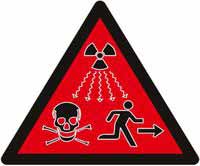 The Radiation That Makes People Invisible: A Global Hibakusha Perspective Robert Jacobs The Asia-Pacific Journal, Vol. 12, Issue 30, No. 1, August 3, 2014.
“…………Discrimination– People who may have been exposed to radiation often experience discrimination in their new homes and may become social pariahs. We first saw this dynamic with the hibakusha in Hiroshima and Nagasaki who found it very difficult to find marriage partners, since prospective spouses feared they would have malformed children, and found it difficult to find jobs since employers assumed that they would be chronically sick. Hibakusha children, moreover, often become the targets of bullying. It became very common to attempt to hide the fact that one’s family had been among those exposed to radiation.6
Many people are familiar with the story of Sadako who died at the age of twelve after being exposed to radiation from the nuclear attack on Hiroshima ten years earlier. Sasaki Sadako folded paper cranes in accordance with a Japanese tradition that someone who folds 1,000 paper cranes is granted a wish. Sadako’s story has become well known and children around the world fold paper cranes when they learn her story, many of which are sent to Hiroshima. While Sadako has become a symbol of the innocence of so many hibakusha, her father tried to hide this fact so that his family would not suffer discrimination and was upset that his daughter had become so famously afflicted.
Children whose families evacuated from Fukushima prefecture after the triple meltdowns at Tepco’s nuclear power plant frequently became victims of bullying at their new schools. Cars with Fukushima license plates were scratched when parked in other prefectures. Often this is the result of the natural fear of contamination that is associated with people exposed to a poison. In the Marshall Islands those who were evacuated from Rongelap and other atolls that became unlivable after being blanketed with radioactive fallout from the US Bravo test in 1954 have had to live as refugees on other atolls for several generations now, with no prospect of return home. The Marshall Islands have a very small amount of livable land and so being moved to atolls that traditionally belonged to others left them with no access to good soil and good locations for fishing and storing boats. They have had to live by the good graces of their new hosts, and endure being seen as interlopers.
Becoming medical subjects– Many people who have been exposed to radiation then become the subjects of medical studies, often with no information about the medical tests to which they are subjected, and frequently without provision of treatment by those conducting the tests. Hibakusha of the nuclear attacks on Hiroshima and Nagasaki became medical subjects of the Atomic Bomb Casualty Commission during the American occupation of Japan after World War Two. This study has continued to this day under the now jointly administered US-Japan Radiation Effects Research Foundation. In the early days of the study Japanese hibakusha had no choice about being subjected to the medical exams. An American military jeep would appear in front of their homes and they had to go in for an examination, whether it was a good time or not. Not only did they receive no information about the results of their tests but the US government provided no treatment.7 This has happened in many radiation-affected communities.
In 1966 a US nuclear bomber blew up in midair and the debris fell on the small village of Palomares, Spain. Four H-bombs fell from the plane, one into the sea, and three onto the small village. None exploded but two broke open and contaminated part of the town with plutonium and other radionuclides. To this day some of the residents of Palomares are taken to Madrid each year for a medical examination as the effects of exposure on their health is tracked. They have never been given any of the results of the tests nor informed if any illnesses they develop were related to their exposures. They are subjects, not participants in the gathering and assessing of the effects of radiation on their bodies. There is no doubt that such studies contribute data to scientific understanding of the health consequences of radiation exposures (the data itself is contentious for reasons cited below)8, however for those from whom the information is gathered, being studied but not informed reduces one’s sense of integrity and agency in one’s health maintenance. Many Pacific islanders exposed to radiation by the nuclear tests of the US, the UK and France had such experiences where they were examined and then sent off with no access to the results and no medical follow-up. Many report feeling as if the data had been harvested from them and at their expense.
Anxiety– Often those exposed to radiation are told that they have nothing to worry about. Their anxieties are belittled. Radiation is a very abstract and difficult thing to understand. It is imperceptible – tasteless, odorless, invisible – adding to uncertainty that people feel about whether they were exposed, how much they were exposed to, and whether they and their loved ones will suffer any health effects. The dismissal of their anxieties by medical and governmental authorities only compounds their anxiety. When other members of their community develop health problems, such as thyroid cancer and other illnesses years later it can cast a pall over their own sense of wellbeing for the rest of their lives.
Every time that they run a fever, every time that they experience stomach pains, nosebleeds, and other common ailments, this anxiety rears up and they think – this is it, it’s finally got me. These fears extend to their parents, their children and other loved ones. Every fever that a child runs triggers fears that one’s child will die. Sadako was healthy for nine years following her exposure to radiation when she was two years old in Hiroshima, then one day her neck suddenly began to swell and she was soon diagnosed with leukemia. This is the nightmare world that the parents of children exposed to radiation, or who even simply suspect radiation exposure, experience on a daily basis. Every ailment can rip them apart.
Radiophobia and blaming the victim– Since it is often the case that who is and isn’t exposed to dangerous levels of radiation, especially to internalized alpha emitting particles, is unknown, large numbers of people near a radiological incident of some kind worry about their health and the health of loved ones. Among this group, some have been exposed and some have not. The uncertainty is part of the trauma. Often, as is currently the case for the people of FukushimaNorthern Japan, all of these people are dismissed as having undue fear of radiation, and are often told that their health problems are simply the result of their own anxieties. In some cases that may be true, but it is beside the point.
For those who have experienced a nuclear catastrophe, who may have been removed from their homes and communities and lost those bonds and support systems, who are uncertain as to whether each flu or stomach ache is the harbinger of the end, and who cannot be certain that contamination from hard to find alpha emitting particles is still possible when their children play in the park, anxiety is the natural response. Regardless of whether it causes acute health problems, forces outside of their control have upended their lives. They now must live a life of uncertainty and often experience discrimination. Of course they are going to suffer from the anxiety that this situation produces. To blame them for this is to blame the victims and is a further form of traumatization.9……….http://japanfocus.org/-Robert-Jacobs/4157
Liquid Fluoride Thorium Reactor (LFTR) simply too dangerous -that’s why it was stopped
 Perhaps these technical problems can be overcome, but why would anyone bother to try, knowing in advance that the MSR plant will be uneconomic due to huge construction costs and operating costs, plus will explode and rain radioactive molten salt when (not if) the steam generator tubes leak. There are serious reasons the US has not pursued development of the thorium MSR process.
Reports are, though, that China has started a development program for thorium MSR, using technical information and assistance from ORNL. One hopes that stout umbrellas can be issued to the Chinese population that will withstand the raining down of molten, radioactive fluoride salt when one of the reactors explodes.
The Truth About Nuclear Power – Part 28 Subtitle: Thorium MSR No Better Than Uranium Process, Sowell’s law blog July 20, 2014
Ukraine tensions cause stalling of U.S.-Russia nuclear deal
U.S.-Russia Nuclear Deal Stalls as Tensions Over Ukraine Rise NYT, By DAVID E. SANGER and WILLIAM J. BROADAUG. 2, 2014 WASHINGTON — The growing confrontation between Washington and Moscow over Ukraine has derailed a recent accord that promised one of the most expansive collaborations ever between the countries’ nuclear scientists, including reciprocal visits to atomic sites to work on projects ranging from energy to planetary defense.
It was only 11 months ago that the American energy secretary — Ernest J. Moniz, a former M.I.T. professor who has championed scientific programs that would bury the Cold War competitions between the United States andRussia — went to Vienna to sign the agreement, an indication of how recently the Obama administration believed it had a chance of building on a quarter-century of gradual integration of Russia with the West.
Handshakes and congratulations exchanged with Mr. Moniz’s Russian counterpart, Sergey V. Kirienko, sealed an arrangement that would let Russian scientists into, among other places, the heart of the American nuclear complex at Los Alamos National Laboratory in New Mexico, where the first atomic bomb was constructed 70 years ago, and a dozen sister laboratories devoted to the making of the American nuclear arsenal. In return, American scientists would be allowed deep into Russian nuclear facilities, including the birthplace of the Soviet bomb……
Today, the real-life accord is on ice. This year, the Energy Department canceled nuclear meetings, symposia and lab visits with Russia……http://www.nytimes.com/2014/08/03/world/europe/us-nuclear-deal-with-russia-fails-as-tensions-rise.html?_r=0
The problems that hold back Japan’s anti nuclear movement
Japan’s anti-nuclear movement Where’s the protest? http://www.economist.com/blogs/banyan/2014/08/japan-s-anti-nuclear-movement Aug 3rd 2014, by T.B. | SATSUMASENDAI ACROSS the rice-paddy fields from the Sendai (川内) nuclear plant, at the southern tip of Kyushu, the southernmost of Japan’s four main islands, Ryoko Torihara is battling to prevent two reactors being switched back on. She is in her 60s, and runs the local anti-nuclear association from her sitting room. That is a typical profile for the movement in Japan, which first gathered numbers in the 1960s. Her association has lacked the force to halt progress towards a restart at Sendai, she admits. Sendai is set to become the first plant to start operations since the last of Japan’s nuclear fleet was shut down last autumn. The plant’s owner, Kyushu Electric, by contrast, has dispatched a small army of around 80 public-relations staff to blitz local officials.
Another seasoned campaigner is Yoshitaka Mukohara, a book publisher who lost a race for governor of Kagoshima prefecture against the pro-nuclear incumbent in 2012, Yuichiro Ito. He won only half as many votes as Mr Ito. Even in the aftermath of the triple meltdown at the Fukushima Dai-ichi power plant in 2011, it proved impossible to win on an anti-nuclear platform when people wished to hear mainly about the government’s economic plans to better their livelihoods.
One reason for the weakness of the movement in Kagoshima prefecture and beyond, Mr Mukohara says, is that its members are usually part-timers.
In Japan it took 15 months for mass anti-nuclear protests to emerge after the disaster of 2011, while thousands of miles away in Germany and elsewhere people took to the streets far sooner. When Japanese did mobilise, mainly in Tokyo, a large proportion were amateur protesters, including plenty of young mothers and unemployed youth. Their energy, and the size of rallies, diminished afterwards.
Since then the anti-nuclear movement has largely failed to gain political traction. Its nadir came in February this year when not even the backing of Junichiro Koizumi, Japan’s charismatic former prime minister, helped an anti-nuclear candidate win an election for governor of Tokyo. The movement has proven “stunningly ineffective”, says Jeff Kingston of Temple University in Tokyo.
There are some notable exceptions, such as Green Action, a Kyoto-based NGO. It is one of the few anti-nuclear organisations able to employ full-time professional staff. Aileen Mioko Smith, its director, says that the anti-nuclear movement has enjoyed a measure of success over the years. Local groups halted the construction of dozens of planned new reactors, including the Ashihama project in Mie prefecture, which wascancelled in 2000. Yet anti-nuclear groups have not managed effectively to lobby politicians or energy-industry leaders to shape government policy, she says, nor have they roused the general public to take action.
The fault may lie in the movement’s own structure. Eric Johnston, a journalist at the Japan Times, describes its elderly members as being out of touch with the media techniques of modern NGOs. Local groups in the regions are fragmented, parochial and suspicious of outsiders. They do not necessarily welcome the younger members who could bring fresh ideas. Potential recruits feel shut out by traditional groups’ seniority systems. And the movement is divided where it could be united. The organisations that demonstrate each year against nuclear weapons at Hiroshima and Nagasaki remain quiet on nuclear energy.
Anti-nuclear sentiment has made a strong impact in the politics of one prefecture, in addition to Fukushima itself. Last month, Taizo Mikazuki from the Democratic Party of Japan won an election for governor of Shiga prefecture after running a strongly anti-nuclear campaign. The public’s anger over the way in which Shinzo Abe, the prime minister, handled a change in national-security policy was crucial to his victory. But fears about more than a dozen reactors across the prefectural border in Fukui also played an important role. Polls of public opinion show that a consistent majority of Japanese, when asked, would prefer a total phase-out of nuclear power. With more modern and professional methods, the anti-nuclear movement might achieve more than it has.
The irradiated community – Losses of homes, community and identity
The Radiation That Makes People Invisible: A Global Hibakusha Perspective Robert Jacobs The Asia-Pacific Journal, Vol. 12, Issue 30, No. 1, August 3, 2014.
“…………Losses of homes, community and identity–Areas that experience radioactive contamination often have to be abandoned by those who live there. The levels of radiation may be so high that continued habitation could be dangerous to health. In these cases people lose their homes, often permanently.
For communities that have to be abandoned, the bonds that have been built up and that sustain the wellbeing of the community disintegrate. Friends are separated, extended families are often separated, and schools are closed. People who have lived in the same place all of their lives have to make a fresh start, sometimes in old age, sometimes as children. The communal structures that sustained them are destroyed: shopkeepers who know them, neighbors who can be relied on, the simple familiarity of communities. What is lost when a person is no longer able to eat an apple from a tree planted by a parent or grandparent? Tony Hood, a former uranium miner from Gallup, New Mexico, spoke of the sense of loss when contemplating the necessity for his Navajo community to abandon their homes because of uranium contamination, “Our umbilical cords are buried here, our children’s umbilical cords are buried here. It’s like a homing device.”2
With the loss of community, many people lose their livelihood. This is especially true in places where many have been farmers, fishers or herders for generations. When someone who has only known farming is taken from the land they have tended, when fishers can no longer fish in areas where they understand the natural rhythms and habits of the fish, it can be impossible to start over. Often such people are forced to enter service positions or become dependent on state subsidies, further eroding their sense of self and wellbeing. Usually, those removed from their land because of contamination are placed into temporary housing. In Fukushima this has been the case for 100,000 who remain in temporary housing while hundreds of thousands of others who are not housed by the government have fled the area.3 In almost all cases the public housing provided to officially recognized victims proves not to be temporary, but becomes permanent.
Frequently, multigenerational families that have been living together for decades, find it impossible to remain together. This can remove care for the elderly, childcare for young families and further erodes the continuity of family identity, knowledge and support. Removal from land also is accompanied by the loss of a traditional diet. Those without access to the land and seas that have provided food for their families often begin a journey of dislocation and ill health. In some communities such as the small villages around the former Soviet nuclear test site in Kazakhstan, many people simply continue to live in dangerously contaminated homes. The state responsible for their exposures (the Soviet Union) no longer exists and neither the Russian nor Kazakh governments feel the responsibility to evacuate them or to provide health care for those with disabilities. Many live very traditional lives deriving most of their food from their own gardens and from livestock raised on their contaminated land. Many long-lived radionuclides simply cycle through this ecosystem and residents can be contaminated and recontaminated over generations.4
In Fukushima Prefecture the Japanese government proclaimed a 20km mandatory evacuation zone, while also designating a “suggested” evacuation zone from 20km to 30km. These zones do not directly reflect the dangers from radiation levels. In some of the mandatory evacuation areas the gamma levels are below those in parts of the suggested evacuation areas. Some areas where the plumes came down 50-80km away have even higher levels. The limits to mandatory evacuation areas reflect efforts to limit the direct liability of the government. Even today children live in areas where the radiation levels are too high for them to be allowed to play or spend significant time outdoors.5 http://japanfocus.org/-Robert-Jacobs/4157
Loss of traditional knowledge– In some remote places survival is dependent on centuries old understandings of the land. In Maralinga, Australia the areas where the British conducted nuclear tests between 1956 and 1963 are very difficult places to live. Traditional communities in these areas often have songs that hold and transmit essential knowledge about how to survive in such a harsh environment, such as where to find water, when to hunt specific animals, when to move to various locations. But can knowledge gathered over millennia be effectively applied to radiation disasters?
When the British relocated entire communities to areas hundreds of kilometers from their homes, the local knowledge chain was broken. It became impossible for the refugees to sustain a traditional life in areas where they had no knowledge of the rhythms of the land and animals. This removal from their lands led to ever increasing dependence on governmental assistance and severed what had been millennia of self-reliance. While self-reliance had been dramatically impacted by the brutal rule of the Australian government and its policies towards aboriginal peoples, the people living near the test site were still living on the land in the 1950s. Relocation led to the further erosion of community, familial and personal wellbeing………http://japanfocus.org/-Robert-Jacobs/4157

Nuclear news snippets this week

Christina Macpherson’s websites & blogs
Gaza. On social media there is gathering world anger at Israel’s actions
Hiroshima and Nagasaki anniversaries bring up the parallels between the cover-ups that went on, about the health results of the atomic bombing, and today’s cover-up of the health effects of the Fukushima nuclear catastrophe
World Nuclear Industry Status Report 2014 is out, showing the continued decline of nuclear power
Japan. While it is supposed to be restarting nuclear power, in reality, Japan’s failure to control the Fukushima radioactive leaks is one of several factors that are delaying the restart.
Fukushima – calls for more thorough examination of the medical effects of the nuclear meltdown. Fukushima’s wild monkeys have blood abnormalities considered to have only one cause – nuclear radiation.
Ukraine Parliament considering a Bill to renew nuclear power (doesn’t that fill you with confidence?) Sanctions imposed by Europe – on Russia – likely to have serious negative effects on European countries’ nuclear industry
Renewable energy is having a record year in Germany also in UK and in Denmark and China
Proper research urgently needed into medical effects of Japan’s nuclear meltdowns
issue under the rug, predicting any harmful effects of the catastrophe is “unlikely.”
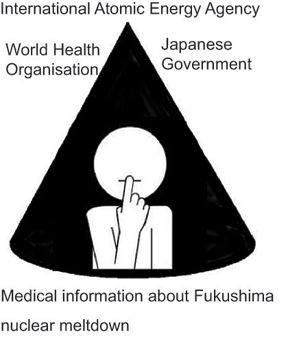
The UN panel made a very broad assumption about the worst nuclear catastrophe in history (or worst since Chernobyl) – and did this BEFORE research is done. However, a local health study raises alarm bells. Fukushima Medical University found 46% of local children have a pre-cancerous nodule or cyst, and 130 have thyroid cancer, vs. 3 expected. Incredibly, the University corrupts science by asserting the meltdown played no role in these high figures.
But Japanese studies must go far beyond childhood thyroid diseases. Japan isn’t the only site to study, as the fallout from the meltdown spread across the northern hemisphere.
In 2011, we estimated 13,983 excess U.S. deaths occurred in the 14 weeks after Fukushima, when fallout levels were highest – roughly the same after Chernobyl in 1986. We used only a sample of deaths available at that time, and cautioned not to conclude that fallout caused all of these deaths.
Final figures became available this week. The 2010-2011 change in deaths in the four months after Fukushima was +2.63%, vs. +1.54% for the rest of the year. This difference translates to 9,158 excess deaths – not an exact match for the 13,983 estimate, but a substantial spike nonetheless.
Again, without concluding that only Fukushima caused these deaths, some interesting patterns emerged. The five Pacific and West Coast states, with the greatest levels of Fukushima fallout in the U.S., had an especially large excess. So did the five neighboring states (Arizona, Idaho, Montana, Nevada, and Utah), which received the next highest levels.
Most of the spring 2011 mortality increase were people over 80. Many of these elderly were in frail health; one possibility is that the added exposure to radioactive poison sped the dying process.
Fukushima radiation is the same as fallout from atom bomb explosions, releasing over 100 chemicals not found in nature. The radioactive chemicals enter the body as a result of precipitation that gets into the food chain. Once in the body, these particles harm or kill cells, leading to disease or death.
Once-skeptical health officials now admit even low doses of radiation are harmful. Studies showed X-rays to pregnant women’s abdomens raised the risk of the child dying of cancer, ending the practice. Bomb fallout from Nevada caused up to 212,000 Americans to develop thyroid cancer. Nuclear weapons workers are at high risk for a large number of cancers.
Rather than the UN Committee making assumptions based on no research, medical research on changes in Japanese disease and death rates are needed – now, in all parts of Japan. Similar studies should be done in nations like Korea, China, eastern Russia, and the U.S. Not knowing Fukushima’s health toll only raises the chance that such a disaster will be repeated in the future.
Joseph Mangano is Executive Director of the Radiation and Public Health Project.
Janette D. Sherman MD is an internist and toxicologist, and editor of Chernobyl: Consequences of the Catastrophe for People and the Environme
Nuclear power could vanish in 50 years
The rise and fall of nuclear power, in 6 charts, Vox by Brad Plumer on August 1, 2014,
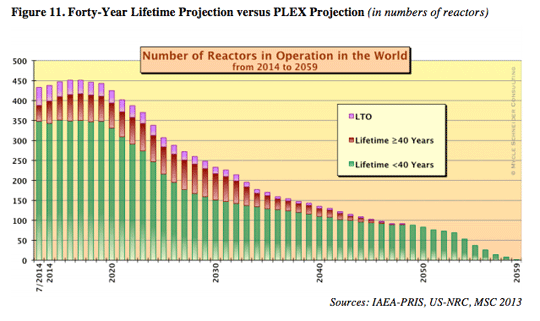
………….Without further action, nuclear power could vanish in 50 years The chart above shows how long the world’s existing reactors are likely to last in the decades ahead. By 2059, most of them are likely to be retired. That means, unless the world goes on a frenzy of new construction, nuclear power will nearly vanish by mid-century.
WE’D NEED TO BUILD 400 REACTORS BETWEEN NOW AND 2059 JUST TO MAINTAIN EXISTING CAPACITY
Here’s how the authors figure: Without new construction, the average age of the world’s nuclear reactors has now reached 28.5 years. Many reactors may shut down once they hit 40 years, although some will likely get extended for longer than that (at a cost of $1 billion or more).
It all depends on the country. In the United States, many reactors were initially licensed to last 40 years, although they can apply for a 20-year extension — and, so far, 72 of the 100 existing reactors have received government permission to keep operating for 60 years.
Eventually, however, all of the world’s current reactors will have to retire — as the chart above shows, the report pegs this date at sometime in the 2050s. That means the world will have to build around 394 additional reactors between now and then just to maintain existing capacity. And if nuclear power is to expand above current levels, we’d have to build more than that. http://www.vox.com/2014/8/1/5958943/nuclear-power-rise-fall-six-charts
Dr Helen Caldicott on the authorities’ concealment of medical effects of Fukushima catastrophe
UN, Japan, Concealing Extent of Fukushima Catastrophe MWC News, By Sherwood Ross Friday, 01 August 2014 Japanese and United Nations authorities have placed “a cone of silence” over medical information an endangered Japanese public is entitled to have about the Fukushima nuclear plant meltdown.
“It is obvious that there is collaboration between the World Health Organization(WHO) and the International Atomic Energy Agency(IAEA) and also the Japanese government…to hide, to lie, and to cover-up vital medical information that must be made available to the Japanese population,” says Dr. Helen Caldicott, the medical doctor who has been showered with honors and awards for her long-time opposition to the dangers of nuclear power manufacture and nuclear war.
“Many doctors have been ordered not to inform their patients that their symptoms could be related to radiation, leaving them in a state of despair,” Dr.Caldicott says. (They) “need to know the truth about their situation and that of their children.”
Dr. Caldicott, who has received 21 honorary doctorates for her work, says that to make matters worse, Japan Prime  Minister Shinzo Abe “has passed a secrecy law which will almost certainly intimidate the media from keeping a very close watch over the tenuous (nuclear) plant.”
The government, she says, and Tokyo Electric Power Co.(TEPCO), “have been reluctant to divulge reliable data and information about radioactive releases, the ongoing state of the severely damaged reactors, the continuous outflow of radioactive water into the sea, and the possibility of a serious accident and radiation release in the event of another earthquake greater than 7 on the Richter scale which could well trigger the collapse of the seriously damaged buildings numbers 3 and 4.”
Damaged Building 3 contains over 100 tons of molten radioactive fuel which “would almost certainly release massive quantities of radioactive elements…threatening millions of people with radioactive contamination,” Dr. Caldicott points out.
She goes on to say that if precariously damaged Building 4 should collapse, 400 tons of extremely radioactive fuel will plunge 100 feet to the ground, releasing its cooling water with possible ignition of the fuel. This could release ten times more cesium than was released at Chernobyl or the equivalent of 14,000 Hiroshima-sized bombs.
What’s more, of the 800,000 healthy youngsters called “liquidators” brought in by the Government from around Russia to fight the burning reactor, within 19 years more than 120,000 were dead.
Dr. Caldicott urged the public to “demand that TEPCO and the Japanese government continually inform the public about the events that are and will be occurring at the Fukushima reactors, without cover-ups and denials of the facts.”
Should another major release of radiation occur, she said, the public must be informed immediately and evacuation begun immediately. http://mwcnews.net/focus/politics/44145-fukushima-catastrophe.html#sthash.5cgmPLZn.dpuf
Bioaccumulation of Fukushima radiation in global food supply
 Fukushima Radiation Poisoning Global Food Supply (includes videos) http://chemtrailsplanet.net/2014/08/01/forget-mh-17-fukushima-radiation-poisoning-global-food-supply/ Chemtrail Following a major earthquake, a 15-metre tsunami disabled the power supply and cooling of three Fukushima Daiichi reactors, causing a nuclear accident on 11 March 2011. All three cores largely melted in the first three days. — World Nuclear Association
Report by Dr. Bill Deagle reminds us that extinction-level amounts of lethal radiation continues to contaminate the planet.
It has to be considered that the consequences of global panic in response to full public knowledge the horrific Fukushima event are so dire that corporate media outlets have been instructed not to cover it. Instead, we get bizarre reports on MH-370, MH-17, the Ebola virus, Israeli war on Gaza, Impeaching Obama,…on and on.
By not reporting on Fukushima, “authorities” hope to hide the dire consequences of continued radiation leak(s) from the American people and global populations for as long a possible.
By monitoring social media conversations, it’s an easy task for “rulers” to know when the “flash-point” of public awareness will prompt need to apply further media distractions or increase certain elements of the police state without actually declaring outright, “martial law”….as a last resort.
Bio-accumulation of radiation from Fukushima can damage nearly all life on earth.
All along the west coast of North America, sea stars are dying at an alarming rate. There was an “outbreak” of some unknown wasting disease last year and it appears to have come back even worse this summer. — Radiation Rain
One aspect of this out-of-control contamination is in the Pacific’s 30 foot deep layer of surface ocean water where much of the global oxygen supply is generated by plankton. Bio-accumulation in this layer is unknown and no questions are being asked by corporate media “experts”. Dalton’s Law of partial pressures of gases tells us that measured CO2 levels will respond by going up if global oxygen levels go down.
Reports of a massive case of dead star-fish, absence of certain species of fish and dwindling herds of animals up and down the Pacific region of the northern hemisphere are never connected to the consequences of bio-accumulation of radiation sprays from the ongoing Fukushima disaster.
Why?
Follow the money. Media will avoid reporting any news that could be bad for business as usual.
Spraying aerosols over the Pacific to interrupt rainfall is a desperate attempt to mitigate radiation from being washed onto crops in the central valley that provides much of our food commodities . The obvious downside is the failure of normal rainfall and forcing of drought that increases the number of wildfires in the Northwest and the opportunistic privatization of water resources.
1 This Month
26 April – Chernobyl: Inside the Meltdown airs on National Geographic on Sunday 26th April from 4pm
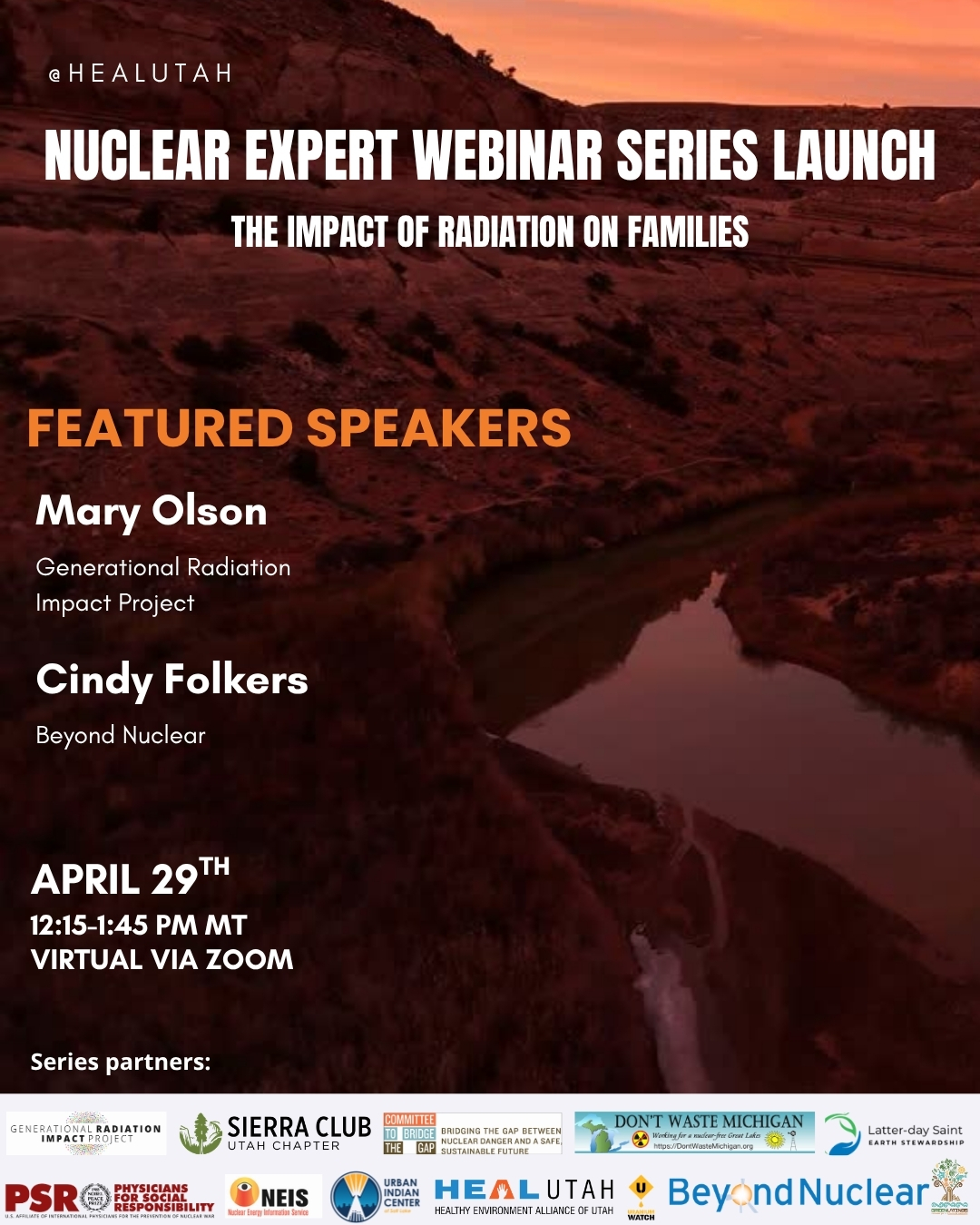
29 April – Nuclear Expert Webinar #1 – Radiation Impacts on Families with Mary Olson and Cindy Folkers
- 12:15 PM MT – 1:45 PM MT
- Location: Virtual – REGISTER TODAY

4 May -West Suburban Peace Coalition to discuss Iran war at May Educational Forum
Monday, May 4, 7:00 – 8:00 PM Central Standard Time
Title: : How Trump’s Narrative Tries to Shape the Reality of the War on Iran.
Contact Walt Zlotow, zlotow@hotmail.com 630 442 3045 for further information
14 May – online event From Bombs to Data Centres: the Face of Nuclear Colonialism

Pine Ridge Uranium is the real threat, not Tehran- Tell Burgum: Stop the Extraction.
Chernobyl: The Lost Tapes – A good documentary on Chernobyl on SBS available On Demand for the next 3 weeks– https://www.sbs.com.au/ondemand/tv-program/chernobyl-the-lost-tapes/2352741955560
To see nuclear-related stories in greater depth and intensity – go to https://nuclearinformation.wordpress.com
-
Archives
- April 2026 (288)
- March 2026 (251)
- February 2026 (268)
- January 2026 (308)
- December 2025 (358)
- November 2025 (359)
- October 2025 (376)
- September 2025 (257)
- August 2025 (319)
- July 2025 (230)
- June 2025 (348)
- May 2025 (261)
-
Categories
- 1
- 1 NUCLEAR ISSUES
- business and costs
- climate change
- culture and arts
- ENERGY
- environment
- health
- history
- indigenous issues
- Legal
- marketing of nuclear
- media
- opposition to nuclear
- PERSONAL STORIES
- politics
- politics international
- Religion and ethics
- safety
- secrets,lies and civil liberties
- spinbuster
- technology
- Uranium
- wastes
- weapons and war
- Women
- 2 WORLD
- ACTION
- AFRICA
- Atrocities
- AUSTRALIA
- Christina's notes
- Christina's themes
- culture and arts
- Events
- Fuk 2022
- Fuk 2023
- Fukushima 2017
- Fukushima 2018
- fukushima 2019
- Fukushima 2020
- Fukushima 2021
- general
- global warming
- Humour (God we need it)
- Nuclear
- RARE EARTHS
- Reference
- resources – print
- Resources -audiovicual
- Weekly Newsletter
- World
- World Nuclear
- YouTube
-
RSS
Entries RSS
Comments RSS
 nuclear-news