USA’s Nuclear – I mean – Environmental Protection Agency
 Officially “Safe” RadiationBy William Boardman OpEd News 8/3/2014 More Radiation Exposure Won’t Hurt You, Says U.S. EPA
“Protection Standards for Nuclear Power Operations” means what?
The Environmental Protection Agency (EPA) of the United States is a full blown oxymoron when it comes to protecting U.S. residents from the danger of increased exposure to ionizing radiation. That’s the kind of radiation that comes from natural sources like Uranium and the sun, as well as unnatural sources like Uranium mines, nuclear weapons, and nuclear power plants (even when they haven’t melted down like Fukushima). The EPA is presently considering allowing everyone in the U.S. to be exposed to higher levels of ionizing radiation.
In 1977, the EPA established levels of radiation exposure “considered safe” for people by federal rule (in bureaucratese, “the regulation at 40 CFR part 190“). In the language of the rule, the 1977 safety standards were: “The standards [that] specify the levels below which normal operations of the uranium fuel cycle are determined to be environmentally acceptable.” In common parlance, this became the level “considered safe,” even though that’s very different from “environmentally acceptable.” “Acceptable by whom? The environment has no vote.
The phrase “considered safe” is key to the issue, since there is no “actually safe” level of radiation exposure. The planet was once naturally radioactive and lifeless. Life emerged only after Earth’s radiation levels decayed to the point where life became possible, in spite of a continuing level of natural “background radiation.” The reality is that there is no “safe” level of radiation exposure.
Is the EPA actually immersed in a protection racket?
The studied ambiguity of the proposal’s title — “Environmental Radiation Protection Standards for Nuclear Power Operations” — goes to the heart of the issue: who or what is really being protected, nuclear power operations?
Quite aware that it is perceived by some as placing the desires of the nuclear power industry above the safety needs of the population, the EPA begins its proposal for changing radiation limits with this defensive and apparently contradictory passage:
This Advance Notice of Proposed Rulemaking is being published to inform stakeholders, including federal and state entities, the nuclear industry, the public and any interested groups, that the Agency is reviewing the existing standards to determine how the regulation at 40 CFR part 190 should be updated and soliciting input on changes (if any) that should be made.
This action is not meant to be construed as an advocacy position either for or against nuclear power.
EPA wants to ensure that environmental protection standards are adequate for the foreseeable future for nuclear fuel cycle facilities. As far as the EPA is concerned, the uranium fuel cycle does not include Uranium mining, despite the serious environmental danger that process entails. Once the environmental and human degradation from Uranium mining has been done, the EPA begins regulating environmental protection from nuclear fuel cycle facilities, beginning with milling and ending with storage or reprocessing facilities for nuclear waste.
According to the agency itself, “EPA’s mission is to protect human health and the
environment. EPA sets limits on the amount of radiation that can be released into the environment.”
Radiation exposure is chronic, cumulative, and unhealthy
Given the pre-existing radiation load on the environment from natural sources, it’s not clear that there is any amount of radiation that can be released into the environment with safety. The EPA pretty much evades that question, since the straight forward answer for human health is: no amount. Besides, the semi-captured protection agency is just as much engaged in protecting economic health for certain industries as it is in protecting human health. This leads it to making formulations that manage to acknowledge human reality without actually supporting it:………
Lower radiation levels provide more environmental protection
Environmental organizations like the Nuclear Information and Resource Service (NIRS) are urging the EPA to lower radiation release standards, to “protect more, not less.” According to NIRS, regulation of nuclear power has a sorry history:……..
In 2005, the National Academy of Sciences addressed “safe” levels of radiation and concluded that there are none in any scientifically meaningful sense.
Humans are exposed to a basic, damaging level of ionizing radiation from multiple sources from gestation till death. This natural background radiation is at a relatively low level, but the risk from radiation is cumulative. Every additional exposure above background radiation adds to the risk. Some of these risks, like radiation treatment to ward off cancer, are widely accepted as reasonable trade-offs. The reasonableness of greater exposure from the nuclear fuel cycle and the uncontrolled growth of nuclear waste is not such an obviously beneficial trade-off. http://www.opednews.com/articles/Officially-Safe-Radiatio-by-William-Boardman-Cancer_Environment_People_Radiation-140803-863.html
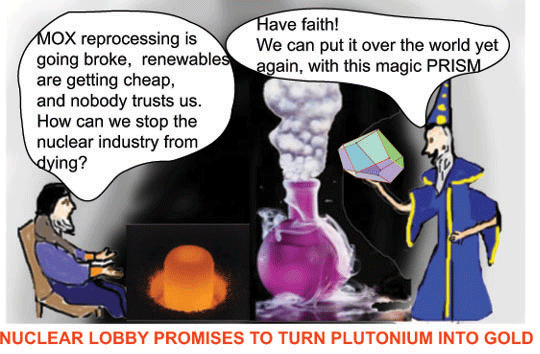
PRISM – Power Reactor Innovative Small Modular, dangerous and produces toxic wastes
USA’s unprecedented nuclear arsenal – the road to mass suicide
 Why We Must Disarm the U.S.’s Unprecedented Nuclear Arsenal http://time.com/3080077/why-we-must-disarm-the-u-s-s-unprecedented-nuclear-arsenal/ Elaine Scarry The potential for so vast a massacre has never before existed.
August 6 is the 69th anniversary of the day the United States dropped an atomic bomb on Hiroshima. The bombing of Nagasaki took place on August 9. An appropriate way to reflect on these events might be to contemplate our current nuclear arsenal and ask why it is being kept in place.The U.S. has by far the most powerful nuclear arsenal on Earth. Our 14 Ohio-class submarines together carry the equivalent of at least 56,000 Hiroshima blasts. These ships are not a remnant of the Cold War. Eight were made after the opening of the Berlin Wall during the presidencies of George H.W. Bush and Bill Clinton.
A fleet of 12 new Ohio-class submarines is currently undergoing design and construction: the first is scheduled for completion in 2021, the last in 2035. Also underway are a next-generation intercontinental ballistic missile and a next-generation heavy bomber, land-based and air-based delivery systems initiated by George W. Bush and continued by Barack Obama.
The country’s nuclear planners do not wait for a crisis to choose possible targets. Thousands of designated targets exist right now, often involving cities whose populations have no quarrel with us. Specific missiles have been assigned to each target city.
The U.S. citizenry cannot stop nuclear missiles once they are fired. Nor can we undo injuries—to humans, animals, plants and to the earth and sky themselves—once they are inflicted. Only by acting now— before they are fired and while the danger seems remote—can missiles be stopped and the injuries cancelled.
Polls conducted at the University of Maryland’s Center for International and Security Studies show that 73% of the U.S. population wants total elimination of nuclear weapons. But anonymous polls require no courage and carry no force. Making audible the population’s voice requires that people speak in their own voices and write their names, putting their opposition on record.
We have freedom over the ways we choose to express our opposition to these weapons. We have no freedom to determine what the stakes are or what happens if opposition fails.
Four factors make openly registering our opposition this summer and fall urgent:
1. Right now we have what we may never have again: a president who, in his Prague speech, put himself on record as saying nuclear weapons have to be eliminated. Furthermore, he acknowledged that because the U. S. is the only country to have used them, we are morally obligated to take the lead in eliminating them. So far Obama has failed to act. But if the U.S. population makes its will clear, he may act.
2. Next spring the Treaty on the Non-Proliferation of Nuclear Weapons will undergo its next five-year review at the United Nations. Article 6 requires that nuclear states give up their nuclear arms. Many of the treaty signers have expressed dismay and disgust with the failure of progress on Article 6. If by April 2015 the nuclear states have—after 45 years—still made little progress, the countries that have so far abstained from acquiring them may become convinced that a nuclear-free world is impossible. The dream of non-proliferation will end.
3. We have at present an ambassador to the United Nations, Samantha Power, who has written extensively about the moral horror of genocide inflicted on Armenians, Rwandans and others. She has criticized the United States for failing to act to stop genocide. Surely our citizenry can convince her that our own nuclear architecture is the genocide-ready instrument most in need of elimination.
4. The U.S. constitution makes Congress (through the requirement for a declaration of war) and the citizenry (through the second amendment) responsible for overseeing the country’s war making. A citizenry that turns its back on this responsibility is infantilized and marooned, severed from all governance. No one can take from us the authority over the country’s defense the constitution gives us; but if we do not act on it, it’s gone.
There are ways of honoring this responsibility that most of us might find too costly. Right now, Megan Rice, an 84-year old nun, is serving a three-year prison sentence for cutting through the security fences at the Oak Ridge, Tenn. nuclear facility. She and two companions set out in the middle of the night, crossing wilderness ground for several hours before they reached and broke through the fences. They risked not just prison sentences; they risked their lives.
The U.S. arsenal has taken away the right of self-defense from all creatures everywhere. Arrangements for so vast a massacre have never before existed on Earth. These arrangements must be unmade. They will not be unmade unless each of us steps forward and insists that it happen.
Elaine Scarry, who teaches at Harvard, is the author ofThermonuclear Monarchy: Choosing Between Democracy and Doom.
Small Modular Nuclear Reactors the energy option that does not stack up economically
 Economics of SMRs nuClear News, August 14 “……….Union of Concerned Scientist says just because these reactors are cheaper doesn’t mean to say they are cost effective.
Wind power – te renewable solution for energy needs in dry Jordan
Jordan turns to wind power in search of renewable energy, Al Monitor, 5 Aug 14 Jordan is carrying out a project to use wind power in Tafila province in the south of the country. The project’s energy production is around 117 megawatts per hour, generating 400 gigawatt hours yearly. The Jordan Wind Project Company (JWPC) will provide the necessary supply for the Jordan Electric Power Company (JEPCO) to carry out the project’s commercial execution in mid-2015, with an estimated cost of around $285 million. JWPC is a joint project between InfraMed (50%), Masdar in Abu Dhabi, UAE (31%) and EP Global Energy (19%). The cost of generating electricity from wind power is estimated at around $120 for every megawatt hour, which is significantly lower than conventional sources of electric power………
The Tafila wind farm project is the first of its kind in Jordan and the region in which a private company uses wind power to generate energy. The project includes installing 38 turbines (3 MW per turbine). The strategy adopted by the energy sector of Jordan aims at having renewable energy rise to 10% of the total energy and reach 8%-10% of the consumed electricity in Jordan by 2020. The Tafila wind farm is expected to generate electricity with a cost 25% lower than thermal energy, which would lower CO2 emissions by 40,000 tons per year.

The Ministry of Energy and Mineral Resources is working on launching a second wind-power project. Last week, the ministry signed a contract with the Spanish company Elecnor for a project designed to generate wind-power energy in Maan [south of the capital, Amman.] The available information shows that this project is going to be funded by the Gulf grant program, Kuwait Fund for Economic Development. On this project as well, the Arab funds create a transparency for contracting and covering expenses……http://www.al-monitor.com/pulse/business/2014/08/jordan-wind-power-project-energy-consumption.html#
Nuclear power would come in far too late to affect global warming
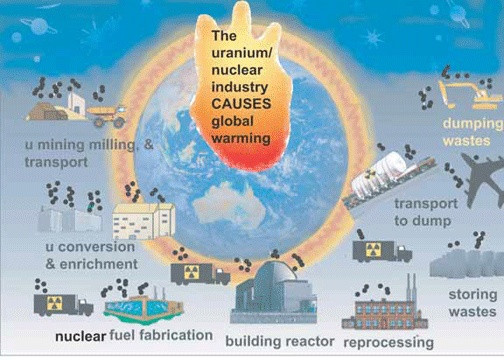
Nuclear power is by no means “emissions free”
Nuclear power is hardly ’emission free http://www.desmoinesregister.com/story/opinion/readers/2014/08/05/nuclear-power-hardly-emission-free/13605607/ Dennis Harbaugh, Once again the Register has published a predictable essay by Carolyn Heising, where she trots out the same old line explaining how nuclear power is this country’s energy savior (“Climate Needs New Support for Nuclear Power,” July 27). Since she is an Iowa State University professor of nuclear engineering, this is no surprise. It’s her job.
It’s inexcusable, however, for her to continually describe nuclear power as “emission-free”. Nuclear power creates plenty of emissions, many of the fatal variety. In addition, each year nuclear power creates 2,000 metric tons of high-level radioactive waste and 12 million cubic feet of low-level radioactive waste in the U.S. alone.
One significant nuclear power accident in Iowa could wipe out millions of acres of productive farmland and endanger thousands of residents. Nuclear power is a dangerous gamble for Iowa, and it’s a risk that insurance companies absolutely will not take. When Heising can produce a single private insurance company willing to insure a nuclear power plant, then we can talk about nuclear power.
Until then, Iowa needs to continue to require investor-owned utilities to produce or buy 105 megawatts of truly renewable energy annually, without nuclear power.
Tanzanian government warned on the dangers of uranium mining
Tanzania Cautioned On Uranium All Africa 5 August 14 Dar es Salaam — The government has been advised to ensure it has in place a comprehensive safety policy on uranium that will guide the extraction, storage and transportation of the mineral. The advice comes as the government is encouraging serious investment in this mining sub-sector.
John Kaaya, an Arusha-based resident, called on the Tanzania Atomic Energy Commission (TAEC) and other related authorities to increase public awareness on the subject, particularly over the risks that are posed by uranium extraction……http://allafrica.com/stories/201408050124.html
Delay in plans to restart Sendai nuclear reactors
 Restart of Sendai reactors unlikely before winter Japan Times 5 Aug 14 Kyushu Electric Power Co. said Tuesday it won’t be able until late September or October to submit documents necessary for regulatory safety checks of two of its nuclear reactors.
This means it is unlikely that reactors 1 and 2 at the nuclear power station in Sendai, Kagoshima Prefecture, will be restarted before this winter.
Kyushu Electric initially planned to submit the documents, including specific steps to deal with accidents, in late May.
It is expected to take at least several months after the documents are submitted before all required procedures for restarting the reactors can be completed…….http://www.japantimes.co.jp/news/2014/08/05/national/restart-of-sendai-reactors-unlikely-before-winter/#.U-MNaONdUnk
Ten top PR firms refuse to work with climate chnage deniers
 World’s top PR companies rule out working with climate deniers
Ten firms say they will not represent clients that deny man-made climate change or seek to block emisson-reducing regulations Suzanne Goldenberg and Nishad Karim theguardian.com, Monday 4 August 2014 Some of the world’s top PR companies have for the first time publicly ruled out working with climate change deniers, marking a fundamental shift in the multi-billion dollar industry that has grown up around the issue of global warming.
Public relations firms have played a critical role over the years in framing the debate on climate change and its solutions – as well as the extensive disinformation campaigns launched to block those initiatives.
Now a number of the top 25 global PR firms have told the Guardian they will not represent clients who deny man-made climate change, or take campaigns seeking to block regulations limiting carbon pollution. Companies include WPP, Waggener Edstrom (WE) Worldwide, Weber Shandwick, Text100, and Finn Partners.
“We would not knowingly partner with a client who denies the existence of climate change,” said Rhian Rotz, spokesman for WE.
Weber Shandwick would also not take any campaign to block regulations cutting carbon emissions or promoting renewable energy. “We would not support a campaign that denies the existence and the threat posed by climate change, or efforts to obstruct regulations cutting greenhouse gas emissions and/or renewable energy standards,” spokeswoman Michelle Selesky said…… http://www.theguardian.com/environment/2014/aug/04/worlds-top-pr-companies-rule-out-working-with-climate-deniers
Callaway Nuclear Reactor – Radioactive Tritium, Cobalt 60 Found in Monitoring Well
“Groundwater doesn’t know boundaries,” Smith says. “So if the contamination happened on Ameren’s property, it could very well move off site.”…..http://stlouis.cbslocal.com/2014/08/04/radioactive-tritium-cobalt-60-found-in-monitoring-well-near-nuclear-reactor/
Hiroshima Day – time to end the suicidal nuclear age
As the mayor of Hiroshima said last August on the anniversary of the bombings, “Nuclear energy and humankind cannot coexist.” the nuclear age is a suicidal age. We’ve had several near misses Fukushima highlighted the dangers of accidents, and nuclear waste can never be truly safely stored. This Aug. 6th, let us remember the victims of Hiroshima and Nagasaki, and let us finally get out from under the nuclear shadow.  On Hiroshima-Nagasaki anniversary, let’s end the nuclear age http://www.guelphmercury.com/opinion/columns/article/772925–on-hiroshima-nagasaki-anniversary-let-s-end-the-nuclear-age Darryl Lorenzo Wellington Aug 04 2012 On the 67th anniversary of the bombings of Hiroshima and Nagasaki, we need to call an end to the nuclear experiment. At 8:15 a.m. on Aug. 6, 1945, the United States dropped an atomic bomb on Hiroshima, killing around 140,000 people. The death toll included men, women and children who died instantaneously, and thousands who died within months from the lingering radiation sickness. The U.S. attack on Nagasaki three days later took the lives of 75,000 more. To these numbers should be added the plight of the Hibakusha: survivors of the nuclear bombings. The Hibakusha, who suffered lifelong diseases, including cancer, have been unwavering in their demand to ban nuclear weapons. Hiroshima-Nagasaki Memorial Day is an occasion to ponder the destructive capacity of nuclear weapons, as well as the wisdom of all uses of nuclear energy — particularly given the spectre cast by the meltdown of the reactors in Fukushima, Japan, last year. Continue reading
Conclusion on Nuclear Power – Not Economic Nor Safe
 The Truth About Nuclear Power – Part 30, Sowell’s Law Blog August 3, 2014
Subtitle: Conclusion on Nuclear Power Not Economic Nor Safe
This is the 30th and final chapter in the Truth About Nuclear Power series, (see links at end of article) at least for now. The TANP series was motivated by many conversations and digital exchanges via emails and online blogs over several years, in which most nuclear advocates advanced various statements about the advantages of nuclear power. Knowing that those statements were false, I answered many of the false statements.
For those who have read some of or the entire TANP series, this concluding article will serve as a review and provide (hopefully) further insight into the actual world of nuclear power. The article is in three parts: 1) the rosy claims of nuclear advocates, 2) questions raised by those rosy claims, and responses to the questions raised, and 3) an answer for why nations continue to build nuclear plants despite the serious and numerous disadvantages.
Part I of this article discusses nuclear advocates’ six primary claims, those being that nuclear power is 1) cheap, only 2 or 3 cents per kWh, 2) reliable, and 3) extremely safe; they insist that 4) the plants run for 60 years before needing replacement, and 5) cost only $2.5 to $4 billion per 1,000 MW plant. They also insist 6) the plants are built in only 4 years from groundbreaking to startup. None of that squares with what I know about nuclear plants.
Part II of this article addresses a series of questions about nuclear power, the answers to which led to many of the previous articles on TANP. The general form of the questions is, If what nuclear advocates say is really true, then Why (insert the question) is this also true? These questions are shown below:
1 Why has nuclear power achieved only 11 percent of world power production, after more than 5 decades of competition?
2 Why do small islands have zero nuclear power plants, but burn expensive oil or diesel resulting in power prices of 25 to 35 cents per kWh?
3 Why do nuclear utilities never, ever, ask for a rate decrease when they build a nuclear plant?
4 Why did France install nuclear plants to provide 85 percent of the country’s power, and no other country in the world followed their lead?
5 Why does France have higher electricity prices than does the US, even with France heavily subsidizing their electricity industry?
6 Why does nuclear power in the US require heavy subsidies from government – and almost total indemnity from costs of a massive radiation disaster?
7 Why are nuclear plants shutting down in the US, with owners saying they are losing money?
8 Why are there so many near-misses on meltdowns in US plants, every 3 weeks?
9 Why were there three serious meltdowns worldwide in just a bit more than 30 years? (Fukushima, Chernobyl, Three Mile Island)
10 Why are new reactor technologies being researched and developed?
Part III of this article poses, then answers, the additional question of Why do countries around the world continue to build nuclear power plants, in spite of all the obvious, documented, irrefutable disadvantages of nuclear power?
I Rosy Claims of Nuclear Advocates………
II A Series of Questions……….
………….Conclusion
Finally, it has been shown throughout the TANP series that nuclear power is not economic – many citations are documented. Nuclear power is not safe either – again many citations are documented. Despite this, many countries are building nuclear plants and plan to build even more. Their reasons to build nuclear may satisfy them, but it is very interesting to note why nuclear cannot compete in the US: the price of natural gas is too low. Many other countries, France included, also have vast resources of natural gas locked away in shale deposits that can be developed (as is the US) using directional drilling and hydraulic fracturing. Producing such gas reserves domestically would reduce the price of natural gas, perhaps far below the oil-based pricing currently prevailing.
As Germany reacted to the Fukushima disaster, declaring nuclear power a menace that will be shut down as soon as possible, other countries will very likely take the same decision. While not wishing any ill effects on anyone anywhere, only one more major disaster such as Fukushima meltdowns and radiation release, would tip the scales in balance of no more nuclear power. http://sowellslawblog.blogspot.com.au/2014/08/the-truth-about-nuclear-power-part-30.html
How the victims of nuclear radiation simply become socially invisible
 The Radiation That Makes People Invisible: A Global Hibakusha Perspective Robert Jacobs The Asia-Pacific Journal, Vol. 12, Issue 30, No. 1, August 3, 2014.

Radiation makes people invisible. We know that exposure to radiation can be deleterious to one’s health; can cause sickness and even death when received in high doses. But it does more. People who have been exposed to radiation, or even those who suspect that they have been exposed to radiation, including those who never experience radiation-related illnesses, may find that their lives are forever changed – that they have assumed a kind of second class citizenship. They may find that their relationships to their families, to their communities, to their hometowns, to their traditional diets and even traditional knowledge systems have been broken. They often spend the remainder of their lives wishing that they could go back, that things would become normal. They slowly realize that they have become expendable and that their government and even their society is no longer invested in their wellbeing.
As a historian of the social and cultural aspects of nuclear technologies, I have spent years working in radiation-affected communities around the world. Many of these people have experienced exposure to radiation from nuclear weapons testing, from nuclear weapons production, from nuclear power plant accidents, from nuclear power production or storage, or, like the people in the community where I live, Hiroshima, from being subjected to direct nuclear attack. For the last five years I have been working with Dr. Mick Broderick of Murdoch University in Perth, Australia on the Global Hibakusha Project. We have been working with victims in radiation-affected communities all around the world. Our research has revealed a powerful continuity to the experience of radiation exposure across a broad range of cultures, geographies, and populations. About half way between beginning this study and today the triple disaster at the Fukushima Daiichi nuclear power plant occurred in Japan. One of the most distressing things (among so many) since this crisis began is to hear people, often people in positions of political power and influence, say that the future for those affected by the nuclear disaster is uncertain. I wish that it were so, but actually, deep historical precedents suggest that the future for the people who lived near the Fukushima Daiichi meltdowns is predictable.
Here I will outline some continuities in the experiences of radiation-affected people. Most of the following also holds true for people who merely suspect that they have been exposed to radiation, even if they never suffer any health effects. Many have already become a part of the experiences of those affected by the Fukushima disaster. There are, of course, many differences and specificities to each community, but there is also profound continuity……..
Conclusion–Radiation makes people invisible. It makes them second class citizens who no longer have the expectation of being treated with dignity by their government, by those overseeing nuclear facilities near them, by the military and nuclear industry engaged in practices that expose people to radiation, and often by their new neighbors when they become refugees. People exposed to radiation often lose their homes, at times permanently, either through forced removal or through contamination that makes living in them dangerous. They lose their livelihoods, their diets, their communities, and their traditions. They can lose the knowledge base that connects them to their land and insures their wellbeing.
Radiation can cause health problems and death, and even when it doesn’t it can cause anxiety and uncertainty that can become crippling. Often those exposed to radiation are blamed for all of the problems that follow their exposures. After a nuclear disaster we count the victims in terms of those who died but they are only a small fraction of the people who are truly victimized by the event. Countless more suffer the destruction of their communities, their families, and their wellbeing. The full scale of devastation that a nuclear disaster wreaks is unknowable.
The lives of those exposed to radiation, or those in areas affected by radiation but uncertain about their exposure, will never be the same. As Natalia Manzurova, one of the “liquidators” at Chernobyl said in an interview published two months after the Fukushima triple meltdowns: “Their lives will be divided into two parts: before and after Fukushima. They’ll worry about their health and their children’s health. The government will probably say there was not that much radiation and that it didn’t harm them. And the government will probably not compensate them for all that they’ve lost. What they lost can’t be calculated.”10
(This article is expanded from an article originally published on the SimplyInfowebsite. Original can be seen here)
Robert Jacobs is an associate professor at the Hiroshima Peace Institute of Hiroshima City University in Japan and an Asia-Pacific Journal Associate. He is the author of The Dragon’s Tail: Americans Face the Atomic Age (2010), the editor of Filling the Hole in the Nuclear Future: Art and Popular Culture Respond to the Bomb (2010), and co-editor of Images of Rupture in Civilization Between East and West: The Iconography of Auschwitz and Hiroshima in Eastern European Arts and Media (2012). His book, The Dragon’s Tail, is available in a Japanese language edition by Gaifu. apanese language edition by Gaifu. He is the principal investigator of the Global Hibakusha Project. http://japanfocus.org/-Robert-Jacobs/4157
Fire risk at Waste Isolation Pilot Plant (WIPP)
 Lab Director: Expect radiation spikes coming from US nuclear facility — Gov’t pays for more air monitors to see impact on populated areas — DOE warns of ‘ignitability’ of 368 containers at site; “Significant fire risk” — Top Official: Material at WIPP “just disintegrated… got very hot, very quickly” (VIDEO) http://enenews.com/lab-director-radiation-spikes-expected-nuclear-facility-govt-pays-air-monitors-impact-populated-areas-doe-ignitability-368-containers-wipp-underground-significant-fire-risk-top-official-mater
Dept. of Energy – Carlsbad, NM Field Office (pdf), July 30, 2014: The purpose of this letter is to provide you [New Mexico Environmental Dept.] written notice that the Department of Energy [is] provisionally applying EPA Hazardous Waste Number (code) D001** for the characteristic of ignitability to some nitrate salt bearing waste containers that have been disposed at the WIPP facility. […] This affects up to 368 containers […] in the underground WIPP facility […] The Permittees plan to implement the [plan] to expedite closure of Panel 6 and Panel 7, Room 7 so that a potential release […] will not pose a threat to human health or the environment.
** “Significant fire risk due either to their low flash point, ability to self-combust and burn, or are able to combust or support combustion” –EPA hazardous waste specialist Daniel Stoehr
Reuters, July 26, 2014: A team of government investigators has turned its attention to Los Alamos in recent days […] to determine whether additional barrels are affected, said [New Mexico Senator Peter Wirth]. “We’re making progress in determining what happened. Now we are much more focused on the scope,” he said.
Minutes of the New Mexico Legislature (pdf), published June 26, 2014: In further explaining what occurred [at WIPP, NMED Secretary Ryan] Flynn said that the material holding the bags of magnesium oxide together that had been on top of the drums just disintegrated. By all indications, he added, the area got very hot very quickly […]
Carlsbad, NM Town Hall, July 24, 2014:
- 37:30 in – Question: Is Dr. Hardy saying that radiation from contaminated ventilation system will continue to be released to the environment periodically? Russell Hardy, director of the Carlsbad Environmental Monitoring & Research Center: That is Dr. Hardy’s assumption… we will probably see spikes at Station B, as contamination… makes its way out of the repository.
- 52:30 in – Hardy: We did receive additional funding from DOE to expand our ambient air sampling sites… very soon we will be deploying 3 additional ambient air sampling towers… one will be here in Carlsbad… we think those 3 additions will give us much better coverage in the future with respect to how this release — or the potential for future releases — may impact the area.
1 This Month
26 April – Chernobyl: Inside the Meltdown airs on National Geographic on Sunday 26th April from 4pm

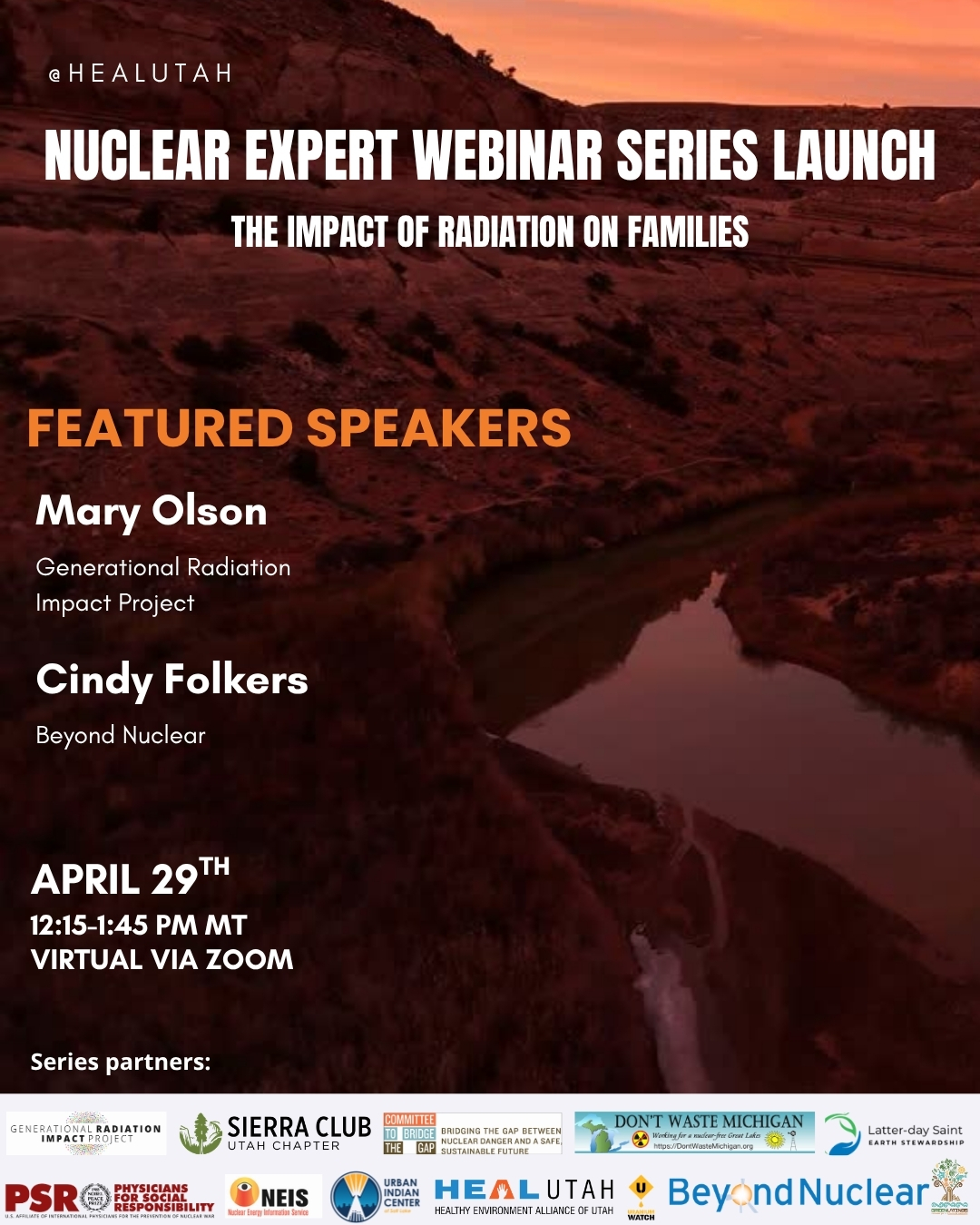
29 April – Nuclear Expert Webinar #1 – Radiation Impacts on Families with Mary Olson and Cindy Folkers
- 12:15 PM MT – 1:45 PM MT
- Location: Virtual – REGISTER TODAY

4 May -West Suburban Peace Coalition to discuss Iran war at May Educational Forum
Monday, May 4, 7:00 – 8:00 PM Central Standard Time
Title: : How Trump’s Narrative Tries to Shape the Reality of the War on Iran.
Contact Walt Zlotow, zlotow@hotmail.com 630 442 3045 for further information
14 May – online event From Bombs to Data Centres: the Face of Nuclear Colonialism
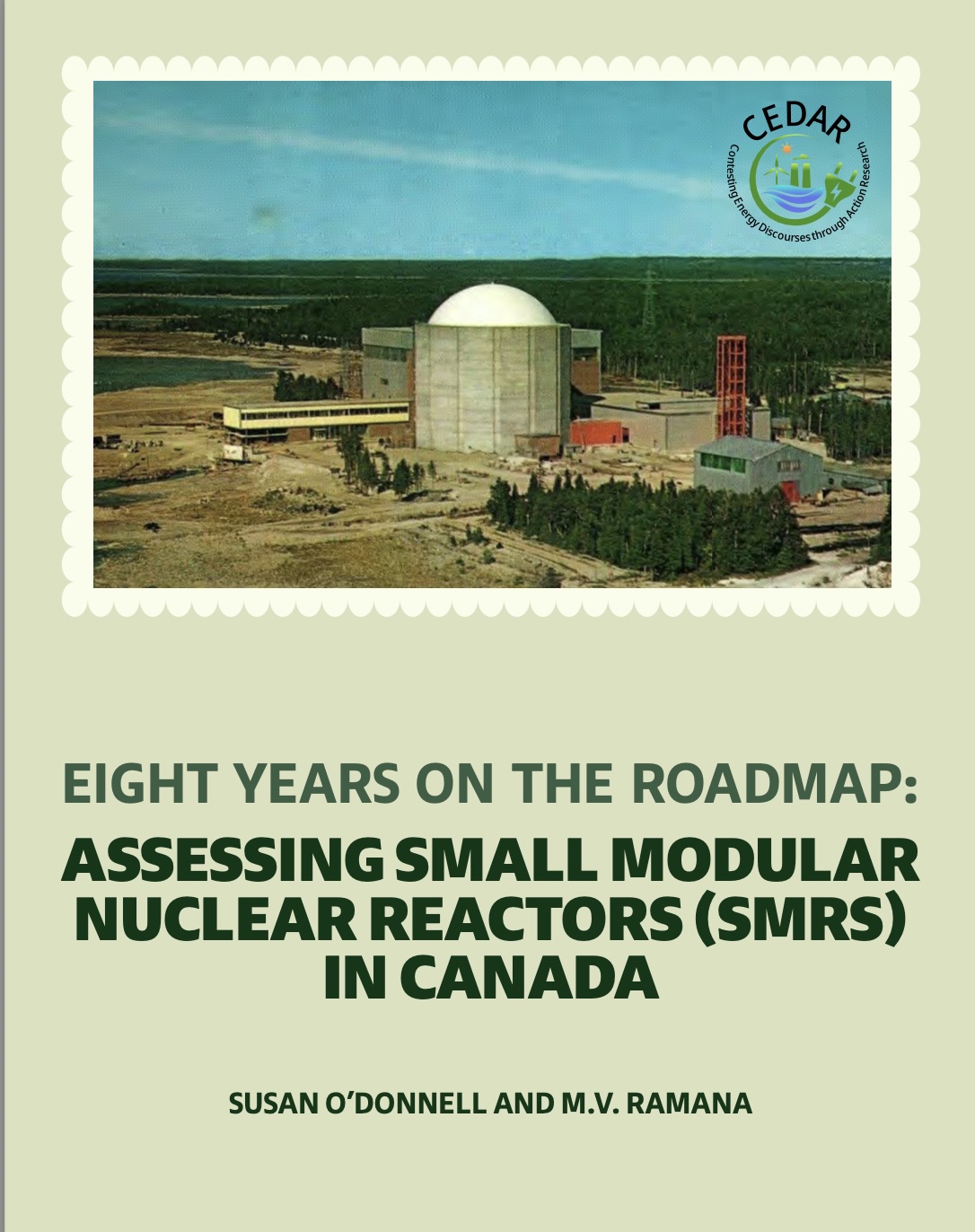

Pine Ridge Uranium is the real threat, not Tehran- Tell Burgum: Stop the Extraction.
Chernobyl: The Lost Tapes – A good documentary on Chernobyl on SBS available On Demand for the next 3 weeks– https://www.sbs.com.au/ondemand/tv-program/chernobyl-the-lost-tapes/2352741955560
To see nuclear-related stories in greater depth and intensity – go to https://nuclearinformation.wordpress.com
-
Archives
- April 2026 (288)
- March 2026 (251)
- February 2026 (268)
- January 2026 (308)
- December 2025 (358)
- November 2025 (359)
- October 2025 (376)
- September 2025 (257)
- August 2025 (319)
- July 2025 (230)
- June 2025 (348)
- May 2025 (261)
-
Categories
- 1
- 1 NUCLEAR ISSUES
- business and costs
- climate change
- culture and arts
- ENERGY
- environment
- health
- history
- indigenous issues
- Legal
- marketing of nuclear
- media
- opposition to nuclear
- PERSONAL STORIES
- politics
- politics international
- Religion and ethics
- safety
- secrets,lies and civil liberties
- spinbuster
- technology
- Uranium
- wastes
- weapons and war
- Women
- 2 WORLD
- ACTION
- AFRICA
- Atrocities
- AUSTRALIA
- Christina's notes
- Christina's themes
- culture and arts
- Events
- Fuk 2022
- Fuk 2023
- Fukushima 2017
- Fukushima 2018
- fukushima 2019
- Fukushima 2020
- Fukushima 2021
- general
- global warming
- Humour (God we need it)
- Nuclear
- RARE EARTHS
- Reference
- resources – print
- Resources -audiovicual
- Weekly Newsletter
- World
- World Nuclear
- YouTube
-
RSS
Entries RSS
Comments RSS
 nuclear-news